The post National Hazing Prevention Week is September 22-26, 2025 appeared first on Phi Delta Theta.
]]>
While hazing prevention is a year-round activity, this week brings awareness to the issues as students return to campuses and welcome new members to their chapters. Two dates that will forever shape the history of Phi Delta Theta are September 14, 2017, the day Max Gruver died due to fraternity hazing at the LSU chapter of Phi Delta Theta, and January 8, 2020, when the Max Gruver Foundation announced a partnership with Phi Delta Theta. Since Max’s death, Steve and Rae Ann Gruver have shared Max’s story with hundreds of college campuses and thousands of college students to prevent another tragedy and stop hazing. Collaborating with Phi Delta Theta, the Gruvers have decided that, with more than 15.1 million high school students at 23,000 high schools in the United States, anti-hazing conversations and education need to begin before students enter college. For this reason,Take Action was created.
Since this partnership, Phi Delta Theta has proudly joined in the fight against hazing through partnerships with the National Hazing Prevention Network and Anti-Hazing Coalition. In addition, Phi Delta Theta was present in the lobbying efforts to pass the Stop Campus Hazing Act, which was signed into law on December 24, 2024.
Phi Delta Theta has zero tolerance for hazing in our brotherhood. No part of Phi Delta Theta’s ritual, ceremonies, or new member process will ask members to do something that makes them feel unsafe. We ask all brothers to Be Their Brothers’ Keepers and take action in the fight against hazing. Below you will find resources and ways you can make a difference during National Hazing Prevention Week.

Hazing Prevention Network, formerly known as hazingprevention.org, is a nonprofit dedicated to empowering people to prevent hazing. Their goal is to educate people about the dangers of hazing, advocate for change, and engage the community in strategies to prevent hazing.
Webinars
Hazing Prevention Network has a series of webinars available for National Hazing Prevention Week. Plan to use the webinars in your National Hazing Prevention Week programming—either the live session or the recording that will be available afterwards to those who register. See complete list of webinars.
Education Resources
The Hazing Prevention Network is committed to sharing hazing prevention resources from partners.
Wear Purple to Bring Awareness
Your campus or organization can pick a day during NHPW (or the whole week) to wear purple to bring awareness to the issue of hazing.
Plan a social media campaign
This week is a great opportunity for your campus or organization to bring attention to the issue of hazing. National Hazing Prevention Network has put together social media graphics and posts to assist in your efforts.
Take the Pledge
As a part of your hazing prevention journey, we encourage you to Take the Pledge! In doing so, you make a commitment to raise awareness of hazing activities in your environment, take notice when a fellow or sister student is experiencing hazing, and don’t be afraid to say something! #BeTheLeader on your campus!
The post National Hazing Prevention Week is September 22-26, 2025 appeared first on Phi Delta Theta.
]]>The post Volunteer Profile – Marc S. Mores appeared first on Phi Delta Theta.
]]>Once a Phi Delt, always a Phi Delt. The bonds created at the beginning of membership are designed to sustain each person through every stage of life, keeping all connected through peer-to-peer relationships and via valuable mentor/mentee networking and intergenerational sharing of wisdom. Phi Delta Theta prides itself on having an incredible network of dedicated alumni and supporters who dedicate their time to give back to the organization. A lifelong commitment to the Fraternity by volunteers enables members to become the greatest version of themselves.
Meet Marc S. Mores, Iowa State ’95, a dedicated volunteer with Phi Delta Theta. Marc Mores is executive vice president of James R. Favor & Company LLC, an exclusive provider of Lloyd’s of London insurance products for fraternities and sororities. Prior to joining Favor & Company, Marc held several key staff positions with Phi Delta Theta General Headquarters where he was instrumental in developing the organization’s Don’t Tarnish the Badge anti-hazing campaign. He’s a frequent speaker at Fraternity leadership events and on college campuses, addressing hazing, alcohol and risk management. Not only does he serve the Fraternity, but he is also serving as the president of the Hazing Prevention Network.
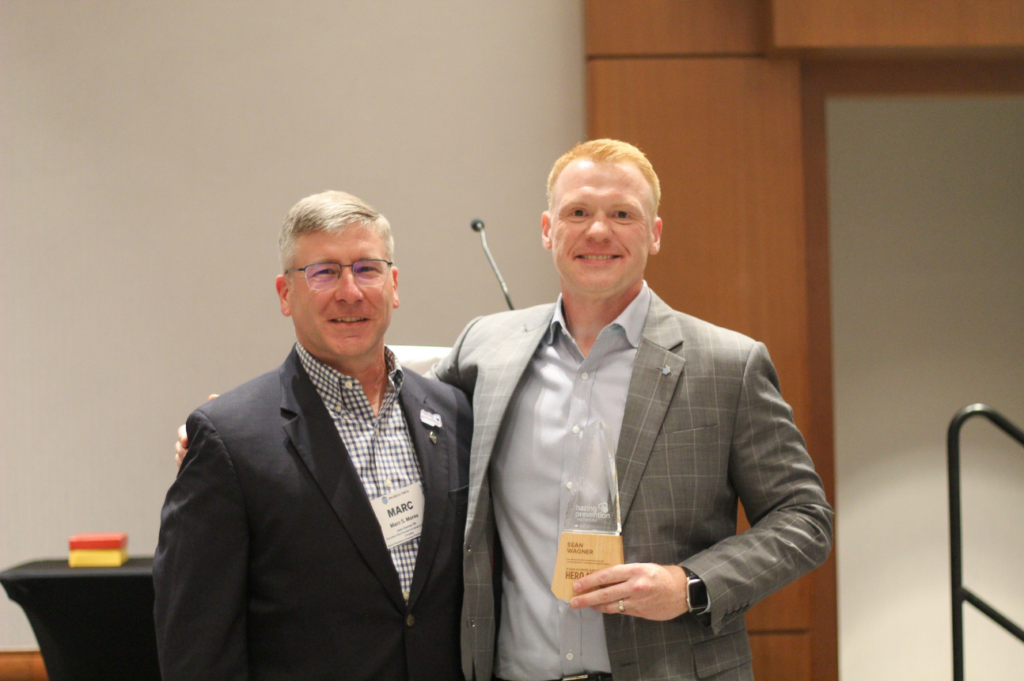
Favor & Co. Executive Vice President and Hazing Prevention Network President Marc S. Mores, Iowa State ’95, with Sean Wagner.
Why have you stayed connected with Phi Delta Theta after graduation?
I had a transformative experience as an undergraduate at Iowa State University. The Iowa Gamma Chapter instilled in me values like trust, loyalty, perspective, and the importance of initiative—lessons I couldn’t have learned in the classroom. After graduation, I worked for the fraternity headquarters which further entrenched my belief that fraternity, when done the right way, has a profound positive impact on young men. Since leaving staff, I strive to give back to the organization that shaped me into who I am today through volunteering for local chapters, and organizations like the Hazing Prevention Network. The bond of brotherhood has carried on for me as I still interact with my pledge brothers on a weekly, if not daily basis, sharing our lives fully and supporting one another.
How did you get involved Hazing Prevention Network? Tell us about your experience.
My career as an insurance professional allows me to emphasize health and safety through interactions with many leaders from other fraternities and sororities. In 2013, Scott Bova, president of the Triangle Education Foundation, invited me to join the Hazing Prevention Network board. I couldn’t fathom at the time serving as president but I am proud of the significant strides we have made in raising awareness about hazing prevention, thanks in part to the support from organizations like Phi Delta Theta.
What accomplishments or career milestones are you most proud of, and how do you attribute them to your experience?
I’m particularly proud of my role in implementing Phi Delta Theta’s Alcohol-Free Housing Policy in 1997, a pivotal change for our Fraternity. Working alongside dedicated, visionary leaders like Bob Deloian, Bob Biggs, and Tom Balzer, we implemented this paradigm-shifting vision for Phi Delta Theta. There were several other cornerstones of Phi Delta Theta’s educational program offerings that are still flourishing today like the McKenzie Family Presidents Leadership Conference, the Kleberg Emerging Leaders Institute, and the event planning program which I am proud of my involvement to help launch. I also cherish my recent term as chair of the Iowa State University Alumni Association Board of Directors, following in my father’s footsteps. All of these experiences were built from my days as a Phikeia where I learned many important life lessons including how to stand up for myself and those around me like my fellow pledge brothers.
How did your time with Phi Delta Theta influence your perspective on hazing prevention?
Having experienced hazing myself, I recognize its damaging impact. At Leadership College in 1993, I was inspired by leaders like Bob Deloian and Tony Ambrose, who helped me revamp my chapter’s Phikeia education program to focus on values-based activities. Later, as a staff member working with Mike Scarlatelli, I helped implement the Fraternity’s Don’t Tarnish the Badge campaign, emphasizing transparency and accountability in our chapters. As an insurance professional, I see all too often the tragedies that occur due to unintended consequences because of a failure to stand up and stop activities that bring harm to individuals, chapters, and the organization.
What advice do you have for current Fraternity members and leaders in fostering a culture of safety and respect?
If you believe in the Ritual of Phi Delta Theta, you understand that hazing contradicts the respect and love we owe one another. Chapters should take pride in showcasing their Phikeia education program to parents, University leaders, and alumni. Any hesitation to do so indicates a need for change, and the GHQ staff is ready to assist you in crafting an enriching experience for your Phikeia that fosters their commitment to our Fraternity. Remember, the more you invest in Phi Delta Theta, the more you will gain from it.
What role do you see alumni playing in hazing prevention, given your own dual perspective as both an alumnus and hazing prevention advocate?
As an alumnus, I’ve facilitated many Phi Delt conferences and witnessed firsthand how engaged alumni can positively impact current chapter leaders. Very simply, our chapter officers need our alumni volunteers—whether it be a chapter advisory board member, a house corporation officer, or just an interested alumnus that stops by the chapter house on a football weekend—to engage with the chapter. The vast knowledge and experience alumni brothers have is unlikely to be tapped unless an offer to assist is extended. The simple presence of alumni volunteers at chapter meetings, speaking at recruitment events, or participating in initiation will be welcomed. Your presence can inspire younger members to strive for excellence.
How can Phi Delts show their support during National Hazing Prevention Week?
During National Hazing Prevention Week, Phi Delts can engage with the Hazing Prevention Network in many ways. Visit our website to join webinars, fundraise, and take the Hazing Prevention Pledge. Every action contributes to fostering a culture of safety and respect. I also encourage you to become a hazing prevention advocate by completing the certification and earning a badge from Credly. Stand up, empower yourself, and inspire those around you to help prevent hazing.
The post Volunteer Profile – Marc S. Mores appeared first on Phi Delta Theta.
]]>The post Anti-Hazing Efforts Recognition at Atlanta Event appeared first on Phi Delta Theta.
]]>Phis and prominent Greek leaders gathered on September 9 in Atlanta, Georgia, to honor Phi Delta Theta’s anti-hazing efforts. The event highlighted the substantial progress made by the Fraternity.
The tragic death of Max Gruver in September 2017 highlighted the urgent need for a stronger, more focused approach to combat hazing. In response, the Fraternity restructured its practices, partnering with Steve and Rae Ann Gruver of the Max Gruver Foundation and the Anti-Hazing Coalition to increase education and awareness about the dangers of hazing and work toward eradicating it entirely.
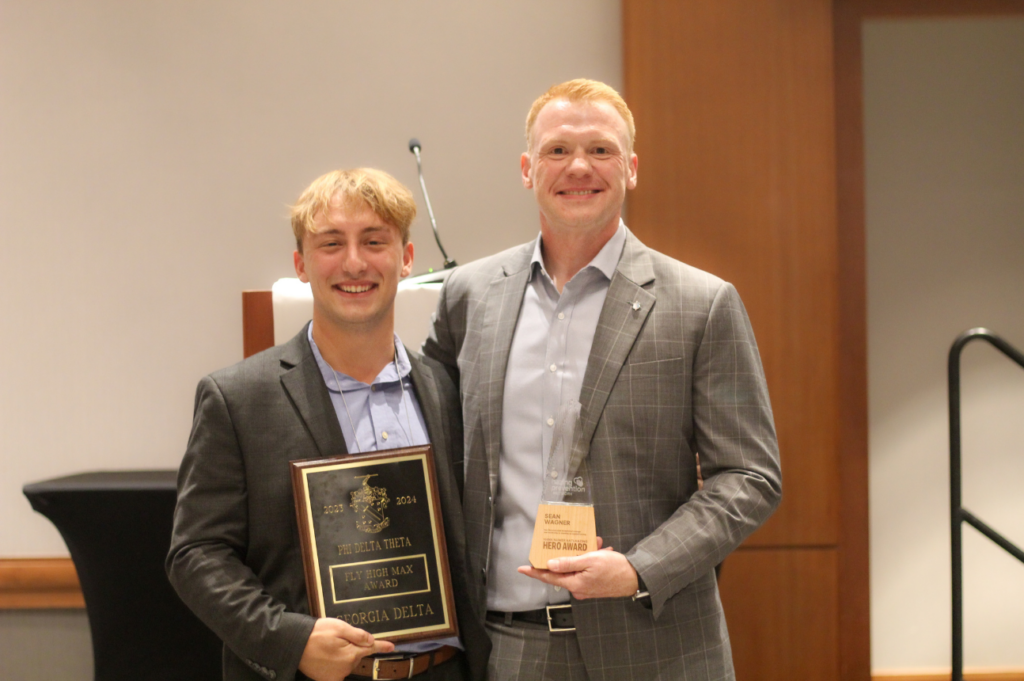
Georgia Delta Chapter President Sam Wells and Phi Delta Theta Fraternity Executive Vice President and CEO Sean Wagner.
Georgia Delta Wins Inaugural Fly High Max Award
Phi Delta Theta has encouraged these efforts throughout its membership, which is why it created the Fly High Max Award. The award annually honors a chapter that actively contributes to anti-hazing education and advocacy, engages in anti-hazing legislation efforts, and raises awareness about hazing prevention.
Steve and Rae Ann Gruver attended to present the inaugural Fly High Max Award to Phi Delta Theta’s Georgia Delta Chapter at Georgia Tech. The awards committee selected Georgia Delta Chapter to receive the Fly High Max Award for their outstanding efforts in raising awareness about the dangers of hazing and their strong commitment to the development and well-being of their new members.
Through a variety of educational programs and outreach activities, the chapter has demonstrated a proactive approach to hazing prevention, making their anti-hazing initiatives a cornerstone of their mission. This year, they took the initiative to deliver an impactful anti-hazing presentation at Blessed Trinity High School, which was Max Gruver’s high school. Their dedication to this cause, along with their involvement with the Max Gruver Foundation, positions them as a model chapter for others in Phi Delta Theta to emulate in the fight to end hazing.
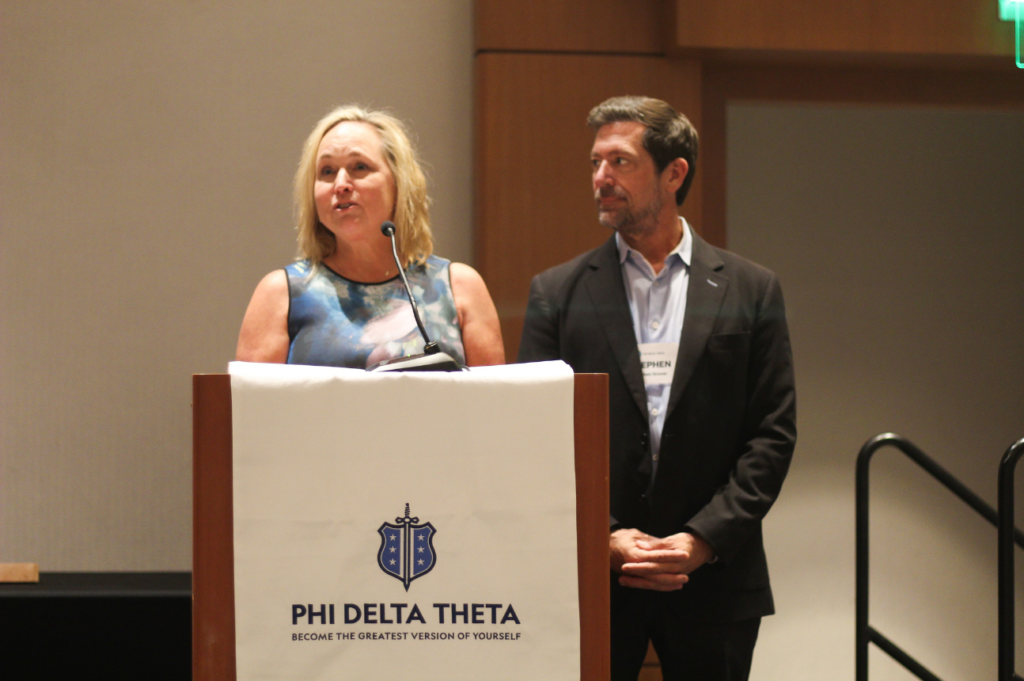
Steve and Rae Ann Gruver presenting the Fly High Max Award to Georgia Delta.
Sean Wagner introduced the Gruver’s and extolled Georgia Delta’s anti-hazing efforts, “The Max Gruver Foundation has been a beacon of hope and change, promoting anti-hazing education and advocacy, lobbying for anti-hazing legislation, and raising awareness about the dangers of hazing. Their tireless efforts and personal sacrifices have inspired many, including those in our own Phi Delta Theta community.”
“This year, we are thrilled and immensely proud to host this event to honor the Georgia Delta chapter for being the inaugural recipient of the Fly High Max Award. With an impressive history of seventy-seven awards dating back to the 1960s, Georgia Delta has long been a shining example of excellence. However, 2024 is particularly significant as it becomes the first chapter to receive this groundbreaking and transformative award. This award recognizes chapters that have actively engaged in initiatives such as the Stop Hazing high school programming, anti-hazing education and advocacy, supporting the Max Gruver Foundation, and more. Their efforts reflect our shared values and set a standard for what it means to be a responsible and caring fraternity member, our desire to invest in our communities and peers, and the issue of hazing.”
Rae Ann complimented Georgia Delta remarking, “The chapter’s passion was evident in their presentation—It does sound like they are looking to become a model chapter that others in the Phi Delt Nation can look toward when taking the next step to ending hazing.”
“We commend and congratulate Georgia Delta! Your work not only honors Max’s legacy but inspires us all to continue striving toward a future where hazing has no place in our world.”
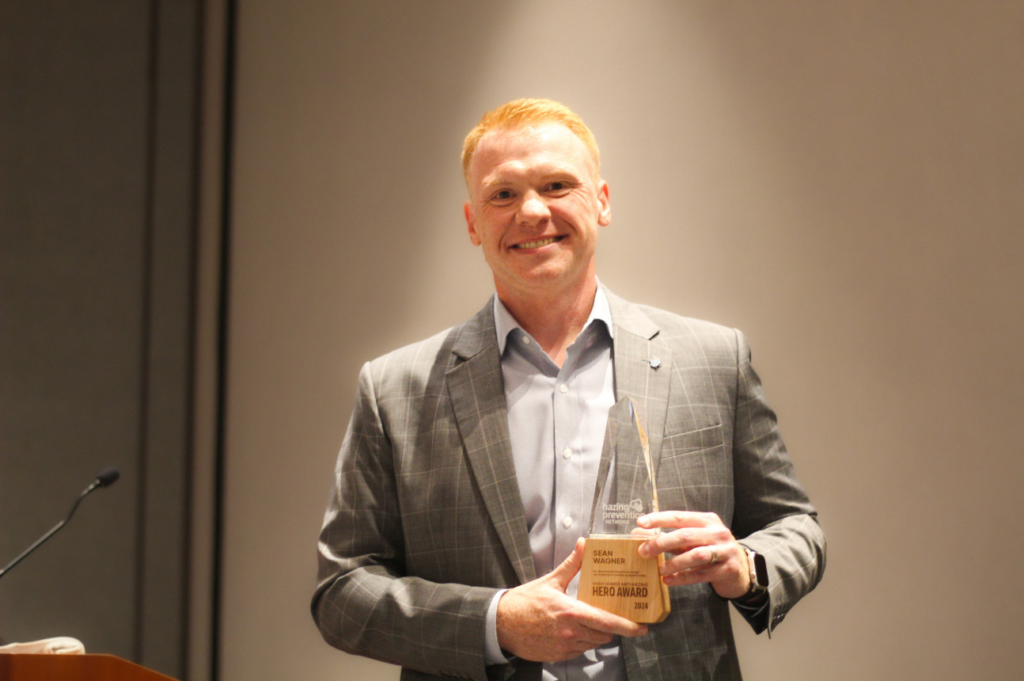
Sean Wagner recieves Hank Nuwer Anti-Hazing Hero Award.
Sean Wagner Wins Prestigious Hank Nuwer Anti-Hazing Hero Award
During the event, the Hazing Prevention Network awarded Phi Delta Theta Executive Vice President and CEO Sean Wagner the prestigious Hank Nuwer Anti-Hazing Hero Award. This award recognizes Wagner’s leadership in anti-hazing initiatives within Phi Delta Theta and the Greek community. His work has raised awareness about the dangerous consequences of hazing and promoted a safer environment for Fraternity members.
Rae Ann Gruver wrote in her nomination, “Sean is a powerful leader who listens and takes action as CEO of Phi Delta Theta Fraternity. He does not back down from the challenges of fighting, educating, and creating real change in the hazing culture in his and all organizations.”
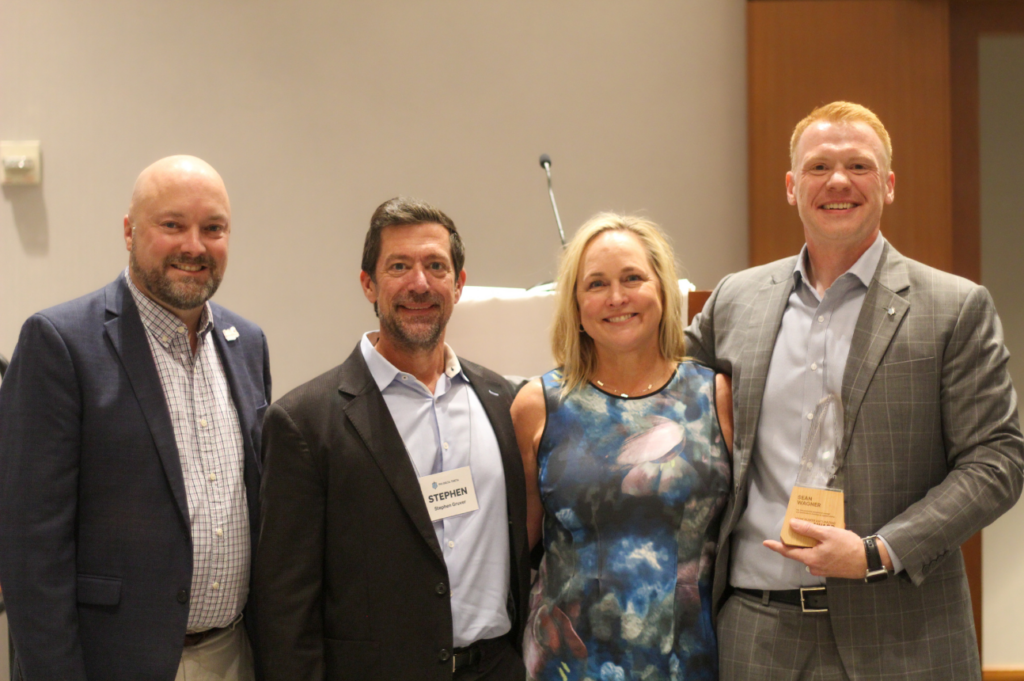
From left to right, Hazing Prevention Network Executive Director Todd Shelton, Steve and Rae Ann Gruver, and Sean Wagner.
“After Max Gruver died in 2017, Phi Delta Theta and the Max Gruver Foundation arranged to work together to make changes within Phi Delta Theta relating to hazing. However, the partnership turned into an entirely different relationship. They have worked together to create more awareness, prevention, and change within Phi Delt and developed a peer-to-peer educational program for high school-level students. Sean is a huge promoter and advocate for the program and strongly encourages young men to participate. Sean actively participates in the Anti-Hazing Coalition, working on state and federal hazing prevention legislation. Sean listens and collaborates to make things happen, and he has gone above and beyond in working with the Max Gruver Foundation to make a difference while honoring Max’s legacy.”
Favor & Co. Executive Vice President and Hazing Prevention Network President Marc S. Mores, Iowa State ’95, with Sean Wagner.
Phi Delta Theta continues championing anti-hazing initiatives across its chapters, promoting education, legislation, and advocacy to create lasting change. The event was a powerful reminder of the Fraternity’s dedication to fostering a brotherhood built on respect, safety, and mutual support, reinforcing its ongoing mission to lead the way in eradicating hazing.
Our partnership with The
Max Gruver Foundation
Phi Delta Theta Fraternity and the Max Gruver Foundation created Take Action: Building New Traditions to further anti-hazing education in high schools to ensure that no more lives are affected by hazing.
The post Anti-Hazing Efforts Recognition at Atlanta Event appeared first on Phi Delta Theta.
]]>The post Phi Delta Theta Launches Max Gruver Award Honoring Chapters’ Commitment to Anti-Hazing Efforts appeared first on Phi Delta Theta.
]]>Named in honor of Max Gruver, a cherished Phikeia of Phi Delta Theta whose life was tragically cut short due to hazing, the Fly High Max Award celebrates chapters that have gone above and beyond in advocating against hazing and promoting a culture of responsibility and accountability.
Max Gruver was a Phikeia at the Louisiana Beta Chapter at Louisiana State University. His passing on September 14, 2017, served as a stark reminder of the devastating consequences of hazing. In response to this tragedy, Phi Delta Theta has partnered with the Max Gruver Foundation to amplify anti-hazing education and awareness efforts.
The Fly High Max Award recognizes chapters that have actively engaged in initiatives such as the Stop Hazing high school programming, anti-hazing education and advocacy, support of the Max Gruver Foundation, lobbying for anti-hazing legislation, and raising awareness about the dangers of hazing.
To qualify for the award, chapters must apply, outlining their commitment to anti-hazing work, evidence of participation in anti-hazing initiatives, and a letter of recommendation from partner organizations advocating for anti-hazing awareness. This application will be submitted with all other chapter and individual awards on myPhiDelt by May 1, 2024.
Establishing the Fly High Max Award emphasizes Phi Delta Theta’s ongoing efforts to eradicate hazing and promote a positive fraternity experience. By recognizing chapters prioritizing safety and accountability, Phi Delta Theta aims to inspire a new generation of leaders committed to upholding the Fraternity’s brotherhood, integrity, and lifelong commitment.
For more information about Phi Delta Theta’s partnership with the Max Gruver Foundation and Phi Delta Theta’s anti-hazing initiatives, please visit phideltatheta.org.
The post Phi Delta Theta Launches Max Gruver Award Honoring Chapters’ Commitment to Anti-Hazing Efforts appeared first on Phi Delta Theta.
]]>The post Phi Delta Theta’s Commitment to Eradicate Hazing appeared first on Phi Delta Theta.
]]>Phi Delta Theta holds the safety of every member of the Fraternity, as well as the members of their campuses and communities in the highest regard. The organization does not tolerate any actions that directly contradict its values and policies and holds strict rulings against members who violate Fraternity expectations or the law. Phi Delta Theta does not condone any form of hazing and spends great resources educating about its dangers and consequences. If discovered, the Fraternity takes swift disciplinary action against chapters or individuals responsible. Hazing is contrary to the purpose of fraternity, let alone Phi Delta Theta Fraternity.
In September 2017, the death of Max Gruver proved Phi Delta Theta wasn’t doing enough to fight hazing. Since then, the Fraternity has worked to restructure its approach. Through partnerships with the Max Gruver Foundation and the Anti-Hazing Coalition, we are working together to educate and eradicate the behavior.
Partnership with Max Gruver Foundation
Following Max’s death, Rae Ann and Steve Gruver created The Max Gruver Foundation. In January 2020, Phi Delta Theta announced its partnership with The Max Gruver Foundation. This relationship provides unique opportunities to work together to strengthen educational efforts to prevent future tragedies.
Our partnership with the Max Gruver Foundation has led to additional efforts. In February 2022, Phi Delta Theta joined the Anti-Hazing Coalition. This coalition is an unprecedented collaboration between families who have lost a child to hazing, to establish laws that provide consequences for hazing. Phi Delta Theta has used its network and has supported Capitol Hill lobbying efforts, including the Stop Campus Hazing Act (S.2901, H.R. 5646).
Anti-Hazing Education
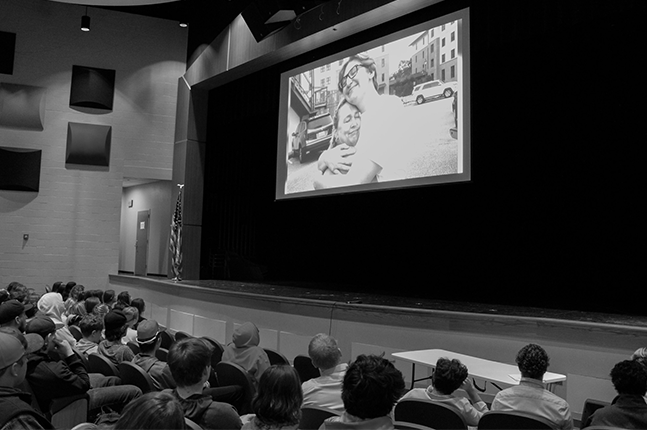
In the fall of 2022, it became apparent that anti-hazing conversations and education need to begin before students enter college. As a result, Phi Delta Theta expanded its partnership with the Max Gruver Foundation by assisting with the education of high school students. Phi Delta Theta Fraternity and the Max Gruver Foundation created Take Action: Building New Traditions to further anti-hazing education in high schools to ensure that no more lives are affected by hazing.
Our efforts with the Anti-Hazing Coalition, the Gruver family, and The Max Gruver Foundation celebrate the life and memory of Max while working to eradicate hazing. Through this partnership, we have initiated a grassroots effort to mobilize members, volunteers, friends, and families to join in the measures to establish laws that provide transparency and true consequences to this behavior that directly contradicts our values.
###
Founded at Miami University in Oxford, Ohio, on December 26, 1848, Phi Delta Theta International Fraternity has 194 chapters and emerging chapters and 85 alumni clubs across the United States and Canada. To date, the Fraternity has initiated nearly 280,000 men into the society whose founding principles are Friendship, Sound Learning, and Rectitude. In 2000, Phi Delta Theta became the largest fraternity to implement an alcohol-free housing policy in all facilities. Guided today by its Phi Delt 2030 strategic plan, Phi Delta Theta’s vision is to be recognized as the premier fraternal leadership development society in North America.
The post Phi Delta Theta’s Commitment to Eradicate Hazing appeared first on Phi Delta Theta.
]]>The post Phi Delta Theta Lobbies in Support of Stop Campus Hazing Act appeared first on Phi Delta Theta.
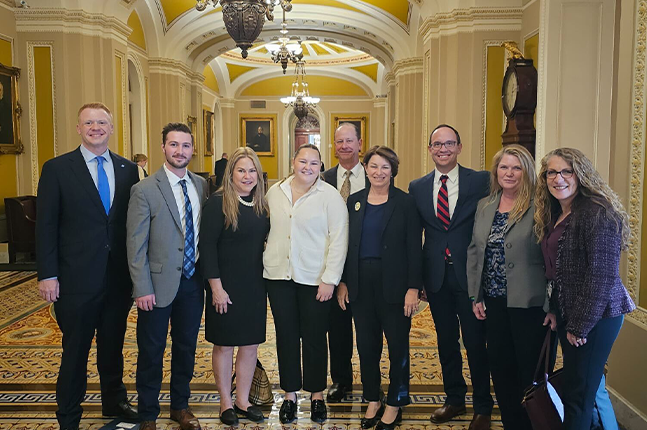
]]>Phi Delta Theta Executive Vice President and CEO Sean Wagner joined to lobby with our partners at the Anti-Hazing Coalition and the Max Gruver Foundation. They met with several elected officials, including Brother Dusty Johnson, South Dakota ’99, US representative for South Dakota, and Senate Co-Sponsor, Senator Amy Klobuchar, Minnesota, to help spread the word about the Stop Campus Hazing Act.
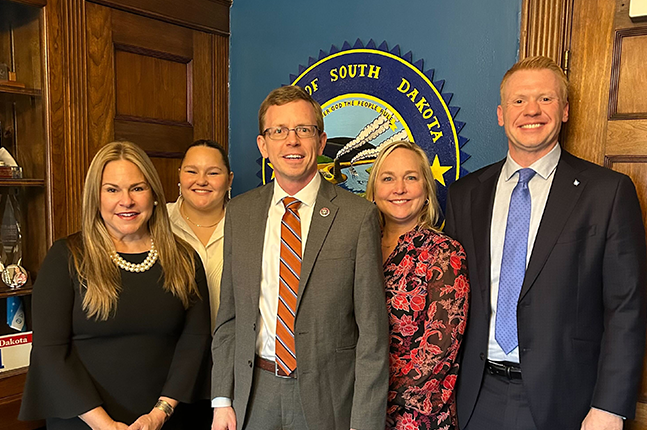
“Phi Delta Theta has, and always will, prioritize the safety of every member of the Fraternity,” said Sean Wagner, Executive Vice President & CEO of Phi Delta Theta Fraternity. “Our efforts with the Anti-Hazing Coalition, the Gruver family, and The Max Gruver Foundation celebrate the life and memory of Max while working to eradicate hazing. Through this partnership, we have initiated a grassroots effort to mobilize members, volunteers, friends, and families to join in the measures to establish laws that provide transparency and true consequences to this behavior that directly contradicts our values.”
About the Stop Campus Hazing Act
The National Study of Student Hazing found that more than 55 percent of college students involved in clubs, teams, and organizations experience hazing at colleges and universities throughout the United States. Unfortunately, hazing continues to have lethal and lasting impacts on individuals, families, and communities across the country. No state is immune to hazing or its effects in its college and university communities. Federal legislation is a necessary step in stopping hazing and the unnecessary harm it causes. If passed, this will establish mandates related to hazing at nonprofit private institutions of higher education and public institutions of higher education.
The Stop Campus Hazing Act requires each institution of higher education that receives federal student aid to maintain and update biannually a website page that discloses student organization violations of the institution’s code of conduct that threaten the safety of students. The report would detail the corrective measures imposed by the school on the student organization. This would allow students and parents to make more informed decisions about which student organizations are safe to join. States such as South Carolina and Pennsylvania have already adopted similar laws, but it would be more effective for federal law to include these disclosures to cover all schools.
The Stop Campus Hazing Act is supported by the Anti-Hazing Coalition, which includes families of hazing victims who partner with the North American Interfraternity Conference (NIC), National Panhellenic Conference (NPC), Hazing Prevention Network, Association of Fraternal Leadership & Values (AFLV), Association of Fraternity/Sorority Advisors (AFA) and other organizations committed to eradicating hazing. Please consider sponsoring the Stop Campus Hazing Act (H.R. 5646/S. 2901), which was introduced in September by sending a message to your state’s elected officials.
Those wanting to join the fight against hazing can do so in several ways.
- Email or call your representative. You can locate your representative’s contact information through house.gov.
- Email or call your senators. You can locate your senator’s contact information through www.senate.gov/senators/senators-contact.htm
- Show your support by using the hashtag #STOPCAMPUSHAZING. And don’t forget to tag your representatives in each post!
End Hazing Before It Comes to Campus
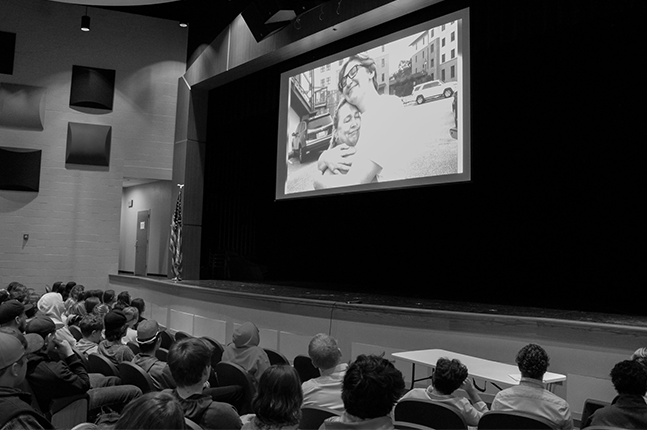
With more than 15.1 million high school students at 23,000 high schools in the United States, it became apparent that anti-hazing conversations and education need to begin before students enter college, as many who enter college have knowingly or unknowingly been hazed through sports teams, bands, and other clubs in high school. That’s why Phi Delta Theta Fraternity and the Max Gruver Foundation created Take Action: Building New Traditions to further anti-hazing education in high schools to ensure that no more lives are affected by hazing.
Learn more, and bring this program to your local high school.
The post Phi Delta Theta Lobbies in Support of Stop Campus Hazing Act appeared first on Phi Delta Theta.
]]>The post Phi Delta Theta Announces Support of Federal Anti-Hazing Legislation appeared first on Phi Delta Theta.
]]>The United States Congress and Senate are currently considering the End All Hazing Act (H.R.3267) and The REACH Act (H.R.662/S.706) which provide greater transparency through the reporting of all hazing acts on a college campus. The Phi Delta Theta Fraternity announces its full endorsement of these potential laws and asks all members to call on their elected officials to vote in support of this important legislation by contacting their representative or senator.
Phi Delta Theta has long battled the societal issue of hazing through policy and education. In addition, the Fraternity has advocated that those found to be involved and in violation of our risk management policies will be held accountable for their individual actions and prosecuted to the fullest extent of the law. This includes supporting the Gruver Act enacted in Louisiana following the tragic loss of our own Max Gruver at Louisiana State University and partnering with the Fraternal Government Relations Coalition to urge the immediate passage of the aforementioned legislation.
The post Phi Delta Theta Announces Support of Federal Anti-Hazing Legislation appeared first on Phi Delta Theta.
]]>The post To Persevere and Excel – Managing Mental Illness as a Student appeared first on Phi Delta Theta.
]]>One of the defining moments during my Phikeia experience occurred when my big brother asked me a compelling question: “What has happened in your life that has made you who you are today?” My answer wasn’t a bad breakup, a family relationship that had deteriorated, or a specific event. I wanted to share that managing two separate mental illnesses has made a profound impact on me. At the time, I felt this was not what the Fraternity or my big brother would want me to reveal. Though I don’t recall my specific answer at the moment, nothing has impacted my development as a human more than my battle with mental illness.
At the age of 22, I have learned how to handle my bouts with depression and General Anxiety Disorder as well as possible. But, for the majority of my life, I struggled to understand and cope with these feelings. By sharing my story and struggles, I am hopeful that I can help others realize that the inner demons you may battle do not define you. It is very possible to live a fulfilling and productive life.
I first started noticing signs of depression in high school, but as a teenage male, I was truly afraid to show my emotions. Art was the only forum that allowed me to share my feelings towards these issues. This, however, did not come until after something that I am still recovering from happened. In December of 2009 at the age of 16, I tried to take my own life. I will spare the specific details, but I had hit that point. As I write this post, I still struggle to accurately describe my state of mind that evening. To start, I was your typical high school student, but I really did not feel like I fit in anywhere at my high school of 2,000 students in the upper middle class area of Fort Wayne, Indiana. My family wasn’t wealthy, I didn’t play high school sports, and I just didn’t “fit in” with the classmates I had grown up with from second grade to high school. But, I persevered.
To say the least, I had very interesting relationship with my father growing up. My mom and dad separated earlier than I can remember, and my dad lived in every state possible besides Indiana for the first ten years of my life. I would see him a handful times throughout the year before he moved back when I was 10. However, this would be short lived as my dad made a few mistakes and again began moving often for work. Until I was about 16, I tried to have a decent relationship with my dad, but at that point, too much had built, and I quit trying. The feeling was pretty reciprocal, and we didn’t talk for eight months. This angered me for a long time, but once again I persevered.
By the time I hit high school, my mom was my best friend. She still is to this day in every way, shape, and form. We have had our differences. I was never the perfect child, especially in high school, but we dealt with each other. She made continual sacrifices for me that I will never be able to repay. She worked a third shift job five days a week, so I was on my own from 8 p.m. until 4-6 a.m. each night. I felt lonely A LOT, especially while I dealt with depression and anxiety of which I had no understanding. I didn’t tell her about the my irrational thoughts, and I didn’t tell her or anybody else how much I hated being alone five nights a week. I wasn’t sleeping more than four hours a night due to the continual thoughts I was having, and I had no real forum to project myself. After four years of this though, I persevered.
I persevered through everything that culminated into the night that I hit rock bottom. This is something I often remind myself of when I have rough days. On May 25, 2010, I had a normal day at school. I arrived home and planned to spend the day playing basketball with a few of the neighborhood kids. When I arrived home, my sister’s car was unexpectedly there – It was a Tuesday, and she lived in Muncie. I will never forget the look on her face when I saw her. She was crying tears I had never seen in another person. She hugged me in a way she had never hugged me before. She had learned that day that her high school boyfriend had committed suicide. This was the moment I figured it out – Life isn’t about one person’s inner struggles, trials, and tribulations. We live for every single person who has ever made even the slightest impact on us. Life is for the family you share at home, your parents, your friends, your fraternity brothers and for whomever you have shared life. Your life matters whether you see it or not. You mean something to someone. I made a promise to my sister that day that I can happily say I have now upheld for six years.
Phi Delta Theta has and continues to play a vital role in helping me persevere. On July 27, 2014, my Uncle Terry passed away after a 20+ year battle with HIV/AIDS. I was in my first summer as an initiated member of Phi Delta Theta at the University of Southern Indiana (Indiana Lambda), and I had been selected to be one of our representatives at the Kleberg Emerging Leaders Institute. I did not attend due to my uncle’s funeral. My truck, as my chapter brothers know, is a glorious piece of machinery that chooses to work when it wants. It decided to call in sick that week. Instead of allowing me to miss my uncle’s funeral, my chapter brother, Russ, decided to drop everything, made the five hour drive to Fort Wayne to help me, and returned home at 6 a.m. the next morning to make his summer class. That is Brotherhood! I was the last person to speak at my uncle’s funeral, and it helped me find a bit of inner peace and solace with his death. We are drawn to the negative moments when we lose someone permanently. It’s human nature, but we have to learn to accept the bad and cherish the great moments. The moments of grief, depression, and anger associated with losing my uncle rocked my world and sent me on an emotional downturn, but I have persevered.
In October 2015, I had a complete breakdown. Anxiety was at an all-time high. I hadn’t been to class that week, and it was Wednesday. I called my sister with plans to transfer to Indy. I had no desire to be in Evansville. For the majority of the semester, one of my three little brothers and a pledge brother basically dragged me out of bed every morning to attend class. On the day of my breakdown, I went to my Greek Advisor, told her about how I felt, and cried in her office for about twenty minutes. We talked, she gave me the time to vent, and then she escorted me to the Campus Counseling Center to schedule an appointment. I hated the initial thought of counseling. I knew I had problems, but I couldn’t imagine counseling was going to help. Regardless, I took a chance and began to see a counselor, and I continue to do so today. This was the first real step I had ever taken to deal with my problems. It helped me realize what I was fighting against, and I learned to treat it differently than I had before. Since, I have been succeeding slowly but surely in life. I was elected IFC President and maintained my Alumni Secretary role in the chapter. As Phikeia Educator, I led the largest initiate class that the chapter has had in the past decade, and I figured out what I wanted to do with my life. I plan to be a Director of Fraternity and Sorority Life someday, and I owe that to my advisor and friend, Trish. I even turned my semester around and made the Dean’s List for the first time.
One of the biggest lessons I have learned through all of this is to stop hating the fact that I have depression and General Anxiety Disorder. I started to embrace that part of my life, and I have made it a big part of who I am. My only goal with this post is to show any individual who may be struggling with the same things that it is possible to achieve more than you think and that your life truly matters. Do not be afraid to seek help. Talk to your chapter brothers. Find a forum where you can project how you feel. Do not hate this part of you. Love every part of who you are. If you think you need professional help, get it. If you think you need medication, talk to a professional to see what they think. You are only so strong on your own, but as Phi Delts, we are never alone. I am proud to be a Phi, a fraternal man, and a twenty something male battling mental illness.
I’m going to leave you with something that has helped me deal with my mental health. It is as simple as a semicolon. A semicolon is used when an author could’ve chosen to end their sentence, but chose not to. The author is you, and the sentence is your life. Be a semicolon. Keep living, keep fighting, and love every moment of your life.
The post To Persevere and Excel – Managing Mental Illness as a Student appeared first on Phi Delta Theta.
]]>The post What You Don’t Know About Your Phikeias appeared first on Phi Delta Theta.
]]>Recruitment and pledging are where we develop the next generation of fraternity men. We hope to select and retain those individuals who exemplify our Cardinal Principles of Friendship, Sound Learning, and Rectitude, as well as live up to the standards set in The Bond of Phi Delta Theta. Ideally, the process of pledging involves taking college boys and helping them grow into fraternal men: a cycle that repeats itself each semester on many college campuses. While we should benefit from new members joining our chapters, we also take on the responsibility of assisting the growth of these individuals into the young fraternity men that we will welcome into the brotherhood: the family of Phi Delta Theta. Our brotherhood serves as a form of social support, a factor that has long been proven to support mental health in individuals.
Fraternities provide the opportunity to choose this new family: something that many people do not experience until they step onto a college campus on the first day of freshman year. When we extend a bid and welcome someone to join our fraternal family, we often assume that they are similar to us, which is highlighted by their ambitions to join our chapter. However, we must remember that the fraternal family is different in several important ways. We do not have the years of shared history that has connected us with our family of origin, and we may not be aware of the many events that an individual has experienced before reaching our doorsteps and signing a bid card. Simply put, we may not be aware of many of the key events, good or bad, that have shaped this person on their path to joining our Fraternity.
GOAT, a movie pending national release that is based upon the life experiences of Brad Land before and during his time at Clemson University, highlights how little we may know about our brothers’ and Phikeias’ personal histories. Brad Land was brutally attacked and nearly killed when his car was stolen by two strangers whom he thought he was giving a ride home. Mr. Land’s kind gesture ultimately led him to becoming a victim and survivor of extreme violence. Later, his traumatic experiences are re-triggered during his pledge process at Clemson, the hazing that he endures brings back memories and feelings of the night that he nearly lost his life. This movie provides our brotherhood with an opportunity to examine our own pledge process and how it builds our fraternal family.
Understanding an individual’s mental health begins by examining how someone functions physically, cognitively, and emotionally as compared to their peers. We often assume that if we cannot see a physical wound that the person is healthy and can tolerate any stress that they may encounter. Unfortunately, we may be unaware of the traumatic events that someone may have experienced before reaching the point of seeking membership into our Fraternity. People may have experienced great loss in their life from losing parents, siblings, caregivers, and/or friends to death or forced separation. Some individuals may have survived being bullied, may have been victims of random acts of violence, in addition to a wide range of potential physical, mental, and emotional traumas. Even the most mentally healthy individuals can have vastly different responses to traumatic events and stress, and sometimes these responses are unknown even to the person until they are subjected to later stress, such as experiencing hazing during the pledge process.
The connection between joining our fraternal family and hazing can truly become problematic, especially in the context of asking someone to trust us to help them become a fraternal man. Engaging in hazing practices places a barrier between the active members and pledges, reducing them to “less than” a brother or sometimes even less than a human being. While we verbalize a message of embracing one another, our actions communicate rejection. Hazing is often framed as a way of having individuals prove that they have earned their membership into an organization. Common hazing practices today have shifted from physical hazing to mental and emotional hazing. Instead of paddling, pledges are deprived of feeling safe and connected, and may even resurrect past traumas in order to earn the family and support that fraternity has to offer.
A family can be constructed and defined in many ways. Those who participate in hazing practices fracture the family that we wish to build. Having a member earn their membership through participation in chapter activities, such as philanthropy, leadership development, community services, attending sporting events, intramural athletics, alumni functions, mixers, and homecoming builds the family into a strong one. Such activities help these individuals prove they are becoming fraternity men not only in the presence of chapter brothers, but also the community that we live in on our respective campus communities. Those that do not demonstrate an ability to practice and demonstrate characteristics we associate with our high standards set for membership should not earn the right to be initiated. The stronger the family we build through mutual respect and unconditional positive regard, the more likely these members are to come when we personally need our fraternal family: When we experience our own hardships as we go through life.
Becoming the greatest version of ourselves involves adding those who can support us during times of high stress. Regardless of someone’s mental health, hazing is a process that not only tears down an individual’s ability to function successfully in our fraternal family, but also weakens it in the long run. Those members who grow together through the attainment of mutual goals, such as bettering their chapter on campus, winning awards, intramural or collegiate championships, and bettering their community, are likely to develop the family that is enduring and supportive even beyond the years we spend as undergraduates on our campuses.
Dr. Mark E. Pleiss was initiated into the Pennsylvania Gamma Chapter of Phi Delta Theta in Spring 2008 as Bond #1255. He graduated from Washington & Jefferson College with a BA in Psychology and a minor Sociology in 2011. While at W&J, he served the chapter in several roles, including president. After graduation, Dr. Pleiss began a doctoral program in clinical psychology at IUP, while serving as a member of the Pennsylvania Lambda CAB. He graduated with his Masters and Psy.D in Clinical Psychology from IUP. Currently, Dr. Pleiss serves as the Upsilon South Province President, and has been a faculty member for several Kleberg Emerging Leadership Institutes and the Presidents’ Leadership Conferences. Additionally, he is the Mental Health Expert on the Education Committee. He works for the Federal Bureau of Prisons as a Drug Abuse Program Coordinator at the Federal Correction Complex- Hazelton, in West Virginia. He is also a fan of professional and college football, and enjoys hiking, cooking, and traveling to new cities.
The post What You Don’t Know About Your Phikeias appeared first on Phi Delta Theta.
]]>The post Looking for Some Heroes appeared first on Phi Delta Theta.
]]>“This is your brain. This is your brain on drugs.”
Years ago, in an effort to fight drug usage, those words were blasted relentlessly on television screens. The commercial first showed an egg (This is your brain) and then showed an egg perfectly frying in a skillet (This is your brain on drugs). I think I know what the government was trying to convey with this public service announcement, but I have to agree with the comedian who said, “Yeah, and there’s some stoned guy out there thinking, ‘That egg sure looks good.’”
I don’t expect fraternity men who haze to read this blog and change what they are doing. So, if you are a hazer and are looking for arguments, ideas, or faults in what I say, stop reading.
This blog is intended for men of character. Men who believe in the teachings of the Bond. Men of substance. Strong men, courageous men. Men of action. Men of strong faith. Men who might be heroes. Men of character. So, if you think that you might fit one of these categories, read on.
I had the privilege to hear fellow Phi Gary Bender (Wichita ’62) speak at convention a couple of years ago, and he ended his talk with a quote that has stuck with me. He said, “Fame is a vapor, popularity is an accident and money takes wings. The only thing that endures is character. Reputation is what man thinks us to be. Character is what God knows us to be. Reputations are chiseled on our tomb stones, character is what the angels of heaven say before the throne of God. If God knows he can trust you, He will enlarge your territory.”
Wow, that’s a powerful statement. Character is what compels you to contribute, to challenge, to grow, to change yourself and others. Character is the quality that determines whether you address the wrongs in your chapter whether they be apathy, alcohol abuse, drug usage, a culture of violence, poor scholarship, or HAZING.
If you are a man of character, you should be compelled to stop hazing in your chapter if it exists. Here are some tips.
Align yourself with other like-minded men of character.
These might not be your best friends, but you know who they are by their actions and words. Have a meaningful discussion about how the new members are treated in your chapter and what you think about hazing. Select only men of character to be your Phikeia educators.
Work overtime to develop Phikeia programming that builds men up, not breaks them down.
Frederick Douglass once said, “It is easier to build strong children than to repair broken men.” Don’t concern yourself with what others will think of you. If you conduct positive Phikeia programming, in a couple of years, the other fraternities will be emulating you. Be courageous and creative.
Have the courage to confront the hazers in your chapter.
Anyone who hazes is a coward. There I’ve said it. Don’t be afraid to gently confront a brother who wants to haze and ask him to explain his motivation for hazing. Be unwilling to accept “tradition”, “it was done to me”, etc. I have often found it impossible to reason with someone who is committed to hazing (especially when using words of two syllables or more!), but give it a try. Confront hazers with like-minded brothers by your side. Confrontation is not a bad thing. If you see a situation that is dangerous (especially involving alcohol), confront quickly, forcefully, and physically if you have to. You won’t get in trouble for doing the right thing.
Rely on GHQ, Province Presidents, University Officials, and Alumni.
First realize that these are not bad people or people out to get you. No one gains when a chapter closes, goes on probation, or when a Phikeia is injured, or leaves with ill feelings toward the fraternity. People who go to Alcoholics Anonymous know that the first step is realizing that there is a problem, standing before others and saying, “Hello, my name is XXX and I am an alcoholic.” If you want to get well, be willing to admit, “My chapter’s name is XXX and we are a hazing chapter.” Doing this puts you on the right track. Please know that there are many people willing to help you. All you have to do is ask.
And, finally,
Look in the mirror and ask yourself, “Is this a man of character at whom I am looking?”
If the answer is yes, you have no choice. You have to stop hazing.
Dr. Sparky Reardon is the Assistant Vice Chancellor/Dean of Students at the University of Mississippi. He has worked in higher education for 34 years. His primary areas of responsibility have included advising fraternities and student government, leadership development, crisis intervention, organizational discipline and teaching. He has a M. Ed. from Delta State University and a B.A.E. and Ph.D. from Ole Miss. Brother Reardon has spoken to thousands of students at numerous universities, conferences, and conventions. He has also been awarded the Robert Shaefer Award for significant, long term service to Greek Life. In 2008 the Ole Miss senior class honored him with a scholarship in his name and in 1995 he was awarded the initial Thomas Frist Award for his outstanding service to students. He has appeared in the History Channel‟s “Frat Boys”, a history of fraternities in America. He enjoys Ole Miss sports, reading, cooking, and traveling.
The post Looking for Some Heroes appeared first on Phi Delta Theta.
]]>The post I Refuse to Believe appeared first on Phi Delta Theta.
]]>Phi Delta Theta is proud to be a founding sponsor of both the RESPONSE ABILITY Project and the Every|Day Hero Campaign. This blog was created for sponsors of the project and will be shared by a number of (inter)national organizations throughout the day in support of National Hazing Prevention Week, and to raise awareness of how bystander intervention can combat hazing.
As we honor National Hazing Prevention Week, I want to challenge us all to think about the unnecessary and harmful act of hazing from all angles. While there are certainly the two obvious parties involved in, and impacted by hazing — the victims and the perpetrator(s) — I want to address the rest of us who may see, hear or even know about these acts. Much has been, and will be, talked about this week in regards to those impacted directly by these unnecessary acts.
However, I will argue that we don’t talk enough about the third party to hazing — the bystanders. While we are certainly shining the spotlight this week on hazing, it’s also important to include other often related problem behaviors like bullying, alcohol and drug abuse, sexual violence, discrimination and everyday life issues. By including these, it’s safe to say we are all bystanders. We have all witnessed problem behaviors in our lives and, while there have certainly been times where we intervened, there are way too many times we didn’t.
We stayed silent. We laughed along. We walked away. We participated. We froze.
When it comes to these actions — or inactions — from ourselves and others, I refuse to believe this is what we actually want to do in that moment of time. I refuse to believe that we don’t care and want to make the difference for those being impacted. I refuse to believe that we don’t know the difference between right and wrong. I refuse to believe that we don’t want to intervene in problem situations.
And, I refuse to believe that every single one of us doesn’t want to be a hero for others, for organizations we love, and for issues we care about.
I choose to believe that we do care and that we want the best for each other. I believe that every person has values of love, compassion, caring, respect, and acceptance — and these act as our moral compass. I believe that we really do want to intervene and make the difference for others — to keep each other safe and protected — to show dignity and respect.
And, I believe we all want to be heroes in one way or another.
We are all committed to being a certain kind of human being in life and there are actions we want to take as a demonstration of who we say we are and want to be for others. In our own respective and unique ways, we actually say “this is who I am and this is what you can count on me for!”
So, here’s the question: do your actions in life match what you say? Is the “you” that shows up in life — especially in critical momentary situations — a match for who you say you are and the commitments you have?
If I gave you a hypothetical scenario — one where someone was in trouble and needed your intervention — and asked you what you would do, would you say you would intervene in some way? I believe you would. I believe we all would. If you take all the reasons, justifications, excuses, doubts, fears, and rationalizations away from the equation, we all believe that we would intervene in that situation. It’s the noble thing to say and this matches who we say we are in life. But, not so fast…
Let’s look at the Penn State sexual abuse case — already one of the most layered cases of bystander behavior. I believe Coach Mike McQueary really did want to immediately intervene. Yet, what he did and didn’t do became water cooler conversation for days — many of us being armchair quarterbacks for what he should have done.
Here’s my take: what happened to Mike McQueary can happen to all of us on some level — our alter ego takes over. There is the person we are all committed to being in life. Then, in the reality of a situation, there is the “you” that shows up in that moment of time. Unfortunately, it’s not the “you” that you wanted to show up. It’s a “you” that lets fear take over. It’s a “you” that listens to your naysayers, even to your own internal voice. It’s a “you” that does nothing — or doesn’t do enough.
I believe there are times when most of us are no different than Mike McQueary. While we want to believe otherwise, we don’t know what we will actually do in the reality of a momentary choice. We simply want to believe we will do what is right.
How do I know this? What evidence do I have? As I travel the country and speak, I invite audience members to text me and share their stories. I have received thousands of stories on the impact of bystander behavior — as a bystander or as a victim to others being bystanders. The stories are heartbreaking. So many of us have had at least one moment that made a lasting impact on our lives — one that we have never forgotten; one where we have never forgiven ourselves or others.
To the positive, I have had conversations with many of these same people and they share that they do care and they do want to do what is right. I also receive texts, emails, Facebook messages and submissions on our website where people are now taking actions that match their values — they are actually intervening in problem situations. Many of them share they literally would not have done what they did without hearing the message of the RESPONSE ABILITY® Project and holding themselves accountable.
I hope you are now asking, “How do I ensure my actions match who I am committed to being in life?” Great question!
We want to provide you the three critical tools I have put together as a framework for being equipped and empowered in life — no matter your age, roles in life, or gender — to make the difference you want to make and to be a hero. These are three life skills you can use for the rest of your life — in any moment when you say there is a problem.
To get these critical tools, go to the Phi Delta Theta page on the RESPONSE ABILITY Project website and take the Every|Day Hero pledge. Once you take the pledge, you will immediately receive an email from me with a link to download a PDF of the three tools and also view a special training video.
In closing, I refuse to believe you don’t want to make this difference. I refuse to believe there is anything you want more than to live out this pledge in your life. Go ahead, try and convince me otherwise — I just refuse to believe we are anything less than caring, loving, extraordinary human beings who just want to make the difference for others, for our organizations and for issues we care about.
I refuse to believe.
And this is what allows me to believe in the good in all of us.
Mike Dilbeck is Founder & President of the RESPONSE ABILITY Project and also Founder of the Every|Day Hero Campaign. Every year, Mike speaks to thousands of college students as a CAMPUSPEAK speaker and member of the National Speakers Association. When he is not traveling, he works on expanding the RA Project, writing articles and blogs, conducting training and workshops, and appearing in the media.
The post I Refuse to Believe appeared first on Phi Delta Theta.
]]>The post Want to Fix a Hazing Problem in Your Chapter? Start by Fixing Your Brotherhood Problem appeared first on Phi Delta Theta.
]]>Hello members, friends, and fans of Phi Delta Theta. In honor of National Hazing Prevention Week, my colleague, Josh, and I want to talk about brotherhood, but first, you need some background. About this time last year, I reached the halfway point of my doctoral dissertation. I was studying the impact of moral judgment and moral disengagement on hazing attitudes, and I was putting the finishing touches on the third chapter and preparing for my proposal defense. My study, in a nutshell, was investigating the environmental variables that support a pro-hazing culture. As I sat and thought about my study, I came to ask myself the question “What matters?” Several fraternities have shaken things up in the last few years and significantly changed the environment in which hazing occurs. Phi Delta Theta has the “Don’t Tarnish the Badge” campaign. Sig Ep has the “Balanced Man Program. “Beta Theta Pi has the “Men of Principle Initiative.” Alpha Gamma Rho and Zeta Beta Tau got rid of pledging altogether. As I sat and pondered these changes, I asked myself “If we wanted to know if any of these changes have had any impact, what would I even measure? It’s hard to measure hazing, so what do we measure? What would we expect the impact of these changes to be?” As I sat and thought, rolling around different possibilities in my head, I kept coming back to the same idea – brotherhood.
What is brotherhood? How do students define it? Are there different kinds of brotherhood? How do you measure it? I pondered these questions and more for several days, and I decided that the best way to get an answer to my question was to ask students. So, I sent out an email to my fraternity member listserv and asked for a few volunteers to come meet with me to talk about brotherhood. On the day of the meeting, a dozen or so guys showed up, and I asked a simple question: “What is brotherhood?” I sat and listened, scribbling notes furiously trying to keep up with the conversation, as the young men bounced the question back and forth. Several themes emerged from that conversation, but when I coded my notes, the students discussed four separate and distinct definitions of brotherhood. They were:
- My brothers support me and “have my back” because we’ve been through a lot together. They would do anything for me, and I would do anything for them.
- My brothers and I do almost everything together – they are the people I prefer to spend most of my time with and we always have a blast, whatever we’re doing.
- My brothers and I are drawn together by our similar beliefs, values and backgrounds. They are my best friends and will be the groomsmen in my wedding.
- My brothers help make me a better person by holding me to high standards based on our shared values.
At this point, my head was spinning. Four completely different themes, sometimes used in combination with one another, sometimes not, had emerged from that initial conversation. My next step was to try to make sense of all this new information, so I called up the one person who I consider to have the ultimate combination of fraternity and nerdy quantitative research skills – Josh Schutts. Josh, I’ll let you jump in here and help us make sense of all this.
Admittedly, I came into the fold in many conversations with Gentry about his work with hazing and moral judgment. He mentioned brotherhood and I was immediately hooked. I presume that for many of you, brotherhood is the reason you joined your chapter, and is likely the reason you are still affiliated. My background is in business, so I tend to view our fraternity chapters much like “mini businesses.” In saying that: fraternities don’t have a profit-motive, we have a brotherhood motive. If Apple or Microsoft is for-profit, then Phi Delta Theta is for-Brotherhood.
Conceptually, brotherhood is the currency of fraternity. It is sold to potential members, traded between brothers and alumni, and deposited within our thoughts and memories for all time. As an alumnus of my organization, I recall those memories from time to time – the things we did as friends and brothers. The trouble we got in, the relationships we made, the times we laughed, and the times where we were there for each other. Perhaps a brother could be thought of as “more than a friend, but no less than someone you love.” I heard a wise past national president of Sigma Alpha Epsilon say that once (Jim Pope, Southern Mississippi).
Theoretically, the research is frankly scant in relation to brotherhood. It’s kind of funny that something that means so much to so many is largely unstudied, undocumented, and unanalyzed. I mentioned earlier about brotherhood as a currency. If you buy that, then when we trade or sell it, we are completing a transaction – let’s call it a social transaction, or maybe even a social exchange. Near as I can tell, the best theoretical framework that exists comes from Blau & Scott (1962) who coined “social exchange theory” and talked about mutual benefit associations. I think of fraternities as mutual-benefit associations, so I think there is some wisdom to be found there. Further, Clawson (1989) talks about masculine solidarity and touched on loyalty through race, social class, and gender.
With this theoretical framework in mind, we sat out to devise a way to measure brotherhood. A list of questions was developed that corresponded with each of the four definitions of brotherhood, with a five-point “agree/disagree” scale. We constructed some initial testing on the instrument, determined that it was good, and set to work. We had to put a name to each of the four types, based on the definitions from the focus group and the questions in the instrument, and here is what we came up with (numbers corresponding to the definitions that Gentry described above):
- Brotherhood Based on Gang Mentality (BROGM)
- Brotherhood Based on Shared Social Experiences (BROSSE)
- Brotherhood Based on Common Interests (BROCI)
- Brotherhood Based on Accountability to Shared Values (BROASV)
We measured brotherhood with our instrument, and we also asked students about their alcohol use, attitudes towards hazing, attitudes about the purpose of the new member process, questions about the importance of social status in their chapter, and a scale that measured their moral development.
What we found amazed us.
Student’s scores on BROGM had strong and significant correlations with pro-hazing attitude. Those correlations became weaker as they moved up the scale, and a high score on BROASV had a negative correlation with hazing attitude. The way students defined brotherhood was predictive of the way they perceived hazing and the amount of hazing they stated they would tolerate in their chapter.
We also measured students’ perceptions of the purpose of the new member process (with statements like ‘the pledging process is an opportunity to weed out weak new members’ and ‘it is important that pledges demonstrate their loyalty to the fraternity before they are initiated’) and had similar findings. Students that measured highest on BROGM were much more likely to have an antiquated view of the purposes of the new member process, and again, the relationships became weaker as they moved up the scale. BROASV was negatively correlated with the scale measuring the perception of the purposes of the new member process.
So, conceptually we have many ideas about what brotherhood is. Most of what we know so far is anecdotal, qualitative and contextual. We tell stories to others, and somehow in our mind, we understand what brotherhood means. . . what it means to us anyways. But does it stop there? What if brotherhood means different things to different people? How can we merge what it might mean to you with someone else’s concept? Wouldn’t it be easier to ‘sell’ that to an interested prospective member? We think you can. And we think that if we could quantitatively measure it, or at least most of it, then we would have a common language to talk to our brothers about.
When we begin to understand what brotherhood is, we can then take the leap to see how it manifests and changes. We first begin by understanding its nature. What it is comprised of, and equally, what is it not comprised of. We think about where it comes from, and we think about the best way we measure it. Next, we begin to see it as the ‘cause’ and search for the symptoms or effects it has on people, chapters, institutions, and communities. We measure it over time, and we see if differences exist between race, or age, or number of years as a member of a fraternity. We see these symptoms as antecedents, and we ask questions about what aspects of brotherhood correlate to that are both positive and negative. We look at hope, and commitment, and unethical behavior, and citizenship behavior, and engagement, and moral judgment, organizational learning, and a host of other things that are related to things that occur in our chapters every day.
What good is all of this? Well, for starters, we could diagnose issues in chapters. We could get to the cause, and quit treating the symptoms. We could leave our campuses better than we found them. We could make a difference in someone’s life. We could be more relevant tomorrow than we were yesterday. In sum: We could become the greatest version of ourselves, and help our Chapters achieve a new level of greatness as well.
Gentry McCreary is the Associate Dean of Students at the University of West Florida in Pensacola, FL. He served four years as the Director of Greek Affairs at the University of Alabama, and two years as Director of Greek Life at Middle Tennessee State University. He is a member of Alpha Gamma Rho fraternity from the University of Tennessee. He completed a master’s degree in Higher Education and Student Affairs from the University of South Carolina, and a Ph.D. in Higher Education Administration from the University of Alabama. His research interests include moral development and the social-psychological causes of hazing. Gentry is an avid outdoorsman who enjoys backpacking, canoeing, golf, fishing and upland bird hunting with his German Shorthaired Pointer, Ellie.
Joshua Schutts is the Assistant Dean of Students at The University of Southern Mississippi and a 2000 initiate of the Delta Mu chapter of Pi Kappa Alpha fraternity. He has a B.S.B.A. in Marketing and a M.Ed in Student Affairs Administration from the University of Southern Mississippi. He is currently pursuing a Ph.D in Research, Evaluation, Statistics, and Assessment at the University of Southern Mississippi. He enjoys playing golf and fantasy football. Josh and his dog Roosevelt live in Hattiesburg, MS.
The post Want to Fix a Hazing Problem in Your Chapter? Start by Fixing Your Brotherhood Problem appeared first on Phi Delta Theta.
]]>The post From Broken Pledges to Lives of Fulfilled Promise appeared first on Phi Delta Theta.
]]>The year was 1978, the date the 26th of February. It was a post-dawn Sunday morning and cold as only a city on a Great Lake can be. I was visiting my parents in Buffalo. Coffee percolated on an oven burner as I spread out an issue of the Buffalo Courier Express. The Courier’s front page sucked the wind out of me. The lead headline was big and black. My mother, wearing her oft-washed robe and plastic curlers, asked me what the story was about that dismayed me so.
“A young man named Chuck Stenzel had perished at a fraternity party,” I said. He’d died of alcohol poisoning.
I’d belonged to a fraternity at Buffalo State College that once had been connected to a national. But by the time I pledged in 1965, the then-chancellor of the State University of New York had converted all national fraternities and sororities to local chapters.
The local chapters kept the traditions, bylaws, and secrets of their previous nationals but lacked the important oversight the parent organizations had provided. The Chancellor would abandon his crusade but eventually unregulated, wild local SUNY chapters would endure hazing deaths at Plattsburgh and Geneseo.
My own local fraternity at Buffalo State College had more guidance than most because of strong faculty and alumni involvement. Nonetheless, our pledge period included the sort of pranks that caused my working-class, no-nonsense father to roll his eyes. He’d driven me to campus and dropped me off just as a brother confronted me verbally and handed me a concrete block with Greek letters.
“This is what I send you to college for?” he said at supper that night.
He was a wise man, my Dad. But I shrugged off the hazing nonsense, got in, and had a wonderful fraternity experience. Through the fraternity I would find my life’s calling as a writer. My mentor was and is a faculty brother named Fraser Drew who had interviewed the likes of Ernest Hemingway to make his English classes more intriguing. He and I co-wrote a book together when he was 97.
Thus, my impetus to write about hazing never occurred until graduate school when I attended the University of Nevada. There I frequently observed alcohol-fueled hazing by a wild bunch of athletes. Some of these students were high-status guys—not only good ballplayers but good students who were active in student government. A minority, unfortunately, were dangerous and would mock their pledges when they got drunk and vomited.
Their hazing consisted not only of crazy pranks but dangerous amounts of alcohol. Their liquor-guzzling made anything I’d experienced at Buffalo State seem like choir practice.
In the spring of 1975 I chanced to enter a Reno bar called the Little Wal on a Hell Night. I observed a pledge half-conscious under the pool table who foamed at the mouth. I nudged an acquaintance and asked him to walk with the young man until he sobered up, which he did without hesitation. But that’s all he did. He lacked the foresight to see a close call and go back to his brothers demanding an end to the dangerous drinking.
In October of 1975, another Hell Night was held far from campus. Unbelievable quantities of alcohol killed a giant Wolfpack football player named John Davies and left another pledge with brain damage. The incident ignited a wakeup call in me.
I learned that alcohol can and does kill. I watched previously well-regarded students become “killers” in the minds of student body members.
I had another revelation in time. As a bystander, had I taken more action such as writing an expose for the student paper, John Davies might not have died.
The death of John Davies came back to me as I read about the death at Alfred University. There in my mother’s kitchen I made a decision. I would write a serious article about fraternity hazing. The next time I traveled to Los Angeles, I approached Human Behavior editor, Marshall Lumsden, with a proposal and he accepted.
Lumsden was a writer’s editor, a veteran of journalistic wars at the Los Angeles Times and Saturday Evening Post. He didn’t care a hill of beans about my own little hazing experiences. He wanted to know the stories behind the deaths of kids like John Davies and Chuck Stenzel.
I wrote the first draft and then a second and third. Lumsden met with me at a coffee shop on Santa Monica Blvd. in Los Angeles. We met there so often I thought Lumsden must keep his typewriter there.
Always he wanted more sources, more documentation, more research. I had taught a continuing education course at UCLA. I plunged into scholarly research in a big way and found the few available studies on hazing. They were all in abnormal psychology or Higher Education.
Then I read a breakthrough book called Groupthink by Yale University professor Irving Janis. I rewrote my article once again employing this theory to explain Davies’s death and took it to Lumsden at the coffee shop.
“Well, good,” he said. “Interview him.” Interview the legendary Janis? I was intimidated, but I said “OK.”
I sought Janis out. He only turned out to be Buffalo-born and a wonderful and brilliant scholar, but he grasped immediately how the Groupthink theory applied to fraternity hazing.
What was the Groupthink theory?
Basically, in the interest of maintaining camaraderie and good will, a group won’t challenge individual members that display reckless tendencies such as hazing. They put aside moral qualms and piss all over their national’s and founder’s moral values and put newcomers in harm’s way, covering all up when the risky behavior causes injury or death.
I remember my relief having one last cup of coffee with Lumsden when he pronounced my article finished. It appeared in print in October of 1978.
The result was a response like no magazine piece I’d ever done or would do. Human Behavior was deluged with letters from readers.
One came from the mother of Chuck Stenzel, the pledge whose death I had read about in my mother’s kitchen. (Unknown to me until much later, Eileen Stevens had photocopied my article and sent it to anyone she could think of–prompting many of those letters). Eileen wrote me from New York that she had read my story and was starting an anti-hazing organization called the Committee to Halt Useless College Deaths. She wanted to meet with me the next time I was in the city on publishing business
We met for lunch in Manhattan. She brought a computer printout of hazing deaths she had paid for out of pocket. I began studying hazing in earnest, applying for a Gannett Foundation fellowship to write a book on hazing. Its title was Broken Pledges: The Deadly Rite of Hazing. University personnel and even members allowed me to interview them, lending their resolute anti-hazing messages to the book.
But that was then and this is 2012.
Some amazing things have occurred to me. I write a column for Stophazing.org. I am writing my fifth book on hazing and maintain Twitter and Facebook sites on hazing.
HazingPrevention.org named its anti-hazing hero award the Hank Nuwer Award in my honor, and Phi Delta Theta took over the funding of the award.
My Alma Mater, Buffalo State, hosts the Hank Nuwer Hazing Collection, my philanthropy, and it is a repository of all available hazing research for students and scholars to use.
But I am unsatisfied. Hazing still claims one or more deaths a year as it has every year from 1970 to 2012. I am in awe of an amazing network of Greek leaders all coming together in the interest of putting an end to hazing.
However it is not enough. Ending hazing should be simple, really. Stopping hazing isn’t like finding a cure for cancer where so much needs to be DONE. All you, I, Greeks and athletes and band members everywhere need to do is nothing, really. Just don’t haze, and you and I will put an end to the more than 160 deaths overall from hazing that exist on the list I still keep.
My Dad was right. He didn’t send me to college to haze. He sent me to acquire a set of values and a mentor and a trade. I won’t give up fighting against hazing in part because fraternities such as Phi Delta Theta won’t give up and motivate me.
Let us work together to make hazing a best-forgotten relic of the past. Just imagine what an amazing undergraduate fraternal experience there would be if hazing were ended, and all the time spent fighting an illicit practice were put into service to one’s chapter, school, national–and society itself.
Hank Nuwer teaches journalism as an associate professor at Franklin College. He resides in Indiana and has property in remote Alaska. He is the grandfather of two and roommate to a Labrador retriever named Dogzilla. His last book was The Hazing Reader for Indiana University Press. Phil Delta Theta supports the Hank Nuwer Antihazing Hero Awards given out each year by HazingPrevention.org.
The post From Broken Pledges to Lives of Fulfilled Promise appeared first on Phi Delta Theta.
]]>The post The Respect Equation appeared first on Phi Delta Theta.
]]>In working with Greeks for the past four years as a Fraternity/Sorority Advisor, the consistent rationale I’ve heard for hazing new members is to create a respect for the initiated guys. “Hazing is the only way they’ll respect the brothers,” “They won’t do anything unless we make them,” or so I’ve been told. Sure, we should have a certain level of admiration for those who have more experience than we do, but there is a fundamental difference between earned and forced respect.
Experts in human motivational factors tell us that the quickest way for someone to gain the attention and focus of another person is through violence. It’s a shortcut with virtually no long-term benefits. In addition, as soon as a forced reaction can be avoided, it will. The same thing goes for respect. If we automatically force someone to respect us, we will not only fail to truly gain their respect, but we will also spend more time and frustration forcing it, than we would in earning it.
How can we earn respect, particularly in the context of fraternity membership? In case you’re wondering, no, you do not have to have that 4.0 GPA, or be the president of your Chapter. You don’t have to necessarily hold a position, or be the best recruiter. People pay more attention to your approach and attitude towards life than they do your title or your Bond number. Think about the people you truly respect. I’ll venture to say you trust them, not because they told you to, but because they have a history of performance, of dependability, and integrity. They tell you they will do something or believe in something, and they follow through with those claims. In essence, to gain respect you only have to be a man of your word.
Earning respect can be broken down to a simple equation:
Respect = Beliefs(Words + Actions)
Basically, respect is the result of others witnessing how our words and actions exhibit our beliefs. In relation to the equation, if our words and actions are both positive factors, then multiplying the sum of words and actions by our beliefs will yield a positive product. However, if the sum of our words and actions is negative, then multiplying that sum by our beliefs will result in a negative product. Therefore, respect can either be a positive or negative product based upon the impact of our words and actions on what we believe.
So what does this all mean? If we want to gain respect as people, and in relation to Fraternities, as men, then our words and actions must positively exhibit our beliefs. However, if we want to lose the respect of others, then we simply must not be men of our words. We should just contradict what we say we exemplify. Sound familiar?
I believe the Respect Equation has innumerable applications to the great concern for instilling respect in new members for the initiated brothers. If you want respect, you have to EARN it. Think about your last Phikeia class. What did you do to earn their respect? Did you pull your weight within the Chapter? Did you attend Phikeia meetings to offer insight and teach the men about the great organization they’ve recently joined? Were you an effective big brother? Did you teach the younger guys life lessons? If you preach your minimum GPA to be initiated, do you meet that requirement as well? More importantly, what have you done to prove yourself to them? The fact that you have a Bond number does not mean you have reached the pinnacle of membership and the ground you walk on should be worshiped.
The fact is that the experience begins with initiation. Throughout the membership experience we should be focused on exploring the mysteries of Phi Delta Theta and discovering who we are, and who we aspire to be, as individuals who pledge to live a life rooted in the Three Cardinal Principles. As a result of this pursuit, we gain not only the knowledge of self-discovery, but I would venture to say the respect of others as well. We have an obligation to teach these essential lessons to our new members, and we do that by exhibiting the results of those lessons, by pursuing a positive product within the Respect Equation.
If you want to foster an environment of respect in your Chapters and do so in a way that doesn’t involve hazing, challenge the membership to follow the Respect Equation and earn it. Take the higher road and be men of your words. I guarantee you’ll be impressed with the results.
As the Director of Education, Brother Luke Benfield is the newest addition to the General Headquarters team. Luke is a member from the Georgia Gamma Chapter at Mercer University. He has a bachelor’s degree in English literature and economics, as well as a master’s degree in educational leadership. Before coming to GHQ, Luke was the Fraternity and Sorority Life Advisor at Coastal Carolina University, as well as the IFC advisor at Florida Gulf Coast University in graduate school.
The post The Respect Equation appeared first on Phi Delta Theta.
]]>The post Hazing: A Rite of Passage? appeared first on Phi Delta Theta.
]]>We often think of hazing as a secret act that is violent or embarrassing; including some forms of ridiculous buffoonery, or malicious acts of “taking wood” or physical activity. We often think of hazing as a behavior of young immature men and women that becomes commentary of lore during reunion weekends with former classmates. And, we often think of hazing as a time-specific act with no consequences. For many of us, these descriptions have served as rites of passage that too many of our students involved in fraternities and sororities are experiencing. These hazing experiences, which for some have replaced our membership rites, have been used to transition our new members into our society; often have been violent and oppressive and have distorted the goals of fraternal organizations. They have distorted the purpose of our membership processes.
Our pledge activities or new member programs are significant rites of passage that honor the traditions of our founders. Rites of passage are a sequence of events that enable individuals to proceed through stages that ultimately end with predetermined outcomes. Rites of passage connect individuals to organizations, or they can serve to connect individuals to communities. Rites of passage are ritualistic and mark significant events in our lives and are celebrated as we mark our entry into our communities. “Without rituals, there would be nothing to mark this cultural change in status as extraordinary” (Manning 2000, p. 30); and in the context of sorority and fraternity life, rituals are an important processes to mark the entrance into and the end of the experience of our distinctive practices. Rites of passage mark entrances into social roles that have significant meaning to a community. They are elaborate, dramatic, and planned sets of activities that consolidate various forms of cultural expressions into one event, which is carried out through our many interactions. Rites of passage activities that mark the entry into our fraternal communities are excellent venues to transmit our organizational cultures and unique histories. However, what we have seen is practices that mark entry into our organizations marred by hazing rituals that themselves have become the norm, a required rite of passage. Our organizational pledge or new member programs are rites of passage that attribute to members understanding and committing to the ideals of their organization. Additionally, many of our members have found meaning in the rites’ rituals and cultural underpinnings. As a process, membership activities serve as a means to indoctrinate our aspirants/new members seeking initiation into our societies. The underlying objectives and outcomes of our rites of passage serve to connect men and women to the values and practices of the organization. This is important to note because rites are valuable and are significant to the future of our organizations, however, far too many of our members are incorporating hazing practices into our organization’s rites of passage.
Hazing rituals can be violent and exploitive. Many college campuses suggest that hazing rituals, though banned publicly by national organizations and illegal in most states, remains a practice that men and women voluntarily engage in when seeking membership in our chapters. From a certain point of view, hazing is a practice of habit, adherence to tradition, and power and oppression. Freire (2000) argues that oppression is learned, transmitted, and replicated. He also notes that at some point in the course of human interactions, we all assume the role of the oppressor. Exposed hazing rituals indicate that participants are bound in the struggle between power and control. Our members often use our rites of passage as a means to secure and maintain power that allows them to maintain control of our chapters. These members believe that hazing rites are a necessary tool to maintain chapter traditions and customs, and to develop organizational pride and respect. Far too often, these members are the most vocal in our chapters and resist change and evolution. These members view hazing as a rite of passage and believe that it is necessary in order to maintain the system. These members are oppressors and will not easily give up power to change the chapter’s culture.
Eliminating hazing rituals in our rite of passage will be NECESSARY if we want to reclaim our traditions and power from those who would distort the core of our fraternal identities. We must empower each member to take a stand against oppressive hazing acts. Taking a stand for rites of passage experiences that are free from hazing practices will take courage, but it is possible. First, chapters need to recommit to their founding values and find meaning in the rituals, customs and traditions of our founders. The founders are long gone, but their words, work, and passion lives in each chapter that has come after them. Tim Marchel discusses this well that “as human-beings, we have a fundamental need to belong to groups, clubs; to affiliate with those who share our values and beliefs.” We need to embrace our members who seek to not be bystanders and desire meaningful change. Second, we need to GET REAL and have conversations with members about their need to harm, intimidate and oppress their follow brothers. Getting real will take courage to confront our members and challenge them to seek a new path. The reality that research is showing us is that folks joining groups want to find meaning and purpose in the membership process. Some folks say, “Nothing easily gained is appreciated.” That being said, we must take a look at our rites of passage, commit to ensuring that they support the organizational values and have MEANING, not HAZING! Men and women will seek out our organizations only if our rites of passage present them with compelling values to which they can commit and find purpose.
Dr. Gina Lee-Olukoya is the Associate Dean of Students at the University of Illinois at Urbana-Champaign. She is a member of Delta Sigma Theta Sorority and has served her sorority as chapter president and collegiate chapter advisor. Her research areas include hazing in historically African American sororities and application of feminist ideology to the experiences of women in sororities. Gina serves on the Board of Directors for HazingPrevention.Org and director of the Novak Institute for Hazing Prevention.
The post Hazing: A Rite of Passage? appeared first on Phi Delta Theta.
]]>The post (Hazers) You Can’t Handle The Questions! appeared first on Phi Delta Theta.
]]>It is one of the most frequently quoted lines from a movie.
Tom Cruise, portraying a youthful lieutenant and reluctant trial attorney is questioning Jack Nicholson, the sneering, hardboiled full bird Marine colonel in the 1992 movie, “A Few Good Men”. At a critical juncture in the trial, Cruise yells, “I want the truth!” to which Nicholson responds, “You can’t handle the truth!”
And, to paraphrase that epic line for purposes of National Hazing Prevention Week: it is the hazers in chapters who can’t handle the questions…not to mention the truth.
Let’s face it. Hazers hate questions. They simply want to haze. They don’t want to think about why they haze, or the damage they do to their chapters—the brotherhood—or the men who don’t join because of the hazing or who choose to leave because of the hazing. They don’t want to answer questions that challenge the very premise of hazing—what gives them the right to haze? The authority? Who are the hazers in a chapter? For the hazers, no questions is a good thing. They want passive victims who will not object to the hazing.
And what questions trouble those who believe in hazing?
Why are we doing this? What is the purpose…the intent? What is the outcome? What are we learning?
And we’re just getting started.
Why didn’t you tell me about the hazing during recruitment? Why did you lie to me? Why do some of the best members of the chapter refuse to take part in the hazing? If hazing is a crime and against university and fraternity policy, why would you risk the charter for hazing?
Once the hazers discover that they can’t dance around the questions—that scornful sneering arrogance and anger won’t fill the void—then the tortured rationalizations and circular arguments surface. “Well, ah, er, you just don’t get it…like, you gotta do this because I went through it and it may not seem to have a purpose right now but when you’re active you’ll get it/everyone has gone through it/it brings you together”
Really? But you didn’t answer the questions.
Why do pledges/new members have to do a disproportionate amount of the work compared to members? Why do we have to do things that we will never have to do again as members—how does that qualify as education or training? Show me a direct correlation between what you expect of us and expectations for members.
You are asking good questions.
Let’s get specific.
Why are those who advocate for hazing usually—not always—the worst members in a chapter? Why are they the ones who won’t show up for anything other than parties, sports and hazing? Why are they among the leaders in missed chapter meetings? Why do they skip initiation and Ritual? Never volunteer to help on committees or projects? Won’t pay their dues on time? Rarely attend a campus event or a regional or national event?
Now you’ve done it. You have angered the hazers. How dare you question the commitment of brothers…even though it is abundantly clear that the hazers are not (with a few exceptions) good members.
Let’s get logical.
Why do we have clean up after members? Why do we have to clean their rooms or their cars in order to obtain a signature? We sure didn’t hear about that during recruitment. Why do we have an ever-growing list of “gotta do” things—we have to carry certain items, use greetings, wear certain clothing, and enter the house or residence hall via a certain door? Why do we have to serve as DDs, as door guards, as drivers for intoxicated members who can’t or won’t take responsibility for themselves? Why do we have to interview every member, especially when some members go out of their way to dodge or avoid the interviews?
Which is more important: pledge class unity or chapter unity? Why then would you support pledge class unity?
All excellent questions. Hazers, can you handle those questions?
Silence…unless a hazer says, “Well, it’s like…you gotta do these things to prove yourselves to me/us”
Really? Do we earn our badges once…or every day? And, following the quote from Albert Einstein—“Example is not the best form of leadership. Example is the only form of leadership”—how are we leading our pledges/NMs by example through hazing?
We prove ourselves every day in Phi Delta Theta. Every. Single. Day. That is the simplest form of brotherhood…and the first thing that hazers forget.
More questions? Sure.
You talked about diversity during recruitment—that our chapter was “Diverse”. How do we encourage, support and exemplify diversity by requiring all pledges/NMs to speak, dress, act and indeed to think the same? Our chapter members don’t do that—why should we?
Wait! Don’t say it! But, the hazers always fall back on “the military argument”.
“This is like the military, dude”
No. It isn’t. First of all, what is your mission as an organization? It isn’t the same as the military.
Secondly, in the military, you have to be qualified to haze. The best of the best. Drill instructors undergo extensive training, including psychological evaluations, before they can lead recruits through basic training or boot camp. Are hazers qualified? No.
In fact, some of us in the anti-hazing movement have discussed developing a “How to Haze Your Pledges” program for fraternity members to be offered each summer. Wanna haze? Enroll here! Regrettably, it would fail for lack of participants. Few if any hazers would qualify because our standards would include a 3.5 GPA, holding at least two major offices, attending at least two national events, leadership on campus, and volunteering time for the less fortunate. And that’s way, way over the standard hazer level of achievement.
Final question: If Phi Delta Theta represents and stands for the noblest of virtues, values and ideals…why do we allow those who rarely represent those expectations haze men who have joined with the intention of living up to those expectations?
Someone must ask the questions. Will it be a courageous young Phikeia…or will it be you, a brother in Phi Delta Theta who wants to become the greatest version of yourself? Men, take the lead. Ask the questions. Step back and evaluate your program with clear eyes and one goal in mind—to create great brothers, not “good” Phikeias. Few fraternity members can say that they accomplished more within their Phi Delta Theta chapters than those who lead the charge to eliminate hazing and replace it with activities and a philosophy which reflect your proud history and bright future.
Dave Westol is an alumnus of Michigan State University and the Detroit College of Law. He served as an assistant prosecuting attorney in Michigan for nine years and as Chief Executive Officer of his national fraternity for eighteen years. Dave now has his own consulting company and focuses upon non-profit organizations and associations. He has over a dozen national men’s and women’s fraternities and sororities as clients and specializes in risk management, membership reviews and investigations along with the relationship between boards and staff members, orientation, and strategic planning. Dave is a member of the board of directors for HazingPrevention.org and the Association of Fraternal Leadership and Values. His website can be found at LimberlostConsulting.com
The post (Hazers) You Can’t Handle The Questions! appeared first on Phi Delta Theta.
]]>The post An Invitation to NFL Commissioner Roger Goodell – Please Join Us in the Fight to Stop Hazing appeared first on Phi Delta Theta.
]]>Hazing: As the International President of Phi Delta Theta, I realize that anytime I say or write this word many of our members, both undergraduate and alumni, roll their eyes and expect to hear yet another lecture on the litany of reasons why hazing has no place in the Greek movement in general, or in our Fraternity specifically. However, this piece isn’t directed at the members of Phi Delta Theta. Instead it is directed at one of the most powerful, thoughtful and influential men in the world of sports: Roger Goodell, the Commissioner of the National Football League.
You see, while the words “fraternity” and “hazing” are often associated together, the problem of hazing exists in many areas of our society including professional, college and high school athletics. I refuse to accept the common perception that hazing is just a college fraternity/sorority problem. In fact, I believe that national fraternities and sororities, and their respective chapters, do more to try and combat hazing then any organizations I can think of. I realize that the Greek system gets most of the focus and I realize we have yet to completely end these practices within our own organizations, even though we have been waging the fight against hazing for decades. However, we Greeks cannot combat hazing alone without key partners joining with us to end these stupid, pointless, harmful and sometimes dangerous traditions. In fact, it makes it more difficult for us to combat hazing in our own ranks, when the media celebrates acts of hazing in shows such as the HBO series “Hard Knocks,” where it humorously profiled hazing in the NFL this past season.
That is why I was so pleased to read this past week that Jack Del Rio, Head Coach of the Jacksonville Jaguars, has banned hazing this year from the Jaguars rookie training camp after things got out of hand in 2010. Coach Del Rio defended his decision by saying that players needed to have more respect for each other in order to be better teammates. And with his simple order, hazing stopped in the Jaguars training camp. And just this week Jason Garrett, Head Coach of the Dallas Cowboys, followed suit with a similar ban for his team.
For a coach to take this step in the NFL is important because it can trickle down to other NFL teams, and then into collegiate and high school athletics. Ask any high school athlete, coach or referee about hazing and you will hear some incredible stories. You can simply Google “high school sports hazing” and read an astonishing number of deplorable stories. The NFL serves as a role model to high school and collegiate athletes whether it accepts the role or not. And when hazing is accepted, and even celebrated, in the NFL, it makes it more acceptable at the high school and collegiate levels by conditioning students that hazing is an acceptable team-building behavior.
I am asking NFL Commissioner Roger Goodell for help. Last September, I wrote Commissioner Goodell a letter asking for his leadership in addressing hazing in the NFL and offering as help Phi Delta Theta’s 30 years of experience in fighting the issue. That request for help from the Commissioner and offer of assistance by our Fraternity stands today. The NFL sets the tone for many norms in our society and the players, coaches and owners do indeed serve as role models for our youth. Their leadership on any issue can make a difference. Their leadership to join the fight against hazing just might even save a life.
At the time I wrote Commissioner Goodell last fall, there were many other things on his plate including the recently completed contract talks between the players and owners. Those talks are now completed, the players are back in training camp and the NFL will most likely have another record breaking season. Unfortunately the Commissioner missed an opportunity to ban hazing with the recently completed collective bargaining agreement.
While I realize that there is much the Commissioner’s office does throughout the year on a wide variety of issues, I would hope that he may see the steps recently taken by the Jaguars and Cowboys as an opportunity to use his position of leadership to begin stamping out hazing in the NFL. His actions now may help lead to the elimination of hazing in other levels of sports, which can also help us in our fight against hazing. Commissioner Goodell has the unilateral ability to draw the line in the sand regarding behavioral standards in the NFL, an authority he has used in the past to deal with other issues which are viewed as a threat to the league and/or its players. I believe the Commissioner has the decency to take a stand that can affect thousands of young men and women who may never play in his league. And beyond the illegality of hazing in many states, it’s just stupid, wrong and harmful.
I’m not suggesting that we blame hazing within our organization on the NFL – far from it. Phi Delta Theta will continue its on-going efforts to stamp out hazing in our own organization regardless of what others do. However, I am suggesting that the active and vocal leadership of Commissioner Goodell on this issue could impact many parts of society for decades to come.
Commissioner Goodell, you have the ability to unilaterally stop hazing in the NFL. All it takes from you is the stroke of a pen. Please consider joining us in this effort, as it will have very positive consequences far beyond the gates of the National Football League.
Brother Mietchen is the General Council President. Scott is a 1984 graduate of the University of Utah where he earned both his B.S. and MPA. He has served the Fraternity as a chapter consultant, chapter adviser, house corporation president, province president, delegate to the NIC and member of the General Council from 1994-2000 and 2004-Present. Scott became an Iron Phi in 2010. Professionally Scott is President and Managing Partner of Fund Raising Counsel, Inc. (FRCI), the oldest fundraising consulting firm in the Intermountain West. He was recognized as Fund Raiser of the Year in 2006 by the Utah Society of Fund Raisers. Prior to joining FRCI, he served as Vice President for University Advancement at Utah State University. Scott, his wife Lisa, and their children, Abby (17) and Alex (14) live in Salt Lake City.
The post An Invitation to NFL Commissioner Roger Goodell – Please Join Us in the Fight to Stop Hazing appeared first on Phi Delta Theta.
]]>The post Taking It Past The Banner appeared first on Phi Delta Theta.
]]>First and foremost, chapters should be reaching out to not only our friends in the Greek community, but others on campus as well. Who are those people that have similar issues as you or an interest in the “fight.” Campus culture will matter in that discussion. Typically athletics, ROTC programs, student organizations, marching bands, campus security, faculty, and other areas all can and should be a part of this movement. Also, don’t limit yourself to just your campus. We have a variety of stakeholders in our communities that would love to help in these efforts. Remember, the more people you pull together, the more resources you have at your disposal. This is especially important given the current economic crisis in our country. A chapter shouldn’t attempt this alone. Get others involved and find ways you can integrate into efforts already taking place on your campus.
When it comes to chapter programming, there are three areas of focus that can guide chapters. The first programming area is AWARENESS. While I alluded that banners don’t prevent hazing, they do help people become aware of the issue of hazing. Look for ways to generate a “buzz” about hazing issues on campus. Use every avenue possible to create awareness. The great thing is that ANY event you do will help in this area. You will know what reaches your fellow students on your campus better than anyone else. Use banners, newsletters, flyers, table cards, or the campus newspaper, if you have it on campus use it to get the word out. Also there are limitless options for ways to incorporate technology. From Facebook to Twitter to campus announcements to iPhone applications there is a buffet of options. The important thing is for your chapter to explore what will best integrate into your campus community. Are you a podcast campus? Do you have a daily student news e-mail? Don’t feel the need to re-invent the wheel. If there is something that works on your campus then use it. It allows you more time to focus on the message than the delivery method.
The next programming area is to create an UNDERSTANDING of the problem. Awareness simply addresses what the problem is, but understanding takes it to that next level of “why it is a problem.” This is harder to address in passive programing. Sometimes national statistics simply fly past students. Many times we hear, “Yeah, but that doesn’t happen here?” This is when you need to create more education-based programs. You need to strive to make this piece real and relevant to the students on your campus. Your chapter will know your fellow students better than anyone else, make sure you find those cultural pieces that will help your campus actually understand why this is a problem. This could be done through hosting a national speaker or an educational program. You need to find a message that makes it personal to your chapter and campus. There are a variety of resources in this area that you can get from your national organization, on campus Greek advisor, and online through sites such as www.hazingprevention.org.
Finally, we need to look at events that EMPOWER our students. This is the most hard task to accomplish. Basically, you are giving people the skills to lead this change and models of change. This is accomplished through activating bystanders. In the hazingprevention.org planning document that can be found on the website, it discusses activating the bystanders on campus.
“The best way to eliminate hazing is to activate the bystanders – those who are standing idly by while hazing takes place. Even students who don’t actively take part in hazing, allow it to continue by not standing up against it. You may feel you are the only one who is opposed to hazing, but that is probably not the case – you are probably in the silent majority, but no one wants to be the first to speak up.”
Look at activities that activate the bystander. In your educational programs, give them actual examples on how to not only actively confront hazing, but how to potentially diffuse a situation through distractions and positive programming. Walk people through real life situations and scenarios and give them options on how to handle the situation. Make sure students are educated about the resources they have on campus to help them actively take a stand against hazing. You want people to leave your programs saying, “I CAN actually make change in my organization.”
I hope you all use your collective chapters to think about taking hazing prevention to the next level. You should be in the business of teaching and creating leaders that are committed to a hazing free environment. Remember, this is just one week to highlight an issue should be addressing all year. Your chapter can be a leader in this effort on campus. How better to live the mission of your founders?
Adam currently resides in Blacksburg Virginia where he is the Assistant Director of Fraternity and Sorority Life at Virginia Tech. Adam also sits on the Sexual Violence Prevention Council for Virginia Tech, and serves on the Mentors in Violence Prevention Facilitation Team. Adam finished a M.S. degree in Educational Leadership with an option in College Student Development in 2008 from Oklahoma State University. He also holds a B.A. in Integrated Sciences/Biology and a M.A. in Secondary Education from West Virginia University. Adam is also a proud lifetime member of Sigma Phi Epsilon Fraternity and volunteers on the local level. Adam is also a facilitator for CAMPUSPEAK
The post Taking It Past The Banner appeared first on Phi Delta Theta.
]]>The post Beyond Hazing appeared first on Phi Delta Theta.
]]>We have done many of you a disservice in the ongoing debate about hazing in fraternities and sororities. As an undergraduate in the late 1990’s, the education I received about hazing consisted of a list of prohibited activities, and I was told there was a zero tolerance policy against hazing. At the campus and inter/national organization levels, chapters were labeled as healthy/non-hazing organizations, or as unhealthy/hazing organizations. In other words, chapters either met the campus’ or headquarter’s minimum expectations, or they did not. But, by definition, to meet minimum expectations is to be merely mediocre.
As a fraternity man, I have been told time and time again that I am to be more than mediocre. As a Theta Chi, I took sacred oaths to perpetuate the ideals of my fraternity for the rest of my life. As a fraternity man or sorority woman, you have taken or will take sacred oaths to be the very best citizen, leader, scholar, and person you can be. As fraternity and sorority professionals, we have done you a disservice by lumping together those groups who have met those minimum expectations.
If you can imagine a continuum of unhealthy organization (left) to healthy organization (right) …
Hazing ———- | ———- Not hazing ———- | ———- ?
… What if we continued the spectrum to the right … where would that lead us as individuals, as organizations, and as a fraternal movement? Imagine the possibilities.
What is hazing?
I want to challenge you to think beyond a list of prohibited activities. Policies are important in some ways, because those are the standard by which violators will be judged in campus conduct procedures or legal proceedings. In other ways, they are not as important because they will not teach you to be an exemplar of your fraternity or sorority’s values. They will not teach you to be a true fraternity man or sorority woman. The definition that I use is: whether or not it is against your/somebody else’s personal values. Alexander Hamilton said, “Those who stand for nothing fall for anything.” If you know what you will stand for (your personal values), you are one step closer to realizing what lies at the far right of the continuum I mentioned above. I’m convinced that this is what our founders had in mind when fraternity and sorority were fragile ideas held strongly by a small group of committed leaders.
On the other hand, hazing teaches the newest members of our organizations to blindly follow a group of leaders, accepting a direction without question. It also teaches those people that, no matter how many times you may stand up or speak out for your personal values, you will be knocked down again and again until you accept the status quo. Lastly, it teaches that going along is getting along, despite a litany of research and scholarship that shows us that “challenging the process” (Kouzes & Posner, The Leadership Challenge, 2008) and introducing diverse, sometimes controversial ideas, are essential to leadership. Hazing reminds me of a “Whack-A-Mole” game, where no matter how many times somebody stands up, they’re smacked back down. When our founders were meeting on campuses throughout the country, when only 1 percent of 18-to-24-year-olds were attending colleges, they gathered around the idea that more could be done to educate men and women, thereby serving their country and fellow man. They were creating organizations that demanded more of an already elite group of men and women.
When you think about what lies at the far right of the continuum I mentioned above, you may imagine a person who stands up in the face of adversity, a champion for those who are less fortunate, or in other words, a hero.
Building Heroes
Almost everybody can name a hero, whether it is somebody who had a significant impact on you personally, somebody who has made a significant impact on the world, or even a fictional character who exemplifies heroic qualities. Some of you may now be thinking of a mother, father, coach, teacher, Mahatma Gandhi, Martin Luther King Jr., a former president of the United States, a religious leader, or Batman and Spider-Man. What do heroes have in common?
According to Zeno Franco and Philip Zimbardo’s The Banality of Heroism (2006-07), heroes:
- Work to preserve ideal/value or life
- Confront an actual or anticipated risk/sacrifice
- Engage actively (fight) or passively (resistance)
- Engage in an one-time act or on-going
In the context of fraternities and sororities, heroism is what lies at the far right side of the continuum – it is the ultimate realization of our organizations’ purposes. It is going way beyond the minimum expectations, to the place our founders wanted us as lifelong members to go. In other words, if we give every single member what we promise to give them, we are preparing them to be our generation’s heroes.
Hazing ———- | ———- Not hazing ———- | ———- Heroism
When you look back at the greatest heroes of the 19th and 20th centuries, do you think it is a coincidence that so many of them are affiliated with fraternities and sororities? Of course not. Those heroes embraced their personal values and their organizations’ purposes, and made it their life’s work to preserve or pursue those ideals and values.
In your chapter, how can you move toward the far right side of the continuum. In hazing or unhealthy organizations, people are taught to blindly follow a group of leaders, to not stand up for their values, and to not rock the boat. In heroic organizations, people are taught to (Franco & Zimbardo, 2006-07):
- Question what is, what could be – to ask: How does this fit with my chapter’s and my personal values?
- Stand up for beliefs/values – to ask: What does it say about me if I stand up against behavior or ideas that do not fit my personal values? What does it say about me if I do nothing?
- Be grounded in who they are – to ask: What would my mother, father, coach, teacher, etc. think of me if they knew what I was doing or thinking right now? What would my future employer, colleagues, neighbors, etc. think of me if they knew what I was doing or thinking right now?
- Lead the way (don’t wait for others) – to know that by standing up, you may be giving others the strength to follow your lead
- Sacrifice short-term for long-term successes – to know that anything worth something is worth standing up for
The greatest gift that we can give the newest members of our organizations is the gift of preparing them to be our generation’s best leaders, its best servants, and its best heroes. Indeed, it also is the greatest gift we can give back to our organizations, and ourselves.
Chad Ellsworth is Coordinator, Office for Fraternity & Sorority Life at the University of Minnesota, in addition to serving as President, Board of Directors for HazingPrevention.Org
Franco, Z. & Zimbardo, P. (2006-07, Fall/Winter). The banality of heroism. Greater Good, 30-35.
Kouzes, J. M. and Posner, B. Z. (2008). The leadership challenge. San Francisco: Jossey-Bass.
The post Beyond Hazing appeared first on Phi Delta Theta.
]]>The post Be A Real Big Brother appeared first on Phi Delta Theta.
]]>How do I know this? I know it because it happens every year around this time. It happened to three Phi Delta Theta chapters last fall. None of these events start out with the intention of sending pledges to the hospital. They occur because members concede, “We’ve always done this”, “It’s tradition”, “All of the other fraternities do it”, or “I had to do it”. You and your members have been educated about the dangers of this activity through your universities and colleges and at ELI and PLC. Yet some of you will turn your heads and think, “That couldn’t happen to us.” These activities include drinking games, drinking races, endurance drinking, and a myriad of other abusive activities that can easily lead to bodily harm and death. You cannot control these events or predict their outcome.
Each member of every chapter has the ability to stand up against hazing in their chapter, specifically against the forced consumption of alcohol or the excessive use of alcohol at Big Brother night events. Once you as a chapter leader allow any activity of this sort to occur, you are complicit with the activity and share responsibility for whatever may happen as a result of that activity. Edmund Burke said, “All that is necessary for the triumph of evil is that good men do nothing.” Are you a man who will do nothing and allow evil to prevail?
Do nothing about alcohol consumption on Big Brother night and you may become a headline, a defendant, a man without a fraternity, or a pall bearer. Evil will prevail.
Do something to stop it and you will become the Phi that our Founders imagined. You will be a hero, a real man, A REAL BIG BROTHER. Evil will have no place in your chapter and the ideals of the Bond will permeate your brotherhood.
As a brother, for your sake and the sake of your chapter, do not think, “That couldn’t happen to us.” On my bookshelf, I have the magazine of a national fraternity which includes the story of a young man on my campus who drank too much at a Big Brother night function, fell down the stairs, and died. The president of the chapter wrote the article for the fraternity magazine. He understood the results of his actions.
The title of his article, “That Couldn’t Happen To Us.”
It can happen to you.
Be the man who says, “To do that which ought to be done, but would not be done unless I did it, I thought to be my duty.”
Be a real man. Be a real Big Brother. Be a true Phi.
Yours in the Bond, Sparky
Dr. Sparky Reardon is the Assistant Vice Chancellor/Dean of Students at the University of Mississippi.
The post Be A Real Big Brother appeared first on Phi Delta Theta.
]]>The post Smoking Out Hazing appeared first on Phi Delta Theta.
]]>And now? Light up within 100 yards of a nonsmoker and you’re treated like you have the plague. The only safe place for smokers to go is out behind a building, standing right next to the dumpster. It is safe to say that our society has grown intolerant of smoking, and those who choose to do it are considered outliers. Smoking still takes place, and consumption levels are still high. There is just a different attitude toward the practice.
I believe this change over the last decade or so has been accelerated by an extraordinary anti-smoking campaign, called “The Truth”. You have probably seen their commercials, the most famous of which shows a group of activists carrying megaphones lining hundreds of body bags on the street below the offices of tobacco executives. This campaign has been effective in reducing smoking – especially in young people – because instead of focusing only on the health reasons, it turns nonsmokers into rebellious youth sticking it to the “man” (tobacco companies). Rebellion has always been a well-received message amongst teens!
The campaign is also effective because it involves young people talking to other young people. This is another good strategy for youth education.
So what does this have to do with hazing? From my observation, the vast majority of anti-hazing messages that are delivered to college students come from much older adults. It smacks of a parent telling their child to “stop doing that” because “I know better than you.” While we’ve made strides against hazing, there certainly hasn’t been the same momentum like we’ve seen against smoking.
Let me offer a vision. What if fraternities and sororities undergraduate members became the chief activists against hazing and brought this message to their brothers and sisters, as well as their peers in sports, the marching band, or other clubs on campus? What if fraternity and sorority members started leading this movement? How about it starts with Phi Delta Theta?
Let’s take it one step further. Where I live in Indiana, there have been some high-profile hazing incidents in the high schools. What if fraternity and sorority members were invited into high schools to educate students about the dangers of hazing?
The messaging could be similar to that of “The Truth” campaign – hazing offers power-hungry meatheads the chance to bully others, and we’re not going to take it anymore!
Imagine if the one place on a college campus where a person could know for sure that they would be safe from hazing was your fraternity. Or any fraternity.
Perhaps this vision is not yet within reach. What is within reach is your personal influence within your own chapter. It’s not enough to be quietly against hazing and just hope that it will go away. I tried that approach, and it didn’t work. If you want to see hazing eliminated, you need to grab your megaphone and work against it. Find like-minded members and start a rally within your own organization. Put the “no hazing” signs right next to the “no smoking” ones.
Hazers are like tobacco executives – getting compensated for promoting an unsafe practice. Treat them as such. Turn the chapter against them. The ones who matter will allow themselves to change.
It’s great to be against hazing. It’s better to make sure it has no place in your fraternity. Working to eradicate it from our society is even better than that. Let’s stop reacting to this issue and start leading.
Oh yeah, and you shouldn’t smoke either.
John Shertzer is a Theta Chi and a graduate of Miami University in Oxford, Ohio. He has worked professionally in higher education as a staff member for Iowa State University, the University of Maryland, and the North American Interfraternity Conference. While at the NIC, John directed their signature programs UIFI, IMPACT, and FuturesQuest. He is now serving Kiwanis International as their Senior Director of Programs. In this position, he oversees all of the Kiwanis service leadership programs for youth and adults. This includes Key Club International and Circle K International. John serves on the board of the Center for the Study of the College Fraternity, and a few local nonprofits. John is also the creator and writer for the blog Fraternal Thoughts. He lives in Indianapolis with his wife Ellen and their sons Jack and Luke.
The post Smoking Out Hazing appeared first on Phi Delta Theta.
]]>The post My Journey From Being Hazed, To Being An Enthusiastic Hazer, To Stopping Hazing appeared first on Phi Delta Theta.
]]>Being hazed:
I pledged Phi Delta Theta at the University of Utah in the fall of 1980. This was just a few years after the release of Animal House and I was the poster child for the target market for Greek life at the time – I was the consummate joiner. I was bound and determined to get involved on campus and, even though I didn’t come from a Greek background, I saw fraternity life as the way to immediately become involved on this large public university campus. Going through Rush, I was split between three fraternities at the end of a very formal Rush Week period and ultimately decided to pledge Phi Delta Theta because I liked the laid back, real and friendly nature of the guys I met. These guys made me feel welcome and wanted.
Soon after our official pledge ceremony we held our first pledge meeting and were given the requirements to complete in order to be initiated. Our requirements included the usual items; read and learn the Phikeia manual, meet and learn something about all of the brothers, organize a community service event, organize a social with a sorority pledge class, etc. The chapter officers also told us that the “best pledge,” as identified by the chapter brothers, would be recognized at initiation with the low bond number of the pledge class. Being competitive, I was determined to earn that low bond number.
Now, I expected some “fun and games” throughout my pledge period because I had seen them in the movies and I figured they were simply a rite of passage that I could tolerate and survive. My ultimate goal, however, was to earn the low bond number and I worked diligently to be that top pledge. I played the role to the best of my abilities. I completed my assignments early, I mastered facts about the Fraternity, I met with all of the active brothers, I maintained a positive attitude. And I adopted the attitude of “grin and bear it” through the hazing. Hazing in my chapter wasn’t extremely physical, it was primarily mental with some minor physical activities included. I wasn’t paddled, forced to do calisthenics or consume massive amounts of alcohol, or dropped off in the dessert somewhere blindfolded and told to walk back. For me it was more subtle; line ups, late night “work” sessions, servitude, yelling, demeaning remarks, surprise requirements, kangaroo courts, etc. And I excelled at all of it. I could recite the Greek alphabet backwards and forwards before the match burned my finger. I could stand stone-faced, with a spotlight in my face at 2:00 a.m., while being yelled and cursed at by the wimpiest guy in the chapter, who also happened to be fairly inebriated. I could say “yes, sir” faster than almost anyone – and mean it. I could memorize stupid poems used to address the brothers as well as to answer the phone. I knew that I could put up with anything because I wanted to be initiated and I wanted that low bond number.
When it came time for “Initiation” or I-Week, I put up with a lot. I wore the dumb clothes, ate the horrible food, carried items around campus, gave up sleep, lived in squalor, and continued to endure mind games. Mental hazing included those exercises where we were lead to believe we wouldn’t be initiated, or that our entire pledge class was a failure. After five days of sleep deprivation, spotlights, yelling, poor food, mind games, physical stress and threats, I have to admit I began to wonder if it was all worth it. Then, just as quickly as it started, it was over and I was initiated. However, I am sad to say, I don’t remember much of my own initiation – I was simply too tired and mentally frayed to pay attention. When initiation starts at 1:00 a.m. and ends at 4:00 a.m., and occurs after five days of hell, there is little to remember or cherish. I was simply in survival mode. But, in the end, I had survived and achieved my goal – I had been named the best pledge and was rewarded with the low bond number in my pledge class. It felt great. The pledge program had made me a great pledge. Unfortunately I had also developed some real enmity toward several of the brothers and younger alumni who were the most aggressive hazers in the chapter. I put on a smile in their presence – but I never developed respect for them – and to this day I have no desire to talk with them at alumni events. I always thought it odd that I had learned a collection of miscellaneous facts and figures about the Fraternity – but I had not learned very much about what makes for a strong chapter. However, I rationalized that perhaps learning about running the chapter wasn’t too important. And once I was initiated, I couldn’t wait to have my turn to haze the next pledge class. Now, it was my turn.
And now it was my turn to be a hazer:
Not long after being initiated we took our Spring pledge class. As part of my own pledge program I had read the Fraternity’s policy prohibiting hazing (it was printed right in the Phikeia Manual) but I had bought into the “tradition” and “rite of passage” rationales and didn’t think anything bad would happen. It was during the first pledge class after mine that I became a great hazer. I could demand respect, play mental games and demean the pledges with the best of them. I wasn’t the worst hazer, but I held my own. I’m not proud of the fact that I could get in a pledge’s face at 2:00 a.m. and yell at him because he didn’t know how many bricks there were in Old North Dorm. I believed that if they really wanted to be Phis, they needed to earn it, and that this was just part of the path to membership. After all, I had come through just fine …. and it was tradition.
By now I was also on the Chapter’s Executive Committee and had started to learn more about the Fraternity’s anti-hazing policies. I met my first Chapter Consultant from General Headquarters and engaged in a heated debate with him about what was, and was not, hazing. I wanted to focus on the specific aspects that made an activity a hazing activity because it made for an endless debate. However, I could never quite bring myself to truthfully evaluate whether it was morally and ethically right or wrong. Quite frankly at the time I thought these policies were just set by a bunch of out-of-touch General Fraternity officers who didn’t really know what was happening at the undergraduate level.
At the same time, my pledge class had taken on several key officer positions and decided to try and really upgrade our chapter and win some Fraternity awards. However, to do this we knew we needed to do something about our pledge program. Or perhaps, we could just lie about some of our most cherished “traditions” in our awards packet.
Why I stopped the hazing:
The next fall, my Sophomore year, we took a fairly large pledge class and our pledge program contained the same hazing traditions and rites of passage from previous years. And I participated as before. However, this time, something happened that changed my attitude forever.
Our Phikeia class had completed their pledge program and was preparing for Initiation Week. It was at this point that one of our pledges, Keith, started to become quiet. He had always been somewhat reserved, but now it was becoming more pronounced. Our chapter’s Initiation Week lasted five days, with formal initiation on the last evening. Through the first four days of I-Week, Keith became progressively more withdrawn, more reserved, and more quiet. Quite frankly, several days of sleep deprivation, stress and mental hazing had dimmed the spark in his eyes – and we started to get worried.
Having finished the “fun” of I-Week, we were preparing the pledge class for their formal initiation, except that we had a problem. When we went to get Keith for the initiation ceremony, we found him in his suit, curled up in the corner of the pledge room, rocking back and forth and humming. He was non-responsive – he had simply gone beyond his limit for emotional stress and lack of sleep and was now nearly catatonic. We were able to get Keith to his feet and literally helped him through each step of the entire initiation ceremony with one brother on each arm, whispering in his ears the words he was to repeat. We were scared for Keith and scared for ourselves. Toward the end of the ceremony, when Keith realized that he had been initiated, his mental state started to improve since the emotional stress of the past five days had begun to dissipate. However, as active members, we were extremely concerned for Keith’s safety and for his parent’s reaction. And to be truthful, we were terrified that the chapter would get into trouble. We persuaded Keith to stay at the chapter house for an additional two days after initiation so he could sleep and return to a normal state of mind, which he did. However, it was then and there that I saw the dangers and banality of hazing. On that day I, and several of my pledge brothers, made the commitment to end hazing in our chapter. We had come face-to-face with the fact that hazing isn’t funny, it’s not entertaining and it can be very dangerous.
Stopping Hazing Activities:
I discovered a very simple truth in our fight to end hazing. Most of the brothers in the chapter really didn’t like hazing, they just went along with it because it was tradition. Except for a small number of hardcore hazers, and they were hardcore, there was very little argument against stopping the hazing. As officers, we simply said “No More Hazing.” And for the most part, hazing ended. It didn’t take discussions at ten chapter meetings, or a chapter task force, or anything else. It simply took leaders standing up and saying “No more.”
Hazing excuses:
Hazing is defined as: “any action taken or situation created, intentionally or unintentionally, whether with or without the consent of the persons subjected to that action which produces mental or physical discomfort, embarrassment, harassment, or ridicule.”
Generally, individuals within chapters with hazing cultures, regardless of age or status, have the same common reply when asked about these practices. I’ve heard the excuses for years and I can tell you from experience that they are simply wrong.
- “It’s tradition”
- “No one will get hurt”
- “It’s funny – what’s the problem?”
- “They like it; they said it was okay”
- “It’s okay if they don’t complain”
- “It helps build team cohesiveness and unity”
- “I went through it, it’s a rite of passage”
One person can stop hazing:
Some may read this and think “there they go again – one of those old national guys preaching to us again about hazing.” And you know what?, I would understand that mentality, because I felt the same way at one time. But I would ask you to consider, for just a minute, the ethics, morals, safety and potential disasters that might occur should a program of hazing go wrong. I would ask you to consider if you would be so resolute in your opinions, if you or your chapter permanently damaged or even lost a brother. I would ask you to consider, would it all be worth it for the sake of “tradition?” I would hope you wouldn’t be so nonchalant in ignoring all of the advice and help available to you to end hazing in your chapter.
If your chapter has a hazing problem I ask you, as a brother, to consider taking just one step. Please consider being that Phi leader who stands up, says “No more” and stops the hazing. Your chapter will become a better place because of your actions.
The aftermath:
An amazing thing happened once we stopped the hazing and improved our Phikeia education program – our chapter got remarkably better. We grew in numbers, academics, quality, chapter operations, and loyalty. Several years after these changes took hold, my chapter went on to win some of the Fraternity’s most prestigious awards. Some of my chapter’s most loyal and active alumni today come from the pledge classes who were spared the indignities of hazing. And to this day, Keith remains one of my best friends. He and his wife have raised a great family and he remains a loyal and active Phi. And as I write this I realize that, beyond that Initiation Week nearly 30 years ago, he and I have never talked about this. It’s probably something we would all just rather forget.
Please remember and consider – Hazing Hurts.
Proud to be a Phi!
Brother Mietchen is the General Council President. Scott is a 1984 graduate of the University of Utah where he earned both his B.S. and MPA. He has served the Fraternity as a chapter consultant, chapter adviser, house corporation president, province president, delegate to the NIC and member of the General Council from 1994-2000 and 2004-Present. Professionally Scott is President and Managing Partner of Fund Raising Counsel, Inc. (FRCI), the oldest fundraising consulting firm in the Intermountain West. He was recognized as Fund Raiser of the Year in 2006 by the Utah Society of Fund Raisers. Prior to joining FRCI, he served as Vice President for University Advancement at Utah State University. Scott, his wife Lisa, and their children, Abby (16) and Alex (14) live in Salt Lake City.
The post My Journey From Being Hazed, To Being An Enthusiastic Hazer, To Stopping Hazing appeared first on Phi Delta Theta.
]]>The post Ten Areas of Reform Much Needed in 2009 appeared first on Phi Delta Theta.
]]>My quest to learn more about the reason hazing exists began in the fall of 1975 after the death of varsity football player John Davies at the University of Nevada during his initiation into a subrosa, but still active local club. From the beginning I wanted to know more about the practice, convinced from the beginning that a hazing death not only ended the life of a participant-turned-victim, but that it disrupted—and in some cases ruined—the lives of all touched by that death. My belief was that a nation that allowed human beings of lesser status to be humiliated and abused was a nation whose moral compass was in peril.
So what are the areas related to hazing most in need of change as I now write 35 years (full-time or almost full-time for me since about 1987) since beginning this quest for public awareness about hazing? Let me make a small list, and I thank Phi Delta Theta for allowing me to contribute to this forum.
The timing of this blog entry is perfect. On October 1, 2010, a Hazing Taskforce composed of leading scholars, activists and Greeks will convene in a think-tank setting at the University of Maine.
My intention in writing this list is to highlight problem areas that may aid activists and educators and journalists in selecting targets in special need of reform, rather than merely taking random actions that I see as less effective. Although I was a member of a fraternity and also an athletic team in college, I would like to step into my role as objective journalist to offer my editorial opinion based on the facts as I see them gleaned from my own daily blog dedicated to recording hazing incidents that I have maintained for many years.
While we have seen Greek organizations, athletic powers such as the NCAA and NFHS, and citizen groups (HazingPrevention.org, Security on Campus, Stophazing.org) step up to form coalitions against hazing, there are far more individuals and groups that need convincing. In my opinion, areas in most need of reform are these:
1. Hazing in professional sports must end. Far too many ordinary citizens share the belief that hazing is not only a benign activity, but that it is a positive force that releases tension among members, builds bonds, and only injures, maims or kills those who are unlucky. My main target for change here is to try changing the minds and practices of high-status adults who practice hazing stunts tantamount to buffoonery and negligence. Specifically, there is a need to end the annual team hazing stunts of professional athletes that are then publicized and given legitimacy by broadcast and print media. My criticism here is most specifically aimed at league commissioners, team owners and media heads that have abdicated too much responsibility for making changes that would teach the public, especially impressionable youngsters, that using people of lesser status for cheap entertainment is morally wrong.
2. HazingPrevention.org needs to be joined by citizens of all nations with one voice raised against hazing for the societal human rights abuse that it is. Far too little awareness has come about to see hazing as an international problem to be faced by all nations with one collective voice. While I am of course as aware as the next person that famine, global warming and hostilities among nations are more urgent problems, there is a need for nations to speak in one firm voice to condemn the practice of hazing that has led to needless deaths of young persons in India, the Philippines, Indonesia, Japan, Great Britain, Russia. the United States, etc. Too few activists exist outside of the U.S., India, the Philippines and Russia.
3. The hazing movement needs supporters who are well known to the public at large. While Greek organizations have produced presidents, scholars, presidents, athletes and other notable persons, too few celebrities have expressed outrage against the practice of hazing over time. Like it or not, our young people look to role models for guidance and except for actress Robin Penn Wright (narrator in “Haze: the Movie”), celebrities have failed to lend their names to a call for an end to hazing abuses and deaths. Hazing education needs celebrity vocal input, especially from athletes and high-profile Greeks in government and entertainment.
4. College and university presidents and trustees must stop continuing to pass the buck when it comes to mandating changes to end hazing (and alcohol) deaths on campus. While much media attention has been drawn to high-dollar settlements following a hazing deaths (see Rider University, MIT, etc.), the fact is that college presidents and trustees with a handful of exceptions have turned their heads to the issue of hazing practices on their campus.
5. Some fraternal organizations have resisted joining the hazing education movement—all resistance must end. While there is hardly a single national or international group that lacks at least one hazing activist among its numbers, too few groups have taken the much-need all-out stand that Phi Delta Theta and Zeta Tau Alpha (there are others but no space to name all) have taken against hazing as national organizations per se. My finger is pointed most directly at the boards of some fraternities (more so than sororities and female fraternities) that have tied the hands of their directors who more often than not are committed to ending hazing.
6. Individual coaches and athletic directors at the high school and college level need to step up with one voice. While the NCAA and NFHS unquestionably are aboard the bus bound for changes in attitudes toward hazing and its destructive consequences, there must be a 100 percent by-in by all coaches and athletic directors to end the misguided notion that hazing is a tradition in athletics that must continue.
7. State by state antiquated and poorly written hazing laws must be rewritten. While states such as Florida and California have taken some needed steps to beef up and reword poorly written hazing laws, the recent (2009) failure of hazing laws in Utah, Nebraska and California point to a real need for legislators in nearly all states to rewrite poorly written laws. In my opinion, a badly written law is no better than no law at all. It lets down the families of hazing victims in a most troubling way. That said, six states continue to have no hazing laws at all, and an attempt to add a law in Wyoming was shot down by the state Senate a couple years ago.
8. High school and college students must express outrage instead of amusement when their peers post photos of hazing incidents on Social networking sites. Sites such as Youtube, Facebook and MySpace ought to write a policy stating that hazing photos should not be posted. That ought to be clear enough.
9. Hazing research needs to be regarded as not only legitimate scholarly research but as valuable, integral research in such critical areas as psychology, education, law enforcement, the law, military science and sociology, etc. To this end I offer sincere thanks to Buffalo State College’s Butler Library for its attempt to back my determination to see all significant hazing research (dissertations, white papers, books, legal and scholarly articles) collected in its Special Collections area. I think the complaint of Dr. Charles Eberly of the Center for the Study of the College Fraternity that academicians by and large do not see the value of scholarly research in the area of hazing and Greek groups themselves is a legitimate concern.
Thanks to Phi Delta Theta for a chance to air my views. As the taskforce on hazing education and prevention convenes at the University of Maine in a few days (you still can have a place at the table by the way if you hurry), I am hopeful that the unbroken string (1970-2009) of hazing deaths at the college level in the U.S. every year, as well as the horrific number of international deaths in military and student groups, can somehow be ended.
Which brings me to point my finger at one more person.
10. I can and must do more as a journalist to tell the story of those who have died in hazing incidents. One important responsibility of every journalist is to speak for the voiceless and those who have been victimized in some way.
I can do better. Much better. Can you? Will you?
Hank Nuwer is the author most recently of “The Hazing Reader” (Indiana University Press). In addition to a biography on Kurt Vonnegut, he is at work on other books viewing hazing as an historic, societal problem of long standing.
The post Ten Areas of Reform Much Needed in 2009 appeared first on Phi Delta Theta.
]]>The post An Amazing Act of Student Leadership appeared first on Phi Delta Theta.
]]>Last night while speaking on a university campus, I witnessed an amazing act of student leadership. It occurred immediately after my anti-hazing program, Hazed and Confused, in which I share the story of the death of my fraternity little brother as well as the subsequent death of one of his pledge brothers.
Following my presentation, a student leader from each fraternity was paired with a student leader from a sorority and they were required to present to the entire Greek community about a particular aspect of hazing (i.e. — media reports, definitions, legal ramifications, university policy, alternatives to hazing, etc.) These students gave wonderful, serious and thoughtful presentations. I was amazed at what a good job each of them did articulating his or her position.
Bradley (not his real name) was truly an effective leader in front of the entire Greek community on his campus last night. Effective leaders, like Bradley, must have a goal they wish to attain and an ability to communicate that goal. Bradley’s goal was to make a mockery out of this school’s National Hazing Prevention Week activities and he succeeded wholeheartedly in his efforts.
I watched Bradley slowly strutting up to the podium and was amazed at what he said. First, he takes the microphone and announces he’s a new member of XYZ fraternity. Then says, no one has forced him to give this presentation and that he’s doing it under his own free will. Everyone in the crowd, including me, laughed at his first comment.
Then his alternatives started with guys sharing arts and crafts time together and like the first, his other alternatives were clearly designed to portray an image that all of this anti-hazing stuff was feminine, sissy-like in nature or otherwise pansy-type activities. His meaning, as I understood it, was men should be men. Men should haze. All of this stuff discussed tonight is ridiculous. And then, he then strutted off the stage with a big ‘ole smile and walked slowly down the aisle back to his seat.
Guys like him are the reason hazing continues to plague Greek communities nationwide. Students know who these members are in their organizations — the guys that love to haze, the guys that talk about what they’re going to do to the pledges during chapter meetings, the guys that force them to do all the crazy “traditions” that hazing organizations supposedly hold so dear. And all of this negative leadership from guys like Bradley results in a group think mentality that hazing is o.k., hazing is the norm and hazing is important to Greek life.
Chapters must weed out the bad seeds – the guys that cause the problems. I believe that 100% of all chapter members are not hazers. Everyone is not doing it. But the men that don’t participate in hazing, must step up to the plate, lead by example, and remove the men from the ranks of their chapter membership that cause the problems. If chapters don’t weed out the bad seeds themselves, it is quite possible the university or the national office will close the entire chapter.
It’s your choice! Choose a different path than Bradley.
Erle Morring is a nationally recognized speaker on fraternity and sorority hazing activities. He is represented by CAMPUSPEAK in Aurora, Colorado. www.campuspeak.com. 303.745.5545.
The post An Amazing Act of Student Leadership appeared first on Phi Delta Theta.
]]>The post Hazing in Phi Delta Theta – Stop the Madness appeared first on Phi Delta Theta.
]]>I know what many of you are already thinking – “Oh no, here we go again. The General Council President is preaching to us, one-more-time, about hazing.” If you are a chapter that does not haze, I can understand and I appreciate your leadership to eradicate hazing in your chapter. However, not all chapters have stepped up to the leadership challenge to stop hazing. If you are one of those chapters that continue to haze, I hope you will finish this letter with an open mind and find the courage to stand up to those brothers who risk your existence as a chapter and as a Phi each and every day. Hazing must stop now.
Brothers, the General Council has an obligation to protect Phi Delta Theta against factors that pose a threat to its existence. Hazing is one of those factors. Hazing is a threat. It is plain and simple, irresponsible drinking and hazing are a threat to the existence of Phi Delta Theta. Why on earth would a brother, who supposedly loves this great Fraternity, commit acts that will cost him his membership, close his chapter and harm Phi Delta Theta? It makes absolutely no sense to me. What does it take to stop the madness? We recruit outstanding potential new members to be a part of the best Fraternity in the world and then some brothers want to haze them. I say again, it makes absolutely no sense to me.
When we conduct hazing prevention education at our conferences we get condemnation on the surveys because our students are “sick of hearing about hazing.” Yet, we still have chapters out there hazing their potential new members. I am of the philosophy that if it has not been said in six months, it hasn’t been said. Our Fraternity will continue to educate our Brotherhood about hazing as well as other threats. Why do we have a Phikeia program? Is it to haze or teach the Phikeias about the history of our fraternity and their chapter? Let me state the obvious – it is to teach the Phikeias about our fraternity and the local chapter.
When discussing hazing and your chapter’s Phikeia education program, always consider the following questions: What are your risks in doing an activity (both as a chapter and as individuals) and are you willing to pay the consequences if you are caught hazing? If you are willing to accept this risk, I can promise you that your days are limited before something goes wrong and your charter is suspended. If you work to minimize or eliminate this risk, I applaud you for doing what ought to be done and exuding leadership.
Brothers, I love this Fraternity and hope that it is still making a positive impact on men 100 years from now. It’s stories like Jordan Campbell’s that make me proud to be a Phi every day. Do me and your chapter one favor this week – Place the word “HAZING” on your executive board and chapter meeting agendas and begin discussions about the topic within your membership. Ask those who are in favor of hazing what is more important – degrading another individual or having a chapter to come back to following graduation. If you need assistance, we are here to help. If there is a hazing culture within your chapter, we will help you find a solution.
Protect your chapter, protect your brothers and the bonds you make with them, and protect Phi Delta Theta by eliminating hazing. By doing so, you will leave a legacy of brotherhood that will transcend many future generations of Phis. The madness stops now.
Yours in the Bond,
Mark Ochsenbein
General Council President
The post Hazing in Phi Delta Theta – Stop the Madness appeared first on Phi Delta Theta.
]]>The post Detecting Hazing appeared first on Phi Delta Theta.
]]>They truly make it easy. The hazers—the bullies in a chapter, those who believe in hazing, those who argue loudly and long that hazing has a place in Phi Delta Theta—a brotherhood that is based upon honorable principles and values—make it very easy for the rest of us to figure out that the chapter is involved in hazing.
I’m writing about detecting hazing…figuring out which chapters employ hazing practices…which chapters allow hazing to exist…which chapters allow the bullies who believe in hazing to take control.
Common sense—as though that was ever something that hazers use—tells us that if you engage in hazing, you should keep it a secret. A big secret. More secret than the formula for the hydrogen bomb or the real explanation of health care or how to beat the spread offense with the Cover Two.
Hazing is illegal. It is a violation of state law in over forty states. It has resulted in deaths and injuries, seven figure judgments in civil litigation against undergraduates, chapters, alumni corporations and national organizations and more recently felony as well as misdemeanor charges, jail time and a criminal record. From the international organization: The loss of the charter or significant sanctions against a chapter, reorganizations or membership reviews, suspensions and expulsions.
Common sense says, “If you are going to do something that is illegal, immoral and that will place your chapter, your charter and your membership in jeopardy, you should keep that a secret”
But, hazers are driven by ego. Ego rarely if ever listens to common sense. And, hazers want the rest of the campus to know that Phi Delta Theta is a tough badge to earn…or at least that is how they mistakenly perceive it.
Hazing actually makes it easy to become a member rather than difficult. Anyone can spout off the “right” answers, run around at the behest of the members, be a custodian and pizza delivery driver and memorize trivia. Anyone. You can have the intelligence quotient of a three-legged flea and be initiated into a hazing chapter.
Hazing is also about control and authority. If you are admitted to a university and you don’t study, you will fail. If you accept a job and don’t show up for work, you will be fired. But, if you are joining a hazing chapter, you don’t have to worry. If you do as you are told and speak as you are told, you will become a member regardless of your actual performance because, “He’s like a great pledge, dude!” That means he is a robot—a metronome. If you look for control and authority—collecting cell phones of pledges, for instance, or requiring pledges to act or respond in certain ways—then you will find hazing.
The signs, indications, clues and hints are Right There if you look, listen or ask innocuous questions.
Ask the question: “Does your chapter haze?” If the answer is, “Why, Phi Delta Theta (or the university) has a policy against hazing!” then it is likely that the chapter is hazing. This non-answer answer is a way of saying, “We haze but we don’t want to go on the record, so we’ll let you do the math and we’ll play hide the ball” I always like to hear, “No, our chapter does not haze” or “Let us show you our program”. Those are direct answers. Hazers treat direct answers like H1N1.
Watch the Phikeias. Look at the way they dress, at the way that they carry their backpacks. Look for uniformity, which translates into pledge class unity, which = hazing. Pledge class unity and hazing share a symbiotic relationship. Each needs the other in order to survive. Listen to the way that pledges interact with members—are they open and relaxed or tense and guarded? The latter suggests hazing.
Ask the brothers: “Which is more important—pledge class unity or chapter unity?” and listen to the answers. Most hazers are incapable of having an intelligent conversation about the fallacies and corrosive effect of pledge class unity in a chapter.
Are the Phikeias required to carry anything with them at all times? Boilerplate hazing practices include requirements to possess or carry certain items, often in the dominant or primary color of the organization. They are hazed if they are found without these items.
Ask to see a copy of the program. Is it vague—a page or two of bland generalities with a touch of innocence, as in, “Pledges learn Greek alphabet”? That is usually but not always a sign of hazing.
Ask this question: “Pretend that I am joining the chapter. Take me through a week—say, 7 p.m. on a Sunday night to 7 p.m. next Sunday night. Just listen—don’t overreact.
Ask about the three most dangerous nights for young men joining a fraternity. Bid night, “Bigs” night (the night that Big Brothers are revealed or announced), and initiation. Ask for detailed answers. In academic year 2008-2009, six young men died joining fraternities in the U.S. and four died during one of these events for pledges during that time. Ask about the use of alcohol in these activities.
Ask about pre-initiation—a period of time when pledges are supposedly preparing themselves for initiation. In reality, the hazing is taken up several notches and usually for hell week—a period of several days that includes a fake ending.
Other signs: coverings for first floor windows and/or notices that “Initiation in progress: brothers only!” posted on the house. In reality, hazing and hell week are in progress. Window coverings are often black plastic trash bags. Ask about “sig” or signature books—when pledges must gather signatures, members will often withhold information or signatures or require pledges to perform tasks or personal servitude in order to receive a signature.
Watch for greetings—of course, these are required for Phikeias but not for members. Ingress and egress—pledges must use certain entrances while members may use any entrance.
Hazers like code words and phrases and especially those related to military history, video games and action movies. If you review the program, look for odd-sounding terms or phrases that require an explanation.
Finally, remember that hazers are not espionage agents. They cannot and will not think of everything that must be concealed or explained away. And the pledges cannot be controlled, despite the belief of the hazers that they can. In fact, if the pledges provide consistently orchestrated answers, that confirms that hazing is occurring. Is that how they would normally respond to questions?
As we celebrate National Hazing Prevention Week, let us remember the values and ideals of our founders…for whom there was no pledging and no hazing. May the day arrive when we do not need to concern ourselves with hazing because…it no longer exists.
Sincerely,
Dave Westol
Limberlost Consulting, Inc.
Carmel, Indiana
Dave Westol served his fraternity for eighteen years as Chief Executive Officer and now owns a consulting company. He received his undergraduate degree from Michigan State University and his law degree from The Detroit College of Law. He is a member of the board of directors of HazingPrevention.org In his spare time he is a high school football official and Phi Delta Theta volunteer David Green is a member of the same varsity officiating crew.
The post Detecting Hazing appeared first on Phi Delta Theta.
]]>The post Hazing Prevention: What YOU Can Do appeared first on Phi Delta Theta.
]]>For those of you who want to do something to end this practice which has no place in organizations that exist to develop leaders, promote community service, and make men better men, here are some ideas:
- Plan a National Hazing Prevention Week observance for your campus or chapter; even if it’s just a discussion or short educational program, it is better than nothing. Start somewhere and build in future years. You can buy copies of the NHPW Resource Guide from the past four years to give you ideas. There are even chapter-level activities in each one.
- Nominate someone you know for an Anti-Hazing Hero Award or submit an essay or photo to our contests for NHPW. You could win a cash prize, and some recognition for your good work.
- Show the documentary HAZE produced by the Gordie Foundation or the DVD Response Ability from BECK & CO, or one of countless other films that deal with hazing, and have a discussion afterward about what you learned.
- Change the hazing culture in your organization or on your campus from within. It is not easy, and it will take some time, but as Margaret Mead said, “Never doubt that a thoughtful, committed group of citizens can change the world. Indeed, it’s the only thing that ever has.”
- Attend a program, speaker, discussion or training about hazing on your campus during NHPW or anytime of the year that they are offered.
- Phi Delta is already a sponsor of our work – supporting the Anti-Hazing Hero Awards for three years – but you can ask your school to become a member campus to receive discounts on resources, educational programs and other benefits.
- Do a speech or paper on hazing for a class project or just to share the latest information with your chapter or Greek community.
- Become familiar with the hazing policies/laws for your school, organization and state.
- Join our Facebook group – Supporting Hazing Prevention Follow us on Twitter – PreventHazing or share a personal story about how hazing has impacted you.
- Raise money or donate to HazingPrevention.Org. We are a 501(c)3 organization, so donations are tax-deductible and supporting good work
No matter what you do to observe NHPW this year, DO SOMETHING! Although the deaths are visible and give all fraternities and sororities a bad name, there are many hidden harms of hazing that we don’t see, but which can be just as damaging. There are countless issues in the world that we may feel powerless to impact, but this is one that you have the power to eliminate. Don’t let this opportunity pass you by.
Tracy Maxwell is the Executive Director of HazingPrevention.org
The post Hazing Prevention: What YOU Can Do appeared first on Phi Delta Theta.
]]>The post Never Been Hazed as a Marine or a Phi appeared first on Phi Delta Theta.
]]>No matter whom I meet, it seems that hazing is a popular topic. I’ve found that a lot of the people can develop stereotypical images of both the Marines and the Greek system, with regards to hazing. Not only outside of these organizations, but also within I find that members of both these Brotherhoods have their own idea of what hazing can be. I may be talking to a marine about my fraternity, or sometimes a fraternity Brother about the Marines. No matter whom I talk to one question everyone seems to ask is: “Did you get hazed?”
Now I can recall some incidents in boot camp where our drill instructors walk a fine line between training and hazing, yet they never seem to cross it. I usually tell the person I’m talking to that, “No, it was alright.” However whenever I am talking to a Marine or someone else outside of my chapter, and they ask, “Does your Fraternity haze you?” I am proud to say that I can honestly answer no. There is absolutely no incident that I can recall that even came close to hazing. In fact I can still remember one of the first things our president, Justin Self, told me. He said, “We are not interested and breaking men down; we are interested in building them up.” This philosophy was ever present throughout my pledging process. Even though I did not get hazed, I know that it still goes on in other fraternities.
This last weekend I traveled to my Marine Corps unit for training. I received my annual class from my commanding officer on hazing in the Marine Corps. One of the first things he asked the group was, “Who here is in college?” Many hands went up, including my own. He then asked, “Who here is in a fraternity?” All but five hands went down. He then had the five of us stand up. The instructor then proceeded to ask each of us if we had been hazed by our fraternity Brothers.
Out of all the other Marines I was the only one who answered “No”. At first the instructor looked at me as if I was lying. Considering the fact that I plan to be a Marine for some time, lying to my commanding officer would not be a good idea. So he asked me again, “Are you sure you didn’t get hazed?” I looked him straight in the eyes and answered again, “No sir, not once.” He was convinced after that and the last thing he said to me was, “Well… I guess you picked an outstanding Fraternity to join.” I truly believe that Phi Delta Theta is that outstanding fraternity and it is experiences such as this that reminds me of it every day.
LCpl. Jordan Campbell
#328, California Xi
Chico State University
The post Never Been Hazed as a Marine or a Phi appeared first on Phi Delta Theta.
]]>