The post The Room Where It Happened appeared first on Phi Delta Theta.
]]>It’s not your typical dorm room – fairly large with a high ceiling, probably a bit more spacious than a typical university dorm room of today…rather drab battleship gray in color, no fancy moldings, mattresses upturned for the summer season, two standard desks with pedestrian chairs…two built-in closets, probably added in the early 1900’s. Nothing really special here, other than two brass plaques that indicate that this was the room in Old North Hall (now called Elliott Hall) that has a very special meaning for Phis worldwide.
Miami University in Oxford, Ohio, the 10th oldest public university in the United States, was chartered in 1809 when Thomas Jefferson was still President. Three story Old North Hall was built for $7,000 in 1825 as a male residence hall for 35 students and designed in the Federal style after Connecticut Hall at Yale University in New Haven. Little was done to modernize it until 1899, when steam heat replaced fireplaces, electric lights subbed for oil lamps and porcelain wash basins and chamber pots were traded for modern bathroom amenities.
As one stands between its two parallel windows on a hot summer day and on an equally deserted Ohio campus, one can imagine the gathering of six tail coated students in 1848 in crisp shirts and ascots. The room was probably heated by a fireplace or a wood burning stove. A carpet undoubtedly covered the bare wooden floor to preserve warmth in the colder months and, in the absence of closets, large chiffarobes (or wardrobe chests) were allotted to each resident for his personal belongings. Mid-Victorian desks were crowned with oil lamps for ease of reading and there was possibly a Bible on prominent display for these young men were, after all, in ministerial training.
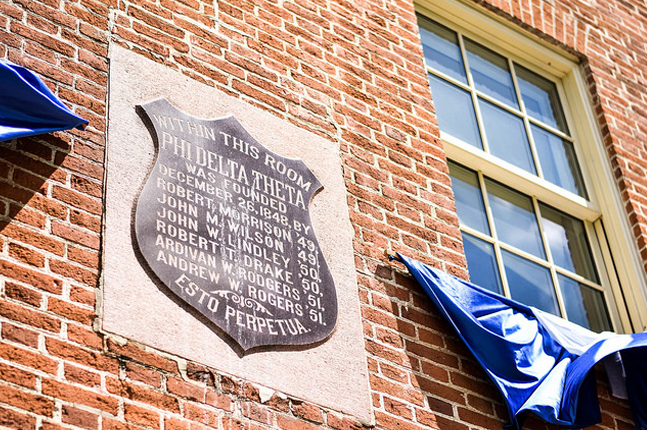
It was in this room that Phi Delta Theta’s vision became reality and where its six noble founders composed and signed the first Bond, handwritten and still preserved at General Headquarters, just a few blocks away. To this day, that same Bond is hand-copied for every new chapter, preserving as best it can the amazingly complex script of the early writers when cursive penmanship was an art form.
As I stood there during the most recent Kleberg Emerging Leaders Institute this summer, my first ever visit to Oxford as a Phi of fifty five years, I was struck by this churning in my brain as we read The Bond aloud – the inevitable song worm that catches us and won’t let go until exhausted. The song, The Room Where it Happened, from the highly lauded Broadway production of Hamilton, encompasses so many of those feelings and emotions:
God help and forgive me
I wanna build
Something that’s gonna
Outlive me
I wanna be in the room where it happens
Brother Ford was a Fellow at the 2017 Kleberg Emerging Leaders Institute. Alongside other alumni, John was immersed in the program and received an on-the-ground look at the leadership development that occurs at the Institute.
The post The Room Where It Happened appeared first on Phi Delta Theta.
]]>The post The Story Behind Convention Ladders appeared first on Phi Delta Theta.
]]>Silver metal. Measuring roughly an inch in length and barely an eighth of an inch wide. Words engraved on their faces such as “Estes Park,” “Miami Beach,” and “Oxford,” along with years like “1932,” “1950,” and “2014.” These descriptors are found on the bars collected by brothers at each convention to designate how many they have attended. These silver bars are also known as “rungs” due to the fact that when linked together, they resemble ladders. Thus, the term “convention ladder” came to be. Each rung reads the city and year in which the convention took place.
Research to determine the history of the convention ladder found that this memento of conventions past is decades old. However, research did not determine a specific year of origin or convention that marked the start of this tradition. The earliest pictorial evidence of convention ladders dates back to the 1908 Convention in which a brother in the forefront of the convention photo is wearing a ladder with nine rungs! With the conventions taking place every two years, this dates the first rung back to the 1891 Convention if he attended each convention consecutively.
Earliest known written mentions of the rungs date back to the 1914 Convention. A 1914 edition of The Scroll quotes a letter written by a Massachusetts Alpha Phi reflecting on his convention experience, “so enjoyable was the entire convention that most of the delegates bought convention ‘ladders’, and swore they would have their first reunion, the fates permitting, at the next national convention of [Phi Delta Theta]” (Ira M. Dempsey, Williams ’15). The next mention of the ladders was seen within a 1933 edition of The Scroll written by Illinois Alpha Phi, Frank J.R. Mitchell, “many years ago the practice began of wearing silver bars to indicate the conventions attended and the lengthening ‘ladders’ seen at convention are a striking evidence of the loyalty of old convention-goers. It is hoped that the next convention will witness the lengthening of many ‘ladders’ both long and short.”
Piecing together a history of this proud tradition was difficult due to the fact that the General Headquarters did not officially produce and purchase these bars initially. Individuals themselves, it would seem, purchased them through an outside vendor. Additionally, some of the brothers pictured in photos with rungs are members of the Chapter Grand and not available for comment on how they went about obtaining their ladders.
Robert J. Miller (New Mexico ’50), Executive Vice President Emeritus and current Fraternity Historian, owns the longest convention ladder at 34 rungs. It will soon increase to 35 with this year’s convention in Savannah. His first bar is from the 1948 Oxford Convention. According a 1954 volume of The Scroll, “the previous record was held by the late ‘Polly’ Ruick [P.P.G.C.*] who had 26 rungs on his convention ladder at the 1950 Chicago Convention – his last.” Even before Brother Ruick, the longest had been owned by George Banta Sr., whose ladder was 19 rungs long. Brother Banta had first attended convention in 1878 and his last was in 1930. With 52 years between his first and last conventions, that means he attended 26 conventions, which raises the question of why he only had 19 rungs? When did the rungs start? These questions still remain along with others. We might never know the full history behind this convention tradition. What we can say for certain though is well said by Past President of the General Council Scott Mietchen, “as Phis attend more conventions, the ladders lengthen, and provide striking evidence of a Phi’s devotion to the Fraternity.”
Phi Delta Theta’s 81st Biennial Convention is quickly approaching, and more than 600 Phis will flood into the historic streets of Savannah, Georgia. Convention has been lauded as not only a time for legislative action in an effort to adapt to changing times, but also an opportunity to celebrate together our great Fraternity and our Bond as brothers in an unique environment. Whether this will be your first convention, or your 31st, consider getting yourself that silver bar with the word “Savannah” and numbers “2016” engraved on its face. It will act as a memento of one of the greatest Phi Delt experiences you may ever have.
Addendum:
In the article posted on June 9th of this year, I stated that the earliest pictorial evidence of the convention ladders in use was from the year 1908. A recent development has occurred to provide us a bit more insight into the history of this convention tradition. In the General Headquarters building there are a number of vaults. In one of these vaults, by pure happenstance, CEO Bob Biggs wandered upon an “artifact”, if you will, while searching for a completely unrelated item. What he found was the oldest Convention Ladder known to our organization. The ladder was owned by the now deceased Samuel “Polly” Ruick, President of General Council (1908-1910), who was mentioned in the initial piece for his appearance in a picture featuring him and his 26-rung ladder. That picture was from his last convention in 1950. The first bar on his rung? Philadelphia – 1896.
Like before, questions remain and we may never know all the answers. For example, were the ladders and rungs made as early as 1896? Or were they made later and delegates retroactively added rungs for past conventions they had attended? The answers likely have been laid to rest with brothers in the Chapter Grand. What does remain true is that another rung was earned by hundreds of Phis in Savannah in June 2016 and as the ladders for many Phi brothers continue to grow longer, so does this time honored tradition.
*Stands for Past President of the General Council.
The post The Story Behind Convention Ladders appeared first on Phi Delta Theta.
]]>The post The Badge of Phi Delta Theta appeared first on Phi Delta Theta.
]]>Phi Delta Theta’s 81st Biennial Convention is approaching and over 600 Phis will soon converge on Savannah, Georgia. Convention is not just a time for legislative action, but it is also a time for Phis to celebrate one another, our great Fraternity and our Bond as brothers. During the Convention season, brothers wear the badge of Phi Delta Theta with great pride and in tremendous unity. This year will be no different. Thus, Phi Delta Theta encourages all brothers to take a few short moments to learn a bit of history about the badge and the proper way to present it.
Listed in Article VII: 15 of The Code as Insignia, or a distinguished mark of membership in an organization, the badge is sacred to every brother of Phi Delta Theta and has been since the badge’s design in June of 1849. The original badge consisted of a flat gold shield with an eye affixed to the upper portion, suggested by Morrison, and a scroll fixed to the lower portion, suggested by Wilson. Morrison added that the Greek letters “ΦΔΘ” shall be inscribed somewhere on Wilson’s scroll. Though the badge was designed in 1849, it was worn only in secret until 1852, when Miami University President, William C. Anderson, an honorary brother, allowed the badge of Phi Delta Theta to be worn at a senior brotherhood celebration and then the senior graduation ceremony a few weeks later. This was the first time since 1841 that the University had shown any support of the Greek community.
Not until 1866 was a sword attached to the golden shield, at the installation of J.C. Black, a brother at the University of Chicago chapter. The addition of the sword to the badge was not official though until the Phi Delta Theta Convention of 1871. Prior to 1871, no description of the badge appeared in Phi Delta Theta’s Constitution. That year, the newly adopted Constitution provided that that badge should consist of a shield, bearing the eye and scroll, with a sword attached by a chain. At the time of its inception, Phi Delta Theta was the first fraternity with a sword incorporated in to its badge design. The badge, except for size and ornamentation, has not been changed since 1871.
A common misunderstanding among many Phis is to wear the badge on the lapel of their coats. Rather, the proper place for the badge of Phi Delta Theta to be worn is over the heart, directly on the dress shirt, rather than on the coat lapel. The Code provides that the badge shall not be worn except by initiated members of the Fraternity or their mothers, wives, daughters, sisters, or fiancées, and a penalty of one year’s suspension may imposed by a chapter on a member violating the clause.
Though the direct meaning and significance of the badge of Phi Delta Theta has never been disclosed to non-members, R.A.D. Wilbanks said it best in 1866, when he wrote to T.M. Paschal of Kentucky Alpha, the emblems of Phi Delta Theta “speak the mystic language of our fraternal union.”
Phi Delta Theta looks forward to joining together with brothers and their families in Savannah! Bring your badge!
The post The Badge of Phi Delta Theta appeared first on Phi Delta Theta.
]]>The post The Words on the Page appeared first on Phi Delta Theta.
]]>What I have come to discover in my Fraternity experience is that you cannot live your Ritual until you are confident in your understanding of it. Think about the last time you heard the words of the Bond, and for our non-Phi Delt readers, think about the last time you read your Creed. Perhaps you simply listened to the words, perhaps someone has memorized the words, perhaps, even, you know the vast majority of the words’ definitions. But what does it all mean? We listen to the writings, but do we truly understand the words on the page?
Our Rituals were written using words, diction, and syntax that are 100-200 years old. They are from a time of intense academic pursuit and a significant appreciation for language; a time of spoken propriety and intellectual prowess for those with the opportunity to attend university. This appreciation for language has been long since forgotten by the general population, and thus poses the inherent question: How can Fraternity and Sorority members of today live their Ritual when its ceremonies and guarded meanings are written in an all but lost form of prose?
Think about the words on the page… When was the last time you used one of those words in such a profound way? When have you heard others use similar words in such an eloquent amalgamation? And when was the last time you stared at those sacred pages and looked beyond the words on the page, looked beyond yourself and your Brothers/Sisters, and sought out the hidden wisdom of the Founders? Unfortunately, the assumption is that we cannot fully answer any of these questions.
Herein lies the challenge for our members – to understand the words on the page to a degree that allows an individual or Chapter to internally process, and externally exhibit the principles and intentions of those words; to live a purposeful life that illustrates the clandestine meanings of those principles. When our vernacular persistently abbreviates and simplifies itself, can we seek the ability to comprehend words that in such a way, have transcended time and have remained unchanged since their inception?
If you are up to the challenge, then let’s talk about where to start. I believe the secret is not only in the words on the page, but also in the words, experiences, and tenets of members from the past that sought the same truths. I believe that living the Ritual of Phi Delta Theta is, quite simply, the actualization of the well-known quote by Walter B. Palmer:
“Phi Delta Theta was organized with three principle objectives: The cultivation of friendship among its members; the acquirement individually of a high degree of mental culture, and the attainment personally of a high standard of morality.”
Think about Brother Palmer’s words… these axioms echo the Three Cardinal Principles of Friendship, Sound Learning, and Rectitude. These few lines of text comprise the articulation of a lifestyle pursuant to the sacred principles we swore to uphold. It is the equation that defines how we can live our Ritual, and it is the map of how we, as members of Phi Delta Theta should live our lives. If this is the map, where is the compass? We can use other quotes from members of the past to clarify Brother Palmer’s words and discern the truth from the words on the page. Below are the three tenets with lines that I believe further-explain their concepts:
The cultivation of friendship among its members…
“It is the spirit of true brotherhood that touches the depths of a man’s inner life and wards off sorrows and disappointments, opens the way for the highest services, and furnishes the inspiration for right living.” – John Wolfe Lindley
The acquirement individually of a high degree of mental culture…
“The Fraternity must always work in harmony with the college for the true ends of education” – Arthur R. Priest.
The attainment personally of a high standard of morality…
“Every organization that is right and proper in its nature, will be what the men who constitute it are.” – Robert Morrison
See how each quote contributes to the clarification of each tenet? If you want to take this exercise a step further, I challenge you to write your own definitions for “highest services, right living, and true ends of education”. In addition, what is Brother Morrison saying in this quote? Take a few minutes and think about these words on the screen, and the fact they are on a screen and not on an actual page… These are just a few examples of thoughts and questions you can ask yourself and your members if you seek to decipher the words on the page.
The fact of the matter is that our members will only understand our Ritual to the degree that they comprehend the meanings of the words on the page. Now, by understand, I’m not referring to having a notion, idea, or feeling, but rather a level of comprehension that one can apply, voice, and model that understanding to others. This is not to say that every member should dedicate years to vigilant study and attaining meaning from the words of Ritual. It simply means that we should work together in helping each other to learn about the words on the page. It means that through sacrificing a little time and deriving greater truth and purpose from the words on the page, we will have the essential ability to articulate what it means to live out those principles and be the men and women we swore to be.
Brother Luke Benfield is the Director of Education at General Headquarters. Luke is a member from the Georgia Gamma Chapter at Mercer University. He has a bachelor’s degree in English literature and economics, as well as a master’s degree in educational leadership. Before coming to GHQ, Luke was the Fraternity and Sorority Life Advisor at Coastal Carolina University, as well as the IFC advisor at Florida Gulf Coast University in graduate school.
The post The Words on the Page appeared first on Phi Delta Theta.
]]>The post Ignore the Static… appeared first on Phi Delta Theta.
]]>As a past staff member of Phi Delta Theta and current Alumni Advisory Board member for the Colorado Gamma Chapter, I have been blessed to have many positive fraternity experiences but none more meaningful and inspirational than sharing the Ritual with a group of new initiates. I have had the privilege of hearing or personally reading The Bond of the Phi Delta Theta well over 100 times. This experience is vastly different than that of a typical undergraduate brother who would be fortunate to hear The Bond read more than three times during his entire membership.
I credit much of my own personal value system to my parents and how they raised me in a home where church and family were staples in our lives. My undergraduate days at Iowa State University and then my time as a staff member helped me solidify and hold values such as loyalty, trust and respect for others near and dear to my heart.
Given it is National Ritual Celebration Week, I am reminded of an article entitled “Secret Thoughts of a Ritual” by Sigma Chi member Edward M. King. Taking the personality of a fraternity ritual, Ed wrote, “Never has the time been so ripe as this period in our history when the young people of today on our college campuses are crying out for the kind of message, guidance, value and leadership that has been so long hidden in my pages.”
I could not agree more as the static presented from recent headlines provide a stark contrast to the principles of our great Fraternity. Take for example, ESPN’s report about an NFL team’s “bounty program”, a radio personality’s choice of words describing a law student’s behavior, and a recent top rated TV comedy’s episode entitled “Sips, Sonnets and Sodomy.” Box office dollars outweigh decorum as Hollywood serves up movies like “The Hangover” and “Project X”. Even in the backyard of where our members are attending school, athletic programs are publicly coping with alleged sexual misconduct by their staffs. And as the Presidential nomination process crawls forward, our brothers, many of whom are voting for the first time, witness the future leaders of our country grapple with the concepts of bailouts and entitlements.
We are bombarded over and over with examples of poor behavior and poor choices that serve as “static” often causing any worthwhile messages of how to act, how to lead, or how to serve to be lost. Fortunately fraternity creates an environment that has the potential for brothers to have meaningful conversation where sharing their innermost feelings and thoughts about their lives is not ridiculed but celebrated. While I firmly believe our brothers have the best intentions, they crave for guidance often not readily found in today’s college environment. Therefore, I feel it is my duty in working with the brothers of Colorado Gamma and with those members in attendance at leadership events to relay how emulating the ideals outlined in our Ritual will serve as a springboard for long-term success and satisfaction with who they will become.
In reading an old history of Phi Delta Theta written by Walter B. Palmer, I came across a tribute by then President of the United States, Brother Benjamin Harrison who spoke at a Phi Delta Theta banquet held in Galesburg, Illinois in 1890. He addressed those in attendance with these timeless words:
“I feel the greatest sympathy with young men who are now disciplining their minds for the work of life. If I were to select a watchword, which I would have every young man write above his door and on his heart, it would be that good word “Fidelity.” I know of no better. The man who meets every obligation to his family, to society, to the State, to his country and his God, to the very best measure of his strength and ability, can not fail of that reward which comes of a good conscience, and will seldom fail of the approval of his fellow-men.”
Please ignore the static, encourage fidelity among your fellow brothers while personally striving to embody the tenants of The Bond, and become the greatest version of yourself.
Yours in the Bond,
Marc Mores
Brother Mores is the Executive Vice President of James R. Favor & Company, the Fraternity’s insurance broker. Following graduation from Iowa State University (IA Gamma), Marc spent 13 years on the GHQ staff. After completing his Masters work at Xavier University, he became a Certified Association Executive and recently earned the Certified Insurance Counselor designation. Volunteering with the Colorado State chapter and the ISU Cyclone Club keep him busy. Marc and his wife Jennifer live in Parker, Colorado with their two daughters.
The post Ignore the Static… appeared first on Phi Delta Theta.
]]>The post Thoughts on “Living Your Creed” appeared first on Phi Delta Theta.
]]>Happy National Ritual Celebration Week! If I had to choose the mantra of the fraternal world in vogue these days, it would have to be “Live Your Ritual,” and there is no better time than now to focus on the ideals that our fraternal rituals espouse.
“Living Your Ritual” is a noble thought, but just how does one go about accomplishing this lofty goal? We know that to be successful in achieving a goal, we must have a plan. One popular example is S.M.A.R.T. – our goals must be Specific, Measurable, Achievable, Realistic, and Timely. Are they?
Simply by asking our members to “Live Your Ritual” defies the very first step of achieving our goal. It is far too vague a command to know exactly what that means and when we have been successful., especially with such a moving, ongoing target. A better option is to clearly define what our individual organizations ask of our members. For some, those ideals may be expressed in a Creed; for others, the key concepts may be part of an Initiation oath or pledge.
I will share the example I am most familiar with as Phi Mu’s National Ritual Chairman. Phi Mu’s Creed sets a standard for members asking them to strive to live loving, honorable, and truthful lives. We all have a certain idea of what each of these means, but the concepts are still far too vague to be measurable.
What does it mean to be loving? Phi Mu’s Creed spells out the expectations: “to lend to those less fortunate a helping hand; to think of God as a protector and guide of us all; to keep forever sacred the memory of those we have loved and lost.; to be to others what we would they would be to us; to keep our lives gentle, merciful and just.”
And to be honorable? By “guarding the purity of our thoughts and deeds; being steadfast in every duty small or large, believing that our given word is binding; striving to esteem the inner man above culture, wealth or pedigree; being honorable, courteous, tender.”
And finally, our members are expected “to serve in the light of truth, avoiding egotism, narrowness and scorn; to give freely of our sympathies.”
I have yet to meet many individuals who can live up to these lofty standards 100% of the time. I will freely admit that I haven’t, but I also know that I try. Some may think it silly of me to keep a copy of the Phi Mu Creed on the dresser where I get ready in the mornings, but it serves to remind me of the kind of person I want to be. We are human beings with human flaws and these are, after all, high expectations. So have I failed? Have we failed? Have our members failed us, or have we failed them?
The Rituals of our fraternal organizations provide a framework for and a picture of the kind of lives we want for our members. We fail our members by not being specific about our expectations. Too often, we recruit our members based on one set of standards and expectations (appearance, partying opportunities), then we do a “bait and switch” when it comes to expecting them to live according to our Ritual. The two are not always in sync.
We fail our members, too, when we do not give them the support and motivation to live our Ritual. Are we providing opportunities for philanthropic work if that is one of our goals? Are we holding memorial services for loved ones we have lost? Are we being the sister/brother to them that we expect them to be to us? When a member strays from our expectations, are we quick to judge and punish, or do we provide a system to address the unacceptable behavior and provide support for change? Do we recognize those that are living examples of our expectations?
To make our Ritual goals more tangible and to demonstrate their achievability, we should be allowing time at every meeting for members who have exemplified our ideals to be recognized and applauded.
Our efforts at clearly defining the meaning of “Living Our Ritual” pay off when we see a measurable difference in the number and caliber of members we recruit and in the number of “cases” that must come before our disciplinary boards. Along the way we may find that for some “Living our Ritual” is not realistic. Is that a bad thing? After all, shouldn’t our members have a shared vision of what it means to be a member?
Where do we begin such a monumental task as “Living Our Ritual”? Let us clearly define what that means and challenge each and every member to invest in our ideals. Let’s take inventory annually to evaluate our shortcomings and plan for change if needed. Let’s celebrate success!
If we truly want to change the too-often negative image of Greek life, let’s not only let our Rituals and ideals be known, but let’s “shout it from the mountaintop” that we are organizations truly striving to develop responsible members to lead their families, their communities and the world today and tomorrow. And we are succeeding! Let’s not make that a well-kept secret!
Peggy King was initiated into the Alpha Eta Chapter of Phi Mu Fraternity at Louisiana State University in 1969. She has served as Phi Mu’s National Council Member-at-large, National Alumnae Vice-president, Volunteer Coordinator, Phi Mu Foundation Trustee and as National Ritual Chairman since 2002. She has received the Fraternity’s Outstanding Alumnae Achievement Award as well as LSU’s Greek Excellence Award and a Leave a Legacy Award in her local community. Peggy holds a B.S. in Spanish, an M.A. in Cultural Anthropology and an MA+30 in Curriculum and Instruction. She currently teaches Spanish in LSU’s Osher Lifelong Learning Institute and is an assessment administrator for Westat, a research company under contract to the U.S. Department of Education.
The post Thoughts on “Living Your Creed” appeared first on Phi Delta Theta.
]]>The post How Do I Know When A Chapter Is Living The Ritual? A Mom Tells Me appeared first on Phi Delta Theta.
]]>As Phi Delta Theta helps observe National Ritual Celebration Week I was asked to share some thoughts on what it means to “Live The Ritual.” I realize that, from time to time, I am asked by university administrators, parents, alumni, and undergraduate members to give a definitive definition of how I know when a chapter is “living the ritual” of Phi Delta Theta. And when I think about this question I’ve come to the conclusion that I know when a chapter is living the ritual when a mom tells me it’s so. Now, I’m going to come back to this “mom as judge” concept a little bit later, but let me first share some thoughts on being a Fraternity man – with a capital ‘F.”
It would be easy and completely appropriate for me to define ‘living the ritual’ as achieving the highest grades on campus; providing a tremendous amount of community service hours and raising a lot of money for charity; holding a lot of campus leadership positions; and using the ritual in all chapter meetings and functions. And while each of these specific acts are visible, public and measurable – and all are good activities that I certainly encourage – for me they don’t define this idea of ‘living the ritual.’
As I think about the three cardinal principles of Friendship, Sound Learning and Rectitude laid out by our Founders 164 years ago in The Bond of Phi Delta Theta, and supported in the ritualistic ceremonies that are the backbone of our Fraternity, they describe to me the characteristics of my concept of a Fraternity man.
I want to return for a minute to the original view and perception of Fraternity men by the broader society. I have always been struck by a visual representation of a Fraternity man which appeared over a century ago. This cartoonist’s drawing coincided with a gathering of Phi Delts, 112 years ago in Louisville, Kentucky, at the Fraternity’s 1900 General Convention. This illustration was printed in the Louisville Courier-Journal and was the first editorial cartoon about any fraternity convention ever published. If you look closely at the cartoon, you’ll see that it characterizes the Phi Delt as standing somewhat larger, broader and with more presence than the man he is walking next to. This cartoon didn’t represent him as a drunk — or slob — or “Frat Guy” – but as “Phi Man” – as a man of character – a leader of men. This Phi Delt wouldn’t have been featured on TFM (Total Frat Move).
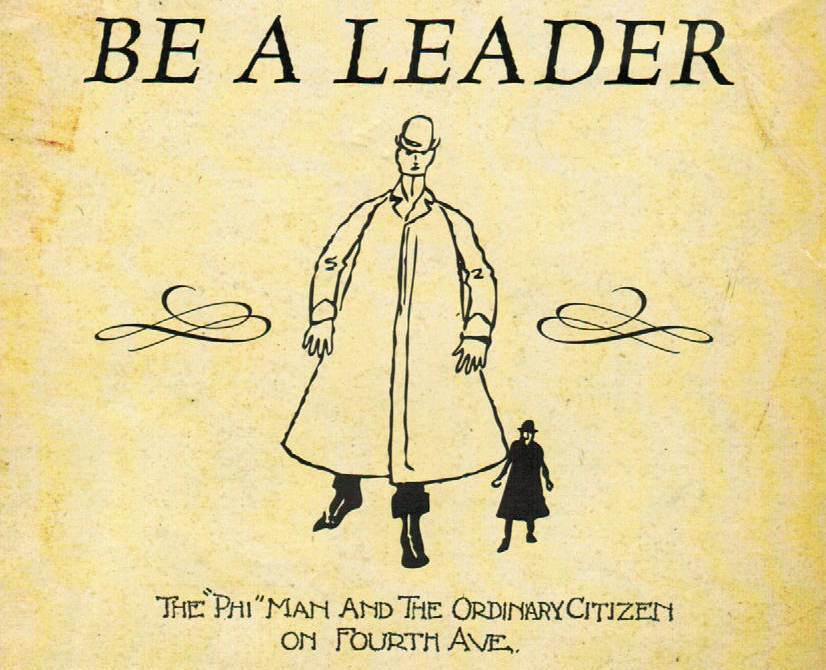
The Founders of Phi Delta Theta were respected leaders of their time and outlined for all of us a set of simple beliefs and principles which, if followed, lead to a life of honor, respect and fulfillment.
To me, living the ritual becomes instinctive, internalized and results in the creation of lifelong habits. And it begins at initiation. As President of Phi Delta Theta, I have had the opportunity of initiating and installing many of our newest chapters. And to each new chapter at the installation banquet I offer the following charge.
“When you were initiated and all signed The Bond of Phi Delta Theta, you agreed to live your lives by three simple principles – Friendship —- Sound Learning — and Moral Rectitude. I charge each of you here to remember and honor those commitments to each other. I charge the men of Phi Delta Theta to:
- To excel in the classroom to the best of your abilities.
- To sit in the front of class, engage with your professors and add to the academic discussion.
- To excel on the athletic field or performance venue– always giving your best performance and exhibiting exemplary sportsmanship and creativity.
- To engage on the campus – get involved in student government and other student organizations. To lead, not just follow.
- To engage in the local community and serve those in need.
- To not abuse alcohol, women or each other.
- Last, but not least, to act in such a manner – both collectively and individually – that all of your mothers, fathers, alumni and friends will take pride in you as a Fraternity man.
If you do that, you will have met the obligations you made when you signed The Bond.”
So, back to the “mom as judge” concept. I know a chapter is “living the ritual” when I hear from the parent of a Phi, which usually turns out to be the mother, who calls or writes to tell me about her son’s experience in the Fraternity. These messages sound like this:
“Having never been involved in a fraternity before, both my husband and I were both VERY impressed and proud to see these young men filled with enthusiasm and dedication. The fraternity has been a wonderful experience for him and I know there will be a void once he graduates this year!”
“The brothers (Missouri Eta – Missouri Western) were going to plunge anyway, but they went beyond a philanthropy project and made it VERY personal for my family. Tanner (who has a disability) is almost 18. We are trying to accept that he will never be married, he will never drive a car and may never attend college. He will never have the opportunity to be a Phi Delta Theta. These men have embraced my family and me and for that I am eternally grateful. Missouri Eta Chapter, from the bottom of my heart, I love each and every one of you. You are compassionate and caring and will ALWAYS be a blessing in my life.”
“I was admittedly apprehensive when he expressed an interest in becoming involved with a fraternity. Our family had no experience with fraternities or sororities and I had some of the typical misconceptions regarding the Greek system. His father and I gave our approval with the caveat that he must maintain a high grade point average and not jeopardize his scholarship, since he wishes to attend law school after graduation. I am proud to say that he is beginning his senior year and has retained his scholarship for all four years in large part due to the scholastic emphasis and support of the Fraternity. I have been very impressed with the level of involvement of the alumni with the undergraduates in Phi Delta Theta. They are truly committed to fostering the development of these young men and certainly stress the virtues that we all wish to instill in our sons: honor, loyalty and responsibility. Personally, I can attest to new levels of leadership and maturity in my son that I believe are directly attributable to his involvement in Phi Delta Theta.”
With time I have become less concerned with “seeing it” in terms of formal activities and more interested in understanding that the process of “living the ritual” is taking place within our chapters. When I hear from a parent with a testimonial like these – I know the chapter is “living the ritual.”
So in closing, here are a few things I believe members of Phi Delta Theta do every day to “live the ritual.”
- We care for one another and lift each other up
- We challenge ourselves, individually, to be better men every day
- We challenge each other to rise to a higher standard
- We call a brother out when he is going down the wrong path
- We don’t turn our backs on a brother in need
- We celebrate each other’s successes
- We believe in words like fraternity, honor, duty, loyalty, leadership, brotherhood, love, and compassion
- We’re not fair-weathered friends
- We take pride in identifying ourselves as Fraternity men
- We believe in the lifetime commitments we made to each other when we signed The Bond
My hope is that all of our brothers do these things – that we each strive to live the ritual to the best of our abilities – because we’re members of Phi Delta Theta – because that’s what Phi Delts do.
Brother Mietchen is the General Council President. Scott is a 1984 graduate of the University of Utah where he earned both his B.S. and MPA. He has served the Fraternity as a chapter consultant, chapter adviser, house corporation president, province president, delegate to the NIC and member of the General Council from 1994-2000 and 2004-Present. Scott became an Iron Phi in 2010. Professionally Scott is President and Managing Partner of Fund Raising Counsel, Inc. (FRCI), the oldest fundraising consulting firm in the Intermountain West. He was recognized as Fund Raiser of the Year in 2006 by the Utah Society of Fund Raisers. Prior to joining FRCI, he served as Vice President for University Advancement at Utah State University. Scott, his wife Lisa, and their children, Abby and Alex live in Salt Lake City.
The post How Do I Know When A Chapter Is Living The Ritual? A Mom Tells Me appeared first on Phi Delta Theta.
]]>The post When All Is Said And Done, Did You Say More Or Do More? appeared first on Phi Delta Theta.
]]>In his book, Seven Habits of Highly Effective People, author Stephen Covey states, “By centering our lives on timeless, unchanging principles, we create a fundamental paradigm of effective living.” I am not sure if Stephen Covey is a fraternity man, but I know for sure that this statement exemplifies exactly what is meant when people in the fraternal world say that you need to live your Ritual. As members of fraternities and sororities we have committed ourselves to organizations that were founded upon timeless, unchanging principles and because of the oath that every one of us took when we became members of our organizations, it is our responsibility to live those values all the time, every day.
Before I move forward with sharing some specific ideas of what living your Ritual looks like, let’s first make sure that we are on the same page about the definition of Ritual. I am sure, for the majority of you who are reading this blog, the first thing that comes to your mind when you hear ‘Ritual’ is some sort of ceremony from your chapter – maybe it’s your formal chapter meeting or maybe it’s your initiation. You are probably also thinking, our Ritual is secret, so how am I supposed to live that every day? Well I am not asking you to put on your robe, sing your songs, or re-enact your ceremonies on a daily basis. What I am asking you to do is to think about the meaning of your organization and what those ceremonies teach you about what it means to be the greatest version of yourself. Think about the words you recited in your oath when you committed yourself to your fraternity for the rest of your life. Think about the three Cardinal Principles of Phi Delta Theta: Friendship, Sound Learning, and Rectitude. Speaker Mari Ann Callais defines it best, Ritual = Values = You!
So now that you understand that living your Ritual means living your organization’s values that you committed to, let’s reflect on what that looks like. My good friend and colleague Scott and I have presented several times to students and professionals about this idea of living your Ritual and what it looks like. We have boiled this idea down to four key categories: knowledge, education, execution, and accountability.
Knowledge. Our Ritual is the one thing that makes our fraternal organizations different from any other organizations on campus and the values and lessons that our own Rituals teach us make our own fraternity or sorority unique from others. It is important for chapters to recognize the importance of learning about your Ritual and making the Ritual readily accessible to all of the members. Members need to embrace the mentality of learning about their Ritual not because they have to but because they want to. Again, I am not referring to just memorizing the lines, the oath, or learning the handshake. I am talking about facilitating discussions and reflections around what that Ritual teaches us about how we live. It is each of our individual responsibilities to make sure that we really know and understand what our Ritual is teaching us. If the fancy words used in your ceremonies confuse you, take some time to dissect that Ritual and interpret what it means today. Re-writing your oath into your own words will help you to gain a deeper perspective and appreciation for the commitment you have made. The very basics of being able to live your Ritual starts with your knowledge and understanding of what it is you are supposed to be living. So if you aren’t familiar with what your Ritual is telling you about your organization, the first step is to take some time to really read it and reflect on it. If you need help comprehending what your Ritual is telling you, your advisors and International staff members are a great resource to reach out to for clarification and understanding.
Education. Once you gain the knowledge of your Ritual, the next step is to make sure that your chapter is teaching the values of your Ritual to all of your members. Chapters who struggle in this category are unable to teach the values and principles of their organization, lack Ritual training, and have little to no follow-up after Ritual ceremonies are conducted. Many organizations have a post-initiation education session with their new members, but what are you doing to continue to educate all of your members about your Ritual? Why not spend 5 minutes at each chapter meeting picking a different part of your Ritual to review and evaluate as a chapter how individual members and the chapter as a whole is actually living that part of the Ritual? Take a separate line of your oath each week and as a chapter discuss it’s meaning and specific examples of how it can be lived. Remember, it’s not just up to our new initiates to understand this, but every member, so let’s be sure we are educating all of our members on an ongoing basis. Chapters who focus on education consistently train, educate, and discuss Ritual in various settings. Members feel comfortable discussing Ritual and a good deal of time is spent reflecting on what Ritual means to the chapter.
Execution. Once you have gained the knowledge and educated your chapter about your Ritual, it’s up to you and all of your members to live and/or execute the values of your Ritual. You have to “walk the walk” and put values into action. The key thing to understand about execution is that you cannot pick and choose when you want to live those values, they must become such a part of your daily routine that you don’t even have to think twice about them. They need to be just as evident on a Friday or Saturday night as they are on a Tuesday afternoon when you are in class. Think back to those three Cardinal Principles and how they can each be incorporated into your daily actions. Demonstrate your friendship by being there for your brothers when they need your help, and putting them before yourself. Dedicate yourself to sound learning, get out of bed and go to class, participate when you are there, and go up and speak to your professor afterwards. Sound learning isn’t just about getting good grades but it is staying open to new experiences and opportunities that will help you to continue to grow into that greater version of yourself, and that doesn’t end when you leave college. When making decisions about how to spend your time and money, both as an individual and as a chapter, let your moral rectitude guide those decisions. Execution is where the rubber meets the road; our Rituals are not just pretty words on papers, but a call to action and a guide for how we should be living our lives every day.
Accountability. Perhaps one of the most important aspects of living our Ritual, but often the most neglected, is accountability. I get so frustrated when I meet with chapter presidents and they tell me that there is nothing they can do about members in their chapter who are not paying dues, getting good grades, or whose behavior is destructive to the organization. “I am not their dad,” they say. Correct, they are not their dads, but they are the president of the organization and each of their members took an oath to uphold the values of their organization. It is up to the leaders, and really all members, to make sure that we are all holding each other accountable for doing what we say we will do when we join our organization. Recognizing members who are living out your values on a regular basis can reinforce accountability among your members. Each week as you review a line of your oath and discuss examples of what it looks like in practice, take time to recognize members who have demonstrated those values through their actions. This will help positively reinforce the idea of living your Ritual and help other members see how they can do that in their own lives. Additionally, when you see members behaving in ways that are inconsistent your values, you must call them out. Have a conversation; remind them of the commitment they made, help them understand the negative impact it is having on the chapter. So often we get caught up in the rules and policies and only holding members accountable for those. Don’t get me wrong, those are important, but remember: our Ritual is the blueprint for the success of our chapter and its members, so let’s start incorporating that into standards meetings and conversations.
At the end of the day it’s important to remember that we made a lifetime commitment to living our Ritual when we were initiated and that doesn’t end when we graduate from college. As a Phi Delt, friendship, sound learning, and rectitude should always be the principles that serve as your paradigm for effective living. Our Ritual is not just words on paper to be memorized or recited once or twice a year. If we are really members of our organization we have to put those timeless and unchanging principles at the center of our life every day.
One of my favorite quotes is “when all is said and done, did you say more or do more?” The future of your fraternity and our Inter-fraternal community depends on your ability and willingness to DO more. It is time for us to stop just saying we stand for these values and actually demonstrating them through our actions every day. Let’s start living our Ritual!
Rachel Westra Marsh currently serves as the Director of Greek Life at the College of Charleston, previous to that she served their community as the Assistant Director of Greek Life for two years. She is originally from Virginia, where she completed her undergraduate studies at Virginia Tech. She spent two years working as a National Consultant for Chi Omega Fraternity before she returned to school to pursue a Master’s Degree in Higher Education and Student Affairs at the University of South Carolina. While pursuing her master’s degree, she served as the graduate assistant for Greek Life as well as Assistant to the Associate Vice President for Student Affairs. Rachel has experience working with NASPA’s Knowledge Community for Sorority/Fraternity Affairs and has given presentations and facilitated at a number of fraternity and sorority conferences. She also serves as a volunteer for Alpha Chi Omega, Beta Theta Pi, Chi Omega, and Sigma Alpha Epsilon.
The post When All Is Said And Done, Did You Say More Or Do More? appeared first on Phi Delta Theta.
]]>The post From Memorization to Action appeared first on Phi Delta Theta.
]]>I would be willing to bet that many of us are still able to recite the Immortal Six and the Greek alphabet from memory (and speaking of the Greek alphabet, where is the real world application of THAT now that the world of high finance has crumbled?).
Now before I go too far, I will say that the history of the fraternity and the information in the Phikeia manual is very important and does provide the basis of knowledge to become a member of Phi Delta Theta. My challenge to all of our members out there is to move from simply memorizing and regurgitating that information for some Phikeia test to acting upon it.
Take for example two of the most commonly memorized phrases in Phi Delta Theta: the last line of the Phikeia Oath and Robert Morrison’s Famous quote (and just in case it’s been a while since you last opened your Phikeia manual, here they are).
Last Line of the Phikeia Oath: I will strive in all ways to transmit the fraternity to those who may follow after, not only, not less, but greater than it was transmitted to me.
Robert Morrison’s Famous Quote: “To do what ought to be done but would not have been done unless I did it, I thought to be my duty.”
I will wager that a lot of Phi Delts can say both of those quotes from memory. This is a good thing, but it means very little if they aren’t applied and acted on. An idea without followers, no matter how great, is still just an idea. Those two quotes only contain 51 words, but those words have the power to dramatically change our fraternity for the better.
Think hard about the Phikeia Oath. We all (again, hopefully) made a pledge to this.
When was the last time you actually thought about those words?
When was the last time you did something to ensure that the fraternity or your chapter would be handed over better off for future generations of Phi Delts?
If you can’t think of a specific time, don’t despair, but instead go out and pledge to yourself that you will do one thing to better the fraternity or your chapter. If you can think of a time, I am glad, but now is not the time to pat yourself on the back. Go and do more.
Now answer those same two questions about Robert Morrison’s quote.
I truly believe that most of the problems in our organization stem from a lack of leadership. I can hardly imagine how great our chapters would be if our officers simply embraced this quote. Put in the work you know you should do and don’t wait for someone else to get it done. Pretty simple, right?
Enjoy the summer break and take some time for personal reflection (including, hopefully being honest with yourself about those earlier questions), but come back to the fall semester ready to take those words you have memorized and put them into action. Our fraternity depends on it.
The post From Memorization to Action appeared first on Phi Delta Theta.
]]>The post Sharing Ritual, Remembering Our History appeared first on Phi Delta Theta.
]]>In memory and honor of our founding father, Robert Morrison, many chapters choose to host a Founders Day event. This event is a chance for alumni to return to the chapter and for friends and family to experience a principal aspect of Phi Delta Theta. The event often includes dinner, presentations and guest speakers. The key to these activities is that they all revolve around the reenactment of our founding ceremony, which portrays the significance of our cardinal principles.
Friendship, Sound Learning and Moral Rectitude, these are our cardinal principles by which we maintain a Bond of Brotherhood. The depiction of how our organization was founded strikes deep in the hearts and minds of the attendees, reminding the alumni where they come from and the brothers why they are there. A most imperative benefit of this is that friends and family are able to understand what Phi Delta Theta stands for, the core of our existence.
Many of our brothers have significant others who spend a lot of time around the chapter. Whether it be hanging around the house, coming to our socials or assisting with philanthropy, I find that they may not fully understand why we exist. It is my personal opinion that when they attend an event such as Founders Day, it reminds them that we are more than a group of friends, we are brothers.
It’s not often that the brothers’ families can come to understand the lighter side of a Fraternity, but the Founders Day event is the perfect place for them to realize that Phi Delta Theta is something more than just letters, more than just a chapter but component of a greater organization, a Bond of Brotherhood.
Yours in the Bond,
Ryan Giordano CA XI #303
The post Sharing Ritual, Remembering Our History appeared first on Phi Delta Theta.
]]>