The post Volunteer Profile – Steve Finn, SMU ’80 appeared first on Phi Delta Theta.
]]>Why did you join Phi Delt, and how has it impacted your life and career?
I arrived at the campus of Southern Methodist University in the fall of 1976, and I knew nothing about Phi Delta Theta Fraternity. As I started meeting members from different houses, every time I met a member of Texas Delta, I walked away knowing that they were the best men on campus. Luckily, I received a bid to join our Fraternity and was initiated on April 20, 1977. Little did I know that during my time at SMU, I would be elected IFC president and then receive a job offer to start my lifelong career from a brother who had graduated from Vanderbilt University. I also didn’t realize, as an undergraduate member, that by signing The Bond, I was now a Phi Delt for life. I owe a great deal to the Fraternity, and I’ve been trying to pay it back through my gifts and service to our active members, including being a CAB member of Texas Delta since fall 2014, and then becoming province president of Rho North in spring 2021.

Who or what inspired you to become a volunteer?
In the spring of 2014, Texas Delta faced some serious issues with its members and the university. Four of my brothers—Tom Sabin, ’79, Kent Krause, ’79, Mike Bristol, ’77, and Charlie Carneal, ’73—stepped up and changed the chapter’s direction. I knew I wanted to be part of that, and I was asked to join the CAB later that fall. From that low point, the CAB and our undergraduates worked hard to foster a positive culture within the chapter. At the 2021 Pittsburgh Convention, Texas Delta received the Kansas City Trophy for the best chapter of its size nationwide. I feel very privileged to be part of that success. That same year, I was asked by the CAB to volunteer as the province president of Rho North. I also just completed my fourth year teaching at the Kleberg Leadership Institute, which has been a very rewarding experience for me, working with brothers from all over the country.

What would you tell someone who is considering volunteering for Phi Delta Theta?
Over half of my job as a volunteer involves simply showing up and letting the members know that I care about them and am there to serve and help them improve their chapter, grow their membership, and enhance their undergraduate experience by being a member of Phi Delta Theta.

The post Volunteer Profile – Steve Finn, SMU ’80 appeared first on Phi Delta Theta.
]]>The post Volunteer Profile – Kris Dudziak appeared first on Phi Delta Theta.
]]>
From left to right: Kris Dudziak, ’81, Fred Schultz, ’74, and Chris Aitken, ’04
Tell me about your undergraduate fraternity experience. Why did you choose Phi Delta Theta, and do you have any favorite memories you would like to share?
I joined Phi Delta Theta because of the guys I met at the chapter house and my wanting to better ‘belong’ at the university. I have many fond memories of my days as an active member. I held the positions of recruitment chair, house manager, social chair, and president. During my time at the Minnesota Beta Chapter at Minnesota State Mankato, we took part in many fundraising events for charity. We consistently won at events like the campus-wide Charity Carnival and organized several trampoline jump marathons, raising thousands of dollars for the American Cancer Society. In fact, Minnesota Beta was awarded the Paul C. Beam Trophy for one of the trampoline jump marathons.
How have you stayed connected with Phi Delta Theta after graduation?
As a member, I made many lifelong friends among fellow undergraduates and alumni. In fact, about twenty to twenty-five of us go fishing together every year, and we have been doing so for the past forty-six years! One of our great alumni, Doug Larson, ’69, inspired me as an undergrad. He was our province president at the time and gave the chapter several presentations. After one of them, he took me aside and encouraged me to run for chapter president and to always strive to reach my full potential.
Who or what inspired you to become a volunteer? What would you tell someone who is considering volunteering for Phi Delta Theta?
Fellow brother and Foundation Trustee Emeritus Fred Schultz, ’74, asked me to consider becoming a faculty member at Kleberg. My time there was an incredible experience; I led an outstanding group of undergraduates in the Alpha Eta chapter and had an amazing peer mentor, Brysen Morgan. I encourage alumni to volunteer for Kleberg and to actively participate in their local area chapters; volunteering is reenergizing! As the leader of our First Thursday with the Phis get-togethers, it’s rewarding to reconnect with Phi Delt brothers from my chapter and to meet and get to know Phis from other chapters as well.

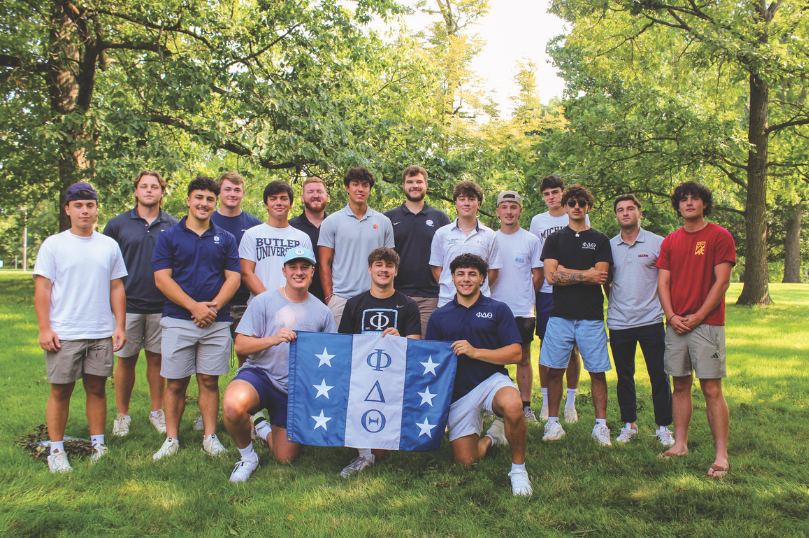
Kris Dudziak with the Alpha Eta Chapter of Phi Delta Theta during the 2025 Kleberg Emerging Leaders Institute. Peer mentor Brysen Morgan pictured holding the flag, Kris is behind him on the left.
I have used this part of the Phikeia Oath to guide me throughout my business career and would advise our current undergraduates to take it to heart:
“Not only not less, but greater than transmitted to me.”—The Phikeia Oath
By doing so in all his endeavors, a man can truly become the greatest version of himself.
The post Volunteer Profile – Kris Dudziak appeared first on Phi Delta Theta.
]]>The post Volunteer Profile – W. Allen Cole III, Hanover College ’80 appeared first on Phi Delta Theta.
]]>For more than forty years, Allen served at Xavier University in Cincinnati, Ohio, where he also earned an MEd in mathematics. His BA degree in mathematics was awarded by Hanover College. Teaching and tutoring mathematics as an adjunct instructor has been an additional role. He has been very active in professional associations and conferences, including roles on executive boards.
He lives in Cincinnati with his wife of thirty-seven years, with whom he has two married grown children—a son and a daughter—and three grandchildren. His son, Andrew, is the senior vice president of advancement for the Phi Delta Theta Foundation.
Recently, the Fraternity reached out to Allen to share why he has remained engaged with Phi Delta Theta:
As an alumni volunteer, I enjoy being able to pass the Fraternity forward, even better than it was instilled in me. It is a privilege to be able to utilize my time, talents, and treasure in this manner. I appreciate the legacy, traditions, and purpose of the Fraternity, as it evolves to meet the needs of today’s students.
I was initiated into the Indiana Epsilon Chapter at Hanover College forty-eight years ago, where I had a wonderful experience as an undergraduate student, with the Fraternity experience (including serving as chapter president) being a highlight that established a lifelong relationship with chapter brothers. The past twenty years include the roles of province president (currently) and CAB member prior as I re-established my connection with Phi Delta Theta as a growing, evolving leadership society where young men can find their successes in their own pursuit of greatness. I know that part of my re-engagement happened by virtue of my own son entering college at my alma mater, including him living in the same chapter house that I did.
I recently retired from a work career of more than forty years in higher education as a university administrator and a college mathematics instructor. College campuses have certainly evolved over my career, driven by a variety of social and cultural issues, along with the student enrollment now being over 60 percent female at most colleges. My direct connection with the changing higher education environment has greatly helped me be a successful mentor to my province chapters and to effectively serve at Kleberg Emerging Leaders Institute and other Fraternity events. And so, the responsibility for Phi Delta Theta to continue to be a premier fraternity leadership society is even greater, given how colleges have become so female-centric. A high-quality and eventful fraternity experience is extremely desirable to help produce high-quality men in today’s world.
One of my constant messages to the current undergraduate students is to live in the present (i.e., seize the day and the moment), while having an eye to the future (of where you want to be). I know when I was recruited as a freshman by the upperclassmen, I admired their qualities and their vision for the chapter being successful, while embracing the joy of the present and sharing tasks with much fun. And now, as I reflect, I know I developed many leadership and communication skills by working within the chapter framework to accomplish goals and meet deadlines, alongside my peers and colleagues at the time.
I encourage every alumnus to stay involved with their chapter, either casually or more formally—the support and connections are very rewarding. Phi Delta Theta is a community of many, where each of us has our story and our path to success.
Allen supports the Phi Delta Theta Foundation!
Allen is a tremendous supporter of the Phi Delta Theta Foundation. He is a member of the Trustees’ Roundtable and the Sword and Shield Society. Allen has presented a challenge match for Indiana Epsilon Phis for the 2025 Days of Giving. He will match donations made by Hanover College Phis.
The post Volunteer Profile – W. Allen Cole III, Hanover College ’80 appeared first on Phi Delta Theta.
]]>The post Volunteer Profile – Kyle T. Prager, Chico State ’18 appeared first on Phi Delta Theta.
]]>Why did you join Phi Delt, and how has it impacted your life and career?
I joined Phi Delta Theta on a whim because two people from my dorm invited me to a recruitment event. I didn’t know what fraternity was, how it worked, or why I was really there. I was offered an opportunity to join. Figuring why not, I can walk away in a few weeks if I don’t like it, and it ended up being the best decision of my life. I have made friends around the world and gotten every job I have had post-college because of this Fraternity. All because I showed up to a random house for pizza and mini golf, and then men who were there offered me a community I never knew I needed.
How have you stayed connected with Phi Delta Theta after graduation?
After graduation, I was offered a position with Phi Delta Theta General Headquarters as an expansion consultant. Traveling across the country, I brought Phi Delta Theta to new campuses, allowing more men to continue their leadership journey. I then transitioned to the chapter services team, and after a year and a half on staff, I worked with over sixty chapters across North America. This endeavor was incredibly meaningful to me, seeing how unique Phi Delt is depending on what part of the world you live in. At the same time, our commonality is the commitment to our values and the quality of our leaders. Schools with undergraduate enrollments of 60,000 and those with 2,000 could not be more different in campus culture. Still, both institutions can offer a Phi Delt journey and make you feel immediately at home. That opportunity was truly unmatched. Since then, I have volunteered as a chapter advisory board chairman for two different California chapters and am currently volunteering as a province president in Northern California. I also facilitate at the McKenzie Family Presidents Leadership Conference and the Kleberg Emerging Leaders Institute each year.
My connection to Phi Delta Theta and my home chapter is just as important to me now as it was when I was an undergraduate. Every January, a group from Cal Xi goes on a ski trip somewhere new. We have more than a few ten-year-running fantasy football leagues. I am in a fantasy baseball league with Phis nationwide that I’ve never met. I was a groomsman in my big brother’s wedding. I will be a groomsman in my little brother’s wedding this fall. A small group of us attend every Sacramento Republic home soccer match. I went to college not knowing a single person and left with a worldwide community, knowing there are brothers all over the world I can help or lean on when in need. It has given me an opportunity to serve ALS families and raise money to end ALS. I can connect where I am today, personally and professionally, back to the day two of my dorm roommates convinced me to go to a day of recruitment with them and then become a Phikeia without knowing what that word even meant.
Do you have any advice for current students?
Take a chance. Who cares if you fail? Be selfish and use this as an opportunity to find yourself. Try things out and take chances. If you have a great idea for a social media campaign you want to try out, great, do it! Run for the social media position. If you want to be an event planner as a career, great! You can be the philanthropy or social chairman and learn how to run events, what parts are hard, how to work with vendors, and how to mitigate risk. This grand ole fraternity has a lot to give you, but if you go through the motions and expect opportunities to come to you, then you will be severely disappointed. Have a great time, say yes to opportunities, and show up to everything. The event you least expect will become the most memorable for you when you look back in twenty years.
What are you most proud of?
I am proud every time I return to my home chapter and see them recruiting new members, carrying on the same traditions while starting new ones, and knowing that my chapter brothers and I contributed to building an opportunity for more young men to be a Phi. One of the most impactful quotes I heard from my first time attending the Kleberg Emerging Leaders Institute was, “plant the seeds of the tree even if you may never benefit from its shade.” Tio Kleberg said that in his address to the attendees, and it has become my personal leadership philosophy. Everything you do will impact someone in the future. As a chapter leader, you will return as an alumnus and hear stories that were passed down about an event you created. In life, you make decisions that will impact your future family. You may never personally see or feel the benefits, but somebody will.
The post Volunteer Profile – Kyle T. Prager, Chico State ’18 appeared first on Phi Delta Theta.
]]>The post Volunteer Profile – Mark Brueggeman, Cincinnati ’81 appeared first on Phi Delta Theta.
]]>Once a Phi Delt, always a Phi Delt. The bonds created at the beginning of membership are designed to sustain each person through every stage of life, keeping all connected through peer-to-peer relationships and via valuable mentor/mentee networking and intergenerational sharing of wisdom. Phi Delta Theta prides itself on having an incredible network of dedicated alumni and supporters who dedicate their time to give back to the organization. A lifelong commitment to the Fraternity by volunteers enables members to become the greatest version of themselves.
Meet Mark A. Brueggeman, Cincinnati ’81, a dedicated volunteer with Phi Delta Theta. Mark graduated from the University of Cincinnati with a bachelor of business administration degree in economics and marketing. He is currently on the Board of Trustees for the Phi Delta Theta Foundation.
Tell me about your undergraduate fraternity experience. Why did you choose Phi Delta Theta, and do you have any favorite memories you would like to share?
My fraternity experience started when I pledged Phi Delta Theta in the fall of my sophomore year at the University of Cincinnati. At the prompting of my mother’s best friend, whose son was then president of the Ohio Theta Chapter, I was invited down during recruitment to investigate what fraternity life was all about. At that time, I met some of my future pledge brothers and undergraduates who have remained my lifelong friends. The Ohio Theta Chapter thrived in the late 1970s, and I chose to join Phi Delta Theta because of the Fraternity’s values of Friendship, Sound Learning, and Rectitude. Of course, it didn’t hurt to be the only fraternity with a swimming pool in the backyard!
Do you feel that Phi Delta Theta made a difference in your life?
As I sit in my armchair recovering from knee replacement surgery, I have had time to reflect on what it means to volunteer for my fraternity, Phi Delta Theta. I chose Phi Delta Theta in 1979 and committed to the Fraternity as it has committed to me. The Fraternity offered so many experiences that I would never have had unless I participated fully each time I was afforded these opportunities for involvement. I had nineteen Phikeia brothers in the fall of 1979, and we were all initiated and committed to Phi Delt, which helped develop the bond between all the brothers that continues to this day. The moral support, the personal support, the late-night discussions, the fun, and the sportsmanship all helped us through to graduation and helped set the course for careers across the country. Those bonds provide some of the best memories and friendships that I could ever ask for.
Upon graduating from the University of Cincinnati in 1981, I moved to Houston, Texas, and began working in the petrochemical distribution industry. After a few years, I joined Chevron Corporation, where I worked for almost fifteen years before starting my own petrochemical marketing, logistics, and distribution company. To this day, many doors in my business have opened directly due to my Phi Delt affiliation.
Who or what inspired you to become a volunteer?
My wife, Elizabeth, was a member of Kappa Kappa Gamma at Vanderbilt University, and she encouraged my involvement with Phi Delt, both in fundraising and ultimately in joining the Phi Delta Theta Foundation Board. She was an active board member for her sorority’s local alumnae chapter and its Houston Charitable Foundation for many years. She understands the value of supporting Greek life as an alum with your time, talent, and treasure.
I started my involvement as a Phi Delt Theta volunteer when the Ohio Theta Chapter raised money to build a new chapter house through its Building the Foundation Campaign. Our old house at 2718 Digby had been sold; the chapter had tried to be part of a new University Greek Village, but it was quickly apparent to the alumni that the chapter needed a new chapter house in order to survive and thrive. From Houston, I called Ohio Theta alums of all ages, encouraging them to join in support of the new chapter house, which was ultimately built. Elizabeth and I toured the house soon after it opened, and it is a wonderful place for the Ohio Theta men to gather and live.
My involvement in that building campaign caught the eye of the former senior vice president of advancement, Steve Bloomer, who visited with Elizabeth and me in Houston and shared the Campaign 2030: A Greater Version for Tomorrow vision. Subsequent visits from Steve and Sean Wagner, the current Phi Delta Theta Foundation president, were very motivating! We ultimately chose to support Campaign 2030 because we had been blessed with a successful business and a loving family. We felt that supporting the campaign was a way to give back to the Fraternity that gave me lifelong friendships, leadership opportunities, and social and academic support. The health and safety initiatives were especially appealing to us as parents of three sons who dealt, either personally or through their friends, with issues of alcoholism, drug addiction, depression, and suicide.
In October 2021, I was nominated and elected to join the Phi Delta Theta Foundation Board of Trustees and serve on the Foundation Finance Committee. I am honored to give back to Phi Delta Theta in this way.
What would you tell someone who is considering volunteering for Phi Delta Theta?
Do it! Through my involvement with Phi Delt, I have met many amazing and talented men. I am very impressed by the varied accomplishments of my fellow Foundation Board members and have learned a lot from them.
Do you have any advice for current students?
I would tell them to get involved in their local chapter and take advantage of any and all opportunities that the chapter and/or the national organization offers. Many of my best friends to this day are brothers from Ohio Theta and other chapters I have met over the years. The bond of brotherhood is truly for a lifetime!
The post Volunteer Profile – Mark Brueggeman, Cincinnati ’81 appeared first on Phi Delta Theta.
]]>The post Volunteer Opportunity: Chapter Advisory Board Financial Advisers Needed appeared first on Phi Delta Theta.
]]>Why Become a Phi Delta Theta Financial Adviser?
Meaningful Impact: Your guidance ensures that chapters adhere to sound financial practices, paving the way for long-term success and sustainability. Your expertise not only helps in managing current financial activities but also prepares chapter members with essential financial skills they will carry into their professional and personal lives.
Networking Opportunities: Connect with other advisers, alumni, and university staff, expanding your professional network while contributing to a greater cause.
Responsibilities
As a financial adviser, you’ll collaborate with the chapter treasurer and finance committee to:
Set Budgets: Work with treasurers to create semester budgets, ensuring responsible financial practices.
Review greekbill Offerings: Assist in billing, collecting dues, and filing tax forms.
Promote Financial Accountability: Share account receivables and encourage responsible financial behavior.
Qualifications
Financial Knowledge: A background in finance, accounting, or related fields is beneficial.
Strong Communication Skills: Collaborate effectively with chapter leaders, alumni, and university staff.
Passion for Phi Delta Theta: A commitment to our values and mission.
About the Chapter Advisory Board
Phi Delta Theta is always looking for men and women who have the desire and willingness to share their expertise and background with the undergraduate brothers. The chapter advisory board’s responsibilities are spread out throughout a committee structure. The CAB commonly includes a chapter advisory board chairman, and advisers that assist with such operations as finances, recruitment, academics, alumni relations, risk management, Phikeia education, and campus relations. The CAB meets independently, occasionally attends chapter meetings, and works with chapter officers that match their responsibilities. Chapter advisory board members are also asked to participate in an online certification process prior to officially assuming their post.
The chapter advisory board is usually made up of alumni from that specific chapter and other Phi Delts who live in the surrounding community. However, an increasing number of chapter advisory boards have enhanced their board membership by involving parents and members of the university and surrounding community. These individuals bring a fresh and different perspective to the Fraternity, which can positively impact the undergraduate brothers.
Interested? Please fill out the volunteer interest form.
The post Volunteer Opportunity: Chapter Advisory Board Financial Advisers Needed appeared first on Phi Delta Theta.
]]>The post Responding to Tragedy by Engaging in Brave Conversations appeared first on Phi Delta Theta.
]]>There is no easy way to say it. On Monday evening, Brian Fraser, president of the Michigan Beta Chapter of Phi Delta Theta, was killed in a mass shooting event at Michigan State University. Brian’s death is a tragedy; he had so much life left to live. Together, the entire Phi Delta Theta Fraternity mourns the loss of our brother. We send our deepest sympathies to Brian’s family and friends. As a Fraternity, we are doing everything we can to support our brothers at Michigan Beta by providing them with the resources they need to grieve this devastating loss.
While supporting Michigan Beta remains our primary focus, the Fraternity realizes that mass shooting events, especially ones that hit so close to home, have the potential to trigger difficult emotions in brothers across our organization. We encourage all of our undergraduate leaders to take time to process this event at their next chapter meeting.
To process this event, we encourage our chapter presidents to collaborate with their chaplain to do the following:
Schedule a time to engage in brave conversation about this event at your next chapter meeting.
Introduce the conversation by summarizing what happened and laying out ground rules. Let members know that this space is for them to share their honest emotional reactions. Each member should feel free to share or not share without fear of judgment. Be sure to remind members that there is no right response to a tragedy. All emotional responses are valid.
Your chapter may already engage in structured conversations like Pass the Gavel. If so, use that structure to facilitate the exchange. Just be sure to frame the discussion as an opportunity to process what happened at Michigan State.
As members share, be comfortable with silence. Remember that this conversation does not need to be a place for solutions or unsolicited advice. It is simply a space to be present with each other. Facilitators should not feel pressured to respond to every comment.
You might also conclude the conversation by inviting members to share positives from their week or by engaging in a gratitude practice that allows members to share things they are grateful for, even in the midst of tragedy.
Once you have given ample time for conversation, end the discussion by reminding members of the various resources available on campus for them to process their grief. You might even distribute the contact information for the college or university counseling center at the meeting. You might also direct them to the Fraternity’s individual emotional health resource document.
Finally, remind members that the chapter’s chaplain, or the designated mental health chairman, is there to engage in further conversations with members if they are experiencing difficult emotions relating to this event. Be sure to refer members to professional services as needed.
By engaging in brave conversations, we can ensure that members across the Phi Delta Theta International Fraternity have access to the care and support they need to process this horrific event. Together, we can be our brother’s keepers.
The post Responding to Tragedy by Engaging in Brave Conversations appeared first on Phi Delta Theta.
]]>The post A Bit of Optimism in a Mad World appeared first on Phi Delta Theta.
]]>To say that this year has been a wild ride compared to previous years is like comparing the differences between riding a wooden roller coaster to launching into space. This year has been shaky, jarring, uncertain, tense, and at times overwhelming. Sometimes it just feels like the world has gone mad. Since February, the twists and turns, such as changing campus and community policies, recommendations for masks, quarantines, and daily life has been turned upside down. Let us not forget the Great Toilet Paper Shortage of 2020.
I doubt many people will look back and call these very happy times as this year has highlighted the separations between ourselves and our fellow humans instead of our commonalities. The marquee events of our semester that bring us together have largely been placed on hold or fundamentally changed, such as homecoming, graduations, philanthropy events, mixers, Founders Day, province retreats, and our leadership conferences. I never thought I would attend a friend’s graduation wedding via Zoom, but it was a great excuse to wear a tie and bathrobe to a wedding.
For me personally, the events that generally recharge my passion for Phi Delt as a volunteer, create space for self-care, reconnect me with brothers that have become some of my closest friends, and my opportunity to interact with our remarkable undergrads at conferences and retreats, have unfortunately been substituted by Zoom meeting, emails, and the occasional phone call. For many of us, this has been a tough time and an adjustment for which none of us were prepared. It has not been fun for me, and I imagine many of you are experiencing similar feelings towards the current state of things. However, as I learned from my time as a wrestler and offensive lineman, sometimes we just have to embrace the suck and find the opportunities that these challenges present us.
Despite many of us feeling down, cheated, or just less enthusiastic, there are ways to learn, grow, and connect with the foundation of our fraternal experience; connecting with others. I am fortunate enough to have several close friends in the Province President Corps that I speak to often. We often discuss our chapters, our concerns for when “normal” will come back, and how current events impact our undergrads’ experience within our provinces. We share successes, challenges, and the occasional venting session as good old alumni will do. I cannot emphasize enough that those of us who volunteer for this brotherhood feel immense pride in what you do in your chapters, on your campuses, and in your communities. I know this is a little tangential, but I don’t think we share that fact enough with all of you.
There are brothers who I see at our educational conferences, and that routine has been largely disrupted. It feels like decades since I last saw them, was able to sit, catch up on our lives, and discuss the current state of the Fraternity, and our hopes for the future. Quite honestly, I have taken many of these relationships and opportunities to see these brothers for granted over the last nine years as a volunteer.
So what does COVID-19 present as an opportunity?
Right now, how we fundamentally build and maintain relationships and our connections to others has been blasted into pieces. Some of the ways that we are most comfortable interacting, such as social gatherings, face-to-face contacts, and events are largely limited or unavailable. But, we do not need to let the distance between us define how we live our life in The Bond. The opportunity now is to experiment with the ways that we connect with others, including our brothers, alumni, Phikieas, and potential new members. Our connection with others at this time serves several purposes, the most important of which is that it is okay to connect with one another, even if it isn’t perfect, and it’s an opportunity to reconnect and re-engage brothers we may have not spoken to in years. If we did fraternity right, the time between these contacts don’t matter as much because the strength of the connections are so powerful, resilient, and ever impactful to our own mental health and the health of others.
The ways we have communicated and kept in touch have changed, but that doesn’t mean that it is any less in quality, even if it feels a little different. I have been on several Zoom hangouts with brothers since April, and it has been refreshing to reconnect with some that I haven’t seen or spoken to in years. We have hosted hangouts to just check in with one another, planned for a bachelor party and wedding, and even held our own homecoming of sorts. Where normally would text once in a while, we now call each other to chat more often. The connections we have been reinvigorating has been helpful to all of us keeping our spirits bright during these tough times. I am lucky enough to have one chapter brother that calls me nearly every Sunday, and we chat about what meat he is grilling or smoking that day, how everyone else is doing, and try to coordinate when we will see one another next. I cannot emphasize enough that the time invested during undergrad with our brothers pays dividends for the rest of our lives. During some of the worst parts of stay-at-home orders, quarantines, increasing spikes in Covid-19 cases, having the outlet to connect with my brothers has kept me in a better place.
Our connections to others is a major part of what it is to be human, and is a core component of our Fraternity. So our opportunity now is to leverage technology and continue to invest in our fraternal experiences. Use this time to try new ways of connecting with brothers, alumni, Phikeias, and potential new members. Some of your advisors and province presidents may have ideas on how to keep connected with your members, but others may not know how to advise you on how to stay connected due to lack of familiarity, and both are okay as we can’t be masters of everything. As a chapter, hold meetings that include those that are off campus this semester. Continue to find ways to bring even small groups together, such as around a fire pit, a weekly dinner, or even just meeting between classes on campus. Create traditions that the chapter may adopt for years to come that add to our value proposition. Breakaway from practices that are antiquated, don’t move the chapter forward, or leave us behind because we are resistant to challenge the process during these uncertain times. Engage new groups of potential new members, recruit through friend groups, and take multiple new member classes in a semester that are smaller, but fully engaged in not only the Phikeia process, but then remain invested in being active and engaged brothers. Recruit quality members that want to be the change in your chapter because holding onto “how things have always been done.”
If your chapter has struggled to put out an alumni newsletter, try it now with fresh eyes and new ideas. I believe I speak for most alumni when I say that we care much less about you winning intramural championships, but more on how you and the chapter is doing, what you are learning throughout this difficult and uncertain time, and how we can help as alumni. Use the resources available to engage alumni that you haven’t for a long time. Have a meeting with the Phikeias and have an alumni join via video and speak with the new class. Tell the alumni of some of the struggles and how you have tried to address them during Covid-19, as maybe some of us have ways to support or ideas of how to address what is going on in the chapter. Use the fund-raising tools provided by GHQ to help pay for new member dues or help brothers that were unable to pay their dues because of not having a summer job. We want you to become the greatest version of yourself, support you through the process, and assist where we can.
During these trying times, investing and engaging in our brotherhood could not be more important for our own growth and the betterment of our chapters. By trying new ways of connecting with one another, we can provide support for one another, create new ways of engaging undergrad and alumni members, and pave the way for how our chapters operate in the future. As we try new ways of connecting, please know that it will never be perfect from the start, your ideas may need to be retooled or redone, and it is the process that is more important than the final product. Engage in behaviors and activities that create the positive change that makes the human experience so awesome, fulfilling, and ever changing. We are all human, and brothers, and we each are perfectly imperfect, but it is what we do despite the challenges of this year and next that will truly define our character, our growth, and our connections with others. If nothing else during the trying times, reach out and connect with others, because you never know how just a simple phone call, text, email, snapchat, or any other form of communication could make someone’s day.
The post A Bit of Optimism in a Mad World appeared first on Phi Delta Theta.
]]>The post Sound Learning Through Education, Listening, and Being Uncomfortable appeared first on Phi Delta Theta.
]]>As someone who works on diversity, equity, and inclusion initiatives professionally every day, I have been asked more than I ever thought I would about my opinions and thoughts on the recent election and how it relates to the racial and gender issues facing the United States. For those who know me well, they would say, “Great, Deray loves to share his opinion.” In this particular case, I have a lot to say, not just because of what I do professionally, but because of who I am. I’m a Middle-Eastern/North African descent American, born of an immigrant and a Daughter of the American Revolution; I was raised in a household where Christian, Jewish, and Islamic traditions were practiced, expressed, and welcomed; I am a southerner, brought up in the low country of Georgia. All those identities makeup who I am and offer personal insight into many of the diverging viewpoints of today.
I also find myself, probably for the first time in my life, remembering the words of George Washington. Again, to those who know me, that is an oddity; for when it comes to history, I am a proud medievalist and tend to flee from topics that occurred after the fourteenth century. However, I now realize we are at a moment in US history where Washington’s farewell words should be brought back to the collective mind:
“The alternate domination of one faction over another, sharpened by the spirit of revenge, natural to party dissension, which in different ages and countries has perpetrated the most horrid enormities, is itself a frightful despotism.” (Washington, Farewell Address, 1796)
Washington spoke then of the dangers of a two-party system, and I fear we did not heed his warning. We are now at a moment where it seems that US citizens are quick to draw their lines. While I stand for knowing, speaking, and fighting for what you believe and being as politically and socially active as any person wants, needs, or is called to be, I am still first and foremost a proponent of educated and informed actions.
As you may know, Phi Delta Theta is founded on three Cardinal Principles—Friendship, Sound Learning, and Rectitude—and I have come to realize for many sound learning has become a simple statement of academic pursuit for collegiate males, in favor of privileging friendship and rectitude. I think it is time we return to sound learning. For through sound learning we make our truest of friendships and amalgamate reason and empathy within our integrity, our rectitude.
There are many issues facing the US at this moment, beyond the fractured nature of our society due to this two-party system. Even more than healthcare or the environment, it seems that conversations around immigration, racism, criminal justice, and LGBTQ+ issues are the more impassioned conversations in the circles I traverse. What I wish for most is that people would educate themselves on these issues, beyond relying on party politics or the dominant media coverage/cycles. Really study an issue, listen to the people that live or experience the issue, and then have a conversation—really have a conversation—where both sides ponder together not to win an argument or dominate another’s thoughts or opinions, but have a real dialogue. A conversation where both parties/positions not only speak but really listen to the other.
Let us not fall into the factional society Washington warned against. Let us continue to be able to have conversations together. It is every person’s job to educate themselves on the facts and listen to those who have experiential/lived knowledge to help inform your opinion or stance on a particular issue.
I know these conversations and topics can be and often are uncomfortable; however, that’s a good thing. Welcome the uncomfortable; we often grow and learn more about ourselves when we grow from a place of discomfort. When you are uncomfortable, the person(s) you are in a conversation with are probably uncomfortable too. Because you both experience discomfort together and you already have something in common. By working/speaking through the uncomfortable, hopefully you will be able to come to a deeper understanding. Though it might not change either side’s opinions, you can walk away knowing that you educated yourself on a topic, took the time to listen to someone else’s point of view, and talked through both your thoughts and feelings. Whether you agree or disagree, you have respected and honored each other, and you can end the conversation in a good place.
I truly believe if we as a brotherhood return to sound learning by educating ourselves, really listening, and at times live uncomfortably, we will not only see that we can transcend party lines and politics, but that we can have real dialogue and conversations as brothers. Let’s not fall into the trap Washington warned us about, let’s embrace and exemplify the second cardinal principle of sound learning as envisioned by the Immortal Six. So that we can continue to grow together and push each other to the greatest versions of ourselves.
Austin A. Deray currently serves the Fraternity as the Diversity and Inclusion Commissioner and the Delta North Province President. He is a PhD candidate in cultural studies at George Mason University, currently working on his dissertation research on the lived experience of students of racial and ethnic identities within historically white fraternities. He received his MA in European history, with a concentration in medieval history, and an MA in gender studies, his thesis entitled: “The Old Boy Mentalities: A Look into Southern Fraternities,” at Armstrong State University, where he was a lecturer in the Gender Studies department from 2014–2018.
Brother Deray currently works in the Office of Graduate Student Life at Mason, working on leadership and advising initiatives for his unit. He is the adviser to the Graduate and Professional Student Association, the student government for graduate students, and his portfolio includes the diversity, equity, and inclusion initiatives within his office. Deray is a frequent facilitator for not only Mason, but also other DMV universities around diversity, equity, and inclusion topics: anti-Blackness, colorism, discussions of race/ethnicity and gender/sexuality within fraternity and sorority communities, policing, Safe Zone, Title IX, and xenophobia.
The post Sound Learning Through Education, Listening, and Being Uncomfortable appeared first on Phi Delta Theta.
]]>The post One Small Step appeared first on Phi Delta Theta.
]]>On May 25, 1961, President John F. Kennedy announced his dream to send a man to the moon. That dream would be realized in 1969 when Neil Armstrong would proclaim, “One small step for a man, one giant leap for mankind.” In the eight years between Kennedy’s proclamation and Armstrong’s words, NASA would send multiple missions into space, each building on the one before. President Kennedy inspired a nation with what seemed like an impossible goal, and NASA made that goal a reality. They set out on a journey where each small step would lead closer to the dream of putting an American on the moon. Each success or failure led them forward on a journey in pursuit of the ultimate goal. The day Armstrong set foot on the moon, eight years of leadership, planning, teamwork, and celebrating incremental success became real. The journey to the moon began and ended with one small step.
We each have our “moon landings.” It’s that goal that you think you can’t achieve. It’s the project you never quite get to. It’s the apathy you witness and have no idea how to address. We look at it and think, “I will figure this out tomorrow,” or “I can’t possibly make this better.” Just like President Kennedy, NASA, and Neil Armstrong, with the right mindset, roadmap, and drive, you can make your dream a reality.
My own personal moon landing came in 2019. Ever since the inception of the program, I had set my sights on becoming an Iron Phi. My goal was to participate in an athletic event I would never normally consider, and for me, that was a marathon. Running 26.2 miles might as well have been trying to fly to the moon. At the time I was running once or twice a week but never more than two to three miles. It was nearly impossible to imagine any scenario where I would be able to run four to five hours straight and finish a marathon.
The first thing I did was to tell people that I was going to run a marathon and become an Iron Phi. This wasn’t an attempt to boast but instead an opportunity to publicly commit to my goal and have others help hold me accountable. In addition, with every person I told, it shifted my mindset from “I want to run a marathon” to “I am going to run a marathon.” This shift is significant. It is the difference between believing you can do something and merely dreaming about it. For me, I was chasing success that was waiting at the finish line.
With my goal defined and a coalition of support, I found a fantastic coach and team with whom to train. The coach led a collaborative discussion planning a progressive roadmap from start to finish. It became a collective goal between my running partner, coach, and me. Broken into weekly objectives, we would reach each smaller step in anticipation of building for the larger goal. At the conclusion of each week, we would celebrate achieving that part of the plan, reflect on what went well and what could be improved, and move on to the next step. Reflection on each progression is important. In addition to recognizing your progress, it also allows you to determine which behaviors can be changed to increase performance on the next phase of the plan.
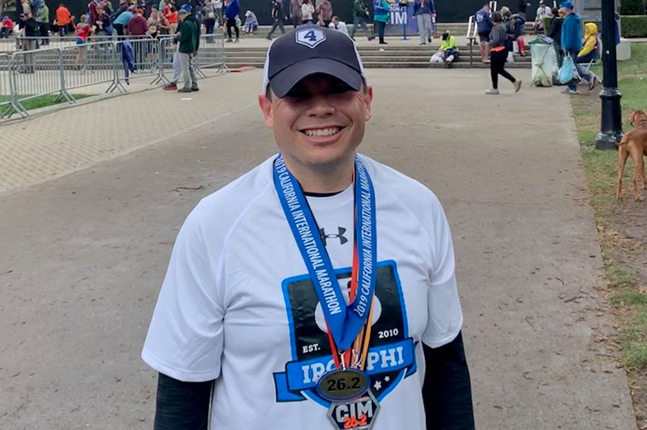
On December 8, 2019, I stepped up to the starting line of the California International Marathon and had no doubt that I would achieve my goal. A few hours later I crossed the finish line and became Iron Phi #946. None of that would have been possible without the support of my coalition, a strong roadmap, or reflection and adjustment at each step of the way.
I share the story of the moon landing and my own Iron Phi journey because they share some common ground. Both set audacious goals, both required drive, and both celebrated small successes in pursuit of a larger purpose. Both required a desire to chase success and embrace failure. Chasing success is far easier than embracing failure. Moving towards the finish line is inspirational. People flock to success. They want to be a part of winning. But everyone knows that few dreams come without setbacks. Failure, when embraced, can often catapult you to the finish line. These aren’t setbacks, instead, they are opportunities to get better and become better.
How will you embrace failure? As a leader, making mistakes can be the greatest opportunity to improve performance and learn what not to do. Many launches never left the pad and some crashed upon landing, but NASA never gave up. They used that experience to get better. They used that experience to build a stronger program. They committed to success and embraced failure to ensure they achieved the dream. For me, I learned what fuel worked and what didn’t for my body to sustain 26.2 miles of running. There were days where the fuel didn’t work. I would be tired and felt like I couldn’t make it. Those days were tough, but they were the days of which I am most proud. My recognition of what didn’t work led me to what did. Ultimately, that was a key part of me realizing my goal.
The very same formula that led NASA to put Neil Armstrong on the moon and led me to run 26.2 miles can help you become “the greatest version of yourself.” Think about your inspirational leaders and whether they are helping you chase success and embrace failure. If they aren’t, ask them to help. Are you, as a leader, inspiring others to chase success and embrace their failure? When you create a roadmap do you allow enough opportunity to measure your incremental success? If you hit a setback, how do you move forward? Is it a springboard for better performance in the next phase or an anchor that holds you back? Finally, when you reach your goals do you take the time to appreciate the journey, the view, and the team that helped you get there? Neil Armstrong stopped to take in the incredible view of Earth from the Moon, and so should you.
We all have opportunities to become better and make a difference for ourselves, families, friends, brothers, and communities. Phi Delta Theta talks about becoming the greatest version of yourself. This isn’t to say that you aren’t already great in your own way. Instead, it is the idea that we all have the opportunity to continuously improve ourselves and reach our goals. Becoming the greatest version of ourselves isn’t the destination; it’s the journey. Chase success, build a roadmap, celebrate your achievements, embrace failure, and take your own small steps to your moon landing.
Mike serves as the director for continuous improvement at Sonoma State University. Working out of the Office of the Provost and Vice President for Academic Affairs, Mike is responsible for managing academic space on campus as well as evaluating campus business processes to develop more efficient and sustainable practices. Mike earned both his master’s in business administration and bachelor of arts in economics at Sonoma State University where he was a Founding Father of the California Sigma Chapter. As a volunteer for Phi Delta Theta, Mike has been a CAB chair for California Sigma and for the past five years has been the Province President for Omicron Northwest. In his spare time, Mike enjoys spending time with his wife, Kimi, and their two children, daughter, Carina, and son, Braden.
The post One Small Step appeared first on Phi Delta Theta.
]]>The post Alumni in Action – Purdue Alumni Step in to Keep the Chapter Competitive on Campus appeared first on Phi Delta Theta.
]]>Written by Brad Dickinson, Purdue ’80
About fourteen years ago three brothers were skiing in Utah together, and on the gondola rides between ski and snow board runs, the three concocted a plan to help make the Indiana Theta Chapter House stand out on campus. With the institution of alcohol-free housing, and no longer being able to use the aspect of the best house party to attract new members, they brainstormed ways to make the most prime student housing real estate property on campus (across the street from the student union and in the very center of campus) a premier recruitment tool.
- From the class of 1980, Andy Bosworth, David Tavitian, and Brad Dickinson devised a program called Alumni in Action (AIA), which predates the Chapter Advisory Board model.
Three goals of an annual fall workdays are:
- To compete with other fraternities by having the nicest house on campus.
- To develop relationships with undergraduate members, not just write checks.
- To advise, plan, work together on common goals to deepen the bond of friendship and brotherhood.
- To teach transferable skills in managing a property, through regular maintenance, remodeling, planning, project management, and communications.
The original weekend schedule:
- Thursday night telethon: alumni and undergraduates make phone calls to alumni to explain the current house projects, create buy in, and ask alumni to contribute toward accomplishing the goals.
- Friday day: alumni begin work on projects, and as class work finishes for the undergraduates, the students work alongside alumni to accomplish projects.
- Friday night: alumni sponsor a steak fry at the house and they enjoy fellowship.
- Saturday: work as needed and alumni host gathering before the home football game.
- Saturday night: social as it happens naturally, out on their own.
- Sunday: finish up any projects that require more time.
The AIA officers and current Chapter Advisory Board members now meet with the chapter every winter or spring to advise. Then, the CAB advisers meet with their respective chapter officers to check in. Then the CAB advisers meet with their respective officers for annual check in.
- Andy Bosworth is the steady presence, as chairman of the CAB, and plans the fall AIA weekend and organizes rentals when necessary. The chapter president and house manager are the undergraduate leaders who coordinate on site.
- Every year they print a t-shirt to commemorate the event and generously give free shirts to the undergraduate Phis.
- Projects this year included the back of the house four story stairwell that was in desperate need of updates and painting. Past projects include an updated dining room, media room, and frequent updates to the common areas.
- Through the years they’ve made lasting friendships. Last year Dickinson, Tavitian, and Bosworth invited several undergraduates to the Dickinson lake house for the weekend along with other alumni brothers.
The post Alumni in Action – Purdue Alumni Step in to Keep the Chapter Competitive on Campus appeared first on Phi Delta Theta.
]]>The post ‘….but, baby, it’s cold outside!” appeared first on Phi Delta Theta.
]]>Inside however, all was calm and bright (including some leftover holiday decor to compete with our Phi Delt flags and banners) as we gathered — 300 strong — for this January rite of passage. T-shirts, mugs, and other swag for sale claimed attention as brothers checked in and grabbed their packets, assignments, and temporary roommates. The latter is designed to enhance the shared experiences of small groups (eight to 10 brothers) into pods, renamed for the Greek alphabet. My Xi Chapter met eight times in sub-groups and then came together in plenary for more serious discussions around stress, alcohol, and sexual assault, and lighter forays into midnight poker and bro humor.
The food was great, including an intro to St. Louis barbecue — met with some trepidation by our Texas brothers and great delight by our ribs-deprived Northeasterners. Midst the surfeit of snacks and good cheer rested the real purpose of the convocation — to learn what it means to be a true leader; how to display real and authentic masculinity; and how to emulate the examples of some well-known and lesser-known Phis who daily walk that talk.
Our keynote and large group speakers ranged from our own GHQ leadership to business leaders to clinical psychologists — all bearing their own Phi Delt banners with messages of inspiration, caution, and life lessons designed to help us become the best versions of ourselves.
In our small groups — intimate on purpose and scattered throughout the now familiar airport Renaissance Hotel (gracious hosts indeed) — we reviewed the key messages and dissected their application to our own chapters back home. Every sub-meeting began and ended with ritual, a reminder of how powerful are these shared practices to each chapter, gaining greater pride, proficiency, and comfort with each re-enactment (though our singing could probably be improved exponentially!).
As a new addition, there were some specific breakout educational sessions, self-selected, on a range of chapter topics. The conversations were intense and illuminating, with subjects ranging from depression, drugs and alcohol, to difficult conversations, conflict resolution, and celebrations. For a guy like me, fifty-eight years since my own initiation, these discussions were revelatory in their honesty and personal exposure. “Shifts do indeed happen” and, almost sixty years out, I could not have been more impressed with the range of opinions and healthy dialog that accompanied each break-out.
So, another successful PLC is in the history books and a great way to start the new year. Group hugs are in order.
Brother John “Charlie” Ford
Maryland Alpha, ’64
Bond# 778
The post ‘….but, baby, it’s cold outside!” appeared first on Phi Delta Theta.
]]>The post Long-Time Kansas Gamma (Kansas State) CAB Chairman Bids Farewell With Heartfelt Letter To Chapter appeared first on Phi Delta Theta.
]]>“I had no idea when taking on the role in 2005, how long I would serve; only that I wanted to get give back; and the opportunity to do so at my grandfather’s chapter was very special to me. I’ve been fortunate enough, even in years with heavy air travel, to have the autonomy to schedule around getting out to Manhattan, Kansas every other Wednesday night or so to work with the chapter and officers.
The best organizations continue to innovate and evolve. They ride the wave, and when it crests, they start to build a new wave. It’s no different with fraternities, or careers in the corporate world. With change comes opportunity and having recently accepted a promotion that involves a relocation, it’s with bittersweet emotions that I have to announce that I will be stepping down as Chapter Advisor. Despite the necessary self-disruption in the name of progress and career evolution, knowing what it would mean for my ability to work with the chapter made it that much tougher a decision in a way that’s difficult to describe. At some point, it becomes more than just ‘giving back,’ it becomes part of who you are. Fortunately, Kansas Gamma has a resurgent alumni base, and I’ve been able to tap into the last 12 years of graduates to augment the Chapter Advisory Board. I’m hopeful to pass the torch to a guy well known and liked by many of you (looking at you James Barrick).
Since 2005, I’ve averaged 8 trips/semester, 120 miles one-way, door to door from Olathe. 16 or more trips a year and 3,900 miles/year; roughly 46,000 miles. 24 Exec Board Retreats either in Manhattan or somewhere in Kansas City helping develop and set officer, exec, and chapter goals. It hasn’t been all business, there have been plenty of retreats followed by brotherhood and 15 undergraduates crashing at my house after BBQ, and many great times. I’ve had the opportunity to initiate close to 300 Phis at Kansas Gamma, mentor and develop 12 chapter presidents, and many of the officers and members over the years. As advisor, you want to get to know everyone and impact them positively on a personal level as they grow and develop in life & college, but with limited time on-site, you only hope that you can find a way to reach some of the guys with the time that you have.
Over the years I’ve dealt with every major issue imaginable but will always remember the positives – the leadership conferences and Exec Board retreats, Friday Night Phis, winning the Phoenix Award at the ’06 Convention in Kansas City, stopping by tailgates, and watching the guys serenade sororities or proudly execute Homecoming performances. Over the years I’ve written dozens of letters of recommendation, reviewed countless resumes for my guys; and watched with pride as they’ve gone on to have success in life after college.
Working as an advisor, the work is never done. Phi Delta Theta thrives because of our enduring value system built on Morrison’s Philosophy, the Phikeia Oath, and our three Cardinal Principles. I’ve said it many times — the only thing stopping Kansas Gamma, is Kansas Gamma. Today, the sky is the limit and the future is bright.
In the end, what’s in a legacy? It’s not miles driven or awards won. It’s always been about the people I’ve been able to positively impact and leaving the chapter better than I found it. So, to all the alumni, but especially to “my guys,” those undergraduate members from 2005-today; I hope my legacy is the relationships and friendships built. Serving as advisor has been an honor and a privilege that I will always cherish. You know you can count on me, and I’ll always be an email, text, phone call, or tweet away.
Semper Fi, and Yours in the Bond,
Brandon G. Bogue
Chapter Advisory Board Chairman 2005 – 2017
The post Long-Time Kansas Gamma (Kansas State) CAB Chairman Bids Farewell With Heartfelt Letter To Chapter appeared first on Phi Delta Theta.
]]>The post How To Keep Your Newly Initiated Brothers Engaged Following The Phikeia Education Period appeared first on Phi Delta Theta.
]]>“I have seen a huge jump in personal growth after joining Phi Delt, and it was sort of addicting in a sense. I have experienced what my Phikeia educator meant when he said, “You get out what you put in.” It motivated me to keep going so I could continue to become a better version of myself. To put it in other words, the Fraternity has given so much to me already, and I want to reciprocate that back to it. There is no difference in how I was taught versus my peers, what matters is how I respond to those teachings.”
I asked a few of the most motivated and engaged new initiates within the chapter I advise about what motivates them to become engaged in a meaningful way as a contributing chapter member. The quotes included in this post are what I received.
Every semester, chapters initiate new members into the Fraternity with the hope that they will become the next leaders of the chapter; that they will find ways to push the chapter to greater heights, and to be some of the most engaged members the chapter has seen in recent memory. Yet, at times, our chapters look at the newly initiated members and see some who are engaged and motivated and others who disengage and rarely contribute. The chapter then looks to the next group of men they recruit and hope that results will be different.
A year passes by, and it’s no different. Why does this happen? Moreover, how do we keep newly initiated members engaged and motivated after the Phikeia education period? Below are a few tips for chapters to think about as they work to maintain engagement of newly initiated members following Phikeia education.
Know Your Phikeias… Truly Know Your Phikeias
Each summer during the Phikeia Educators College, the faculty spends time with Phikeia educators discussing how to facilitate an environment within their program that results in true learning and growth. To do this, members of the chapter’s Phikeia Education Board must build a relationship with each Phikeia individually and at a greater depth. They need to know much more than surface level information: major, year in school and where they call home. They should learn more about their motivations for joining the chapter, their hopes and wishes for membership in Phi Delt, their strengths and areas of improvement, their successes and their challenges, their background, life experiences, and what they are bringing to the Phi Delt experience.
By knowing your Phikieas at a deeper level early on, you can better identify ways in which they can be motivated and engaged beyond the new member period.
Immediately Involve Newly Initiated Brothers in Ways That Are Meaningful to Them
Committees. Committees. Committees. Scholarship Committee, Social Committee, Recruitment Committee, Phikeia Education Committee, Philanthropy Committee, Risk Management Committee, Public Relations Committee, Alumni Committee, Judicial Board, Campus Interfraternity Council Committees. There are so many opportunities for newly initiated members to be involved and engage with their chapter beyond simply attending events and chapter meetings. Find ways to provide newly initiated members with the opportunity to serve on a committee. Through this involvement, they can better understand how the chapter operates, observe motivated and engaged members in their leadership roles, and feel as if they are contributing to the future direction of the chapter.
The caution with this is not to create committees just to have them on paper, but to truly use them and engage more members in the chapter.
Do Not Pressure
We’ve all seen it. The Phikeia who joins enthusiastically, is charismatic and passionate about the Fraternity, and has incredible leadership potential and natural qualities that inspire those around him to be better. He wants to be as involved as possible the second he walks through the door as a potential new member. This is the guy who talks about how he aspires to be a future chapter leader during his Phikeia period. And then, a year later, he is nowhere to be seen. He’s not engaged, does not demonstrate motivation, and is not planning to take on a leadership role within the chapter.
So what happened?
Sometimes, the pressure of wanting an individual to be an instant leader can be detrimental. While you may be excited about someone’s leadership potential, let him ease into it. Provide him with various leadership opportunities that can help set him up for success, but do not overwhelm him. If he dives in too quickly, it can be a challenge. He may not be able to understand who he wants to be as a leader, or what he may bring to leadership roles at the time your brothers are telling him that he’s going to be the next great leader of your chapter. The result could include losing an individual with great leadership potential, because he never fully met the expectations placed upon him.
With that said, you can and should begin to have early conversations with Phikeias who demonstrate sheer leadership potential and talent. Help guide them through the experience and advise them to set realistic and timely expectations to complete their goals.
Intentional Big Brother Programs
“After my Phikeia period ended, the thought of not being involved within the Fraternity never crossed my mind. It was something I wanted to do. I believe I built such strong relationships that it made me want to stay committed to the Fraternity as a whole. I also grew a very strong relationship with my Phi Delt Big Brother which keeps me present within the chapter.”
Big Brother programs vary within our chapters. The ultimate goal of a Big Brother program is to provide each Phikeia with a mentor and a guide, who they connect with, to provide sound advice, counsel, and support. The Big Brother programs we have should be very intentional. This goes back to knowing Phikeias at a deeper level.
Some questions to think about:
- How do you create a pairing that is best for both the Phikeia and the Big Brother?
- How do you ensure that you have criteria and minimum requirements for being a Big Brother?
- How do you create accountability for Big Brothers who take on the responsibility of mentoring and guiding a Phikeia?
If you want to motivate and engage Phikeias after their new member education period, why would you pair them with an unengaged and unmotivated member of your chapter? Apply a critical lens to your Big Brother program and start making intentional pairings. Build a structure that allows for meaningful mentorship to occur between Big and Little Brothers during the Phikeia education period and beyond.
Involve Newer Members in Higher Level Chapter Conversations
When appropriate, find ways to include newly initiated members into higher-level chapter conversations. For example, invite a few newly initiated members to an Executive Committee meeting. Bring a few newly initiated members to the Interfraternity Council meeting and to meetings with the campus-based Fraternity & Sorority Advisor, the House Corporation, or the Chapter Adviser so they can start to learn the bigger picture. Seek their opinion of matters that have an influence on the chapter.
Continually Encourage Reflection on Why Members Joined in the First Place
“I found it easy to stay motivated and involved after my Phikeia semester. I can attribute it directly to Morrison’s philosophy: To do what ought to be done, but would not have been done unless I did it, I thought to be my duty.” This philosophy reminds me to continually devote myself to my chapter and to serve the chapter and my brothers to my greatest abilities. It inspires me to live out what it means to be a Phi every day.”
As a Chapter Adviser for over a decade, I have seen hundreds of members come through the chapter. I am always curious to learn why some members, who received the same educational content as their peers, choose to engage differently and exhibit greater levels of motivation. It is a given that every person is unique and provides his own perspective, but we must capitalize on this as we formally initiate our new members. Reflection is key. If you can encourage your newest members to reflect on the reason(s) they sought out and chose Phi Delt in the first place, you will be more successful in finding ways to meaningfully keep them motivated and engaged.
The post How To Keep Your Newly Initiated Brothers Engaged Following The Phikeia Education Period appeared first on Phi Delta Theta.
]]>The post Six Tips For A Successful And Safe Spring Break appeared first on Phi Delta Theta.
]]>Ah, Spring Break. A time to relax, enjoy, and spend time with brothers before heading back to school for the dreaded end of the semester. For many of you, this week may be your favorite time of year, and most of you are likely embarking on some type of Spring Break adventures. Some of you are probably heading home to spend time with your family, while others may be volunteering for an Alternative Spring Break Program. But chances are, most of you are quite possibly heading somewhere close to a beach, hoping to have the best week of your lives.
While Spring Break can make for some of the most memorable and fun times of your college career, it can also be one of the most dangerous weeks in the life of a college student. While I want to tell you to alternate your drinks with water (and you should), I want you to consider that there are many practical ways to keep yourself and your brothers safe during your Spring Break activities, whatever they may be. We want you to have fun, but we also want you to protect yourself and your brothers as much as possible.
Use the buddy system
While this may sound like something a third-grade teacher once told you, one of the best ways for you to stay safe this Spring Break is to make sure that you always have someone with you. When you’re traveling with a large group, it can be easy to lose track of people. The best way to avoid losing your group is by always having a buddy. Before you leave town, download the Find My Friends app so you can always keep track of each other.
Track your consumption
The average male consumes 18 drinks per day during Spring Break, which for most of you, could be potentially very dangerous. Consuming this amount of alcohol can lead to alcohol poisoning and unintentional injuries, which is the leading cause of Spring Break incidents for men. Realistically, I know it’s unlikely that you will count the number of drinks you’ve had, but there are many apps that will track your drinks and calculate your BAC for you. Try downloading InteiliDrink or R-U-Buzzed to help keep track and keep you safe. The goal is to never get yourself into a situation where you are not aware of your surroundings or your actions, so tracking your consumption is key.
Don’t “do it for the snap”
In fact, you’re better off not posting what you’re doing on social media at all. Doing something risky to show off on social media may seem like a clever idea at the time, but trust me when I tell you that this is never a good idea. What happens on Spring Break doesn’t always stay on Spring Break, especially if you ‘re sharing it with the world.
Ask for consent
If you take nothing else away from this post, I hope that you will remember that before you engage in any activity this Spring Break, the best way to protect yourself is to ask for consent. A recent study showed that women’s two biggest concerns when attending Spring Break activities were 1. Being taken advantage of and 2. Being drugged. Trust me when I tell you that women go away for Spring Break to relax and have fun, but women want things to happen on their own terms. Regardless of what someone is wearing or how they are acting towards you, you must always respect peoples’ boundaries. The best way for you to protect yourself this Spring Break is to always ask for consent.
When in doubt, intervene
If you see a situation where your brothers or someone else is at risk, intervene. This could be directly stepping in or even just causing a distraction – anything to allow the situation to take a turn for a more positive outcome. The bystander effect is in full force during Spring Break, but it’s on us to make sure that we’re looking out for the people around us. If you feel you can’t directly intervene, the best thing you can do is report what you saw or heard and ask someone else to step in.
Do what ought to be done
My final piece of advice to you this Spring Break season is that if you consistently refer to the principles of Phi Delta Theta, you can’t go wrong. When you are in a situation that calls for action, step up and be the man who takes responsibility. We want you to have a fun Spring Break, but we also want you to have fond, positive memories that you can look back on for years to come. At the end of the day, as you’ve heard repeatedly, do what ought to be done.
The post Six Tips For A Successful And Safe Spring Break appeared first on Phi Delta Theta.
]]>The post Mental Wellness: Doing The Little Things Right appeared first on Phi Delta Theta.
]]>Every moment of our lives is filled with stress. Our body preforms its basic functions, such as breathing, heartbeat, and digestion, in response to internal and external stressors throughout our entire life. Quite simply, a life without stress is impossible; however, how we manage stress and stressful situations is immensely important to our own mental health and wellness. According to the World Health Organization (WHO), “Health is a state of complete physical, mental, and social well-being and not merely the absence of disease or infirmity.” Managing stress is a major component of overall wellness, and although I will be concentrating on mental wellness, it is important to note that coping with stress impacts all aspects of our life. Fortunately for many of us, our fraternity experience within Phi Delta Theta can provide some of the best supports and opportunities to cope with stress through use of our own coping skills combined with available social supports.
As an undergraduate, the stress of classes, midterms, fraternity obligations, jobs/work studies, research and labs, interviews for jobs or internships, and applications to scholarships, graduate schools, medical school, or employment, can impact our mental wellness significantly. You may also participate in college sports, intramural sports, clubs, other Greek-related activities, philanthropies, and community service projects, which adds to things that we must manage in our busy schedules. We also have the added stress of maintaining relationships with our family, friends, significant others, and fraternity brothers. For our seniors, there is the added stress of your upcoming graduation. Just looking at that list of stressors can feel a bit overwhelming at times. Some stressors are temporary, such as midterms, job interviews, and a tough semester of challenging classes, while others are likely to last longer, such as interpersonal relationships, family members with series illnesses, or work-related stress. Simply put, life is stressful, but that’s okay.
As I write this, many of you are likely going through the stress of midterms, planning spring break trips or what to do while off for a week, and finishing out the remainder of the semester. These are added to your daily stressors of managing your time to study, maintaining your friendships, preparing for life after graduation or the summer between semesters, and whatever else you choose to do to occupy your time. Increases in stress are going to occur regardless of what we do, and this is just a natural part of life. Stress is always going to impact us, but the impacts can be either positive or negative.
Negative stress can be detrimental to our overall health physically, mentally, emotionally, and socially, going back to the definition of health by WHO. Negative or mismanaged stress can impact us in many ways physically, mentally, emotionally, and behaviorally. Some signs that we are not managing our stress well include headaches, fatigue, increase in colds/flu, worry, inability to concentrate, negativity, loss of confidence, irritability, depression, anger, loss of sleep, restlessness, and increases in alcohol, tobacco, illicit substance abuse, as well as engaging in risky behavior. These are just some of the signs that someone is not managing stress well, and each person is going to differ greatly based upon the stressor, the perception of their ability to manage stress, and how well they can cope with the stressor.
So what can we do to manage our stress as an individual and as a fraternity chapter? Well individually, we can identify our sources of stress, control the controllable stressors and let go of those that are outside of our control, find ways of coping that work best for us, practice a healthy lifestyle, strive for balance, stay organized with good time management skills, prioritize tasks, maintain a routine, and engage in social support. This can take shape in many different ways and is always tailored to the individual. In a practical approach, this may be as simple as keeping a list of things to do and due dates, going to the gym regularly, avoiding distractors when studying, such as social media and texting, taking time to relax and just listen to a favorite song or watch a funny video clip, or take time to get off of campus. Sometimes the little things that we do to manage our stress are most important and unfortunately the first to go when we feel large amounts of stress. The possibilities are endless and each person has to take responsibility to try and practice different ways of coping to find those techniques that work best for them to manage their stressors.
In the context of our fraternity chapters, we hopefully have a well-developed social support system that we can utilize when feeling stressed out. Chapters can hold brotherhood dinners after chapter, all go to the dining hall around the same time, have a flag football game every Friday after classes are done for the week, go and do the community service and philanthropy events for other organizations, pass the gavel in chapter, provide time to just relax with a movie night, going to sporting events, or other campus activities. Again, these don’t always have to be large organized activities, but just engaging with our brothers and sharing experiences can build those strong relationships that help add resiliency when an individual experiences stress. Just having people around us that support us is often enough for us to cope with any stressor in a healthy way.
So as the semester continues to move forward, remember to do the little things for yourself and for your brothers. Create a list of things that you can do when feeling stressed out that are healthy and helpful to you, and then go out and do those things that help you cope with any stress in your life. At the end of the day, life will be stressful enough by itself, so go and actively manage the stressors that you can to promote you becoming the greatest version of yourself, and help your brothers do the same.
The post Mental Wellness: Doing The Little Things Right appeared first on Phi Delta Theta.
]]>The post National Volunteer Appreciation Week – House Corporation President Beck Johnson appeared first on Phi Delta Theta.
]]>Why do you volunteer for Phi Delta Theta?
My years as a Phi Delt at the University of Kansas were some of the best years of my life. I made lifelong friends, experienced stout personal growth and became part of a time-honored tradition of excellence. It seemed right to give back to an organization that gave so much to me during a critical developmental period of my life.
How did you initially become engaged as a volunteer?
After completing job training in Tulsa, Oklahoma following my graduation from KU, I moved back to Kansas City. I have always been involved in the community and was looking for a way to get reengaged. I approached my predecessor as Board President, Andrew Wank, and asked how I could get involved with the Alumni Corporation Board. After nearly a year of shadowing and helping with various tasks, I was elected the President of the Board in June of 2016.
What you are currently doing to support the undergraduate men of Kansas Alpha?
The Board and I are working diligently to rebuild our chapter house. Over winter break this year we had a fire suppression system pipe break in the attic of our newly renovated and award-winning chapter house. The damage resulted in the young men not being able to occupy the house during the spring semester. We were able to relocate all 87 live-in residence to a brand-new loft facility in downtown Lawrence. So far we have restored the dining facility so the members have a place to eat meals, congregate and study. The rest of the chapter house will be completed by the time the fall semester begins. The Alumni Board, parents, and most importantly the active members are looking forward to reoccupying the house. None of this would be possible without the support of alumni, undergraduates and other friends of the Kansas Alpha Chapter of Phi Delta Theta.
This year, the Phi Delt Fund is dedicated to our Brotherhood – To our Cardinal Principles, our Bond, and each other.
All gifts in 2017 may be made in honor of a brother or brothers who exemplify our Cardinal Principles and make you say, “Proud to be a Phi.”
When you make a gift—either online or through the mail— include a note to the brother you’re honoring and we’ll forward it to him along with a One Man Is No Man decal he can display proudly.
The post National Volunteer Appreciation Week – House Corporation President Beck Johnson appeared first on Phi Delta Theta.
]]>The post National Volunteer Appreciation Week – CAB Chairman Keith Lopez appeared first on Phi Delta Theta.
]]>- They should become better.
- Their brothers should become better because they were a part of each other’s lives.
- Their chapter and organization should be better because they were each a part of it.
As the current Chapter Advisory Board Chairman for the Colorado Gamma Chapter at Colorado State University, I have been able to witness men attempting to work towards these tenants year after year.
I constantly get questions from the various people in my life that include:
“Why do you still help out with that fraternity? “Are you really going to do that conference again?” “What do you do as an Adviser?” “How much longer are you really going to do that fraternity thing?”
I continue to volunteer for Phi Delta Theta, because I believe in living the Cardinal Principles of our organization. Transmitting those values is a conscious part of every interaction, my work, how I advise and mentor students, my personal relationships, and how I hope to live my life. I am fortunate to have great mentors in Phi Delt who continue to challenge me to live out the values of our great Fraternity. I truly believe that brotherhood runs extremely deep, a feeling that was specifically affirmed by the actions of some of my brothers since my father passed away last summer.
My path to Phi Delta Theta was an unexpected one and definitely not the traditional path to joining a fraternity. After completing my undergraduate work at the University of New Mexico with a Secondary Education degree, I attended Colorado State University to obtain my Masters in Student Affairs in Higher Education with the goal of working in college student services. At the time, Colorado State University had recently decided to pilot a program in which they were placing graduate students as Live-In Advisors in fraternity housing facilities.
As someone who did not join a fraternity during my undergraduate experience, I was somewhat hesitant of the opportunity when placed with Phi Delta Theta. After a year of working with the chapter in an advising capacity, the men in the chapter chose to initiate me as a brother, an opportunity and an experience that has provided a lasting impact in my life.
Beyond serving Colorado Gamma directly, I also serve as a member of the Education Committee as Co-Chair of the Phikeia Educators College experience. In this role, I work alongside an incredible group of volunteers to enhance the resources provided to our Phikeia Educators. These resources include the facilitator’s guide and online resources which encourage congruence of the new member education programs in the Fraternity with the values of the organization. I have also collaborated on writing the curriculum for and facilitated at the Phikeia Educators College that occurs every July in Oxford, Ohio since it its inception.
In addition to my work with the Fraternity, I am also completing my third year of coursework for a Ph.D. in Higher Education Leadership at Colorado State University. My volunteer work with Phi Delt has led me to continue to learn more about leadership curriculum for fraternities, specifically curriculum and programming related to new member education processes. Thus, I hope to conduct research on the correlation between fraternity new member education programs and the influence on the new member education experience.
Through this entire journey, I have found that giving back to the Fraternity as a volunteer has given me much more than I can quantify, and volunteering in these capacities has been my way of transmitting the Fraternity not only, not less, but greater than it was transmitted to me. I am grateful for the experiences and can only hope that the undergraduate men I have advised find their own unique and personal ways to transmit the Fraternity beyond their undergraduate experience in ways that are especially meaningful to them.
This year, the Phi Delt Fund is dedicated to our Brotherhood – To our Cardinal Principles, our Bond, and each other.
All gifts in 2017 may be made in honor of a brother or brothers who exemplify our Cardinal Principles and make you say, “Proud to be a Phi.”
When you make a gift—either online or through the mail— include a note to the brother you’re honoring and we’ll forward it to him along with a One Man Is No Man decal he can display proudly.
The post National Volunteer Appreciation Week – CAB Chairman Keith Lopez appeared first on Phi Delta Theta.
]]>The post National Volunteer Appreciation Week – CAB Chairwoman Mckinlaye Harkavy appeared first on Phi Delta Theta.
]]>It’s now been almost three years since I started volunteering for Phi Delta Theta, and in that time, I have been fortunate enough to become the acting CAB chairwoman, present at various province and international Phi Delta Theta conferences, and even attend and serve as on faculty at the Kleberg Emerging Leaders Institute. As you can imagine, I have learned a lot during this time; about the organization, about the men who choose to become Phi Delts, and the alumni that continue to give their time and resources to support such a great leadership society of men.
I currently have a few main responsibilities with Kansas Beta. I serve as their campus advisor and liaison to the university. I also serve as a mentor to the men and provide them with advice and tools to run a successful chapter and make decisions that drive the chapter towards success. I’ve helped the chapter plan educational sessions on sexual assault and bystander awareness, encourage them to cook their own chapter dinners once a week, and encourage membership in campus organizations and the community.
There’s an even deeper connection to the Fraternity for me other than getting to work with such an exceptional group of young men: baseball. When I learned that members of Phi Delta Theta support The ALS Association, specifically because Lou Gehrig was a Phi, I knew that I was going to stick around for awhile. I have been an avid baseball fan (Let’s Go Mets!) my entire life, so much so that I have been to 20 of 30 professional baseball stadiums. I am continually excited to support an organization that gives back to one of my favorite pastimes – and I was even able to attend the 2016 presentation of the Lou Gehrig Memorial Award to Curtis Granderson, one of my favorite players and the second New York Met to receive the honor.
Sure, you can say that I’ve given a lot to Phi Delta Theta in my brief time working with Kansas Beta, but really the organization has given just as much back to me. It has allowed me to grow as a person and as a professional, while simultaneously showing me the value of volunteering and serving the community. Watching Granderson receive the Lou Gehrig Memorial Award, and seeing how meaningful it was to him and all the MLB players who have been honored with the award, showed me that what we do, and what Phi Delta Theta does on an international level, matters. I look forward to continuing my service with Phi Delta Theta, and I cannot wait to see what the next few years bring!
This year, the Phi Delt Fund is dedicated to our Brotherhood – To our Cardinal Principles, our Bond, and each other.
All gifts in 2017 may be made in honor of a brother or brothers who exemplify our Cardinal Principles and make you say, “Proud to be a Phi.”
When you make a gift—either online or through the mail— include a note to the brother you’re honoring and we’ll forward it to him along with a One Man Is No Man decal he can display proudly.
The post National Volunteer Appreciation Week – CAB Chairwoman Mckinlaye Harkavy appeared first on Phi Delta Theta.
]]>The post National Volunteer Appreciation Week – CAB Chairman Tony Magistro appeared first on Phi Delta Theta.
]]>For almost 30 years, Tony has given thousands of volunteer hours to the Ohio Mu Chapter of Phi Delta Theta Fraternity. He has served in roles as the Fraternity’s chapter advisor, housing improvement chairman and alumni liaison. He has spearheaded summer weekend work projects and has been instrumental in the planning of numerous Fraternity programs and activities that have raised thousands of dollars to augment the Thad Trautwein–Krueger Endowed Scholarship fund. Tony takes personal interest in students, always willing to help them with career, academic and personal matters.
Brother Magistro has been with ABC Supply Company for 19 years and established their National Account Division. For the past 44 years, he has been involved in the building materials industry and has worked in manufacturing as well as one-step and two-step distribution.
While at Ashland, Magistro earned a degree in Business Management and Marketing, was a member of the wrestling team and Phi Delta Theta Fraternity. He is an avid hunter and fisherman; active in the Ducks Unlimited Shawnee Mission, Kansas chapter. He founded chapters for Ducks Unlimited in both Evergreen, Colorado, and Carrollton, Ohio. Magistro is a member of the Rocky Mountain Elk Foundation, Crazy Horse Foundation and is an Indy Car Racing Fan.
Why do you volunteer for Phi Delta Theta?
Well first of all, I don’t consider myself a volunteer. I’m an owner. I bought a franchise in 1966 when I pledged Phi Delta Theta. 660 Broad Street is my house and the undergraduate chapter members and alumni are my brothers. A volunteer’s time is as good as money to me, and I have had the opportunity to help a lot of young men and brothers see what service means. I’m betting my brothers will pay it forward in some meaningful way to the chapter and university.
What is the most rewarding aspect that comes from your Phi Delt volunteerism?
A few things come to mind: Staying connected with the 100 brothers with whom I went to college, acting as a conduit for alumni brothers to engage with the chapter and university, and knowing I helped keep my chapter open on campus through positive growth after its membership fell to seven.
What are some of your best memories as a Phi Delt volunteer?
My best memories are the conversations that have continued with brothers for the past 50 years. My wife, Laura, and I were fortunate to meet two brothers and their wives in Kansas City this summer. We went on a Colorado adventure with the same couples in the 1970s. When we reunited, the conversation picked up where we left off, 40 years later. When we have a reunion, golf outing, barbecue, or Homecoming celebration, you embrace the brotherhood, you feel the love.
Why would you encourage others to volunteer for Phi Delta Theta?
When one gives back and pays it forward, he is doing good for the health of the brotherhood. Everyone likes to feel good. Supporting your chapter, your franchise, your university, and our international organization are fundamental to the three Cardinal Principals of Phi Delta Theta. “They don’t put pockets in caskets” is a quote I have heard, so give back!
This year, the Phi Delt Fund is dedicated to our Brotherhood – To our Cardinal Principles, our Bond, and each other.
All gifts in 2017 may be made in honor of a brother or brothers who exemplify our Cardinal Principles and make you say, “Proud to be a Phi.”
When you make a gift—either online or through the mail— include a note to the brother you’re honoring and we’ll forward it to him along with a One Man Is No Man decal he can display proudly.
The post National Volunteer Appreciation Week – CAB Chairman Tony Magistro appeared first on Phi Delta Theta.
]]>The post National Volunteer Appreciation Week – Province President Nat Love appeared first on Phi Delta Theta.
]]>Every two years at the Phi Delta Theta Biennial Convention, the General Fraternity recognizes one Province President with the Oliver J. Samuel Award. The award is given as a token of appreciation for all Province Presidents but specifically to recognize one outstanding volunteer for his time and commitment to the Fraternity. At the 2016 Biennial Convenition, in Savannah, Georgia, Phi Delta Theta honored Nathaniel “Nat” Love for his service to the chapters in the Sigma North Province and across the nation. Today, as a part of National Volunteer Appreciation Week, we once again recognize Nat Love for his continued service to Phi Delta Theta Fraternity.
Brother Love graduated from The University of Michigan (Michigan Alpha) in 1980 and began his volunteer service with Phi Delta Theta in 1997 as the Michigan Alpha Housing Corporation Vice President. Nat transitioned to the role of Housing Corporation President in 1999, prior to becoming Sigma North Province President in 2000.
Brother Alex Carrick, Michigan Alpha ’10, said, “Nat has been a consistent positive force for Michigan Alpha since our re-founding in the mid-2000’s. Seeing Nat’s commitment to the chapter as both an undergraduate and a GHQ staff member has proven that he is doing everything possible to transmit the Fraternity to the next generation.”
Through the frequency of communication with his constituents, Nat has developed a keen understanding of our needs as an organization and provides insight and ideas to organizational leaders to better the organization and often challenge the status quo.
“As a Leadership Consultant working within Nat’s region, I know I can always rely on Nat to visit his chapters regularly and have a confident understanding of each chapter’s needs and goals, ultimately making my job easier and more enjoyable,” said Evan Newman, West Liberty ’15.
Nat has worked diligently to establish a stronger network for Phi Delta Theta in Michigan and Ohio by working alongside Sigma South Province President Jim Warner to host their annual Bi-Province, now Tri-Province, Retreat.
Brother Warner, Ohio Epsilon ’74, stated, “Having had the pleasure of working together with Brother Love on probably 15 BiProv retreats, you get a great chance to realize what a real team player he actually is. Our common goal each year is to make the BiProv, now a TriProv, (with the addition of the Zeta East Province) better than the previous one. In an effort to make this happen Nat always comes up with innovative ideas to keep this undergraduate leadership experience fresh, interactive, and rewarding. He is a true Phi MVP!”
Brother Love has welcomed new colonies and new chapters into his region over the years, all while guiding the active chapters to become the great versions of themselves.
Central Michigan University (Michigan Zeta) Chapter President Adam Fischer said the following about Nat when asked to about his involvement in the region and with the young chapter.
“Nat has been more than just a Province President for the men of Michigan Zeta. He’s been an incredible support system, not only for the colony/chapter, but for the men within the organization. From business calls, simply checking in on our lives, and giving us friendly reminders that he is there no matter what, Nat truly exemplifies the meaning of brotherhood. We are truly blessed to have Nat as our Province President.”
Nat was able to perform this extraordinary volunteer work for Phi Delta Theta while working full time as a Vice President at Meijer Corporation. With his recent retirement, we are excited to see what more he can do as leader of the Sigma North Province.
Newman ended by saying, “As a result of his leadership, we are a better organization with stronger local organizations and more committed alumni. Hopefully we have him on our team for years to come. Thank you, Nat!”
This year, the Phi Delt Fund is dedicated to our Brotherhood – To our Cardinal Principles, our Bond, and each other.
All gifts in 2017 may be made in honor of a brother or brothers who exemplify our Cardinal Principles and make you say, “Proud to be a Phi.”
When you make a gift—either online or through the mail— include a note to the brother you’re honoring and we’ll forward it to him along with a One Man Is No Man decal he can display proudly.
The post National Volunteer Appreciation Week – Province President Nat Love appeared first on Phi Delta Theta.
]]>The post What You Don’t Know About Your Phikeias appeared first on Phi Delta Theta.
]]>Recruitment and pledging are where we develop the next generation of fraternity men. We hope to select and retain those individuals who exemplify our Cardinal Principles of Friendship, Sound Learning, and Rectitude, as well as live up to the standards set in The Bond of Phi Delta Theta. Ideally, the process of pledging involves taking college boys and helping them grow into fraternal men: a cycle that repeats itself each semester on many college campuses. While we should benefit from new members joining our chapters, we also take on the responsibility of assisting the growth of these individuals into the young fraternity men that we will welcome into the brotherhood: the family of Phi Delta Theta. Our brotherhood serves as a form of social support, a factor that has long been proven to support mental health in individuals.
Fraternities provide the opportunity to choose this new family: something that many people do not experience until they step onto a college campus on the first day of freshman year. When we extend a bid and welcome someone to join our fraternal family, we often assume that they are similar to us, which is highlighted by their ambitions to join our chapter. However, we must remember that the fraternal family is different in several important ways. We do not have the years of shared history that has connected us with our family of origin, and we may not be aware of the many events that an individual has experienced before reaching our doorsteps and signing a bid card. Simply put, we may not be aware of many of the key events, good or bad, that have shaped this person on their path to joining our Fraternity.
GOAT, a movie pending national release that is based upon the life experiences of Brad Land before and during his time at Clemson University, highlights how little we may know about our brothers’ and Phikeias’ personal histories. Brad Land was brutally attacked and nearly killed when his car was stolen by two strangers whom he thought he was giving a ride home. Mr. Land’s kind gesture ultimately led him to becoming a victim and survivor of extreme violence. Later, his traumatic experiences are re-triggered during his pledge process at Clemson, the hazing that he endures brings back memories and feelings of the night that he nearly lost his life. This movie provides our brotherhood with an opportunity to examine our own pledge process and how it builds our fraternal family.
Understanding an individual’s mental health begins by examining how someone functions physically, cognitively, and emotionally as compared to their peers. We often assume that if we cannot see a physical wound that the person is healthy and can tolerate any stress that they may encounter. Unfortunately, we may be unaware of the traumatic events that someone may have experienced before reaching the point of seeking membership into our Fraternity. People may have experienced great loss in their life from losing parents, siblings, caregivers, and/or friends to death or forced separation. Some individuals may have survived being bullied, may have been victims of random acts of violence, in addition to a wide range of potential physical, mental, and emotional traumas. Even the most mentally healthy individuals can have vastly different responses to traumatic events and stress, and sometimes these responses are unknown even to the person until they are subjected to later stress, such as experiencing hazing during the pledge process.
The connection between joining our fraternal family and hazing can truly become problematic, especially in the context of asking someone to trust us to help them become a fraternal man. Engaging in hazing practices places a barrier between the active members and pledges, reducing them to “less than” a brother or sometimes even less than a human being. While we verbalize a message of embracing one another, our actions communicate rejection. Hazing is often framed as a way of having individuals prove that they have earned their membership into an organization. Common hazing practices today have shifted from physical hazing to mental and emotional hazing. Instead of paddling, pledges are deprived of feeling safe and connected, and may even resurrect past traumas in order to earn the family and support that fraternity has to offer.
A family can be constructed and defined in many ways. Those who participate in hazing practices fracture the family that we wish to build. Having a member earn their membership through participation in chapter activities, such as philanthropy, leadership development, community services, attending sporting events, intramural athletics, alumni functions, mixers, and homecoming builds the family into a strong one. Such activities help these individuals prove they are becoming fraternity men not only in the presence of chapter brothers, but also the community that we live in on our respective campus communities. Those that do not demonstrate an ability to practice and demonstrate characteristics we associate with our high standards set for membership should not earn the right to be initiated. The stronger the family we build through mutual respect and unconditional positive regard, the more likely these members are to come when we personally need our fraternal family: When we experience our own hardships as we go through life.
Becoming the greatest version of ourselves involves adding those who can support us during times of high stress. Regardless of someone’s mental health, hazing is a process that not only tears down an individual’s ability to function successfully in our fraternal family, but also weakens it in the long run. Those members who grow together through the attainment of mutual goals, such as bettering their chapter on campus, winning awards, intramural or collegiate championships, and bettering their community, are likely to develop the family that is enduring and supportive even beyond the years we spend as undergraduates on our campuses.
Dr. Mark E. Pleiss was initiated into the Pennsylvania Gamma Chapter of Phi Delta Theta in Spring 2008 as Bond #1255. He graduated from Washington & Jefferson College with a BA in Psychology and a minor Sociology in 2011. While at W&J, he served the chapter in several roles, including president. After graduation, Dr. Pleiss began a doctoral program in clinical psychology at IUP, while serving as a member of the Pennsylvania Lambda CAB. He graduated with his Masters and Psy.D in Clinical Psychology from IUP. Currently, Dr. Pleiss serves as the Upsilon South Province President, and has been a faculty member for several Kleberg Emerging Leadership Institutes and the Presidents’ Leadership Conferences. Additionally, he is the Mental Health Expert on the Education Committee. He works for the Federal Bureau of Prisons as a Drug Abuse Program Coordinator at the Federal Correction Complex- Hazelton, in West Virginia. He is also a fan of professional and college football, and enjoys hiking, cooking, and traveling to new cities.
The post What You Don’t Know About Your Phikeias appeared first on Phi Delta Theta.
]]>The post A Tribute To Brother Ethan Schmidt appeared first on Phi Delta Theta.
]]>The sudden death of this beloved assistant professor of history, scholar and student, fraternity brother, family man, friend and colleague has shocked thousands in two states. Schmidt grew up in the small rural hometown community of Peabody, Kansas where he remained strongly connected each holiday and vacation cycle.
Schmidt’s higher education journey began at Emporia State University where he was initiated into Phi Delta Theta Fraternity, eventually serving as chapter president. He was inducted into Order of Omega and became a student senator who would be elected student body president. Brother Schmidt was inducted into numerous honorary societies and was named Distinguished Senior of his class. While he earned his master’s degree, he was the chapter’s graduate adviser.
Ethan Schmidt earned his PhD in History at the University of Kansas, and his expertise and interests were in Native American ethohistory, Atlantic history and colonial British North America. He had published two scholarly books and numerous papers at the time of his death at 39.
“He was a remarkable student. He was one of the best students I ever had and I was thrilled he went on to a career in teaching history. He was on his road to being one of the great scholars of American history.”
– Dr. Karen Manners Smith, professor of history at Emporia State University
Many more in Kansas and Mississippi have written in tribute.
“Ethan entered his freshman year fully prepared to learn, engage, grow and experience the new chapter of life before him. He was exuberant about life and career, family and friends. His innate friendliness and his exuberance affected those around him. As he stepped-up to lead as an undergraduate, and later as an academician and professor, Ethan’s success and sphere of influence increased.”
– Roger Heineken, Kansas Epsilon alumnus and chapter adviser
“Ethan Schmidt was nothing less than a rock-star on this campus. When we met soon after we both arrived here in 2013, I immediately liked him. He was engaging, smart, and giving, and I knew he would have an impact on this campus. In fact, he has had an amazing impact. I have heard so many positive comments about his teaching and advising. His leadership of our First Year Seminar program was superb. At the start-up of this year’s FYS on the football field, we were together for the special welcome for our new students. I watched his glee as his program unfolded, and as our students were made to feel a part of this university. Ethan leaves a legacy that will never be forgotten.”
– William N. LaForge, president, Delta State University
“Dr. Schmidt was one of the most dynamic professors on our campus. He loved what he did and he loved our student-athletes. His excitement for our program was always evident and he will be missed.”
– Todd Cooley, head football coach, Delta State University
“One of my favorite quotes regarding education is from William Butler Yates, who once said that “education is not the filling of a pail, but the lighting of a fire.” Based on my interactions with Ethan, I can truly say that he took that quote to heart. Teaching for Ethan, was not simply a job, it was a calling. He loved lighting fires within his students by challenging them to think critically and communicate effectively.”
– Dr. Dave Breaux. Dean, Delta State University
“Dr. Schmidt is my favorite instructor at DSU. I have and will again recommend him to other students. I was never a ‘history person’ until I took his classes. He makes the material fun as if he was talking about friends to other friends, just casual conversation. And I’ve done really well in his courses, so he’s doing something right!”
– Student comment from a course evaluation, Delta State University
“In the summer of 2006, I was accepted into an intensive Japanese language program in Yokohama, Japan. I planned to stay an extra year for dissertation research. Ethan arranged a small going away dinner before I left and of course Connor and Liz were there. Toward the end Ethan and I were saying our goodbyes and he hugged me and began to sob softly. I remember Connor asked him, ‘Dad, why are you crying?’ and Ethan simply replied, ‘I’m not going to see my friend for a long time.’ It was a touching moment and, as I write this, one that brings me to tears. For as much as we loved Ethan as a friend, a colleague, or as a ‘brother,’ Ethan loved us back, and loved us fiercely. That kind of person does not come along very often.”
– John Schneiderwind, former colleague, University of Kansas Department of History
“Ethan was a dear friend and brother. I remember watching his relationship with Elizabeth grow. I remember when each of his children were born. Ethan loved being a father more than anything. Of all the awards, accolades and accomplishments, being a family man was one thing he held deep in his heart that fueled the fire in his soul. Everything else was just the icing on the cake.”
— Mike Allen, Kansas Epsilon alumnus
“Ethan was an everyman who did what a lot of us try to do. He contributed to the common good through his career, doted on his family, poured his passion into seemingly trivial but unifying things like sports, campuses, and hometowns. He was a supportive and accessible friend to so many. He did the things most of us do. But what made Ethan so remarkable was that he seemed to do them with a greater sense of goodness than most. The humanity he brought to the routine was, in part, what drew so many to him, and what I will miss seeing so dearly.”
– Brian Horn, Kansas Epsilon alumnus
“He was the best of us.”
– Excerpt of a social network comment
Much has been spoken, written and done in tribute. More will happen to honor the memory of Ethan Schmidt at both Delta State and Emporia State. What he transmitted in life cannot be taken back. Brother Ethan A. Schmidt’s legacy is indelible like his Bond number to be engraved in the granite of his marker back home in Peabody, Kansas. In coelo quies est.
The post A Tribute To Brother Ethan Schmidt appeared first on Phi Delta Theta.
]]>The post Paying it Forward? appeared first on Phi Delta Theta.
]]>Over the past 18 months, I’ve had the honor of helping “birth” a new chapter of Phi Delta Theta at West Liberty University, West Virginia Gamma.
I recently ran into the mother of a current undergraduate at the grocery store.
She enthusiastically thanked me for helping the young men become a part of Phi Delta Theta, and she was completely thrilled with what her son had to say about the Kleberg Emerging Leaders Institute. She then asked why I stay involved. “Paying it forward” was the fast answer, but it was not good enough for her.
I initiated with Ohio Mu at Ashland College in 1979.
I was not the best active member –spotty attendance at meetings and events, late with my dues.
In spite of my shortcomings, the Fraternity was there for me. I was prodded by my brothers to do better in class, improve my attendance and stay involved. Whether they liked me or not, my brothers did what brothers do. The impact on my life was enormous.
Twenty years ago, a founding member of Ohio Mu insisted that I engage with Phi Delta Theta again. It was something more than an invitation. I became engaged again as a chapter adviser.
I can’t begin to describe to you what I get from working with a great group of young people, watching them grow as leaders and develop as individuals. I’m honored each time one of them calls and asks for my opinion. I’m thrilled when I watch them make decisions and act upon them, both as a group and as individuals. I’m proud with every success and am there for them when they fail.
It’s also the alumni and advisers from other chapters I get to meet that make the role so rewarding. Recently retired or still working, they bubble about the funds they raised for a new chapter house or the success of one of their chapter’s undergraduates or alumni.
Maybe I’m paying it forward, but I’m still receiving more than I could have imagined.
It might be selfish, but it’s the real reason I’m actively engaged with Phi Delta Theta.
The post Paying it Forward? appeared first on Phi Delta Theta.
]]>The post Phi Delta Theta – Maker of Men appeared first on Phi Delta Theta.
]]>We are entering a new era in the life of the college fraternity. The good news, more students are attending college than ever before. But, these students are increasingly coming to college with a driven focus on their careers and with seemingly little time for extra-curricular activities. Due to increasing costs, more students are choosing to enroll in 2-year community colleges or online schools like the University of Phoenix. Even the ones who are attending the traditional 4-year schools are struggling to make ends meet and often question the value of spending money for fraternity dues. And the proportion of women on campus is increasing as well.
Adding to these demographic changes college and university administrations and the federal government are focusing more than ever on issues of sexual assault, sexual harassment, and just plain sexism. Generally speaking, concern over these issues leads to more attention on two sources – athletics and fraternities. As fraternity men, we are faced with two related challenges – sharing our value to our communities and changing our often negative image as it relates to women.
Living in the modern, technological world that we do and the fact that this post started with a brief analysis of contemporary challenges, one would think that the solution would be something new and hip and, well, modern. However, as a historian I am trained to look to the past for solutions and this case is no different.
The solution to these problems is not to be found in new technology, but rather in our focus on the three Cardinal Principles of Phi Delta Theta. But, before you think I am simply going to give you a lecture on the importance of following these precepts laid out by our Founding Brothers, I want to instead focus on an often discussed, yet seldom understood, part of what makes fraternities important – their ability to help young people become men.
Contrary to popular belief, masculinity is not some biological trait. It is socially constructed and it is learned. In America, manhood is often defined as being tough, not showing emotion, and being confident and dominant in what we do. Former NFL player, motivational speaker and activist, Joe Ehrmann spells out what he calls the lies of masculinity: the Ball Field, the Bedroom, and the Billfold. Think about your early life. How often did you hear or feel that your status as a man was tied up in your athletic ability? Didn’t we often make fun of kids in school who weren’t as good at sports? As we got into middle school and high school, our worth as men was tied to our sexual appeal and abilities. Finally, in college and beyond, our value as men is often based on our earning ability. Ehrmann argues that these notions are myths that society, family, and peers drum into our heads from an early age. Often it is only with age and maturity that men are able to break these stereotypes and redefine what it means to be a man.
What we as fraternity men and as Phi Delts can do is challenge those myths to help our members redefine what it means to be a man. Brother Arthur R. Priest gave us the roadmap:
I believe in the college fraternity, creator of friendships.
I believe in its quick-sympathies, and its helping hand.
I believe in its brave idealism,
Stirring every valiant emotion.
Rousing every potential talent.
I believe in its compelling drive for sound scholarship.
For genuine culture.
For clear-eyed honesty.
For business integrity.
I believe in the college fraternity, maker of men.
Read this poem again. Where does it say that manhood means being sexually active? Where does it say that being a man means being good at sports? Where does it say that how much I make defines my worth as a man? Instead, Priest uses words like scholarship, culture, honesty, integrity, emotion, talent, sympathies, helping, and friendship. Being a man is about being true to yourself. This includes being willing to show emotion. It includes being there to help someone in need. It includes living life with integrity. It includes being a genuine friend to people in your life. It includes treating all people, regardless of their gender, race, sexual orientation, or background, with respect and kindness.
I will admit that at various points in my life, I have bought into the myths of manhood and at various points felt either validated or rejected as a man because of it. But, for me, being a member of Phi Delta Theta has helped me learn the value of being myself. Becoming the greatest version of yourself means not buying into the myths of masculinity. It means being able to be vulnerable and emotional if necessary and not allowing society or your peers dictate to you how you must act. A fraternity should be a place where you are free to be yourself and where you know your brothers won’t judge you or force you to conform to society’s definition of manhood.
So, how can we as members of Phi Delta Theta and leaders on campus and in the world show our value and change our reputations? By rejecting the myths of manhood we received growing up and by showing our brothers and the world what it means to be a real man. Like Brother Priest, I too believe in the college fraternity, maker of men.
Jeff Ramsey was initiated into the Wisconsin Beta chapter (Lawrence University) in 1997. He graduated in 2000 with a degree in history and has since been working with college students. He worked in Student Affairs for several years and has recently completed a Ph.D. in history and is looking for a full-time faculty job. He is currently the Province President of Iota North (the Wisconsin chapters) and previously served the Fraternity as a Leadership Consultant (2000-2003). He and his wife, Christina have two boys, Timothy (4 years old) and Samuel (4 months old) and live in the Milwaukee area. In his limited spare time, Jeff enjoys reading, sports and spending time with friends and family.
The post Phi Delta Theta – Maker of Men appeared first on Phi Delta Theta.
]]>The post 2015 Presidents Leadership Conference: The Start of a Journey appeared first on Phi Delta Theta.
]]>Nervous. Intimidated. Worried. Maybe a little scared. Those are some of the thoughts I had as I landed in St. Louis for the 2002 Presidents Leadership Conference as a junior at the University of South Dakota, beginning my journey as newly-elected chapter president of South Dakota Alpha. I can honestly say that some of those same emotions were with me as I arrived in St. Louis in 2015 for my first major event, starting another journey as Phi Delta Theta’s education commissioner.
You see, the duties of a chapter president and the education commissioner have some similarities. We are both the public faces of what we lead. As chapter presidents, you are the face of your chapter, and as Education Commissioner, I am the face of our educational conferences. Many people depend on us to put the time in, planning and executing on our goals in order to further our organization. And, maybe most nerve-racking, we will be those held accountable if something should go wrong. I think it is safe to say that the 2015 Presidents Leadership Conference was a success, and I have the utmost confidence that the student-leaders who attended Phi Delta Theta’s premiere educational event will find their own successes when they return to their campuses.
Our time in St. Louis kicked off with General Council President Rich Fabritius discussing how, as leaders in our organization, it is incumbent upon us to swing a heavier bat; to do whatever needs to be done in order to become the greatest version of ourselves. Later that night, Corey Ciocchetti, a business and ethics professor at the University of Denver, reminded us all to chase authentic success.
Friday morning began with Brother David Almacy, former White House Internet Director under George W. Bush and current Senior Vice President at Edelman, recounted his experiences as chapter president and how they prepared him for post-graduate success. Later that day, Marc Mores, former General Headquarters staff member and current Executive Vice President at James R. Favor, spoke about CEO-level responsibility and our mandate, as leaders, to do what ought to be done. Friday evening, Suzette Walden Cole, lead consultant for the Fraternity Health and Safety Initiative, talked to members about the importance of bystander behavior and our duty as leaders to take a stand against sexual misconduct.
Past President of the General Council Rudy Porchivina kicked off the final day of the conference with a humorous look at effectively running chapter meetings and what it truly means to be the chapter president. Miami Phi James Barr, group president of Ritchie Brother Auctioneers, joined us after lunch for our annual Leadership Forum, imparting his experiences as a successful business executive. The conference was concluded with General Council Member-at-Large Sparky Reardon giving a rousing speech on leadership, “bringing it home” for our chapter presidents.
In addition to the general sessions, presidents attended small group or “chapter” meetings. The meetings were expertly facilitated by our conference faculty made up of many dedicated volunteers including current General Council members, Past Presidents of the General Council, current Province Presidents and local chapter volunteers.
As our presidents return to their colleges and universities, it is my hope that the lessons they learned while in St. Louis, lessons of leadership, chapter operations, and relationship building among others, will serve them as well as they served me on my journey 12 years ago. I trust that those feelings of nervousness, intimidation, and worry have been relieved and that our chapter leaders, the best and brightest Phi Delta Theta has to offer, are better equipped to continue their own leadership journeys and become the greatest versions of themselves.
Jesse Moyer is the Director of State Advocacy and Research for KnowledgeWorks. Prior to joining KnowledgeWorks, Brother Moyer worked for the Fraternity as the Director of Chapter Services. He currently serves as the Fraternity’s Education Commissioner, a volunteer role that allows him to be involved with all of Phi Delta Theta’s educational initiatives. He holds a B.A. in contemporary media and journalism from the University of South Dakota and a M.Ed. from Xavier University.
The post 2015 Presidents Leadership Conference: The Start of a Journey appeared first on Phi Delta Theta.
]]>The post The Value Of Phi Delta Theta’s Social Structure To Graduating High School Students appeared first on Phi Delta Theta.
]]>One of the attributes that I admire the most about Phi Delta Theta is that it was founded as a social organization. As an undergraduate member, I defined the social aspect as going out with friends on weekends, attending formals and spring break trips. Now as a young professional, as I reflect on my overall undergraduate experience, the most valuable lessons and cherished memories were in line with how our Founding Fathers defined a social fraternity, which is very different than my original understanding of the term. This, along with my current position as an assistant principal of a large suburban high school, ignited my interest in writing this article about what our great Fraternity has to offer graduating high school seniors.
I often see high quality young men graduating from high school who would not only benefit from our great Fraternity, but have a lot to offer in return. However, they often share with me their disinterest in joining a “frat” because of their Animal House misconceptions, or belief that their future goals do not allow time for a simple social club. It is here that I challenge their beliefs, as well as our practices, at least in how we sell PDT to potential new members.
Our Founding Fathers built a social fraternity on the principles of Friendship, Sound Learning and Rectitude. The social aspect allowed the original six members back in 1848 to support each other in growing up as gentlemen while they were great distances from their families. These Founders held each other accountable to these principles, allowing for tough conversations and disagreements among one another when one would stray too far from the teachings of The Bond. This accountability did not cause long-lasting rifts within their friendships, but formed a stronger, more intimate friendship and brotherhood.
Each year, Forbes publishes a piece that highlights the qualities that employers seek in new employees. Recently, the qualities were identified and many fall into the soft skills category. Such qualities as the ability to work collaboratively within a team, make decisions and solve problems, communicate well verbally with others, and organize and prioritize work were all identified. Although I do not agree that fraternity men lack these soft skills, many generalize that today’s college graduates lack these characteristics. I believe Phi Delta Theta’s greatest benefit to our members is that our social organization does in fact teach and allow members to practice these skills in the chapter operations model.
Let me explain why I keep emphasizing “social fraternity.” It is the social structure that our Founders defined that offers the most to our potential new members. High school graduates are experiencing more options now than they ever have before. The days of attending high school for seven hours a day are in the past. Students now explore potential career paths by participating in internships during the day, taking virtual courses from college professors all over the globe, and graduating as a second semester college freshmen through dual credit courses. These students balance these academic experiences with athletic endeavors or clubs such as student council. Young men pursuing these types of opportunities reflect the values PDT should seek in new recruits. However, these young men are not interested in a social drinking club alone. These students are interested in activities and clubs that will make them well-rounded individuals and increase their stock for future employers.
The social fraternity fosters the maturity needed of graduating high school students to be able to turn a friendship into a brotherhood as defined by Robert Morrison and John McMillan Wilson. This brotherhood allows new members to share conversations of common interest, disagreements and the ability to hold one another accountable to a high set of standards. Gandhi once said, “Friendship that insists on agreement on all matters is not worth the name. Friendship to be real must ever sustain the weight of honest differences, however sharp they be.” However, these positive and difficult conversations need to be role modeled and taught during the Phikeia education process.
The democratic and chapter operations model we use allows members to practice, in a real-life scenario, how to have professional conversations with one another. Furthermore, it teaches members conflict resolution and how to disagree while keeping synchronicity. The structure teaches that when the vote or conversation has concluded, the common interest in our brotherhood is stronger than any disagreement. This allows members to hold each other accountable to paying dues, misbehavior that may be unbecoming of a Phi, or the importance of contributing to community service in a manner that builds stronger, well-balanced men, all while maintaining friendships in the chapter.
Today, so much of our lives and communications are online. We text, IM or tweet our friends to talk about our days. We post articles online that we find interesting for others to read and spend roughly eleven hours each day on digital media. Phi Delta Theta teaches members how to have these conversations, and so much more, in person. It allows brothers to share their disagreements without offending each other, as well as how to facilitate a conversation to gain consensus among the chapter for our operational activities. The Fraternity reminds members of simple professional etiquette, such as maintaining eye contact during heated discussions while valuing everyone’s perspective, no matter how much one may disagree. Or, the ability to be vulnerable and stand in front of a chapter to take ownership of a mistake that ultimately will maintain one’s credibility with brothers. Throughout my career, I have had a greater respect for my colleagues who are able to demonstrate these qualities.
In addition to these professional conversations, Phi Delta Theta offers high quality new members so much more than what is learned through high school or family life alone. Through taking advantage of conferences and educational programs, members can learn the importance of professional dress, dinner etiquette, the importance of introducing oneself to successful professionals and the importance of hand-written thank you notes. Members can also learn confidence in the interview structure such as the introduction hand shake, reading social cues throughout the discussion, and how to conclude a conversation, which are taught within the Fraternity structure.
As I think back on how I learned these skills, the social structure of the Fraternity was not the only factor. It was the members that came before me who modeled these practices and coached me through my mistakes that made the difference. As you look on your own campuses and how you can recruit better young men to take your chapter to the next level, do not forget to recruit new members by role modeling and communicating how they will gain and hone these soft skills employers seek through the social structure of Phi Delta Theta.
Kerrie is from Lincoln, NE and attended the University of South Dakota. After graduating, he worked for GHQ as a Leadership Consultant from 2005-07 and traveled the South and Southeast Regions of the U.S. Kerrie currently resides in Kansas City with his wife, Lisa, and is an Assistant Principal of a high school. Kerrie has his master’s and doctorate in Educational Leadership and Policy Studies from the University of Kansas. He continues to serve the Fraternity as the Mu North Province President.
The post The Value Of Phi Delta Theta’s Social Structure To Graduating High School Students appeared first on Phi Delta Theta.
]]>The post Emerge appeared first on Phi Delta Theta.
]]>As a member of the Phi Delta Theta Educational Committee, I can tell you that a great deal of planning is put into the Kleberg Emerging Leaders Institute. The rewards recognized from this event are second-to-none. Professional and collegiate organizations alike face the ongoing challenge of discovering hidden talent. Case-in-point, Brother Drew Houston emphasized in his General Convention address how his leadership experience in our Fraternity helped him create, manage and expand Dropbox. The Emerging Leaders Institute affords us an opportunity to expand our leadership commitment by discovering hidden talent; within ourselves and others. Whether you are a chapter officer or an emerging leader, you will leave Oxford with an expanded skill set and a renewed commitment to personal excellence.
We are a Brotherhood, a collective, an organization based in the assisting others. The Fraternity also embraces the responsibility to assist the men who make up our collective in becoming the greatest version of themselves. Whether you are joining us in Oxford this summer or not, it will benefit you to reflect on the following.
Purpose
Every business is built upon founding principles: a mission, vision, and collection of values that serve to characterize the quality of their human resources. Now more than ever, employees are seeking out organizations that encompass community involvement as part of their go-to-market offering.
Ask yourself this:
- Is your personal belief system in-sync with Phi Delta Theta’s core principles?
- As you enter the professional world, what purpose will you seek in an organization?
- Do those with whom you associate have a strong purpose and conviction in their lives?
The answers to these questions may not come simply. You may want to revisit them from time to time. Let the questions above serve not so much to judge yourself (or others) but as a reminder of what is genuinely important.
I can assure you of this; those retiring from the workforce in the years to come will not remember most fondly their biggest paycheck. The real meaning in life comes from the friends you make, the lessons you have learned and the tough decision you have made.
Networking
In this day-and-age we may think of a network as the number of followers or connections we have on social media. We may fancy ourselves influential by the size of our social networks. It is important, however, to consider the following:
- How many of your Facebook “friends” would drop everything to meet you for an in-person conversation to help you through a personal struggle?
- Will your connections on Twitter help you get a job when you graduate?
- Are you using your network to find the newest YouTube sensation… or is there an element of learning in your social interactions?
Social Media has changed my life! I utilize LinkedIn, Twitter, and Google every single day to benefit my professional development. I have found professional advancement, extended my subject matter expertise, met industry giants, and have shared my knowledge with people across the world through social media. I consider it a treasure! But, conversations in Siri only go so far.
Your real network is made up of human beings. It’s seeing the face of a friend you haven’t seen in years, giving a hug to someone who needs it, or tying the shoe of a child who would trip without your support. Connections are human interactions. We owe it to ourselves to put down our devices from time-to-time and to find genuine human connection.
Leadership
You don’t have to be a chapter president to be considered a leader. Some of the strongest employees in our company do not have an elevated title.
Ask yourself this:
- Do my conversations with people make them feel better about themselves?
- Do I judge more than I participate?
- Am I willing to put the goals of other ahead of my own?
Leaders serve many different functions. They are servants and kings alike. It is the birth right of our members to acquire as much knowledge as possible, to use it to benefit mankind, and to learn from the times we abuse our power.
Brother Sparky Reardon often speaks of a tiny voice that calls to us to do the right thing. Doing the right thing is often harder than allowing the opportunity for change to pass us by.
You are called upon to make the world a better place…. Because you can!
See you in Oxford!
Yours in the Bond,
David J Kovacovich
Phi Delta Theta Educational Committee
Arizona Beta, Bond #969
The post Emerge appeared first on Phi Delta Theta.
]]>The post The Importance Of Accomplishing Something For Yourself – My Iron Phi Journey appeared first on Phi Delta Theta.
]]>I recently crossed off an item on my bucket list that I didn’t know was there until I had completed it. I really didn’t have much of a bucket list but hiking to the Lighthouse at Palo Duro Canyon with my longtime friend Jim McManigal made me realize the importance of accomplishing something for yourself. I started out doing it for my Fraternity, for which I’ve done a lot in the last 12 years. I was doing it to raise money for The ALS Association; after all, it’s a dreadful disease, and I’ve known my share of individuals suffering from it and caring for those suffering from it. I was doing it because it was defined as athletic, and I felt like I’d really be accomplishing something since I’m not very athletic. What I learned is that not only was I doing it for these reasons but more importantly, I accomplished something that really only mattered for me.
I’ve never been one for setting a lot of personal goals. Sure, I believe it’s of utmost importance for an organization to have a plan and set goals, but I pretty well contribute to those organizational goals without thinking a lot about how I need to accomplish something. I do what needs to be done now, because I believe it needs to be done for the good of whatever organization I’m working with be that work, church or civic. This hiking experience made me realize that all of us need to do things occasionally because those things are good for us.
I got involved with Phi Delta Theta in a very roundabout way at the age of 32. Through a variety of circumstances, I agreed to be the on-campus adviser for the local chapter since I worked at West Texas A&M. I thought it would be a good professional move since I was WT’s director of alumni relations and there were many Greek alumni with whom I wanted to be more closely connected. And of course, if I was going to do it, I was going to do it all the way. So I “pledged” just like all the other new members, learning the history and traditions of not only the local chapter but the international organization as well. Yes, I even went into a dark room on a cold night and learned the secret handshake and obscure motto. I even helped the chapter establish a plan and set goals for achieving that plan. Then, all of a sudden, I realized that I wasn’t just doing this because it benefited me professionally, but I was gaining a great deal personally. I believed completely in what the organization stood for. It’s funny that some of the men who were involved with the chapter in my early days of affiliation (who were 10 and 15 years my juniors) are some of my very best friends. They accepted this old dude as one of their own and even listened to me occasionally when I had “sage advice” to share. I’ve been in their weddings, held their children and was there alongside his “contemporary” brothers when one buried both parents. Suffice it to say that I’ve gained far more personally in the way of relationships than I’ve put into the organization.
As is my habit, I continued to get more and more involved including serving in roles at general Fraternity conferences and events. That involvement led to my being appointed by the Fraternity as President of the Rho Northwest Province, which spans in Texas from Lubbock north to Amarillo and east almost to Oklahoma City. Basically, it means that I’m not just the adviser for the chapter at WT anymore but also responsible to and for the chapters at Texas Tech and Southwestern Oklahoma. And yes, on a regular basis, I discuss with those chapters and with the Fraternity as a whole what our mission is, how each piece fits that mission and what steps we’re going to take to accomplish that mission.
And, if you know me well, you know that Phi Delta Theta is not the only place I’m involved. I serve as the worship leader for my church, serve on the board of the school district’s foundation, am a Rotarian and try to support as many things as possible, because I believe that making a difference where you are is what makes our society run in general. All of these activities are more successful if we have a plan and work that plan. Just today, I put together a plan to create an endowment for my work that raise more than half a million dollars for student scholarships and that will be easily accomplished if we work the plan!
So why don’t I have a personal plan for what I want to accomplish? Well, of course it’s easier not to. It’s partly because I’m busy working the plan for these other organizations and not thinking about my personal plan. It’s some because I’m single and don’t have to be accountable to a spouse or children. But mostly it’s because I just don’t do it!
I’ve thought and talked about becoming an Iron Phi since the program began several years ago. I’ve researched how to go from “couch to 5K.” I’ve made a mental list of people I knew would support my efforts toward ALS. I even participated (walking!!!) in the Iron Phi 5K at last year’s Kleberg Emerging Leaders Institute, but I had never put it all together and accomplished becoming an Iron Phi. Never, that is, until the WT chapter set a goal of becoming an Iron Phi chapter (meaning they raised $10,000 for the program in 2012-2013 with alumni participation counting toward that goal), and when they told me they would contribute the money for me, I said “No, I’ll raise the money (what I considered the easy part) and I’ll complete my personal challenge.” Their deadline was June 30 (for which they had the money raised in April), and I completed my challenge on June 29!
Thanks to the many people who supported me in this endeavor, we raised almost $2000,and I got my Iron Phi Bond Number. I knew I had generous friends and family, and I knew, even though I’m not much of an athlete, that I could hike to the Lighthouse without much difficulty. What I didn’t know is what I would learn about myself in the process.
The post The Importance Of Accomplishing Something For Yourself – My Iron Phi Journey appeared first on Phi Delta Theta.
]]>The post What Brings Us This Great Distance? appeared first on Phi Delta Theta.
]]>January 6, 2013
St. Louis, Missouri
5:00am Central Time
The sun has not yet smiled on the Mid-Western Plains but the airport is filled with men wearing Phi Delta Theta letters over their heart. The Presidents Leadership Conference (PLC) has reached its conclusion, and we are on our way back to our institutions to carry out our leadership mission. Back at my institution, a boy sleeps soundly with his favorite teddy bear under his arm, a little girl dreams of Cinderella, and my wife keeps one eye on her cell phone awaiting my call. It is 3am in California. I do not report to PLC on behalf of a Phi Delt Chapter; I do not work in higher education; I am not a General Headquarters staff member; Nor am I a General Council member. I am simply a man who is proud to be a Phi. At every conference, the undergrads are asked to thank the event faculty for taking time away from work and their families. If the undergrads only knew how grateful we are to have the opportunity to experience the development of their character. Those who do not wear the letters of Phi Delta Theta often ask me why I would travel across the country for a “frat” conference. The answer is simple….
I finished my undergraduate brotherhood experience with Phi Delta Theta in the late 1990s. The experience that I gained from being a chapter president allowed me entrance into the professional field of my choice, a collection of valued lessons to guide my decision making and a large group of friends for life. I left college and began a 15-year commitment to personal and professional development. In my post-graduate life, I had earned exemplary professional accolades, got married, purchased a home, and had welcomed the arrival of 2 beautiful children into this world. Then, I received an email from the Phi Delta Theta Fraternity challenging me to become the greatest version of myself. That was not the message on the cover of our rush manual in the fall of 1992 (designed to resemble the cover of a playboy magazine). The accompanying video explained how we made the hard decision to declare ourselves an alcohol-free housed brotherhood and the new-found mission of our membership. We are now what we had once pretended to be: a character building lifetime commitment. In an effort to honor my commitment, I volunteered to be a faculty member at the Kleberg Emerging Leaders Institute this past summer. This was not your father’s Phi Delta Theta.
These days, I am pleasantly surprised by the character of our undergraduate members. Our organization is comprised of men who excel academically, men who are committed to their university and the surrounding community and men who have seized the opportunity to be part of something bigger than they alone strive to be. This is not the entitled generation stereotyped in HR case studies. Our membership is committed to deriving maximum benefit from their college experience.
Phi Delta Theta is a fraternity for life. As such, we are committed to recruiting the men of highest moral character on every campus across the US and into Canada. As alumni, it is incumbent upon us to support our Fraternity’s direction. We should be humbly aware enough to admit that ‘what is’ is as important as ‘what was’ and continue with the mission to recruit members for life. If nothing else, it should be our duty to help young people avoid making the mistakes we may have through our mentorship.
As a faculty member, I have had the opportunity to help our emerging leaders and incoming presidents understand the role that our cardinal principles will play in their development as students, professionals, husbands and fathers. We have explored the transferable social skills that will differentiate our membership from other students as they enter the professional world. The process of teaching serves as a continual reminder of our principles and is never an exhaustive experience. I learn as much as I share with the undergrad members of our Fraternity. I have never been more confident in the future of Phi Delta Theta!
At Phi Delta Theta, we understand that friendships built in the principles of The Bond have lifelong dependency. We understand that learning and educating does not end at graduation. We understand that decision making is the key to success and the right decisions are rooted in our cardinal principles. We understand that hazing serves no purpose except to devalue those we have deemed worthy of wearing our letters over their heart. We understand that the feeling you get from helping others is far more enjoyable than the feeling you get from over-consuming alcohol.
So when my neighbor (who spent just 2 years in active fraternity experience) asks me how the “frat” event was…? I will simply reply, “You wouldn’t understand”!
David Kovacovich (Arizona State ‘97) served as Chapter President and IFC VP of Fraternal Affairs during his undergraduate journey at Arizona State University. Brother Kovacovich has been a faculty member for the Kleberg Emerging Leaders Institute and Presidents Leadership Conference. He currently serves on the Phi Delta Theta Educational Committee.
The post What Brings Us This Great Distance? appeared first on Phi Delta Theta.
]]>