The post Fall 2025: An Important Back-to-School Message from General Council President Nat J. Love appeared first on Phi Delta Theta.
]]>August is an exciting time for our great Fraternity. Colleges are back in session, students have new opportunities to learn and lead, and most importantly, we open our doors to the next generation of Phi Delts. A new wave of students are preparing to begin their collegiate journey. While the unfamiliar campus environment may bring some nerves as they adjust to life away from home, we have the opportunity to help them create a true home away from home.
As we welcome these first member classes of the new biennium, let us lead by example and demonstrate what it truly means to be a Phi Delt. To be our Brother’s Keeper—a brother who cares deeply and acts boldly to keep every brother safe.
Remember, true leadership is about making the right decisions, even when they are difficult. By prioritizing risk management, we ensure that Phi Delta Theta remains a place where values are lived daily, where brotherhood flourishes, and where futures are built on a foundation of respect and safety.
Twenty-Fifth Anniversary of Alcohol-Free Housing
In today’s world, risks come in many forms—from alcohol misuse and hazing to situations that threaten the physical or emotional safety of our members. Phi Delta Theta has taken a clear and unwavering stance: these dangers have no place in our organization. We are devoted to creating an environment where every brother can thrive without fear of harm or misconduct.
Speaking at our Semi-Centennial Convention in 1898, Robert Morrison urged us not to rest on past achievements but to, “guard against elation. Do not look at the past as a thing that should be satisfying; look at it only as something in general that was well done. Thank God for it but go and do something better.”
Our Fraternity has always embodied that spirit of striving for better. Twenty-five years ago, we were not satisfied with the risk management policies in place—particularly concerning alcohol in our chapter houses. While our membership was strong, our General Council knew we could do more to protect our brothers.
This year marks the twenty-fifth anniversary of one of the boldest decisions in the fraternal world. Many said it would be the end of Phi Delta Theta, but today, we are stronger, safer, and more than three times larger than we were back then.
Leaders like Dr. Robert B. Deloian, M. Scott Mietchen, Robert A. Biggs, and my fellow General Council member Tom Balzer, who was the coordinator of Alcohol-Free Housing, who championed this change and reminded us of Morrison’s challenge to guard against elation. In July 2000, Phi Delta Theta became the first Fraternity to implement an alcohol-free housing policy.
As we reflect on this milestone this school year, let it inspire us to continue pushing forward—to innovate, lead, and protect our brothers with the same courage and care. Phi Delta Theta continually strives to educate our members on ways to conduct chapter activities in a safe and responsible manner. Please review Phi Delta Theta’s risk management policies, which include the alcohol-free housing policy. As a member of Phi Delta Theta, you have a responsibility to uphold the values of our brotherhood. One of the most noble duties of membership is to look out for your fellow brothers. If you see certain members of your chapter engage in activities that are illegal or violate Fraternity policies, it is your responsibility to intervene and prevent them from occurring.
As a dad, I’m proud of this alcohol-free housing policy, and I know many other parents feel the same. These new members are someone’s son, new to campus and starting a big chapter in their lives, and it’s on us to keep them safe. Be your Brother’s Keeper!
Wishing you all the best this semester!

The post Fall 2025: An Important Back-to-School Message from General Council President Nat J. Love appeared first on Phi Delta Theta.
]]>The post An Important Back-to-School Message from General Council President Moe Stephens appeared first on Phi Delta Theta.
]]>As a kid, I looked forward to seeing who my teacher was going to be and whether that teacher would have a reward drawer filled with candy.
As a high school kid of Asian descent in a Midwestern Indiana farm town, I experienced the oft-felt anxiety and fear of rejection. However, sports teams, teammates, and coaches were key to helping me navigate those years.
In college, going back to school meant gathering the boys for the first chapter meeting of the year, recruitment barbecues, and wondering which classes I could blow off and still get an A and which ones I would need to focus on and eke out a B.
In my role at the University of Puget Sound, we spend all summer preparing for the next academic year and do everything we can to help first-year students assimilate and encourage the more seasoned students to help those new faces on the campus.
As a Phi Delt volunteer, I’ve assisted chapters with officer transitions, recruitment, retention, and event planning, all part of the fall experience on a college campus with Greek life. Seeing everyone proudly wearing their letters demonstrates the value of the camaraderie of small, tight knit, organized groups.
As president of the Fraternity’s General Council, I feel nostalgic as we head into this 2022-23 school year, hopeful that the worst of the COVID pandemic is behind us. Even though there were many discouraging aspects of the coronavirus restrictions, as we reflect, it is becoming apparent that there were many positive outcomes because of how the constraints forced us to think differently.
To mention a few, we enhanced our online educational resources to include credentials our men can use during their job searches, demonstrating mastered leadership skills. In addition, there are now online methods for our conferences and special events to virtually include many more undergraduates and alumni. And finally, we’ve seen our undergraduate leaders and alumni try new and innovative ways to engage their brothers and the community. It’s truly been amazing to watch how our organization has thrived under this pressure.
This school year will bring us many new brothers, all having had their high school experiences vastly impacted by the pandemic and hopeful for a unique and wonderful experience on campus. I encourage you, our undergraduate members and leaders, to remember what it is like to be new. Seek opportunities to make these first days on campus full of encouragement, find ways to make a younger student more comfortable, and demonstrate by example what it means to be a Phi. Recruitment doesn’t have to be complicated. It can start with a hello and lead to a lifetime of friendship. The brotherhood and friendship extended to new students the minute you hand them bid cards should come without conditions. At that point, it becomes our job to bring out the best in them and do so in a way that brings honor to the values we all pledged ourselves to live out in our daily lives.
Best of luck to all of you as we begin another year full of promise. I look forward to hearing of your successes, and as always, I am proud to be a Phi!
Moe Stephens II, Southern Indiana ’99
General Council President 2021–23
The post An Important Back-to-School Message from General Council President Moe Stephens appeared first on Phi Delta Theta.
]]>The post Our Obligation appeared first on Phi Delta Theta.
]]>I have watched the news the past couple of weeks with a heavy heart. I have heard stories from many of our members and alumni. I have had many restless nights. I have shed tears, thinking about the countless lives impacted by violence, bigotry, and racism. My heart hurts. I have worked to continue to educate myself. I have more work to do, and I recognize that I am not going to be perfect. Anti-racism work is messy and difficult. Those who know me well, know that I am happy to engage in spirited debate on a range of issues and ultimately agree to disagree if necessary. Racism is not, and will never be, one of those things.
I have no problem saying that Black Lives Matter. As a movement, BLM has been weaponized for political purposes. Some people have strong opinions on both sides. However, we must filter out the noise of politics. Saying Black Lives Matter is a humanity issue. Do All Lives Matter? You bet. However, the Black community continues to face violence, harassment, and racism on a daily basis. Is that your reality? If it is not, consider yourself to be in a position to make a difference and amplify the voices of those that do.
Phi Delta Theta Fraternity was founded on the high ideals of friendship, sound learning, and rectitude. Our Founders formed this society to create a place for the free exchange of ideas in a time when universities were less than hospitable to this type of self-awareness. The fact that Phi Delta Theta contributed to systems of oppression and racism, both in policy and practice, in later years is ironic in a way that I would prefer it not to be. For almost 50 years, like many organizations of the time, Phi Delta Theta did not allow students of color to join our Fraternity. Although this policy was abolished in 1954, we cannot continue to diminish this historical fact and its place in our history.
We have come a long way, but we still have work to do. Saying the phrase, “Becoming the greatest version of yourself” does not magically make it so. It takes work. It takes sound learning. It takes rectitude. It takes friendship. Our ritual tells us we have an obligation to our fellow man to live our lives in a way that makes our world a better place. History has shown, and the past two weeks have magnified, the fact that we have a long way to go.
So what do we do now? First, we must listen. We cannot understand what our members of color experience, the lives they have lived. We must not listen without action, and my promise to you is that we will act. I have work to do. We have work to do. We will do this work together.
Moving Forward – A Note from Phi Delta Theta
The death of George Floyd and the resulting protests throughout the world have caused much anger and frustration, and once again highlight issues of racism, inequality, and injustice for Black Americans in the United States. The events have also led to promising conversations about a better tomorrow, and we are greatly encouraged by them.
Phi Delta Theta wants to do everything it can to be part of the solution. We know that making meaningful change begins by listening, learning, and having open dialogue with each other. This is what we are doing, and we’ve been encouraged by the number of our members who have raised their hands to participate.
We are continuing this dialogue with our members who have said they want to be a part of the solution. We are very encouraged by these conversations, and we know it will help Phi Delta Theta take action where it will be most effective for our organization and its people.
The post Our Obligation appeared first on Phi Delta Theta.
]]>The post How Playing 75 Holes Of Golf In One Day Made Me Realize That We Can Do Philanthropy Better appeared first on Phi Delta Theta.
]]>Nobody likes to be told they are doing something wrong. So, I’m going to ask you to brace yourself before continuing on. Ready? Ok. Each year, our chapters host at least one philanthropy event. Some of you even do two. We often hang our hats on the fact that we get out there and raise money for The ALS association. Chapters win awards for their efforts, raising thousands of dollars annually. At this point, you might be wondering what is wrong with raising money? I’ll get to that, but first I want to tell you a story.
Last spring, I was sitting in a General Council meeting and Steve Good, the Director of the Iron Phi program, was updating us on future efforts. Steve proceeded to tell us about a brilliant idea he had that involved golfing all day.
The idea was to golf 75 holes over the July 4th weekend to celebrate the 75th anniversary of Lou Gehrig’s famous speech. Wait, you want me to play golf all day and raise money? Sign me up!
When I returned to the Pacific Northwest, I contacted the manager at the Allenmore Golf Course, which is just down the road from my house. I wanted to complete all 75 holes in one day, and I wanted to do it on July 4th. He was intrigued by the idea, and I think he also thought I was a little crazy. When he asked why I was doing this, I proceeded to tell him about The ALS Association and our Fraternity’s connection.
As soon as I finished my spiel, he told me to be at the golf course at 6:15 AM, and he would make sure everything was set up for me. When I asked if I might be able to play at a discounted rate, he graciously waved me off and told me that it was on the house. To recap, I got to play golf all day… for free!
I showed up bright and early on July 4th, ready to go. The guys in the clubhouse gave me a cart with a flag on it. Every golfer on the course that day was being told to let the guy with the flag play through. The two guys working the clubhouse had several questions for me, and I was able to educate them about ALS before I teed off.
With nobody in front of me, my first round went by quickly. After a quick snack, I started my second round. The first group that I ran into was a husband and wife that belong to the club. They were on a quick pace, so I played a couple of holes with them. The guys in the clubhouse told them all about what I was trying to do that day and why. They were both very interested to hear about ALS, and they were surprised to hear that a Fraternity man (even one as old as me) cared so much.
We reached a par 5, and I decided to continue on. Just before I teed off, the wife asked me when I expected to be done for the day. I told them that I hoped to be done around 6:30 that night and continued on to finish my next round. I finished my second round pretty early and looped back around for my third.
Not only did the golf get slower, but I was also starting to feel it. My hands were sore and my back was starting to tighten. By the end of the third round, I could no longer feel my hands. I won’t bore you with the details of the rest of the day, but let’s just say that my scores did not improve. I was keeping track of how many golfers I played with that day. Counting the first couple that I told you about, I played at least one hole with 51 fellow golfers. For the record, I actually played 76 holes that day, because I had to play my way back to the clubhouse.
Anyway, I was limping my way back to the parking lot at the end of the day, when I heard a shout. It was the couple that I had joined for a couple of holes early that morning. They had come back to congratulate me for finishing! That alone would have been amazing, but they also had three beers with them. We sat on the tailgate of my truck and shared a beer as the sun started to make its descent. It turns out, the wife’s father had passed away from ALS, and they just wanted to say thank you.
Sitting on my back deck that night, barely able to move, I had a realization. This is the part where I tell you that most of us are doing it all wrong when it comes to philanthropy. Don’t get me wrong, raising money to support research and patient care is both essential and worthy of commendation. However, we often miss the boat when it comes to educating others about our cause. I only raised about $150 for The ALS Association that day, but I was able to talk about it with 51 other golfers, the two clubhouse attendants and the manager of the golf course. If you’re a math major, you now know that at least 54 people thought about ALS that day. It has taken me almost 40 years to realize there is a whole other half of the equation we are missing when it comes to philanthropy.
Put simply, we must continue to raise funds, but we must also do a better job of educating others about why we are doing it. The what is important, but the why is essential. The great comedian George Carlin once said, “I put a dollar in the change machine; nothing changed.” He was half right. If we put a dollar in the change machine, we’ll get a dollar back. If we put a dollar in and educate others, we might just get two.
Moe is a 1999 graduate of the University of Southern Indiana and holds a MA in Higher Education Leadership from Sacramento State University. Moe has many years of progressive leadership and success in Greek Affairs. He has traveled the country working for Phi Delta Theta as both a Leadership Consultant and as the Director of Expansion. Moe and his wife, Allison, and their daughter Maya are enjoying the Pacific Northwest where Moe is the Director of Greek Life and Leadership at the University of Puget Sound. Named the AFLV West’s Greek Advisor of the Year in 2005, he also travels the country as a professional facilitator for the Recruitment Book Camp Program. Moe has a passion for the outdoors, and enjoys backpacking, running, rock climbing, cycling and golf. Previously, Moe served the Fraternity as the Pi North Province President, Awards Committee Chairman and Survey Commissioner. Moe is currently serving the Fraternity as the General Council Member-at-Large.
The post How Playing 75 Holes Of Golf In One Day Made Me Realize That We Can Do Philanthropy Better appeared first on Phi Delta Theta.
]]>The post Swing A Heavier Bat appeared first on Phi Delta Theta.
]]>It’s an incredible honor to have been elected the 65th president of Phi Delta Theta. To think of the men I admire and respect that have held this position before me renders me humbled, and I’m found lacking for the appropriate words to express my gratitude for your trust and support. Thank you so very much.
The General Convention is always a tremendous opportunity for our Phi Delt family and friends to gather and celebrate. We are a blessed organization in so many ways. Blessed with incredible, committed alumni and volunteers. We are blessed with a multitude of undergraduate members who’ve chosen to define their college experience by something more than being drunk and “Fratty.” Blessed with a legacy of courageous leadership that defines and positions Phi Delta Theta at the forefront of the fraternity movement. Our position in the fraternity world – and our reputation on campuses across North America – is a testament to the work that has been done over 166 years. It is that legacy that calls and compels us forward. It is a legacy of leadership that provides the environment for young men and alumni alike to be more than common. To excel and strive for greatness individually and collectively.
As we look towards these next two years, I’m reminded of a baseball story I heard recently.
Only four baseballs have ever been hit so hard that they flew out of Dodgers Stadium. The same player – Willie Stargell – of the Pittsburgh Pirates, hit the first two. His first blast was the longest ever in LA, measuring 507 feet. Incidentally, his second bomb was hit on my 2nd birthday… so perhaps I was meant to hear his story and carry it forward.
Consider some of these remarkable facts about Stargell’s slugging prowess: In 61 years, only 18 home runs cleared the right field roof at cavernous Forbes Field in Pittsburgh. Stargell hit seven of them. Only six homers landed in the upper deck at Three Rivers Stadium. Stargell hit four of them. In 1978, he launched a ball 535 feet into the shadowy recesses of Montreal’s Olympic Stadium. The Expos organization commemorated the event by identifying the seat where the ball landed… and painting it gold. The dude could flat out crush the ball. The Dodgers’ Don Sutton said it best when reflecting upon Stargell’s skills, “He doesn’t just hit pitchers. He takes their dignity.”
Beyond being an amazing athlete and first-ballot hall-of-fame slugger, Stargell was known throughout baseball for coming to the plate with a bat that would be considered heavy even by major league standards. An average major league bat weighs about 32 oz. Over the years, Stargell’s lumber far exceeded that average. In fact, he used a sledgehammer in the at-bat circle to warm up.
When asked about his abnormally heavy bat, he acknowledged that it wasn’t easy learning to hit with it. The heavy lumber required a great deal of hard work and commitment. He believed that if he pushed himself, he could be more than an average major league slugger. He believed that swinging a heavier bat would produce hall-of-fame results.
While unorthodox, the results of Stargell’s labors are undeniable. In his career, he hit 475 dingers and most baseball historians believe he would have eclipsed 600 had he not played home games in such large, pitcher-friendly parks.
Stargell was introduced to the concept of swinging a heavier bat from Roberto Clemente at Pirates spring training. Clemente believed that while more difficult, the effort yielded better than average results… for the right player.
I live in Atlanta and the Braves are a big deal. There’s been no ballplayer since Hank Aaron more beloved than Chipper Jones. Chipper was the #1 overall pick by the Braves in 1990. Chipper’s first hitting coach in the minor leagues was, you guessed it, Willie Stargell. And while Chipper’s dad was always the bat-whisperer in terms of his swing mechanics, it was Stargell who recognized an uncommon work ethic and ability in Chipper and introduced him to the idea of swinging a heavier bat.
Jones retired last season and is ranked fourth all time in home runs for a third baseman and first in RBIs. It was never easy swinging a heavier bat, but Chipper committed himself to the practice because he knew that it would propel his performance forward.
One of the most exciting and talented new ballplayers in the majors is Bryce Harper of the Washington Nationals. He’s gritty. Tough. And, yes, abrasive at times with his cockiness. Bryce Harper swings a heavier bat. And it was Chipper Jones at a Braves/Nationals spring training session that introduced the young Harper to the idea of swinging a heavier bat.
A select few of the game’s greats have swung a heavier bat. Names like Ruth and Cobb and, yes, even our own Lou Gehrig.
All believed that they could be better than their peers if they dug in, worked harder and asked a little more of themselves. In the process, they’d develop into great ballplayers – the greatest version of the athlete within themselves. They could have been very good. Perhaps even been all stars and hall-of-famers without the sacrifice made. But they wanted more. Knew they could do more. Knew that there was something inherently great within them that needed to be brought out; forged through the fire of hard work and determination.
So it is tonight. We sit here as an organization that by most accounts is already one of the best – if not the best – of its kind in existence today. And yet we can do more. We should do more as the leaders of the fraternity movement.
We all have heavier bats to swing for I know – I believe – that within us – individually and collectively – is the ability to separate ourselves even further from the competition. Our committed and faithful volunteers must swing a heavier bat. All of our undergraduate members must swing a heavier bat. Our GHQ staff must swing a heavier bat. And yes, your General Council must swing a heavier bat.
We all need to recognize the opportunity before us. An opportunity to separate ourselves from the sea of sameness and mediocrity that is all too familiar in today’s Greek world. An opportunity to create value on our campuses and communities that is recognized and rewarded with success academically, socially, philanthropically and in chapter size.
Your General Council’s bat consists of some very real, very important issues that require attention and priority.
We’ve got such an incredible story to tell. We’re not an organization comfortable with telling our story and proactively marketing itself. Most, if not all the fraternities today, would kill to be in our shoes. We are leaders on campus. In the classroom. On the field. Simply, we have what many young men attending college want. Moving forward, you’ll see us increase the sophistication of our marketing apparatus by developing the programs necessary to get Phi Delt headed down the road to becoming a true marketing organization. Fundamental to this is creating demand on campus for our undergraduate chapters where it is needed and providing materials and support across the entire enterprise. In the end, we’ll have an even more robust membership that is more connected and engaged to the larger organization and a General Fraternity that is poised for success for years to come.
Further, we must address the needs of our undergraduates and alumni in regards to housing. We’ll develop a proactive plan to deal with and manage the physical structures within our realm. We must develop a program that supports our house corporations appropriately, deals with the condition of our houses and assists those chapters who dream of having a chapter house or lodge of their own.
One of the inherent benefits of membership in our organization is the networking opportunities that exist. Regrettably, there is more talk about this than action. For far too long we’ve not capitalized on the career and professional opportunities that exists by connecting our alumni with our brothers graduating – or preparing to graduate – college. We are moving forward with a technology solution that will connect the young men seeking career opportunities with the multitudes of alumni we have across North America. There is no reason why we cannot and should not facilitate the connection between these two parties and in the process add value to being a member of Phi Delta Theta.
Finally, while we are performing well as a fraternity by most – if not all measures – we are not immune to the potentially crippling effects of alcohol, drugs, sexual assault and hazing.
Our efforts in educating our membership on these issues must be redoubled. We must reinforce the rationale for our historic alcohol-free housing initiative, and we must provide the tools and the training for all our members as it relates to the risk associated with inappropriate behaviors and bad decision making. We must continue to throw ourselves tirelessly at the issue of Phikeia education and hazing. Our staff and volunteers have done yeoman’s work developing and introducing a model Phikeia program that provides our local chapters the freedom they desire with a pledge program while insuring that the overall mission and standards of Phi Delta Theta are met and understood among our new members. Yet, in many corners of North America, we continue to dwell in an archaic and counterproductive culture that places tradition above human dignity. It’s not right, and we will continue to work on the eradication of destructive pledge education activities. While not the panacea, the model program will receive greater attention and amplification moving forward. There is no room in Phi Delta Theta for members or chapters who believe that brotherhood consists of degrading and demoralizing those who you claim as brothers. We expect excellence and an evolved sense of right and wrong. I believe in all my heart, that on each campus and across our vast Fraternity, that we can be better than the practices inherited from those before us. We must not ever give up, and we desperately need all your help if we’re ever going to make sustained progress in the fight against hazing.
As I look forward, towards the next two years and beyond, I see many opportunities for our great Brotherhood. Yes, there are challenges but we will meet them head on as we have with all other challenges that have beset our path over the years and through the decades. We have been – and will always be – the leaders of the fraternity movement.
And, while we are enjoying success and prosperity, there is much work to be done. We cannot settle and rest. For within our collective beats the heart of a champion. Our Founders call to us – challenge us – to be more than adequate or average. We are leaders and if there was ever an organization that should swing a heavier bat, it is Phi Delta Theta.
This will be a great biennium with so much promise to be capitalized upon and fulfilled. Let’s propel Phi Delta Theta forward by first preparing ourselves, each, individually, to swing that heavy bat.
The post Swing A Heavier Bat appeared first on Phi Delta Theta.
]]>The post Election Time – Advice for Presidents appeared first on Phi Delta Theta.
]]>In case you haven’t heard, the United States just finished a pretty significant process. Election time for me always comes with mixed emotions of excitement for potential change or fear of the same. As a university administrator, all of the election coverage also got me to think about the election process for fraternities and sororities across North America. Many of you are electing new executive boards and might be feeling many of the same emotions I described above.
If you are running for, or have recently been elected, president of your chapter, the task before you is likely intimidating, exciting and full of the unknown.
I must preface the following with the realization that I am by no means an expert in fraternity and sorority life. I am well versed and have many experiences in this area, but it is such a dynamic environment that I believe you are the experts because you are living it.
That being said, I often meet with new presidents and I provide the following advice:
Communicate authentically – There are so many different constituent groups a chapter president must communicate with, it can be hard to remember whom you have brought into the loop. If you are practicing what I call authentic communication, it shouldn’t matter. Everyone you are bringing to the table will have the same information. It will require you to be honest with both yourself and your chapter. Authentic communication is not always the easiest course of action but, I guarantee you, it will only help. When the fecal matter hits the oscillating device, the more trust you have developed with your various constituent groups, the easier it will be to work through the challenge before you.
You are now living in the fishbowl – The Phi Delta Theta Chapter at the University of Washington has a large glassed in dining area they call the fishbowl. The sidewalk and street right outside are well travelled with students and community members passing by. The chapter eats there, holds social events there, and often has special meetings in the fishbowl. I have always thought it was great that the public could see into the daily life of a Phi Delt at UW. However, I have also thought about how difficult that might be at times. Everything the chapter does in that room is visible and anyone passing by will draw their own conclusions about what is happening. As a chapter president, you are now living in that fishbowl. Your actions and words are being seen and heard; often by people you are not even aware are watching and listening. You are setting an example for your brothers and broadcasting a message to the rest of your community. Make sure it is the right example. Be certain it is the right message.
Make good choices – I often end meetings with the phrase, “Make good choices.” Outside of the context of sorority and fraternity life, this simple phrase is much more difficult and open to interpretation. As a member of a fraternity or sorority, it is actually very simple. Learn and live the ritual of your organization. Within your ritual are values that are relevant and have withstood the changing times. As Dr. Ed King stated in his classic piece, The Secret Thoughts of Ritual, “Because I am a system of values, I am therefore, an instrument of self evaluation. My values are clear and absolute and yet difficult to emulate. To state a few, I am honor, courage, integrity, fidelity, courtesy and I demand self control as well as ambition and humility. What your Founders did is take the idea of friendship and move it a significant step forward to the concept of commitment.” As a fraternity and sorority advisor, I do not think you are going to be perfect. However, I do expect that you and your chapter members think about the values of your organization and use them to guide your decisions. Imagine how much easier it would be to make decisions as an executive board if you consistently asked the simple question, “How does this align with Friendship, Sound Learning or Rectitude?”
Own it – You must be willing to accept responsibility for the actions of your chapter, both past and present. Noted entrepreneur and author Jim Rohn once said, “You must take personal responsibility. You cannot change the circumstances, the seasons, or the wind, but you can change yourself.” Once you decide it is time to own it, you can begin the process of creating positive change.
Enjoy the ride – Being a chapter president is arguably the most difficult leadership position on a college campus. You are a role model, a counselor, a mentor, an administrator, an advisor and a spokesperson. Expectations for chapter presidents are high, and they should be. However, many chapter presidents get so caught up in being all things to all people that they forget to simply be a sister or a brother. Along with the rest of the responsibilities you have as a chapter president, it is important for you to remember to have fun, take care of yourself and enjoy the ride.
My preference for this blog entry would be for this to be a conversation, and not just me giving advice. Of course, this is not an extensive list of advice for new presidents; I am not sure one could even be compiled. I am interested in hearing from all of you, mainly because your voice is the one that truly matters.
Moe has many years of progressive leadership and success in Greek Affairs. He has traveled the country working for Phi Delta Theta as both a Leadership Consultant and as the Director of Expansion. Moe and his wife, Allison, and their daughter Maya are enjoying the Pacific Northwest where Moe is the Assistant Director of Student Activities at the University of Puget Sound. Moe was the AFLV West’s Greek Advisor of the Year in 2005. Moe has a passion for the outdoors and enjoys rock climbing, cycling and golf. He also never passes up the opportunity to play ultimate frisbee. Previously, Moe served the Fraternity as the Pi North Province President, Awards Committee and Survey Commissioner. Moe is currently serving the Fraternity as the General Council Member-at-Large.
The post Election Time – Advice for Presidents appeared first on Phi Delta Theta.
]]>The post To Love Your Home Chapter While Serving An International Brotherhood appeared first on Phi Delta Theta.
]]>My Phi Delt experience has been filled by the presence of so many tremendous volunteers. Many of them have never gotten a mention in The Scroll or during a convention; but they work hard for our undergraduate men and alumni brothers day after day. I’ve been asked to write about a Fraternity volunteer who’s enriched my experience – and my life in general. My variety of great experiences with many a Phi Delt volunteer makes it difficult to comment on one brother.
My first contact with the General Fraternity was through my province president when I was an undergraduate, Brother George Porosky. With his Mercedes Benz parked in the street across from the chapter house – parking lights on – he was a consistent, positive presence in our chapter. Patient and ever in control, George steered us when we needed it and let us go when we needed to learn a lesson. He hated our chapter meetings. He thought they were too long. He’s an engineer so I think some of our ridiculousness was in firm contrast to George’s constitution. Those meetings were long, very long. He was right of course. But they were fun and I remember thinking there was no other place on the planet I’d rather be than down in the chapter room on Sunday nights. George is a main figure in my mind’s memory of those days.
But, the volunteer who taught me perhaps my most treasured lesson about Phi Delta Theta is Brother Jim Warner. Jim succeeded George as province president of Sigma South and prowls the sidelines of Northeast Ohio for us to this day. Jim was an adviser at Akron with Ohio Epsilon – his alma mater just like George – when I first met him. I was an undergraduate and remember meeting him at a Kent State homecoming. Now, there is a rivalry between Akron and Kent; both institutionally and between our chapters. So I was a tad perplexed by the presence of an ‘Akron Phi’ at a Kent homecoming. But, when I met Jim I realized quickly that he didn’t care about what chapter you were from, he cared about you and he cared about Phi Delta Theta. I learned from Jim a lesson that has led me to this position today on the General Council. I learned that Phi Delt isn’t just about your home chapter and school. It’s a whole lot more than that. I learned that Phi Delt is an International brotherhood – not a chapter. I learned that you can love your home chapter while serving an international brotherhood. I learned that Phi Delt is a whole lot bigger than Kent State University. And, make no mistake about it; I love Kent State and Ohio Lambda.
I’ll never be able to repay Jim for the gift he gave me. He planted in me a curiosity about the larger organization. I developed a thirst to know our brotherhood beyond the buildings of Kent, Ohio. This curiosity lead me to intern at the General Headquarters, which lead to employment on the GHQ staff. While working for GHQ I met my wife. To this day, Jim’s gift returns to me ten-fold daily. I can’t imagine my life without Phi Delta Theta. I can’t imagine my Fraternity experience without the deep, gratifying experiences I’ve had serving the General Fraternity. And, I can’t imagine being a Phi without Jim as my brother, mentor and friend.
Thanks Jim!
Brother Fabritius is the General Council Reporter. His other volunteer service to Phi Delt has included Education Commissioner and Province President. Rich lives in Atlanta with his wife, Heather, and their daughters, Austin and Reese. A past consultant and Director of Chapter Services for the General Headquarters Staff, he is a graduate of Kent State University and a member of the Ohio Lambda Chapter. Rich is Vice President, Managing Director of Brunner, an advertising and marketing agency. His hobbies include travel, golf, and boating.
The post To Love Your Home Chapter While Serving An International Brotherhood appeared first on Phi Delta Theta.
]]>The post How Do I Know When A Chapter Is Living The Ritual? A Mom Tells Me appeared first on Phi Delta Theta.
]]>As Phi Delta Theta helps observe National Ritual Celebration Week I was asked to share some thoughts on what it means to “Live The Ritual.” I realize that, from time to time, I am asked by university administrators, parents, alumni, and undergraduate members to give a definitive definition of how I know when a chapter is “living the ritual” of Phi Delta Theta. And when I think about this question I’ve come to the conclusion that I know when a chapter is living the ritual when a mom tells me it’s so. Now, I’m going to come back to this “mom as judge” concept a little bit later, but let me first share some thoughts on being a Fraternity man – with a capital ‘F.”
It would be easy and completely appropriate for me to define ‘living the ritual’ as achieving the highest grades on campus; providing a tremendous amount of community service hours and raising a lot of money for charity; holding a lot of campus leadership positions; and using the ritual in all chapter meetings and functions. And while each of these specific acts are visible, public and measurable – and all are good activities that I certainly encourage – for me they don’t define this idea of ‘living the ritual.’
As I think about the three cardinal principles of Friendship, Sound Learning and Rectitude laid out by our Founders 164 years ago in The Bond of Phi Delta Theta, and supported in the ritualistic ceremonies that are the backbone of our Fraternity, they describe to me the characteristics of my concept of a Fraternity man.
I want to return for a minute to the original view and perception of Fraternity men by the broader society. I have always been struck by a visual representation of a Fraternity man which appeared over a century ago. This cartoonist’s drawing coincided with a gathering of Phi Delts, 112 years ago in Louisville, Kentucky, at the Fraternity’s 1900 General Convention. This illustration was printed in the Louisville Courier-Journal and was the first editorial cartoon about any fraternity convention ever published. If you look closely at the cartoon, you’ll see that it characterizes the Phi Delt as standing somewhat larger, broader and with more presence than the man he is walking next to. This cartoon didn’t represent him as a drunk — or slob — or “Frat Guy” – but as “Phi Man” – as a man of character – a leader of men. This Phi Delt wouldn’t have been featured on TFM (Total Frat Move).
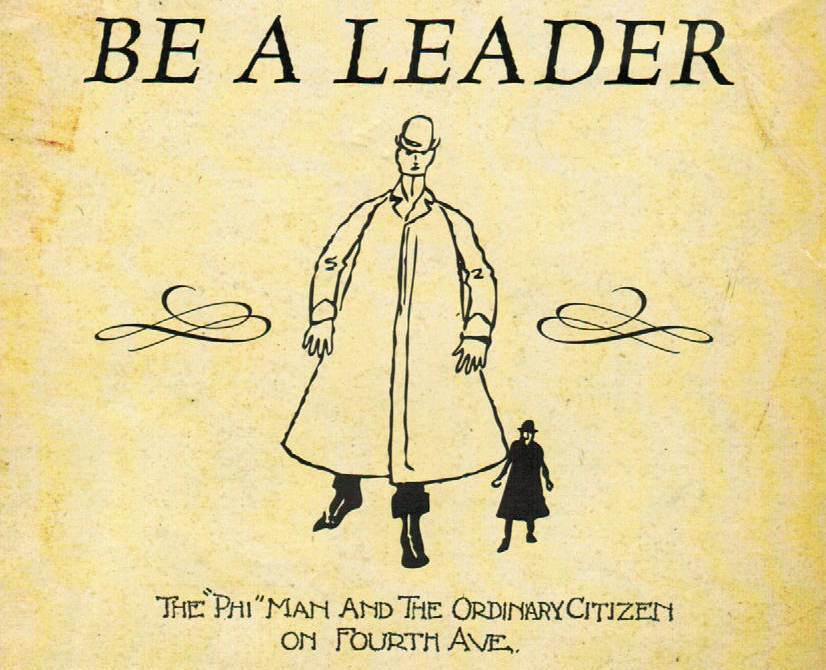
The Founders of Phi Delta Theta were respected leaders of their time and outlined for all of us a set of simple beliefs and principles which, if followed, lead to a life of honor, respect and fulfillment.
To me, living the ritual becomes instinctive, internalized and results in the creation of lifelong habits. And it begins at initiation. As President of Phi Delta Theta, I have had the opportunity of initiating and installing many of our newest chapters. And to each new chapter at the installation banquet I offer the following charge.
“When you were initiated and all signed The Bond of Phi Delta Theta, you agreed to live your lives by three simple principles – Friendship —- Sound Learning — and Moral Rectitude. I charge each of you here to remember and honor those commitments to each other. I charge the men of Phi Delta Theta to:
- To excel in the classroom to the best of your abilities.
- To sit in the front of class, engage with your professors and add to the academic discussion.
- To excel on the athletic field or performance venue– always giving your best performance and exhibiting exemplary sportsmanship and creativity.
- To engage on the campus – get involved in student government and other student organizations. To lead, not just follow.
- To engage in the local community and serve those in need.
- To not abuse alcohol, women or each other.
- Last, but not least, to act in such a manner – both collectively and individually – that all of your mothers, fathers, alumni and friends will take pride in you as a Fraternity man.
If you do that, you will have met the obligations you made when you signed The Bond.”
So, back to the “mom as judge” concept. I know a chapter is “living the ritual” when I hear from the parent of a Phi, which usually turns out to be the mother, who calls or writes to tell me about her son’s experience in the Fraternity. These messages sound like this:
“Having never been involved in a fraternity before, both my husband and I were both VERY impressed and proud to see these young men filled with enthusiasm and dedication. The fraternity has been a wonderful experience for him and I know there will be a void once he graduates this year!”
“The brothers (Missouri Eta – Missouri Western) were going to plunge anyway, but they went beyond a philanthropy project and made it VERY personal for my family. Tanner (who has a disability) is almost 18. We are trying to accept that he will never be married, he will never drive a car and may never attend college. He will never have the opportunity to be a Phi Delta Theta. These men have embraced my family and me and for that I am eternally grateful. Missouri Eta Chapter, from the bottom of my heart, I love each and every one of you. You are compassionate and caring and will ALWAYS be a blessing in my life.”
“I was admittedly apprehensive when he expressed an interest in becoming involved with a fraternity. Our family had no experience with fraternities or sororities and I had some of the typical misconceptions regarding the Greek system. His father and I gave our approval with the caveat that he must maintain a high grade point average and not jeopardize his scholarship, since he wishes to attend law school after graduation. I am proud to say that he is beginning his senior year and has retained his scholarship for all four years in large part due to the scholastic emphasis and support of the Fraternity. I have been very impressed with the level of involvement of the alumni with the undergraduates in Phi Delta Theta. They are truly committed to fostering the development of these young men and certainly stress the virtues that we all wish to instill in our sons: honor, loyalty and responsibility. Personally, I can attest to new levels of leadership and maturity in my son that I believe are directly attributable to his involvement in Phi Delta Theta.”
With time I have become less concerned with “seeing it” in terms of formal activities and more interested in understanding that the process of “living the ritual” is taking place within our chapters. When I hear from a parent with a testimonial like these – I know the chapter is “living the ritual.”
So in closing, here are a few things I believe members of Phi Delta Theta do every day to “live the ritual.”
- We care for one another and lift each other up
- We challenge ourselves, individually, to be better men every day
- We challenge each other to rise to a higher standard
- We call a brother out when he is going down the wrong path
- We don’t turn our backs on a brother in need
- We celebrate each other’s successes
- We believe in words like fraternity, honor, duty, loyalty, leadership, brotherhood, love, and compassion
- We’re not fair-weathered friends
- We take pride in identifying ourselves as Fraternity men
- We believe in the lifetime commitments we made to each other when we signed The Bond
My hope is that all of our brothers do these things – that we each strive to live the ritual to the best of our abilities – because we’re members of Phi Delta Theta – because that’s what Phi Delts do.
Brother Mietchen is the General Council President. Scott is a 1984 graduate of the University of Utah where he earned both his B.S. and MPA. He has served the Fraternity as a chapter consultant, chapter adviser, house corporation president, province president, delegate to the NIC and member of the General Council from 1994-2000 and 2004-Present. Scott became an Iron Phi in 2010. Professionally Scott is President and Managing Partner of Fund Raising Counsel, Inc. (FRCI), the oldest fundraising consulting firm in the Intermountain West. He was recognized as Fund Raiser of the Year in 2006 by the Utah Society of Fund Raisers. Prior to joining FRCI, he served as Vice President for University Advancement at Utah State University. Scott, his wife Lisa, and their children, Abby and Alex live in Salt Lake City.
The post How Do I Know When A Chapter Is Living The Ritual? A Mom Tells Me appeared first on Phi Delta Theta.
]]>The post Being Your Reputation’s Keeper appeared first on Phi Delta Theta.
]]>When I was asked to blog about PR for this month’s post my immediate thoughts went to exploring an experience from my professional life. As an advertising guy I work alongside our PR professionals all the time, as well as practitioners from other agencies. It’s fun to work with them in building a client’s business – building their reputation.
While there are certainly lessons and observations I can draw upon to inform this post, in the end I find them a little weightless in the context of being a Phi.
Instead, I got to thinking about reputations within our Fraternity and the fraternity world. We are very lucky to be Phi Delts. We’ve got one of the best – if not the best – reputation in the fraternity world today. Other fraternities envy our organization for a variety of reasons. Our educational programming is among the best out there; providing our undergrads and alumni volunteers with tremendous opportunities for growth and development. Our undergraduates are among the best men walking the hills of college campuses across North America. Our alumni are engaged and give tremendous amounts of time, talent and treasure to Phi Delt. And most importantly, we are always willing to make hard decisions for the betterment of the organization in order to honor and perpetuate the objectives of The Immortal Six. Other groups envy us because we make hard decisions.
I personally find strength in the notion that I am a member of an organization who is willing to do the right thing. Which leads me to reputation management. We owe each other, and ourselves, the effort to be the best we can be. To manage our reputations individually and as an organization.
Do you like what you see when you look in the mirror? Do you feel like you’re living up to the challenges of The Bond?
I’d argue that the best reputation management that can be done is making sure you can look yourself in the eye. Being a Phi means being better than common and challenging ourselves and our brothers to be better than ordinary.
The great thing about Phi Delt is the expectations are clear and easy to understand. And we know when we’ve lived up to the challenge and when we’ve fallen short. Falling short is OK. Falling short means you recognize the need for improvement and perhaps some help from your brothers in the process. That’s what they’re there for!
I was given a book call The Edge when I went off to Kent State. It was a compilation of inspirational quotes and stories. The book’s author was a Cleveland area high school wrestling coach. With the exception of my badge, it was my most prized possession in college. (Many an eye rolled when I quoted The Edge at a chapter meeting.) During my last chapter meeting before graduating I bequeathed The Edge to one of my favorite brothers. I miss that book. But I learned years later that Collin Boetger still has it in his home – years since I gave it to him that spring night in 1994.
My favorite passage from The Edge is a poem entitles The Man In The Glass.
I’ll end this post with it. I hope you challenge yourself to manage your reputation by challenging yourself to be the best you can be. To live a satisfied life. Knowing that you are accepting the challenge of our Founders to be more than ordinary, more than average. In the end, the only one who will know if you’ve truly succeeded is you!
The Man In The Glass
By David Winbrow
When you get what you want in your struggle for self
And the world makes you king for a day,
Just go to the mirror and look at yourself
And see what that man has to say.
For it isn’t your father or mother or wife
Whose judgment upon you must pass.
The fellow whose verdict counts most in you life
Is the one staring back from the glass.
You may be like Jack Horner and chisel a plum
And think you’re a wonderful guy.
But the man in the glass says you’re only a bum
If you can’t look him straight in the eye.
He’s the fellow to please-never mind all the rest,
For he’s with you clear to the end.
And you’ve passed your most dangerous, difficult test
If the man in the glass is your friend.
You may fool the whole world down the pathway of years
And get pats on the back as you pass.
But your final reward will be heartache and tears
If you’ve cheated the man in the glass.
Brother Fabritius is the General Council Reporter. His other volunteer service to Phi Delt has included Education Commissioner and Province President. Rich lives in Atlanta with his wife, Heather, and their daughters, Austin and Reese. A past consultant and Director of Chapter Services for the General Headquarters Staff, he is a graduate of Kent State University and a member of the Ohio Lambda Chapter. Rich is Vice President, Managing Director of Brunner, an advertising and marketing agency. His hobbies include travel, golf, and boating.
The post Being Your Reputation’s Keeper appeared first on Phi Delta Theta.
]]>The post Building Your Career Through Our Values appeared first on Phi Delta Theta.
]]>My years in college were some of the most enjoyable of my life. It was where I gained my independence by living on my own, developed lifelong bonds of friendship and brotherhood through the Fraternity, developed leadership skills through intercollegiate athletics and involvement in campus life, and gained a love and appreciation for learning. In college, I laid the foundation for my career by working my tail off, but also by playing just as hard.
A healthy balance of hard work and play was important to my success. Those years of extraordinary personal growth and development of my mind, soul, and friendships prepared me for the next phase of my life. Phi Delta Theta’s values of friendship, sound learning, and rectitude were the building blocks to my success.
Friendship
You need others to develop and grow your career. You can’t pull this off alone. The ability to develop and grow your network of friends will provide you with multitudes of people who might help or add value to your career development. The mastery of the Fraternity’s value of friendship has the ability to make you wildly successful in the development and growth of your career.
There is one thing that successful people have more than the average—they have greater networks. The secret to success in any contact-dependent profession (i.e., any career where you have to deal with people – almost every career) is the ability to initiate contacts with prospective buyers on a consistent basis. This simply means that if you are developing your career, looking for a job, applying to graduate programs, the more contacts that you initiate with prospective buyers of your talents (employers), the more opportunities that you will have before you. This also applies to making contacts or making yourself visible to others who have networks of friends who could help you. For example, let your chapter brothers know that you are looking for a job or an opportunity. You never know, one of them may have a father, mother, aunt, uncle, or a family friend who might be looking for your talents or willing to help you grow your career.
Being a member of a fraternity, especially Phi Delta Theta, provides an incredible advantage. Building friendships, both in quantity and quality, will expand your networks and opportunities as you develop and grow your career. Whether you are cultivating friendships within the chapter or learning how to recruit prospective members, you are initiating contacts with others and building your personal network. While the Fraternity provides a strong foundation for your professional network, it is very important to expand your contacts beyond Phi Delta Theta. This not only helps your chapter in recruitment and enhancing the chapter’s visibility on campus, but it expands your friendship base and personal network to realms that may become valuable to you in the future as you grow and develop your career.
Many of the best employment opportunities are identified and pursued through relationships. The more people you know, the more opportunities tend to come your way. Relationships are at the core of business in any sector (for profit, nonprofit, or government). People hire or do business with people. Your first step in any job hunt is to make contact with prospective employers. Your network can help open those doors.
Sound Learning
Learning is the primary reason that you and your family are investing time, money, and resources into four or more years of higher education. As you transition into a career in a global marketplace, the competition is fierce. If you aren’t technically prepared with a good foundation of knowledge in your discipline, you are already at a disadvantage. You certainly don’t have to be a 4.00 student to be a successful in your transition to a career, but you do have to be competent.
Employers and better graduate school programs look for candidates who are technically competent; however, there is a differentiator that will significantly enhance your chances of landing that pivotal first job or getting into a top graduate school. That differentiator is the ability to communicate, in writing and verbally, and the ability to convey a sincere love of learning.
Poor writing skills are the easiest way to eliminate a candidate in a competitive marketplace. Most employers will assess writing skills in your resume or through writing samples. One of the most important courses that you can take as you prepare for your career is a technical writing course. The ability to write in a cogent, concise manner will serve you well to not only land a good job, but to propel you through a successful career.
Employers invest in people in order to develop their talent and to hopefully yield a return on investment. This means that employers, as well as graduate and professional schools, look for candidates who have a love of learning and who will be self-motivated to continually improve and reinvent themselves. My business is very different today than it was five, fifteen, and twenty years ago. My employees and I have had to learn new techniques, technologies, and processes to remain relevant in the market. As an employer, I love to invest in people who have the ability and desire to learn and grow because their innovation “innovates” our business, allowing our firm to succeed and thrive in a competitive market. The easiest way to develop this desire and love of learning is to find a career path or profession that you love. If you become passionate about something, you will love to learn about it.
Rectitude
Once you have made contact with prospective employers or individuals who can help progress your career, you must have something of value to offer. Sound learning should take care of this requirement. However, one more critical element will make or break your career growth and development – that is your integrity. People hire and invest in individuals that they like and trust. Simply put: you are only as valuable as your reputation.
Your judgment and actions shape your character and reputation. Decisions that you make now will stick with you for some time. The Internet and social media often memorialize and make very public both good and bad decisions. Make good decisions; do the right thing; always treat everyone with respect; and guard your reputation. Unimpeachable rectitude will make you an attractive candidate for future employers or business associates.
Chris W. Brussalis is Member-at-Large of the General Council. Chris is President & CEO of The Hill Group, Inc., a national management consulting firm and Adjunct Professor of Management and Policy at the Heinz College of Carnegie Mellon University.
The post Building Your Career Through Our Values appeared first on Phi Delta Theta.
]]>The post An Invitation to NFL Commissioner Roger Goodell – Please Join Us in the Fight to Stop Hazing appeared first on Phi Delta Theta.
]]>Hazing: As the International President of Phi Delta Theta, I realize that anytime I say or write this word many of our members, both undergraduate and alumni, roll their eyes and expect to hear yet another lecture on the litany of reasons why hazing has no place in the Greek movement in general, or in our Fraternity specifically. However, this piece isn’t directed at the members of Phi Delta Theta. Instead it is directed at one of the most powerful, thoughtful and influential men in the world of sports: Roger Goodell, the Commissioner of the National Football League.
You see, while the words “fraternity” and “hazing” are often associated together, the problem of hazing exists in many areas of our society including professional, college and high school athletics. I refuse to accept the common perception that hazing is just a college fraternity/sorority problem. In fact, I believe that national fraternities and sororities, and their respective chapters, do more to try and combat hazing then any organizations I can think of. I realize that the Greek system gets most of the focus and I realize we have yet to completely end these practices within our own organizations, even though we have been waging the fight against hazing for decades. However, we Greeks cannot combat hazing alone without key partners joining with us to end these stupid, pointless, harmful and sometimes dangerous traditions. In fact, it makes it more difficult for us to combat hazing in our own ranks, when the media celebrates acts of hazing in shows such as the HBO series “Hard Knocks,” where it humorously profiled hazing in the NFL this past season.
That is why I was so pleased to read this past week that Jack Del Rio, Head Coach of the Jacksonville Jaguars, has banned hazing this year from the Jaguars rookie training camp after things got out of hand in 2010. Coach Del Rio defended his decision by saying that players needed to have more respect for each other in order to be better teammates. And with his simple order, hazing stopped in the Jaguars training camp. And just this week Jason Garrett, Head Coach of the Dallas Cowboys, followed suit with a similar ban for his team.
For a coach to take this step in the NFL is important because it can trickle down to other NFL teams, and then into collegiate and high school athletics. Ask any high school athlete, coach or referee about hazing and you will hear some incredible stories. You can simply Google “high school sports hazing” and read an astonishing number of deplorable stories. The NFL serves as a role model to high school and collegiate athletes whether it accepts the role or not. And when hazing is accepted, and even celebrated, in the NFL, it makes it more acceptable at the high school and collegiate levels by conditioning students that hazing is an acceptable team-building behavior.
I am asking NFL Commissioner Roger Goodell for help. Last September, I wrote Commissioner Goodell a letter asking for his leadership in addressing hazing in the NFL and offering as help Phi Delta Theta’s 30 years of experience in fighting the issue. That request for help from the Commissioner and offer of assistance by our Fraternity stands today. The NFL sets the tone for many norms in our society and the players, coaches and owners do indeed serve as role models for our youth. Their leadership on any issue can make a difference. Their leadership to join the fight against hazing just might even save a life.
At the time I wrote Commissioner Goodell last fall, there were many other things on his plate including the recently completed contract talks between the players and owners. Those talks are now completed, the players are back in training camp and the NFL will most likely have another record breaking season. Unfortunately the Commissioner missed an opportunity to ban hazing with the recently completed collective bargaining agreement.
While I realize that there is much the Commissioner’s office does throughout the year on a wide variety of issues, I would hope that he may see the steps recently taken by the Jaguars and Cowboys as an opportunity to use his position of leadership to begin stamping out hazing in the NFL. His actions now may help lead to the elimination of hazing in other levels of sports, which can also help us in our fight against hazing. Commissioner Goodell has the unilateral ability to draw the line in the sand regarding behavioral standards in the NFL, an authority he has used in the past to deal with other issues which are viewed as a threat to the league and/or its players. I believe the Commissioner has the decency to take a stand that can affect thousands of young men and women who may never play in his league. And beyond the illegality of hazing in many states, it’s just stupid, wrong and harmful.
I’m not suggesting that we blame hazing within our organization on the NFL – far from it. Phi Delta Theta will continue its on-going efforts to stamp out hazing in our own organization regardless of what others do. However, I am suggesting that the active and vocal leadership of Commissioner Goodell on this issue could impact many parts of society for decades to come.
Commissioner Goodell, you have the ability to unilaterally stop hazing in the NFL. All it takes from you is the stroke of a pen. Please consider joining us in this effort, as it will have very positive consequences far beyond the gates of the National Football League.
Brother Mietchen is the General Council President. Scott is a 1984 graduate of the University of Utah where he earned both his B.S. and MPA. He has served the Fraternity as a chapter consultant, chapter adviser, house corporation president, province president, delegate to the NIC and member of the General Council from 1994-2000 and 2004-Present. Scott became an Iron Phi in 2010. Professionally Scott is President and Managing Partner of Fund Raising Counsel, Inc. (FRCI), the oldest fundraising consulting firm in the Intermountain West. He was recognized as Fund Raiser of the Year in 2006 by the Utah Society of Fund Raisers. Prior to joining FRCI, he served as Vice President for University Advancement at Utah State University. Scott, his wife Lisa, and their children, Abby (17) and Alex (14) live in Salt Lake City.
The post An Invitation to NFL Commissioner Roger Goodell – Please Join Us in the Fight to Stop Hazing appeared first on Phi Delta Theta.
]]>The post Courage Is Key appeared first on Phi Delta Theta.
]]>I just did one of the hardest things I have to do in my job – I had to let an employee go. The reasons don’t really matter. I could blame it on the sluggish economy, poor performance, a career that didn’t evolve with the changes in technology. Regardless of the reason, these meetings are tough on me. They are infinitely tougher on the person on the other side of the table. That can never be questioned.
As I prepared for this unpleasant meeting, I drifted back to where I was just a few short days ago: in a beautiful lecture hall filled with 400+ undergraduate Phis and Alumni at ELI. I had the distinct honor and privilege of unveiling Phi Delt’s new brand strategy and position at this meeting in Oxford. This new brand position is most notably articulated in our tagline: Become the Greatest Version of Yourself.
When you are facing tough times, it’s pretty natural to return in your own mind to something less daunting, less difficult, or even, less intimidating. So while preparing to say goodbye to a co-worker, my mind kept returning to Oxford. To ELI. To the support of my Brothers and the warmth in which our new brand work was received. A good memory without a doubt.
I used this marvelous experience as a source of strength and confidence while steadying myself this morning. Funny, many people cite public speaking as their greatest fear… but I frankly love it. I wonder how many people would trade places with me right now? “Heck, I’ll let the guy go from his job before standing up to talk in front of 400 strangers.” Can’t imagine. Maybe I’m crazy!
But what hit me, and why I’m writing this, is that at the cornerstone of being a Phi is courage. That’s really what our new position is about – Courage. Courage to seek out the best in yourself and in others. I continually learn from being a member of this great Fraternity. I learned more than I ever realized during my undergraduate years. Some of those lessons return to me everyday while I perform my duties as an advertising executive and in my most important roles as a father and a husband.
This is what I love most about Phi Delt. If embraced, it is the greatest time of your life while simultaneously being one of the most challenging and difficult endeavors you’ll ever face. It teaches you humility while instilling confidence. It is filled with incredible memories while preparing you for the future. It never stops making you better.
I don’t think that I was the greatest version of myself this morning. Far from it. But, I do believe that Phi Delt had a huge part in why I was able to do what I had to do for my company today. And why I had the courage to do it.
Brother Fabritius is the General Council Reporter. His other volunteer service to Phi Delt has included Education Commissioner and Province President. Rich lives in Atlanta with his wife, Heather, and their daughters, Austin and Reese. A past consultant and director of chapter services for the General Headquarters Staff, he is a graduate of Kent State University and a member of the Ohio Lambda Chapter. Rich is Vice President, Managing Director of Brunner, an advertising and marketing agency. His hobbies include traveling, golf, and boating.
The post Courage Is Key appeared first on Phi Delta Theta.
]]>The post Wall Street Journal’s “Shutter Fraternities for Young Women’s Good” Offers Faulty Logic and Wrong Conclusion appeared first on Phi Delta Theta.
]]>I am writing as the International President of Phi Delta Theta Fraternity to express my surprise that such a well-regarded, international, publication as the Wall Street Journal would allow such a weakly argued article as “Shutter Fraternities for Young Women’s Good” to appear on its news pages. While the piece could have certainly been written as an OpEd piece, expressing the author’s personal point of view, it appeared in a section reserved for fact-based news items. In my view the story’s writer exhibited poor journalistic and logic standards and did a tremendous disservice to the millions of current undergraduate and/or alumni members who have had exemplary fraternity experiences. Please let me explain.
First let me state that what happened to Ms. Seccuro as an undergraduate at the University of Virginia 27 years ago is absolutely horrible and beyond explanation or excuse and I hope the perpetrator was appropriately punished. But, however horrible this event was, and I agree it was horrible, it was not caused because a fraternity existed at the University of Virginia. For the same reason that it did not happen because the University of Virginia is coeducational. It happened because the young men involved did not know the boundaries; be they legal, moral or ethical, between right and wrong.
The author, Ms. Flanagan, writes “The Greek system is dedicated to quelling young men’s anxiety about submitting themselves to four years of sissy-pants book learning by providing them with a variety of he-man activities: drinking, drugging, ESPN watching and the sexual mistreatment of women.” I could not disagree with Ms. Flanagan more about her broad and untrue characterization of fraternity men. This is simply not a description of fraternity life that I recognize. As well, I believe her article commits one of the classic logical fallacies – confusing association with causation.
As the President of Phi Delta Theta Fraternity, with nearly 10,000 undergraduate members and 200,000 alumni members located in chapters on over 170 North American campuses, I can state unequivocally that Ms. Flanagan’s characterization of what “we” are dedicated to is just flat wrong and based on a stereotypical view, often times reinforced in the media through movies such as Animal House. It’s time to put Animal House to rest – it’s a movie, nothing more – it’s not reality. I can also state unequivocally that I have never heard of any other national or international fraternity dedicated to the anti-intellectual activities described in the article.
The vast majority of fraternity men I know do not fit the author’s description at all. The men I know serve as campus leaders, achieve academic success in the classroom, take part in academic research, graduate at higher levels than non-affiliated men, move on to graduate or professional schools at higher levels, excel on the athletic field or artistic venue, and serve their communities. This may play a large role in explaining why fraternity men generally have a great deal of pride and affection for their fraternity as well as institution.
I sadly have to agree with Ms. Flanagan’s assessment that abuse of alcohol is a significant problem on college campuses today – and I also have to agree that surveys reveal that this problem can affect fraternity populations at a higher level than the general student body. I also agree that abuse of alcohol plays a significant role, for both men and women, in many of the challenges facing undergraduates today whether it be sexual harassment or abuse, academic performance issues, or harmful interpersonal relationships.
The entire Greek movement (fraternities and sororities), working with our partners in higher education, has been working to educate our members and stem the abuse of alcohol for many years. Each of the more than 70 men’s national/international fraternities has developed their own approaches for addressing this serious issue. I applaud all of these proactive efforts. For Phi Delta Theta, in addition to extensive education programs, we have taken the approach of creating Alcohol-Free Housing and removing alcohol from our chapter houses for the past decade. For our organization this has worked. For other fraternities, other approaches have worked
I wish that all fraternity chapters across North America offered an exemplary experience, but that would be dishonest. Unfortunately some chapters have lost their way and digressed from the values around which they were created. It is then up to each fraternity to hold their chapters accountable to the values and beliefs of their individual organizations. I believe most fraternities work to hold their individual chapters accountable – I know that Phi Delta Theta is committed to upholding our founding principles of friendship, sound learning and rectitude.
Fraternities have existed and thrived on North American campuses for nearly two centuries. We have our issues that we continue to address and we have never claimed to be perfect. However, as a former senior university administrator, I would argue that fraternities and sororities continue to provide an invaluable learning experience that complements the classroom experience and that we continue to provide the best, real life, leadership learning laboratory on a campus.
As the father of two children, one a daughter who is in her junior year of high school and just beginning the college search process, and the other a junior high school son, I have to admit that I am proud to say that I not only believe in the continuing relevance and importance of today’s fraternity and sorority system, but that I will enthusiastically encourage both my son and daughter to consider if it is right for them. For Phi Delta Theta, we have had a chapter at the University of Virginia since 1873 and have a great deal of pride in the accomplishments and characteristics of the men that comprise our chapter at UVA.
I think it is unfortunate that the author would take such a horrendous personal experience and use it to demonize and categorize the more than 100,000 undergraduate men, as well as millions of alumni, who belong to college fraternal organizations in North America. We don’t disparage all corporate employees for the unethical actions of a few; we don’t fire all of the faculty of a university because one plagiarizes a thesis; we don’t cancel all professional sports because some athletes broke the rules and took performance-enhancing drugs; we don’t shut down all non-profit organizations because one operated in an unethical manner. It just isn’t how we do things.
This is the story of a despicable rape and its aftermath – not a story about fraternities. A sound argument is a valid argument with true premises – this article provided neither. Please don’t use poor logic, and lack of facts, to paint all of us fraternity men with a broad brush due to the inexcusable actions of a few – it just isn’t right.
Brother Mietchen is the General Council President. Scott is a 1984 graduate of the University of Utah where he earned both his B.S. and MPA. He has served the Fraternity as a chapter consultant, chapter adviser, house corporation president, province president, delegate to the NIC and member of the General Council from 1994-2000 and 2004-Present. Scott became an Iron Phi in 2010. Professionally Scott is President and Managing Partner of Fund Raising Counsel, Inc. (FRCI), the oldest fundraising consulting firm in the Intermountain West. He was recognized as Fund Raiser of the Year in 2006 by the Utah Society of Fund Raisers. Prior to joining FRCI, he served as Vice President for University Advancement at Utah State University. Scott, his wife Lisa, and their children, Abby (17) and Alex (14) live in Salt Lake City.
The post Wall Street Journal’s “Shutter Fraternities for Young Women’s Good” Offers Faulty Logic and Wrong Conclusion appeared first on Phi Delta Theta.
]]>The post My Journey From Being Hazed, To Being An Enthusiastic Hazer, To Stopping Hazing appeared first on Phi Delta Theta.
]]>Being hazed:
I pledged Phi Delta Theta at the University of Utah in the fall of 1980. This was just a few years after the release of Animal House and I was the poster child for the target market for Greek life at the time – I was the consummate joiner. I was bound and determined to get involved on campus and, even though I didn’t come from a Greek background, I saw fraternity life as the way to immediately become involved on this large public university campus. Going through Rush, I was split between three fraternities at the end of a very formal Rush Week period and ultimately decided to pledge Phi Delta Theta because I liked the laid back, real and friendly nature of the guys I met. These guys made me feel welcome and wanted.
Soon after our official pledge ceremony we held our first pledge meeting and were given the requirements to complete in order to be initiated. Our requirements included the usual items; read and learn the Phikeia manual, meet and learn something about all of the brothers, organize a community service event, organize a social with a sorority pledge class, etc. The chapter officers also told us that the “best pledge,” as identified by the chapter brothers, would be recognized at initiation with the low bond number of the pledge class. Being competitive, I was determined to earn that low bond number.
Now, I expected some “fun and games” throughout my pledge period because I had seen them in the movies and I figured they were simply a rite of passage that I could tolerate and survive. My ultimate goal, however, was to earn the low bond number and I worked diligently to be that top pledge. I played the role to the best of my abilities. I completed my assignments early, I mastered facts about the Fraternity, I met with all of the active brothers, I maintained a positive attitude. And I adopted the attitude of “grin and bear it” through the hazing. Hazing in my chapter wasn’t extremely physical, it was primarily mental with some minor physical activities included. I wasn’t paddled, forced to do calisthenics or consume massive amounts of alcohol, or dropped off in the dessert somewhere blindfolded and told to walk back. For me it was more subtle; line ups, late night “work” sessions, servitude, yelling, demeaning remarks, surprise requirements, kangaroo courts, etc. And I excelled at all of it. I could recite the Greek alphabet backwards and forwards before the match burned my finger. I could stand stone-faced, with a spotlight in my face at 2:00 a.m., while being yelled and cursed at by the wimpiest guy in the chapter, who also happened to be fairly inebriated. I could say “yes, sir” faster than almost anyone – and mean it. I could memorize stupid poems used to address the brothers as well as to answer the phone. I knew that I could put up with anything because I wanted to be initiated and I wanted that low bond number.
When it came time for “Initiation” or I-Week, I put up with a lot. I wore the dumb clothes, ate the horrible food, carried items around campus, gave up sleep, lived in squalor, and continued to endure mind games. Mental hazing included those exercises where we were lead to believe we wouldn’t be initiated, or that our entire pledge class was a failure. After five days of sleep deprivation, spotlights, yelling, poor food, mind games, physical stress and threats, I have to admit I began to wonder if it was all worth it. Then, just as quickly as it started, it was over and I was initiated. However, I am sad to say, I don’t remember much of my own initiation – I was simply too tired and mentally frayed to pay attention. When initiation starts at 1:00 a.m. and ends at 4:00 a.m., and occurs after five days of hell, there is little to remember or cherish. I was simply in survival mode. But, in the end, I had survived and achieved my goal – I had been named the best pledge and was rewarded with the low bond number in my pledge class. It felt great. The pledge program had made me a great pledge. Unfortunately I had also developed some real enmity toward several of the brothers and younger alumni who were the most aggressive hazers in the chapter. I put on a smile in their presence – but I never developed respect for them – and to this day I have no desire to talk with them at alumni events. I always thought it odd that I had learned a collection of miscellaneous facts and figures about the Fraternity – but I had not learned very much about what makes for a strong chapter. However, I rationalized that perhaps learning about running the chapter wasn’t too important. And once I was initiated, I couldn’t wait to have my turn to haze the next pledge class. Now, it was my turn.
And now it was my turn to be a hazer:
Not long after being initiated we took our Spring pledge class. As part of my own pledge program I had read the Fraternity’s policy prohibiting hazing (it was printed right in the Phikeia Manual) but I had bought into the “tradition” and “rite of passage” rationales and didn’t think anything bad would happen. It was during the first pledge class after mine that I became a great hazer. I could demand respect, play mental games and demean the pledges with the best of them. I wasn’t the worst hazer, but I held my own. I’m not proud of the fact that I could get in a pledge’s face at 2:00 a.m. and yell at him because he didn’t know how many bricks there were in Old North Dorm. I believed that if they really wanted to be Phis, they needed to earn it, and that this was just part of the path to membership. After all, I had come through just fine …. and it was tradition.
By now I was also on the Chapter’s Executive Committee and had started to learn more about the Fraternity’s anti-hazing policies. I met my first Chapter Consultant from General Headquarters and engaged in a heated debate with him about what was, and was not, hazing. I wanted to focus on the specific aspects that made an activity a hazing activity because it made for an endless debate. However, I could never quite bring myself to truthfully evaluate whether it was morally and ethically right or wrong. Quite frankly at the time I thought these policies were just set by a bunch of out-of-touch General Fraternity officers who didn’t really know what was happening at the undergraduate level.
At the same time, my pledge class had taken on several key officer positions and decided to try and really upgrade our chapter and win some Fraternity awards. However, to do this we knew we needed to do something about our pledge program. Or perhaps, we could just lie about some of our most cherished “traditions” in our awards packet.
Why I stopped the hazing:
The next fall, my Sophomore year, we took a fairly large pledge class and our pledge program contained the same hazing traditions and rites of passage from previous years. And I participated as before. However, this time, something happened that changed my attitude forever.
Our Phikeia class had completed their pledge program and was preparing for Initiation Week. It was at this point that one of our pledges, Keith, started to become quiet. He had always been somewhat reserved, but now it was becoming more pronounced. Our chapter’s Initiation Week lasted five days, with formal initiation on the last evening. Through the first four days of I-Week, Keith became progressively more withdrawn, more reserved, and more quiet. Quite frankly, several days of sleep deprivation, stress and mental hazing had dimmed the spark in his eyes – and we started to get worried.
Having finished the “fun” of I-Week, we were preparing the pledge class for their formal initiation, except that we had a problem. When we went to get Keith for the initiation ceremony, we found him in his suit, curled up in the corner of the pledge room, rocking back and forth and humming. He was non-responsive – he had simply gone beyond his limit for emotional stress and lack of sleep and was now nearly catatonic. We were able to get Keith to his feet and literally helped him through each step of the entire initiation ceremony with one brother on each arm, whispering in his ears the words he was to repeat. We were scared for Keith and scared for ourselves. Toward the end of the ceremony, when Keith realized that he had been initiated, his mental state started to improve since the emotional stress of the past five days had begun to dissipate. However, as active members, we were extremely concerned for Keith’s safety and for his parent’s reaction. And to be truthful, we were terrified that the chapter would get into trouble. We persuaded Keith to stay at the chapter house for an additional two days after initiation so he could sleep and return to a normal state of mind, which he did. However, it was then and there that I saw the dangers and banality of hazing. On that day I, and several of my pledge brothers, made the commitment to end hazing in our chapter. We had come face-to-face with the fact that hazing isn’t funny, it’s not entertaining and it can be very dangerous.
Stopping Hazing Activities:
I discovered a very simple truth in our fight to end hazing. Most of the brothers in the chapter really didn’t like hazing, they just went along with it because it was tradition. Except for a small number of hardcore hazers, and they were hardcore, there was very little argument against stopping the hazing. As officers, we simply said “No More Hazing.” And for the most part, hazing ended. It didn’t take discussions at ten chapter meetings, or a chapter task force, or anything else. It simply took leaders standing up and saying “No more.”
Hazing excuses:
Hazing is defined as: “any action taken or situation created, intentionally or unintentionally, whether with or without the consent of the persons subjected to that action which produces mental or physical discomfort, embarrassment, harassment, or ridicule.”
Generally, individuals within chapters with hazing cultures, regardless of age or status, have the same common reply when asked about these practices. I’ve heard the excuses for years and I can tell you from experience that they are simply wrong.
- “It’s tradition”
- “No one will get hurt”
- “It’s funny – what’s the problem?”
- “They like it; they said it was okay”
- “It’s okay if they don’t complain”
- “It helps build team cohesiveness and unity”
- “I went through it, it’s a rite of passage”
One person can stop hazing:
Some may read this and think “there they go again – one of those old national guys preaching to us again about hazing.” And you know what?, I would understand that mentality, because I felt the same way at one time. But I would ask you to consider, for just a minute, the ethics, morals, safety and potential disasters that might occur should a program of hazing go wrong. I would ask you to consider if you would be so resolute in your opinions, if you or your chapter permanently damaged or even lost a brother. I would ask you to consider, would it all be worth it for the sake of “tradition?” I would hope you wouldn’t be so nonchalant in ignoring all of the advice and help available to you to end hazing in your chapter.
If your chapter has a hazing problem I ask you, as a brother, to consider taking just one step. Please consider being that Phi leader who stands up, says “No more” and stops the hazing. Your chapter will become a better place because of your actions.
The aftermath:
An amazing thing happened once we stopped the hazing and improved our Phikeia education program – our chapter got remarkably better. We grew in numbers, academics, quality, chapter operations, and loyalty. Several years after these changes took hold, my chapter went on to win some of the Fraternity’s most prestigious awards. Some of my chapter’s most loyal and active alumni today come from the pledge classes who were spared the indignities of hazing. And to this day, Keith remains one of my best friends. He and his wife have raised a great family and he remains a loyal and active Phi. And as I write this I realize that, beyond that Initiation Week nearly 30 years ago, he and I have never talked about this. It’s probably something we would all just rather forget.
Please remember and consider – Hazing Hurts.
Proud to be a Phi!
Brother Mietchen is the General Council President. Scott is a 1984 graduate of the University of Utah where he earned both his B.S. and MPA. He has served the Fraternity as a chapter consultant, chapter adviser, house corporation president, province president, delegate to the NIC and member of the General Council from 1994-2000 and 2004-Present. Professionally Scott is President and Managing Partner of Fund Raising Counsel, Inc. (FRCI), the oldest fundraising consulting firm in the Intermountain West. He was recognized as Fund Raiser of the Year in 2006 by the Utah Society of Fund Raisers. Prior to joining FRCI, he served as Vice President for University Advancement at Utah State University. Scott, his wife Lisa, and their children, Abby (16) and Alex (14) live in Salt Lake City.
The post My Journey From Being Hazed, To Being An Enthusiastic Hazer, To Stopping Hazing appeared first on Phi Delta Theta.
]]>The post Our “Phi Delt Nation” and Six Things That Make Me Proud appeared first on Phi Delta Theta.
]]>Several weeks ago I was meeting with a group of parents of newly initiated Phi Delts. Only one of the parents had come from a fraternity or sorority background. The purpose of the meeting was to ease their parental concerns about what joining a fraternity would mean for their sons, and to educate them about both the short– and long-term benefits of joining the international brotherhood that makes up Phi Delta Theta.
As I was preparing to talk with these parents I realized how easy and common it is for most of us in Phi Delta Theta to only view the Fraternity through the lens of our own chapter and our own undergraduate experience. While we learned some facts and figures about the broader international Fraternity through the process of our own individual recruitment (rush) and pledge education periods, for many Phis, the larger Fraternity oftentimes remains rather amorphous.
When the six Founders formed the Fraternity and wrote The Bond of Phi Delta Theta nearly 162 years ago, it is clear that they envisioned, from the very beginning, an organization that would extend well beyond the boundaries of Miami University. They envisioned an organization of leaders, scholars and gentlemen on every campus where Phi Delta Theta was represented. It was expected that, following their time as undergraduates, these men would go on to lead lives of character and service for themselves, their families and their communities.
As I was thinking about our larger brotherhood, I was also reminded of a comment made to me months earlier by Steve Good (Iowa State ’04), the Director of Education and Technology at General Headquarters. Last year, in a short note to me, Steve used the term “Phi Delt Nation,” a phrase that has stuck with me ever since.
With apologies to those many sports teams and organizations who attach the word “Nation” as an appendage to highlight something such as a team’s fan base, I propose a slightly different definition.
Phi Delt Nation, noun, the compilation of the individual and collective actions and characteristics of members of Phi Delta Theta, whether they be undergraduates or alumni, living or deceased, regardless of chapter, national origin, or geographic location.
So, as a Phi, following are six items that make me proud of our Phi Delt Nation.
1. In 2009 Phi Delt chapters were, on average, 45% larger than the average NIC fraternity chapter in North America: This compares to being 21% larger in 2000 and 11% larger in 1993. Phi Delta Theta remains relevant on today’s college campus and continues to be a leader in the Greek movement.
2. Phi Delts are community leaders: Phi Delts have held nearly every top office in the United States and Canada including President, Vice President, Speaker of the House, Senator, Representative, Member of Parliament, Cabinet Secretary, Justice and Chief Justice of the Supreme Court, Governor and Mayor. Our undergraduate brothers today continue this long tradition of leadership. The numbers and names of every Phi or chapter today who is student body president, IFC president, Fraternity Man of the Year, Outstanding Graduate of the Year, Outstanding Fraternity of the Year or Homecoming, Greek Week or Intramural champion is too long to list here. But the Founders’ vision of inviting the best men on campus to become Phis continues 162 years later across North America.
3. More Phi Delts have received the Congressional Medal of Honor than of any other college fraternity: I was reminded once again of the outstanding service and sacrifices Phis have made in the defense of freedom last week when I learned that one of my own chapter brothers, Lt. Colonel (Ret.) Thomas W. McKevitt (Utah ’85), has just been named the Chief Operations Officer at the United States Military Academy at West Point. The first Phi who made the ultimate sacrifice did so nearly 150 years ago in the early days of the Civil War. Since that time, Phis have served with distinction in every military service branch and every war of the United States and Canada and been recognized with every significant honor presented by these countries, including the most prestigious of all, the Congressional Medal of Honor. This service to our countries continues today from brothers such as General Council President, Lt. Colonel (Ret.) Mark H. Ochsenbein (Eastern Kentucky ’77) and in many of our chapters where Phis like John Garcia (Johns Hopkins ‘11) are recognized as the Outstanding ROTC Student Leader on their campus and when two Phis, fresh from tours of duty in Iraq, return to serve as president of their respective chapters, Cullen Millsap (Alabama ’10) at Alabama Alpha and Philip Schermer (Auburn ‘10) at Alabama Beta.
4. Phi Delts achieve academic excellence: Our chapters continue to focus on supporting the academic success of brothers and their individual commitment to sound learning, one of Phi Delta Theta’s three cardinal principles. Nearly 25% of our chapters were ranked #1 in grades on their campus, with nearly 40% achieving above a 3.0 cumulative GPA for the chapter and well over 50% of our chapters ranked above the campus all-men’s average. During a recent meeting with a chapter I was gratified to see, through a show of hands, that nearly 75% of the chapter members had plans to attend either graduate or professional school after completing their undergraduate studies. Phi Delts remain committed to a lifetime of learning.
5. Phi Delts are committed to serving those in need: In 2009, 84 of our 160 chapters received Community Service Citations recognizing exemplary community service efforts. Our chapters have run, walked, biked, lifted, danced, raced turtles, dodged balls, climbed, golfed, collected food and clothes, teeter tottered, trick or treated, and sung for needs as broad as ALS, Haiti relief, Hurricane relief, preventing violence against women, cystic fibrosis, cancer, autism, and programs for at-risk youth.
6. Phi Delts excel on the playing field as well as in the performance hall: Continuing in the footsteps of Phis such as “Iron Man” baseball great Lou Gehrig (Columbia ‘25) and Legendary Cincinnati Pops Conductor “Prince of Pops” Erich Kunzel (Dartmouth ‘57), our members are committed to being the best. Whether it is George Stevens (Centre ’11) being awarded the SCAC “Character & Community” Student-Athlete Award; two University of Miami Phis, Eric Spiegel ‘11 and Stephen Sorace ‘12, competing in the 2010 Varsity Vocals International Championship of Collegiate A Cappella; country music star Chris Cagle (Northwest Missouri ‘90) topping the country music charts; Phi swimmer Tim Stumbaugh (MIT ‘12) being named NEWMAC Rookie of the Year; or Frank Lapple (California State – Northridge ’57) being elected into the National Senior Softball Hall of Fame; Phi Delts continue to excel in their respective venues.
So while we will always be loyal to, and grateful for, our own chapter experience, let us take pride in and not forget that we are each, in our own sphere of action and influence, affecting and enhancing the reputation and future of our collective Phi Delt Nation. I’m Proud to be a Phi!
Scott Mietchen is a 1984 graduate of the University of Utah where he earned both his B.S. and MPA. He has served the Fraternity as a chapter consultant, chapter adviser, house corporation president, province president, delegate to the NIC and member of the General Council from 1994-2000 and 2004-Present. He currently serves as General Council Treasurer. Professionally Scott is President of Fund Raising Counsel, Inc.(FRCI), the oldest fundraising consulting firm in the Intermountain West. Prior to joining FRCI, he served as Vice President for University Advancement at Utah State University. Scott, his wife Lisa, and their children, Abby (16) and Alex (13) live in Salt Lake City.
The post Our “Phi Delt Nation” and Six Things That Make Me Proud appeared first on Phi Delta Theta.
]]>The post On Being a Brother appeared first on Phi Delta Theta.
]]>This is a tricky one as there are certainly differences between being a “brother” and a “friend” but the differences are so very hard to identify and dissect. If you look up friend in the dictionary you’ll find that is it defined as one attached to another by affection or esteem; while brother is simply one related to another by common ties or interests. Neither of these really help.
As a member of the General Council, I participate in all of our educational programming for undergraduates and alumni volunteers. Without question, the biggest issue we discuss is the idea of holding each other more accountable and responsible. Time and again a discussion that starts about member apathy or counterproductive Phikeia education devolves into exploring a willingness to hold brothers accountable to the standards of their chapter and our International Fraternity.
All too often a chapter struggles because the members don’t hold each other accountable. At the end of the day, I think this is the difference between just being a friend and being a brother. Being a Brother in the Bond demands that we hold each other accountable to certain standards of conduct. In fact, we’ve pledged to look out for one another, to be an advisor and counselor and to be a conservator of each other’s morals. I think we forget about these pledges or more importantly we dismiss them as unnecessary or not our job. Which I think is cowardly.
I actually think this is our biggest job as fraternity men. I think this was ultimately what our Founding Fathers had in mind when they created our organization. They wanted a support system to help them grow. They understood their own folly and fallibility and knew that together they would be stronger, smarter, and ultimately better people. I contend that this idea of being better because of our Brothers’ critical involvement in our lives is as relevant today as it was over 160 years ago.
We need to accept the challenge from our Founders to support our brothers when a helping hand is needed and confront when confrontation is demanded. We need to create a culture in our chapters where we have functioning judicial boards that are not merely paper tigers but a living, active tool that helps reinforce the obligations and responsibilities of our membership. We should encourage chapter-wide efforts to enforce our standards and we should learn to recognize and appreciate the men in our ranks who are courageous enough to be a brother, to provide us with the insight and input that can make us better men.
This brings me back to my brother who is getting married. I love Kevin because he holds me accountable. He’s been this way since we met as freshman at Kent State and he continues this service in my life to this very day. Plus, he demands this of me as well. He wants my counsel and advice and while at times we don’t like to hear what the other has to say, we know that it is with true intentions that we confront one another. It makes me feel closer to my brother and it makes me feel like I am accepting the challenge of our Founding Fathers – A challenge to be better than ordinary and to help those who have also accepted their charge to do the same. It is through each other that those six men speak to us. They challenge us and we should challenge each other a little more.
Rich Fabritius is a member-at-large on the General Council. His other volunteer service to Phi Delt includes Education Commissioner and Province President. Rich lives in Atlanta with his wife, Heather, and their daughters, Austin and Reese. A past consultant and director of chapter services for the General Headquarters Staff; he is a graduate of Kent State University and a member of the Ohio Lambda Chapter. Rich is Vice President, Managing Director of Brunner, an advertising and marketing agency. His hobbies include traveling, golf, and fixing up his old pontoon boat.
The post On Being a Brother appeared first on Phi Delta Theta.
]]>The post Hazing in Phi Delta Theta – Stop the Madness appeared first on Phi Delta Theta.
]]>I know what many of you are already thinking – “Oh no, here we go again. The General Council President is preaching to us, one-more-time, about hazing.” If you are a chapter that does not haze, I can understand and I appreciate your leadership to eradicate hazing in your chapter. However, not all chapters have stepped up to the leadership challenge to stop hazing. If you are one of those chapters that continue to haze, I hope you will finish this letter with an open mind and find the courage to stand up to those brothers who risk your existence as a chapter and as a Phi each and every day. Hazing must stop now.
Brothers, the General Council has an obligation to protect Phi Delta Theta against factors that pose a threat to its existence. Hazing is one of those factors. Hazing is a threat. It is plain and simple, irresponsible drinking and hazing are a threat to the existence of Phi Delta Theta. Why on earth would a brother, who supposedly loves this great Fraternity, commit acts that will cost him his membership, close his chapter and harm Phi Delta Theta? It makes absolutely no sense to me. What does it take to stop the madness? We recruit outstanding potential new members to be a part of the best Fraternity in the world and then some brothers want to haze them. I say again, it makes absolutely no sense to me.
When we conduct hazing prevention education at our conferences we get condemnation on the surveys because our students are “sick of hearing about hazing.” Yet, we still have chapters out there hazing their potential new members. I am of the philosophy that if it has not been said in six months, it hasn’t been said. Our Fraternity will continue to educate our Brotherhood about hazing as well as other threats. Why do we have a Phikeia program? Is it to haze or teach the Phikeias about the history of our fraternity and their chapter? Let me state the obvious – it is to teach the Phikeias about our fraternity and the local chapter.
When discussing hazing and your chapter’s Phikeia education program, always consider the following questions: What are your risks in doing an activity (both as a chapter and as individuals) and are you willing to pay the consequences if you are caught hazing? If you are willing to accept this risk, I can promise you that your days are limited before something goes wrong and your charter is suspended. If you work to minimize or eliminate this risk, I applaud you for doing what ought to be done and exuding leadership.
Brothers, I love this Fraternity and hope that it is still making a positive impact on men 100 years from now. It’s stories like Jordan Campbell’s that make me proud to be a Phi every day. Do me and your chapter one favor this week – Place the word “HAZING” on your executive board and chapter meeting agendas and begin discussions about the topic within your membership. Ask those who are in favor of hazing what is more important – degrading another individual or having a chapter to come back to following graduation. If you need assistance, we are here to help. If there is a hazing culture within your chapter, we will help you find a solution.
Protect your chapter, protect your brothers and the bonds you make with them, and protect Phi Delta Theta by eliminating hazing. By doing so, you will leave a legacy of brotherhood that will transcend many future generations of Phis. The madness stops now.
Yours in the Bond,
Mark Ochsenbein
General Council President
The post Hazing in Phi Delta Theta – Stop the Madness appeared first on Phi Delta Theta.
]]>The post Why It Matters To Me That Neil Armstrong Is a Phi appeared first on Phi Delta Theta.
]]>I was seven years old in 1969 when on July 16th, at 5:00 a.m., my parents woke me up to watch the launch of Apollo 11. As I sat there in my pajamas, my family and I watched this amazing event unfold on our small black and white television. Four days later we sat around that same television and watched the first man walk on the moon. To this day I still remember those crackly, fuzzy, pictures coming from both Houston and the moon, and I can still hear Walter Cronkite’s voice providing the narrative. Apollo 11 sparked in me a lifetime interest in space exploration.
You see, as a seven-year old I had become a space and NASA fanatic. I had been cutting out and collecting newspaper articles about the moon shot for weeks leading up to the landing on July 20th. I had carefully pasted each of these articles in a make-shift scrapbook made of paper from brown grocery sacks, and had followed the most minute details of the astronauts and the Apollo 11 mission. I’m sure I read about the display that had been set up at the Indiana Theta chapter house at Purdue University, but at that age I had no idea what a fraternity was. I followed Apollo 11 and all the subsequent Apollo missions throughout the years, like all fans of the space program are prone to do. Unfortunately, somewhere along the line, my Apollo 11 scrapbook was lost, misplaced or thrown away. I’ve thought about it from time to time and wondered how it would look now through the eyes of a 47-year old.
11 years later when I went through Rush Week at the University of Utah, and had narrowed my choice of fraternity down to three, my decision to join Phi Delta Theta was impacted by the opportunity to join the same fraternity as quality men like Neil Armstrong, Lou Gehrig (Columbia ’25) and J. Willard Marriott (Utah ’25). If it was good enough for them, it was good enough for me.
I have had several experiences where my interest in the space program and membership in the fraternity have intersected. While working for the fraternity as a Chapter Consultant in the 1980’s, I was with the brothers of Pennsylvania Theta at Penn State University watching the launch when the Challenger exploded during lift-off. I have been inside a satellite testing capsule at the Jet Propulsion Laboratory at Cal Tech in Pasadena. I have watched the shuttle launch of Phi Astronaut Jon McBride (West Virginia ‘64). I have met F. Story Musgrave (Syracuse ‘58) several times, and been inspired by his work on, and pictures of, the Hubble Space Telescope. Brother Armstrong’s first steps on the moon helped pave the way for all of these subsequent achievements in space. And like many Phis, I have marveled at the Phi Delt pin and flag that he took with him to the moon and, soon after his return, presented to the Fraternity where it is now on permanent display at General Headquarters in Oxford.
What has meant the most to me, however, is that Brother Armstrong is a true and proud member of Phi Delta Theta, not just one of those members’ who “was” a Phi Delt during their undergraduate years and hasn’t done much since. When I think of him, at the age of 39, serving as Commander of Apollo 11 and using limited and precious cargo space to take his Phi Delt badge and flag with him, I am amazed. He didn’t have to take his badge with him – he chose to. He chose to take Phi Delta Theta to the moon and back. Stories abound about Brother Armstrong returning over the years to Purdue during Homecomings, football games, alumni weekends, etc and being a regular visitor at the Indiana Theta chapter house, just like any other alumnus, except he isn’t any other alumnus, he’s Neil Armstrong. It is well known that he is rarely willing to talk about Apollo 11, and when he returns to his chapter house he won’t talk about the moon, but he will gladly talk and share stories about his time as a Phi Delt undergraduate. I don’t know for sure, but I imagine that some of his stories are enhanced just like most alumni stories tend to become over time.
To me, Brother Armstrong’s actions as a gentleman best represent Phi Delta Theta’s values. He could have easily taken credit for, and boasted about, being the first man on the moon. He could have cashed out with book deals, movies, speaking engagements, selling his signature and likeness on t-shirts and gadgets, etc. – but he didn’t. Instead, he returned to Ohio and became a professor at the University of Cincinnati and proceeded to touch the minds of young people for nearly forty years. He has acted with class, humility, and a sense of purpose.
I can understand his reticence about talking about the moon shot, because while all of the attention is often focused on him as the “first,” the achievement of his first steps was really the success of thousands of unnamed and unrecognized men and women. In a day where too many of our “heroes” and “celebrities” overextend their stay and/or their own sense of worldly importance, Brother Armstrong had the class and humility to simply and quietly leave the stage and do something important and substantive. His actions have always reflected those of a true “Gentleman Phi.”
I have never met Brother Armstrong nor is it likely I will ever have that opportunity, but I have always been thankful for the impact that he and his colleagues had for mankind and for the interest in the space program that they sparked in me as a young child. And as a Phi I have always felt a strong sense of pride in knowing that Brother Armstrong and I signed the same document, The Bond of Phi Delta Theta, and share the same letters, rituals, secrets and values that are Phi Delta Theta.
Plus, it’s just very cool that he’s a Phi.
Scott Mietchen is a 1984 graduate of the University of Utah where he earned both his B.S. and MPA. He has served the Fraternity as a chapter consultant, chapter adviser, house corporation president, province president, delegate to the NIC and member of the General Council from 1994-2000 and 2004-Present. He currently serves as General Council Treasurer. Professionally Scott is President of Fund Raising Counsel, Inc. (FRCI), the oldest fundraising consulting firm in the Intermountain West. Prior to joining FRCI, he served as Vice President for University Advancement at Utah State University. Scott, his wife Lisa, and their children, Abby (15) and Alex (12) live in Salt Lake City.
The post Why It Matters To Me That Neil Armstrong Is a Phi appeared first on Phi Delta Theta.
]]>