The post Historical Phi Delta Theta Gatherings: McKenzie Family President Leadership Conferences appeared first on Phi Delta Theta.
]]>Thirteen years after the Fraternity introduced the Leadership College, the Presidents Leadership Conference (PLC) was born out of the careful planning of Robert A. Biggs, GHQ staff, and the General Council in 2000. After seeing the fruits of the Leadership College that successfully brought leaders from chapters together to learn and network with each other, they determined there was a similar application that targeted the CEO of each chapter, the chapter presidents.
In January 2000, ninety-nine chapter presidents and twenty faculty gathered in St. Louis, Missouri, for the Fraternity’s first PLC. An article from the Summer 2000 issue of The Scroll starts with these charges for a chapter president to:
- Unite the chapter with a common goal.
- Take full responsibility for the actions of your chapter.
- Learn to listen and respond to the concerns of your brothers.
- Assume the role of the leader of your chapter.
Your direction will make an enormous impact on the quality of life for your chapter brothers.
This inaugural PLC was themed The Courage to Lead. See the full article here.
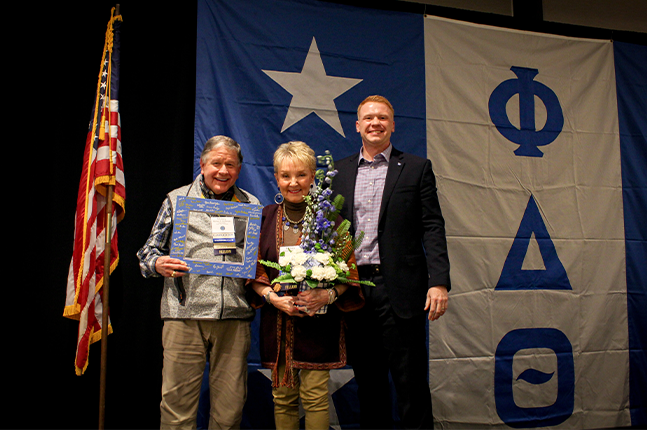
Since its inception, PLC, now endowed and named the McKenzie Family Presidents Leadership Conference, has specifically targeted chapter leaders and often added secondary programming based on chapter operations’ current needs or trends. This conference has helped over 5,000 chapter leaders gain the skills needed to run their chapters. Volunteer summits have coincided with it, focused on house corporation volunteers or chapter advisory board members. Often, recruitment or Phikeia education workshops have been added to invite recruitment and Phikeia education officers whose roles are also very instrumental in the success of each chapter.
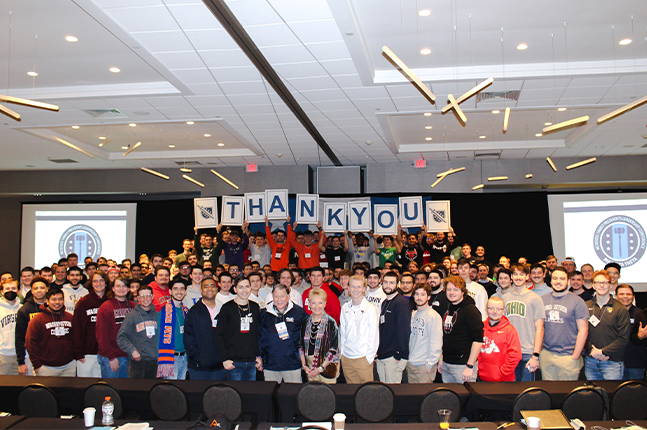
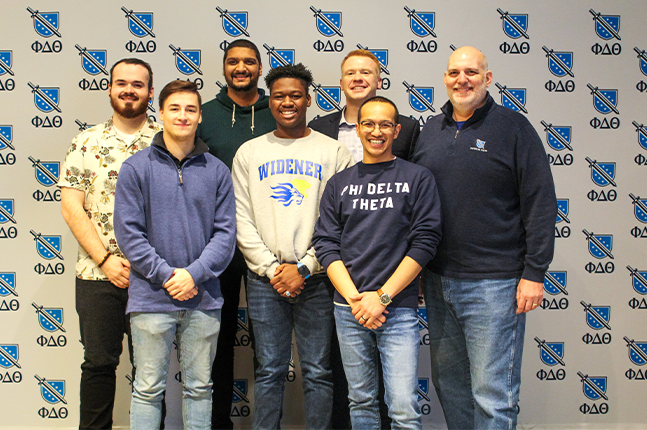
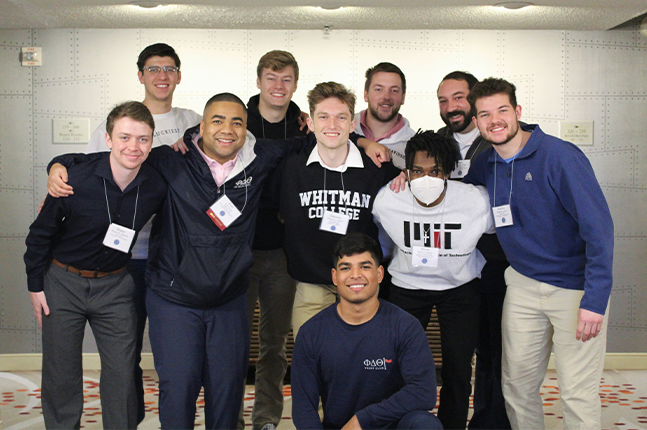
See the following photos from the 2022 McKenzie PLC which was the first in person gathering since the last PLC held in 2020. During the conference, chapter presidents are divided into smaller participant groups to allow meaningful small group dynamics and discussions. Often these men become friends and remain in communication through their undergraduate experience.
The post Historical Phi Delta Theta Gatherings: McKenzie Family President Leadership Conferences appeared first on Phi Delta Theta.
]]>The post Historical Phi Delta Theta Gatherings – Alumni Club Gatherings appeared first on Phi Delta Theta.
]]>The first alumni gathering recorded in the History of Phi Delta Theta was the 1851 Convention in Cincinnati. Ohio Alpha created the event when there were only four chapters. Six of the seven brothers in attendance were from Miami; the other alumnus was from Indiana (Indiana Alpha).
Even though it took a few years to organize and find a use for, the first alumni clubs can be traced to Indiana in 1871, according to the Walter B. Palmer History of Phi Delta Theta.
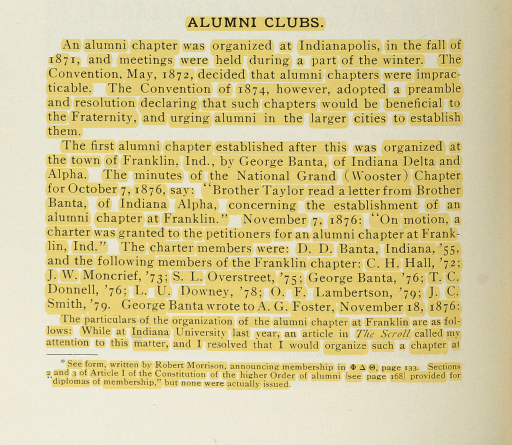
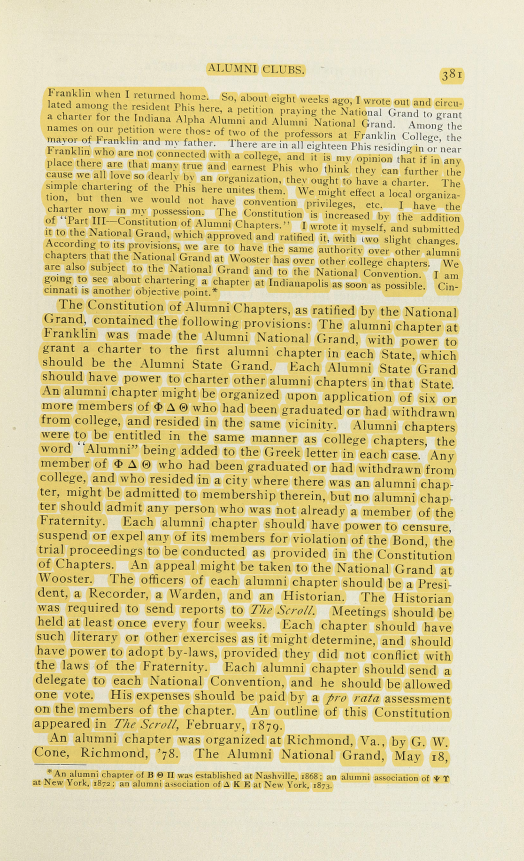

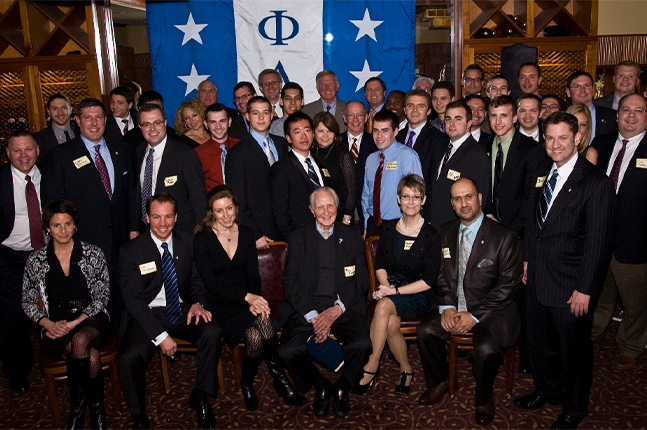
Even though they were deemed at the 1871 Convention to be “impracticable,” alumni club gatherings became so widespread and well-attended that by 1939, fifteen pages of The Scroll were required to cover the various Founders Day events held around North America.
From the 1939–40 Volume 64,
This year’s Founders Day celebrations represent one of its most widely observed Founders Day seasons. From late February until early May, the alumni and undergraduates gathered at dinners, large and small, to pay tribute to the Six Founders and the ideals for which they stand.
Based on actual reports and conservative estimates, there is ground for stating that close to ten thousand graduate and undergraduate Phis this year attended the Fraternity’s traditional annual feast day.
As has been the custom hitherto, there have been many instances in which neighbor clubs joined in the dinner celebration. Again, this year, chapter delegations attended dinners of their nearest alumni clubs.
The observance at Indianapolis was somewhat of a state-wide dinner with nearly 100 percent registration of all Indiana chapters, rolling up a total attendance of nearly five hundred. Something of the same trend occurred at Columbus, Ohio, where, in addition to nearby chapters, the General Council, by virtue of a meeting in that city, attended. The celebration at Charleston, West Virginia, on May 4, literally and officially was state-wide, it being the annual meeting of the West Virginia State Alumni Association, the only organization of that type.
Read more in the complete listing in this issue of The Scroll.
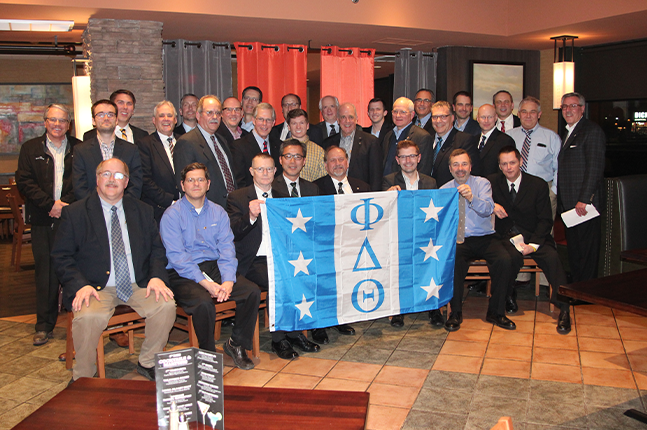
Through the years, alumni clubs have held an important role in the life of Phi Delta Theta. The Fraternity for Life ideal of Phi Delta Theta lives through such alumni events, large and small.

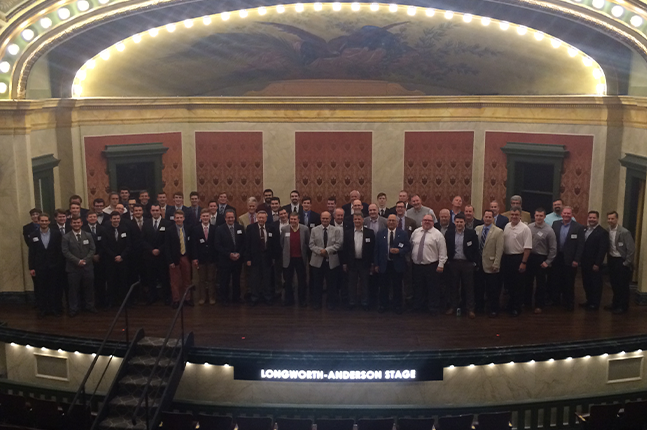
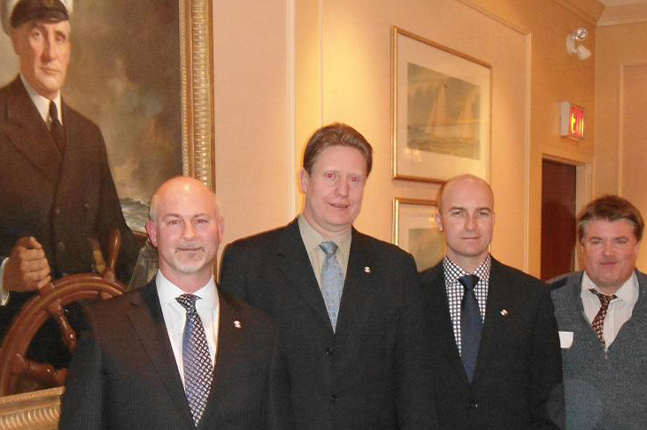
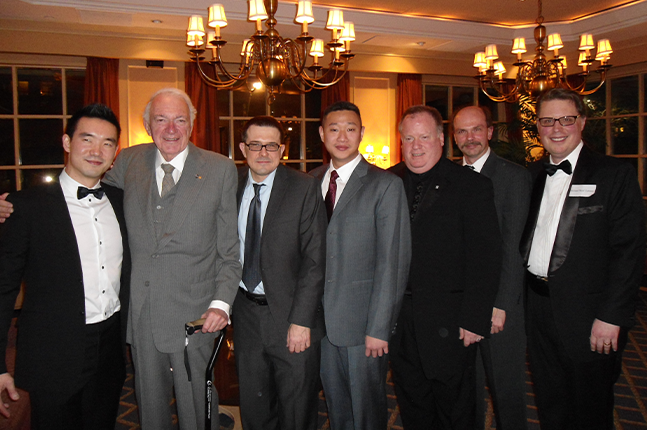
The post Historical Phi Delta Theta Gatherings – Alumni Club Gatherings appeared first on Phi Delta Theta.
]]>The post Historical Phi Delta Theta Gatherings – Leadership College appeared first on Phi Delta Theta.
]]>Tio and Janelle Kleberg endowed the program with the Fraternity’s first-ever $1 million donation are on-site for what proves to be the largest Phi Delt educational conference each year and one of the most impactful for the young and emerging leaders who attend from each chapter.
Upon its inception, the event was called simply Leadership College. It was going to be a flagship conference, at Miami’s campus, for the sole purpose of developing leadership skills for our undergraduate students.
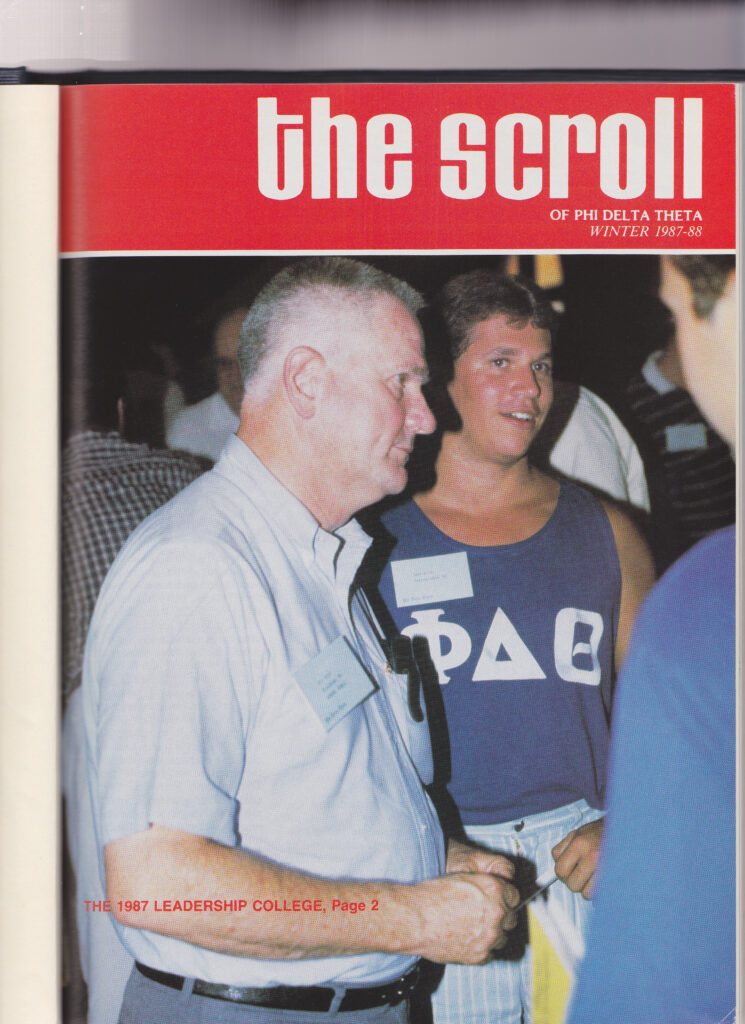
For the first recap written by Robert A. Biggs, Georgia Southern ’76, in The Scroll of the very first Leadership College, see this 1987 issue of The Scroll of Phi Delta Theta for coverage of the earliest known institute, called Leadership College back then.
An additional historical perspective from In the Bond, explains an initiative during the leadership of Robert J. Miller.
This video provides a wonderful overview by volunteers and students about the impact of the Kleberg Emerging Leaders Institute.
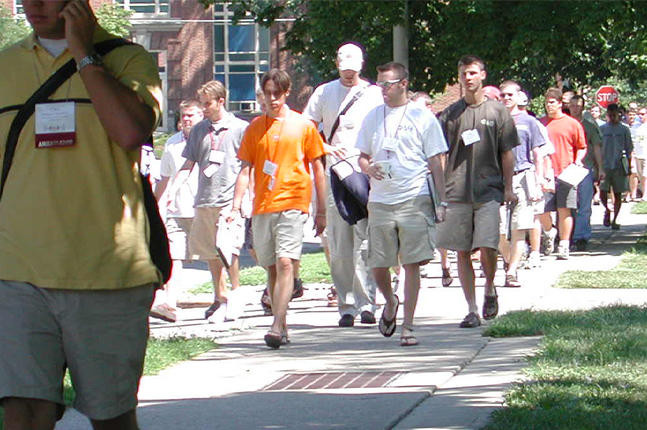
Here are a few 2001 photos and a 2018 group shot of the growing group of Kleberg delegates. We are excited to welcome young leaders back to Oxford this summer for the 2022 Kleberg Emerging Leadership Conference.



The post Historical Phi Delta Theta Gatherings – Leadership College appeared first on Phi Delta Theta.
]]>The post Historical Phi Delta Theta Gatherings – Province Meetings appeared first on Phi Delta Theta.
]]>Today we look back on the history of province meetings. The first mention of utilizing provinces related to the structure of Phi Delta Theta came during the business discussions at the General Convention held in Indianapolis, Indiana, in late October 1880.
During the Thursday, October 28 evening session, The Scroll reports officially “On the motion of Brother Reddig, Brothers Reddig, Parrish, and Owsley were appointed a committee to divide the chapters of the Fraternity into Provinces.”
Later on page 17 of the same edition, the details of the division are adopted.
“Brother Reddig presented the following report, which, on motion, was adopted:
Your committee on Dividing the Chapters of the Fraternity into Provinces recommend the following five Provinces:
Alpha Province, A. C. McCauley, president;
Vermont Alpha, Pennsylvania Alpha, Beta, Gamma, Delta, Epsilon, Zeta, and Maryland Alpha Alumni.
Beta Province, Scott Bonham, president;
Ohio Beta, Delta, Gamma, Epsilon, Delta, Zeta, Eta, Indiana Alpha, Beta, Gamma, Delta, Epsilon, Zeta, Eta, Alpha Alumni, and Beta Alumni.
Gamma Province, Milo C. Summers, president;
Illinois Gamma, Delta and Epsilon, Missouri Alpha and Beta, Wisconsin Alpha, Michigan Beta, and Iowa Alpha.
Delta Province, Lyman Chalkley, president;
Kentucky Alpha, Tennessee Alpha and Beta, Virginia Alpha, Beta, Gamma, Delta, and Epsilon, and Virginia Alpha Alumni.
Epsilon Province, J. M. Barrs, president;
North Carolina Alpha, South Carolina Alpha, Georgia Alpha, Beta, Gamma and Delta, Alabama Alpha, Alabama Beta, Mississippi Alpha, Texas Alpha and Alabama Alpha Alumni.
NOTE: The chapters are given by a list including several defunct chapters.”
J. Reddig, Gettysburg 1877
M. F. Parrish, Ohio 1876
W. W. Owsley Jr., Centre 1882
As early as 1910, we see reports of bi-province meetings, where two neighboring provinces convened to better the Fraternity through joining together and sharing ideas for improvement.
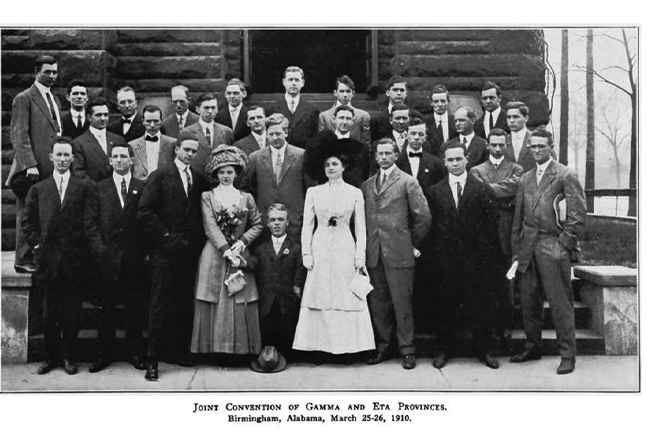
Joint Convention of Gamma and Eta Provinces
For the first time Gamma and Eta Provinces convened jointly on March 25 at Birmingham, Alabama, the great coal, iron, and steel center, and the headquarters of Eta Province. The usual balmy weather that characterizes the South in the springtime made the occasion most pleasant as it gave larger opportunities for outdoor entertainment and sightseeing.
All the delegates arrived on early trains greeted by a delegation from the Birmingham Alumni Club.
The active chapter of the University of Alabama arrived during the day with many visitors from Kentucky, Tennessee, Georgia, and Alabama. The delegates were seated at desks arranged in a semi-circle before the rostrum.
The meeting was called to order at eleven o’clock Friday morning by Monro B. Lanier, president of Eta Province, it having been decided that the two province presidents, W. R. Manier, Jr. of Gamma Province and M. B. Lanier, of Eta Province should alternate at the meetings as president and reporter.
See the full report in an early 1900s issue of The Scroll reporting about an early bi-province meeting held in 1910.
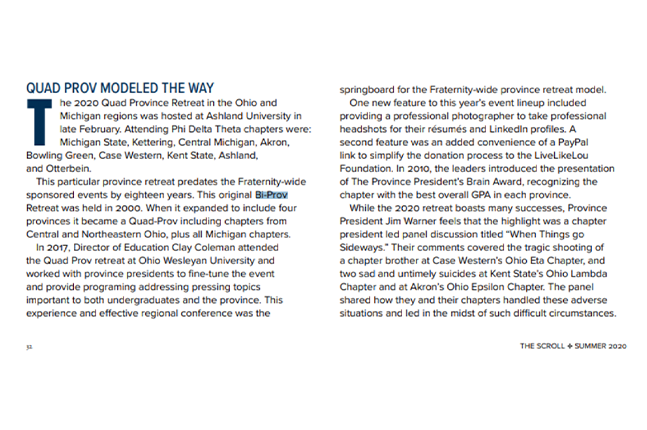
Flash forward to one of the more recent multiple province meetings during 2020 (just before the pandemic), including chapters from Central and Northeastern Ohio, plus all Michigan chapters.
The post Historical Phi Delta Theta Gatherings – Province Meetings appeared first on Phi Delta Theta.
]]>The post Historical Phi Delta Theta Gatherings – Anniversary Gatherings appeared first on Phi Delta Theta.
]]>Excerpted from an email written by Ed Travis (on behalf of John Hammond, both from the initiated class of March 1953), the following is a report of the planning and celebration.
Planning and executing Missouri Alpha’s 150th birthday was not an easy undertaking. Special thanks to the following contributors:
- Bruce Beckett: master of ceremonies
- Matt Beckett and Travis Condict: memorial committee
- Brad Boswell: Friday night host
- John Clark: honored hero and guest speaker
- Chris Crocker: chapter adviser during re-charter
- Mike Ruesler: 150th birthday brochure, flagpole, and memorial construction
- Josh Tagtmeyer: ROTC color guard and Sunday program
- Chris Widmer: dedication director and veterans memorial committee
- Paul Hobbs: American Legion Post, color guard
Friday night, Brad and Martha Boswell hosted Missouri Alpha back in their magnificent home overlooking a lighted Jesse Hall Dome with warm hospitality and delicious food.
After Saturday’s football game, the group met atop the bank’s rooftop bar hosted by Matt Beckett and his wife.
Bruce Beckett masterfully emceed Sunday’s banquet and memorial unveiling and delicately guided us through one emotional moment after another. Nearly one hundred Missouri Alpha undergraduates were in the mass welcoming brigade.
According to alumnus Ed Travis, “Nothing was overlooked, absolutely NOTHING: presentation of colors by the ROTC color guard; the national anthem, sung by undergrad Phi Jack Graham; invocation by the chapter chaplain Matt Boyer; and special introduction of guests including Phi Delta Theta’s General Headquarters Executive Vice President and CEO Sean Wagner and General Council President Moe Stephens. Also represented were the parents of one of our fallen Phis. Finally, each fallen veteran’s name was read during the somber and respectful ceremony.”
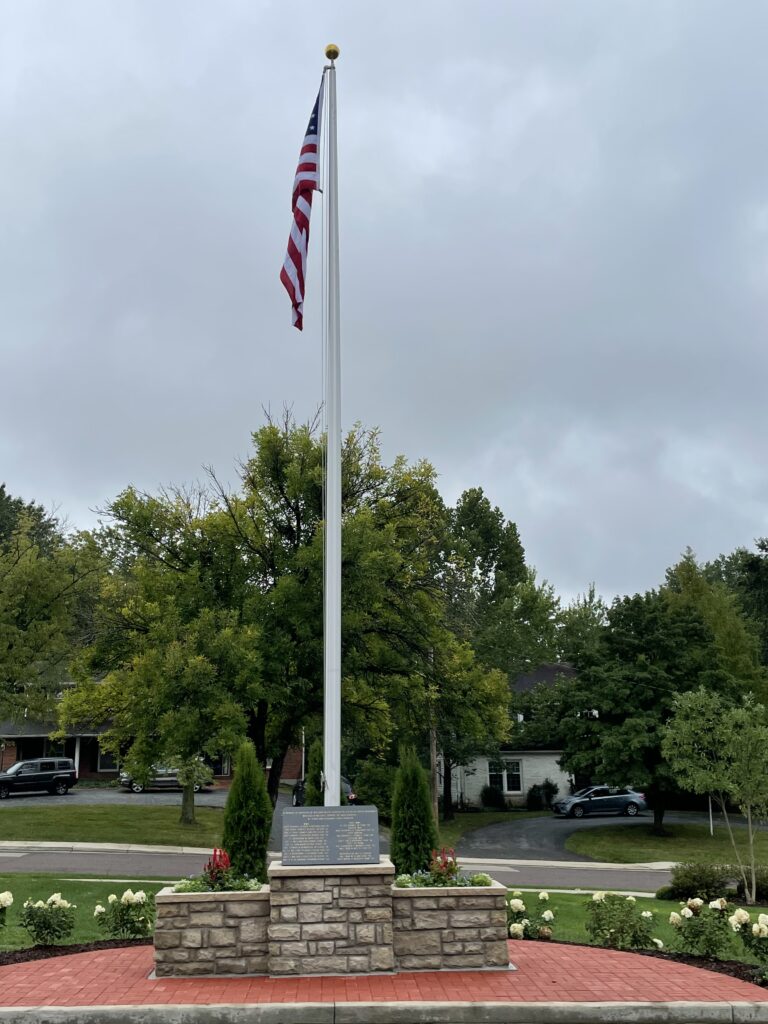
As would be consistent with most military events, the morning ended with a three-round rifle volley by a local American Legion Post #202 and a moving rendition of “Taps.”
Nineteen Missouri Alpha Phis have died while on active duty protecting our country and the freedoms enjoyed therein. Hundreds more managed to avoid the Chapter Grand while serving. One of them was our honored speaker, Colonel John W. Clark, USAF. When this man spoke, everyone listened. A HERO in every sense of the word, Brother John was a Vietnam RF-4C Phantom jet pilot with over eighty combat missions before being shot down in the jungles, captured and imprisoned for six years. A ‘guest’ in the infamous Hanoi Hilton known for its torture and brutality, he endured, survived, and returned to MIZZOU to receive his MBA. There was dead silence, and a tear or two shed with riveted attention while Brother John related personal experiences endured during captivity.
PS: My grandson, Jack Travis Kavanaugh, Bond Number 2926, is a current Phi senior who wears my sapphire and diamond badge. During initiation ceremonies, I surprised and presented my badge to him, after which we hugged and cried and became brothers in the bond.
Chapters with scheduled events and celebrating special anniversaries spring 2022 include:
- Georgia Gamma Chapter at Mercer University is one hundred fifty years old
- Texas Delta Chapter at Southern Methodist University is one hundred years old
- Oklahoma Beta Chapter at Oklahoma State University is seventy-five years old
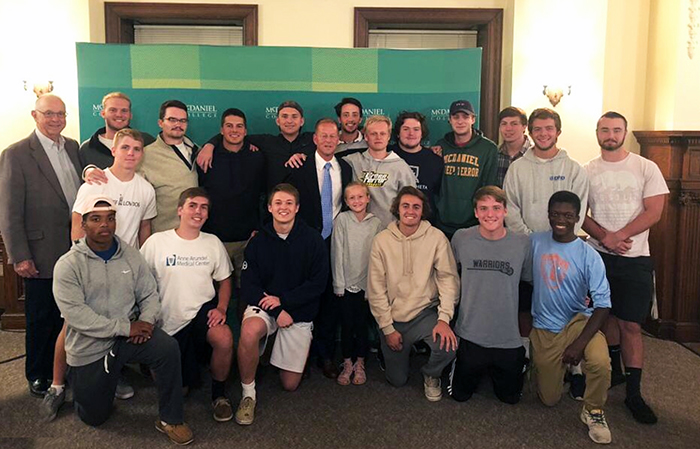
- Maryland Beta Chapter at McDaniel College is fifty years old
- Virginia Eta Chapter at Virginia Tech University is fifty years old
If you would like to read about the many anniversary celebrations in past issues of The Scroll, visit the archives.
The post Historical Phi Delta Theta Gatherings – Anniversary Gatherings appeared first on Phi Delta Theta.
]]>The post Historical Phi Delta Theta Gatherings – General Conventions appeared first on Phi Delta Theta.
]]>“But the earliest Phis realized the importance of keeping lines of communication open and conventions provided this vehicle. The first Convention in Cincinnati in 1851 was called by Ohio Alpha at a time when there were only four chapters…”
Conventions are celebrations of the Fraternity, the coming together of alumni, undergraduates, and special guests to enjoy and commemorate the Fraternity’s successes and look toward the future.
An excellent overview of one of the longest-running traditions of the Fraternity can be found in a 2012 blog post written by then General Council President Scott Mietchen, as it talks about the very first convention and many other customs and traditions which link us to the past.
We hunted our archives at General Headquarters and found these fun photos from earlier General Conventions.
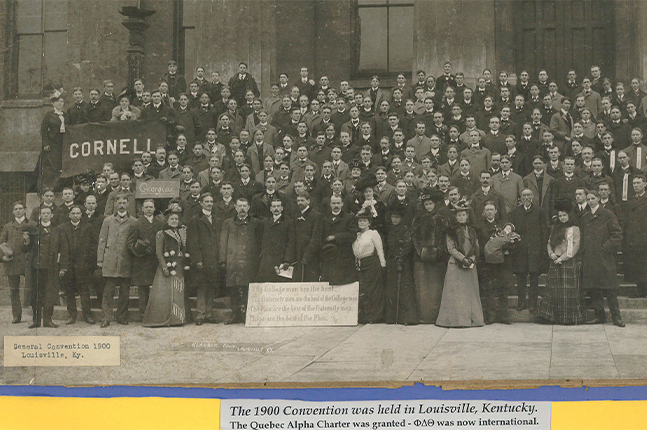
Here is the 1900 General Convention in Louisville, Kentucky, where the first-ever Canadian chapter was approved. Welcome, Quebec Alpha!
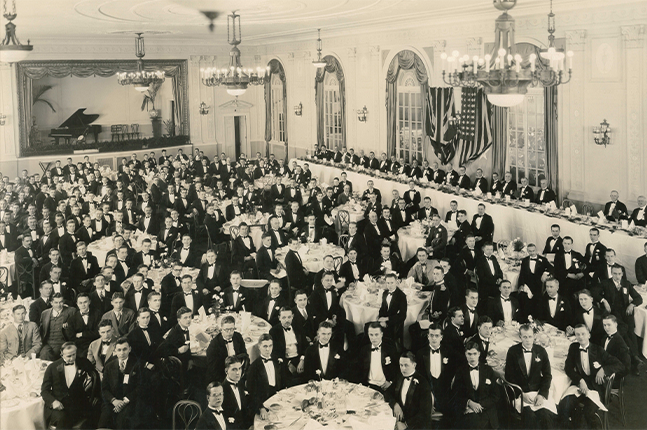
Here is the 1926 General Convention held in Windsor, Ontario.
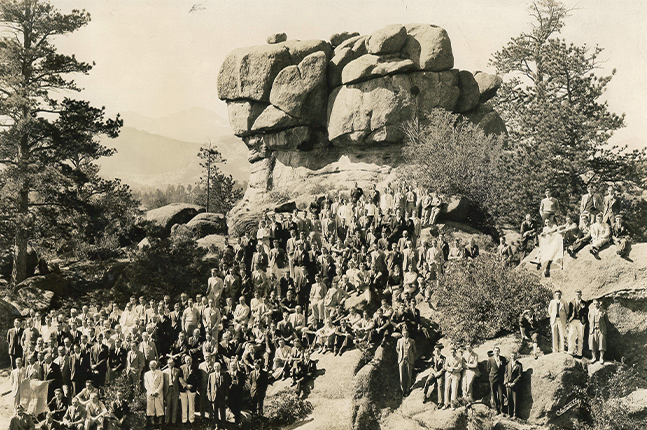
See this 1932 photo of the group of Phi Delta Theta members and guests in the beautiful Colorado Hills.
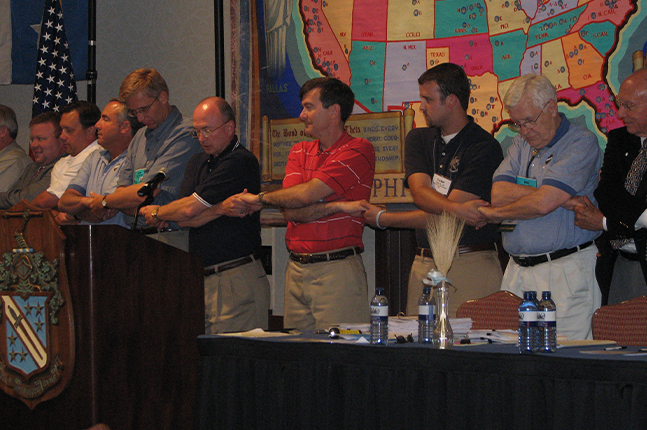
From a General Convention during the twenty-first century, see the 2008 photo of brothers during the closing ceremony of the 77th General Convention in Paradise Valley, Arizona.
The post Historical Phi Delta Theta Gatherings – General Conventions appeared first on Phi Delta Theta.
]]>The post Historical Phi Delta Theta Gatherings – Ground Breakings appeared first on Phi Delta Theta.
]]>Through the years, there have likely been hundreds of groundbreakings attended by Phis and special guests, commemorating new chapter houses or lodges, renovated spaces, war memorials recognizing Phis who have fought and died in various wars, special gates along the sidewalks of several campuses in Ohio, and this very important groundbreaking at the General Headquarters site in the late 1940s.
At the 1948 Centennial General Convention of the Fraternity, there were dignitaries and alumni at the setting of the cornerstone of the new and permanent location of the General Headquarters and Memorial Library at 2 South Campus Avenue.
Retired Admiral Wat Tyler Cluverius, Fraternity General Council president in 1948, placed the cornerstone of the General Headquarters building.
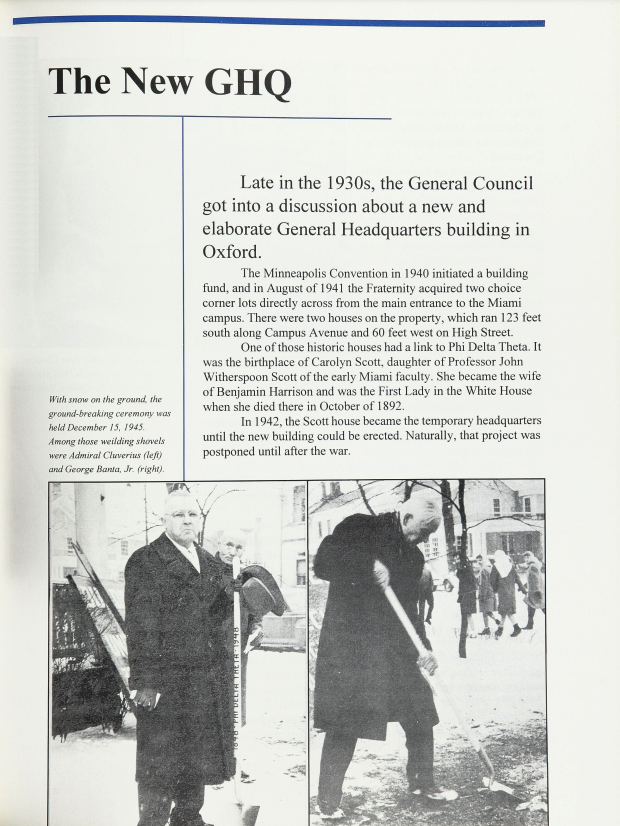

GHQ Today
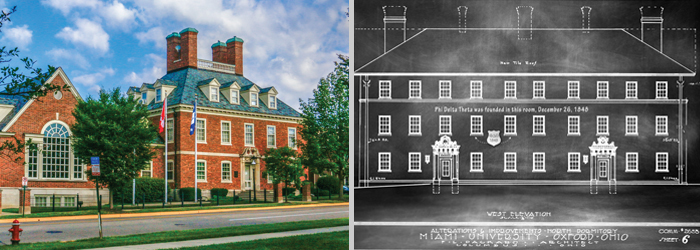
On June 19, 1998, during the Sesquicentennial Convention, another ceremonial groundbreaking occurred with the recent expansion of the headquarters building. The headquarters building resembles the Governor’s Palace located in Williamsburg, Virginia. The goal of the building expansion was to house the Foundation and Fraternity staff together, enabling them to better serve alumni and undergraduate members. This has been achieved, and the remodeling of the existing building has allowed for more efficient use of space. The Paul E. Martin General Headquarters Building is a great source of pride for members of Phi Delta Theta, and it is a cornerstone property between the Miami University campus and the Uptown District in Oxford, Ohio.
Watch our Phi Delta Theta General Headquarters tour, or schedule a day to visit us in Oxford!
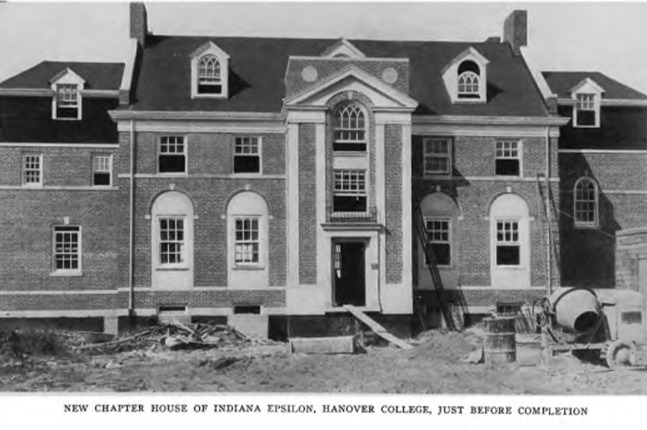
Indiana Epsilon Groundbreaking
One of the earliest groundbreakings reported in the 1931 October edition of The Scroll of Phi Delta Theta, the new chapter house at the Indiana Epsilon Chapter at Hanover College in Madison, Indiana.
One of the most recent groundbreaking ceremonies was at the Benjamin Harrison Presidential Site in Indianapolis, Indiana, where Phi Delta Theta alumni and friends raised more than $50,000 to support the gigantic flagpole that flies the US flag daily and will raise the Phi Delta Theta flag every March 15 to commemorate Founders Day of Brother Benjamin Harrison’s Fraternity, Phi Delta Theta.
The post Historical Phi Delta Theta Gatherings – Ground Breakings appeared first on Phi Delta Theta.
]]>The post Historical Phi Delta Theta Gatherings – The Founding appeared first on Phi Delta Theta.
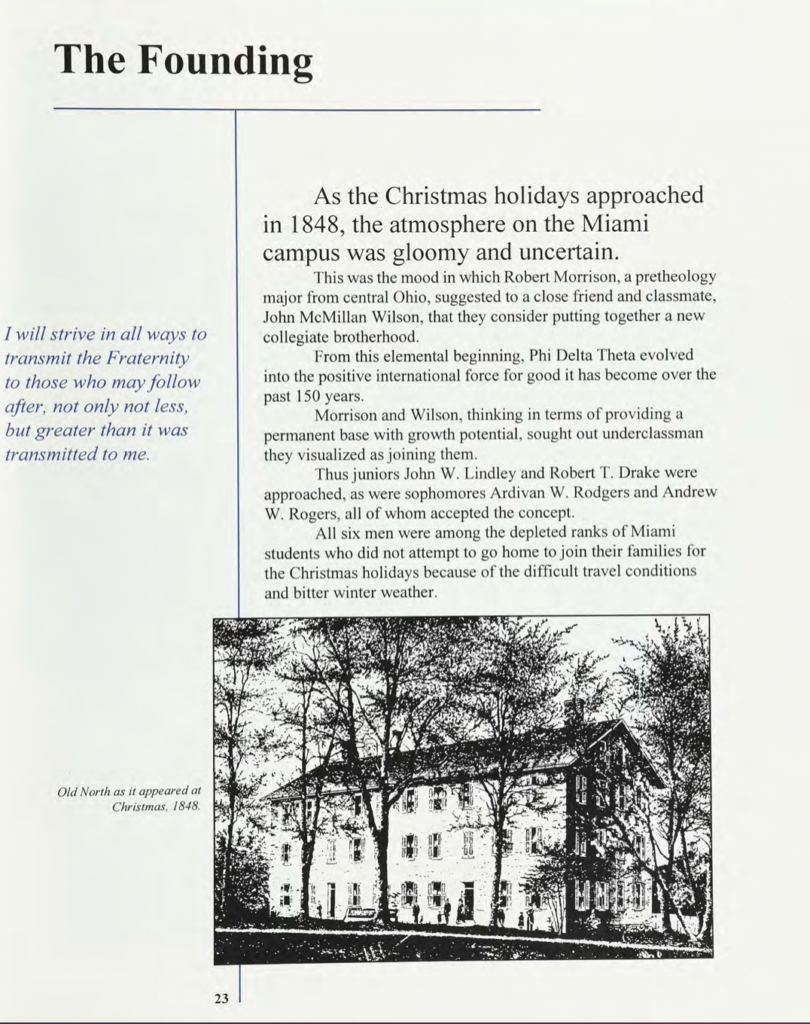
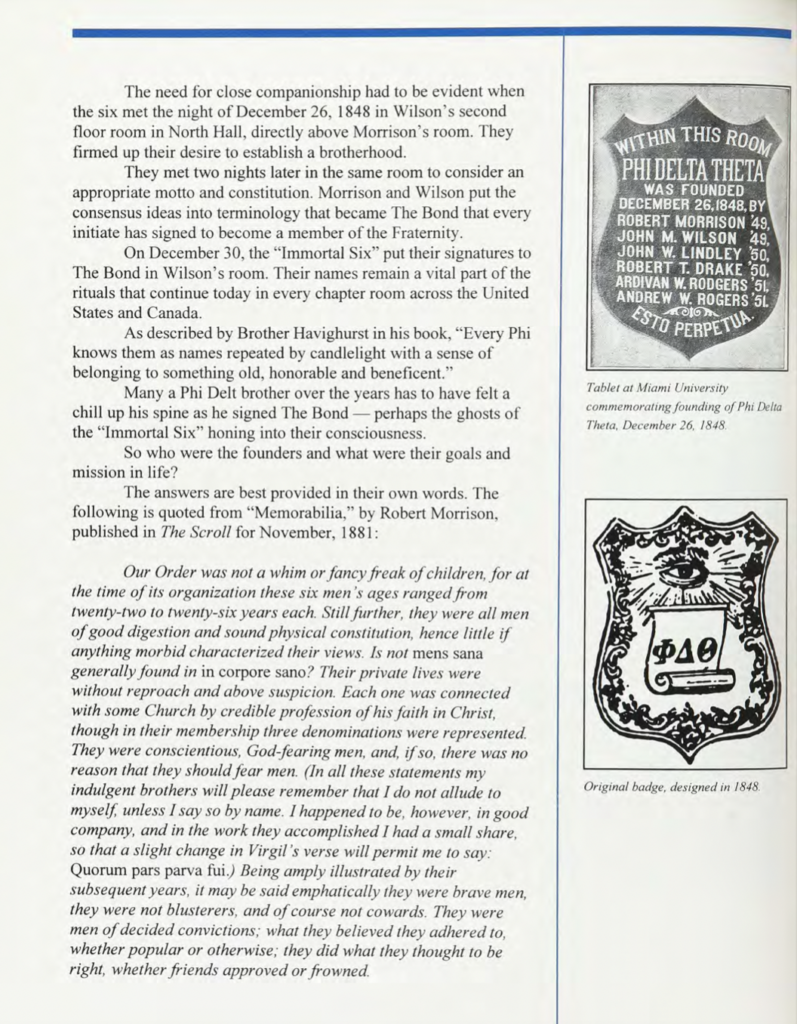
]]>The first and most important Phi Delta Theta gathering of all time is the small and intimate meeting in that second floor dormitory room, on that cold December night in 1848,
“… when the six met the night of December 26, 1848, in John McMillan Wilson’s second floor room in North Hall, directly above Robert Morrison’s room.
They firmed up their desire to establish a brotherhood. They met two nights later in the same room to consider an appropriate motto and constitution. Morrison and Wilson put the consensus ideas into terminology that became The Bond that every initiate has signed to become a member of the Fraternity.
On December 30, the “Immortal Six” put their signatures to The Bond in Wilson’s room. Their names remain a vital part of the rituals that continue today in every chapter room across the United States and Canada.
As described by Brother Havighurst in his book, “Every Phi knows them as names repeated by candlelight with a sense of belonging to something old, honorable and beneficent.””
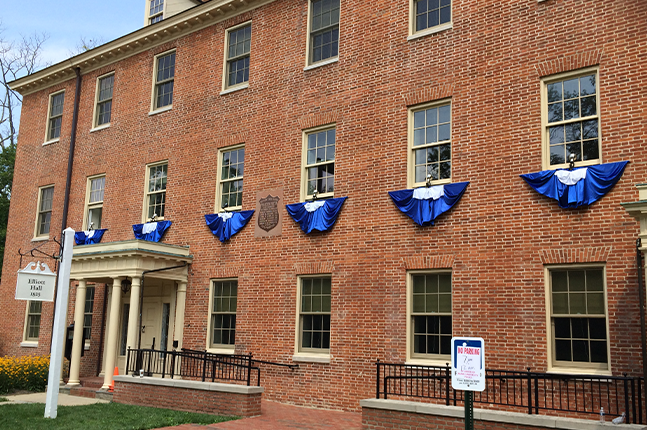
For a more detailed description of the earliest days of the Fraternity’s Founding, see Brother Ritter Collett’s chapter on The Founding in the sesquicentennial anniversary history of Phi Delta Theta, In the Bond.
The post Historical Phi Delta Theta Gatherings – The Founding appeared first on Phi Delta Theta.
]]>The post From Pi Alpha Alpha to Phi Delta Theta – Thoughts from Maryland Beta (McDaniel) Phis appeared first on Phi Delta Theta.
]]>BG Don Schenk, Bond # 2
Joining a fraternity is the most important act of my college experience and remains one of the three most important decisions of my life. For purposes of full disclosure, the other two were, in sequence, a career in the US Army and getting married and becoming a father (while I suppose that is three, let’s not quibble).
In March 1968, I pledged an existing local fraternity founded in 1923 as a leadership organization for Western Maryland College men. Our members made the gutsy decision in October 1969 to seek affiliation with Phi Delta Theta and petition for a charter. For the next two years, I served on the group’s executive board as it navigated and negotiated its way forward. As a chapter officer, I learned lessons in the planning and execution of large group activities, steering the executive team as a chief operating officer of an organization of over seventy diverse (and mostly aligned) peers, and leading the entire organization to achieve a strategic goal. That goal, of course, was becoming the Maryland Beta Chapter of Phi Delta Theta on 24 April 1971.
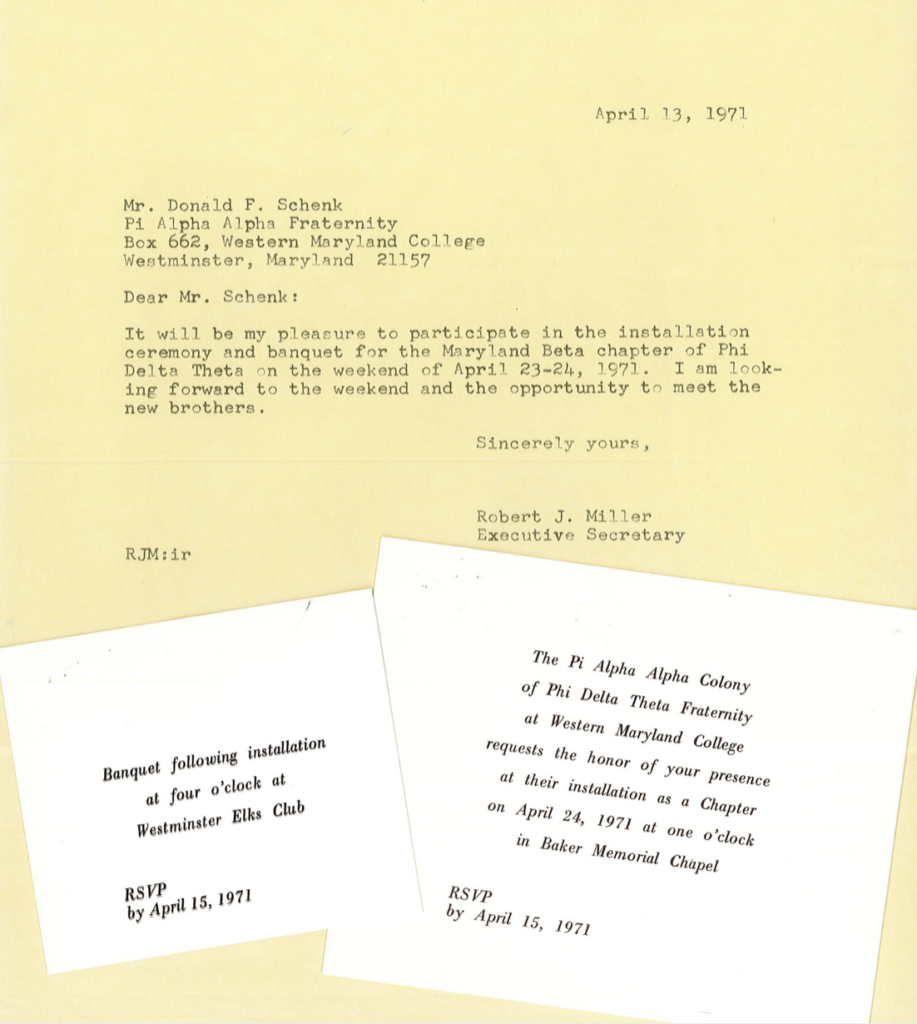
For a look at some of the typical correspondence between an interest group and General Headquarters in 1970, see these letters.
The most memorable experience of my senior year was our installation weekend. We initiated sixty-four new brothers of Phi Delta Theta on Friday, 23 April 1971. Those new members—sixty-one undergraduates and three alumni—gathered the next day for formal chapter installation officiated by Lothar Vasholz, then the recorder of the General Council, with the assistance of Bob Miller, Carl Scheid, Woody Prince, Bill Ross, Marv Perry, and Pat Nolan. Our celebration continued at the installation banquet held at the local Elks Club as a perfect capstone event. Guests included staff and faculty of Western Maryland College (now McDaniel College) as well as brothers from Maryland Alpha, Virginia Delta, Pennsylvania Beta, and the Washington, DC Alumni Club. On Sunday, I had the honor of presiding at the initiation of six more brothers in the bond, bringing our chapter size to seventy Phis.
I often reflect on those days as a young man of twenty-one. Inspiring others in this wildly eclectic group to achieve our shared vision, building consensus among all fraternity and college stakeholders, holding others accountable, and celebrating each success. Additionally, negotiating the bumps—at least one of which was quite remarkable—encountered on the journey.
I often tell others that what I learned as an undergraduate officer of a college fraternity was of far greater and lasting significance and relevance than any formal leadership training that I received during my first ten years in uniform as a commissioned officer in the US Army. It is for that reason that I repay Phi Delta Theta daily by volunteering at the chapter I led in 1971, with my local alumni club in Metro Detroit, and as a faculty member in the best leadership programming I have experienced.
Throughout every memory, it is always the people who have mattered the most and whose continued associations are the most meaningful. That group includes men of every conceivable background and professional experience. From it, I chose my best man. Others have hosted my family on road trips and gatherings in Maryland to which we traveled from our home in Michigan. Fifty years later, our core group gathers biannually to celebrate our friendship and brotherhood while recalling those taken from us too soon.
I lead the current chapter advisory board and am pleased to have Charlie Moore—my predecessor as president, Bond #1 of Maryland Beta, and one of my closest friends—as a board member. Other members of that board from across the decades are now just as close as those who signed The Bond with me in 1971.
The experience as a Founder grounded me in the fundamentals of making informed decisions, of making things happen, and of making a difference. Those fundamentals sustained me through a successful thirty-three-year career in our Nation’s Armed Forces, from which I retired in 2004, having led America’s treasure in tough assignments in peace and combat. They continued to undergird my time as an executive leader in a major defense company and its unique operational challenges with active interests in the US, Canada, the Middle East, and North Africa.
Saying my time as a fraternity man and as a Founder impacted who I am today would be an understatement. The positive and lasting impacts of leading, guiding, directing, mentoring, and accomplishing something that has had meaning for others remain the centerpieces of all I do as a volunteer in service to this Grand Old Fraternity.
Proud to be a Phi!
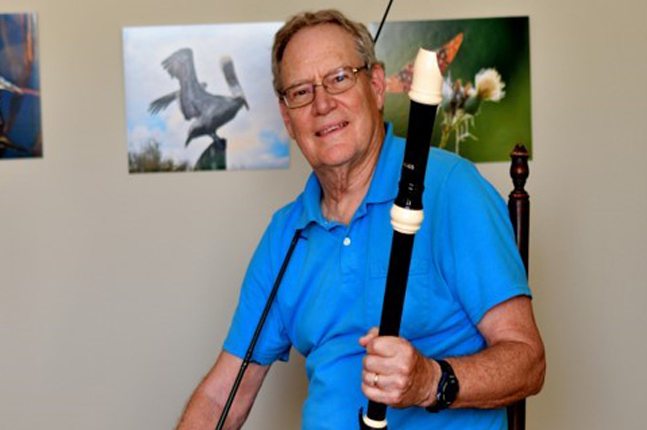
Joseph Powell, Bond # 9
Although the Fraternity had a different name during my first three years at Western Maryland College, it was my brothers’ help that changed my academic direction for the better. I was having real trouble with my genetics class. My roommate, David Moore, persuaded a brother who had taken the course to offer his assistance and stay up nearly all night to prepare me for the final exam. That’s the only thing that got me through that class.
A little later, I realized I was in the wrong major and that my real love was music, like David Moore’s. We were performing music together informally, both vocally and instrumentally, for nearly two years. To make a long story short, I changed my major, and my grades changed dramatically. I graduated with a BS in vocal music education and an honorable mention. Then, I earned an MA, taught music in New Jersey for more than thirty-eight years, and was a finalist for the New Jersey Teacher of the Year in 2003.
There is no telling what would have happened if that one guy hadn’t accepted the challenge to tutor me that night long ago.
Randolph “Randy” Dove, Bond # 44
The brothers from that initial class, and the classes that immediately followed, are my closest friends to this day. Being a part of starting the new chapter remains a strong and special memory but being a part of such a diverse group of individuals made it even more significant. A fraternity for life embodies the relationships we still carry in our lives.
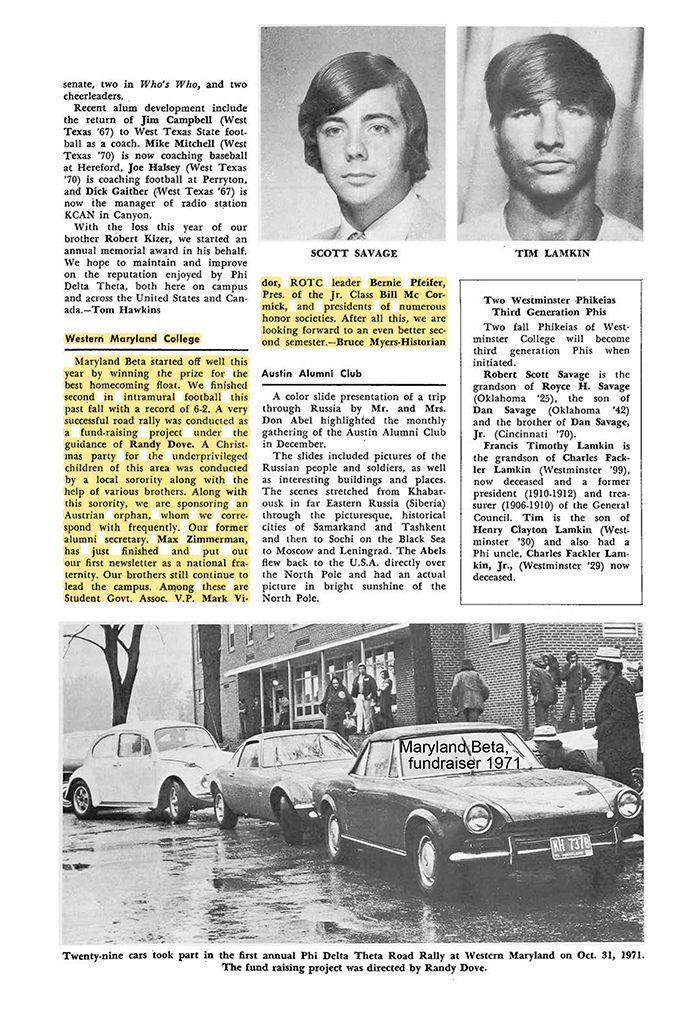
Maryland Beta’s first fundraiser, organized by Randy Dove.
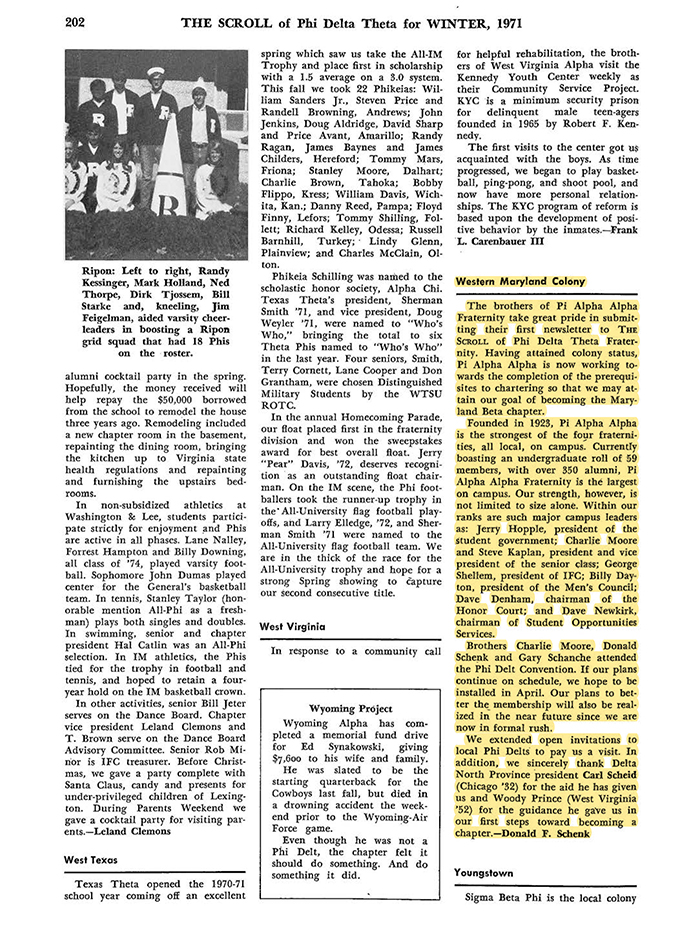
Maryland Beta’s first chapter update in a 1971 edition of The Scroll
Maryland Beta’s Golden Anniversary
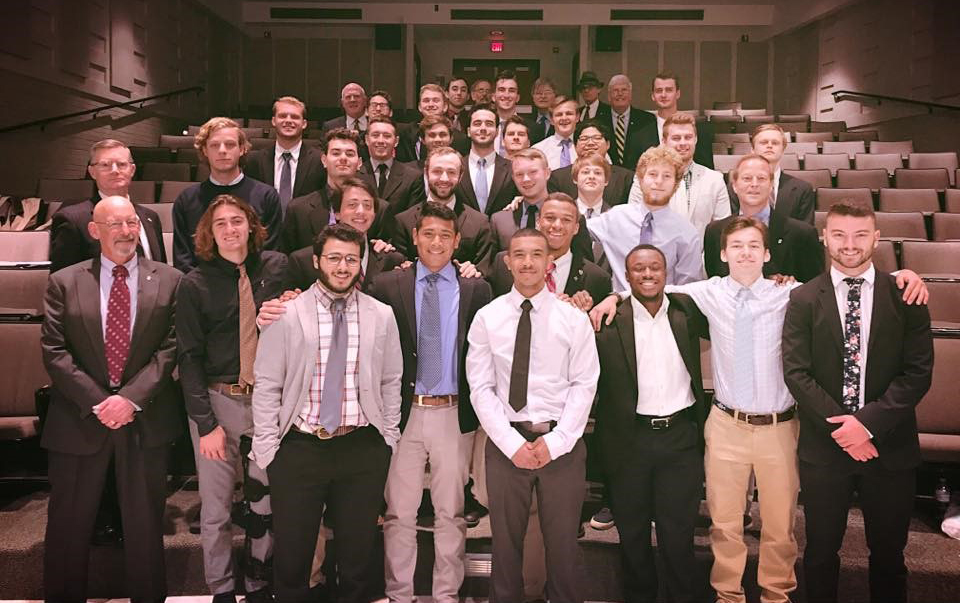
More than fifty years later, this once fledgling emerging chapter, from local fraternity to Phi Delta Theta in 1971, prepares to celebrate its 50th Anniversary. Bond Number 2, Brother Don Schenk, is the current chapter advisory board chairman, showing a full circle of brotherhood and service.
Almost every year, the founders gather to commemorate days gone by while renewing their friendship and brotherhood.
See the chapter’s latest electronic newsletter with details of its upcoming Golden Anniversary.
The post From Pi Alpha Alpha to Phi Delta Theta – Thoughts from Maryland Beta (McDaniel) Phis appeared first on Phi Delta Theta.
]]>The post It’s What Keeps Me Going appeared first on Phi Delta Theta.
]]>In 1968, Eastern Kentucky University’s President Martin didn’t believe in the idea of Greek life; he held that college was for academic purposes, and these social clubs would only hold back the students. With the lack of Greek life flowing through the campus, there was an empty feeling of social life, an essential aspect of the college experience. Campus social life all changed when one man helped create change for the better.
Ralph “Doc” Thompson, one of Eastern’s professors, was asked by a group of his students to be the faculty sponsor of the brand-new fraternity chapter, Phi Delta Theta, and his life was never the same after.
The request was baffling to him because President Martin was still opposed to such groups. Ralph understood the importance of social clubs and their effect on college campuses. “EKU was very much a suitcase campus at the time. All the students went home on the weekends, and Richmond was a ghost town.” He didn’t hesitate to jump on the opportunity to bring life back into the campus.
As these were brand new social clubs for Eastern’s campus, there was no outside affiliation and were no more than a large group of friends coming together. Thompson realized that if these clubs were to have any longevity, there would be a need to bring in official organizations. After many requests from these social clubs to President Martin, the president finally allowed the clubs to petition inter/national fraternities and sororities for affiliation. Doc and his foundling social club asked Phi Delta Theta to authorize their group to induct officially. “In April of 1969, they [General Headquarters] came down and initiated our forty-seven original members as brothers of Phi Delta Theta and initiated me as well even though I was a faculty sponsor as the forty-eighth.”
Leading up to Phi Delta Theta’s founding, Doc’s story starts in small-town South Bend, Texas. He graduated from the University of Texas in 1963 with a physics and chemistry degree. After graduation, he took a two-year postdoctoral research position at Indiana University. Upon its end, he was on the lookout for a teaching position. Though his search found many good opportunities, President Martin offered him a job on the spot after his interview to join the Eastern Kentucky faculty.
“I had several other offers, but coming to EKU has worked out pretty well for me. I think it was all predestined, that everything happens for a reason, and taking this position led me to Phi Delta Theta.”
In becoming a professor at Eastern, Doc prioritized student relationships from the beginning. A chemistry student named Steven Oakenson was in the first class he ever taught. He became the founding president of the Phi Delta Theta chapter. He and Steven shared the idea that for EKU to thrive as a college, there was a need for a social community and Greek societies. When President Martin finally allowed clubs and required each to have a faculty sponsor, Steven immediately came to Thompson and asked him to be his club’s adviser.
Over the years as Kentucky Theta chapter adviser, many experiences and high points have made him proud. In 1986 General Headquarters awarded Doc the Samuel B. Stone award for chapter adviser of the year. GHQ awarded the Phi Delt chapter the Founders Trophy, the highest honor a chapter can receive. “Everything just seemed to come together for us. Yes, that would be my highest point over the last fifty years at this campus.”
The lowest point Doc has ever experienced during his tenure with Phi Delta Theta sadly counterbalanced the highs from 1986. A member of the chapter suffering from severe depression made a decision that would affect Doc for the rest of his life; he chose to end his life. “I knew him very well, he left a recording, and he named me as one of his pallbearers in this tape. I was extremely bothered by it for a long time.”
To this day, at ninety-one years of age, he still gives back to the chapter. He provides tutoring to any student that may ask for help in chemistry or physics. He speaks publicly and provides wisdom to new members of the chapter that may be struggling. He also takes trips all over the world with members of the chapter. “I love to travel, and my brothers take care of me everywhere we go. As my wife is in a nursing home, she is unable to travel. Now I give back to the students by covering the fees on these trips, and it feels good to let them experience life outside of Richmond.”
Doc is a beloved and well-known public figure amongst Greek life members and campus-wide. In April of 2018, Doc received the Student Life Achievement Award in front of hundreds of Greek students. “I’ve been speaking to students for years, so I wasn’t necessarily nervous speaking in front of a crowd. I remember at the awards ceremony, I was worried about getting up the steps onto the stage because there were no rails to get up on the stage, but as soon as I was announced, three brothers instantly got up and helped me make it to the stage. They were right there for me.”
Even though Doc has spent most of his life in Richmond, his kids did not. Most of his family resides in Florida. Although they have been trying to get Doc to move since retiring, he never has. “Phi Delt is a huge reason for never leaving; the support from the chapter has been overwhelming for so many years.”
It’s been more than fifty years with Phi Delta Theta, and Doc hasn’t regretted a moment. “I just think it’s fun; it’s the brotherhood; I enjoy doing things with these guys. It’s what keeps me going.”
More about Doc Thompson
As found in a 2017 nomination for an award by the acting house director of Kentucky Theta—
Ralph “Doc” Thompson is a Phi Delta Theta alumnus at Eastern Kentucky University. Originally from Texas, Doc moved to Richmond, Kentucky, to work at EKU as a chemistry professor. Phi Delta Theta first came on campus in 1969, where Ralph and forty-eight other brothers were the founders. Initiated on April 15, 1969, Ralph Thompson is Bond No. 48.
His love for this brotherhood is like none other.
At the age of ninety-one, whenever possible, Brother Thompson still participates at tailgates, homecoming and often speaks at chapter meetings. Ralph Thompson regularly supports his fellow brothers and invests in their future. For example, because Ralph Thompson understands how much medical school can cost, he wanted to help three recent EKU graduates accepted into Marshall University’s medical school further their education. He gave each a check in the form of a scholarship, which he likes to call the “Doc Thompson” scholarship.
During recruitment week, he speaks with the potential new members, which is a huge influence in getting them to join this great Fraternity. Once initiated, he takes each new member to dinner to get to know them better.
Every year, Ralph Thompson picks two Phis, sends them to Dallas for a weekend, and pays for the whole trip. Academic excellence is also a cornerstone value to Doc. He spends his morning in the school library and tutors his fellow brothers in just about any subject with which they need help.
Doc Thompson always does what ought to be done and is a true inspiration and a great depiction of what it means to be a brother in the bond.
—Award nomination by the KY Theta house director
The post It’s What Keeps Me Going appeared first on Phi Delta Theta.
]]>The post Who Was Ardivan Walker Rodgers? appeared first on Phi Delta Theta.
]]>Brother Rodgers was born in 1824, just north of Oxford in Piqua, Ohio. His parents had eight children, of which Ardivan was the fifth. He enrolled at Miami in 1846, and two years later Ardivan met up with Morrison and Wilson.
Brother Rodgers was a sophomore founder and best of friends with the other AWR, Andrew Watts Rogers. Though not related, the two friends shared the same physique, six feet tall and strong in stature. They were often together on campus, side by side, and easily recognized by their fellow students.
He was known as one of the best-informed men on every subject, a bit brusque, and though sometimes aggressive, always just. The chivalrous Ardivan Rodgers warmed any group with his friendly greeting and an easy smile. He never knew a grudge and often smothered a quarrel.
Brother Rodgers graduated in 1851 and went back home to Piqua to teach. He moved on to St. Mary’s, Ohio and finally taught in Brighton, Iowa. Just eight years after he helped pioneer the great and beloved Phi Delta Theta brotherhood, Ardivan caught Typhoid fever, which was quite common in those days. He was the first to join the Chapter Grand. He is buried in Brighton, Iowa, just south of where the Fraternity’s Iowa Alpha Chapter would be founded in 1871.
Sometimes, years after his early death, undergraduate Phis thought of the noble Ardivan Rodgers while the chorused voices sang:
And when at last,
This life is past,
We’ll join the Chapter Grand.
May luck and wealth,
Life, hope, and health,
Be with the Phikeias’ band.
The post Who Was Ardivan Walker Rodgers? appeared first on Phi Delta Theta.
]]>The post Who Was Andrew Watts Rogers? appeared first on Phi Delta Theta.
]]>Andrew Watts Rogers was welcomed into the world on March 12, 1825 on his parent’s farm near Greenfield, Ohio, equidistant between Columbus and Cincinnati. With his half-brother being a Miami graduate and a citizen of Oxford, he decided Miami would be a favorable place to pursue his education. Andrew was enrolled at Miami for five years, where he was introduced to our great brotherhood.
Rogers was a man of action and thought. Both he and Ardivan Walker Rodgers were tall, strapping, collegiate men. Fellow students were well aware of their friendship.
In 1858 he moved to Illinois to begin a legal practice, encountering Abraham Lincoln and Stephen A. Douglas along the way. Brother Rogers was a major in the Union army in the battles around Jackson, Mississippi. He served as lieutenant colonel (later colonel), where he commanded the 81st Illinois Voluntary Infantry during the Siege of Vicksburg, the Battle of Nashville, and the Siege of Mobile.
After practicing law in Illinois and Missouri, he became a leader in Missouri education, a member of the Missouri legislature, and a special judge in the Circuit Court.
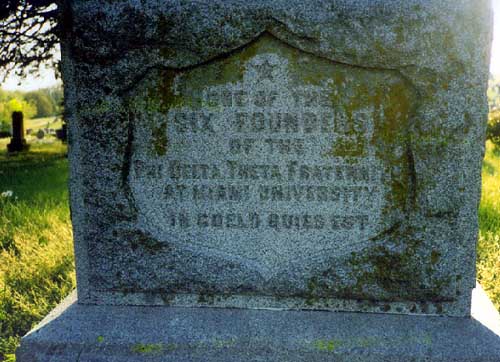
Brother Rogers died of an affliction of the heart in 1901 and was laid to rest in Warrensburg, Missouri, south of Kansas City. Those who knew Andrew remembered him as genial, frank, open-hearted, and a natural teacher.
The post Who Was Andrew Watts Rogers? appeared first on Phi Delta Theta.
]]>The post What Else Happened in 1848? appeared first on Phi Delta Theta.
]]>While December 26, 1848, is meaningful for Phi Delts, many significant events preceded the Fraternity’s birth that year. The United States was growing as a nation. The United States and Mexico ended the Mexican-American War by signing the Treaty of Guadalupe Hidalgo on February 2, 1848. As a result, the US gained the Rio Grande as a boundary for Texas, US ownership of California, and a large area comprising roughly half of New Mexico, most of Arizona, Nevada, Utah, and Colorado. On May 29, Wisconsin became the thirtieth state. On August 14, President James Polk annexed the US-owned portion of Oregon and created the Oregon Territory. The Territory of Oregon originally consisted of the present-day states of Idaho, Oregon, and Washington and parts of present-day Montana and Wyoming.
Human rights advocates were creating turmoil philosophically in the US. Women were asking for the same rights as men. African Americans were working towards emancipation. Countries in Europe were in upheaval as citizens wanted to break the chains of serfdom. Famous men like Wyatt Earp were born, and others like sixth President of the United States John Quincy Adams, and first US multi-millionaire businessman, John Jacob Astor, died.
Gold Rush
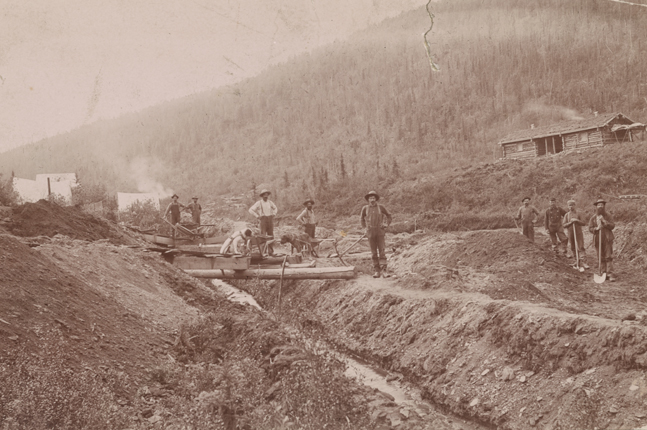
While many may associate the Gold Rush with the “forty-niners,” the excitement began on January 24, 1848, when James W. Marshall found gold in Coloma, California. Marshall, a builder, was overseeing a sawmill’s construction on the American River that ran through Johann Sutter’s property when he spotted flecks of gold shimmering in the ditch he was inspecting. It wasn’t until August 19, 1848, that word of the gold strike reached the East Coast when the New York Herald newspaper ran a story about Marshall and his gold. President James Polk endorsed Marshall’s find on December 5, 1848, before Congress. This confirmation led to masses of people to head to California in 1849 and thereby earning the nickname of forty-niners. Even though Marshall was the impetus to the beginning of the big rush, he died penniless.
Men, women, emancipated slaves, freedom fighters from Europe, all with visions of gold in their pocket, came in search of the California Dream. Over 300,000 people came from around the world, with most fortune seekers from the US, but other large groups came from England, Australia, France, China, and Latin America.
Early miners may have had luck making their fortune, but recent research shows that savvy merchants made the most money, men like Levi Strauss who came west to sell dry goods to the prospectors.
The United States owned California, but it wasn’t even a territory when the rush began. With the sudden influx of population, it became a state in 1850 and, by 1856, had two US senators. The immigration of so many people led to the displacement of native peoples and clashes with prospectors. State agencies sent in militia to protect the miners, and it was a combination of fighting, disease, and starvation that led to a massive decline in the native population. The changes brought to the area known as California are enormous.
The Gold Rush influenced the global economy. Businesses in other countries sent goods for trading, and immigrant miners sent gold home. It led the US to drop silver as currency and only use gold as a standard. It financed the final western leg of the First Transcontinental Railroad (which connected California to the East Coast and transformed a journey that took many weeks or months into days). As California didn’t have enough military men to join the fighting, it sent gold to fund the Union Army during the American Civil War.
Revolutions of 1848
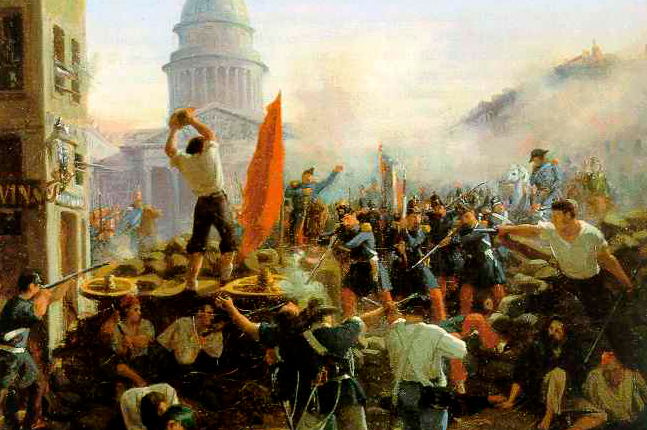
The years 1848–49 saw many uprisings throughout Europe when reformers, the middle class, and workers united in temporary coalitions. Many influencing factors led to these revolts. New technological advances stemming from the Industrial Revolution transformed the lives of the working classes. They began to express political awareness and become interested in new ideas expressed in popular liberalism, nationalism, and socialism. Many peasants and urban poor were particularly hard-hit during years of crop failures and, in particular, the blight of the potato in Ireland, Scotland Highlands, and Northern Europe. Food prices soared, and many starved to death or emigrated. Large-scale unemployment resulted in a lack of demand for manufactured goods, and many people destroyed industrial machines in protest.
Even though the revolutions did not bring about immediate change, over the next few decades, Austria and Hungary abolished serfdom, Denmark ended the absolute monarchy, and the Netherlands introduced representational democracy. Switzerland ended a twenty-seven-day civil war and transformed into a federal state after establishing a federal constitution influenced by both the US Constitution and ideals from the French Revolution. During this year of conflict, the ideals expressed even spread to Latin America, specifically in Columbia, Chile, Brazil, and Mexico.
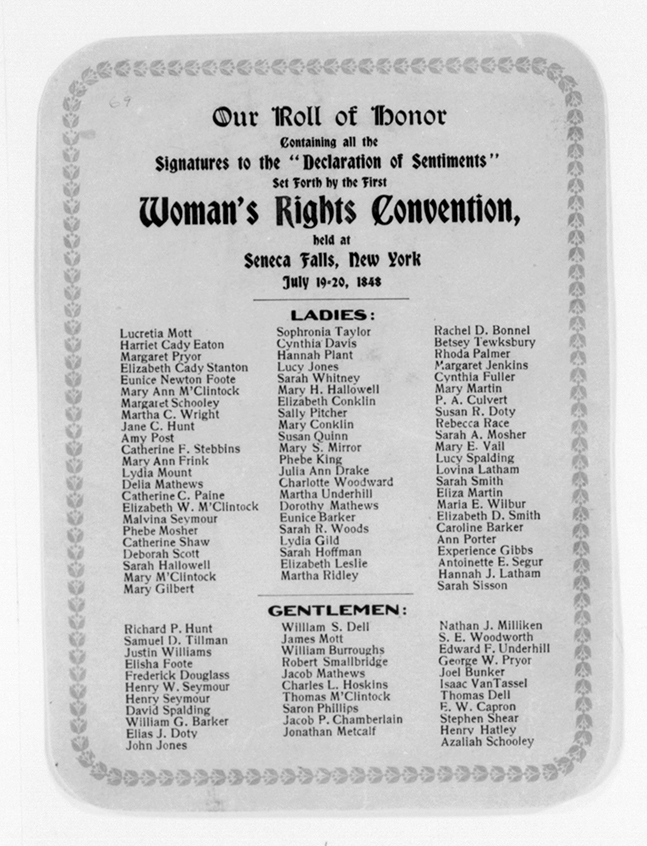
Seneca Falls Convention
The Seneca Falls Convention took place on July 19–20, 1848, and was the first women’s rights convention. The ideas that brought these women (and men) together were women’s social, civil, and religious rights. Many of these items discussed and resolved during those two days led to women’s suffrage. The Women’s Rights Convention took place at the Wesleyan Chapel in Seneca Falls, New York, with over three hundred people in attendance.
The five women who planned the convention were stout abolitionists and ardent supporters of women’s rights: Elizabeth Cady Stanton, Lucretia Mott, Mary M’Clintock, Martha Coffin Wright, and Jane Hunt. The main organizer of the event, Stanton, started off the convention with the following speech:
“We are assembled to protest against a form of government, existing without the consent of the governed—to declare our right to be free as man is free, to be represented in the government which we are taxed to support, to have such disgraceful laws as give man the power to chastise and imprison his wife, to take the wages which she earns, the property which she inherits, and, in case of separation, the children of her love.”
Two days before the convention, Elizabeth Cady Stanton and Mary M’Clintock held a planning session and discussed resolutions that should be discussed and presented for approval. Elizabeth worked with her husband, a lawyer, and wrote the Declaration of Sentiments, which they modeled on the Declaration of Independence. They came up with eleven grievances, one of which was the idea of allowing women the right to vote. Even though her husband was an abolitionist and worked for social justice reform, he did not want his name tied to the resolutions, so he left Seneca Falls before the convention began.
During the two days, the group discussed the eleven resolutions, and attendees voted on each one. They all passed initially except for the ninth issue, which was women’s suffrage: “Resolved, that it is the duty of the women of this country to secure to themselves their sacred right to the elective franchise.” Frederick Douglass was a strong proponent of women’s rights and spoke passionately on the topic. He said, “In this denial of the right to participate in government, not merely the degradation of woman and the perpetuation of a great injustice happens, but the maiming and repudiation of one-half of the moral and intellectual power of the government of the world.” His eloquence convinced a large majority to pass it.
Of the three hundred people in attendance, one hundred people signed the Declaration of Sentiments: sixty-eight women and thirty-two men. The energy created led to several conventions in New York, Ohio, Indiana, and Pennsylvania. But it wasn’t until the nineteenth amendment passed into law in 1920 that women were allowed the right to vote.
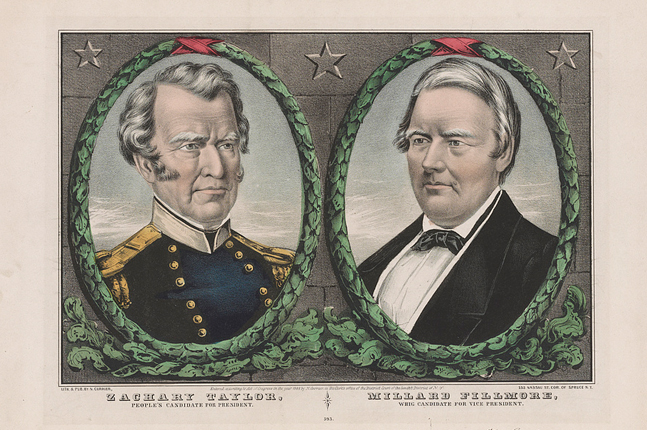
1848 Presidential Election
The 1848 presidential election was a presidential election of firsts. It was the first election held in the United States where every state voted on the same day, it was the first held on a Tuesday, and it was the first in which the two candidates that received electoral votes carried the same number of states. On November 7, Mexican-American War General Zachary Taylor defeated US Senator Lewis Cass. Taylor’s term officially began on Sunday, March 4, with the swearing-in ceremony the following day, March 5, due to religious concerns. He died the next year in office on July 9, 1850, and Vice President Millard Fillmore became the thirteenth president.
The post What Else Happened in 1848? appeared first on Phi Delta Theta.
]]>The post Who Was John Wolfe Lindley? appeared first on Phi Delta Theta.
]]>Fourth of the Immortal Six and junior John Wolfe Lindley might have shared this about himself if he were speaking to us today.
“I was born in Fredericktown, Ohio, in August 1826. Even though my humble place of birth lay between what was to become Ohio Beta at Ohio Wesleyan University and Ohio Delta at The College of Wooster, I decided to attend Miami University in the fall of 1846. I was a third cousin to Robert Morrison, so perhaps Robert had no choice but to include me in this great brotherhood experiment. When the six of us gathered that day after Christmas in 1848, I was the youngest of the lot.
I completed my studies in 1850 and began teaching Latin and mathematics at an academy in Tennessee. Later, I moved on to Charlestown, Indiana, where I graciously accepted an invitation to become a member of the Masons. However, Phi Delta Theta was always closest to my heart. Founding Father Morrison and I were known to have stayed up until the wee hours of the morning at the 1898 Convention banquet and 1899 Semi-Centennial debating our Fraternity’s direction and the news of the day. Robert could probably be credited with my fluctuation in political views as he was a Democrat. I was a Whig, a Republican, and even a “know-nothing” for a time. I wrote copies of The Bond of Phi Delta Theta until the year of my death in 1907, some still in use today. As it turned out, I outlasted the rest of my Immortal Brothers.”
Seen as a gentleman, tender, professorial, teacher, and eventual college president, John Wolfe Lindley had an open, responsive, and wide-ranging mind. A man of mild manner and balanced judgment, he always thought before he spoke. He seems to belong to the fireside on a winter night, and we can picture him now, making his points in deliberate, well-chosen words while the firelight plays on the faces of his friends. Lindley had a fruitful life.
For more than fifty years, he held offices in colleges and churches in Ohio, Indiana, and Kentucky. The longest-lived of the founders, he laid the cornerstone of the Memorial Chapter House at Miami on the day before Thanksgiving in 1907.
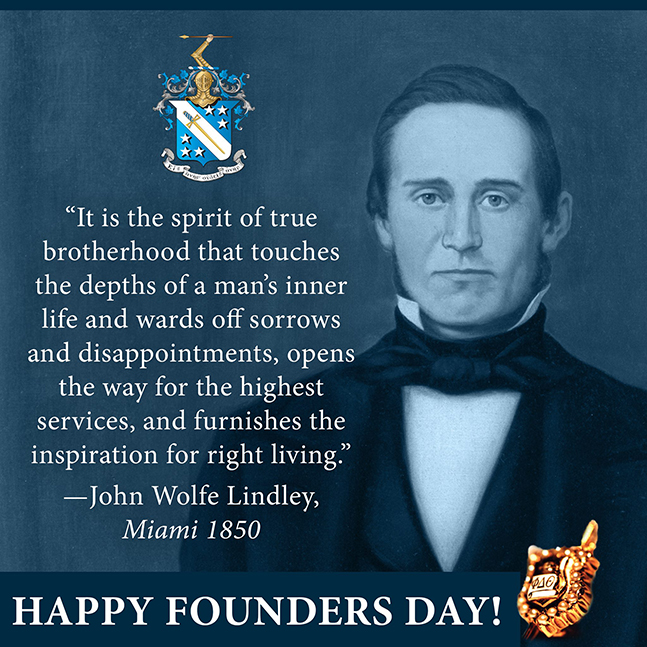
Phi Delt Fact
Have you ever wondered why we call Phi Delta Theta a General Fraternity? See this 1971 post from The Scroll.
Support the Heritage Fund!
Take the opportunity to honor the Phi Delta Theta heritage this month by making a contribution in support of our General Headquarters building in Oxford, Ohio. Donate at one of our five levels to receive your Founders Day gift!
The post Who Was John Wolfe Lindley? appeared first on Phi Delta Theta.
]]>The post Phi Delta Theta During A Crisis: World War II appeared first on Phi Delta Theta.
]]>An estimated 12,233 initiated members of Phi Delta Theta served in World War II, 559 killed in action.
From Six at First history by Walter E. Havighurst, Ohio Wesleyan ’23
On Sunday afternoon, December 7, 1941, in the hundred chapter houses undergraduate Phis were lounging by the fireside when radio programs were interrupted by an astounding news bulletin. Without warning Japanese naval and air forces had struck Pearl Harbor Naval Base in Hawaii. Of the eight battleships at Peral Harbor three were sunk, one was grounded, one capsized, and three were severely damaged. On December 19 Congress extended military conscription to men of age 20 to 44. In the chapter houses young men packed their bags for Christmas vacation, wondering how the second World War would shape their future.
In January 1942, hundreds of colleges announced a list of war emergency courses for the new term. Such offerings as meteorology, navigation, cartography, signaling and communications, and production management were designed to prepare students for service in war industry and in the armed forces.
At the 1942 General Convention in Chicago, Brother George Housser, McGill ’06, was elected to the General Council. Former province president, this rugged man, bronzed and crew-cut, had an outdoor look, offering a ‘steady hand to seer our ship in these sullen, troubled times.” Also, at convention, magnetic, white-haired Hilton U. Brown, Butler ’80, last of the patriarchs and the first two-term president of the Fraternity, spoke to a hushed convention hall. He told of the long line of Phis, many now in distant zones of war. “But the line,” he said, “will not be broken, because the Fraternity’s life is continuous, with a mystic cord binding one generation to another.
During the war’s first winter students began enlisting in military units. Others joined volunteer training programs. Within months, military officers arrived on many campuses to set up basic training for the Army, Navy, and Air Corps. Thousands of Phis enlisted in these units.
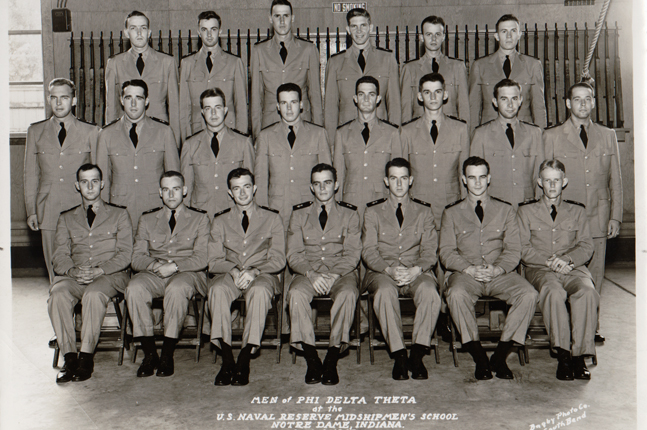
To Phis in uniform, chapter newsletters told what was happening on campus and brought word from members in the armed forces. Miami alumnus, Harry Gerlach, ’30, sent the bi-monthly Fighting Phi News. This mimeographed sheet became an exchange of experience, of memories, and of military addresses. It enabled men to find each other in distant camps and bases and led to some rare reunions in strange parts of the world. To more than two hundred Phis from the classes of the 1930s and 40s, this newsletter kept a gleam of fraternity in the long night of war.
The Fighting Phi News was sent to men in flight training, on island beachheads, on naval vessels, in military schools, hospitals, and prisoner of war camps.
By September 1944, medically discharged veterans were returning to the colleges from war. Many spent months in military hospitals before returning to civilian life. In a college editorial, one of the veterans spoke for all. “It is a long way from bullets to books—a long way. The soldier in combat has seen how cheap life can be. He knows how precious it is… The returned student veteran had a part in shaping the future. He knows that this new role of student is not only the greatest of all privileges but is also an obligation born of the blood of men he has known who have perished in battle.”
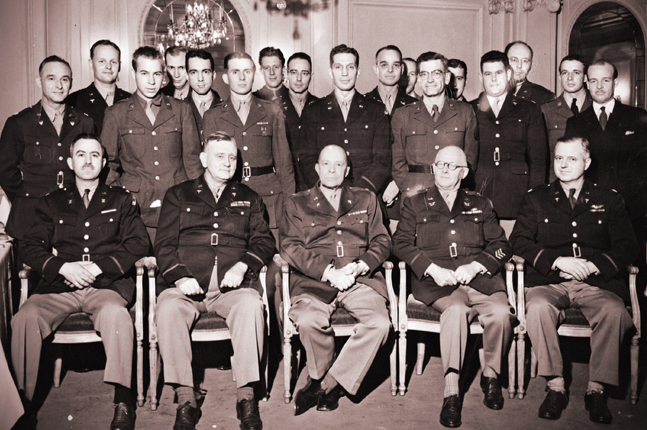
In WWII Phi Delta Theta contributed 12,233 men to the military forces. They served in all ranks, from seaman and private to four-star general. Among Phi leaders in the war were John Edwin Hull, Miami ’17, Commanding General of Army Forces in the Pacific; Major General Paul R. Hawley, Indiana ’12, Chief Surgeon, European Theater of Operations; Major General Edward P. King, Georgia ’05, artillery commander in the Philippines; Major General Charles P. Hall, Mississippi ’09, commander of the XI Corps in the South Pacific; Vice Admiral Robert P. Ghormley, Idaho ’03, commander of naval forces in the Southwest Pacific; Rear Admiral Wat Tyler Cluverius, Tulane ’95, recalled from retirement to head the US Navy Production Board.
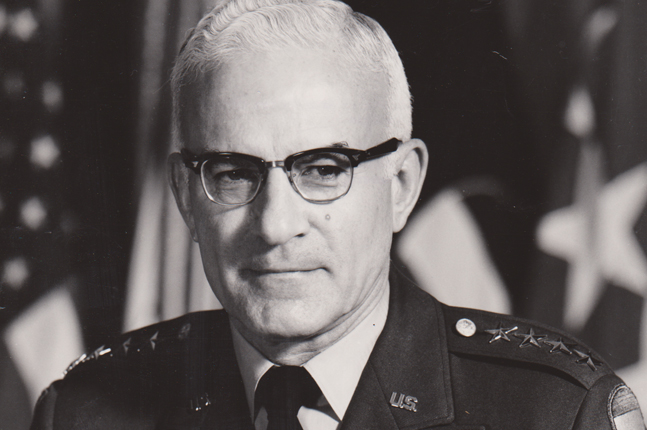
General Bernard William Rogers, Kansas State
Bernard William Rogers, Kansas State, was a United States Army general who served as the 28th Chief of Staff of the United States Army, and later as NATO’s Supreme Allied Commander, Europe and Commander in Chief, United States European Command.
Besides the Distinguished Service Cross, Rogers’ decorations included the Defense Distinguished Service Medal, the Silver Star, four awards of the Legion of Merit and three awards of the Distinguished Flying Cross.
Foremost civilian officials were Robert P. Patterson, Union ’12, Secretary of War; Elmer Davis, Franklin ’10, head of the Office of War Information; and Fred M. Vinson, Centre ’09, Director of War Mobilization and Reconversion.
Phi Delta Theta lost 559 men killed in action. The first Phi casualty came in the opening hour of the war. Ensign William Manley Thompson, North Carolina ’41, went down with the USS Oklahoma in the attack on Pearl Harbor. The last casualty was Vice Admiral John S. McCain, Mississippi ’05, commander of carrier task forces in the Pacific, who died of a heart attack brought on by stress and exhaustion the day after his return from the formal surrender of the Japanese in Tokyo Bay.
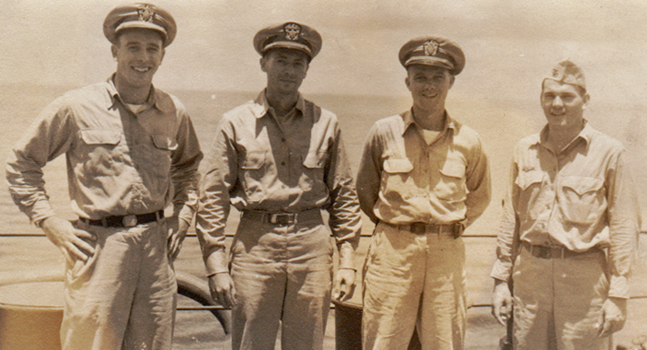
(L-R) Warren L. Rockwell, Miami ’42; A. B. Herndon, JR., Florida ’42; L. L. Fergus, Louisiana ’42; James R. Nuzum, West Virginia ’40.
The claim for being the fightin’est alumni chapter afloat was made by the above foursome while aboard a US Navy warship during the operation to capture Peleliu Island from the Japanese. Rockwell is attached to a mine demolition team, while Herndon is an officer on a fast destroyer transport. Fergus is a gunnery officer on a battleship and Nuzum, a shipmate, is a scout-observation pilot.
All four Phis held Lieutenant, Junior Grade rank in the US Navy.
Phi Delt Fact
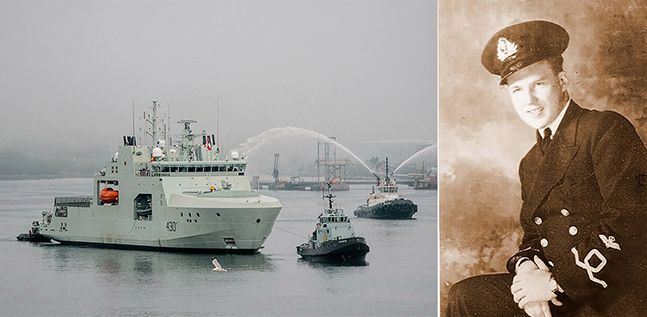
Royal Canadian Navy pilot Robert Hampton “Hammy” Gray, VC, DSC British Columbia ’40, was a Canadian naval officer, pilot, and recipient of the Victoria Cross (VC) during World War II. Gray is the last Canadian to be awarded the Victoria Cross.
On Aug. 9, 1945, Brother Gray led two attack flights of Corsair aircraft against enemy naval vessels in Onagawa Bay and was hit by anti-aircraft fire.
With his aircraft in flames, and one bomb lost, he continued the attack and released his remaining bomb on the escort vessel Amakusa, causing the ship to capsize and sink.
Gray’s aircraft crashed into the sea and his body was never recovered.
The navy recently welcomed the first offshore patrol ship, HMCS Harry DeWolf, into service at a ceremony in Halifax, five years after the Irving shipyard started cutting steel on the vessel. The patrol ship was named in honor of Robert Hampton Gray.
Support the Heritage Fund!
Take the opportunity to honor the Phi Delta Theta heritage this month by making a contribution in support of our General Headquarters building in Oxford, Ohio. Donate at one of our five levels to receive your Founders Day gift!
The post Phi Delta Theta During A Crisis: World War II appeared first on Phi Delta Theta.
]]>The post Why is Phi Delta Theta’s Founders Day on March 15? appeared first on Phi Delta Theta.
]]>IV. History of Phi Delta Theta
Robert Morrison’s birthday, March 15, was established in 1910 as Founders Day.
We believe March 15 became Founders Day because the fateful first meeting of the Immortal Six in Elliott Hall, December 26, was too close to the holidays for a convenient annual celebration. Robert Morrison is the original Bond No. 1. Therefore, his birthday is the annual Founders date of celebration.
Many alumni clubs and chapters meet on this date to honor the founders and celebrate the occasion with special ceremonies.
Silver, Golden, and Diamond Legionnaires
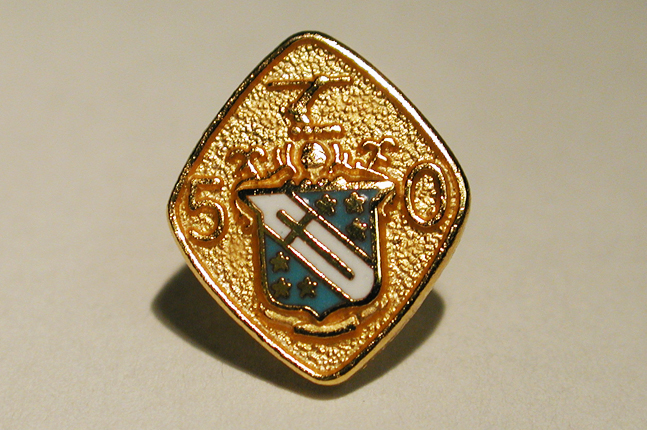
Members who have been Phis for 25 years are inducted into the Silver Legion. Members who have been Phis for 50 years are honored as Golden Legionnaires. Ceremonies inducting these alumni into the legions can be performed at Founders Day celebrations. Each legionnaire is given a lapel pin acknowledging his years of devotion to the Fraternity.
Every five years after becoming a Golden Legionnaire, members are also honored as “Palladians.” Palladians receive a pin inscribed with years since initiation, 55, 60, 65, or 70. Members who have been Phis for 75 or more years are Diamond Legionnaires.
Phi Delt Fact
From Miller’s Meanderings
The first fraternity founded at Miami was Beta Theta Pi in1839, followed by Phi Delta Theta in 1848, and Sigma Chi in 1855. (Actually, Sigma Chi’s founding name was Sigma Phi until the members learned that a fraternity by that name had been established at Union College in 1827.) The three became widely known as the “Miami Triad” just as the first three fraternities founded at Union College became the “Union Triad.”
From Walter B. Palmer’s, The History of Phi Delta Theta,
“Phi Delta Theta was the first fraternity to enter the States of Texas, Wisconsin, and Nebraska. In entering Texas, it was the first fraternity to cross the Mississippi River. When Phi Delta Theta entered Indiana University and Centre College, Kentucky, there were no other fraternities in those states, the chapter of Beta Theta Pi there being suspended. Phi Delta Theta was the pioneer fraternity at Wisconsin, Northwestern, Indianapolis, Franklin, Nebraska, Vanderbilt, Texas, and Stanford; and in point of continuous existence, it has the senior chapters at Miami, Indiana, Central (formerly Centre), Wabash, Missouri, Knox, Mercer, Alabama, Lombard, Auburn, and Washington.
Support the Heritage Fund!
Take the opportunity to honor the Phi Delta Theta heritage this month by making a contribution in support of our General Headquarters building in Oxford, Ohio. Donate at one of our five levels to receive your Founders Day gift!
The post Why is Phi Delta Theta’s Founders Day on March 15? appeared first on Phi Delta Theta.
]]>The post Phi Delta Theta During A Crisis: The Great Depression appeared first on Phi Delta Theta.
]]>The Good Ship Phi
In the summer of 1930, James E. Davidson, Hillsdale ’87, co-chairman of the convention committee, chartered the S.S. Eastern States, September 2–6, for the thirty-ninth convention of Phi Delta Theta.
This was the second summer convention of the Fraternity and the most festive and congenial. The conclave opened in Detroit in the ballroom of the Hotel Statler. After a business session, the delegates accompanied by wives and visiting Phis streamed down to the big steamer at the foot of Wayne Street. Gleaming with fresh paint and polish, the Eastern States wore along her middle deck long streamers of Phi Delta Theta white and blue.
At 3:00 p.m., the deep whistle blared. An orchestra struck up on the main deck, and the ship steamed through the river toward Lake Huron. At 4:00 p.m., a convention summons brought delegates to the assembly hall arranged on the main deck forward. After a festive dinner and another business session, Phis strolled in September moonlight with a fresh breeze blowing.
The next morning, they voyaged up the winding, island-strewn St. Mary’s River, and after a business meeting, delegates lined the deck to watch big freighters coming down from Lake Superior. From the Sault Ste. Marie wharf a hundred motor cars took them to the Soo Locks and around the historic town. Many crossed by ferry to Sault Ste. Marie, Ontario, where Canadian flags fluttered a welcome.
This unique convention, through international waters, had enlarged the Fraternity’s northern horizon. Of five charters granted, four went to new chapters in Canada. Phi Delta Theta now entered the University of Alberta, the University of British Columbia, Dalhousie University, and the University of Manitoba.
The years ahead, darkened by depression and war, saw just four new chapters established between 1932 and 1946. But 1930 was a triumphant Canadian year for the Fraternity.
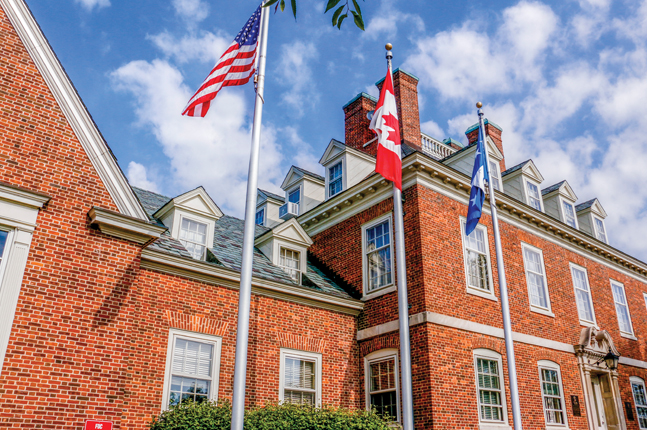
General Headquarters Today, Showing Off Its International Pride
Budgets Tighten
The eight issues of The Scroll (1931–1932) made up a slender volume, as the magazine’s size was barely half in recent years.
Wrote the editor: “Depressions have a habit of impartiality which spares no one, not even the old and well-established college fraternities. Financial caution has decreed that The Scroll must do its part in helping with fraternity economy.” In colleges, enrollment was down, budgets were tight, and austerity dampened student social life.
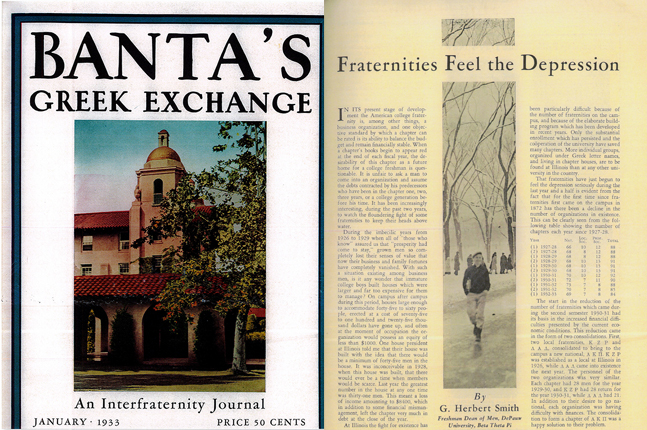
Banta’s Greek Exchange
Being Tested
George Riddle Banta, Sr. Indiana ’1876 (initiated at Franklin College) was the founder of the George Banta Company (later the Banta Corporation) and an influential figure in the development of the collegiate Phi Delta Theta Fraternity and Delta Gamma women’s Fraternity.
For many years he published Banta’s Greek Exchange, a monthly review of fraternity and sorority news. In a January 1933, an article on “Fraternities Feel the Depression” pointed to fraternities’ financial problems across the country. On many campuses, chapter houses were unpaid for, mortgaged, and under-occupied. Local organizations were the first to go under, and some of the newer national fraternities collapsed. In this stress, many colleges began providing financial advisors to fraternities, supervising budgets and accounting methods, and cooperating on dormitory and chapter house occupancy.
In Phi Delta Theta, as in other established fraternities, there was a rallying of alumni support for the active chapters. An alumni symposium in The Scroll (April 1932) acknowledged the threats of depression while re-asserting Phi Delta Theta’s firm foundations. Led by Past President Frank J.R. Mitchell, Northwestern ’96, more than fifty eminent alumni members affirmed the theme “Once a Phi, Always a Phi.” Elmer Davis, Franklin ’10, former Rhodes Scholar and a distinguished writer, described the Fraternity as a residential and educational unit like his college at ancient Oxford. Charles A. Macauley, Miami ’98, recalled lean years in the past and declared that Phi Delta Theta would meet the test of the present. William R. Bayes, Ohio Wesleyan ’01, treasurer of the Fraternity and a future president, asserted that loyal alumni would carry Phi Delta Theta forward in pinched times as well as in prosperity.
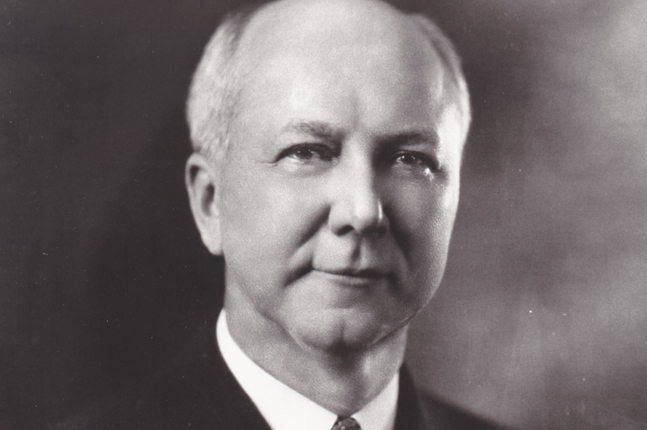
Arthur R. Priest
At General Headquarters, Phi Delta Theta had the guidance of Arthur R. Priest, DePauw ’91, who brought many years of university teaching and administration experience to the office. He believed in the Fraternity as an educational force rather than as a social sideline to student life. Stressing scholarship, financial management, and group morale, he insisted that “the Fraternity must always work in harmony with the college for the true ends of education . . .The future Fraternity will ensure the right atmosphere in the chapter house through the presence of a refined housemother. It will ensure the right scholarship through the presence of a preceptor. It will ensure supervised finance through the organization of a group of alumni in connection with every chapter home. Each chapter will realize that it is an integral part of a general organization and that any action permitted in its own home reflects upon every other home and on the general organization. More and more, there will be developed a national consciousness and a national pride.” This warm-hearted Phi, dignified and genial, often reflective but never remote, held up high standards for the Fraternity.
With industrial stagnation and widespread unemployment in the mid-1930s, many thousands of students were helped by the federal government, being paid thirty cents an hour for assigned work up to a maximum benefit of fifteen dollars a week. At its peak, the National Youth Administration aided 750,000 students in 1,700 colleges and universities. The NYA-assigned tasks were various; many students gave research and clerical assistance to faculty members, others served in local health, recreation, and welfare agencies.
Economic depression-induced a mood of self-examination in America, a disposition evident in current literature, in the questioning of established institutions, and new demands upon education. The nation was asking: What kind of society have we been, and what kind can we be? What resources can we draw upon? What are our valid traditions and aspirations? Why should poverty exist in a land of plenty? How can our people find freedom from want and freedom from fear? Men like President Roosevelt’s crusading Secretary of the Interior Harold L. Ickes, Chicago ’98, and Chief Justice Fred M. Vinson, Centre ’09, of the Supreme Court, actuated the goal of social justice. It shaped legislation in Congress and spurred research in the universities. Inevitably chapter houses felt the legislation across the country.
Early in the depression years, Mark Bradford, Whitman ’28, a thoughtful young traveling secretary, reported on his Fraternity: “For the moment I enjoy the distinction of being the only man who has visited every one of the 102 chapters of Phi Delta Theta. From that experience, I see that more is demanded of fraternities today than ever before. Most of those who control the destinies of higher education have but recently awakened to the tremendous possibilities of the Greek letter organization and are suddenly impatient to see them realized. The demand for higher measures of achievement is the greatest thing that ever befell the fraternity system. We are being tested.”
At the end of August 1934, the Grand Hotel on Mackinac Island, Michigan, hosted the forty-first biennial General Convention. Inside, adorning the great hall were Fraternity colors and portraits of the Founders. On display were historical documents of the Fraternity, early issues of The Scroll, and the Harvard, Cleveland, and Founder’s trophies.
In the opening convention session, Dr. Francis Shepardson, the national president of Beta Theta Pi, paid tribute to Phi leaders he had known and to The Bond of Phi Delta Theta. He found The Bond akin to the Beta ideal of “mutual association in the honorable labors and associations of life.” Then, looking toward the windows and their sweeping view of woods and water, he said, “Out yonder men used to travel, hunting for something, hunting for the possibility of a great domain that would stretch from sea to sea . . .The old Fort Mackinac represents the ownership of several nations that sought this dominion, mentioned in the early chapters of our country’s history. And now, as you gather here in this convention, you in a sense represent the drama of the Founding Fathers of America, with a domain extending from Hudson Bay to the Gulf of Mexico and from sea to sea. Surely, if there is any place in America where you representatives of a great fraternity should get a thrill, it is right here at Mackinac.”
In that historic setting, undergraduate Phis from California to Nova Scotia, from British Columbia to Florida, found themselves united in one organization.
Student Life in the Great Depression
Outside articles that give a glimpse into the student experience during this era:
- University of Illinois Archives – Student Life in the Great Depression
- University of Washington – Student Life and School Spirit at U of Washington 1929-1934
Support the Heritage Fund!
Take the opportunity to honor the Phi Delta Theta heritage this month by making a contribution in support of our General Headquarters building in Oxford, Ohio. Donate at one of our five levels to receive your Founders Day gift!
The post Phi Delta Theta During A Crisis: The Great Depression appeared first on Phi Delta Theta.
]]>The post From Local to International: The Founding Story of Michigan Delta appeared first on Phi Delta Theta.
]]>In 1926, six men rooming together on Mason Street in Flint, Michigan, based on the common bonds of friendship and brotherhood, decided to form a fraternity. With the help of Mr. Macking—the shop superintendent of General Motors Institute of Technology (GMI) at the time—these six, along with two others, formed Alpha Delta Fraternity, one of the first fraternities at General Motors Institute (eventually chartered in 1928).
As the membership grew, Alpha Delta became affiliated with the Burr Patterson Company of Detroit in 1929, and with their cooperation came the coat of arms and motto.
When the Great Depression devastated the country, Alpha Delta was not immune to its effects. Membership dropped, but Alpha Delta remained involved on campus through sports and social events. In late 1935, membership was low enough to consider merging with another fraternity on campus, but the fraternity abandoned the idea when a large class of freshmen enrolled.
In May 1961, the land adjacent to Phi Gamma Delta on Dupont Street became Alpha Delta’s property, and building a house became Alpha Delta’s top priority. Early in 1962, Alpha Delta accepted architects Gibbs, Tomblinson, and Harburn to design the new house. Members turned the first shovel of dirt on August 25, 1962, and the fraternity periodically received progress reports the rest of the year. On the weekend of February 10, 1963, the brothers of Alpha Delta moved into their first new home, constructed specially for fraternity life.
Becoming Phi Delta Theta
Throughout most of the 1900s, many national fraternities wouldn’t establish chapters at schools unless the institution was fully accredited. When GMI achieved certification in the 1960s, many local fraternities on campus petitioned to join national organizations. When Alpha Delta began discussions for affiliation with a national organization, chapter president Gary Joy made a strong push for Phi Delta Theta. Gary, a native of Iowa, had several friends back home who had become Iowa Beta Phis at the University of Iowa.
During the next two years, much of the brothers’ fraternal efforts focused on their goal of becoming affiliated with Phi Delta Theta. Six brothers represented Alpha Delta at the 1964 Phi Delta Theta Convention in Pasadena, California. They set up a booth at the convention displaying the merits of Alpha Delta. The General Council voted on Friday, September 4, 1964, and Alpha Delta was to become the Michigan Delta Chapter of Phi Delta Theta officially.
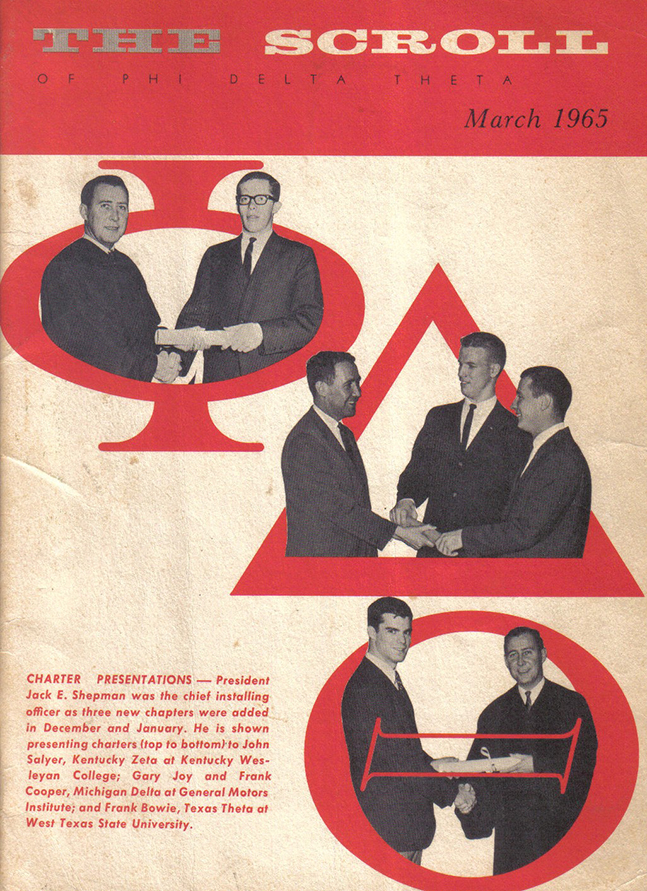
On Friday, February 12, 1965, eighty charter members of the Michigan Delta Chapter signed The Bond of Phi Delta Theta at the initiation ceremony. On Saturday, February 13, Alpha Delta Fraternity became the 154th chapter of the Phi Delta Theta Fraternity at the installation ceremony.
See the chapter’s original installation petition from 1964.
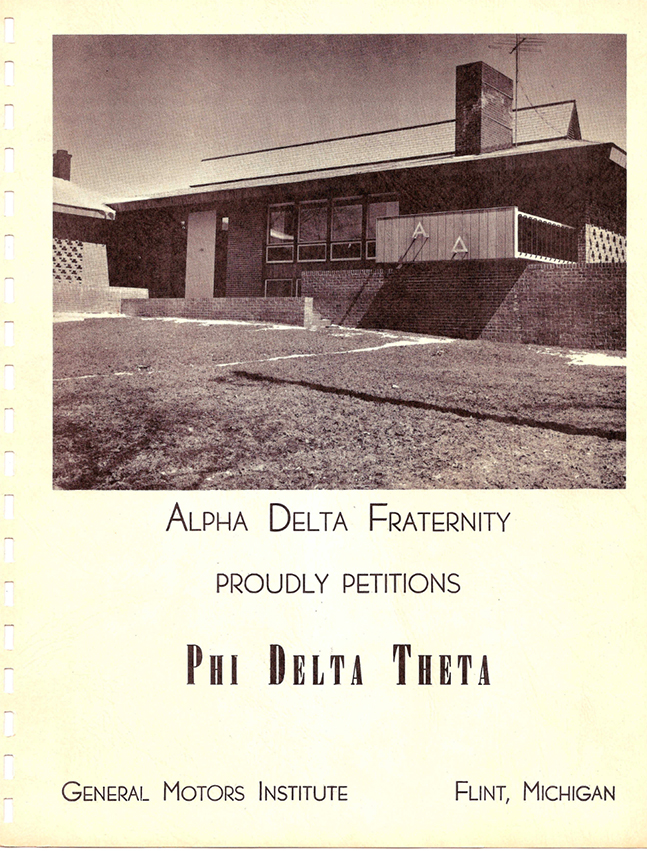
“I have so many memories of the whole process of moving from our local, Alpha Delta, to being voted in as the Michigan Delta Chapter of Phi Delta Theta. There were many visits from the province president and officers from the other chapters in the province.
We created the petition booklet and manned our booth at the 1964 General Convention in Pasadena, California. All this work culminated in the installation of the chapter in February 1965. I believe this contributed more to my later successes in life than my academic education.”
—Gary Joy, Kettering ’67
See pictures from the of Michigan Delta installation
Brotherhood Tree
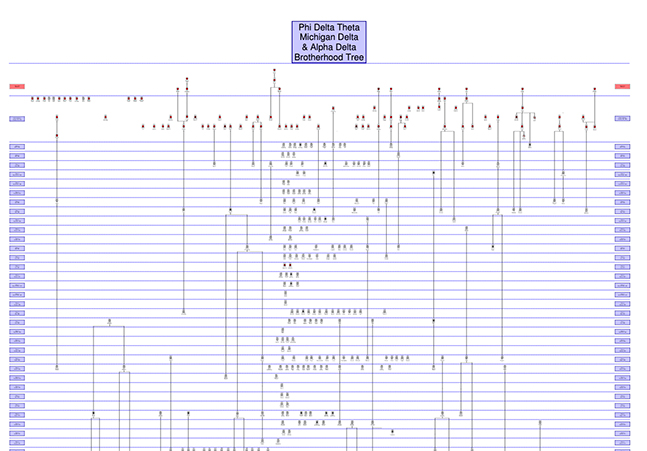
One night, while waiting for the floor wax to dry, big brother Joe Jagadics, ’11, and little brother John Lawniczak, ’13, decided to scribble on some nearby whiteboards to trace their Phi family backward through the generations. What started as a fun task used to pass the time turned into an elaborate Brotherhood Tree, connecting all big brothers and little brothers since the chapter’s founding.
They moved from the whiteboards to GenoPro, which is an intuitive family tree software tool. The two continue to add relationships with each new Phikeia class.
Joe shares, “While not complete, the newest class from A-Section (Winter 2020) can trace their lineage back to the class of June 1968 Bond # 211, Chester A. Basiewicz.”
View the chapter’s brotherhood tree.
50th Anniversary
In 2015 the chapter celebrated its 50-year commemoration. Brothers from every era of the chapter’s history attended by scores, including more than fifty of the first 175 brothers. It was a great reunion with many who have not been together since 1967.
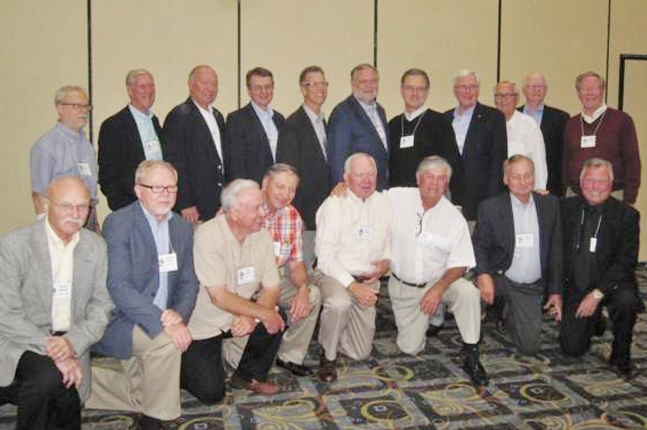
The weekend commemoration event was a grand celebration. Friday night featured a reunion and a short history on the chapter’s founding led by the Michigan Delta founding class. Saturday afternoon included tours of the chapter house and campus. On Saturday evening, the highlight of the evening was the Golden Legion ceremony banquet. Included were guest speakers such as Kettering University President Dr. Robert McMahon, General Council Member Moe Stephens, former General Council President Mike Scarlatelli (Bond #353), Dennis Kulonda (Bond #65), and Gary Joy (Bond #1).
Sunday capped the weekend off with brunch at the chapter house and a very special initiation. Dick Krzys had been an Alpha Delta member while the organization was petitioning Phi Delta Theta for affiliation. Dick was never initiated as a member of Phi Delta Theta as he had graduated before the Michigan Delta Chapter’s chartering. The chapter reached out to him before the 50th-anniversary celebration to see if he wanted to finish what he had started. The weekend’s final event was the initiation of Dick Krzys as Bond #1287 of Michigan Delta—fifty years after he worked to affiliate Alpha Delta with Phi Delta Theta. There could not have been a more fitting and beautiful end to the weekend than with our ritual and honoring one of the chapter’s founders. Sadly, Brother Krzys entered the Chapter Grand on February 24, 2018.
Michigan Delta Today
To date, Michigan Delta has initiated 1,372 brothers and currently has fifty-six undergraduate members and seven Phikeias. The chapter has consistently won the Gold Star Award and ranked in the top three for their academics out of all eleven fraternities on campus. Members are active in campus leadership roles and the community.
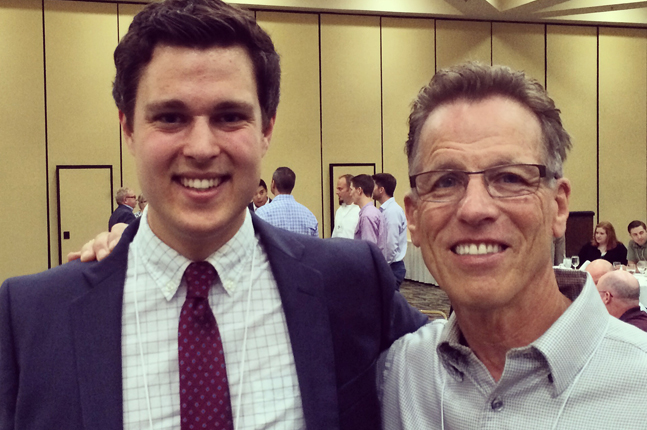
Province President Michael Boulter, Kettering ’12, shares why he continues to volunteer his time to support and advise the undergraduate members of Michigan Delta:
“Phi Delta Theta has given me more than I could have ever imagined. From incredible life experiences to my closest friendships—I owe so much to Michigan Delta. The opportunity to pay it forward by advising the newest generation of brothers is so rewarding.”
The post From Local to International: The Founding Story of Michigan Delta appeared first on Phi Delta Theta.
]]>The post Who Was Robert Thompson Drake? appeared first on Phi Delta Theta.
]]>Robert Thompson Drake was born March 6, 1822. He was a junior at the time of the Fraternity’s founding, Brother Drake was known as brave, faithful, conscientious, and dignified. Though he was the most reserved of the founding Phis, he bore a natural dignity that did not diminish the warmth of his attachments. From Miami he went on to the Princeton Theological Seminary, became an ordained minister, and served the churches in Ohio, Kentucky, Indiana, and Iowa.
Found on the Phi Delta Theta museum is a perspective as if Drake were telling us about himself–
“Just east of Dayton, Ohio, and a bit south of Springfield, you’ll find the little village of Yellow Springs. That’s where I was born in the spring of 1822. When I reached the age of twenty- four, I decided it was time to expand my horizons, and I enrolled at Miami University that fall. My friends in the Miami Union Society, and the Fraternity, called me “Thompson,” but I didn’t mind that at all. I had the fortunate opportunity to lead hymns in both the college chapel and the Oxford Presbyterian Church. My faith, you could say, defined my college experience. I even gave my commencement address on The Influence of Christianity on Civilization.
Upon leaving my alma mater, I entered work as a minister. I first went to New Albany, Indiana, just across the river from Louisville, but I didn’t stay too long. I migrated back near my fraternal home, to Lebanon, Ohio, about 30 miles east of Oxford. I traveled as far west as Des Moines, Iowa, but I generally stayed close to Old Miami. I resided in New Castle, Indiana until I followed Ardivan into the Chapter Grand in 1873. They brought me back to Lebanon and buried me there.”
In an 1884 issue of The Scroll, from a letter about his fellow Phi Delta Theta Founders, Brother Robert Morrison recounts this story about Drake’s brave service to a young family in need during the cholera outbreak of 1849, while Brother Drake was still in school at Miami.
Phi Delt Fact
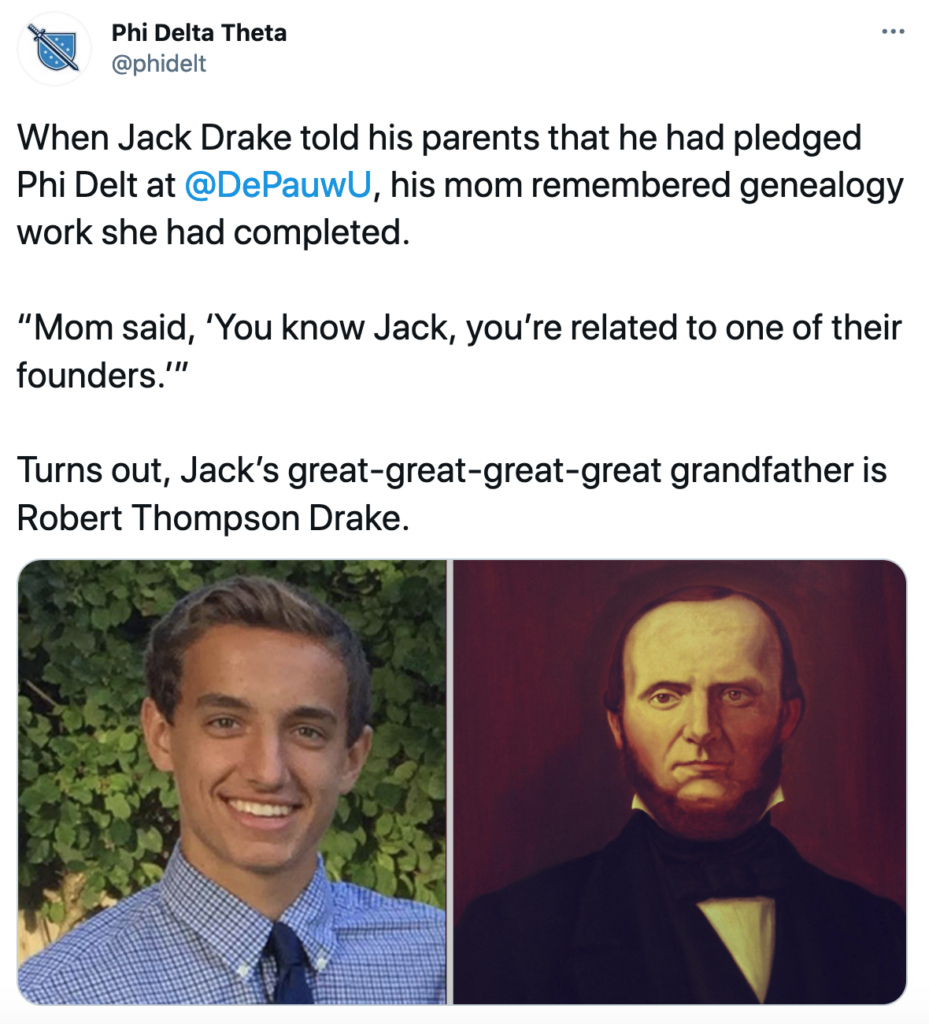
Robert Thompson Drake’s great-great-great-great grandson is an undergraduate member of Phi Delta Theta at DePauw University (Indiana Zeta)!
Support the Heritage Fund!
Take the opportunity to honor the Phi Delta Theta heritage this month by making a contribution in support of our General Headquarters building in Oxford, Ohio. Donate at one of our five levels to receive your Founders Day gift!
The post Who Was Robert Thompson Drake? appeared first on Phi Delta Theta.
]]>The post Who Was John McMillan Wilson? appeared first on Phi Delta Theta.
]]>Brother Wilson was born and raised on a farm in Union County, Indiana. He was “compactly built.” He was known to be quiet, reclusive, and a bit of a bookworm. He was an authority on history of all kinds and a respected teacher. Wilson was a senior when the Fraternity was founded.
Brother Wilson attended Xenia Academy and entered Miami University in 1846 where he received his bachelor of arts and a master of arts. Upon graduation, he taught part time at the Western Female Seminary and attended the theological seminary in Oxford intermittently.
Living near the chapter after graduating, he kept a close eye on the society. He was known to the undergraduates as “Pop” Wilson and “Old Dad” and dressed the part in his plain, down-home, and unassuming way.
In 1855, he became pastor of the church at Morning Sun, Ohio.
During the Civil War, he was commissioned as a recruiting officer in both Ohio and Indiana. After the war, he went to Southern Illinois where he was engaged in various enterprises.
Want to Read More About Wilson?
Read a biographical sketch of Wilson from the December 1886 The Scroll, written by the biological brother to Brother Wilson, Archibald Wilson.
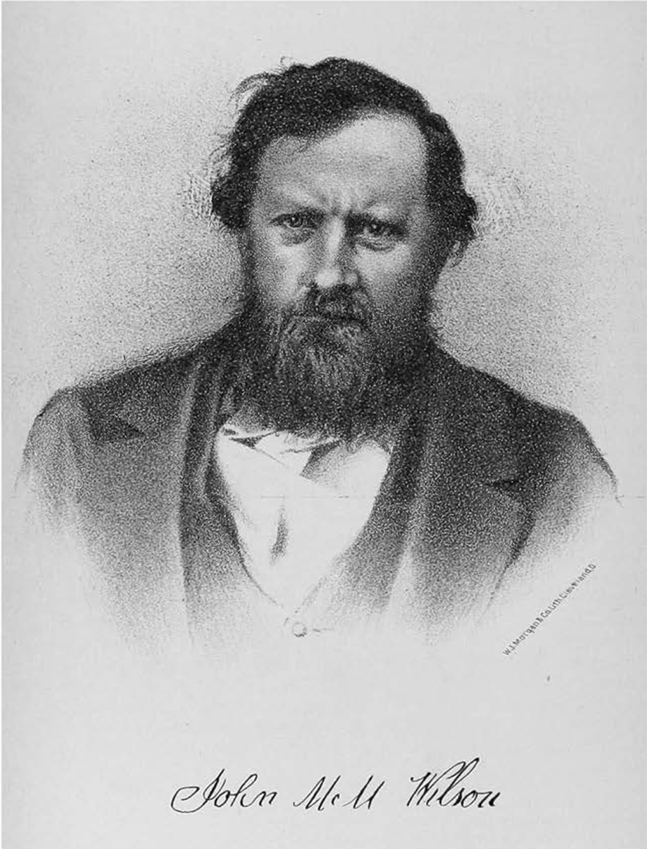
Support the Heritage Fund!
Take the opportunity to honor the Phi Delta Theta heritage this month by making a contribution in support of our General Headquarters building in Oxford, Ohio. Donate at one of our five levels to receive your Founders Day gift!
The post Who Was John McMillan Wilson? appeared first on Phi Delta Theta.
]]>The post Phi Delta Theta During A Crisis: World War I appeared first on Phi Delta Theta.
]]>From Ohio Wesleyan Phi and writer Ritter Collett’s history, In the Bond
When hostilities broke out in Europe in 1914, the majority of North Americans had no idea the Unites States eventually would be involved in the first World War and what would become the greatest bloodbath the world had known up to that time.
European history had been punctuated by a pattern of recurring warfare that did not involve us on this side of the Atlantic.
As a whole generation of British, French, and German young men were sacrificed in the senseless struggle, fraternity life went on as usual in the USA for the first two years of combat.
But this was not the case with our two Canadian chapters at the University of Toronto (Ontario Alpha) and McGill University (Quebec Alpha). Almost 100 men had been initiated in the nine years Ontario Alpha had existed. Within months of the start of the war, twenty had volunteered and more would soon be on the way.
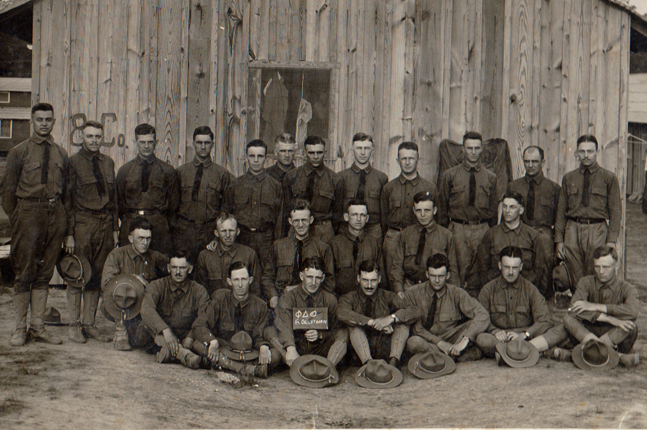
Phi Delts at First Officer Training Camp
In the best of British Empire tradition, the educated college graduates and/or students were considered candidates for Officer Training Schools.
The summer of 1915 found many Phis in training at Niagara-on-the-Lake and a number were in the first Canadian contingent sent overseas.
Among that group was C.A.V. McCormack, Toronto ’12, who rose to the rank of major, commanding the 83rd Battalion, and Keith Munro, McGill ’10, wounded and captured by Germans at the Battle of Ypres. Dr. Alfred K. Haywood, Toronto ’08, headed a medical contingent and won the military cross for gallantry in the field. Ontario Alpha’s report to The Scroll in 1915 described the situation “… The war has been a severe blow to Canadian chapters of all fraternities … yet we feel that in taking up the sword, we are living up to The Bond in the highest interpretation of the phrase.”
The first Phi casualty reported from Ontario Alpha was Lt. Colin Simpson, killed “somewhere in France” while commanding an artillery battery.
Simpson had been a leader among Phis. “His lie adorned the chapter,” a classmate wrote. “His death leaves and ideal of splendid manhood.: Lt. Simpson was barely twenty-one.
The first Americans to go overseas were volunteers in the American Ambulance Corps. As citizens of a neutral nation, they accepted the hazards of war as non-combatants.
The first Phi on record with that group was Edward F. Sheffey II, Randolph Macon ’13, who had gone to Harvard for his MA before joining the ambulance unit. A letter from Sheffey in 1915 offers a poignant glimpse of his experience:
“Sometimes the scenes at the station are very pitiful. Think of seeing literally hundreds of men with arms and legs gone, suffering sometimes excruciating pain in the transference to the ambulance.”
The United States Army set up a training program at Plattsburg, New York, for civilians who would volunteer for military training. Those who passed the training course would be enlisted in the Army reserves. The program had great appeal to college students who could spend their summer vacations there.
Whether by accident or design, those barracks were situated just a few miles south of the Canadian border where the trainees were hearing or reading about the Canadian war effort which was all voluntary but very popular.
The participation of 1,400 Americans who took military training as volunteers at Plattsburg in the summer of 1915 must have given the military the idea to use college campuses as areas to develop preparedness in the event of future wars. Soon there were military camps operating on the same basis as Plattsburg at other sites. This was the beginning of what was to become the ROTC training for college credit.
In The Scroll, letters from American Phis about their experiences at Plattsburg and messages from Canadian Phis in the trenches began to appear side-by-side.
The Honor Roll of Phis who died in World War I, at the Fraternity’s General Headquarters, shows the 155 men from sixty-five chapters who paid the supreme sacrifice and were killed in action. More than 5,000 Phis served, more than 3,000 in France.
Visit The Scroll Archive
Visit our archives for more about Phi Delta Theta during this time in history.
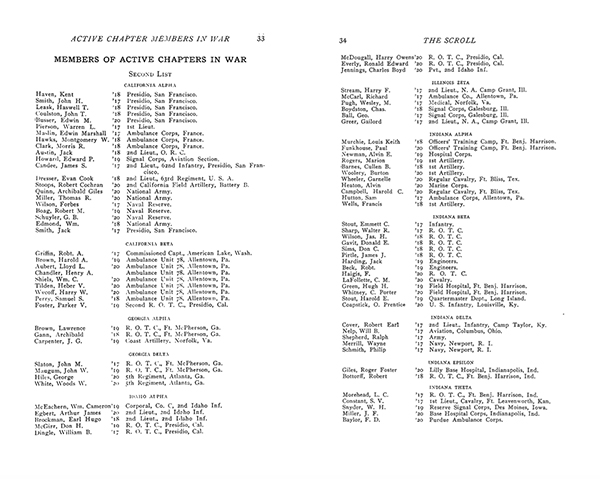
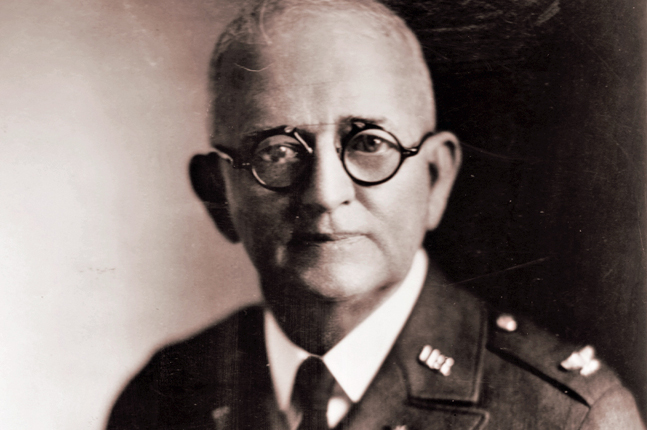
Phi Delt Fact
Colonel Joseph Franklin Siler, MD, Auburn, was a US Army physician noted for investigations of mosquito transmission of dengue fever in the Philippines and for marijuana smoking in Panama, one of the first experimental reports on cannabis. Siler was commander of the Laboratory Service in the American Expeditionary Forces in France in World War I and undertook extensive experimental observations on the manufacture and immunizing efficacy of anti-typhoid vaccines.
Support the Heritage Fund!
Take the opportunity to honor the Phi Delta Theta heritage this month by making a contribution in support of our General Headquarters building in Oxford, Ohio. Donate at one of our five levels to receive your Founders Day gift!
The post Phi Delta Theta During A Crisis: World War I appeared first on Phi Delta Theta.
]]>The post Phi Delta Theta During A Crisis: The Civil War appeared first on Phi Delta Theta.
]]>From Walter B. Palmer’s History
From the beginning to the end of the war, Phi Delta Theta was well represented from the first call for volunteers to the gallant death of Brevet Brigadier General Theodore Read, Indiana 1854, who was killed April 6, 1865, only three days before the surrender of General R. E. Lee.
Several members enlisted as early as April 15, 1861, the day after the fall of Fort Sumter. Irvin Robbins, Butler 1860, enlisted in the 7th Indiana Infantry on April 24, 1861, and took part in the engagement at Philippi, Virginia (now West Virginia) on June 3, 1861, which was the first battle of the war.
Henry L. Powell, Indiana 1867, enlisted on April 25, 1861, was wounded at Rick Mountain, Virginia (now West Virginia), on July 11, 1861. P. A. Davidson, volunteered April 18, 1861, and was a member of Stonewall Jackson’s command at the battle of Manassas on July 21, 1861. During a charge of that famous brigade, he was shot through the right shoulder.
General J. C. Black, Wabash 1862, was elected Commander-in-Chief of the Grand Army of the Republic, 1903.
Two hundred and eighty one members of Phi Delta Theta are known to have served in the American Civil War.
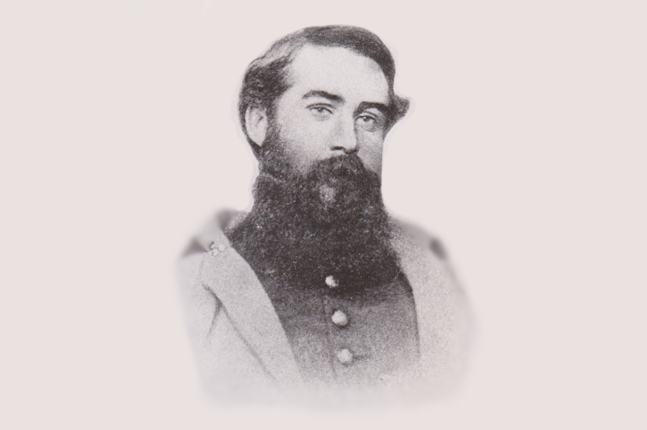
Photo: BG Theodore Read, Indiana 1854
Involvement of the Fraternity’s Founders and Benjamin Harrison
- Founder John McMillan Wilson served in the US Army as a recruiting officer.
- Founder Andrew Watts Rogers served as major in the US Army.
- Early initiate of Ohio Alpha and future president Benjamin Harrison served in the Army and was promoted to brevetted Brigadier General of the 20th Army Corps, and recognized “for his ability and manifest energy and gallantry of the brigade.”
As Seen in the 1886 Issue of The Scroll
From The Scroll Archive – Read the report from General Council President, Hilton U. Brown to the National Convention ab0ut the impacts of the Civil War to the Fraternity
Phi Delt Fact
The original coat of arms was introduced in 1866.
Support the Heritage Fund!
Take the opportunity to honor the Phi Delta Theta heritage this month by making a contribution in support of our General Headquarters building in Oxford, Ohio. Donate at one of our five levels to receive your Founders Day gift!
The post Phi Delta Theta During A Crisis: The Civil War appeared first on Phi Delta Theta.
]]>The post Who Was Robert Morrison? appeared first on Phi Delta Theta.
]]>Brother Robert Morrison, Bond # 1, a mature and natural leader, had the calloused hands of a farm youth and the thoughtful mind of a scholar. On the farm, he once split 200 rails in a day, and on another day, he reaped 384 bundles of wheat.
He came to Miami at age twenty-five. Soon after he arrived at college, he won a wrestling match with the campus champion. A tireless walker, he also had an untiring mind. Before coming to Miami, he had spent a freshman year at Ohio University. He taught at the district schools in the hills of Pennsylvania at breaks from pursuing his studies. At Miami University, he became the honor man of his class, graduating magna cum laude. In the fraternity circle, he was a listener as well as a leader. He took counsel from his friends, his gray eyes thoughtful and his strong face often lighting with a smile.
Throughout his life, he kept a sense of humor joined to a sense of honor. He had a long career as a teacher, editor, and minister. Though he was an inland man, he liked sea-going metaphors; he was the first to speak of the good ship Phi and her sturdy crew.
His lifetime commitment to Phi Delta Theta resulted in the opening of four chapters: Miami University, Indiana University, Centre College, and Westminster College. He attended many General Conventions, including the semi-centennial in Columbus, Ohio, in 1898.
Even though the first meeting of Phi Delta Theta was December 26, 1848, the Fraternity celebrates its founding on March 15, the annual birthday of Robert Morrison.
His lifework involved hardship, self-denial, and sacrifice, and he did much to advance the cause of education and the church.
His most famous quote is this— “To do what ought to be done but would not have been done unless I did it, I thought to be my duty.”
- Morrison was the first to sign The Bond of Phi Delta Theta
- Morrison designed the Badge of the Fraternity and had the first of its kind created by a Cincinnati jeweler
- Upon Morrison’s death, the Fraternity honored him at the 1902 convention and presented Widow Morrison with a paid-in-full mortgage and a lifetime annuity
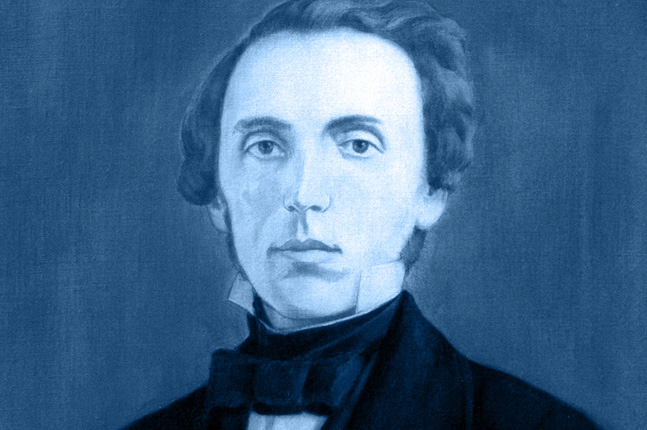
Read The Hunt for Robert Morrison’s Birthplace
Support the Heritage Fund!
Take the opportunity to honor the Phi Delta Theta heritage this month by making a contribution in support of our General Headquarters building in Oxford, Ohio. Donate at one of our five levels to receive your Founders Day gift!
The post Who Was Robert Morrison? appeared first on Phi Delta Theta.
]]>The post The Hunt for Robert Morrison’s Birthplace appeared first on Phi Delta Theta.
]]>Nobody knows where Robert Morrison was born. Really? Nobody knows?
Over forty years ago, I pledged Phi Delta Theta and became a member of the Pennsylvania Gamma Chapter at Washington and Jefferson College in Washington, Pennsylvania. As a new member, I read Morrison was born in Greene County just south of the college. I asked where: Is there a sign? A plaque? Is the building still there? No one seems to know the answer.
Really?
Since Pennsylvania Gamma is the closest chapter, and the oldest chapter in continuous existence in Pennsylvania, I felt it was our duty to find out where he was born.
I emailed General Headquarters in Oxford and asked if anyone had ever pin-pointed Morrison’s birth site. Executive Vice President and CEO Bob Biggs was excited when I explained my interest. He sent me what they did have, Brother Morrison’s autobiography published in The Scroll in the late 1800s. I discovered Greene Township in Greene County, Pennsylvania was where he was born.
According to his autobiography: “Robert Morrison, my grandfather, was of Scots-Irish parentage. He was born in County Derry, Ireland … In 1765, when Robert was sixteen years old, with brothers older than himself, he came to America and settled in Delaware.
After the Revolutionary War, in which Robert had served with the ‘blue hen chickens,’ as soldiers from Delaware were called, he and his wife with two little children go west. General George Washington asked him to take his tract of 600 acres in the northwestern part of Fayette County, Pennsylvania, lying on the Youghiogheny River. He went and looked at the land, but thought it too much exposed to incursions from the Indians, and continued his journey about fifty miles southwest into Greene County …”
From this account, General Headquarters learns much about Morrison’s grandfather, but still no mention of Founder Morrison’s official birth site.
Greene County is in the southwest corner of Pennsylvania and was part of Washington County up until 1790 give or take. Parts of Greene County were also parts of Westmoreland County. To add to the confusion, the state of Virginia also claimed this area to be part of Virginia, not Pennsylvania in the late 1700s. But it was a start.
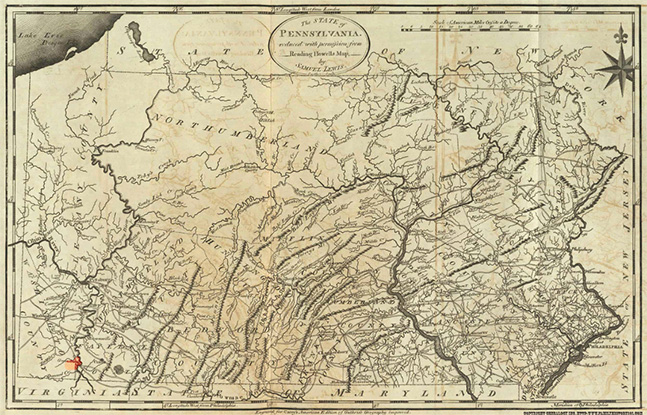
Area of search.
The Search
The Washington County Courthouse and the recorder of deeds office politely thought I was nuts when I inquired about early Greene County land records stored there. Greene County land records were in Greene County, I was told. I explained an attorney had told me early records, prior to 1790, were probably in Washington, Pennsylvania. I was welcome to look, they said, but they suggested that I drive south to Waynesburg and search Greene County’s courthouse. After having no luck in Washington County, I headed south.
The Greene County Courthouse staff were very helpful as I was a rookie at searching land records. I knew that Revolutionary War soldier Robert Morrison bought more than 200 acres known as McClungs’s Thicket in 1786 as reported in an 1896 issue of The Scroll, by Robert Morrison; “My grandfather bought out the McClung’s, who took their slaves and went to Kentucky, as Pennsylvania had in 1780 passed an ordinance of gradual emancipation.”
On those 200 plus acres and other property they purchased, Grandfather Robert Morrison and his wife, Elizabeth Culbert raised their ten children. Their oldest son, Thomas, was born in 1791. Thomas married Mary Jennings in December 1820, and for the price of $7.00, bought 20.75 acres of land from his father in June of 1821. The following March 15, 1822, their son, Robert Morrison, was born.
The basis for our Founders Day was established.
The question became, “Where in the county are Grandfather Morrison’s 200 and some acres? Where are the additional land parcels he purchased and sold, and where are the 20.75 acres son Thomas bought in 1821?” Did son buy some of grandfather’s original 200 acres, or were they from a separate parcel grandfather had purchased?
Danny Gillette, Washington & Jefferson ’79, and I took a road trip to the Greene County Historical Society and Museum where we met Executive Director Ebenezer Williams-Karrick. Eben was very helpful in our search providing us a survey of McClung’s Thicket, the property purchased by Grandfather Robert Morrison. But where is it? The survey was helpful but didn’t contain the references to show where it was actually located!
While visiting the museum, we were fortunate to run into Mr. Thomas Headlee, a generous contributor to the Historical Society and the Museum. Mr. Headlee is a lifelong resident of Greene County, his family owning a lumber mill there dating back to the early 1900s. Even more fortuitous, he is Greene County’s retired recorder of deeds, having served in that post for nearly four decades.
The four of us were the only patrons in the museum building that day, and Mr. Headlee was generous with his time and his stories of growing up in the county. He offered to “show us around the courthouse” to pinpoint the land the Morrisons occupied nearly two hundred years ago, if he could. Danny and I jumped at the chance and got his number so we could meet during a weekday at the recorder’s office.
I’m a mortgage banker by profession, and Danny Gillette is a longtime realtor, but neither one of us are wizards at looking up historical land records, especially in a county courthouse neither one of us had been in before. Boy did Mr. Headlee open doors for us!
Meeting Mr. Headlee was lucky, indeed!
He took us into the basement looking for ancient maps and plot maps in locked rooms not available to the public. We searched the deed books and tried to determine where this parcel was located. Mr. Headlee explained that a good portion of the county lands were merged together and became state game lands in the first half of the twentieth century. Individual parcel references would be tougher to track down if this were the case.
Our morning with Mr. Headlee was well worth our time. We were able to find a copy of Grandfather Morrison’s deed showing his 221-acre purchase on July 18, 1786 (the deed shows it was Washington County then). We were also able to track down a copy of his son Thomas Morrison’s purchase of 21.75 acres from his father. But we still were unable to pinpoint geographically Grandfather Morrison’s original homestead, or the parcel he sold to son Thomas, thirty-five years later in 1821.
About eight months later, I contacted Brad Mellor, Washington & Jefferson ’85, an attorney and resident of Greene County. Brad became interested in our project. He had worked for a law firm which dealt with the Marcellus oil and gas industry. They had several land title searchers familiar with the county and could likely help with what we were trying to track down.
At a reduced rate, they would be able to really search the original site grandfather purchased (the original survey) and hopefully the 20.75 acres his son Thomas bought off of it. This isn’t all that easy since the deed’s legal description starts off with: “Beginning at a chestnut oak thence by land of the said Robert Morrison, North eighty-four degrees, West forty-two perches to a post…” From this cryptic and old-fashioned description, they were then able to put together title references and a plot map showing Grandfather Morrison’s original 221 acres and the 21.75 acres grandfather sold to his son Thomas the year before our Robert Morrison was born March 15, 1822.
Our problem now was the maps provided didn’t give us any reference points to know where the land was in Greene County.
Brother Mellor mailed inquiries to three probable property owners with no response. Letters from unknown law firms probably were not well received by the landowners. The oil and gas development in the area probably filled up their mailboxes as all kinds of people proposed all kinds of schemes.
It was time for another road trip.
The Search Continued, visit 2
In November 2019 it was time for a road trip! Dan Gillette and I met with Chris Brussalis, president of the Fraternity’s General Council, and headed to Greene County for the afternoon. On the way there, we filled Chris in on what we knew and what was still missing. We had a good idea where Grandfather Morrison’s 221 acres were, but hadn’t the proof, nor had we truly scouted out the area.
Late afternoon, driving along the road, we spotted a name and street number to which attorney Brad Mellor had sent letters. The owner was in the driveway! We stopped, introduced ourselves, and explained our mission. The owner thought our mission was terrific and began telling stories about the area. His uncle still lived next door, and had for many years, and suggested that if we came back in the daylight, we could walk the grounds.
We thanked the owner for his help and had to head back to Pittsburgh as the sun had already set.
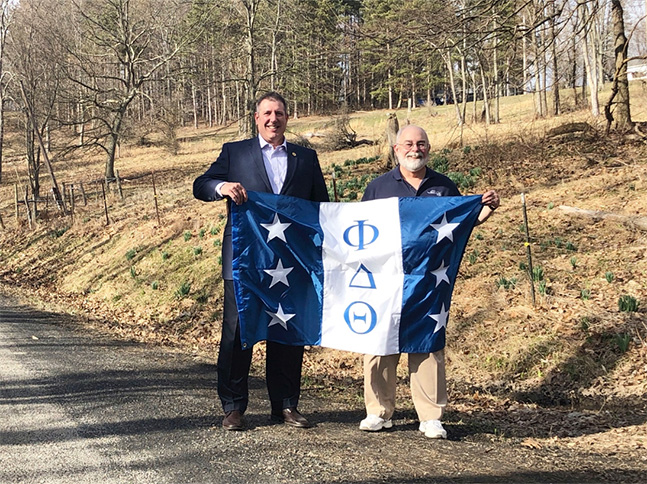
General Council President Chris Brussalis with Brother Rob Langley
Search Continued, Visit 3
Just last week, the day after Pittsburgh Alumni Club’s 2020 Founders Day, Brother Brussalis and I journeyed again to the birth site of Founder Morrison. As we drove the remote drive, along Laurel Creek, to get to the 200-acre lot, we were fortunate to come across the sister to the landowner. When we explained our intent, she was excited to be part of this story’s telling and helped by snapping the photo above. (Her brother had told her about the Fraternity’s interest in the land, and she also offered to help by sending even more photos of the property.)
Because the 21-acre lot sold to Thomas was actually across the ridge from this original 200 acres and belonged to a different landowner we had yet to meet, we had to leave an earnest walk of the exact acreage for another day. So, sometime soon, we hope to connect with this landowner, explain our interest, and finish this meaningful hunt for clues or remnants of the Morrison homestead.
2022: 200 years since Morrison’s birth
After arriving home, President Brussalis was able to speak with a township official to explore ways to commemorate this hallowed ground in memory of Robert Morrison and the birthplace of our founding Phi. Leading to the next big question, how might we appropriately commemorate this site in time to celebrate Founder Morrison’s 200th birthday in 2022?
The post The Hunt for Robert Morrison’s Birthplace appeared first on Phi Delta Theta.
]]>The post Miller’s Meanderings – Fraternities Founded at Miami University appeared first on Phi Delta Theta.
]]>The first fraternity founded at Miami was Beta Theta Pi (male) in 1839, followed by Phi Delta Theta (male) in 1848 and Sigma Chi (male) in 1855. (Actually, the founding name was Sigma Phi until the members learned that a fraternity by that name had been established at Union College in 1827.) The three became widely known as the “Miami Triad” just as the first three fraternities founded at Union College became the “Union Triad.”
In 1902, a women’s group was created by the name of Delta Zeta. Brother Phi, Guy Potter Benton, Ohio Wesleyan ’86 was president of Miami University at the time. He assisted the young ladies to the extent that he helped them write the ritual, thus he was considered a member of the Fraternity. (It was standard procedure in those days for the women’s groups to be known as women’s fraternities.) To this day, he is revered as the Grand Patron of Delta Zeta.
In 1906, Phi Kappa Tau (male) came along. This was the fifth and final organization founded at Miami that is in existence today, although others live on as part of Delta Zeta. Delta Sigma Epsilon (female) came to life in 1914 and it was headquartered in Oxford, on Campus Avenue, a couple blocks from the Phi Delta Theta Headquarters. Its fifty two chapters were merged with Delta Zeta in 1956.
In 1921, five young men founded Delta Sigma Rho, the name of which was changed to Sigma Delta Rho to avoid confusion with a recognition society of the same name. Fourteen years later (1935), it disintegrated. Three of its nine chapters joined Alpha Kappa Pi and one went with Pi Kappa Phi. The other five gradually disappeared.
The final founding (I know you will appreciate the name) was Pi Delta Theta (female) in 1925-26. Several alumnae of other sororities met to form this new group in 1925 but it was 1926 before the first chapter saw the light of day. In 1941, the nine chapters of this organization merged with Delta Sigma Epsilon and were part of that organization when it became part of Delta Zeta.
Now you know the real story.
Brother Robert J. Miller joined the General Headquarters staff in 1951 and was named Executive Secretary (later Executive Vice President) in 1955, a position from which he retired in 1991. He continued to serve as President of the Educational Foundation until 1997 and later served proudly as the Fraternity’s Historian.
The post Miller’s Meanderings – Fraternities Founded at Miami University appeared first on Phi Delta Theta.
]]>The post Miller’s Meanderings – The Convention Map (Mural) appeared first on Phi Delta Theta.
]]>Thousands of Phis and visitors have seen the mural map (convention map) exhibited behind the speaker’s podiums in the assembly halls and banquet rooms at conventions since 1940. The map measures eight feet in height and twelve feet in width. The top of the painting displays portraits of the six founders along with the coat-of-arms, Phikeia pin and Fraternity badge. A painting of Pallas decorates the left side and the Fraternity flag adorns the right side. All chapters, in existence at the time, are highlighted by stars.
First mention of the map appears in the minutes of a General Council meeting conducted in early March of 1940 at the Nicollet Hotel in Minneapolis, Minnesota. The minute reads:
The following minute of a meeting held in August at the same hotel, immediately preceding the General Convention, reads:
“The Executive Secretary presented a plan for the production of an attractive pictorial map of the Fraternity. The large original painting will be used for decorative purposes at the 44th Biennial Convention and then be hung permanently in General Headquarters.”
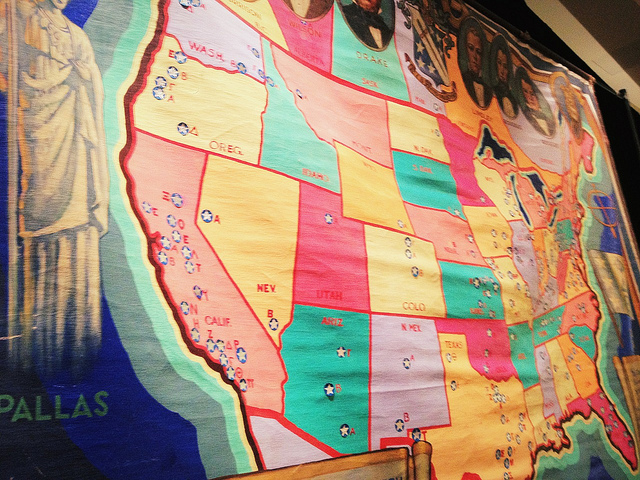
“The General Council was unanimous in its approval of the new mural map of Phi Delta Theta painted by Brother John Garth, Washburn ’12…and it was further decided that small lithographic reproductions should be produced and made available to members upon order at a price to be determined later.”
A print of the map first appeared on the inside back cover of the September 1940 Scroll (in a single color) advertising color reproductions of the map (17” X 22”) to be available for $1.50 postage prepaid.
The artist, John Garth, was initiated March 13, 1911 shortly after Kansas Beta was chartered in 1910. He was assigned Bond # 59. He graduated from Yale in 1914 and later changed his name from Wallace Hogarth Pettyjohn. He was a member of the Professional Artists’ League in San Francisco and was included in Who’s Who in Art in America. He was an Infantry Lieutenant in WWI. He entered the Chapter Grand June 1, 1971.
There is no evidence that the map was ever displayed in General Headquarters.
The post Miller’s Meanderings – The Convention Map (Mural) appeared first on Phi Delta Theta.
]]>The post December 7, 1941- A Day of Infamy appeared first on Phi Delta Theta.
]]>There are thousands of stories, both verbal and written, about the influence the bombing of Pearl Harbor, by the Japanese, had on the lives of Americans. The declaration of war on the United States four days later by Germany and Italy added to the legends. The history of Phi Delta Theta is no exception.
The September 1941 Scroll announced “The First Call For The 1942 Convention” followed by an article in the November 1941 Scroll by Executive Secretary Paul C. Beam praising “America’s Most Beautiful All-Year Resort”, the Greenbrier Hotel in White Sulphur Springs, West Virginia as the site selected for Phi Delta Theta’s forty-fifth Convention. The four-day meeting was scheduled to take place August 25-28, 1942. Additional stories appeared in The Scrolls of March and May, 1942, months after the disaster in Hawaii.
The members of the General Council, at their March 1942 meeting, began to show concern about convention plans in light of the after-effects of the “call-to-arms” which was beginning to decrease the college enrollment of male students. This was expressed in a minute which read “the Executive Secretary was instructed to ascertain at once whether or not it would be advisable to change the dates of the Convention because of changes in academic schedules…the Convention will be reduced to three days August 27-28-29…”
Convention plans changed significantly in the three months that followed. Note the following paragraph from a convention article that appeared in the June 1942 issue of The Palladium:
“The Forty-Fifth General Convention of Phi Delta Theta will be held at the Edgewater Beach Hotel in Chicago, Illinois, on August 26-28, 1942. The decision to transfer the Convention to Chicago has been reached after many disappointing and unavoidable delays, while hope was constantly held out that the White Sulphur Springs Convention site would be available as originally planned. These hopes were shattered, however, when war was declared on the satellite nations of Germany, involving the internment at the Greenbrier of representatives of Hungary, Rumania, and Bulgaria.”
The newly designated convention site was highly praised in the remainder of the Palladium article but, alas, the final pre-convention issue of the Scroll was now history. Even so, 438 Phis were in attendance at the meeting. The first guest speaker, Brigadier General Donald Armstrong, Columbia ’09, talked about Phi Delta Theta in war. “The most important subject in my life and yours, today, is WAR.”
The final convention speaker, William Mather Lewis, Knox ’00, closed the assembly with these comments: “…..let us join hands tonight going forward with courage to meet whatever life has for us—for our Fraternity, for our Nation, and for mankind.” Little did anyone in that gathering anticipate that the next “biennial” convention would not be convened for another four years.
The post December 7, 1941- A Day of Infamy appeared first on Phi Delta Theta.
]]>The post Miller’s Meanderings – Phi Delta Theta’s Five Chief Executive Officers appeared first on Phi Delta Theta.
]]>Between 1848 and 1880 the affairs of the Fraternity were in the hands the National Grand Chapter (Ohio Alpha), and State Grand Chapters (the first chapters chartered in each state) until the 1868 convention created an Executive Committee which had very limited powers. All the foregoing were discontinued in 1880 when the Indianapolis convention provided for a General Council of four members. A fifth member was added in 1896. This elected body was, in effect, the “chief elected officer” of Phi Delta Theta.
Due to the growing work of correspondence and record keeping the General Council conceived the idea of a paid employee to assist with the day-to-day details of fraternity management. The Scroll for February/April 1919 listed, for the first time, a Central Office in Oxford, Ohio with the name of Fred R. Cowles, Kansas ‘04 as Assistant to the General Council. In the same directory, Brother Cowles was listed as President of Zeta South Province. The identical listing appeared in the Scroll through February 1922. The April issue of the magazine announced the appointment of Arthur R. Priest, DePauw ’91 as the Traveling Secretary for the Fraternity and Cowles was no longer listed as a Province President. In the interim, the headquarters office was moved to Indianapolis and the “Assistant to the General Council” became the “Executive Secretary.”
At a General Council meeting on September 29, 1923, Brother Priest “was asked to take over the Central Office.” At the following General Council meeting on October 7, 1923, Cowles was “dismissed” and Priest was appointed Executive Secretary. During Priest’s tenure of 14 years he was assisted by seven Assistant Secretaries. He was succeeded in 1937 by Paul C. Beam, Indiana-Illinois ’25. It is ironic that the retirement of Priest, the appointment of Beam and the death of Cowles were all reported, complete with photographs of each, in the June 1937 Scroll. Brother Beam served for eighteen years until his death in July 1955. He hired a total of fourteen assistants, the last of which arrived in Oxford on the day of Brother Beam’s death.
Beam’s eleventh appointment was Robert J. Miller, New Mexico, 50 who came on board the Good Ship Phi in June 1951. In the spring of 1953, Miller’s title was changed to Assistant Executive Secretary and in the summer of 1954 he was named Administrative Secretary. He succeeded Brother Beam as Executive Secretary. His title was changed to Executive Vice President in 1972 Miller employed 78 ”Field Secretaries/Chapter Consultants” during his 35 years in office, one of whom was Robert A. Biggs, Georgia Southern ’76. Biggs was named Director of Chapter Services in 1978 and continued in that position until 1991 when he succeeded Miller. This accounts for a total of five executive officers who have been responsible for the day-to-day affairs of the fraternity since 1919.
The post Miller’s Meanderings – Phi Delta Theta’s Five Chief Executive Officers appeared first on Phi Delta Theta.
]]>The post Miller’s Meanderings – Just Exactly Where Is The Phi Delta Theta Headquarters? appeared first on Phi Delta Theta.
]]>I have read the following quotation in several publications:
“From the founding of the Fraternity until 1920, all day-to-day affairs of the organization were undertaken by members of the General Council. The Central Office was created by the General Convention of 1920, and the first such office was established in Indianapolis.”
I have no incisive argument with the first sentence although the second sentence is far from accurate. It became apparent that Phi Delta Theta was destined to have a central office as early as 1915 when an article written by George Banta, Jr., supporting the idea, appeared in the October Palladium. (He suggested Chicago.) The plan received additional support from Frank J. R. Mitchell, Past President of the General Council, in a commentary printed in the June 1917 Palladium.
A report of the Special Committee on Reorganization of the Administration was presented to the thirty-third Biennial General Convention in Indianapolis on January 1, 1918. The report went into considerable detail regarding a person who would be put in charge of a Central Office but avoided any mention of where such an office might be located. That question was answered in the February and April 1918 issue (Yes, both issues were printed as one) of The Scroll when the magazine’s Directory listed THE CENTRAL OFFICE in Oxford, Ohio.
There are numerous references to the Central Office in future publications but without a specific address. At the Birmingham convention of 1914-15, “legislation was passed whereby the general Fraternity took over the ownership of the chapter house of Ohio Alpha…” Funds were raised from the membership at large to finance construction of the Memorial Chapter House; included in the house was the library of the National Fraternity where the Central Office was located, at 506 East High St.
The 1920 convention in Atlanta approved the recommendation of George Banta Jr. that “the Central Office of the Fraternity… shall be in some centrally located and easily accessible city…should be Indianapolis, Ind.” The office was formally opened on October 4, 1921. The January, 1922 Palladium reported that “The Central Office is fast assuming finished proportions and by the end of May we hope to have everything in fine shape for work or inspection.” The article listed the location of the new office at 819 Peoples Bank Building, 134 East Market St., Tel. No. Circle 8441. This became the second central office of Phi Delta Theta.
In October, 1923, the Central Office was moved to Detroit,
Michigan, first at 527 Majestic Building, 1029 Woodward Avenue before moving to 1216 Book Building in 1924. In 1926 the General Council voted to move the Central Office back to Oxford where it drifted between four locations before reaching its destiny at 2 South Campus Avenue.
The south side of a duplex house, 111 South Beech Street, owned by Brother Karl Zwick Miami ’00, served as the beginning site. The office was located on the first floor; bedrooms on the second floor accommodated the Fraternity professionals. Within a year, arrangements were made to purchase a red brick home at 208 East High Street (Oxford’s main east/west thoroughfare). For the next 21 years this building served as the General Headquarters.
Having survived the “great depression of the ‘30s” and World War II of the ‘40s, Phi Delta Theta’s leaders were ready to undertake a new adventure. That “adventure” was the construction of a building designed specifically to serve the needs of a rapidly growing fraternity.
A property at the south-west corner of Campus and High Streets, less than a block from the existing headquarters was purchased. The house on that lot was the birthplace of Carolyn Scott who married Brother Benjamin Harrison. The property at “208” was sold to, and became the headquarters of, Beta Theta Pi.
The newly purchased house became the temporary office of the Fraternity until it was time to begin construction on the new building. Again, it was necessary to find provisional office space; Headquarters was moved to 18 West Church St., a short distance away. On December 15, 1947, Admiral Wat Tyler Cluverius, President of the General Council, turned the first shovel of dirt to officially begin work on a project that would be dedicated during the Fraternity’s Centennial Convention. Note: GHQ moved, physically, from Church Street to the new building during Thanksgiving week-end, 1947.
Now you know the complete history. During the past fifty years, Phi Delta Theta’s “Central Office/General Headquarters” has been in nine locations, the first and five others of in Oxford, Ohio.
The post Miller’s Meanderings – Just Exactly Where Is The Phi Delta Theta Headquarters? appeared first on Phi Delta Theta.
]]>The post Miller’s Meanderings – Volume 8 appeared first on Phi Delta Theta.
]]>In June, 1951, Robert J. Miller, New Mexico, ’50, joined the Phi Delta Theta General Headquarters staff at the invitation of Executive Secretary Paul C. Beam, Indiana-Illinois, ’25. Time in the office during the summer hours was spent, for the most part, processing chapter reports and cleaning up left over business from the prior school year, plus preparing the staff for the ensuing academic year.
During the summer of 1954, Miller found time to page through some of the magazines from other fraternities which were on display in the exchange rack. It was common practice for fraternities (sororities) to exchange their publications with other Greek letter organizations. An article in the Caduceus of Kappa Sigma Fraternity caught his eye, and he wasted no time marching into Brother Beam’s office with the question “Why doesn’t Phi Delta Theta have a scholarship foundation?” An article in the Kappa Sigma journal reported on the scholarships awarded that year to members all over the country, and it appeared that at least one brother in practically every chapter received an honorarium even if it was only $50.
This led to a discussion of how to best approach the establishment of a fund, devoted to granting scholarship rewards, within Phi Delta Theta. A provision would need to be included in the Code (Constitution and General Statutes); it would require the approval of a General Convention and legal help would be needed to be certain that the fund measured up to federal regulations. It was too late to prepare an addition to the Code at this late date with the 1954 convention only a couple months away. Beam was inundated with routine work that required his personal attention so he turned the project over to Miller.
Paul Beam passed away very unexpectedly on July 5, 1955 and any thought of legislation for a scholarship fund was put on hold. Following an executive search, Miller was eventually named Beam’s successor.
With the 1956 convention out of the way, plans developed rapidly for the new Foundation. There was reluctance on the part of some members to authorize a new money raising fund because of legislation adopted in the early 1930s which provided for alumni dues in the amount of $2.00 per year “to be deposited to the General Fraternity Fund and be dispersed under the direction of the General Council…” Obviously this income was used to administer the needs of the Fraternity.
The provision for volunteer contributions not withstanding, the 1958 convention in Asheville, North Carolina, gave unanimous approval for additions to The Code creating the Phi Delta Theta Educational Foundation.
The Foundation was incorporated in the state of Ohio on August 16, 1960, at which time six trustees were appointed and the board’s first meeting was held on September 1 of the same year. In 1962, two scholarships of $500 each were awarded.
Now that the Foundation had become a reality, the work of the new trustees had just begun. For starters, the General Council would not permit the solicitation of donations from any member who, at any time, had made a gift to the Fraternity under the alumni dues program. That meant that all soliciting had to be made in virgin territory, although brothers who had paid their “alumni dues” and wished to also give financial support to the Foundation were permitted to do so.
In due time the suggested gift of $2.00 was eliminated and later the General Council removed the restriction of soliciting from “dues paying members” with the provision that $25 of each gift would be credited to the General Fraternity account and the balance would be deposited in the Foundation account unless the donor requested an alternate distribution. This was a boon to the Fraternity because the average gift had been below $25, and it was an asset to the Foundation because it opened the prospective donor base.
By 1982, the Foundation was awarding as many as 28 scholarships of $1,200 each plus a Priest Award to an outstanding undergraduate of $2,000. The board underwent a reorganization in 1984. The president of the board became the Chairman and the title of President was given to Miller who made arrangements with his Fraternity governing board to devote 25% of his time to the Foundation. Within two years the trustees began talking about underwriting Fraternity expenses of an educational nature.
During the first thirty years of the Foundation’s existence, income was used exclusively for scholarship grants to undergraduates. Eventually, the Foundation was enabled to grant money to the Fraternity for programs of an educational nature and, still later, cash awards were made available for graduate work.
From two $500 scholarships in 1962 the capability of the Foundation Trustees grew to $183,000 in Scholarships and Fellowships plus a grant of $200,000 to the Fraternity to help underwrite the education portion of the Emerging Leaders Institute, the Chapter Consultant Program, and similar endeavors for a grand total of $383,000 in 2009.
Perhaps we should say “thank you” to Kappa Sigma for the initial inspiration.
The post Miller’s Meanderings – Volume 8 appeared first on Phi Delta Theta.
]]>