The post Volunteer Profile – Will Ramsey appeared first on Phi Delta Theta.
]]>Once a Phi Delt, always a Phi Delt. The bonds created at the beginning of membership are designed to sustain each person through every stage of life, keeping all connected through peer-to-peer relationships and via valuable mentor/mentee networking and intergenerational sharing of wisdom. Phi Delta Theta prides itself on having an incredible network of dedicated alumni and supporters who dedicate their time to give back to the organization. A lifelong commitment to the Fraternity by volunteers enables members to become the greatest version of themselves.
Meet Will Ramsey, LSU ’07, a dedicated volunteer with Phi Delta Theta. As a province president, Will has overseen the undergraduate chapters in the Theta West Province. Will also serves as a committee member for the Diversity and Inclusion Committee and, on the first Thursday of each month, leads the New Orleans First Thursday with the Phis.
How have you stayed connected with Phi Delta Theta after graduation?
I’ve stayed connected with brothers of my chapter over the years, but when I relocated to Louisiana, I started up a First Thursdays with the Phis monthly alumni get-together. After living out of state for nearly ten years, I was thrilled to reconnect with alumni from my own chapter as well as those from different generations and other chapters who have relocated to New Orleans and/or are in town visiting family or for a work conference (which occurs very frequently).
Who from your chapter inspired you? Have you ever told them that?
A handful of alumni were very influential with me while I served my first chapter role as an alumni secretary. Some of them visited from out of state, some would engage with me to check in, and some would simply reply to my quarterly newsletter updates. Seeing how they remained engaged with the chapter—even with people from different eras—was really encouraging for me to see how our organization is much more than a four-year experience. I enjoyed seeing one of those alumni, Thomas McGuffey, ’83, at the 2024 McKenzie Family President’s Leadership Conference. Reuniting and sharing our life updates from the past eighteen years was amazing. I was attending as a faculty volunteer, and he was attending as one of the distinguished fellows.
What accomplishments or career milestones are you most proud of, and how do you attribute them to your experience?
Phi Delt has provided me with opportunities to find my leadership style. As a chapter officer, I gained experience with budgeting, people management, as well as event planning and execution. I use all those skills in my career today while I serve as a regional vice president of operations in a large corporate establishment.
The post Volunteer Profile – Will Ramsey appeared first on Phi Delta Theta.
]]>The post Volunteer Profile – Jason Schwemer appeared first on Phi Delta Theta.
]]>Once a Phi Delt, always a Phi Delt. The bonds created at the beginning of membership are designed to sustain each person through every stage of life, keeping all connected through peer-to-peer relationships and via valuable mentor/mentee networking and intergenerational sharing of wisdom. Phi Delta Theta prides itself on having an incredible network of dedicated alumni and supporters who dedicate their time to give back to the organization. A lifelong commitment to the Fraternity by volunteers enables members to become the greatest version of themselves.
Meet Jason Schwemer, Widener ’12, a dedicated volunteer with Phi Delta Theta. Jason is the Gamma South province president, a chapter advisory board member for the Pennsylvania Chapter, and a dual general manager for Colwen Hotels.
Do you feel that Phi Delta Theta made a difference in your life?
Phi Delta Theta has absolutely made a difference in my life; when I was an undergraduate at Widener University, I was very unhappy and homesick during my freshman year. I would spend many nights alone and on the phone with family back home. At the end of my freshman year, I planned to transfer to a community college and finish my college education there. But then I decided to give it one more semester; during the summer between freshman and sophomore year, I found the brothers of Phi Delta Theta, many of whom are still my friends today. They gave me the home and family I was looking for and missing. Through the friendships I made with Phi Delta Theta, I felt more comfortable at college and felt like I belonged. Because of the Fraternity, I gained confidence and took on multiple leadership roles, including Phikeia educator, for four semesters. This leadership experience fostered many skills I still use today. If it was not for Phi Delta Theta, I would not have found many of my lifelong friends, would not have finished college, and would not have found a successful career in hotel management. After graduation I have relocated multiple times for different jobs. Without my experience in the Fraternity, I would never have considered these moves, which have made me successful in my career and life. Through my Phi Delta Theta network, I knew no matter where I moved, I could find someone with a common interest and build friendships. I feel that Phi Delta Theta made a difference in my life and fostered all of the success I have had post-college.
How have you stayed connected with Phi Delta Theta after graduation?
As an undergraduate, I always thought the way to give back was financial. After twelve years of volunteering, I have realized that offering time to undergraduates is just as valuable to the Fraternity. After graduating, staying connected was very important to me as Phi Delta Theta shaped my college career, and many volunteers helped me through this journey. I wanted to give back to do this for undergraduates after me. After graduating, I moved from Philadelphia to California, so staying connected with my chapter was hard. I stayed involved with the local California alumni club to keep connected with Phi Delta Theta. When I moved back East, I was quick to get involved in Pennsylvania Mu’s chapter advisory board and advise on Phikeia education. As my career kept me moving around the East Coast, I was able to stay involved as a CAB chair at my home chapter even though I was not directly located near the chapter. This created a great way to allow more local alumni to be involved, and I could lead from a distance. I serve on a chapter advisory board and volunteer my time to serve as a faculty at the Kleberg Emerging Leaders Institute and McKenzie Family Presidents Leadership Conference to advise both the members of my home chapter and those across the Phi Delt nation. Volunteering as a CAB member and faculty has kept me refreshed and relevant as a leader in my career. To this day, twelve years into my journey, I still learn more about myself from the undergraduates than I teach them.
If you could go back in time, would you change anything about your experience? If so, what?
The answer here is simple, the only thing I would change to my Phi Delta Theta experience is when I joined. Prior to college, I was not interested in fraternities. I was under the impression from the movies that fraternities were only about social life. I didn’t see the benefit until I met the group of brothers entering my sophomore year. Looking back, I wish I had joined earlier as I would have had that much more time to spend with these brothers.
The post Volunteer Profile – Jason Schwemer appeared first on Phi Delta Theta.
]]>The post Sound Learning Through Education, Listening, and Being Uncomfortable appeared first on Phi Delta Theta.
]]>As someone who works on diversity, equity, and inclusion initiatives professionally every day, I have been asked more than I ever thought I would about my opinions and thoughts on the recent election and how it relates to the racial and gender issues facing the United States. For those who know me well, they would say, “Great, Deray loves to share his opinion.” In this particular case, I have a lot to say, not just because of what I do professionally, but because of who I am. I’m a Middle-Eastern/North African descent American, born of an immigrant and a Daughter of the American Revolution; I was raised in a household where Christian, Jewish, and Islamic traditions were practiced, expressed, and welcomed; I am a southerner, brought up in the low country of Georgia. All those identities makeup who I am and offer personal insight into many of the diverging viewpoints of today.
I also find myself, probably for the first time in my life, remembering the words of George Washington. Again, to those who know me, that is an oddity; for when it comes to history, I am a proud medievalist and tend to flee from topics that occurred after the fourteenth century. However, I now realize we are at a moment in US history where Washington’s farewell words should be brought back to the collective mind:
“The alternate domination of one faction over another, sharpened by the spirit of revenge, natural to party dissension, which in different ages and countries has perpetrated the most horrid enormities, is itself a frightful despotism.” (Washington, Farewell Address, 1796)
Washington spoke then of the dangers of a two-party system, and I fear we did not heed his warning. We are now at a moment where it seems that US citizens are quick to draw their lines. While I stand for knowing, speaking, and fighting for what you believe and being as politically and socially active as any person wants, needs, or is called to be, I am still first and foremost a proponent of educated and informed actions.
As you may know, Phi Delta Theta is founded on three Cardinal Principles—Friendship, Sound Learning, and Rectitude—and I have come to realize for many sound learning has become a simple statement of academic pursuit for collegiate males, in favor of privileging friendship and rectitude. I think it is time we return to sound learning. For through sound learning we make our truest of friendships and amalgamate reason and empathy within our integrity, our rectitude.
There are many issues facing the US at this moment, beyond the fractured nature of our society due to this two-party system. Even more than healthcare or the environment, it seems that conversations around immigration, racism, criminal justice, and LGBTQ+ issues are the more impassioned conversations in the circles I traverse. What I wish for most is that people would educate themselves on these issues, beyond relying on party politics or the dominant media coverage/cycles. Really study an issue, listen to the people that live or experience the issue, and then have a conversation—really have a conversation—where both sides ponder together not to win an argument or dominate another’s thoughts or opinions, but have a real dialogue. A conversation where both parties/positions not only speak but really listen to the other.
Let us not fall into the factional society Washington warned against. Let us continue to be able to have conversations together. It is every person’s job to educate themselves on the facts and listen to those who have experiential/lived knowledge to help inform your opinion or stance on a particular issue.
I know these conversations and topics can be and often are uncomfortable; however, that’s a good thing. Welcome the uncomfortable; we often grow and learn more about ourselves when we grow from a place of discomfort. When you are uncomfortable, the person(s) you are in a conversation with are probably uncomfortable too. Because you both experience discomfort together and you already have something in common. By working/speaking through the uncomfortable, hopefully you will be able to come to a deeper understanding. Though it might not change either side’s opinions, you can walk away knowing that you educated yourself on a topic, took the time to listen to someone else’s point of view, and talked through both your thoughts and feelings. Whether you agree or disagree, you have respected and honored each other, and you can end the conversation in a good place.
I truly believe if we as a brotherhood return to sound learning by educating ourselves, really listening, and at times live uncomfortably, we will not only see that we can transcend party lines and politics, but that we can have real dialogue and conversations as brothers. Let’s not fall into the trap Washington warned us about, let’s embrace and exemplify the second cardinal principle of sound learning as envisioned by the Immortal Six. So that we can continue to grow together and push each other to the greatest versions of ourselves.
Austin A. Deray currently serves the Fraternity as the Diversity and Inclusion Commissioner and the Delta North Province President. He is a PhD candidate in cultural studies at George Mason University, currently working on his dissertation research on the lived experience of students of racial and ethnic identities within historically white fraternities. He received his MA in European history, with a concentration in medieval history, and an MA in gender studies, his thesis entitled: “The Old Boy Mentalities: A Look into Southern Fraternities,” at Armstrong State University, where he was a lecturer in the Gender Studies department from 2014–2018.
Brother Deray currently works in the Office of Graduate Student Life at Mason, working on leadership and advising initiatives for his unit. He is the adviser to the Graduate and Professional Student Association, the student government for graduate students, and his portfolio includes the diversity, equity, and inclusion initiatives within his office. Deray is a frequent facilitator for not only Mason, but also other DMV universities around diversity, equity, and inclusion topics: anti-Blackness, colorism, discussions of race/ethnicity and gender/sexuality within fraternity and sorority communities, policing, Safe Zone, Title IX, and xenophobia.
The post Sound Learning Through Education, Listening, and Being Uncomfortable appeared first on Phi Delta Theta.
]]>The post One Small Step appeared first on Phi Delta Theta.
]]>On May 25, 1961, President John F. Kennedy announced his dream to send a man to the moon. That dream would be realized in 1969 when Neil Armstrong would proclaim, “One small step for a man, one giant leap for mankind.” In the eight years between Kennedy’s proclamation and Armstrong’s words, NASA would send multiple missions into space, each building on the one before. President Kennedy inspired a nation with what seemed like an impossible goal, and NASA made that goal a reality. They set out on a journey where each small step would lead closer to the dream of putting an American on the moon. Each success or failure led them forward on a journey in pursuit of the ultimate goal. The day Armstrong set foot on the moon, eight years of leadership, planning, teamwork, and celebrating incremental success became real. The journey to the moon began and ended with one small step.
We each have our “moon landings.” It’s that goal that you think you can’t achieve. It’s the project you never quite get to. It’s the apathy you witness and have no idea how to address. We look at it and think, “I will figure this out tomorrow,” or “I can’t possibly make this better.” Just like President Kennedy, NASA, and Neil Armstrong, with the right mindset, roadmap, and drive, you can make your dream a reality.
My own personal moon landing came in 2019. Ever since the inception of the program, I had set my sights on becoming an Iron Phi. My goal was to participate in an athletic event I would never normally consider, and for me, that was a marathon. Running 26.2 miles might as well have been trying to fly to the moon. At the time I was running once or twice a week but never more than two to three miles. It was nearly impossible to imagine any scenario where I would be able to run four to five hours straight and finish a marathon.
The first thing I did was to tell people that I was going to run a marathon and become an Iron Phi. This wasn’t an attempt to boast but instead an opportunity to publicly commit to my goal and have others help hold me accountable. In addition, with every person I told, it shifted my mindset from “I want to run a marathon” to “I am going to run a marathon.” This shift is significant. It is the difference between believing you can do something and merely dreaming about it. For me, I was chasing success that was waiting at the finish line.
With my goal defined and a coalition of support, I found a fantastic coach and team with whom to train. The coach led a collaborative discussion planning a progressive roadmap from start to finish. It became a collective goal between my running partner, coach, and me. Broken into weekly objectives, we would reach each smaller step in anticipation of building for the larger goal. At the conclusion of each week, we would celebrate achieving that part of the plan, reflect on what went well and what could be improved, and move on to the next step. Reflection on each progression is important. In addition to recognizing your progress, it also allows you to determine which behaviors can be changed to increase performance on the next phase of the plan.
On December 8, 2019, I stepped up to the starting line of the California International Marathon and had no doubt that I would achieve my goal. A few hours later I crossed the finish line and became Iron Phi #946. None of that would have been possible without the support of my coalition, a strong roadmap, or reflection and adjustment at each step of the way.
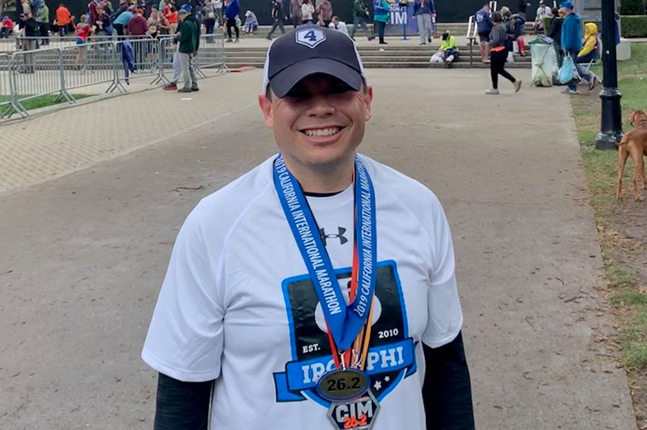
I share the story of the moon landing and my own Iron Phi journey because they share some common ground. Both set audacious goals, both required drive, and both celebrated small successes in pursuit of a larger purpose. Both required a desire to chase success and embrace failure. Chasing success is far easier than embracing failure. Moving towards the finish line is inspirational. People flock to success. They want to be a part of winning. But everyone knows that few dreams come without setbacks. Failure, when embraced, can often catapult you to the finish line. These aren’t setbacks, instead, they are opportunities to get better and become better.
How will you embrace failure? As a leader, making mistakes can be the greatest opportunity to improve performance and learn what not to do. Many launches never left the pad and some crashed upon landing, but NASA never gave up. They used that experience to get better. They used that experience to build a stronger program. They committed to success and embraced failure to ensure they achieved the dream. For me, I learned what fuel worked and what didn’t for my body to sustain 26.2 miles of running. There were days where the fuel didn’t work. I would be tired and felt like I couldn’t make it. Those days were tough, but they were the days of which I am most proud. My recognition of what didn’t work led me to what did. Ultimately, that was a key part of me realizing my goal.
The very same formula that led NASA to put Neil Armstrong on the moon and led me to run 26.2 miles can help you become “the greatest version of yourself.” Think about your inspirational leaders and whether they are helping you chase success and embrace failure. If they aren’t, ask them to help. Are you, as a leader, inspiring others to chase success and embrace their failure? When you create a roadmap do you allow enough opportunity to measure your incremental success? If you hit a setback, how do you move forward? Is it a springboard for better performance in the next phase or an anchor that holds you back? Finally, when you reach your goals do you take the time to appreciate the journey, the view, and the team that helped you get there? Neil Armstrong stopped to take in the incredible view of Earth from the Moon, and so should you.
We all have opportunities to become better and make a difference for ourselves, families, friends, brothers, and communities. Phi Delta Theta talks about becoming the greatest version of yourself. This isn’t to say that you aren’t already great in your own way. Instead, it is the idea that we all have the opportunity to continuously improve ourselves and reach our goals. Becoming the greatest version of ourselves isn’t the destination; it’s the journey. Chase success, build a roadmap, celebrate your achievements, embrace failure, and take your own small steps to your moon landing.
Mike serves as the director for continuous improvement at Sonoma State University. Working out of the Office of the Provost and Vice President for Academic Affairs, Mike is responsible for managing academic space on campus as well as evaluating campus business processes to develop more efficient and sustainable practices. Mike earned both his master’s in business administration and bachelor of arts in economics at Sonoma State University where he was a Founding Father of the California Sigma Chapter. As a volunteer for Phi Delta Theta, Mike has been a CAB chair for California Sigma and for the past five years has been the Province President for Omicron Northwest. In his spare time, Mike enjoys spending time with his wife, Kimi, and their two children, daughter, Carina, and son, Braden.
The post One Small Step appeared first on Phi Delta Theta.
]]>The post On Becoming a Great Man appeared first on Phi Delta Theta.
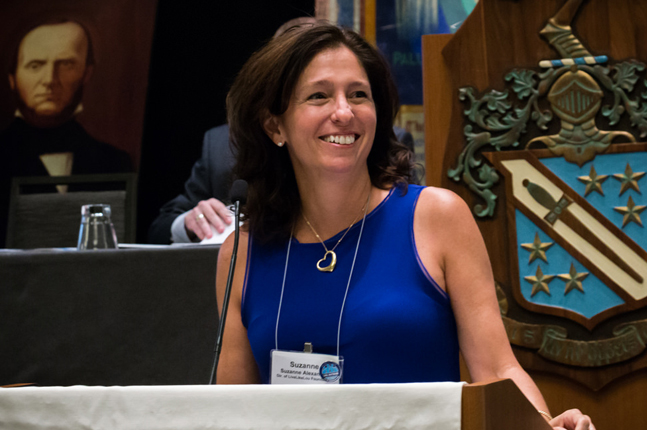
]]>By Suzanne Alexander
I want to tell you a story. It’s a lesson I learned for how to live through really hard things when living at all seems impossible. I had a front-row seat in one man’s journey from a healthy, happy life, to a life filled with a lot of loss. Loss of normalcy, loss of frivolity, loss of hope, and ultimately life itself. In the process, I watched Neil Alexander transform from a regular guy to a Great Man.
It is funny that I call Neil a great man because I knew him ‘back when,’ if you get my drift. A twenty-three-year-old recent college graduate with an unremarkable GPA, a lot of confidence, a quick wit, a dashing smile, and five dollars to his name, but he was enough for me. We built a wonderful life together, pretty satisfied with being unremarkable.
Then there was that teachable moment. Not the moment you would expect me to write about, as the widow of a man whose life was stolen by the 100 percent fatal disease Amyotrophic Lateral Sclerosis (ALS). Not the moments of confusion, confounding aches and pains, baffled doctors, and unhelpful test results for years leading up to his diagnosis either. And not even the moment of his death, something that I still can’t write about.
It was a different teachable moment, as I sat across a room and watched my husband describing his newly-announced diagnosis to a local newspaper reporter as if he was describing a legal case . . . with a dry description of the symptoms, his prognosis, and some colorful dark humor.
It started with the reporter’s surprising question.
It was an obvious question. One that everyone wondered, but no one had dared to ask. Not even me. The mighty Neil Alexander was in his corner office, with floor-to-ceiling windows and a beautiful view of his beloved Pittsburgh, with framed photos of his healthy wife and kids and advanced degrees on display. The room was filled with devoted co-workers and friends prepared to be quoted for the newspaper article and to express encouragement for him upon his early retirement because of ALS.
The story headline: Local Executive Bravely Faces ALS Death Sentence
The reporter’s surprising question: “Are you angry?”
This was the first time I heard Neil speak publicly about the awful hand he had been dealt. As a forty-seven-year-old successful business leader and attorney, with healthy habits, a loving family, and every expectation of growing old comfortably, it was a shock that doctors were now telling him: “There is no treatment. There is no cure.”
They told him, “Two to five years.”
They said, “Do what you love in the time you have left.”
That was it.
Privately well, that was tough. Our kids were nine and seven years old. How could it be? The constant state of grief was paralyzing.
Publicly, that was something else. Neil finally had the answer to the strange twitches, muscle pains, and fatigue. He was almost relieved that he had a name for the mysterious physical maladies he had endured for two years before his diagnosis. So to his friends and newspaper reporters, Neil put on a brave face and voiced a brave conviction that he would fight this disease with everything he had. He would beat the odds and live to see his kids graduate high school!
The human drama of Neil’s diagnosis prompted a lot of interest in those early days. Local reporters called regularly to write Neil’s story of determination to live. He was glad to share his thoughts because he wanted, ultimately, for his kids to one day read his story and follow his example in their own lives; having a public record would be helpful, he thought. So much positivity surrounded Neil as he proclaimed his goals to fight that we nearly forgot the grief and terror of his ALS death sentence.
So the reporter’s probing and personal question felt a bit obtrusive. As if she was looking for a crack in Neil’s veneer to give readers something more intriguing to read.
“Are you angry?” she had asked.
I knew Neil was sad. I saw him cry. Once. On the day of his diagnosis but never again. Years later he revealed to me, in private of course and toward the end of his life, that he cried every single day.
Neil said, “Suzanne, sometimes a good cry just feels good.” And then, he laughed, “You wipe your eyes, check your nose, and get back to work.”
Apparently the act of crying, for Neil, was a private and daily self-care routine that allowed him to focus on his losses and then, once refreshed, decide what he was going to do about them. I love that he shared this lesson with me and I can now share it with his kids. I agree that crying feels good!
But, I was not prepared for this deeply private and evocative question “Are you angry?” to be asked in a crowded room, and for Neil’s answer to possibly become the newspaper story headline: Local Executive Is Angry About His Losses.
We all just watched as Neil answered the reporter’s question with such conviction it seemed he had spoken the words before. But, I can attest, he had never spoken the words before:
“Look,” Neil said. “I have never been hungry. I have never been lonely. I have never lived in fear. I’ve had a good life. I don’t want to die. But I’m not going to start complaining now.”
Neil was lying!
Of course, it’s true he didn’t want to die, and amazingly Neil never did complain. But the rest of it simply wasn’t true.
Neil did actually experience hunger in his life. He did live through excruciating periods of loneliness. And he did have moments of palpable fear, both as a child and as an adult.
I’ve come to learn that most people read the quote from Neil and thought, “Wow. What a good man to show such perspective and such acceptance for his terrible fate!”
But this is the lesson that Neil taught me in that moment: He wasn’t showing perspective, and he was not accepting his terrible fate. Neil was making a choice, just as he had so many times before.
He chose to forget he lived with periods of hunger, loneliness, and fear in his life.
He chose to fight for that unremarkable GPA despite those factors in his early years, to fake that young graduate confidence, to tell a few jokes, and give us all a dashing smile when he only had a few dollars to his name.
He chose to push through the strange twitches, muscle pains, and fatigue, and to keep pushing his doctors for the answer he really didn’t want to hear.
He chose to cry as a daily practice of self-care because life was hard. And he chose to never let me and his kids see him cry.
Then, when pushed by a reporter with a probing and personal question, Neil chose to focus on all that he still had—his family, friends, job, community, time (he still had time)—and he said, “I’ve had a good life.”

When the easy, expected answer was to focus on all of his losses and show anger and sadness, Neil focused his mind and chose to focus on all that he still had. He chose to live his remaining days with gratitude.
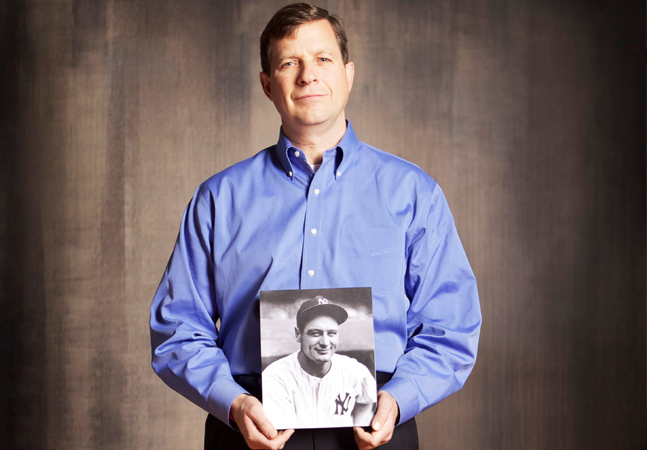
Of course, The Iron Horse Lou Gehrig played a big part in the rest of Neil’s story and what we are building together because of The Luckiest Man’s example is so amazing. Maybe I’ll write about that next. But for now, I hope this lesson Neil left gives you an example of how to live through really hard things. When life seems impossible, I hope you choose to focus on all that you still have, and that you choose to live your remaining days with gratitude, too.
It’s a choice.
Suzanne Alexander is the co-founder and director of The LiveLikeLou Foundation, a national nonprofit organization she started with her husband Neil upon his diagnosis of ALS in 2011. Neil died from his disease in 2015. The Foundation’s purpose is to Leave ALS Better Than We Found It, in honor of baseball Hall-of-Famer and Luckiest Man Lou Gehrig, and the more than 16,000 Americans living with this 100 percent fatal condition every year. Phi Delta Theta Fraternity is the primary philanthropic partner of LiveLikeLou and is active in the cause of ALS through multiple philanthropic programs. Learn more at www.LiveLikeLou.org.
The post On Becoming a Great Man appeared first on Phi Delta Theta.
]]>The post It Is Civility That Will Lead Us Forward appeared first on Phi Delta Theta.
]]>“Be the person that others will look for your daily posts because they know you will encourage them. Be the positive one and help others to have a great day, and you will find that not only will they like you, but you will like you too.” John Patrick Hickey
During my years of service as an army combat engineer officer and as a member of the all-volunteer military force of the United States, I was fascinated by both the art and science of leadership. Military historian Roger Nye once wrote that “leadership is not defined by an individual’s position or rank, but rather confirmed when those that one is charged to lead choose to follow.” The wonderful beauty in realizing this reality is that leaders can then help elevate others while simultaneously accomplishing the mission. Formal and informal leaders, some defined by position and others who are not, demonstrate certain characteristics that influence others in a positive way. Leaders display an uncommon commitment to the cause, other team members, customers, and partners. They serve other members of their organization and their communities selflessly, with humility, empathy, wisdom, and kindness.
At this point, you may be wondering why my opening paragraph in this post about civility is all about leadership. I hope that by starting with leadership I can lay out the argument that a well-functioning civil society needs, no requires, sound leadership, so others can experience a good example that can be emulated, replicated, and seen as a source for positive change.
My argument is meant to promote the merits of civility during these difficult times. I would suggest that civility within a community can itself establish positive conditions for change, mutual support, and the greater good. It is often assumed that an argument is fueled by emotion, even anger. Although that can sometimes be the case, an argument during civil discussion is simply an opposing view, and should be seen as a starting point, instead of a hard stop.
In modern times, there are numerous examples where civility won the day and exposed the roadmap to better times. For example, the market crash of 1929, caused by fears of excessive market speculation by the United States Federal Reserve, caused tremendous upheaval in our society, but calmer heads prevailed. With civility and sound leadership across many sectors of society, and a stronger economy, our people experienced a greater appreciation for place, an increased sense of community—neighbors looking out for neighbors, and tremendous opportunity. The reciprocity achieved out of such a negative far-reaching event sowed the way towards ever greater achievement as a society.
During these challenging times, it is civility that can energize collective innovation and initiative. If only we, as one people, forego antagonizing those with differing views through social media posts, the messaging on our clothes, and threatening actions. We can and should use our arguments to promote better understanding and perhaps better solutions to the challenges we all face.
How can fraternity help us bridge the gap between where we are and where we are heading? Fraternity establishes a baseline for accepted norms, collective values, mutual support, and friendship. In this sense, individual members commit themselves to a code of conduct and the accountability that comes from belonging to a fraternal order.
During the conduct of fraternity business, it is essential that time be allowed for all viewpoints to be shared, so the best possible outcomes can be realized. At the beginning of meetings conducted by one of the groups I belong to, and I will paraphrase here, it is said, “let not our petty grievances disrupt our discussions and our good work.” It’s a solemn reminder that we all have biases, preferences, and beliefs shaped by our upbringing, environment, opportunities, and life’s journey, but at the same time, if we are to imagine what is new and possible, we must embrace civility as a responsibility of all.
For most of us, 2020 has been a year unlike most others. We have dealt with a series of events outside of our control, and in some cases, the second and third order effects of those events. The year is not yet over, but as we enter the fourth quarter, having pulled through the first two-thirds of the year together, it is becoming ever more evident that together we will navigate the remainder of a pandemic, a recession, and a national election. Many of the solutions we discover along the way can make us stronger, more resilient, wiser, and hopefully a little more humble and open to new ideas.
The post It Is Civility That Will Lead Us Forward appeared first on Phi Delta Theta.
]]>The post Our Obligation appeared first on Phi Delta Theta.
]]>I have watched the news the past couple of weeks with a heavy heart. I have heard stories from many of our members and alumni. I have had many restless nights. I have shed tears, thinking about the countless lives impacted by violence, bigotry, and racism. My heart hurts. I have worked to continue to educate myself. I have more work to do, and I recognize that I am not going to be perfect. Anti-racism work is messy and difficult. Those who know me well, know that I am happy to engage in spirited debate on a range of issues and ultimately agree to disagree if necessary. Racism is not, and will never be, one of those things.
I have no problem saying that Black Lives Matter. As a movement, BLM has been weaponized for political purposes. Some people have strong opinions on both sides. However, we must filter out the noise of politics. Saying Black Lives Matter is a humanity issue. Do All Lives Matter? You bet. However, the Black community continues to face violence, harassment, and racism on a daily basis. Is that your reality? If it is not, consider yourself to be in a position to make a difference and amplify the voices of those that do.
Phi Delta Theta Fraternity was founded on the high ideals of friendship, sound learning, and rectitude. Our Founders formed this society to create a place for the free exchange of ideas in a time when universities were less than hospitable to this type of self-awareness. The fact that Phi Delta Theta contributed to systems of oppression and racism, both in policy and practice, in later years is ironic in a way that I would prefer it not to be. For almost 50 years, like many organizations of the time, Phi Delta Theta did not allow students of color to join our Fraternity. Although this policy was abolished in 1954, we cannot continue to diminish this historical fact and its place in our history.
We have come a long way, but we still have work to do. Saying the phrase, “Becoming the greatest version of yourself” does not magically make it so. It takes work. It takes sound learning. It takes rectitude. It takes friendship. Our ritual tells us we have an obligation to our fellow man to live our lives in a way that makes our world a better place. History has shown, and the past two weeks have magnified, the fact that we have a long way to go.
So what do we do now? First, we must listen. We cannot understand what our members of color experience, the lives they have lived. We must not listen without action, and my promise to you is that we will act. I have work to do. We have work to do. We will do this work together.
Moving Forward – A Note from Phi Delta Theta
The death of George Floyd and the resulting protests throughout the world have caused much anger and frustration, and once again highlight issues of racism, inequality, and injustice for Black Americans in the United States. The events have also led to promising conversations about a better tomorrow, and we are greatly encouraged by them.
Phi Delta Theta wants to do everything it can to be part of the solution. We know that making meaningful change begins by listening, learning, and having open dialogue with each other. This is what we are doing, and we’ve been encouraged by the number of our members who have raised their hands to participate.
We are continuing this dialogue with our members who have said they want to be a part of the solution. We are very encouraged by these conversations, and we know it will help Phi Delta Theta take action where it will be most effective for our organization and its people.
The post Our Obligation appeared first on Phi Delta Theta.
]]>The post Words of Wisdom from Past Chapter Presidents appeared first on Phi Delta Theta.
]]>Leave time to focus on yourself.
Learn as much as you can from your alumni.
Reports are important, chapter meetings are important, paperwork is important, BUT the most important thing is brotherhood. You can’t make it happen, it has to come organically from other brothers bonding and connecting. Give them that opportunity whether it’s a group dinner, lunch, pick-up sports etc., and let the magic happen! Don’t push it, but just extend the invitation with a smile!
Set goals early and keep the bar high.
“This is the way we’ve always done it” is an excuse used by single-minded people.
Have FUN!
Take time for yourself. If you can’t take care of yourself, you can’t take care of the chapter.
Enjoy the little things.
Lead by example and practice what you preach.
Separate fraternity and friendship when making decisions.
Be accountable for yourself and all of your brothers. If you tell someone that you are going to do something, stay true to your word and do it.
Do not focus on those people in the chapter who may not be showing up to meetings as much as those that you know have potential. As a leader you cannot turn every person into a leader.
Always have a pulse on all the chapter functions so you won’t be blindsided by anything.
Actively prevent and speak against things that are risky. Don’t be silent.
Be strong in your communications. Make an effort to communicate effectively with your CAB.
At the end of the day, it’s just a group of college kids. Make sure to keep your cool even when you are getting frustrated.
Be aware of all GHQ, IFC, and university rules and risk management policies.
Be prepared to say no to some of the guys in the chapter and do the responsible thing instead of the fun thing. Make the hard decision instead of the easy one.
This position is going to be taxing. Know that you’re doing your best and don’t be afraid to rely on others around you (CAB and your exec). Delegation is key.
Always be communicating, especially with less involved members about what can be done better.
Be yourself. Communication is key.
Being a leader isn’t easy. Criticism and praise will be given no matter what you decide to do. It’s what you do with the feedback you receive and how you continue to improve your chapter. In the end have the best intentions no matter what and look to truly become the greatest version of yourself and strive for your chapter to do the same.
Believe in yourself. You need to be able to say no and put your foot down.
Communication is key. It is vital to stay in touch with your CAB, province president, and leadership consultant. In addition, be sure to be open and honest with your members as to what is going on with the Fraternity.
Divide key responsibilities among brothers with strong leadership early on. This promotes growth on their part and keeps any one strong leader from burning out. Have deliverable (reports, events, newsletters, meetings) due for key positions on set dates or intervals of time (weekly, by-weekly, monthly).
Do not procrastinate and follow the chapter greatness checklist.
Don’t be afraid to ask for help from anyone.
Don’t do everything yourself. Find your core officers who you can trust and have them help you a lot. Also, be positive, your attitude is what makes everyone else’s attitudes.
Don’t worry about pleasing everyone. Instead, worry about improving yourself and the Fraternity like you know you should.
Don’t get bogged down with everyone’s complaints. They are adults and can deal with it themselves.
Don’t let the opinions or traditions of the chapter keep you from making the right decision.
Don’t procrastinate and make sure your VP is doing his job.
Don’t take on too much too quickly. You have an executive board that is there to help you.
You have the power to do great things as president. Don’t doubt your abilities. You were elected because people saw something in you.
Focus on yourself and show other positions how to do their jobs instead of doing it for them.
Follow the values of the Fraternity and you will never be misguided.
Follow your gut and make sure to value everyone’s opinion.
Give people the benefit of the doubt and a few chances. Be firm but fair. Follow through on commitments.
Hard work and preparation are essential for running an effective and smooth chapter meeting. YOU and your executive board set the tone for the entire organization. Make it a positive tone of unity not division.
Don’t be afraid to make people upset. Focus on making this chapter better, not making everyone happy.
Have as many individual conversations as you can.
Lead by example. People will follow you when they see you backing up your word. And stay positive. Turn what looks like setbacks into opportunities.
Learn to be political. You could be objectively correct, but if your ideas are unwieldy, you will get nowhere.
Listen to all your members. Be willing to reach out to them to get some input on how they think the chapter is doing.
Most people in the chapter look out for themselves. You have to look for the betterment of the chapter.
Never be afraid to ask for help (even when you think no one else cares), and don’t try to do everyone else’s job.
Pay attention to your chapter and member needs.
Set a calendar and book venues before the semester even starts.
Set the tone early. Make it apparent that you are in charge but be willing to listen to others.
Lean on the most recent president for advice, and don’t get too worried if at the beginning you feel lost.
Stay motivated.
Stay on top of things early and stay organized. Once you get behind it’s hard to catch up.
Stay organized and don’t procrastinate.
Supporting the active members of your chapter should always be your first priority.
Take time to yourself and let the officer positions work for you.
The external side of the job is arguably more important than the internal. Being respected by your chapter matters a lot, but if people outside the chapter don’t respect your opinions and know who you are, your whole chapter will suffer.
Thicken your skin and have 4-5 people to turn to always.
Always remember that you are the face and should carry yourself with respect. Be completely transparent with the information you receive.
Trust your gut and remember that you serve the chapter.
Work closely with the executive board and stay on top of everything.
You have to command respect. It will be hard to yell at your closer friends, but they will respect you more in the long run.
You were elected for a reason so don’t doubt yourself.
Sometimes the right decision isn’t the most popular one.
The post Words of Wisdom from Past Chapter Presidents appeared first on Phi Delta Theta.
]]>The post Mental Wellness: Doing The Little Things Right appeared first on Phi Delta Theta.
]]>Every moment of our lives is filled with stress. Our body preforms its basic functions, such as breathing, heartbeat, and digestion, in response to internal and external stressors throughout our entire life. Quite simply, a life without stress is impossible; however, how we manage stress and stressful situations is immensely important to our own mental health and wellness. According to the World Health Organization (WHO), “Health is a state of complete physical, mental, and social well-being and not merely the absence of disease or infirmity.” Managing stress is a major component of overall wellness, and although I will be concentrating on mental wellness, it is important to note that coping with stress impacts all aspects of our life. Fortunately for many of us, our fraternity experience within Phi Delta Theta can provide some of the best supports and opportunities to cope with stress through use of our own coping skills combined with available social supports.
As an undergraduate, the stress of classes, midterms, fraternity obligations, jobs/work studies, research and labs, interviews for jobs or internships, and applications to scholarships, graduate schools, medical school, or employment, can impact our mental wellness significantly. You may also participate in college sports, intramural sports, clubs, other Greek-related activities, philanthropies, and community service projects, which adds to things that we must manage in our busy schedules. We also have the added stress of maintaining relationships with our family, friends, significant others, and fraternity brothers. For our seniors, there is the added stress of your upcoming graduation. Just looking at that list of stressors can feel a bit overwhelming at times. Some stressors are temporary, such as midterms, job interviews, and a tough semester of challenging classes, while others are likely to last longer, such as interpersonal relationships, family members with series illnesses, or work-related stress. Simply put, life is stressful, but that’s okay.
As I write this, many of you are likely going through the stress of midterms, planning spring break trips or what to do while off for a week, and finishing out the remainder of the semester. These are added to your daily stressors of managing your time to study, maintaining your friendships, preparing for life after graduation or the summer between semesters, and whatever else you choose to do to occupy your time. Increases in stress are going to occur regardless of what we do, and this is just a natural part of life. Stress is always going to impact us, but the impacts can be either positive or negative.
Negative stress can be detrimental to our overall health physically, mentally, emotionally, and socially, going back to the definition of health by WHO. Negative or mismanaged stress can impact us in many ways physically, mentally, emotionally, and behaviorally. Some signs that we are not managing our stress well include headaches, fatigue, increase in colds/flu, worry, inability to concentrate, negativity, loss of confidence, irritability, depression, anger, loss of sleep, restlessness, and increases in alcohol, tobacco, illicit substance abuse, as well as engaging in risky behavior. These are just some of the signs that someone is not managing stress well, and each person is going to differ greatly based upon the stressor, the perception of their ability to manage stress, and how well they can cope with the stressor.
So what can we do to manage our stress as an individual and as a fraternity chapter? Well individually, we can identify our sources of stress, control the controllable stressors and let go of those that are outside of our control, find ways of coping that work best for us, practice a healthy lifestyle, strive for balance, stay organized with good time management skills, prioritize tasks, maintain a routine, and engage in social support. This can take shape in many different ways and is always tailored to the individual. In a practical approach, this may be as simple as keeping a list of things to do and due dates, going to the gym regularly, avoiding distractors when studying, such as social media and texting, taking time to relax and just listen to a favorite song or watch a funny video clip, or take time to get off of campus. Sometimes the little things that we do to manage our stress are most important and unfortunately the first to go when we feel large amounts of stress. The possibilities are endless and each person has to take responsibility to try and practice different ways of coping to find those techniques that work best for them to manage their stressors.
In the context of our fraternity chapters, we hopefully have a well-developed social support system that we can utilize when feeling stressed out. Chapters can hold brotherhood dinners after chapter, all go to the dining hall around the same time, have a flag football game every Friday after classes are done for the week, go and do the community service and philanthropy events for other organizations, pass the gavel in chapter, provide time to just relax with a movie night, going to sporting events, or other campus activities. Again, these don’t always have to be large organized activities, but just engaging with our brothers and sharing experiences can build those strong relationships that help add resiliency when an individual experiences stress. Just having people around us that support us is often enough for us to cope with any stressor in a healthy way.
So as the semester continues to move forward, remember to do the little things for yourself and for your brothers. Create a list of things that you can do when feeling stressed out that are healthy and helpful to you, and then go out and do those things that help you cope with any stress in your life. At the end of the day, life will be stressful enough by itself, so go and actively manage the stressors that you can to promote you becoming the greatest version of yourself, and help your brothers do the same.
The post Mental Wellness: Doing The Little Things Right appeared first on Phi Delta Theta.
]]>The post To Persevere and Excel – Managing Mental Illness as a Student appeared first on Phi Delta Theta.
]]>One of the defining moments during my Phikeia experience occurred when my big brother asked me a compelling question: “What has happened in your life that has made you who you are today?” My answer wasn’t a bad breakup, a family relationship that had deteriorated, or a specific event. I wanted to share that managing two separate mental illnesses has made a profound impact on me. At the time, I felt this was not what the Fraternity or my big brother would want me to reveal. Though I don’t recall my specific answer at the moment, nothing has impacted my development as a human more than my battle with mental illness.
At the age of 22, I have learned how to handle my bouts with depression and General Anxiety Disorder as well as possible. But, for the majority of my life, I struggled to understand and cope with these feelings. By sharing my story and struggles, I am hopeful that I can help others realize that the inner demons you may battle do not define you. It is very possible to live a fulfilling and productive life.
I first started noticing signs of depression in high school, but as a teenage male, I was truly afraid to show my emotions. Art was the only forum that allowed me to share my feelings towards these issues. This, however, did not come until after something that I am still recovering from happened. In December of 2009 at the age of 16, I tried to take my own life. I will spare the specific details, but I had hit that point. As I write this post, I still struggle to accurately describe my state of mind that evening. To start, I was your typical high school student, but I really did not feel like I fit in anywhere at my high school of 2,000 students in the upper middle class area of Fort Wayne, Indiana. My family wasn’t wealthy, I didn’t play high school sports, and I just didn’t “fit in” with the classmates I had grown up with from second grade to high school. But, I persevered.
To say the least, I had very interesting relationship with my father growing up. My mom and dad separated earlier than I can remember, and my dad lived in every state possible besides Indiana for the first ten years of my life. I would see him a handful times throughout the year before he moved back when I was 10. However, this would be short lived as my dad made a few mistakes and again began moving often for work. Until I was about 16, I tried to have a decent relationship with my dad, but at that point, too much had built, and I quit trying. The feeling was pretty reciprocal, and we didn’t talk for eight months. This angered me for a long time, but once again I persevered.
By the time I hit high school, my mom was my best friend. She still is to this day in every way, shape, and form. We have had our differences. I was never the perfect child, especially in high school, but we dealt with each other. She made continual sacrifices for me that I will never be able to repay. She worked a third shift job five days a week, so I was on my own from 8 p.m. until 4-6 a.m. each night. I felt lonely A LOT, especially while I dealt with depression and anxiety of which I had no understanding. I didn’t tell her about the my irrational thoughts, and I didn’t tell her or anybody else how much I hated being alone five nights a week. I wasn’t sleeping more than four hours a night due to the continual thoughts I was having, and I had no real forum to project myself. After four years of this though, I persevered.
I persevered through everything that culminated into the night that I hit rock bottom. This is something I often remind myself of when I have rough days. On May 25, 2010, I had a normal day at school. I arrived home and planned to spend the day playing basketball with a few of the neighborhood kids. When I arrived home, my sister’s car was unexpectedly there – It was a Tuesday, and she lived in Muncie. I will never forget the look on her face when I saw her. She was crying tears I had never seen in another person. She hugged me in a way she had never hugged me before. She had learned that day that her high school boyfriend had committed suicide. This was the moment I figured it out – Life isn’t about one person’s inner struggles, trials, and tribulations. We live for every single person who has ever made even the slightest impact on us. Life is for the family you share at home, your parents, your friends, your fraternity brothers and for whomever you have shared life. Your life matters whether you see it or not. You mean something to someone. I made a promise to my sister that day that I can happily say I have now upheld for six years.
Phi Delta Theta has and continues to play a vital role in helping me persevere. On July 27, 2014, my Uncle Terry passed away after a 20+ year battle with HIV/AIDS. I was in my first summer as an initiated member of Phi Delta Theta at the University of Southern Indiana (Indiana Lambda), and I had been selected to be one of our representatives at the Kleberg Emerging Leaders Institute. I did not attend due to my uncle’s funeral. My truck, as my chapter brothers know, is a glorious piece of machinery that chooses to work when it wants. It decided to call in sick that week. Instead of allowing me to miss my uncle’s funeral, my chapter brother, Russ, decided to drop everything, made the five hour drive to Fort Wayne to help me, and returned home at 6 a.m. the next morning to make his summer class. That is Brotherhood! I was the last person to speak at my uncle’s funeral, and it helped me find a bit of inner peace and solace with his death. We are drawn to the negative moments when we lose someone permanently. It’s human nature, but we have to learn to accept the bad and cherish the great moments. The moments of grief, depression, and anger associated with losing my uncle rocked my world and sent me on an emotional downturn, but I have persevered.
In October 2015, I had a complete breakdown. Anxiety was at an all-time high. I hadn’t been to class that week, and it was Wednesday. I called my sister with plans to transfer to Indy. I had no desire to be in Evansville. For the majority of the semester, one of my three little brothers and a pledge brother basically dragged me out of bed every morning to attend class. On the day of my breakdown, I went to my Greek Advisor, told her about how I felt, and cried in her office for about twenty minutes. We talked, she gave me the time to vent, and then she escorted me to the Campus Counseling Center to schedule an appointment. I hated the initial thought of counseling. I knew I had problems, but I couldn’t imagine counseling was going to help. Regardless, I took a chance and began to see a counselor, and I continue to do so today. This was the first real step I had ever taken to deal with my problems. It helped me realize what I was fighting against, and I learned to treat it differently than I had before. Since, I have been succeeding slowly but surely in life. I was elected IFC President and maintained my Alumni Secretary role in the chapter. As Phikeia Educator, I led the largest initiate class that the chapter has had in the past decade, and I figured out what I wanted to do with my life. I plan to be a Director of Fraternity and Sorority Life someday, and I owe that to my advisor and friend, Trish. I even turned my semester around and made the Dean’s List for the first time.
One of the biggest lessons I have learned through all of this is to stop hating the fact that I have depression and General Anxiety Disorder. I started to embrace that part of my life, and I have made it a big part of who I am. My only goal with this post is to show any individual who may be struggling with the same things that it is possible to achieve more than you think and that your life truly matters. Do not be afraid to seek help. Talk to your chapter brothers. Find a forum where you can project how you feel. Do not hate this part of you. Love every part of who you are. If you think you need professional help, get it. If you think you need medication, talk to a professional to see what they think. You are only so strong on your own, but as Phi Delts, we are never alone. I am proud to be a Phi, a fraternal man, and a twenty something male battling mental illness.
I’m going to leave you with something that has helped me deal with my mental health. It is as simple as a semicolon. A semicolon is used when an author could’ve chosen to end their sentence, but chose not to. The author is you, and the sentence is your life. Be a semicolon. Keep living, keep fighting, and love every moment of your life.
The post To Persevere and Excel – Managing Mental Illness as a Student appeared first on Phi Delta Theta.
]]>The post Want To Greatly Improve Your Chapter? Send More Men To The Kleberg Emerging Leaders Institute appeared first on Phi Delta Theta.
]]>Each year, when Ohio Epsilon at the University of Akron begins the process of selecting members to represent the chapter at the Kleberg Emerging Leaders Institute, we remember a great quote from our Province President, Jim Warner.
“You shouldn’t send ducks to eagle school.”
It is a quote that has resonated greatly within Ohio Epsilon, and the chapter has benefited from following this advice and sending as many “eagles” as possible to Kleberg each summer.
The three pillars of the Kleberg Emerging Leaders Institute are purpose, networking and leadership. These values are extremely important because they coincide with the three Cardinal Principles that we abide by as men of Phi Delta Theta. The men that spend valuable time in Oxford, Ohio during Kleberg refine their skills in these three categories, and they always return with a greater understanding of each one.
Sending a large number of men to Kleberg year-after-year has greatly impacted our chapter. Over the past three years, Ohio Epsilon has sent a total of 34 delegates to the conference. We sent 15 men in 2014 with one being a Peer Mentor and another being our first Whole Man Scholar. We were able to show our support of the Kleberg Emerging Leaders Institute and grow the capacity for leadership within Ohio Epsilon at the same time.
The most notable benefits that the chapter has gained are positive attitudes, heightened leadership skills and a greater drive from those who have attended Kleberg. By developing a greater purpose to live our ritual, connect with members of GHQ and other chapters, and attend sessions to refine leadership skills, our members begin to step into leadership roles even before they leave Miami University.
Upon returning to campus, it’s guaranteed that those who attended will begin to work harder, take on more responsibility and apply the knowledge gained at Kleberg to benefit the chapter. Any leadership book can be read and applied, however, what happens to a Phi while he is at the Kleberg Emerging Leaders Institute lights a fire that burns his Phi Delt passion brighter than ever. The building of this Phi pride and the desire to lead, coupled with a greater understanding of the purpose of Phi Delta Theta is easily the most important factor that has led to Ohio Epsilon’s success.
The proof is concrete. More than 70% of our current executive board members attended Kleberg at one point in their undergraduate career. Our past four presidents attended the conference. Three of those four have returned as Peer Mentors.
This summer, we hope to send two peer mentors, three Whole Man Scholars, and 15 undergraduates, for a total of 20 Ohio Epsilon men in attendance.
The experience a man gains in four days at the Kleberg Emerging Leaders Institute is invaluable. It is the gift that keeps on giving, generation after generation. Our chapter has more than doubled in size, been recognized for numerous awards on campus, been named the most outstanding fraternity at the University of Akron’s for three years in a row, and was recently the runner-up for Phi Delta Theta’s Harvard Trophy. This success directly correlates with Ohio Epsilon’s focus on sending more men to Kleberg.
Registration is now open for the 2015 Kleberg Emerging Leaders Institute through myPDT. Per the 2015 Chapter Minimum Standards and Expectations policy, all chapters must have at least three (3) delegates in attendance. This can be a mix of Kleberg delegate track and Phikeia Education training track participants, but does not include brothers named as Peer Mentors or those who receive Whole Man Scholarships to attend the Honors College of Leadership. If a chapter registers three members for the delegate track and one for the Phikeia Education training track, all register for free. Additional delegates may pay the $350 registration fee to attend. All delegates are responsible for their travel costs.
The post Want To Greatly Improve Your Chapter? Send More Men To The Kleberg Emerging Leaders Institute appeared first on Phi Delta Theta.
]]>The post Phi Delta Theta – Maker of Men appeared first on Phi Delta Theta.
]]>We are entering a new era in the life of the college fraternity. The good news, more students are attending college than ever before. But, these students are increasingly coming to college with a driven focus on their careers and with seemingly little time for extra-curricular activities. Due to increasing costs, more students are choosing to enroll in 2-year community colleges or online schools like the University of Phoenix. Even the ones who are attending the traditional 4-year schools are struggling to make ends meet and often question the value of spending money for fraternity dues. And the proportion of women on campus is increasing as well.
Adding to these demographic changes college and university administrations and the federal government are focusing more than ever on issues of sexual assault, sexual harassment, and just plain sexism. Generally speaking, concern over these issues leads to more attention on two sources – athletics and fraternities. As fraternity men, we are faced with two related challenges – sharing our value to our communities and changing our often negative image as it relates to women.
Living in the modern, technological world that we do and the fact that this post started with a brief analysis of contemporary challenges, one would think that the solution would be something new and hip and, well, modern. However, as a historian I am trained to look to the past for solutions and this case is no different.
The solution to these problems is not to be found in new technology, but rather in our focus on the three Cardinal Principles of Phi Delta Theta. But, before you think I am simply going to give you a lecture on the importance of following these precepts laid out by our Founding Brothers, I want to instead focus on an often discussed, yet seldom understood, part of what makes fraternities important – their ability to help young people become men.
Contrary to popular belief, masculinity is not some biological trait. It is socially constructed and it is learned. In America, manhood is often defined as being tough, not showing emotion, and being confident and dominant in what we do. Former NFL player, motivational speaker and activist, Joe Ehrmann spells out what he calls the lies of masculinity: the Ball Field, the Bedroom, and the Billfold. Think about your early life. How often did you hear or feel that your status as a man was tied up in your athletic ability? Didn’t we often make fun of kids in school who weren’t as good at sports? As we got into middle school and high school, our worth as men was tied to our sexual appeal and abilities. Finally, in college and beyond, our value as men is often based on our earning ability. Ehrmann argues that these notions are myths that society, family, and peers drum into our heads from an early age. Often it is only with age and maturity that men are able to break these stereotypes and redefine what it means to be a man.
What we as fraternity men and as Phi Delts can do is challenge those myths to help our members redefine what it means to be a man. Brother Arthur R. Priest gave us the roadmap:
I believe in the college fraternity, creator of friendships.
I believe in its quick-sympathies, and its helping hand.
I believe in its brave idealism,
Stirring every valiant emotion.
Rousing every potential talent.
I believe in its compelling drive for sound scholarship.
For genuine culture.
For clear-eyed honesty.
For business integrity.
I believe in the college fraternity, maker of men.
Read this poem again. Where does it say that manhood means being sexually active? Where does it say that being a man means being good at sports? Where does it say that how much I make defines my worth as a man? Instead, Priest uses words like scholarship, culture, honesty, integrity, emotion, talent, sympathies, helping, and friendship. Being a man is about being true to yourself. This includes being willing to show emotion. It includes being there to help someone in need. It includes living life with integrity. It includes being a genuine friend to people in your life. It includes treating all people, regardless of their gender, race, sexual orientation, or background, with respect and kindness.
I will admit that at various points in my life, I have bought into the myths of manhood and at various points felt either validated or rejected as a man because of it. But, for me, being a member of Phi Delta Theta has helped me learn the value of being myself. Becoming the greatest version of yourself means not buying into the myths of masculinity. It means being able to be vulnerable and emotional if necessary and not allowing society or your peers dictate to you how you must act. A fraternity should be a place where you are free to be yourself and where you know your brothers won’t judge you or force you to conform to society’s definition of manhood.
So, how can we as members of Phi Delta Theta and leaders on campus and in the world show our value and change our reputations? By rejecting the myths of manhood we received growing up and by showing our brothers and the world what it means to be a real man. Like Brother Priest, I too believe in the college fraternity, maker of men.
Jeff Ramsey was initiated into the Wisconsin Beta chapter (Lawrence University) in 1997. He graduated in 2000 with a degree in history and has since been working with college students. He worked in Student Affairs for several years and has recently completed a Ph.D. in history and is looking for a full-time faculty job. He is currently the Province President of Iota North (the Wisconsin chapters) and previously served the Fraternity as a Leadership Consultant (2000-2003). He and his wife, Christina have two boys, Timothy (4 years old) and Samuel (4 months old) and live in the Milwaukee area. In his limited spare time, Jeff enjoys reading, sports and spending time with friends and family.
The post Phi Delta Theta – Maker of Men appeared first on Phi Delta Theta.
]]>The post 2015 Presidents Leadership Conference: The Start of a Journey appeared first on Phi Delta Theta.
]]>Nervous. Intimidated. Worried. Maybe a little scared. Those are some of the thoughts I had as I landed in St. Louis for the 2002 Presidents Leadership Conference as a junior at the University of South Dakota, beginning my journey as newly-elected chapter president of South Dakota Alpha. I can honestly say that some of those same emotions were with me as I arrived in St. Louis in 2015 for my first major event, starting another journey as Phi Delta Theta’s education commissioner.
You see, the duties of a chapter president and the education commissioner have some similarities. We are both the public faces of what we lead. As chapter presidents, you are the face of your chapter, and as Education Commissioner, I am the face of our educational conferences. Many people depend on us to put the time in, planning and executing on our goals in order to further our organization. And, maybe most nerve-racking, we will be those held accountable if something should go wrong. I think it is safe to say that the 2015 Presidents Leadership Conference was a success, and I have the utmost confidence that the student-leaders who attended Phi Delta Theta’s premiere educational event will find their own successes when they return to their campuses.
Our time in St. Louis kicked off with General Council President Rich Fabritius discussing how, as leaders in our organization, it is incumbent upon us to swing a heavier bat; to do whatever needs to be done in order to become the greatest version of ourselves. Later that night, Corey Ciocchetti, a business and ethics professor at the University of Denver, reminded us all to chase authentic success.
Friday morning began with Brother David Almacy, former White House Internet Director under George W. Bush and current Senior Vice President at Edelman, recounted his experiences as chapter president and how they prepared him for post-graduate success. Later that day, Marc Mores, former General Headquarters staff member and current Executive Vice President at James R. Favor, spoke about CEO-level responsibility and our mandate, as leaders, to do what ought to be done. Friday evening, Suzette Walden Cole, lead consultant for the Fraternity Health and Safety Initiative, talked to members about the importance of bystander behavior and our duty as leaders to take a stand against sexual misconduct.
Past President of the General Council Rudy Porchivina kicked off the final day of the conference with a humorous look at effectively running chapter meetings and what it truly means to be the chapter president. Miami Phi James Barr, group president of Ritchie Brother Auctioneers, joined us after lunch for our annual Leadership Forum, imparting his experiences as a successful business executive. The conference was concluded with General Council Member-at-Large Sparky Reardon giving a rousing speech on leadership, “bringing it home” for our chapter presidents.
In addition to the general sessions, presidents attended small group or “chapter” meetings. The meetings were expertly facilitated by our conference faculty made up of many dedicated volunteers including current General Council members, Past Presidents of the General Council, current Province Presidents and local chapter volunteers.
As our presidents return to their colleges and universities, it is my hope that the lessons they learned while in St. Louis, lessons of leadership, chapter operations, and relationship building among others, will serve them as well as they served me on my journey 12 years ago. I trust that those feelings of nervousness, intimidation, and worry have been relieved and that our chapter leaders, the best and brightest Phi Delta Theta has to offer, are better equipped to continue their own leadership journeys and become the greatest versions of themselves.
Jesse Moyer is the Director of State Advocacy and Research for KnowledgeWorks. Prior to joining KnowledgeWorks, Brother Moyer worked for the Fraternity as the Director of Chapter Services. He currently serves as the Fraternity’s Education Commissioner, a volunteer role that allows him to be involved with all of Phi Delta Theta’s educational initiatives. He holds a B.A. in contemporary media and journalism from the University of South Dakota and a M.Ed. from Xavier University.
The post 2015 Presidents Leadership Conference: The Start of a Journey appeared first on Phi Delta Theta.
]]>The post You Don’t Need To Be The Chapter President To Lead appeared first on Phi Delta Theta.
]]>As I type, the 2015 Presidents Leadership Conference (PLC) is underway in St. Louis, Missouri. More than 200 Phis have the opportunity to experience this wonderful, three-day leadership development conference each year. Your chapter president is there, and he will surely return to campus with confidence, vision, ideas and a plan to improve your chapter.
The vast majority of our undergraduate members will not have this experience. From a statistical perspective, the PLC delegates make up just over 1.5% of our undergraduate members today. Yes, individuals with incredible leadership skills can move a chapter in the right direction, but as the maxim goes, a good leader must surround himself/herself with great people. If you’re reading this and you are not the chapter president, know that your chapter president needs you to lead as well.
My point – You do not need to be the chapter president to lead within your chapter. You must only have the desire the leave your mark and exhibit persistence to see your ideas executed.
The beauty of Fraternity is the inherent opportunity that exists for each individual to leave the organization greater than it was transmitted to him. A familiar phrase indeed.
Titles are simply words. Leadership is achieved through the actions by anyone who is compelled to take them. I’ve had the opportunity to see many Phis make wonderful strides as leaders. Some of them were chapter presidents; some were chapter officers; some had no official title or responsibilities. With the new-year rolling, there’s no better time for each Phi to resolve to lead in a positive way.
As I’ve grown older, I’ve also realized that being ‘the man in charge’ is not for everyone. I see this in myself, and I’ve learned that the best place for me as a leader is within roles that are generally out of the limelight. It’s nothing to be ashamed of, rather, it’s an understanding of my personal characteristics, strengths and weaknesses.
I recently discovered a great mobile app that can help you understand the answers to such questions as: What are your unique strengths? How do you come across to others? What are your networking strengths? What is your approach to getting things done? What kind of coworker are you? You can even see how your traits fit in with your friends or potential employers. These personal inventories and the understanding of who you are great assets to developing your leadership skills in any arena that you may be playing.

General Council President Rich Fabritius challenged each Phi to swing a heavier bat this year. It’s a simple, yet powerful analogy that is vital to the success of Phi Delta Theta. There are many ways to ‘swing this heavy bat’ for those who aren’t chapter presidents.
If you’re a chapter officer, become your chapter president’s go-to-guy. Approach him and say, “I’m here to help you and this chapter become the greatest version of itself. Here are my goals in the position and these are the actions that I’m going to take to get them done.”
If you’re an undergraduate without an official role, make one up and get at it. There are countless things that need to be done outside of the normal officer structure. Your innovation will impress others and set you up for further responsibilities. I work with a student at the Iowa Gamma (Iowa State) Chapter who loves helping others find their fit – in the chapter, on campus and in life. He took it upon himself to create his own position and now takes pride in working with others to understand themselves better. He also recommends areas within the chapter and on campus where they can succeed. I love it. Heck, become the “Director of Snow Removal” and own the parking lot and sidewalks. Have fun with it.
If you’re a Phikeia, take the time to learn about different positions and volunteer to help an officer in his role. Trust me, they won’t stop you from helping. You’ll help that officer make more progress while setting yourself up for future roles if desired.
If you’re a senior, take pride in modeling great behavior and continue to show up. Many younger Phis look up to you, and your approach will set the example for them in the future. Nobody likes the senior who only complains but doesn’t do anything about it.
2015 is going to be a great year and leadership is vital in all corners. I hope that this is the year that you make a positive impact, no matter your title.
The post You Don’t Need To Be The Chapter President To Lead appeared first on Phi Delta Theta.
]]>The post Swing A Heavier Bat appeared first on Phi Delta Theta.
]]>It’s an incredible honor to have been elected the 65th president of Phi Delta Theta. To think of the men I admire and respect that have held this position before me renders me humbled, and I’m found lacking for the appropriate words to express my gratitude for your trust and support. Thank you so very much.
The General Convention is always a tremendous opportunity for our Phi Delt family and friends to gather and celebrate. We are a blessed organization in so many ways. Blessed with incredible, committed alumni and volunteers. We are blessed with a multitude of undergraduate members who’ve chosen to define their college experience by something more than being drunk and “Fratty.” Blessed with a legacy of courageous leadership that defines and positions Phi Delta Theta at the forefront of the fraternity movement. Our position in the fraternity world – and our reputation on campuses across North America – is a testament to the work that has been done over 166 years. It is that legacy that calls and compels us forward. It is a legacy of leadership that provides the environment for young men and alumni alike to be more than common. To excel and strive for greatness individually and collectively.
As we look towards these next two years, I’m reminded of a baseball story I heard recently.
Only four baseballs have ever been hit so hard that they flew out of Dodgers Stadium. The same player – Willie Stargell – of the Pittsburgh Pirates, hit the first two. His first blast was the longest ever in LA, measuring 507 feet. Incidentally, his second bomb was hit on my 2nd birthday… so perhaps I was meant to hear his story and carry it forward.
Consider some of these remarkable facts about Stargell’s slugging prowess: In 61 years, only 18 home runs cleared the right field roof at cavernous Forbes Field in Pittsburgh. Stargell hit seven of them. Only six homers landed in the upper deck at Three Rivers Stadium. Stargell hit four of them. In 1978, he launched a ball 535 feet into the shadowy recesses of Montreal’s Olympic Stadium. The Expos organization commemorated the event by identifying the seat where the ball landed… and painting it gold. The dude could flat out crush the ball. The Dodgers’ Don Sutton said it best when reflecting upon Stargell’s skills, “He doesn’t just hit pitchers. He takes their dignity.”
Beyond being an amazing athlete and first-ballot hall-of-fame slugger, Stargell was known throughout baseball for coming to the plate with a bat that would be considered heavy even by major league standards. An average major league bat weighs about 32 oz. Over the years, Stargell’s lumber far exceeded that average. In fact, he used a sledgehammer in the at-bat circle to warm up.
When asked about his abnormally heavy bat, he acknowledged that it wasn’t easy learning to hit with it. The heavy lumber required a great deal of hard work and commitment. He believed that if he pushed himself, he could be more than an average major league slugger. He believed that swinging a heavier bat would produce hall-of-fame results.
While unorthodox, the results of Stargell’s labors are undeniable. In his career, he hit 475 dingers and most baseball historians believe he would have eclipsed 600 had he not played home games in such large, pitcher-friendly parks.
Stargell was introduced to the concept of swinging a heavier bat from Roberto Clemente at Pirates spring training. Clemente believed that while more difficult, the effort yielded better than average results… for the right player.
I live in Atlanta and the Braves are a big deal. There’s been no ballplayer since Hank Aaron more beloved than Chipper Jones. Chipper was the #1 overall pick by the Braves in 1990. Chipper’s first hitting coach in the minor leagues was, you guessed it, Willie Stargell. And while Chipper’s dad was always the bat-whisperer in terms of his swing mechanics, it was Stargell who recognized an uncommon work ethic and ability in Chipper and introduced him to the idea of swinging a heavier bat.
Jones retired last season and is ranked fourth all time in home runs for a third baseman and first in RBIs. It was never easy swinging a heavier bat, but Chipper committed himself to the practice because he knew that it would propel his performance forward.
One of the most exciting and talented new ballplayers in the majors is Bryce Harper of the Washington Nationals. He’s gritty. Tough. And, yes, abrasive at times with his cockiness. Bryce Harper swings a heavier bat. And it was Chipper Jones at a Braves/Nationals spring training session that introduced the young Harper to the idea of swinging a heavier bat.
A select few of the game’s greats have swung a heavier bat. Names like Ruth and Cobb and, yes, even our own Lou Gehrig.
All believed that they could be better than their peers if they dug in, worked harder and asked a little more of themselves. In the process, they’d develop into great ballplayers – the greatest version of the athlete within themselves. They could have been very good. Perhaps even been all stars and hall-of-famers without the sacrifice made. But they wanted more. Knew they could do more. Knew that there was something inherently great within them that needed to be brought out; forged through the fire of hard work and determination.
So it is tonight. We sit here as an organization that by most accounts is already one of the best – if not the best – of its kind in existence today. And yet we can do more. We should do more as the leaders of the fraternity movement.
We all have heavier bats to swing for I know – I believe – that within us – individually and collectively – is the ability to separate ourselves even further from the competition. Our committed and faithful volunteers must swing a heavier bat. All of our undergraduate members must swing a heavier bat. Our GHQ staff must swing a heavier bat. And yes, your General Council must swing a heavier bat.
We all need to recognize the opportunity before us. An opportunity to separate ourselves from the sea of sameness and mediocrity that is all too familiar in today’s Greek world. An opportunity to create value on our campuses and communities that is recognized and rewarded with success academically, socially, philanthropically and in chapter size.
Your General Council’s bat consists of some very real, very important issues that require attention and priority.
We’ve got such an incredible story to tell. We’re not an organization comfortable with telling our story and proactively marketing itself. Most, if not all the fraternities today, would kill to be in our shoes. We are leaders on campus. In the classroom. On the field. Simply, we have what many young men attending college want. Moving forward, you’ll see us increase the sophistication of our marketing apparatus by developing the programs necessary to get Phi Delt headed down the road to becoming a true marketing organization. Fundamental to this is creating demand on campus for our undergraduate chapters where it is needed and providing materials and support across the entire enterprise. In the end, we’ll have an even more robust membership that is more connected and engaged to the larger organization and a General Fraternity that is poised for success for years to come.
Further, we must address the needs of our undergraduates and alumni in regards to housing. We’ll develop a proactive plan to deal with and manage the physical structures within our realm. We must develop a program that supports our house corporations appropriately, deals with the condition of our houses and assists those chapters who dream of having a chapter house or lodge of their own.
One of the inherent benefits of membership in our organization is the networking opportunities that exist. Regrettably, there is more talk about this than action. For far too long we’ve not capitalized on the career and professional opportunities that exists by connecting our alumni with our brothers graduating – or preparing to graduate – college. We are moving forward with a technology solution that will connect the young men seeking career opportunities with the multitudes of alumni we have across North America. There is no reason why we cannot and should not facilitate the connection between these two parties and in the process add value to being a member of Phi Delta Theta.
Finally, while we are performing well as a fraternity by most – if not all measures – we are not immune to the potentially crippling effects of alcohol, drugs, sexual assault and hazing.
Our efforts in educating our membership on these issues must be redoubled. We must reinforce the rationale for our historic alcohol-free housing initiative, and we must provide the tools and the training for all our members as it relates to the risk associated with inappropriate behaviors and bad decision making. We must continue to throw ourselves tirelessly at the issue of Phikeia education and hazing. Our staff and volunteers have done yeoman’s work developing and introducing a model Phikeia program that provides our local chapters the freedom they desire with a pledge program while insuring that the overall mission and standards of Phi Delta Theta are met and understood among our new members. Yet, in many corners of North America, we continue to dwell in an archaic and counterproductive culture that places tradition above human dignity. It’s not right, and we will continue to work on the eradication of destructive pledge education activities. While not the panacea, the model program will receive greater attention and amplification moving forward. There is no room in Phi Delta Theta for members or chapters who believe that brotherhood consists of degrading and demoralizing those who you claim as brothers. We expect excellence and an evolved sense of right and wrong. I believe in all my heart, that on each campus and across our vast Fraternity, that we can be better than the practices inherited from those before us. We must not ever give up, and we desperately need all your help if we’re ever going to make sustained progress in the fight against hazing.
As I look forward, towards the next two years and beyond, I see many opportunities for our great Brotherhood. Yes, there are challenges but we will meet them head on as we have with all other challenges that have beset our path over the years and through the decades. We have been – and will always be – the leaders of the fraternity movement.
And, while we are enjoying success and prosperity, there is much work to be done. We cannot settle and rest. For within our collective beats the heart of a champion. Our Founders call to us – challenge us – to be more than adequate or average. We are leaders and if there was ever an organization that should swing a heavier bat, it is Phi Delta Theta.
This will be a great biennium with so much promise to be capitalized upon and fulfilled. Let’s propel Phi Delta Theta forward by first preparing ourselves, each, individually, to swing that heavy bat.
The post Swing A Heavier Bat appeared first on Phi Delta Theta.
]]>The post Emerge appeared first on Phi Delta Theta.
]]>As a member of the Phi Delta Theta Educational Committee, I can tell you that a great deal of planning is put into the Kleberg Emerging Leaders Institute. The rewards recognized from this event are second-to-none. Professional and collegiate organizations alike face the ongoing challenge of discovering hidden talent. Case-in-point, Brother Drew Houston emphasized in his General Convention address how his leadership experience in our Fraternity helped him create, manage and expand Dropbox. The Emerging Leaders Institute affords us an opportunity to expand our leadership commitment by discovering hidden talent; within ourselves and others. Whether you are a chapter officer or an emerging leader, you will leave Oxford with an expanded skill set and a renewed commitment to personal excellence.
We are a Brotherhood, a collective, an organization based in the assisting others. The Fraternity also embraces the responsibility to assist the men who make up our collective in becoming the greatest version of themselves. Whether you are joining us in Oxford this summer or not, it will benefit you to reflect on the following.
Purpose
Every business is built upon founding principles: a mission, vision, and collection of values that serve to characterize the quality of their human resources. Now more than ever, employees are seeking out organizations that encompass community involvement as part of their go-to-market offering.
Ask yourself this:
- Is your personal belief system in-sync with Phi Delta Theta’s core principles?
- As you enter the professional world, what purpose will you seek in an organization?
- Do those with whom you associate have a strong purpose and conviction in their lives?
The answers to these questions may not come simply. You may want to revisit them from time to time. Let the questions above serve not so much to judge yourself (or others) but as a reminder of what is genuinely important.
I can assure you of this; those retiring from the workforce in the years to come will not remember most fondly their biggest paycheck. The real meaning in life comes from the friends you make, the lessons you have learned and the tough decision you have made.
Networking
In this day-and-age we may think of a network as the number of followers or connections we have on social media. We may fancy ourselves influential by the size of our social networks. It is important, however, to consider the following:
- How many of your Facebook “friends” would drop everything to meet you for an in-person conversation to help you through a personal struggle?
- Will your connections on Twitter help you get a job when you graduate?
- Are you using your network to find the newest YouTube sensation… or is there an element of learning in your social interactions?
Social Media has changed my life! I utilize LinkedIn, Twitter, and Google every single day to benefit my professional development. I have found professional advancement, extended my subject matter expertise, met industry giants, and have shared my knowledge with people across the world through social media. I consider it a treasure! But, conversations in Siri only go so far.
Your real network is made up of human beings. It’s seeing the face of a friend you haven’t seen in years, giving a hug to someone who needs it, or tying the shoe of a child who would trip without your support. Connections are human interactions. We owe it to ourselves to put down our devices from time-to-time and to find genuine human connection.
Leadership
You don’t have to be a chapter president to be considered a leader. Some of the strongest employees in our company do not have an elevated title.
Ask yourself this:
- Do my conversations with people make them feel better about themselves?
- Do I judge more than I participate?
- Am I willing to put the goals of other ahead of my own?
Leaders serve many different functions. They are servants and kings alike. It is the birth right of our members to acquire as much knowledge as possible, to use it to benefit mankind, and to learn from the times we abuse our power.
Brother Sparky Reardon often speaks of a tiny voice that calls to us to do the right thing. Doing the right thing is often harder than allowing the opportunity for change to pass us by.
You are called upon to make the world a better place…. Because you can!
See you in Oxford!
Yours in the Bond,
David J Kovacovich
Phi Delta Theta Educational Committee
Arizona Beta, Bond #969
The post Emerge appeared first on Phi Delta Theta.
]]>The post Morrison’s Philosophy and Leading a Life of Value appeared first on Phi Delta Theta.
]]>“To do what ought to be done but would not have been done unless I did it, I thought to be my duty.”
-Robert Morrison
The Fork in the Road for Millennials
Today, as young millennials eagerly venturing out into the so-called “real world,” we are confronted with a two-way road where we must make a very crucial decision. In reality, not much has changed about the system that educated us in the years prior to graduation. In fact, while many new terms and studies have been adopted, the entire education system as a whole has remained consistent but yet unresponsive to what is truly happening in the outside world today.
Thus, we are entering into a world that essentially no book or institution can adequately prepare us for. The world is rapidly changing, and our preparation for it is not.
I have always believed that just because you can get really good at doing something, doesn’t necessarily mean that what you are doing is important to begin with. And while the goal of this article is not to bash the school system by any means, it is my hope to shed some light on a concept that we must always remember while we are pursuing the things that we dream of achieving with our lives.
Throughout all of my 17 years of schooling, I was constantly told to build my resume and learn how to sell myself. The more that you add to your resume, the greater your chances of success are in life, right? Back then, it seemed simple enough.
But as millennials, if we wish to be truly successful in this world, we must face that crucial decision of whether to be successful, or to be of value. It is my direct observation that the most successful people in the world did not accomplish what they did in life because they were necessarily smarter, had better resumes, or interviewed better; instead, they were simply just more valuable.
What It Means to Be Valuable
Robert Morrison tells us that he found it to be his duty to do the very things that no one else would have done. This is the very basis of what it means to be a valuable person. And in the world we live in today, it is not a perfect resume nor a great sales pitch that can guarantee you anything. It is what you do and how you do it that will guarantee you a life of true value.
All around us there are those duties to be performed, as Morrison would call them. Perhaps these duties might involve our own personal goals, responsibilities, or relationships, and in other cases, they involve other people, our communities, and the problems within our society. We are living in the day and age when there are more problems to be solved around us than there are people to create them. And if our world really is so advanced and more capable than ever before, where are all of the solutions to these problems?
If you take a close look at all of the people who have changed your life, it is obvious that we should strive to become valuable to the world, and not just successful for the sake of success. In the world we live in, there are far too many people that need our help, far too many problems to be solved, and far too many people who are not willing to do something about either.
It is our responsibility to do what ought to be done. No matter what career path you choose, no matter what your passion may be, these same principles apply and there still remain many duties to be performed.
Doing What Ought to Be Done
Is it enough to know and understand that there is a right thing to do, but not take action to actually do the right thing?
The world is full of people who are world class finger pointers. In the business world, the education world, and even the nonprofit world, everyone knows what the right thing to do is. In fact, we know exactly what the right thing to do is. We even make Powerpoint presentations about the right thing to do, we give speeches about the right thing to do, and we even go so far as to tweet and post about the right thing to do, but there is an elite population of people who actually do the right thing when it needs to be done. That’s a valuable person.
And this should come as no surprise. Doing the right thing is not always as easy as saying yes or no. Oftentimes, when trying to fulfill a universal good, we are met with resistance, hostility, and opposition, and when this happens, we usually throw in the towel.
But valuable people, the people who will never have to worry about finding an opportunity, simply because people will need them to get something done, those people do what ought to be done because no one else wants to do it.
This is our duty as young leaders and as the future of our world. We have to acknowledge the duties that exist around us and make the conscious decision to fulfill those duties. It doesn’t matter if your job title includes that duty or not, or even if you weren’t the first person to realize that duty; simply knowing and realizing is enough for us to do what ought to be done.
A person who is truly valuable always makes the conscious effort to do what ought to be done, especially if no one else wants to do it.
If you don’t do it, who will?
Solve Other People’s Problems
The biggest pitfall I have experienced in students is their sense of entitlement. It is true that we are all naturally good at certain things and naturally, we also love to flaunt the fact that we are good at those things. And when the realization sets in and we have discovered that we have an ability to outperform others, we suddenly develop an ego and feel that the world is indebted to us.
But are any of us really that good at anything?
The biggest fault of this type occurs when people refuse to offer their time and talents simply for the benefit of others and nothing more. As counter-intuitive as it may sound, many college students that I mentor have landed jobs just weeks after gradation simply because they were willing to work for free and offer their talents to solve other people’s problems.
If you have an ability that can be of benefit to others, sometimes you have to swallow your pride and let your abilities speak for themselves. A monetary price for your abilities will never tell someone how truly valuable you are, but your ability to solve problems and help others always will.
I can personally attest to teaching countless hours of private lessons for free, teaching classes for free, performing for free, writing for free, tutoring for free, advising and consulting businesses and nonprofits for free, and even solving some of the biggest problems of others, all for free. And now today, when the time comes for my startups to get off the ground, or for my own problems to be solved, there are people all around me offering to help me out. Even when the time came for me to get my first salaried position, other people whom I had helped in the past were working tirelessly to secure me a position, without me asking them to do so. This all happened because I had proved that I was valuable to them and that my abilities could produce and solve problems; all the while, other people were refusing to offer their time and help without some sort of material compensation.
We sometimes forget that in the grand scheme of things, it is our relationships with people and the things that we do for others that matter the most. Most people make the mistake of trying to win and have everything too soon, while forgetting the big picture altogether.
Be a valuable person by helping others, serving others, and offering your talents where they are needed, even if that sometimes means working for free. Once people realize that the job can’t be done without you, you don’t have to look for opportunities because people will send those opportunities to you. Add value to people’s lives, and even if it doesn’t always come back to you in the form of a paycheck, continue to add value where you can.
This is just part of doing the right thing for the sake of doing the right thing.
Become a Student of Reality
There are really only two things that are certain in life: obstacles and death. Death is inevitable, and should constantly remind us that our time here is limited. There is nothing we can do to counter death, nor is there anything that we can do to skip over it. Let death always be a reminder that life is short and delicate, and it is how we spend our time that will make life worthwhile.
Obstacles, however, belong to an entirely different world of strategy.
A huge pitfall that I have observed in my students is the inability to seek out advantages in obstacles. Most people face obstacles, get angry and upset, blame the world, shut off, and wait it out. But the top 1% of performers in the world experience obstacles and use them as raw material for growth.
As Napoleon Hill famously said, “Every adversity, every failure, every heartache carries with it the seed of an equal or greater benefit.” Except sometimes, we just aren’t digging deep enough to find that benefit.
The final, and probably the most important component of making yourself valuable is to be a perpetual student of the world. By this, I don’t mean just learning about the nuts and bolts of your career or industry, I mean learning from anyone and from every experience. In our lives, we don’t have enemies and great friends, we just have teachers. Every experience with every person is an opportunity to learn something.
While I aim to not make this concept a far too esoteric one, the biggest takeaway is that we need to always seek out the lesson in everything that we do. If you didn’t get a job offer, find out why and make improvements. If someone cheated you out in a business deal, find out where the holes in your plan were and fill them. If a relationship previously ended in your life, learn what went wrong and what you need to improve in your own self for the future.
You see, the seed of benefit is always present, we just have to dig for it. We need to learn how to condition ourselves to see the hidden benefit in every obstacle by asking ourselves what sort of virtue must be put to use at any given moment. In Meditations by Marcus Aurelius, a book I strongly recommend for any person who desires to make positive changes in their life, Marcus Aurelius says, “…always take the present moment as raw material for the exercise of rational and social virtue.” Indeed, we must look to our experiences as opportunities to practice the very virtues that we so deeply hope to exemplify.
Be a person who makes a habit of treating failures and pitfalls as opportunities and advantages. Use obstacles as opportunities to develop and call upon your virtues. Perhaps in this moment you need to be patient, perhaps you need to be more selfless, or perhaps you just need to show up and keep trying until it happens. Only then do you make yourself immune to obstacles in life, and only then do you make yourself a beacon of light and value to others.
It is our duty, as Robert Morrison would call it, to stop chasing after empty success and fame for selfish reasons. Instead, I hope that we can recognize that we are each just one person in an entire world of needs and problems. Let us use our talents and our abilities to become individuals of value to both the world and to ourselves for many generations to come.
For more of my content, visit www.thepolymathinstitute.com
The post Morrison’s Philosophy and Leading a Life of Value appeared first on Phi Delta Theta.
]]>The post Creating A Mentality Of Greatness appeared first on Phi Delta Theta.
]]>A few years ago, I became a fraternity adviser again by accepting the Chapter Advisory Board Chairman role for the Iowa Gamma Chapter at Iowa State University. The role itself is both rewarding and challenging. Like anything in life, fraternity chapters have their ups and downs. From giving praise and lighthearted debates to tough conversations and holding the students accountable, each day is a new adventure. I wouldn’t trade it for the world.
Through this experience, I’ve come to realize how important creating a mentality of greatness is to the long-term health of a fraternity. I’ve also realized that achieving this mentality is extremely tough. This has nothing to do with the quality of student within the chapter, as I’m fortunate to work with great students. Proof. It does, however, have everything to do with the simple fact that everyone has their own definition of what greatness is, and to reach collective greatness, each individual definition must be flexible.
At Phi Delta Theta, we challenge our members to “Become the Greatest Version of Yourself.” Personally, I love it, because it empowers each individual member to find his own personal greatness and encourages uniqueness over conformity. For a chapter to become the greatest version of itself, the path is a little more difficult, as the chapter’s people must first determine just what the heck greatness means to the group.
If you ask an undergraduate Phi, alumnus, chapter advisory board member, house corporation board member and GHQ staff member what Phi Delt greatness is, you’re going to get responses with variability. It makes great sense as the metrics that these audiences use to define greatness may be different based on age, priorities, knowledge, roles and responsibilities.
A chapter accomplishes the greatness mentality when it takes time to get all audiences together to compare definitions and find that Venn diagram sweet spot. While metrics may be different, odds are, there are strong principles or philosophies that congregate in the middle and will lead to a shared mentality of greatness.
Does creating the greatness mentality by itself make a chapter great? No, but it can be the guiding light to getting there. The only proof of greatness is results.
Below are a few examples of how the greatness mentality works and a metric that can be used to prove your greatness in that area.
Academics:
Average Mentality – “Our chapter GPA should be above the All-Men’s or All-Fraternity average.”
Greatness Mentality – “We should actively help our members find the right majors for them, and our chapter GPA should rival the top sorority GPA on campus.”
Proof – An ever-increasing GPA as compared to your past performance.
Campus Involvement:
Average Mentality – “We encourage our members to join student organizations on campus.”
Greatness Mentality – “We expect our members to lead student organizations on campus.”
Proof – Increasing the percentage of your members in leadership roles on campus outside of Phi Delt.
Recruitment:
Average Mentality – “Let’s recruit enough guys to fill the house or get above the fraternity average on campus.”
Greatness Mentality – “How do we get to the point where the best guys show up on campus wanting to be Phi Delts?”
Proof: Dollars spent per new member recruited. Over time, this number should go down as people come to you. Think about Harvard University. They do much more selecting than recruiting.
Alumni:
Average Mentality – “I was a Phi Delt in college and enjoy meeting up with my contemporaries at the Homecoming game.”
Greatness Mentality – “I am a Phi Delt and take great pride in continually enhancing the chapter through my time, talents, mentorship and treasure.”
Proof – Increasing number of alumni mentors, active alumni advisers, alumni donations for campaigns, internships/jobs landed through Phi connections, % of good email/mailing addresses.
Philanthropy/Service:
Average Mentality – “Let’s create an annual event that is recognizable on campus.”
Greatness Mentality – “Let’s make the greatest impact for our cause with the dollars that we raise and the hours that we serve.”
Proof – Increasing $ raised/member, service hours/member, # of hours of education about the cause, and a decreasing cost/$ raised.
To recap, to create a mentality of greatness within your chapter and to prove to others that you are achieving it:
- Realize that each person defines greatness differently.
- Bring all chapter entities together to compare definitions of greatness.
- Identify the commonalities in definitions and shift mindsets to create the ideal mentality for how the chapter wants to achieve greatness in each area.
- Get to work
- Track your results each year and compare them to where you started.
The post Creating A Mentality Of Greatness appeared first on Phi Delta Theta.
]]>The post What Does It Mean To “Become the Greatest Version of Yourself”? appeared first on Phi Delta Theta.
]]>During my last semester as an undergraduate, I overheard a classmate talking about the new fraternity he and some friends were helping to get started. After talking to him about it after class, I decided to check it out. In our student center were a couple of well-dressed young men standing behind a table covered with a blue Phi Delta Theta cloth, flanked by banners of Lou Gehrig on one side, and Neil Armstrong on the other. As I spoke with the expansion consultants and looked at the materials, my mind kept returning to the tagline “Become the Greatest Version of Yourself.”
When I transferred to Syracuse University in the Spring of 2010, I told myself that I wasn’t going to waste time with extracurriculars, that I was in college for an education and a degree. I didn’t want to pursue anything that was going to hinder my academic performance, and yet, here I was three semesters removed from swearing off extracurriculars, considering a fraternity. From everything I had been told by the consultants and read in the materials, Phi Delta Theta was not just any fraternity, it was a fraternity that wants to help its members achieve excellence in all aspects of life.
What I found locally at New York Epsilon, as well as throughout the fraternity at the Presidents Leadership Conference, General Convention and Kleberg Emerging Leaders Institute is a group of young men committed to bettering themselves, their campuses and their communities. I am continuously inspired and challenged to do more and be even better by men I call Brothers in the Bond. During rush last semester I likened my chapter to an incubator of highly motivated people pushing each other to be even more successful, pushing each other to become the greatest version of themselves.
The beautiful thing about our fraternity’s tagline, is the individual nature of it. People often associate conformity and suppression of individuality with Greek organizations, and yet here emblazoned on nearly everything Phi Delta Theta publishes is a tagline urging its membership to develop their own unique, and individual talents. Diversity of individuals and their talents is what has made the United States of America the strong nation that it is today, what made my chapter, New York Epsilon at Syracuse University, the strong chapter that it is, and is also what has made Phi Delta Theta such a strong fraternity.
Becoming the Greatest Version of Yourself requires a certain amount of self-knowledge. What I mean by self-knowledge is knowing what makes you, you. It means knowing your strengths, weaknesses, values and goals. It means knowing the things that will drive you, as well as those that will hold you back. Taking time to develop this self-knowledge through reflection will help you to recognize yourself at present, as well as that greatest version you’d like to become.
Personally, becoming the greatest version of myself meant stepping up to the challenge of being a graduate student, student teacher, and chapter president. These different hats and responsibilities each required vast amounts of time and effort, and yet I still had only 24 hours in a day. I had to learn to manage my time better, to delegate tasks and responsibilities that could be delegated, schedule time for myself and others so as to maintain the personal relationships with friends and family that mean so much to me. By taking the time and figuring out what I value, when time constraints required I give things up, I was able to sacrifice those things that meant the least to me, and focus my time and energy on those that meant the most.
In striving to Become the Greatest Version of Myself, I will never focus on becoming the most amazing basketball player, (my chapter brothers can attest I’m not even close), but rather, I will focus on being the best teacher, mentor, brother, uncle, friend, etc. that I can. The greatest version of myself is inspired by great men and women of the past, teachers I looked up to in school, Brothers in the Bond, my family, and all who help me to strive each day to be even better, and do even more to be of service to the world.
Dwight Stevenson is a recent graduate of Syracuse University, as well as a Re-Founding Father and former president of the New York Epsilon Chapter.
The post What Does It Mean To “Become the Greatest Version of Yourself”? appeared first on Phi Delta Theta.
]]>The post What Brings Us This Great Distance? appeared first on Phi Delta Theta.
]]>January 6, 2013
St. Louis, Missouri
5:00am Central Time
The sun has not yet smiled on the Mid-Western Plains but the airport is filled with men wearing Phi Delta Theta letters over their heart. The Presidents Leadership Conference (PLC) has reached its conclusion, and we are on our way back to our institutions to carry out our leadership mission. Back at my institution, a boy sleeps soundly with his favorite teddy bear under his arm, a little girl dreams of Cinderella, and my wife keeps one eye on her cell phone awaiting my call. It is 3am in California. I do not report to PLC on behalf of a Phi Delt Chapter; I do not work in higher education; I am not a General Headquarters staff member; Nor am I a General Council member. I am simply a man who is proud to be a Phi. At every conference, the undergrads are asked to thank the event faculty for taking time away from work and their families. If the undergrads only knew how grateful we are to have the opportunity to experience the development of their character. Those who do not wear the letters of Phi Delta Theta often ask me why I would travel across the country for a “frat” conference. The answer is simple….
I finished my undergraduate brotherhood experience with Phi Delta Theta in the late 1990s. The experience that I gained from being a chapter president allowed me entrance into the professional field of my choice, a collection of valued lessons to guide my decision making and a large group of friends for life. I left college and began a 15-year commitment to personal and professional development. In my post-graduate life, I had earned exemplary professional accolades, got married, purchased a home, and had welcomed the arrival of 2 beautiful children into this world. Then, I received an email from the Phi Delta Theta Fraternity challenging me to become the greatest version of myself. That was not the message on the cover of our rush manual in the fall of 1992 (designed to resemble the cover of a playboy magazine). The accompanying video explained how we made the hard decision to declare ourselves an alcohol-free housed brotherhood and the new-found mission of our membership. We are now what we had once pretended to be: a character building lifetime commitment. In an effort to honor my commitment, I volunteered to be a faculty member at the Kleberg Emerging Leaders Institute this past summer. This was not your father’s Phi Delta Theta.
These days, I am pleasantly surprised by the character of our undergraduate members. Our organization is comprised of men who excel academically, men who are committed to their university and the surrounding community and men who have seized the opportunity to be part of something bigger than they alone strive to be. This is not the entitled generation stereotyped in HR case studies. Our membership is committed to deriving maximum benefit from their college experience.
Phi Delta Theta is a fraternity for life. As such, we are committed to recruiting the men of highest moral character on every campus across the US and into Canada. As alumni, it is incumbent upon us to support our Fraternity’s direction. We should be humbly aware enough to admit that ‘what is’ is as important as ‘what was’ and continue with the mission to recruit members for life. If nothing else, it should be our duty to help young people avoid making the mistakes we may have through our mentorship.
As a faculty member, I have had the opportunity to help our emerging leaders and incoming presidents understand the role that our cardinal principles will play in their development as students, professionals, husbands and fathers. We have explored the transferable social skills that will differentiate our membership from other students as they enter the professional world. The process of teaching serves as a continual reminder of our principles and is never an exhaustive experience. I learn as much as I share with the undergrad members of our Fraternity. I have never been more confident in the future of Phi Delta Theta!
At Phi Delta Theta, we understand that friendships built in the principles of The Bond have lifelong dependency. We understand that learning and educating does not end at graduation. We understand that decision making is the key to success and the right decisions are rooted in our cardinal principles. We understand that hazing serves no purpose except to devalue those we have deemed worthy of wearing our letters over their heart. We understand that the feeling you get from helping others is far more enjoyable than the feeling you get from over-consuming alcohol.
So when my neighbor (who spent just 2 years in active fraternity experience) asks me how the “frat” event was…? I will simply reply, “You wouldn’t understand”!
David Kovacovich (Arizona State ‘97) served as Chapter President and IFC VP of Fraternal Affairs during his undergraduate journey at Arizona State University. Brother Kovacovich has been a faculty member for the Kleberg Emerging Leaders Institute and Presidents Leadership Conference. He currently serves on the Phi Delta Theta Educational Committee.
The post What Brings Us This Great Distance? appeared first on Phi Delta Theta.
]]>The post The Year to Become the Greatest Version of Yourself appeared first on Phi Delta Theta.
]]>Very soon young men across North America will begin their odyssey in higher education. Some of these men will join our Phi Delta Theta chapters. What these guys may not fully understand as freshmen will be clearly evident to seniors. During their undergraduate Phi years they will become better men through a genuine commitment to the Bond and Cardinal Principles.
“You will become the greatest version of yourself with self confidence, self pride.” – Josh Sowden, Virginia Theta 2011
Phis serve a dynamic apprenticeship for life. I like this important quote.
“The Fraternity is a workshop in brains and emotion where one man, in four years, spends an apprenticeship for life.”
Arthur Priest summarized the concept more broadly this way.
“I believe in the college fraternity, creator of friendships. I believe in its quick-sympathies and it’s helping hand. I believe in its brave idealism, stirring every valiant emotion, rousing every potential talent. I believe in its compelling drive for sound scholarship, for genuine culture, for clear-eyed honesty, for business integrity. I believe in the college fraternity, maker of men.”
Phi Delta Theta has always been a values-based, lifetime association which has helped its members grow since 1848. Over the decades, our fraternity has had no greater emphasis on our ideals than in the last 15 years, with our alcohol-free housing commitment, and with our long-range 2020 plan. I commend our leadership.
Phi Delta Theta cannot exist successfully unless it has deep meaning and recognized value resonating with each individual brother. Graduating seniors understand the intangibles of Phi Delta Theta in a way that freshmen cannot.
Each Phi brother will have a different and personal threshold for growth and development, but through our fraternity, he will come to understand and affirm that he became a better version of himself because of Phi Delta Theta. Greek life is the most comprehensive leadership experience on any campus. Phi Delta Theta is an excellent program, more so today than ever before.
I want to conclude this post by sharing some of what I see Phi Delta Theta gives our undergraduate brothers.
- Brothers can build personal confidence in a safe environment by trying different leadership strategies in various roles. There is room to fail and learn. Planning and implementation is universal to professional life and in family life where there may be no room to fail.
- Brothers will understand what making a life-long commitment really means. This is key to all relationships and marriage but also true in many other avenues of life. Phis will also have greater insight into becoming a nurturing parent gained through pop/son mentoring roles.
- Graduating brothers will have learned the value of service to community. Service does not end at graduation. Vibrant communities rise by the service and leadership of the citizens who reside in them. Many employers expect community service. Phi Delta Theta prepares our brothers to lead and make a difference locally, regionally, and nationally.
- Brothers will assemble a toolbox of leadership skills to enable them to apply what they learn in the classroom. Too many professionals move up into leadership without appropriate skills to maximize effectiveness. The skill-set can be a competitive edge in the job market. It underpins the good GPA. This can help you stand out and elevate you to finalist status. All this happens because you know you better.
- Brothers will develop better interpersonal skills and broaden the scope of friendships beyond the generationally-bound high school experience. Life after college will include associations with a broad range of generations, cultures and circumstance.
- Brothers will have a developed sense of right and wrong. Phi Delta Theta produces ethically cognitive brothers for career and personal life. In our world today, we so need more people with rectitude and moral bearing.
For Phis across North America another year is here. Build deep, lifelong friendships in your higher education odyssey as you become the greatest version of yourself.
Roger Heineken (Emporia State) is a past chapter adviser for Kansas Epsilon and has recently returned to a informal weekly role in support of the chapter and undergraduates after a 14 year hiatus. He is the 1989 recipient of the Samuel V. Stone Adviser of the Year Award.
The post The Year to Become the Greatest Version of Yourself appeared first on Phi Delta Theta.
]]>The post The Power of a Simple Thank You appeared first on Phi Delta Theta.
]]>I had a really good day the other day. It was one of those days that caused me to think about those people in my life who somehow made an impact on why the day was such a good one. It would have been very easy for me to just go about my business that day, but I felt compelled to sit down, take 15 minutes, and send an email to a former professor, thanking him for sparking one of my interests. Now, I’m not writing this post to gloat about my good deed, rather, the response that I received from the professor made me think about how easy it is to make somebody’s day.
Response from my email – “Thank you so much for your email. I cannot express how much your kind words meant to me. You made my day.”
It’s easy for many of us to forget to thank the people who have helped us along the way, but “Becoming the Greatest Version of Yourself” is dependent on the support, assistance and guidance of others – You know, the whole “One Man is No Man” thing. Your greatest version includes the ability to identify the people who have been positive influences in your life and makes it a priority to let them know this. While written thank you cards are a nice touch, I believe that a thank you can be given in many ways: Phone calls, emails, text messages, Facebook/Twitter posts, etc. I also believe that the most impactful thank you does not involve a gift. The power of the written, typed or spoken word brings more meaning than a tangible gift.
So here’s my challenge to you. Sit down today, make a list of five people who have been of positive influence to you, and thank them. Here’s where you can start:
- Thank your parents – Think of the selflessness your parents have given to allow you to succeed. I believe this deserves a thank you. If your parents have not been supportive in your goals, thank those who have. There is no greater feeling for a parent than when his or her son or daughter says thank you.
- Thank a professor, educator or mentor that has sparked an interest in your life – Educators are some of the most underpaid and undervalued people in our world, yet they commit themselves to seeing others succeed. Think about those teachers in your life who went the extra mile to help you learn or find direction. My wife used to work in a Greek-life office on a college campus, and I vividly remember the days when she would come home and read me the kind words of others. It energized her and helped her realize that what she was doing added value to others.
- Thank a colleague or a fellow Phi Delt – No matter if you’re in the workplace or the Fraternity house, there are people around you who encourage your success. If you have colleagues, thank the ones who have helped you grow professionally. If you’re still in college, thank those peers who have encouraged you to get involved in something that’s important to you.
- Thank somebody who constantly provides a service to you – Think of how many times each week another individual is providing a service to you. Whether it’s your coffee guy/gal, the guys at the shop who change the oil in your car, or the waiter/waitress who makes great effort to keep you happy during your lunch hour, I can promise that you will make somebody’s day if you go out of your way to say thanks for their great service. It doesn’t happen often in their world.
- Thank your wife, husband, partner or significant other – The people who we take for granted the most are generally those individuals who are by our side the most. The day-to-day grind many times gets in the way of life’s greatest purpose, building meaningful relationships. Make an effort today to show your significant others that you are grateful to be with them.
I can promise two things from completing this exercise. You will not only make somebody else’s day, but you will also make your own day. That is the power of a simple thank you.
The post The Power of a Simple Thank You appeared first on Phi Delta Theta.
]]>The post Phi Delt and the Social Animal appeared first on Phi Delta Theta.
]]>While on vacation with my wife earlier this year, I was 326 pages into The Social Animal by David Brooks when a concept called Social Mobility was introduced. I was familiar with this concept from my days in college, grad school and on the news but never considered the direct application to Phi Delta Theta. It’s actually a fairly hot topic now as the “great divide” between the wealthy and middle class is harped on in political debates and by pundits on broadcasts. Essentially, it’s the concept that birth should not equal destiny and that certain opportunities can be provided to balance that out.
Then about a month later, I was presented with our initial core brand concept of “Greatness” from Pocket Hercules, our branding agency and with our new tagline, “Become the greatest version of yourself.” I realized that there was quite a bit of synergy to these two concepts but in our case, social mobility is provided very simply through a Phi Delt experience. We aren’t talking about the difference between the impoverished and the wealthy. Instead, we are talking about the opportunity to enhance a college experience, improving an individual’s overall potential during their college years and the ramifications for success in their adult life.
By becoming a Phi Delt, an individual is given the following:
- Access to like-minded individuals who strive for success through the values they commit to in their Fraternity experience
- A social experience that is a great “living laboratory” that promotes personal and professional development
When we say “Become the greatest version of yourself,” this is what we really mean. We have members that come from many different “walks of life”; however, they are attracted to our chapters by meeting like-minded individuals who are bound by common values. Then, through their fraternal experience, our members are afforded an opportunity to leverage these relationships and experiences into an enhanced trajectory for their lives and careers not offered in any other collegian organization.
This experience is why you hear all of the stats regarding fraternity and sorority members as the world’s leaders. Within Phi Delta Theta, we have had eight Pulitzer Prize Winners, three Astronauts, one VP and one President of the United States amongst many other Famous Phis!
The term “elitist” is often associated with fraternities and sororities. The reality is that the only thing here that is elite is our values. Phi Delta Theta was founded on friendship, sound learning and rectitude but all other Greek organizations are founded on very similar concepts of brotherhood/sisterhood, academics and service. Those who commit to these values, commit to one another and to live by them.
The practical application is how we define ourselves when communicating the benefits of membership. Rather than talking about this vast intangible alumni network and vague opportunity to lead, you can talk about experience between you and your brothers and how you can grow and thrive within the context of the chapter. Describe your interaction with alumni who have been willing to offer an internship or job, with chapter brothers who have culturally enriched one another’s lives by sharing interests and about your brothers who have fully embraced their chapter leadership opportunities, leading them to other roles on campus and beyond.
We always define ourselves as a social Fraternity based on interactions with our pledge class, big brother and favorite sorority. Having said that, it may be time to start challenging ourselves and realize that being a member of a social fraternity actually defines who we are individually well beyond our college years as we aspire to become the greatest possible version of ourselves.
The post Phi Delt and the Social Animal appeared first on Phi Delta Theta.
]]>