The post First-Generation College Student 2024 Impact Report appeared first on Phi Delta Theta.
]]>Phi Delta Theta outpaces both averages irrespective of whether a student is a first- or continuing-generation student.* The past three years, Phi Delta Theta freshmen have returned to campus for a sophomore year 99 percent of the time, whether first-generation or not. Compare this to the national average. According to the Center for First-Generation Student Success, 81 percent of first-generation students return to school for a sophomore year, compared to 87 percent continuing generation students.
* A first-generation college student is defined as a student who has not had a parent or guardian complete a four-year degree. A continuing-generation student is a student who has a parent or guardian who has completed a four-year degree.
Bridging the Gap to Membership
In 2020, the Phi Delta Theta Foundation Board of Trustees approved an initiative to fund $1,000,000 in first-generation new member scholarships over four years. Since then, 560 individuals from 157 chapters have received a first-generation new member scholarship: that’s 84 percent of eligible chapters! These scholarships are available to new members in their first year of membership and are first-generation college students.
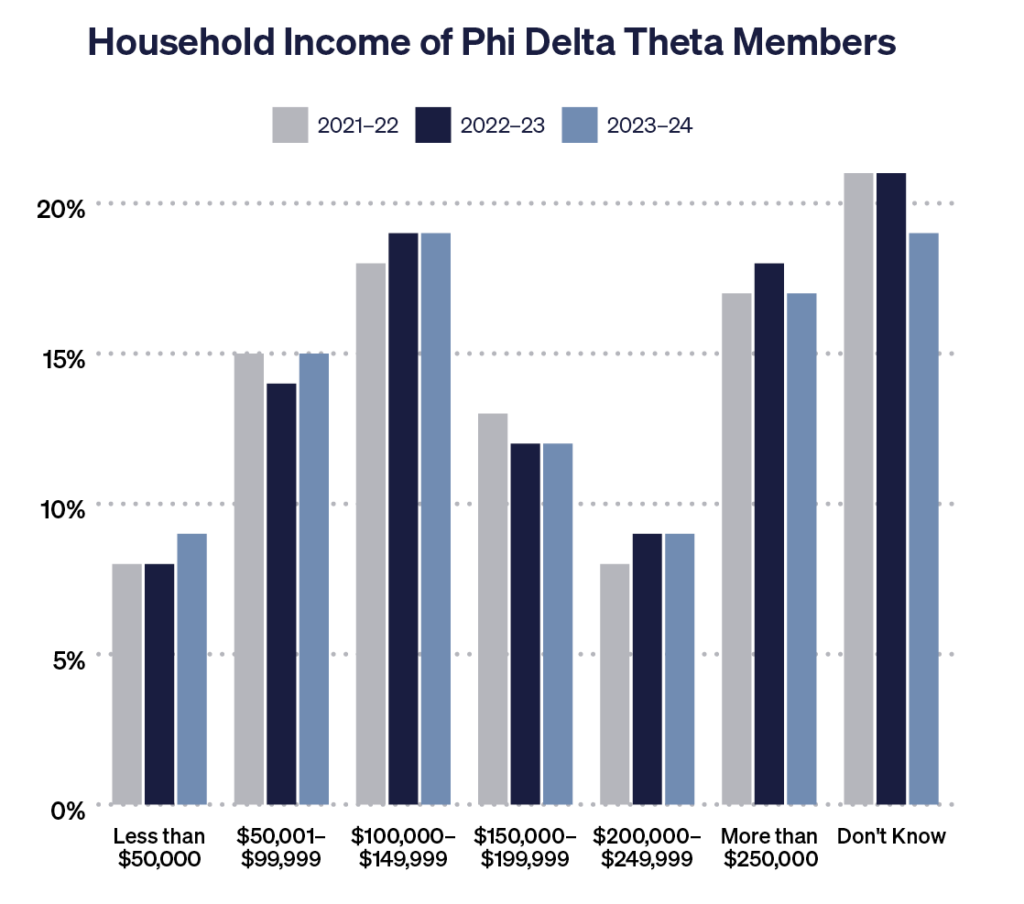
First-generation college students have a median household income that is less than 50 percent of their continuing-generation peers. This scholarship serves as a bridge to membership for those needing extra support during their first year. Students have shared that this scholarship allowed them to work fewer hours to spend more time studying, buy books needed for their classes, and take research trips, to name a few. While scholarships cannot pay directly for fraternity membership, they are offsetting the investment students are making in their commitment and exposure to an organization that can directly improve their social mobility through a values-based experience.
Primarily due to financial challenges, navigating unfamiliar environments, and a lack of on-campus mentorship, retention and graduation rates for first-generation college students are significantly lower than for students with parents who attended college.
“This scholarship not only alleviates some of the financial pressures associated with my studies but also motivates me to keep pushing through.”
Izaiah Acosta, UW-Whitewater ’24
Demographics
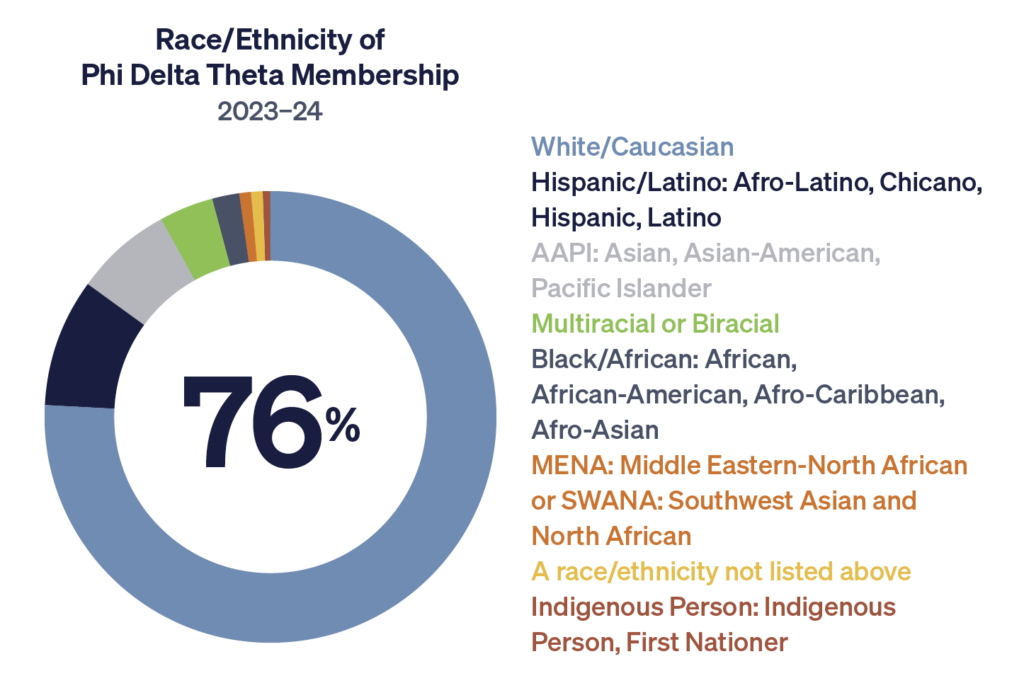
Phi Delta Theta’s work includes understanding the makeup of the Fraternity’s undergraduate membership. Being transparent about our undergraduate member demographics has facilitated valuable conversations and impactful decision-making. It also led to a focus on attracting first-generation students to our organization.
“I am dedicated to making the most out of this opportunity, determined to use my education to create a positive influence in my community and beyond. Your support not only has unlocked doors for me but has also ignited my enthusiasm for ongoing learning and personal development.”
Bryce Wiginton, West Texas A&M ’25
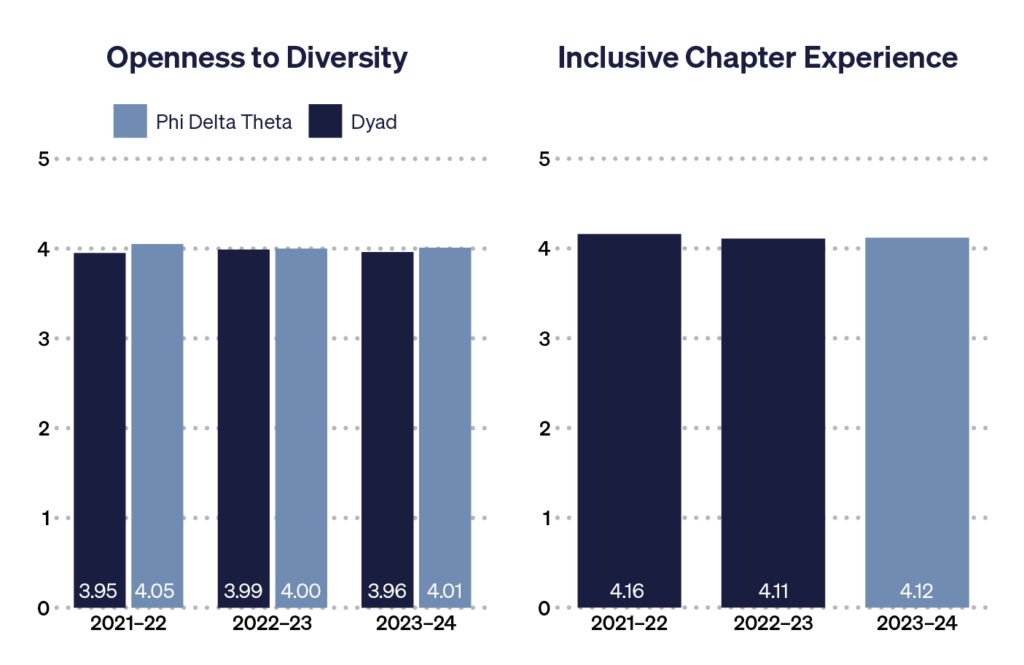
Through our partnership with Dyad Strategies, we know that first-generation college students are less likely to prioritize the social aspects of the Fraternity and have different life experiences and perspectives. On average, they work twenty or more hours per week, pay their own dues, and need financial assistance. We also learned that their views are more inclusive, promote further diversification, and help our chapters focus on leadership and philanthropy, ensuring a better and healthier experience for all.
Letter from the Executive Vice President and CEO
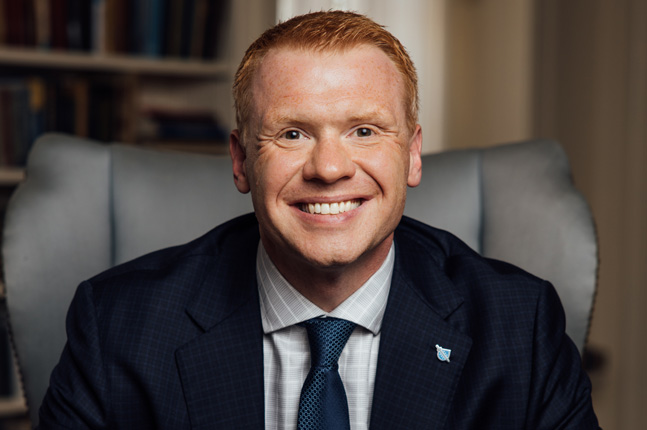
Dear Brothers, Parents, and Friends,
It has now been three years since Phi Delta Theta Fraternity and Foundation launched our initiative to expand opportunities for first-generation student members. As we reflect on the progress made, I am thrilled to share the incredible achievements and outcomes that have come from these efforts, which have far exceeded our expectations.
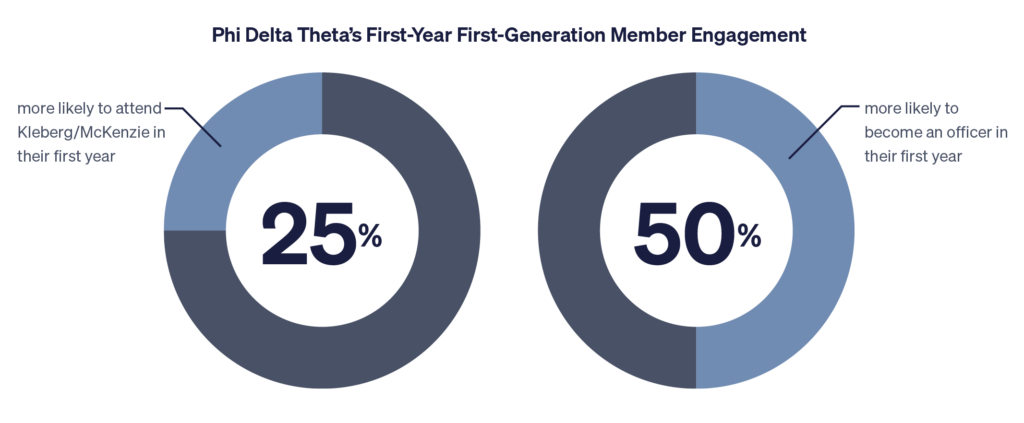
Through careful monitoring and evaluation of both first-generation students and their continuing-generation peers, we’ve gained invaluable insights. The data confirms that our first-generation members are not just participating in our leadership programs; they are excelling. These brothers are demonstrating exceptional leadership potential early in their fraternity experience. For instance, first-generation new members are 50 percent more likely to become officers within their first year of membership compared to their peers. This speaks volumes about their drive and the effectiveness of our leadership training. Furthermore, 38 percent of our 2024 first-generation scholarship recipients have assumed officer roles in their first year. Additionally, nearly 20 percent of scholarship recipients have attended a milestone leadership conference like McKenzie or Kleberg, further solidifying their leadership journey.
These statistics are more than just numbers. They highlight the profound impact Phi Delta Theta is having on these students. Not only are they rising to leadership positions within our chapters, but they are also thriving academically and socially. Our data shows that first-generation members are 18 percent more likely to remain enrolled at their institution beyond their first year compared to their first-generation peers outside the Fraternity. This is a testament to the supportive community, personal growth, and opportunities for development that Phi Delta Theta provides.
What does this mean for the broader fraternity experience? It means that our first-generation members are contributing significantly to the strength and vitality of our chapters. Their presence enhances the overall brotherhood, bringing diverse perspectives and experiences that benefit all members, especially as they assume leadership roles. Moreover, these programs are not only advancing the individual growth of these members but also contributing to the overall retention rates of first-generation students at their universities—a powerful, positive outcome for both the Fraternity and higher education institutions alike.
Looking ahead, we are energized by the progress we’ve seen and eagerly anticipate even greater achievements in the coming years. We are especially excited to follow the careers of our first-generation scholarship recipients as our first class of recipients enter the workforce next year. These young men are the future leaders in their communities and industries, and we take pride in knowing that Phi Delta Theta has played a pivotal role in their development.
As always, none of this would be possible without your unwavering support. Whether through financial contributions, mentorship, or involvement, you have helped make this program a resounding success. We are incredibly grateful for your continued dedication to advancing our mission. Please do not hesitate to reach out if you have any questions or wish to learn more about how you can further support our initiatives.
Thank you again for your generosity and belief in the potential of our first-generation members.
Humbly and proud to be a Phi!

The post First-Generation College Student 2024 Impact Report appeared first on Phi Delta Theta.
]]>The post Pride: Celebrating the Diverse Identities Within Our Brotherhood appeared first on Phi Delta Theta.
]]>Earlier this June, many traveled home from the 2023 General Convention in Scottsdale, Arizona, excited and proud to be Phis. While there, I had a conversation with one undergraduate member that transported me back to 2008, when I was the Greek life intern at Mercer University. This new member came by my office and asked to grab lunch, where he asked if I thought his coming out would change everyone’s opinion of him. I said I would hope not and encouraged him to talk to my Fraternity little brother about his experience, remembering he didn’t come out until after he had graduated. Reflecting now, I know that it wasn’t for a few years after my graduation that the chapter had a member who was out to the whole chapter while pledging and active membership.
Back to the conversation in Scottsdale with an undergraduate delegate questioning if he should come out to his chapter; while he is not the first, this delegate was nervous because he would be the first queer member to become president of his chapter. I told him being the first can be lonely, but it’s important. He is opening the doors for others. While sharing some of my experiences as a person of color, although a different type of social identity, our experiences both saw moments of isolation, panic, and worry. This conversation and memory reminded me that while we have come a long way, there is still work to be done. The coincidence of this conversation was that it took place during June, Pride Month.
Coined by gay activists M. McConnell, J. Baker, and T. Higgins in the 1980s and ’90s, ‘pride’ from ‘gay pride’ promotes dignity, equality, self-affirmation, and visibility of LGBTQ+ communities and people. Pride finds its true origins in the Christopher Street Liberation Day. Coming in response to the Stonewall Riots in NYC, where LGBTQ+ communities came together to protest the raids of the Stonewall Inn on June 28, 1969. Born from that riot and demand for a conscious witness, more and more protests, parades, and social movements have occurred in June. It was not until 1999 that President Bill Clinton recognized June as Gay and Lesbian Pride Month, with it being shortened to Pride Month the following year. After President Clinton, Presidents Obama and Biden have both continued the tradition.
I asked a close friend and fellow Georgia Phi, Tyler Wilson, Georgia Southern ’16, what his experience was like in 2014, and he shared:
“Outside of Phi Delt, I came from a deeply religious Pentecostal familial upbringing. For the most part, my chapter brothers were some of the only people to ever accept me. I don’t know that I’d be who I am today without the support of those men—Nick, Jonno, Hunter, Scottie, Matthew, and Austin. Hell, I genuinely don’t even know that I would be here— that is the importance of brotherhood; being a man of character and principle while standing in the gap to support your brother. Regardless of belief, difference, or creed. Supporting others as you would want to be supported and pushing each other towards the greatest version of themselves. For those reasons, for those men, and for all the reasons I am sure are to come. I am damn proud to be a Phi.”
Speaking to Tyler made me realize what J. David Almacy, Widener ’92, our newly elected General Council President, shared during his opening speech was timely and something we all need to keep top of mind. Brother Almacy reminded Convention attendees that the Wilford Plaque in the Founders Room in Elliot Hall reads:
“In friendship sincere as a brother devoted; in honor, aspiring to the noblest culture; with conduct unblemished; revering God.”
Brother Almacy then went on to speak of Phi Delta Theta as a lifelong commitment to personal growth and development and that we need to, as a Fraternity, return to our Cardinal Principle of Rectitude. He stressed, however, that moral rectitude is not only being faithful, but someone who exemplifies compassion, honesty, integrity, and kindness. The celebration of Pride is all those things: showing compassion to our brothers who are part of the LGBTQ+ community; showcasing our brothers who are living their truths and presenting themselves in an honest manner; demonstrating the kindness we have for our fellows and our brothers while they celebrate their lived experiences; and giving our members the chance to live a life of integrity, a life where they are fully authentic.
I want to leave you with the words of Nikith Poovaiah, San Francisco ’23. Brother Poovaiah shared:
“I define pride as the acceptance and equality of all individuals, regardless of any other aspect of who they are. Phi Delt exemplifies this by actively embracing and celebrating the diverse identities within our brotherhood as well as striving for equality and acceptance in all facets of our brotherhood.”
If we are going to be a fraternity that helps nurture the future leaders of our global society, we have to practice our principles like Brother Almacy reminded us. By supporting and celebrating the lived experiences of our brothers, we are creating a more inclusive fraternity and compassionate brotherhood that allows its members to live honestly and authentically.
Join me and others in wishing our brothers who are members of the LGBTQ+ communities a Happy Pride in 2023!
The post Pride: Celebrating the Diverse Identities Within Our Brotherhood appeared first on Phi Delta Theta.
]]>The post Why Did I Join A ‘White’ Fraternity? appeared first on Phi Delta Theta.
]]>By Austin A. Deray
The most frequent question I have been asked since joining Phi Delta Theta is, “Why did you join a ‘white’ fraternity?” I always found the question and some of the follow-ups and comments interesting. “Do you actually fit in?” or “How’s it going, Uncle Tom?”
The notion that, as a man of color, I could find community with an all-white or predominantly white student organization baffled my friends and peers. The simple truth is that I did fit in for the most part, and I did find a brotherhood; however, it would be a lie to respond to the question with, “yes, I fit in seamlessly; no, I’ve never been ‘Uncle Tommed,’” because frankly, I have. I would choose what I could and would share with brothers; some getting to know the real Austin, and others the Phi Delt “Deray.” In the early 2000s, there were constant negotiations I made; some conscious and others subconscious I didn’t realize I was making until years later.
In 2020, chapter brothers and pledge brothers asked, “did you feel different?” or “did we make you uncomfortable at points?” and I was surprised to learn that they were surprised that I answered yes. In the 1960s, Phi Delt repealed its Arian Clause from our code and general statute, and an era of color-blind policy began in our organization. It wasn’t until the summer of 2020, in the midst of a pandemic and moment of socio-political unrest, did our Fraternity take the next step to grapple with the lived experience of our membership. Justin Holmes, Campbell ’17, has shared with me that “during my undergraduate experience, Phi Delt wasn’t the best at acknowledging our unique differences through the lens of diversity. As an alumnus of the organization and General Headquarters, it is comforting to see Phi Delt install systems and processes to intentionally celebrate diversity and educate our members on the importance of inclusivity.” As we strive to be an inclusive environment for all our members, we are now recognizing all aspects of our memberships’ diverse identities and have moved from a color-blind Phi Delt.
The recognition of Juneteenth is just one of the many steps Phi Delt and our Diversity and Inclusion (D&I) Commission are making to help change the climate of our Fraternity to one that is inclusive of all our members’ diverse identities. For many, Juneteenth represents not the end of enslavement, but the moment when the United States really began to take the first steps on the journey of inclusion, a journey it is still on today. While President Lincoln’s proclamation ended the enslavement of individuals in states that seceded, it was the Union army that went out and enforced the proclamation. It took almost 900 days, two years and 169 days (i.e. June 19, 1865/Juneteenth) for the Union army, under General Gordon Granger, to arrive in Texas and enforce Lincoln’s proclamation, the last Confederate state to still practice the institutional enslavement of peoples. For many, Juneteenth marks a change in the US policy and a first step in the country’s journey toward inclusion. While the observance of Juneteenth has not always had a national/international stage, for Persons of Color this holiday has been recognized since the 1930s (starting in Georgia and Texas) and was made a Federal Holiday in 2021, the first federal holiday to be added since Martin Luther King Jr. Day, added by President Reagan in 1983.
As The Bond serves as the North Star for our Fraternity, our undergraduate members are navigators propelling us forward. Themba Nsubuga, Mercer ‘23, shares that, “I celebrate Juneteenth to recognize that regardless of what background one has, we should all celebrate the day that our country put to an end to an excruciatingly painful horror called slavery. I am humbled and blessed by the efforts of my Fraternity celebrating this holiday, because I am proud to witness that my brotherhood supports my cultural background and is willing to take extra steps to embrace and understand what it values.” I think Brother Nsubuga’s words are important for us to remember as it speaks to the direction our Fraternity is currently tracking. With the creation of the D&I Commission, the first-generation student scholarships, the expansion of the roles of the chaplain, and the new chaplain track at Kleberg, the observation of holidays and celebrations that speak to the identities of our membership is pivotal a step as the rest.
The post Why Did I Join A ‘White’ Fraternity? appeared first on Phi Delta Theta.
]]>The post Phi Delta Theta Announces $250,000 in First-Generation Student Scholarships in Addition To New Diversity and Inclusion Education appeared first on Phi Delta Theta.
]]>In an effort to support first-generation college students while complementing and strengthening the Fraternity’s diversity and inclusion efforts, the Phi Delta Theta Foundation will provide $250,000 in academic scholarships for first-generation new members during the 2021–22 academic year. The scholarships will directly impact the financial hardships of first-generation college students and indirectly lower the economic burden of membership into Phi Delta Theta. First-generation students initiated during the upcoming academic year will automatically be eligible to apply for the scholarships with funding dispensed following the conclusion of each semester.
“Being a first-generation college student, Phi Delta Theta provided me with the support I didn’t even know I needed. The intricacies of the higher education environment are hard to navigate alone. My brothers helped me learn how to register for classes, how to fill out a financial aid form, and how to find a good on-campus job. Without this support, I would have persisted, but it would have been a much bumpier road. In addition to the guidance and moral support, these scholarships will offer meaningful financial assistance to ensure a place for first-generation students on their campus and within our brotherhood,” said General Council President Moe Stephens.
In addition to the Foundation’s scholarships for first-generation students, continued educational programming that addresses cultural competency and implicit bias will help shape the membership experience for all new and current members. This programming will include online training for the entire chapter while addressing the economic disparity of individual members and increased officer responsibilities for the chapter’s chaplain to advocate for diversity and inclusion within the chapter, on campus, and in local communities.
The Fraternity’s comprehensive effort will accomplish two important objectives: first, to ensure greater and equitable access to an experience that allows individuals to enhance their personal trajectory through best-in-class leadership programming, mentorship, and community. Second, to broaden the perspective of its members to achieve success in an increasingly diverse and inclusive world.
The success of these important initiatives will be measured annually through the benchmarking of demographic and socioeconomic membership data. The Fraternity will focus on memberships being representative of each campus where there is a Phi Delta Theta chapter. Additionally, Phi Delta Theta’s partner Dyad Strategies will conduct an annual assessment of the Fraternity’s undergraduate members, gauging the lived experience of diverse members and the individual behavior and beliefs of all members surrounding diversity and inclusion.
These initiatives are possible thanks to the generous and visionary support of Phi Delta Theta Foundation donors alongside the direction of the Fraternity’s Diversity and Inclusion Committee; this committee’s review helped reshape the Phi Delt 2030 plan, impacting sixteen goal statements and objectives across five strategic initiatives.
Founded at Miami University in Oxford, Ohio, on December 26, 1848, Phi Delta Theta International Fraternity has 194 chapters and emerging chapters and 85 alumni clubs across the United States and Canada. To date, the Fraternity has initiated nearly 280,000 men into the society whose founding principles are Friendship, Sound Learning, and Rectitude. In 2000, Phi Delta Theta became the largest fraternity to implement an alcohol-free housing policy in all facilities. Guided today by its Phi Delt 2030 strategic plan, Phi Delta Theta’s vision is to be recognized as the premier fraternal leadership development society in North America.
The post Phi Delta Theta Announces $250,000 in First-Generation Student Scholarships in Addition To New Diversity and Inclusion Education appeared first on Phi Delta Theta.
]]>The post Sound Learning Through Education, Listening, and Being Uncomfortable appeared first on Phi Delta Theta.
]]>As someone who works on diversity, equity, and inclusion initiatives professionally every day, I have been asked more than I ever thought I would about my opinions and thoughts on the recent election and how it relates to the racial and gender issues facing the United States. For those who know me well, they would say, “Great, Deray loves to share his opinion.” In this particular case, I have a lot to say, not just because of what I do professionally, but because of who I am. I’m a Middle-Eastern/North African descent American, born of an immigrant and a Daughter of the American Revolution; I was raised in a household where Christian, Jewish, and Islamic traditions were practiced, expressed, and welcomed; I am a southerner, brought up in the low country of Georgia. All those identities makeup who I am and offer personal insight into many of the diverging viewpoints of today.
I also find myself, probably for the first time in my life, remembering the words of George Washington. Again, to those who know me, that is an oddity; for when it comes to history, I am a proud medievalist and tend to flee from topics that occurred after the fourteenth century. However, I now realize we are at a moment in US history where Washington’s farewell words should be brought back to the collective mind:
“The alternate domination of one faction over another, sharpened by the spirit of revenge, natural to party dissension, which in different ages and countries has perpetrated the most horrid enormities, is itself a frightful despotism.” (Washington, Farewell Address, 1796)
Washington spoke then of the dangers of a two-party system, and I fear we did not heed his warning. We are now at a moment where it seems that US citizens are quick to draw their lines. While I stand for knowing, speaking, and fighting for what you believe and being as politically and socially active as any person wants, needs, or is called to be, I am still first and foremost a proponent of educated and informed actions.
As you may know, Phi Delta Theta is founded on three Cardinal Principles—Friendship, Sound Learning, and Rectitude—and I have come to realize for many sound learning has become a simple statement of academic pursuit for collegiate males, in favor of privileging friendship and rectitude. I think it is time we return to sound learning. For through sound learning we make our truest of friendships and amalgamate reason and empathy within our integrity, our rectitude.
There are many issues facing the US at this moment, beyond the fractured nature of our society due to this two-party system. Even more than healthcare or the environment, it seems that conversations around immigration, racism, criminal justice, and LGBTQ+ issues are the more impassioned conversations in the circles I traverse. What I wish for most is that people would educate themselves on these issues, beyond relying on party politics or the dominant media coverage/cycles. Really study an issue, listen to the people that live or experience the issue, and then have a conversation—really have a conversation—where both sides ponder together not to win an argument or dominate another’s thoughts or opinions, but have a real dialogue. A conversation where both parties/positions not only speak but really listen to the other.
Let us not fall into the factional society Washington warned against. Let us continue to be able to have conversations together. It is every person’s job to educate themselves on the facts and listen to those who have experiential/lived knowledge to help inform your opinion or stance on a particular issue.
I know these conversations and topics can be and often are uncomfortable; however, that’s a good thing. Welcome the uncomfortable; we often grow and learn more about ourselves when we grow from a place of discomfort. When you are uncomfortable, the person(s) you are in a conversation with are probably uncomfortable too. Because you both experience discomfort together and you already have something in common. By working/speaking through the uncomfortable, hopefully you will be able to come to a deeper understanding. Though it might not change either side’s opinions, you can walk away knowing that you educated yourself on a topic, took the time to listen to someone else’s point of view, and talked through both your thoughts and feelings. Whether you agree or disagree, you have respected and honored each other, and you can end the conversation in a good place.
I truly believe if we as a brotherhood return to sound learning by educating ourselves, really listening, and at times live uncomfortably, we will not only see that we can transcend party lines and politics, but that we can have real dialogue and conversations as brothers. Let’s not fall into the trap Washington warned us about, let’s embrace and exemplify the second cardinal principle of sound learning as envisioned by the Immortal Six. So that we can continue to grow together and push each other to the greatest versions of ourselves.
Austin A. Deray currently serves the Fraternity as the Diversity and Inclusion Commissioner and the Delta North Province President. He is a PhD candidate in cultural studies at George Mason University, currently working on his dissertation research on the lived experience of students of racial and ethnic identities within historically white fraternities. He received his MA in European history, with a concentration in medieval history, and an MA in gender studies, his thesis entitled: “The Old Boy Mentalities: A Look into Southern Fraternities,” at Armstrong State University, where he was a lecturer in the Gender Studies department from 2014–2018.
Brother Deray currently works in the Office of Graduate Student Life at Mason, working on leadership and advising initiatives for his unit. He is the adviser to the Graduate and Professional Student Association, the student government for graduate students, and his portfolio includes the diversity, equity, and inclusion initiatives within his office. Deray is a frequent facilitator for not only Mason, but also other DMV universities around diversity, equity, and inclusion topics: anti-Blackness, colorism, discussions of race/ethnicity and gender/sexuality within fraternity and sorority communities, policing, Safe Zone, Title IX, and xenophobia.
The post Sound Learning Through Education, Listening, and Being Uncomfortable appeared first on Phi Delta Theta.
]]>The post In Times Like These, Your Black Brothers Are Also Blue appeared first on Phi Delta Theta.
]]>As our nation continues to grapple with racial injustice and turmoil, I write this not only as a Brother in the Bond, but as a black man who has experienced a lot of cognitive dissonance as a member of a Greek community that is historically and predominantly white. I’ve been a black man for twenty-four years, and I’ve only been a Phi Delt for four of them. For a really long time, I grappled with how those two identities could coexist.
I am a first-generation college graduate, and the only one of my family to join a Greek organization. When I arrived at college, I did not see the value in a fraternity experience, whether that experience was within a historically Black, white, or otherwise organization.
However, after becoming friends with a few of the members from the North Carolina Epsilon Chapter at UNC-Charlotte in spring 2016, and joining the chapter, this decision remains one of the best decisions in my lifetime.
I found comfort in sharing my successes and failures with my brothers. They celebrated my victories and strengthened my resolve to continue bettering myself when faced with challenges. These became favorite focal points and experiences as a college man.
Unfortunately, during my time as a member of Phi Delta Theta, I have also been subjected to internal conflict and general unease. I’ve experienced disdain and received discouraging comments from Greeks in other organizations, fellow brothers, distant relatives, and family friends who couldn’t comprehend how I, a black man, could choose to call these men my brothers.
As an example, police brutality and racial injustice has always been something that has directly and negatively impacted black people in communities across the world. Clearly, this is an issue that affects my life, and it would spark conversations. Usually, my chapter brothers would be there to help me through challenging issues, but in this case, not everyone could relate. Often, I was met with either passive indifference or overall disapproval for referencing these atrocities. Except for a few, it eventually got to a point where I felt collectively silenced and disregarded by these men to whom I had grown so close.
I also learned about “the clause” in the Fraternity’s history, which limited membership based on race. This clause was in place from 1912 until it was removed at the 1954 General Convention. Knowing this history caused some persistent doubt within myself on whether I had made the right decision to align with this organization or these men.
The sociocultural climate that we live in as fraternity men has changed a great deal since 1954; but as current events have shown, there is room to improve in order to be as supportive and as protective of our members, especially during times of crisis.
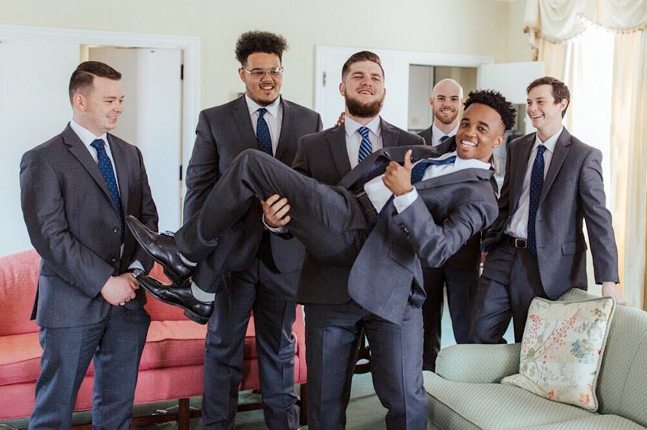
In June 2020, I completed my first year as a leadership consultant for Phi Delta Theta General Headquarters and have been dedicated to spreading and nurturing our Cardinal Principles in new members at the beginning of their own journeys to personal greatness.
Reconciling my early internal conflict wasn’t easy. I’ve considered the reasons behind every step I’ve taken on my journey as a man of Phi Delta Theta. If there is anything that brings me peace and resolve with that initial emotional malaise, it’s this. Whether the Phis who voted to pass “the clause” a century ago realized it or not, Phi Delta Theta’s greater mission as outlined in The Bond is paramount and applies to everyone regardless of the color of their skin.
Our open motto is, “We enjoy life by the help and society of others”; so whether black or white, I can really only be as happy as the rest of the people in the world with whom we share our human experience.
Thankfully, Phi Delta Theta has evolved since 1954 and has made progress including recent efforts to promote inclusion and increase diversity among our membership. It is a great start, but there is still more work to be done. I am not the first black Phi Delt, and I surely won’t be the last. I know that I have a solemn opportunity to be part of the change and have an impact on the lives of a diverse group of young men across North America.
Something else I’ve discovered is that the passive indifference I mentioned earlier doesn’t come from a lack of caring, but rather from a lack of understanding and knowledge. These issues are complex and can make some people uncomfortable. However, I was taught that the best thing you can do in these situations is ask. You’ll never be at fault for trying to understand and empathize with someone else’s struggle.
So, please check on your black brothers especially in these times of crisis, because I can say with an astronomical level of certainty that they are probably not okay. Please do not pretend or imagine that these injustices are not affecting them, their friends, and loved ones. Ask them how they’re holding up, ask them how they’re feeling, and more importantly, ask them what you can do to help. It’s always nice to have someone who listens. If you’re an undergraduate Phi and have begun returning to campus, prompt continued conversations about racism with your fellow brothers. Fraternities should be venues for tough conversations.
Finally, to our black brothers who may feel obligated to speak on issues that plague our community, please know that the struggle is not yours alone to bear. From the viewpoint of a GHQ staff member and as a brother who has experienced the same injustices, this is not your fight alone.
One man is no man. I encourage you all to continue “to do what ought to be done but what would not have been done unless you did it – because that is your duty.”
The post In Times Like These, Your Black Brothers Are Also Blue appeared first on Phi Delta Theta.
]]>The post Phi Delta Theta Takes Immediate Action to Promote Diversity and Inclusion appeared first on Phi Delta Theta.
]]>As a result of these conversations, a summary report of participant feedback and a list of recommendations was created and then submitted for review by strategic advisors Dr. Michelle Allen, Diversity Education Director at the University of Alabama at Birmingham, and Marlon Gibson, experienced fraternity and sorority professional and doctoral candidate at the University of Georgia. The recommendations were then provided to the General Council for consideration.
The General Council met July 16–17, 2020 and thoroughly reviewed the report. After careful consideration, the General Council took the following immediate actions:
- Created the volunteer position of Diversity and Inclusion Commissioner and appointed Brother Austin A. Deray, Mercer ’10, to serve in this capacity. In addition to advising the General Council and General Headquarters staff, the commissioner shall be responsible for overseeing all educational programming, policy recommendations, and communication efforts related to diversity and inclusion initiatives on behalf of Phi Delta Theta.
- Designated and defined an undergraduate role (chapter officer) responsible for advocating for diversity and inclusion within the chapter, on campus, and in local communities.
- Approved the recommendation from the Diversity Working Group and the Survey Commission to adopt new terminology for burgeoning groups. The use of Colony will be replaced with Emerging Chapter and initial members of these new groups will now be referred to as Founders.
- When evaluating recipients of chapter excellence awards, the Awards Committee will include new criteria in the application that places value on the promotion of diversity and inclusion efforts and programming.
Other areas recommended by the working group for continued review and consideration by Brother Deray, the General Council, and the General Headquarters Leadership Team include individual, new member, chapter, and conference education with a focus on cultural competency and implicit bias training, specific language to adopt that would explicitly prohibit the display of divisive symbols on chapter premises and at Fraternity-sponsored events, collaboration with interfraternal partners, diverse identity and first-generation scholarships, and enhanced communication strategies featuring members of color.
We are grateful for the interest, efforts, and insights of all those on the Diversity Working Group. Though these actions represent significant progress, we realize there is more to be done, and we look forward to continuing our work together to create positive change and a culture of diversity and inclusion for every member of Phi Delta Theta.
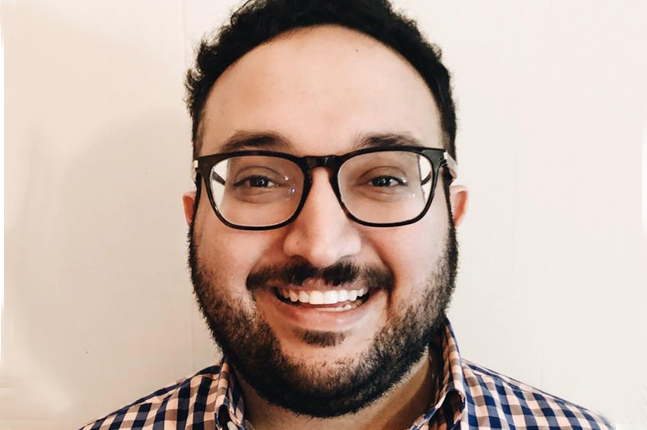
Diversity and Inclusion Commissioner – Austin A. Deray
Austin A. Deray is a PhD candidate in cultural studies at George Mason University, currently working on his dissertation research on students of racial and ethnic identities within historically White fraternities. He received his MA in European history with a concentration in medieval history, and an MA in gender studies, and his thesis entitled: “The Old Boy Mentalities a Look into Southern Fraternities,” at Armstrong State University, where he was a lecturer in the gender studies department from 2014–2018.
Brother Deray currently works in the Office of Graduate Student Life at George Mason, working on all leadership and advising initiatives for his unit. He is the adviser to the Graduate and Professional Student Association, the student government for graduate students, and his portfolio includes the diversity, equity, and inclusion initiatives within this office. Austin is a frequent facilitator and mentor within the LEAD (Leadership Education and Development) office at George Mason, facilitating groups and conversations around diversity and inclusion topics including: oppression, racism, Blackness, policing, racial triangulation.
Brother Deray was initiated into the Georgia Gamma Chapter of Phi Delta Theta at Mercer University in February 2007 and held officer positions in both his chapter and on the IFC board. He was hired on, after graduating in 2010, as the Greek life intern at Mercer for the 2010–11 academic year. Deray has served the Fraternity as chairman of the advisory board for both the Georgia Epsilon Chapter and the District of Columbia Alpha Chapter and is now the Delta North province president. He has served as a faculty member of both the Kleberg Emerging Leaders Institute and the Presidents Leadership Conference and presented on “Recruiting Students of Diverse Identities and First Generation Students” at both.
Working Group Membership:
Education and Programming:
Braden Ash, Puget Sound ’20
Collin Bell, Wabash ’17
Christopher Chambers, Hofstra ’20
Lawrence Daves, Hofstra ’13
Kwesi Essilfie, CSUN ’15
Jelani Gandy, Stockton ’21
Josh Gastineau, Washington College ’22
Carlito Herring-Forchion, IUP ’20
Aaron Hollis, Valparaiso ’17
Joshua Langston, Dalhousie ’21
Richard McCoy, San Francisco ’21
Oscar Moncada, Georgia Southern ’21
David Ndozi, West Georgia ’18
Donald Schenk, McDaniel ’71
Todd Simmons, Akron ’17
Moe Stephens, Southern Indiana ’99
Adeyemi Thomas, Chicago ’21
Devin Thornton, Georgia Southern ’19
Matthew Wittress, Butler ’23
Brandon Wong, Idaho ’19
Policy and Communications:
David Almacy, Widener ’92
Daniel Baluch, Seton Hall ’22
Steffan Barahona, Washington College ’21
M. Keith Brown, West Texas A&M ’91
Andrew Crosby, Puget Sound ’17
Felipe Cuatecontzi, Wabash ’17
Christopher Dann, Chicago ’21
Austin A. Deray, Mercer ’10
Michael Dike, Mercer ’22
Rob Eberly, Kent State ’70
Malique Elder, Nova Southeastern ’18
Carlos Gregory, Hofstra ’21
Justin Holmes, Campbell ’17
Pierrie Jefferson, UNK ’15
Javier Jurado, Johns Hopkins ’21
Dustin Liu, Cornell ’19
Sammy Mah, Kettering ’82
Anthony Mai, Wichita State ’18
Gerrin McKinnie, Millersville ’19
Reganold Robinson, Stockton ’22
Greg Rush, UNC Charlotte ’19
Rasheen Underwood, Montclair State ’21
Paul Vernick, George Washington ’21
Bob Wolfley, Southern Indiana ’10
The post Phi Delta Theta Takes Immediate Action to Promote Diversity and Inclusion appeared first on Phi Delta Theta.
]]>The post Our Obligation appeared first on Phi Delta Theta.
]]>I have watched the news the past couple of weeks with a heavy heart. I have heard stories from many of our members and alumni. I have had many restless nights. I have shed tears, thinking about the countless lives impacted by violence, bigotry, and racism. My heart hurts. I have worked to continue to educate myself. I have more work to do, and I recognize that I am not going to be perfect. Anti-racism work is messy and difficult. Those who know me well, know that I am happy to engage in spirited debate on a range of issues and ultimately agree to disagree if necessary. Racism is not, and will never be, one of those things.
I have no problem saying that Black Lives Matter. As a movement, BLM has been weaponized for political purposes. Some people have strong opinions on both sides. However, we must filter out the noise of politics. Saying Black Lives Matter is a humanity issue. Do All Lives Matter? You bet. However, the Black community continues to face violence, harassment, and racism on a daily basis. Is that your reality? If it is not, consider yourself to be in a position to make a difference and amplify the voices of those that do.
Phi Delta Theta Fraternity was founded on the high ideals of friendship, sound learning, and rectitude. Our Founders formed this society to create a place for the free exchange of ideas in a time when universities were less than hospitable to this type of self-awareness. The fact that Phi Delta Theta contributed to systems of oppression and racism, both in policy and practice, in later years is ironic in a way that I would prefer it not to be. For almost 50 years, like many organizations of the time, Phi Delta Theta did not allow students of color to join our Fraternity. Although this policy was abolished in 1954, we cannot continue to diminish this historical fact and its place in our history.
We have come a long way, but we still have work to do. Saying the phrase, “Becoming the greatest version of yourself” does not magically make it so. It takes work. It takes sound learning. It takes rectitude. It takes friendship. Our ritual tells us we have an obligation to our fellow man to live our lives in a way that makes our world a better place. History has shown, and the past two weeks have magnified, the fact that we have a long way to go.
So what do we do now? First, we must listen. We cannot understand what our members of color experience, the lives they have lived. We must not listen without action, and my promise to you is that we will act. I have work to do. We have work to do. We will do this work together.
Moving Forward – A Note from Phi Delta Theta
The death of George Floyd and the resulting protests throughout the world have caused much anger and frustration, and once again highlight issues of racism, inequality, and injustice for Black Americans in the United States. The events have also led to promising conversations about a better tomorrow, and we are greatly encouraged by them.
Phi Delta Theta wants to do everything it can to be part of the solution. We know that making meaningful change begins by listening, learning, and having open dialogue with each other. This is what we are doing, and we’ve been encouraged by the number of our members who have raised their hands to participate.
We are continuing this dialogue with our members who have said they want to be a part of the solution. We are very encouraged by these conversations, and we know it will help Phi Delta Theta take action where it will be most effective for our organization and its people.
The post Our Obligation appeared first on Phi Delta Theta.
]]>