The post Phi Delta Theta Fraternity Responds to Incident at University of Idaho appeared first on Phi Delta Theta.
]]>Phi Delta Theta holds the safety of every member of the Fraternity as well as the individuals of the campuses and communities they are a part of, in the highest regard, and does not support or condone violence. The organization does not tolerate any actions that directly contradict the values and policies of the Fraternity and holds strict rulings against members and chapters that violate Fraternity expectations and the law.
###
Founded at Miami University in Oxford, Ohio, on December 26, 1848, Phi Delta Theta International Fraternity has 194 chapters and emerging chapters and 85 alumni clubs across the United States and Canada. To date, the Fraternity has initiated nearly 280,000 men into the society whose founding principles are Friendship, Sound Learning, and Rectitude. In 2000, Phi Delta Theta became the largest fraternity to implement an alcohol-free housing policy in all facilities. Guided today by its Phi Delt 2030 strategic plan, Phi Delta Theta’s vision is to be recognized as the premier fraternal leadership development society in North America.
The post Phi Delta Theta Fraternity Responds to Incident at University of Idaho appeared first on Phi Delta Theta.
]]>The post National Hazing Prevention Week is September 22-26, 2025 appeared first on Phi Delta Theta.
]]>
While hazing prevention is a year-round activity, this week brings awareness to the issues as students return to campuses and welcome new members to their chapters. Two dates that will forever shape the history of Phi Delta Theta are September 14, 2017, the day Max Gruver died due to fraternity hazing at the LSU chapter of Phi Delta Theta, and January 8, 2020, when the Max Gruver Foundation announced a partnership with Phi Delta Theta. Since Max’s death, Steve and Rae Ann Gruver have shared Max’s story with hundreds of college campuses and thousands of college students to prevent another tragedy and stop hazing. Collaborating with Phi Delta Theta, the Gruvers have decided that, with more than 15.1 million high school students at 23,000 high schools in the United States, anti-hazing conversations and education need to begin before students enter college. For this reason,Take Action was created.
Since this partnership, Phi Delta Theta has proudly joined in the fight against hazing through partnerships with the National Hazing Prevention Network and Anti-Hazing Coalition. In addition, Phi Delta Theta was present in the lobbying efforts to pass the Stop Campus Hazing Act, which was signed into law on December 24, 2024.
Phi Delta Theta has zero tolerance for hazing in our brotherhood. No part of Phi Delta Theta’s ritual, ceremonies, or new member process will ask members to do something that makes them feel unsafe. We ask all brothers to Be Their Brothers’ Keepers and take action in the fight against hazing. Below you will find resources and ways you can make a difference during National Hazing Prevention Week.

Hazing Prevention Network, formerly known as hazingprevention.org, is a nonprofit dedicated to empowering people to prevent hazing. Their goal is to educate people about the dangers of hazing, advocate for change, and engage the community in strategies to prevent hazing.
Webinars
Hazing Prevention Network has a series of webinars available for National Hazing Prevention Week. Plan to use the webinars in your National Hazing Prevention Week programming—either the live session or the recording that will be available afterwards to those who register. See complete list of webinars.
Education Resources
The Hazing Prevention Network is committed to sharing hazing prevention resources from partners.
Wear Purple to Bring Awareness
Your campus or organization can pick a day during NHPW (or the whole week) to wear purple to bring awareness to the issue of hazing.
Plan a social media campaign
This week is a great opportunity for your campus or organization to bring attention to the issue of hazing. National Hazing Prevention Network has put together social media graphics and posts to assist in your efforts.
Take the Pledge
As a part of your hazing prevention journey, we encourage you to Take the Pledge! In doing so, you make a commitment to raise awareness of hazing activities in your environment, take notice when a fellow or sister student is experiencing hazing, and don’t be afraid to say something! #BeTheLeader on your campus!
The post National Hazing Prevention Week is September 22-26, 2025 appeared first on Phi Delta Theta.
]]>The post Phi Delta Theta Welcomes 1,100 Student Leaders to Oxford, Birthplace of the Fraternity appeared first on Phi Delta Theta.
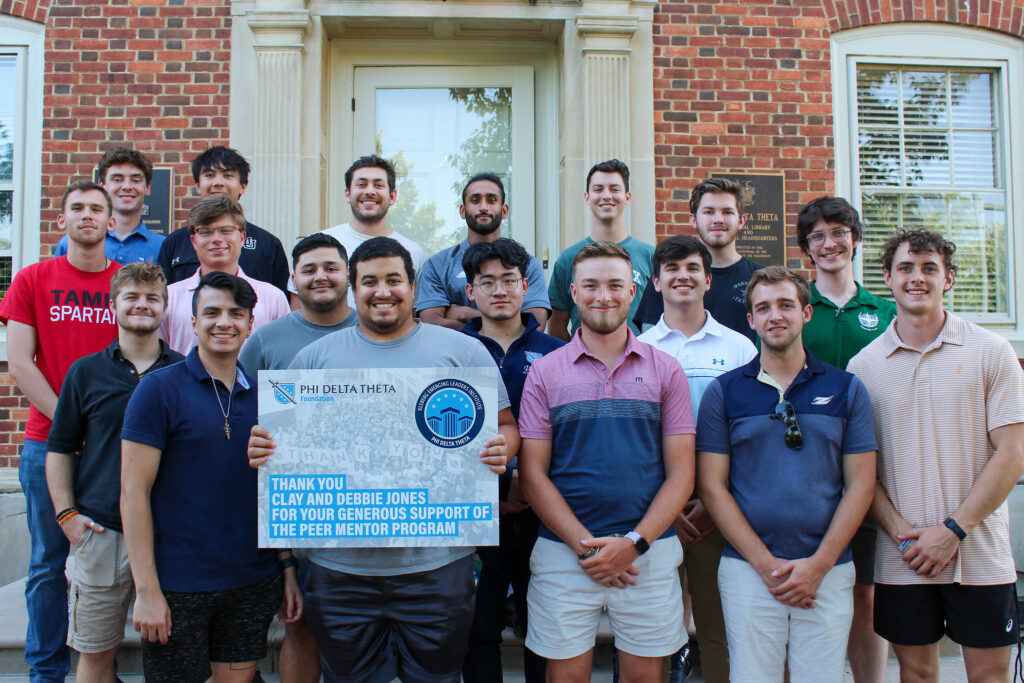
]]>Almost every summer since 1987, hundreds of undergraduate and alumni Phis have gathered in Oxford for the Fraternity’s Leadership College. To date, over 20,000 Phi Delts have attended. Kleberg, named for benefactors Tio Kleberg, Texas Tech ’69, and Janell Kleberg, is a cornerstone of Phi Delta Theta’s educational programming.
Inspiring Leaders
Designed for young members of the Fraternity who aspire to one day lead their chapter, Kleberg is an amazing opportunity for members to learn more about Phi Delta Theta beyond the borders of their campus, develop relations with brothers from across the organization, and build the skills necessary to become a better leader, citizen, and Phi.
Over three days, attendees have the opportunity to listen to world-class speakers, attend educational sessions about important topics, and participate in small group discussions with other undergraduate brothers led by Phi Delt volunteers. The Kleberg experience builds on what one has learned during an undergraduate’s time in the Fraternity while preparing him for more prominent leadership roles within the chapter. For example, over 40 percent of Phis who attend Kleberg Emerging Leaders Institute go on to become the president of their chapter.

The Klebergs
In 2012, the Leadership College was renamed the Kleberg Emerging Leaders Institute when Tio Kleberg, Texas Tech ’69, and Janell Kleberg endowed the program with the Phi Delta Theta Foundation’s first-ever $1 million donation from a living donor.
Tio joined the Texas Epsilon Chapter of Phi Delta Theta at Texas Tech University where he met his wife Janell. They both served in the US Army before embarking on a career in business and civic affairs in Kingsville. A rancher by trade, Tio’s career has centered around the world-famous King Ranch of South Texas.
Tio has been supporting the Phi Delta Theta Foundation for over five decades. He made his first donation of $10 in 1969. He took a more active role in 2000 joining the Phi Delta Theta Foundation Board of Trustees, then in 2009, he was named chairman of the Building on the Bond Capital Campaign. This laser-focused effort aimed to increase the Foundation’s endowment from just above $5 million to more than $20 million by 2020. The Klebergs helped the campaign meet its goal two years ahead of schedule.
When Tio and Janell agreed to support the campaign, they made a pledge of $1 million—however, for the Foundation to receive the funds, $360,000 had to be raised to support five scholarships of $72,000 each. This creative pledge provided motivation to raise additional scholarship funds while securing the Klebergs’ historic and transformational gift.
Today, Tio and Janell attend the annual conference and not only address the students in a general session, but are active participants in smaller breakout sessions, chapter meetings, and one-on-one conversations.
Tio and Janell Kleberg have deepened their legacy with a second, transformative $1 million gift in 2025. As co-chairs of Campaign 2030, the Klebergs’ generosity is not only a testament to their lifelong commitment to principled leadership but also a harbinger of their vision for the future—one centered on empowering generations of young men to grow as ethical, courageous, and visionary leaders.
This new $1 million gift is the first step to doubling the reach of the Kleberg Emerging Leaders Institute, allowing up to 2,000 students to benefit from life-changing leadership development opportunities each year. The Klebergs’ stewardship ensures the Institute remains a cornerstone of the Fraternity’s mission, broadening its impact while nurturing a culture of giving and personal growth.
The post Phi Delta Theta Welcomes 1,100 Student Leaders to Oxford, Birthplace of the Fraternity appeared first on Phi Delta Theta.
]]>The post City of Oxford Declares July 28, 2025 ‘Phi Delta Theta Week’ appeared first on Phi Delta Theta.
]]>“The Fraternity holds its annual Kleberg Emerging Leaders Institute in Oxford, Ohio, to promote the ideas of scholarship, service to others, leadership, personal development, and fraternal values and ethics to its diverse membership.”
William B. Snavely, Mayor of Oxford, Ohio
Almost every summer since 1990, hundreds of undergraduate and alumni Phis have gathered in Oxford, Ohio, for the Fraternity’s Leadership College. To date, nearly 20,000 Phi Delts have attended. Kleberg, named for benefactors Tio Kleberg, Texas Tech ’69, and Janell Kleberg, is a cornerstone of Phi Delta Theta’s membership development program.

About Kleberg Emerging Leaders Institute
Designed for young members of the Fraternity who aspire to one day lead their chapter, Kleberg is an amazing opportunity for members to learn more about Phi Delta Theta beyond the borders of their campus, develop relations with brothers from across the organization, and build the skills necessary to become a better leader and Phi.
Over three days, attendees have the opportunity to listen to world-class speakers, attend educational sessions about important topics, and participate in small group discussions with other undergraduate brothers led by Phi Delt volunteers. The Kleberg experience builds on what one has learned during an undergraduate’s time in the Fraternity while preparing him for more prominent leadership roles within the chapter. For example, over 40 percent of Phis who attend Kleberg Emerging Leaders Institute go on to become the president of their chapter.
Founded at Miami University in Oxford, Ohio, on December 26, 1848, Phi Delta Theta International Fraternity has 194 chapters and emerging chapters and 85 alumni clubs across the United States and Canada. To date, the Fraternity has initiated nearly 280,000 men into the society whose founding principles are Friendship, Sound Learning, and Rectitude. In 2000, Phi Delta Theta became the largest fraternity to implement an alcohol-free housing policy in all facilities. Guided today by its Phi Delt 2030 strategic plan, Phi Delta Theta’s vision is to be recognized as the premier fraternal leadership development society in North America.
The post City of Oxford Declares July 28, 2025 ‘Phi Delta Theta Week’ appeared first on Phi Delta Theta.
]]>The post Phi Delta Theta Chapters Raise $1.22 Million to Support ALS Through Live Like Lou and Iron Phi appeared first on Phi Delta Theta.
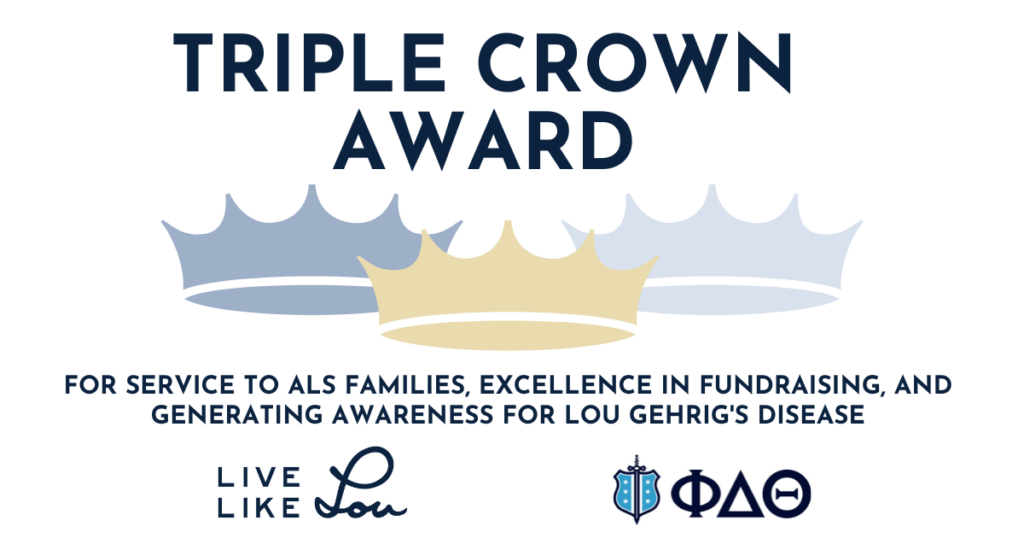
]]>In 2023, the Live Like Lou Foundation introduced the Triple Crown Award for Phi Delta Theta chapters. The award is named in honor of Brother Lou Gehrig, Columbia 1925. In Major League Baseball, the Triple Crown is a difficult feat to achieve, as a player must lead either the American League or National League in batting average, home runs, and RBIs. Only fourteen players have achieved this feat, including Lou Gehrig, who won the Triple Crown in 1934.
With the Triple Crown as its inspiration, Live Like Lou created a prestigious award that recognizes chapters that excel in supporting the Live Like Lou Foundation’s mission through meaningful engagement. To achieve this recognition, a chapter must complete the following:
- Register to serve an ALS family.
- Become an Iron Phi Chapter – Minimum of $10,000 raised through the chapter’s Iron Phi participants during the academic year.
- Generate awareness and support for Lou Gehrig’s disease by hosting a chapter philanthropy event that contributes $444 or more to the Live Like Lou Foundation.
Live Like Lou awarded the Triple Crown Award to twenty-nine Phi Delta Theta chapters for the 2023-24 school year, up from twenty-four last year. Along the way, 142 Phi Delta Theta chapters registered to serve an ALS family through Live Like Lou’s Connect & Serve program, providing meaningful service to ALS families and learning about the disease first-hand through their interactions.
Congratulations to our Triple Crown Chapters
Alabama Beta, Auburn University
Arizona Alpha, University of Arizona
California Phi, Chapman University
Colorado Alpha, University of Colorado Boulder
Colorado Gamma, Colorado State University
Florida Iota, University of Central Florida
Florida Kappa, Florida International University
Georgia Alpha, University of Georgia
Indiana Gamma, Butler University
Indiana Theta, Purdue University
Kansas Alpha, University of Kansas
Kansas Delta, Wichita State University
Kansas Gamma, Kansas State University
Kentucky Iota, University of Louisville
Missouri Alpha, University of Missouri
Missouri Beta, Westminster College
Nebraska Alpha, University of Nebraska–Lincoln
Nebraska Gamma, Creighton University
New Jersey Gamma, Seton Hall University
New York Lambda, St. John’s University
Ohio Epsilon, The University of Akron
South Carolina Beta, University of South Carolina
South Carolina Gamma, Clemson University
Texas Delta, Southern Methodist University
Texas Zeta, Texas Christian University
Utah Alpha, University of Utah
Virginia Eta, Virginia Tech
Washington Alpha, University of Washington
Washington Delta, University of Puget Sound
Iron Phi
Just as Lou Gehrig lived his remarkable life, Iron Phi participants embody the spirit of determination, resilience, and courage. Through participants’ efforts to achieve unique and personal athletic endeavors, Iron Phi is building a community of philanthropists who strive to leave ALS better than they found it while strengthening the Fraternity’s leadership programs.
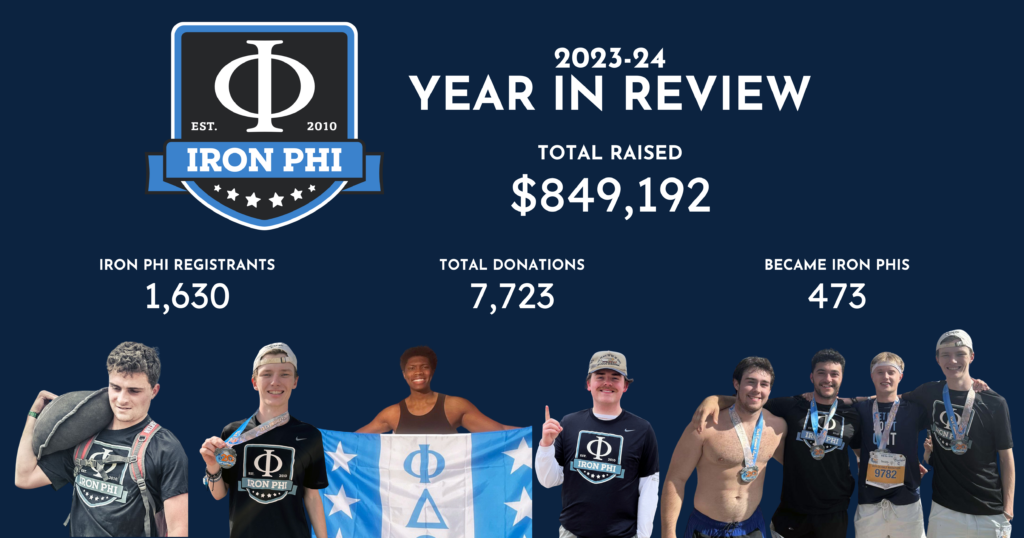
Made up of individuals, Phi Delta Theta chapter members, friends and family of Phi Delts, and ALS advocates as diverse as their interests, Iron Phis have raised $4.54 million since the program’s inception in 2010. The Iron Phi program serves as a fitting tribute to Lou Gehrig’s legacy and his impact on both Phi Delta Theta and the fight against ALS.
From July 1, 2023 through June 30, 2024, the Iron Phi program once again saw records broken.
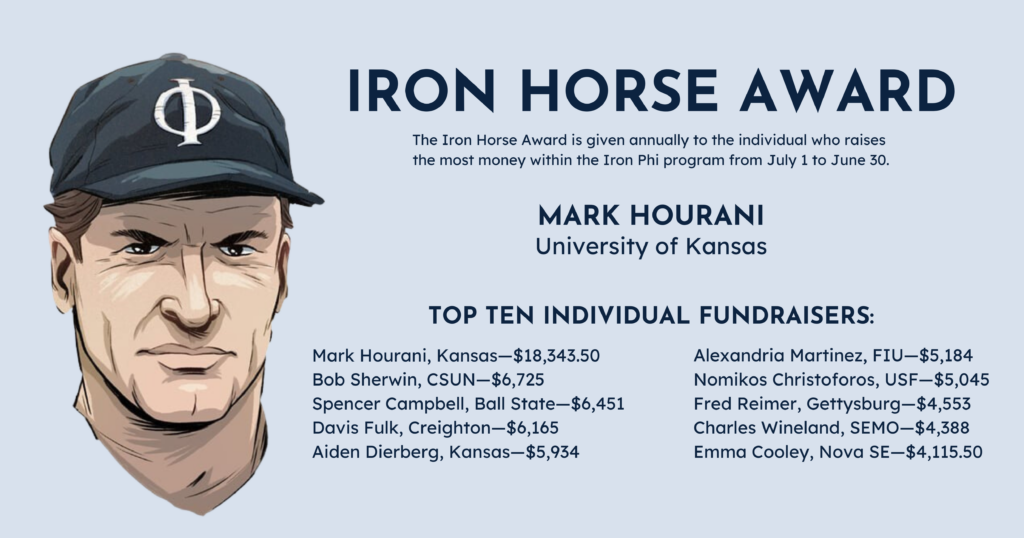
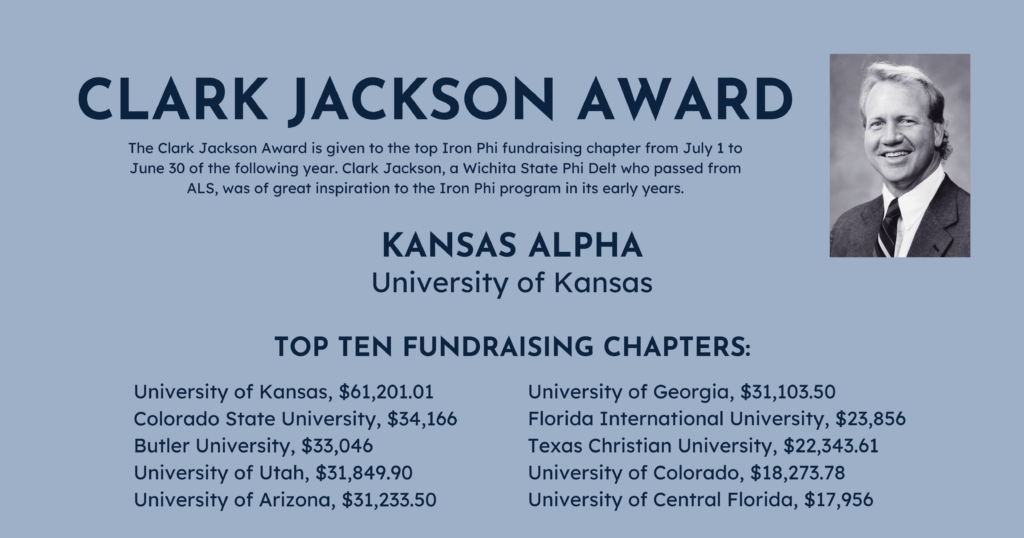
2023-24 Iron Phi Awards
In the spirit of Lou’s resilience and gratitude, we are honored to share this year’s top Iron Phi individuals and chapters.
Congratulations to our Iron Phi Chapters
Iron Phi Chapters raise a minimum of $10,000 through the chapter’s Iron Phi participants during the school year.
Alabama Beta, Auburn University
Arizona Alpha, University of Arizona
California Upsilon, California State University, Fresno
California Phi, Chapman University
Colorado Alpha, University of Colorado Boulder
Colorado Gamma, Colorado State University
Florida Iota, University of Central Florida
Florida Kappa, Florida International University
Florida Omicron, Nova Southeastern University
Georgia Alpha, University of Georgia
Indiana Gamma, Butler University
Indiana Theta, Purdue University
Indiana Kappa, Ball State University
Kansas Alpha, University of Kansas
Kansas Delta, Wichita State University
Kansas Gamma, Kansas State University
Kentucky Iota, University of Louisville
Missouri Alpha, University of Missouri
Missouri Beta, Westminster College
Missouri Zeta, Southeast Missouri State University
Nebraska Alpha, University of Nebraska–Lincoln
Nebraska Gamma, Creighton University
New Jersey Gamma, Seton Hall University
New York Lambda, St. John’s University
Ohio Epsilon, The University of Akron
Ohio Lambda, Kent State University
South Carolina Beta, University of South Carolina
South Carolina Gamma, Clemson University
Texas Delta, Southern Methodist University
Texas Zeta, Texas Christian University
Utah Alpha, University of Utah
Virginia Eta, Virginia Tech
Washington Alpha, University of Washington
Washington Delta, University of Puget Sound
We Do it for Lou
Phi Delta Theta would like to thank those who have contributed to our chapters’ philanthropic successes this year. Your support is making a difference in the world of ALS and is helping our members become the greatest versions of themselves.
We encourage members of Phi Delta Theta to help us leave ALS better than we found it. The Live Like Lou Foundation is always searching for Phi Delts of all ages to serve ALS families in their communities through its Connect and Serve program. See the list of ALS families for whom we are seeking volunteers. Are you interested in using your athletic abilities and goals to support the ALS cause? Become an Iron Phi to make a lasting impact on both ALS and Phi Delta Theta.
The post Phi Delta Theta Chapters Raise $1.22 Million to Support ALS Through Live Like Lou and Iron Phi appeared first on Phi Delta Theta.
]]>The post Phi Delta Theta Fraternity Responds to Ole Miss Protest appeared first on Phi Delta Theta.
]]>May 6, 2024 – [Oxford, OH]– The past few weeks have been challenging for many colleges and universities across the United States as they struggle to balance the protection of free speech with maintaining appropriate and respectful discourse among demonstrators and others within the campus community.
As part of that community, Phi Delta Theta recognizes that freedom of expression is part of the collegiate experience; however, the Fraternity is committed to upholding its principles as a private membership organization.
After reviewing the incident, it was determined that the individual’s behavior was unacceptable. The action in question was offensive, outside the bounds of this discourse, and contradictory to our values.
In partnership with local alumni, undergraduate leadership, and the university, disciplinary due process was initiated which resulted in the removal of membership. The situation will continue to be monitored in cooperation with any further investigation.
###
Founded at Miami University in Oxford, Ohio, on December 26, 1848, Phi Delta Theta International Fraternity has 194 chapters and emerging chapters and 85 alumni clubs across the United States and Canada. To date, the Fraternity has initiated nearly 280,000 men into the society whose founding principles are Friendship, Sound Learning, and Rectitude. In 2000, Phi Delta Theta became the largest fraternity to implement an alcohol-free housing policy in all facilities. Guided today by its Phi Delt 2030 strategic plan, Phi Delta Theta’s vision is to be recognized as the premier fraternal leadership development society in North America.
The post Phi Delta Theta Fraternity Responds to Ole Miss Protest appeared first on Phi Delta Theta.
]]>The post Phi Delta Theta Honors Memory of Brian Fraser through Scholarship Recipients appeared first on Phi Delta Theta.
]]>Brian Fraser, who served as the Michigan State Phi Delta Theta chapter president, was known for his leadership, kindness, and unwavering commitment to his fraternity brothers and the broader campus community.
Following Brian’s passing, supporters across the United States and Canada joined forces to assist the Michigan State community. The collective efforts of over 1,400 supporters, including more than one hundred Phi Delta Theta chapters and campuses, raised over $150,000 in Brian’s honor.
These funds established two annual scholarships in Brian’s name. The Brian Fraser Presidential Memorial Scholarship, awarded to future Michigan Beta presidents to support their education, was first presented to Matt Quick, Brian’s immediate successor. “This scholarship has meant the world to me and has allowed me to fund my education at Michigan State University and carry on Brian’s legacy,” Quick said.
The inaugural scholarship was presented by Brian’s parents, Mary and Sean, and sister, Micaela Fraser, during the Phi Delta Theta Kleberg Emerging Leaders Institute in Oxford, Ohio, a leadership conference that Brian had attended the previous year. Ryan Bennett, the current Michigan State chapter president, was the most recent recipient of this scholarship.
“This scholarship has given me the ability to pursue my goal of graduating college with less debt than anticipated. Living out the rest of my college career through Brian with this scholarship only pushes me to work harder as well both in academics and the growth of my fraternity through my presidential position,” Bennett said.
In addition, recognizing the importance of supporting first-generation college students, Brian’s parents established a second scholarship for first-generation Michigan State Phi Delta Theta students. John Canelopoulos was the first recipient of this scholarship; another will be awarded later this year.
“Being the first person in my immediate family to go to college has been a very challenging process,” Canelopoulos said, “Phi Delta Theta and this scholarship helped my transition from a high school student to a first-generation college student immensely. I thank everyone involved and the opportunity to continue my college career through Brian and his legacy.”
As we commemorate the anniversary of Brian’s passing, Phi Delta Theta reaffirms its commitment to honoring his memory and supporting the Michigan State community. Through scholarships and acts of kindness, we strive to carry Brian’s legacy of leadership, compassion, and generosity.
###
Founded at Miami University in Oxford, Ohio, on December 26, 1848, Phi Delta Theta International Fraternity has 194 chapters and emerging chapters and 85 alumni clubs across the United States and Canada. To date, the Fraternity has initiated nearly 280,000 men into the society whose founding principles are Friendship, Sound Learning, and Rectitude. In 2000, Phi Delta Theta became the largest fraternity to implement an alcohol-free housing policy in all facilities. Guided today by its Phi Delt 2030 strategic plan, Phi Delta Theta’s vision is to be recognized as the premier fraternal leadership development society in North America.
For approved photos and video content, please visit this link.
The post Phi Delta Theta Honors Memory of Brian Fraser through Scholarship Recipients appeared first on Phi Delta Theta.
]]>The post The Evolution Of The Modern Fraternity appeared first on Phi Delta Theta.
]]>The Dark Power of Fraternities, written on February 19 by Caitlin Flanagan of The Atlantic, caught the attention of the leadership and general membership of Phi Delta Theta Fraternity. While we are very aware of the issues that remain within the walls of fraternities, specifically alcohol-abuse and hazing, Phi Delta Theta and its bold leadership has long been making tough decisions to address them.
No parent, who has the highest hopes when their son or daughter attends college, entering the prime of their life with every good experience yet to come, should have to bury a child. Having said this, society today has become less tolerant of the behavior referenced in the article, especially when it leads to the unthinkable. Understandably, rare instances of death, injury and stereotypical behavior will always make the front page. However, it is unfortunate that positive stories about community service, philanthropy and acts of brotherhood that occur every day are either overshadowed by the bigger, more sensational story or ignored altogether.
Phi Delta Theta introduced an Alcohol Free Housing policy in 1997 with these growing concerns in mind. There was a three-year phase-in period and an implementation of the full policy on July 1, 2000. When this policy was introduced, many skeptics believed that this was the end of our organization. Many predicted the organization’s doom in five years. However, today I’m proud to report that the policy is having a tremendously positive impact, disproving our naysayers, and placing Phi Delta Theta in a much better state today than prior to this groundbreaking decision.
In the early 90s, Phi Delta Theta experienced two undergraduate member deaths. Such moments were incredibly troubling for my predecessors on our Board and they understood that they needed to tackle an issue that was bigger than just Phi Delta Theta. Their solution was to return to the values established by our Founders in 1848 and focus on the Fraternity’s three Cardinal Principles: Friendship – the cultivation of friendship among members, Sound Learning – the acquirement individually of a high degree of mental culture, and Rectitude – the attainment personally of a high standard of morality.
As Phi Delta Theta chapters and its members drifted away from the Fraternity’s true purpose and the vision of our Founders, and upon reflection of our Cardinal Principles, it pointed to a need to realign the organization’s values and actions. Such realignment occurred with the help of Alcohol Free Housing.
Once the organization’s leadership made the decision to move forward, seven goals were established alongside the institution of the Alcohol Free Housing policy: 1) return the focus to our founding principles, 2) combat an alcohol-dominated culture, 3) improve members’ academic performance, 4) stop the deterioration of chapter facilities, 5) slow the rising cost of liability insurance, 6) meet the needs of today’s college students with substantial programming and leadership education, 7) reengage our alumni members.
The return to our core values and the implementation of Alcohol Free Housing has produced overwhelmingly positive results for Phi Delta Theta and the 188 campuses where we exist. We have discovered that many students seek a values-based experience from their fraternity. From 2000, when the policy was fully implemented by all of our chapters until today, we’ve experienced a 41.37% increase in the number of new members who join our organization each year. Our total number of undergraduate members has increased 38.64%.
From a competitive standpoint, our average chapter size is 64 members, the second highest among all fraternities and up from 49 in 2000. The national average hovers around the low to mid 40s. From a chapter growth perspective, we have installed or reinstated 64 chapters since 2000. During the 2012-13 academic year, we installed eight new groups with an average size of 45 new members. We are on pace to do this again in 2013-14.
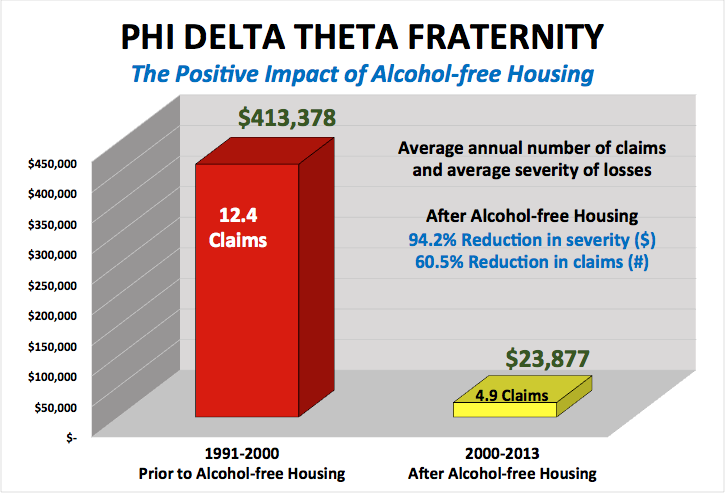
Sound learning has also improved as the organization’s collective GPA is at 3.01, up from 2.73 in 2000. In addition, our members are making smarter decisions outside of the classroom that keep themselves and their brothers safe from high-risk events. The best way to measure this success is by evaluating the number of incidents that might manifest themselves into insurance claims. We averaged 12.3 alcohol-related insurance claims per year prior to 2000 with an average annual payout of $413,378. Today, we average 4.9 claims a year with an average annual payout of $23,877. The average number of annual claims has decreased 60.5% and the severity of payout has decreased 94.2%. Because of this, our liability insurance costs have dropped substantially, thereby, offering a much more affordable and safer experience to our members. Today, the average per member insurance rate for fraternities is approximately $160 per member; our rate is less than half that at $74 per member.
Our alumni have quickly noticed the difference in our organization and have returned to be involved as advisers and mentors. In 2000, we had approximately 200 advisers. Today, we have 885, a 342.5% increase. Because of the positive effects of Alcohol Free Housing, alumni are more comfortable providing both their time and treasure. Additionally, alumni giving is at an all-time high. In 1990, our Foundation raised just over $494,000; in 2000, just over $1.08 million. This past year, $3.65 million was raised to provide valuable educational programs and financial assistance to our members in the form of undergraduate scholarships and graduate fellowships.
More than anything, I believe that by removing alcohol from our facilities, we have been able to focus on things that make us a better organization. While we concentrate a great deal on risk management education, our volunteers and staff no longer regularly focus on incidents involving alcohol. We are now able to broaden our focus to other progressive programming for our members.
While we will be the first to admit that we are certainly not perfect, we are extremely confident about our direction, decisions, and leadership, and we remain committed to tackling the tough issues that currently face our organization and our members. Most importantly, we are proud of our members and their support in helping our Fraternity become the greatest version of itself.
The post The Evolution Of The Modern Fraternity appeared first on Phi Delta Theta.
]]>The post Being Your Reputation’s Keeper appeared first on Phi Delta Theta.
]]>When I was asked to blog about PR for this month’s post my immediate thoughts went to exploring an experience from my professional life. As an advertising guy I work alongside our PR professionals all the time, as well as practitioners from other agencies. It’s fun to work with them in building a client’s business – building their reputation.
While there are certainly lessons and observations I can draw upon to inform this post, in the end I find them a little weightless in the context of being a Phi.
Instead, I got to thinking about reputations within our Fraternity and the fraternity world. We are very lucky to be Phi Delts. We’ve got one of the best – if not the best – reputation in the fraternity world today. Other fraternities envy our organization for a variety of reasons. Our educational programming is among the best out there; providing our undergrads and alumni volunteers with tremendous opportunities for growth and development. Our undergraduates are among the best men walking the hills of college campuses across North America. Our alumni are engaged and give tremendous amounts of time, talent and treasure to Phi Delt. And most importantly, we are always willing to make hard decisions for the betterment of the organization in order to honor and perpetuate the objectives of The Immortal Six. Other groups envy us because we make hard decisions.
I personally find strength in the notion that I am a member of an organization who is willing to do the right thing. Which leads me to reputation management. We owe each other, and ourselves, the effort to be the best we can be. To manage our reputations individually and as an organization.
Do you like what you see when you look in the mirror? Do you feel like you’re living up to the challenges of The Bond?
I’d argue that the best reputation management that can be done is making sure you can look yourself in the eye. Being a Phi means being better than common and challenging ourselves and our brothers to be better than ordinary.
The great thing about Phi Delt is the expectations are clear and easy to understand. And we know when we’ve lived up to the challenge and when we’ve fallen short. Falling short is OK. Falling short means you recognize the need for improvement and perhaps some help from your brothers in the process. That’s what they’re there for!
I was given a book call The Edge when I went off to Kent State. It was a compilation of inspirational quotes and stories. The book’s author was a Cleveland area high school wrestling coach. With the exception of my badge, it was my most prized possession in college. (Many an eye rolled when I quoted The Edge at a chapter meeting.) During my last chapter meeting before graduating I bequeathed The Edge to one of my favorite brothers. I miss that book. But I learned years later that Collin Boetger still has it in his home – years since I gave it to him that spring night in 1994.
My favorite passage from The Edge is a poem entitles The Man In The Glass.
I’ll end this post with it. I hope you challenge yourself to manage your reputation by challenging yourself to be the best you can be. To live a satisfied life. Knowing that you are accepting the challenge of our Founders to be more than ordinary, more than average. In the end, the only one who will know if you’ve truly succeeded is you!
The Man In The Glass
By David Winbrow
When you get what you want in your struggle for self
And the world makes you king for a day,
Just go to the mirror and look at yourself
And see what that man has to say.
For it isn’t your father or mother or wife
Whose judgment upon you must pass.
The fellow whose verdict counts most in you life
Is the one staring back from the glass.
You may be like Jack Horner and chisel a plum
And think you’re a wonderful guy.
But the man in the glass says you’re only a bum
If you can’t look him straight in the eye.
He’s the fellow to please-never mind all the rest,
For he’s with you clear to the end.
And you’ve passed your most dangerous, difficult test
If the man in the glass is your friend.
You may fool the whole world down the pathway of years
And get pats on the back as you pass.
But your final reward will be heartache and tears
If you’ve cheated the man in the glass.
Brother Fabritius is the General Council Reporter. His other volunteer service to Phi Delt has included Education Commissioner and Province President. Rich lives in Atlanta with his wife, Heather, and their daughters, Austin and Reese. A past consultant and Director of Chapter Services for the General Headquarters Staff, he is a graduate of Kent State University and a member of the Ohio Lambda Chapter. Rich is Vice President, Managing Director of Brunner, an advertising and marketing agency. His hobbies include travel, golf, and boating.
The post Being Your Reputation’s Keeper appeared first on Phi Delta Theta.
]]>The post Mastering Your Chapter’s Communication Efforts appeared first on Phi Delta Theta.
]]>Communication is one of the basic functions of management in any organization and its importance can hardly be overemphasized. It is a process of transmitting information, ideas, thoughts, opinions and plans between various parts of an organization.
Mastering communication within your chapter can seem quite overwhelming due to the many audiences that you must reach. Once achieved, it will drive positive results in everything your chapter does. Chapter communication comes in many forms (external, internal, online, written, listening, spoken, in groups, one-on-one, etc.) but it should never be the responsibility of one member. A collective effort that breaks down your audiences and assigns specific duties to specific officers can get your chapter moving in the right direction.
The Chapter Communications Committee
To master the art of communication in your chapter, consider the development of a chapter communications committee comprised of the following five officers: President, Public Relations, Secretary, Alumni Secretary and Webmaster. The Secretary should be the chairman of the committee. Start by creating a communications calendar at the beginning of each term and then begin to meet a few times each month to check progress and discuss issues.
Below are examples of where each of these five officers should concentrate.
President:
- Report campus activities to the chapter
- Report Greek activities to the chapter
- Communicate chapter successes to campus officials
- Communicate chapter goals & strategic plan to constituents
- Lead communicator with GHQ
- Lead communicator with Chapter Advisory Board
- Lead communicator with House Corporation
- Lead communicator with campus officials
- Encourage campus involvement by announcing opportunities
- Develop an awards program to recognize successful brothers
Public Relations Chairman:
- Communicate chapter successes to GHQ
- Manage the chapter’s Facebook page
- Manage the chapter’s Twitter account
- Gather content to share online – Website/Social Media
- Develop relationships with media outlets in the community and pass along successes
- Educate brothers about public relations
- Oversee all promotional and marketing materials
- Gather parent information and include in communication pieces
Secretary:
- Manage the chapter’s calendar
- Develop and share chapter/exec meeting minutes
- Track the submission of reports from the Chapter Greatness Checklist
- Assist with agenda building for chapter and executive board meetings
- Order and keep stock of correspondence materials
- Organize files for officer transitions
- Develop lists of pertinent information (Members’ contact information, extracurricular activities of brothers, student organizations on campus, sorority/fraternity founding dates, service & philanthropy dates, classes brothers are taking (majors), other important contacts and listserv/alumni information lists)
Alumni Secretary:
- Manage alumni contact information
- Gather content for alumni newsletters
- Develop alumni e-newsletters (Try these MailChimp, Constant Contact)
- Develop alumni profiles and successes to feature on the website/social media
- Communicate chapter events to alumni
Webmaster:
- Gather information for chapter website
- Edit and update chapter website content
- Gather pictures for online content
While chapter communication encompasses much more than what is on this post, focusing on these areas will get your chapter moving in the right direction.
And remember…..
“Communication works for those who work at it.” – John Powell
After spending time as a Leadership Consultant, Director of Expansion and Director of Education & Technology, Steve is now the Director of Communications & Iron Phi for the Fraternity. He spent his undergraduate days at Iowa State University and completed his MBA at Xavier University. Steve was recently named an Iowa Statement Maker by the Iowa State Alumni Association for his work on the Iron Phi program. Steve enjoys sports of all sorts, traveling, photography, running, attempting to find the best burger, reading, accumulating bobbleheads and trying to keep up with his two dogs. Steve and his wife Tillie live in Ames, Iowa.
The post Mastering Your Chapter’s Communication Efforts appeared first on Phi Delta Theta.
]]>The post Break Out Of Your Cage appeared first on Phi Delta Theta.
]]>The other day I saw a Harley Davidson commercial that showed people going about their everyday lives as normal except for one major change – they were all enclosed in individual cages. Along comes a man riding on a Harley Davidson motorcycle and he is the only one not stuck in a cage. I found the commercial entertaining and it made me think. Now, I’m not quite ready to go out and buy a motorcycle, but the commercial did speak to me in another way.
What struck me about this commercial was the part about being stuck in a cage. I feel that this isn’t far from the truth and that people become more and more like this every day. Even when we are out in public, we retreat inside our own little cages. It seems that most of us would rather stand quietly than reach out and be friendly to those around us. People get so caught up checking email on their Smartphone (or playing Angry Birds), reading the news, or listening to their iPods, that they don’t interact with those around them. The crazy thing about this is that no one puts us into these cages except for ourselves. We choose to be in these cages instead of reaching out and striking up a conversation with those around us.
One of the primary purposes of a fraternity is to cultivate social development and make friends. I truly think that as members of Phi Delta Theta we have the duty to break out of our cage and interact with those around us. I’m not saying that it will be easy, but if we focus on being a little more social every day we can gradually break out of our cages. Here are three simple ways that can make you more social every day.
1. Have a conversation with the individual who serves you coffee. Many of us enjoy a nice cup of coffee in the morning and there is usually a very pleasant person that serves that coffee to you and he/she is contractually obligated to be nice. Striking up a conversation with this person should be fairly simple. Tomorrow, go beyond the “I’ll have a small coffee” and ask him/her about their day. Simple enough right? Now, the kicker…listen to his/her response and respond appropriately. You could have a nice 2-3 minute conversation while your coffee is being prepared.
2. Say hello to the person next to you at the crosswalk. I don’t know about you, but I like to walk to places whenever possible. During these walks, I often stop at an intersection waiting for the light to change. Equally as often, there is someone stopped there with me. Usually this time is spent gazing at the clouds, checking my watch or urgently looking at something on my cell phone. But, what if we took that time to greet the person next to us? Say hello, ask them how their day is going or even resort to everyone’s favorite small talk topic…the weather. These conversations only have to be awkward if you make them so. Be pleasant but brief and go about the rest of your day.
3. Sit next to a stranger at the library/student union/cafeteria (or anywhere else for that matter.) It seems that people spend all of their time circling these locations looking for an unoccupied table rather than sitting down next to someone they don’t know. Take a chance, ask them if it’s alright to sit next to them and pull up a chair. Once you’re seated, introduce yourself and ask some sort of conversation starting question.
So, now you are ready to go. Take the first step and start breaking down that cage. For those of you who think this just isn’t feasible to do, I’m going to practice what I preach. I have challenged myself to “walk the talk” and for the next 30 days I am committing myself to have a conversation with a total stranger every day. You can read about it and follow my progress on Facebook here. I plan to post daily updates about my personal challenge. I invite you to push yourself to try something similar. So go ahead, break out of your cage, be a Harley.
The post Break Out Of Your Cage appeared first on Phi Delta Theta.
]]>The post Gettin’ in Good with GHQ appeared first on Phi Delta Theta.
]]>This is a question that I have heard many times; sometimes on a phone call with a chapter president as they are being removed from probation, sometimes while facilitating at one of Phi Delta Theta’s many educational conferences, and even sometimes during dinner with a chapter adviser. The question always makes me laugh, because there is no simple answer to this question and GHQ certainly doesn’t have the equivalent of Santa’s list with the good chapters on one side and the bad chapters on the other. In reality, the answer to this question is not a difficult one: think before you act, use common sense, and live up to the teachings of The Bond. While I could sit here all day and recount all of the things that chapters have done over the years to get on GHQ’s bad side, that is not quite the point of this blog. What I would like to do instead is leave you with a list of helpful tips to “get on ‘headquarters’ good side.”
1. Pay your bills. Being financially delinquent is probably the easiest way to get on the bad list. Pay your bills and pay them on time and you will stay out from under the microscope.
2. Communicate. Answer the phone if you can, return voicemails if you can’t. Do your best to return emails within 24 hours. If something goes wrong, tell us. If something goes right, tell us. We want to know how you are doing so that we can help you get better.
3. Tell the truth. Lying won’t get you anywhere and is a great way to destroy your chapter’s credibility. If something goes wrong, don’t be afraid to call.
4. Ask for help. If you don’t know what to do… ask! I would rather spend 10 minutes on the phone explaining how to do something, than spend 30 minutes fixing a mistake. After all, my job is to help you.
5. Share your accomplishments. If your chapter does something great, make sure everyone knows about it. Send an article and pictures to GHQ, the local newspaper, news stations, post it online, etc.
6. Represent Phi Delta Theta with pride and integrity. Be friendly and respectful to everyone you meet, be a leader inside and outside the classroom, and let your morals guide you. You never know who is watching.
7. Turn in your reports. GHQ does not require Red Letter Days reports just because. Most of these reports ensure that the General Fraternity can continue to operate smoothly and keep accurate records for generations to come. The GHQ Trophy is the easiest award to win, and yet so few actually win it.
8. Have fun, but be safe. Remember that you are in a social fraternity, so be social! We want you to have a good time, but do it safely. Remember to fill out Event Planning Forms for your events, look over the Risk Management Policies every semester, pay your insurance bill, and most importantly; use your head.
9. Get involved. While in school get involved on campus or in the Greek Community, or become a Peer Mentor. Once you graduate, become a Chapter Adviser, a Leadership Consultant, or a Facilitator at a Conference.
10. Apply for awards. As chapter members you put in a lot of hard work; you might as well be recognized for it. Apply for University and GHQ awards. Winning awards is a great way to build a positive reputation within Phi Delta Theta and within your community.
Jacob Kingdon received a degree in psychology from Lawrence University before joining the General Headquarters staff in the summer of 2007. At Wisconsin Beta, Jacob served as President, Recruitment Chairman, and Brotherhood Chairman. Jacob also served as Vice President of Operations for the Interfraternity Council, President of the Greek Leadership Council, and was a member of the Lawrence University Judicial Board. Jacob currently serves as Director of Chapter Service for Phi Delta Theta General Headquarters and Treasurer of the Oxford Alumni Club. In his spare time he enjoys playing racquetball, golf, and poker.
The post Gettin’ in Good with GHQ appeared first on Phi Delta Theta.
]]>