The post Phi Delt Nation, Sideline Pop-Up Store Now Open Through November 13 appeared first on Phi Delta Theta.
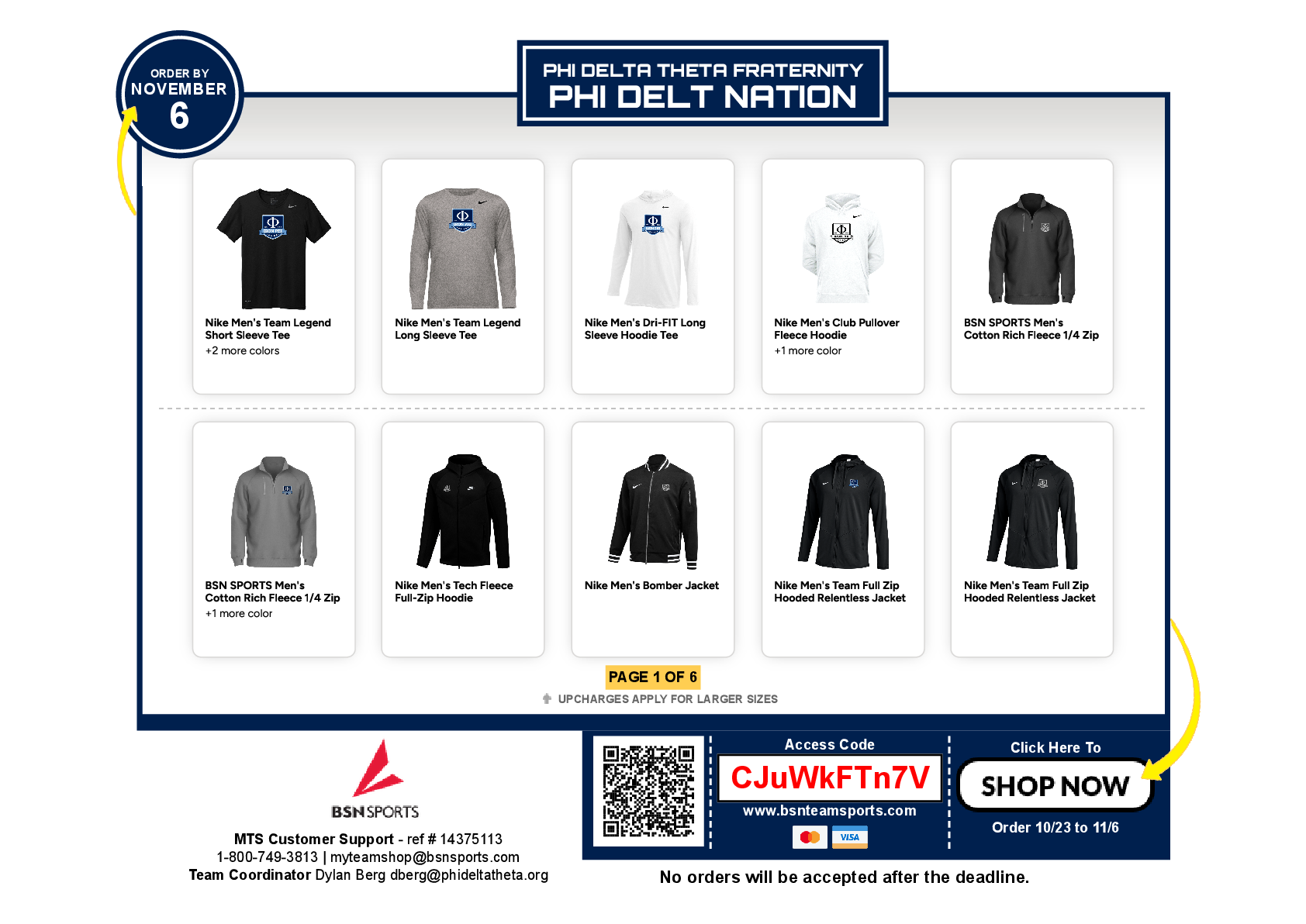
]]>Get ready—our limited-time Phi Delt Nation, Sideline Pop-Up Shop is open October 23–November 13!
Wear the same gear as your players and coaches from your school. Stock up on exclusive designs from Nike, Jordan, and more top athletic brands. Wear the same performance gear and winter essentials as your favorite team for intramurals, your next Iron Phi event, or the big game. This shop has everything you need—beanies, jackets, sweats, and more—perfect for chilly days ahead.
Don’t miss your chance to grab these exclusive items before the shop closes November 13.
The post Phi Delt Nation, Sideline Pop-Up Store Now Open Through November 13 appeared first on Phi Delta Theta.
]]>The post Twenty-Five Years Alcohol-Free: Reflections of Phis Who Led the Change appeared first on Phi Delta Theta.
]]>For some, it was controversial. For us, it was defining. Twenty-five years later, the students of today have never known Phi Delta Theta any other way. To reflect on this transformative moment, we sat down with members across generations—undergraduates, chapter leaders, alumni volunteers, and staff—each offering a unique perspective on what this change meant for them and for the Fraternity as a whole. Together, their stories capture how the entire organization played a role in shaping the organization we know today.
“We saw that 75 percent of our undergraduates were underage. And what we were doing as a fraternity and as a Greek system, we were providing places for them to break the law. And we decided that that wasn’t something we wanted to do. Fraternities and sororities are the only organizations on a college campus that have a pledge or take an oath to be better than the average student. And so we felt that there was something better out there. We wanted to provide a better opportunity, a better chance for learning what the Fraternity is all about, rather than having alcohol be the important factor.”
—Bob Deloian, General Council President, 1996–98
“You know, I think the one thing about Phi Delta Theta that is so unique is that we have a long history of adopting change initiatives that are industry-leading and make us who we are, and we’ve been able to embrace those differences. We’ve been able to implement those differences, and we’ve done so fearlessly.”
—Tom Balzer, Program Coordinator of Alcohol-Free Housing, 1997–2001
Because of alcohol-free housing, “The other key things that I’ve seen, growth in the Fraternity, recruitment numbers went up. Our insurance costs, as the broker and as the staff member at the time in charge of that, had a dramatic reduction. If we look now, today, our frequency of claims is down about 67 percent, and the severity of claims is down about 68 percent.”
—Marc Mores, Director of Chapter Services, 2000–04
“There was a lot of positive feedback, because you have to realize, you know, prior to, say, the late 1960s, our fraternity houses were alcohol- and substance-free, and they were like older alumni saying, ‘You finally figured it out. You’re getting back to the core principles of a fraternity: Friendship, Sound Learning, and Rectitude.’ As I like to tell people, reporters in particular, we’re getting out of the bar business, and we’re getting back into the fraternity business, and that was successful.”
—Bob Biggs, Executive Vice President, 1991–2016
“We wouldn’t be where we are without alcohol-free housing. It changed the quality of our members. It changed our parental engagement. It changed the university engagement and changed our alumni engagement. It helped us improve our chapter houses and helped our members focus more on what a fraternity is supposed to be. Nothing would be possible today, or we would not have the success we’re having today, without alcohol-free housing.”
—M. Scott Mietchen, General Council Reporter, 1998–2000
“When I went through recruitment in 1998, alcohol-free housing was a huge selling point for me to join the organization. When I saw the facilities and knew that it would be a safer and cleaner place, it really attracted me as an undergrad to want to join the organization, particularly since the other fraternities on my campus were not alcohol-free.”
—Joe Morel, initiated 1999
“I think it’s important to remember that the organization is what we’re here to protect in the long run. And being alcohol-free means the ideals of the organization can come to the forefront of everything that we do. From volunteering in the community to being a more impactful community member to being more academically driven and focused, it can really shift an organization to that perspective when alcohol isn’t the culture anymore.”
—Phil Cantrill, initiated 2000
“The policy was meant to reduce harm, to basically stop providing a mechanism for undergraduate members to hurt themselves. So, we’re twenty-five years down the line in enforcement. The reason the policy works is because when [a violation] comes to light, there’s rigorous enforcement, meaning we’re removing officers, we’re engaging in education, putting disciplinary controls on a chapter of social probation, then if necessary, charter suspension.”
—Rudy Porchivina, General Council Member-at-Large, 2000–02
“Phi Delta Theta has been able to initiate big strategic plans like Phi Delt 2020 and Phi Delt 2030 and live our values by doing big things to serve our communities. This includes our partnership with the Gruver Foundation and the advent of our Taking a Stand, high school education program, and the creation of the Iron Phi Foundation and the Live Like Lou Foundation. These efforts allow us to live our values in taking on causes a lot bigger than us. Because we’re focusing on our values, and not on our problems, we can focus on delivering best-in-class leadership programming, funding transformational scholarships, and investing our resources in those things.”
—Sean Wagner, chapter president, 2000–01
“We survived twenty-five years where some people thought we might last five by going alcohol-free housing. We proved some of the challenges that we have that we could overcome, and we can sell the idea, and people were willing to join an organization that had alcohol-free chapter houses. The one thing we challenged with people, that doesn’t mean we’re an alcohol-free fraternity; it means our chapter houses are alcohol-free. People can still join, they can still drink, and still have a good time if that’s what they want. It’s just not going to be in our chapter facility. So, I think the biggest thing is we’re still here; we’re still a viable group. [Alcohol-free housing is] a selling point on some campuses when we’re doing expansion presentations.”
—Charley Pride, General Council Treasurer, 2000–02
“Every one of our chapters doesn’t have to be alcohol-free, but they get to be alcohol-free, and there’s an important distinction there. Our chapter houses are our boardrooms. They’re our offices, our places of residence. And keeping that clean and organized is a heck of a lot easier when you’re not throwing humongous parties there. It’s pretty nice to visit a campus on parents’ weekend and not have your feet sticking to the floor. It’s pretty nice to bring a partner or prospective partner to your place of residence, to your fraternity house, and not have the place smelling like a barn. These are just general things that accompany our commitment to alcohol-free housing.”
—Dave Kovacovich, Chapter President, 1996–97
“But for me, specifically as somebody who was leading a group of men, having to wrap my head around fraternity without alcohol in the chapter house, and then communicate that [to others] . . . so navigating not being hypocritical, and making my own choices and what that means—there was a lot there, that I grew a lot during those couple of years.”
—Moe Stephens, Chapter President, 1996–98
“The greatest challenges [of implementation] were actually getting some of the alumni on board. When you think about it, you know, back in the late 1990s and early 2000s, when there would be homecoming games, tailgating generally, they were starting at their fraternity houses. Some fraternity houses were right there by the stadium. And of course, what was there? Alcohol. So that had to stop, and there was a lot of pushback from the alumni until they got used to not being able to have it on the property. And for the undergrads, their biggest problem was that a lot of the more recent alumni would show up at the house with a case of beer or something, and it was difficult to get them to say, ‘Hey, brothers, we can’t have that anymore in here. You need to remove that and take it outside.’”
—Mike Scarlatelli, General Council Member-at-Large, 2000–02
“And as a chapter president, I was terrified. After going to leadership conferences and such and learning about risk management and my own responsibility, if something were to happen under my watch, I would not want to be responsible for that. And so we did everything in our power to make sure that folks were safe at our own parties. And so I sort of think back about that, and then the plight of current chapter presidents and future chapter presidents and the quality of our membership. You know, if we were recruiting based upon actual brotherhood and Sound Learning and Rectitude and what it meant to be a family on campus who enjoyed social activities, certainly. But if all we shared was alcohol, then that wasn’t really a brotherhood in my mind.”
—J. David Almacy, Province President, 1996–2005
The post Twenty-Five Years Alcohol-Free: Reflections of Phis Who Led the Change appeared first on Phi Delta Theta.
]]>The post Now Hiring: Growth Coordinator appeared first on Phi Delta Theta.
]]>Who We Are
Phi Delta Theta Fraternity is an international nonprofit organization whose mission is to provide its members a lifetime experience that allows each member to reach their own personal greatness. Founded at Miami University in Oxford, Ohio, on December 26, 1848, Phi Delta Theta International Fraternity has 189 chapters and emerging chapters and ninety alumni clubs across the United States and Canada. To date, the Fraternity has initiated over 294,000 men into the society whose founding principles are Friendship, Sound Learning, and Rectitude.
We are a dynamic organization overseeing multiple entities with a strong commitment to operational excellence, financial integrity, and mission-driven outcomes.
Who We Serve
Guided by our Cardinal Principles, we create transformational experiences for our members, volunteers, communities, and staff all in the pursuit of greatness.
Duties & Responsibilities
- Ensure that emerging chapters are receiving adequate support and have the resources needed to assist them with remaining on track to achieve installation and charter. This includes, but not limited to, conducting in-person visits, assisting with recruitment efforts, facilitating member education, and reviewing and reacting to accreditation submissions.
- Provide oversight on the collection and review of petition materials in conjunction with working with the Senior Director of Alumni Engagement to plan and execute installation weekends.
- Collaborate with the Vice President of Growth & People to identify chapters to enroll in the Recruitment Coaching program based on growth potential, recent recruitment efforts, and members graduating. This includes the identification of chapters and implementation of support strategies for micro-expansion efforts.
- Work with the Vice President of Growth & People to identify and implement a support plan for chapters that need reactive recruitment coaching throughout the year based on semesterly recruitment performance.
- Support the growth, education, and operations of interest groups as they work towards a successful induction. This includes, but not limited to, conducting an in-person visit, assisting with recruitment efforts, facilitating Founders education, the selection and training of chapter officers, and preparing for induction.
Qualifications
- Bachelor’s degree required
- 1-2 years of fraternity recruitment experience, preferably with chartering knowledge
- Strong project & process management skills
- Excellent written and verbal communication abilities
- Ability to work independently and manage multiple priorities
What We Offer
- 100% employer-paid health plan, including vision and dental supplemental coverages, health reimbursement arrangements, short- and long-term disability, and life insurance.
- Meaningful 401k retirement plan with a 4% match and additional performance-based contributions.
- Flexible Paid Time Off Policy with additional paid time off for holidays, office closures at years end, and short- and long-term disability insurance, and life insurance plan options.
- Additional benefits include an employee wellness stipend, flexible workspaces, technology stipends with mobile phone plan reimbursements, staff events, and employee recognition programs.
- Remote work flexibility, allowing for optimal work-life balance while maintaining collaborative relationships with our team.
- Opportunity to work on a mission focused team and make a meaningful impact on a historic international organization with a 200,000+ membership base.
Work Environments and Physical Requirements
Frequent travel at least 60% of the year in addition to prolonged periods of sitting at a desk and working on a computer.
Application Process
Interested candidates should provide fill out the application below by November 21, 2025. If you run into any issues, please reach out to Myra Duritsch.
Growth Coordinator Application
"*" indicates required fields
The post Now Hiring: Growth Coordinator appeared first on Phi Delta Theta.
]]>The post Job Posting – Recruitment Specialists appeared first on Phi Delta Theta.
]]>Are you passionate about leadership, sales, and growing the future of Phi Delta Theta? Phi Delta Theta General Headquarters is looking for driven and dynamic individuals to join our team as full-time Recruitment Specialists for both January 2026 and June 2026 start dates.
As a Recruitment Specialist, you’ll be on the front lines of expanding and strengthening Phi Delta Theta, helping to establish new or re-emerging chapters and coaching undergraduate leaders through successful membership growth. This role is perfect for someone who thrives in sales, business development, and relationship-building—and wants to make a lasting impact on the Fraternity.
If you’re looking for a rewarding career that combines leadership, sales, and fraternity growth, this is your opportunity to make an impact! Apply today and help shape the future of Phi Delta Theta.
Who We Are
Phi Delta Theta Fraternity is an international nonprofit organization whose mission is to provide its members a lifetime experience that allows each member to reach their own personal greatness. Founded at Miami University in Oxford, Ohio, on December 26, 1848, Phi Delta Theta International Fraternity has 189 chapters and emerging chapters and ninety alumni clubs across the United States and Canada. To date, the Fraternity has initiated over 294,000 men into the society whose founding principles are Friendship, Sound Learning, and Rectitude.
We are a dynamic organization overseeing multiple entities with a strong commitment to operational excellence, financial integrity, and mission-driven outcomes.
Who We Serve
Guided by our Cardinal Principles, we create transformational experiences for our members, volunteers, communities, and staff all in the pursuit of greatness.
Duties and Responsibilities
Recruitment and Business Development
- Collaborate with the growth team to plan and execute expansion projects, setting goals, organizing logistics, and ensuring a smooth launch on new campuses across North America.
- Network and establish key relationships with university faculty, administrators, student leaders, and campus organizations to build momentum and credibility for Phi Delta Theta.
- Proactively generate and cultivate potential new member leads through strategic networking, referrals, social media campaigns, and campus partnerships.
- Engage with potential Founders through cold outreach, warm introductions, personalized messages, and in-person interactions to showcase the Phi Delta Theta experience and help students discover the benefits of joining.
- Host interactive, high-energy recruitment events, info sessions, and one-on-one meetings to identify top students, assess organizational fit, and build strong peer-to-peer connections.
Founder Education and Chapter Operations
- Educate and mentor Founders on fraternity leadership, recruitment strategies, chapter operations, and campus engagement to ensure long-term success.
- Guide the emerging chapter in forming their executive committee, ensuring the right candidates’ step into leadership roles and receive the necessary training to lead effectively.
- Provide ongoing support in recruitment, chapter operations, philanthropy, and brotherhood-building to help new and re-emerging chapters establish a strong foundation.
Growth Coaching for Active and Emerging Chapters
- Act as a recruitment coach for existing and emerging chapters, helping them develop strategies to attract top-tier members and achieve their growth goals.
- Lead in-person and virtual training sessions, recruitment workshops, and one-on-one coaching for recruitment chairmen to sharpen their communication, networking, and sales skills.
- Support Phi Delta Theta’s recruitment education initiatives, contributing to regional conferences, flagship programs, and digital learning resources to enhance the Fraternity’s overall growth efforts.
Qualifications
- Bachelor’s degree
- Leadership experience within Phi Delta Theta or other campus organizations
- A demonstrated history of recruiting, sales, and/or marketing
- Results-oriented, strategic thinker and planner
- Strong coaching and mentoring skills
- Excellent verbal, analytical, organizational, and written skills
- Sound judgment with strong problem-solving skills
- Servant leadership focused
What We Offer
- Competitive salary structure and benefits that align with top entry-level sales and recruiting roles, blending a strong base salary with performance-based incentives.
- Comprehensive mentoring program that connects recruitment specialists with experienced industry professionals, providing guidance on execution strategies and personalized support for career growth and development.
- Housing accommodations and a daily meal stipend for recruitment specialists while on assignment at a college campus or traveling for Fraternity business purposes.
- Traditional benefits package includes 100% employer-paid health insurance, health reimbursement arrangement, 401k retirement plan with a 4% match and additional performance-based contributions, paid holidays, paid time off program with additional paid time off for office closures at years end, and short- and long-term disability insurance and life insurance.
- Additional benefits include an employee wellness stipend, flexible workspaces, a personalized travel benefits program, technology stipends with mobile phone plan reimbursements, holiday events, and employee recognition.
Work Environment
- Campus based position during traditional fall and spring academic calendars.
- Prolonged periods of time working on a computer.
Applicants wanting to be considered for the January start date, please apply before November 21.
Applicants wanting to be considered for the June start date, please apply before December 19.
Work At Phi Delta Theta
Phi Delta Theta General Headquarters is Certified by Great Place To Work® in the United States. Within the walls of Phi Delta Theta’s General Headquarters, you can find a roster of individuals who care deeply for the Fraternity and spend their working hours helping to take Phi Delta Theta to new heights. Our family-like culture provides for a valuable work experience in many different areas within the Fraternity.
"*" indicates required fields
The post Job Posting – Recruitment Specialists appeared first on Phi Delta Theta.
]]>The post A Remarkable Year of Impact So Far: Advancing the Mission of Phi Delta Theta appeared first on Phi Delta Theta.
]]>These scholarships offer more than financial support—they enable recipients to access new opportunities and reinforce Phi Delta Theta’s values of Friendship, Sound Learning, and Rectitude. Looking ahead, we hope to grow these scholarships even further as part of Campaign 2030: A Greater Version for Tomorrow, expanding our impact and providing even more members with resources to thrive and succeed.
By the Numbers: 2025 Scholarship Awards
- First-Generation Student Scholarships
177 students | $240,800.00
These awards support brothers who are the first in their families to attend college — a powerful step forward for them and future generations.
- Undergraduate Scholarships
163 students | $177,532.36
Merit-based awards that recognize academic achievement, leadership, and community impact.
- Whole Man Scholarships
73 students | $88,561.39
Funding to attend the Shaffer Honors College of Leadership at Kleberg, awarded to those who exemplify the Fraternity’s holistic approach to personal development.
- Local Chapter Scholarships
69 recipients | $29,728.32
Scholarships funded by specific chapters and donors, empowering students at the local level.
- Harrison Presidents Scholarships
17 students | $18,958.34
Named for former President Benjamin Harrison, these awards recognize outstanding chapter presidents and executive leaders.
- Kenneth D. Hansen Grants
20 recipients | $20,000.00
Awarded to undergraduate student-athletes who do not receive athletic scholarships from their universities. These grants support brothers who balance academic achievement, chapter involvement, and athletic excellence without institutional athletic aid.
Each of these awards represents more than just a dollar amount—they’re a reflection of the Fraternity’s deep commitment to building future leaders. From first-generation students to student-athletes and chapter officers, this year’s 519 recipients represent 133 different chapters across North America — a powerful testament to the widespread impact of the scholarship program.
As we look to the future, the Phi Delta Theta Foundation is committed to growing these programs and reaching even more deserving students. Together, we are building a stronger, smarter, and more service-minded brotherhood.
Thank you for making this extraordinary year possible.
This year’s impact spanned academic disciplines, leadership roles, and campus involvement. From first-generation college students to chapter presidents, the stories behind each recipient reflect the depth of character and potential within our brotherhood.
One recipient expressed the meaningful connection between scholarship and Fraternity values, writing:
“Being a member of Phi Delta Theta has been one of the most meaningful parts of my college experience. The values of friendship, sound learning, and rectitude resonate deeply with me. It is truly humbling to be connected to Jordan L. Haines’s legacy through this scholarship.”
Andrew Jamail, Kansas ‘27
Another shared how donor support provided critical financial relief:
“The Proud to be a Missouri Alpha Phi Scholarship has completely opened new opportunities for me and has alleviated my financial burdens. This scholarship gives me the liberty to focus on my academic goals and curricular involvement, and I cannot say thank you enough.”
Baylor Adamovsky, Missouri ‘27
Still another recipient reflected on how support fuels personal growth and leadership:
“As a proud member of Phi Delta Theta at the University of Puget Sound, I have been fortunate to grow as a student, athlete, leader, and brother—especially this last year being on the executive team as Treasurer. Your investment in students like me is a powerful reminder of the lifelong impact that alumni and supporters have on our Fraternity’s future.”
Ethan Roeder, Puget Sound ‘27
Phi Delta Theta Foundation
Fund your brother’s leadership experience.
Your donation to the Phi Delta Theta Foundation today ensures that your youngest brothers, our students, are receiving the highest level of leadership education to become impactful servant leaders, inspiring thinkers, and philanthropists, while also cultivating a strong brotherhood.
Your support provides all Phis with this experience.
The post A Remarkable Year of Impact So Far: Advancing the Mission of Phi Delta Theta appeared first on Phi Delta Theta.
]]>The post Celebrating Twenty-Five Years of Alcohol-Free Housing appeared first on Phi Delta Theta.
]]>By Kate Ferguson, Senior Director of Strategic Communications, and Jennifer Morrow, Senior Director of Marketing Communications and Scroll Editor
In 1997, Phi Delta Theta made a decision that would forever shape its future: the move to alcohol-free housing. At the time, it was groundbreaking territory that no other fraternal organization of our size had forged.
For some, it was controversial. For us, it was defining. Twenty-five years later, the students of today have never known Phi Delta Theta any other way.
Flashback to the Year 2000
On July 1, 2000, alcohol-free housing officially started, and Phi Delta Theta gained national attention. If you were in college then, you might remember the uncertainty. You might have heard that it was going to be the death of Phi Delta Theta. You may have even wondered, will this work? Fast forward to today; those same students are now in their forties, some with college-aged kids of their own. A lot has happened in twenty-five years.

A Change in Culture
The policy wasn’t just about removing alcohol from chapter facilities; it was about restoring the Fraternity’s focus to what the Immortal Six intended: Friendship, Sound Learning, and Rectitude.
In the mid-to-late 1990s, fraternities faced low academic performance, rising insurance costs, and declining alumni involvement due to an alcohol dominated culture on campus. Phi Delta Theta’s leadership at the time realized they needed to address these challenges head-on and replace them with a values-driven culture that would continue to shape stronger men and better versions of themselves. The Fraternity’s decision was supported by the fact that some students also wanted a change. In 1980, 20 percent of college students wanted an alternative to the status quo, something like alcohol-free housing; by 1990, 35 percent of the students wanted an alternative, and by 1995, 52 percent did.
“If you want to change your organization, don’t be afraid to take big steps; most decisions in organizations are made incrementally. The Greek movement was facing a serious issue with alcohol. It was the cause of every significant problem the Fraternity had: grades, quality of members, alumni participation, and quality of chapter houses. Additionally, parental support and Greek numbers were declining,” reflects Past President of the General Council, M. Scott Mietchen. Scott served on the General Council during the decision-making and implementation of the alcohol-free housing policy.
In 1993, a Phikeia at Auburn named Chad Saucier died from alcohol, leading the General Fraternity to take a hard look at the social aspect of fraternity, as it was attracting students who were more focused on the fun that you can have in college rather than the values of the organization. Alcohol was leading to the deterioration of facilities, assaults, and hazing incidents. General Headquarters staff and the General Council began to recognize that Phi Delta Theta was moving further and further away from its founding principles of Friendship, Sound Learning, and Rectitude, and the values of the founders and The Bond that Phi Delts all try to live up to today. In 1994, at the General Officers Conference, the idea of alcohol-free housing was discussed. General Headquarters staff presented, and students and volunteers were invited to participate. At the end of the conference, there was a vote on whether it should be taken up as a resolution at the 1996 Orlando Convention. As a province president at the time, J. David Almacy remembers the moment they voted. “I remember at GOC, they asked us for 100 percent support on moving forward with the alcohol-free housing initiative. We didn’t start the conference talking about alcohol-free housing, so it’s fascinating to see that as the two or three days went through, there was a lot of politicking and a lot of communication and education, and eventually, I remember on that last night, the lighting was a little bit dimmer in the room . . . the vote came through, and I remember looking around the room and seeing every hand raised, and I was so proud of the decision that we made. And in my view, we’ve become a better organization because of it.”
Phi Delta Theta’s accomplishments stem from the united front of the General Council and General Headquarters, with further support from house corporations providing grants and the Foundation funding scholarships. But it was also the local alumni and students. As General Council Treasurer Tom Balzer points out, “the local chapter members who embraced this and made this part of the lifestyle and showed really early on, you know, the critical mass that we started developing . . . that early success, I don’t know that we would have been able to make the groundswell that we got.” Tom served as the project coordinator for alcohol-free housing at General Headquarters and traveled to chapters in the US and Canada, educating and enforcing the new policy.
Even with early support, it wasn’t always an easy journey. Young leaders had to make hard choices. Educational Commissioner David Kovacovich recalls that going alcohol-free at Arizona State in the 1990s was not a smooth transition. The culture at ASU was very alcohol dominated on campus, especially in the Greek system. As chapter president, “We had to do some member reviews. We had to eliminate some people from the chapter. And that was a very difficult thing to do. But ultimately, what we tend to take for granted is that we go to college for an education. We go to college to create the format for our career. The social aspect is a complement to what we do after we’ve fulfilled our academic obligations. That was a little bit lost at the time when I was in college at Arizona State. Having alcohol-free housing helped us focus better on the genuine intent of our Fraternity, the Cardinal Principles of our Fraternity, and the real benefits of our Fraternity.”
By shifting the focus back to the Cardinal Principles and providing policies and education to keep our members safer, this has led to reduced property damage, injuries, and insurance claims, which in turn keeps costs stable and facilities in better condition for future generations.
A Lasting Legacy
Alcohol-related incidents, including deaths, sexual assaults, fights, hazing, and vandalism, had become alarmingly common in the Greek community. In 1989, a study showed that as many as 47 percent of students living in Greek housing identified as heavy drinkers. This is compared to 14 percent of students overall, indicating a significant gap in heavy drinking rates between those in Greek housing and the general student population. Of all insurance claims filed against Phi Delta Theta up to mid-1997, 53 percent were alcohol-related. Insurance settlements for these claims totaled over $5.5 million.
In 2004, when Michael Scarlatelli was General Council President, the Fraternity had between 6,500 and 7,000 undergraduates; now, Phi Delt has 14,200. Mike says this is due to the quality of members today. “The level of the undergrad in terms of participation, being able to discuss topics, presenting themselves, showing up on time, the way they come dressed to conventions and conferences is night and day. This has led to the growth of the Foundation by leaps and bounds from where we were. I mean, multiple times, not just two, three, or four times, because our alumni are looking at the value. They’re coming to our conferences, our conventions. They’re seeing the undergrads and interacting with them and seeing the quality of the students we’re bringing in. And that’s bringing in donations so we can fund more of these programs. So, the legacy over twenty-five years in terms of where we were with our Leadership College that began in August 1990, when we’d have maybe 200 and 300 students in one of the smaller conference rooms. Tio and Janell Kleberg saw the value this conference made on our students and invested $1 million in 2012 to support what is now called the Kleberg Emerging Leaders Institute. Their generosity means that we’re able to fund over a thousand students every August coming to Miami University in Oxford, Ohio. It has grown to have not just the main Kleberg track but also the Shaffer Honors College, and most recently, due to Mark and Shirley Craig’s $1 million gift, we have two more tracks that will allow even more leadership support for our members. What we’ve been able to implement with the Fraternity and the growth of the Fraternity with donor support—it’s been amazing.”
When alcohol-free housing began, it was a bold experiment. Today, it’s simply part of who we are. It has shaped a generation of Phi Delts who see the Fraternity not as a social club, but as a true value to their career and personal aspirations. When asked about living in the chapter house, Drew Annable, Widener ’26, said, “It’s been actually pretty nice having alcohol-free housing, having that safe space to go to be able to just hang out with brothers and chill and being able to bring PNMs (potential new members) into the house to showcase it and show them what we’re about. Also, working with our brothers to have events and recruitment events at different locations. Especially philanthropy events. That’s a big way we like to show off our Fraternity—those moments are, I think, key in our recruitment and advertise Phi Delta Theta.” Fellow Pennsylvania Mu brother Joe Walsh, ’27, confirms. “This is my first year staying in the house, and I’m really enjoying it. I feel like a big stereotype that we run into while recruiting is the belief that fraternity is about alcohol. A lot of the freshmen that I’ve talked to this year say that alcohol is the reason they don’t want to be in a fraternity. Their coach or the sports teams are really scared that being in a fraternity is going to take their time away from what they’re supposed to be doing. But I feel that rather than that, Phi Delt pushes our integrity of academics, and everything that you’re supposed to be doing as a student, like making sure your grades come first. That has helped change perceptions that fraternity can be more than being social and alcohol.”
Alcohol-Free Housing set a new standard for the fraternal world, but for nearly two decades, Phi Delta Theta stood alone in fully implementing the initiative. In 2017, Sigma Phi Epsilon passed a resolution at their Grand Chapter Conclave to achieve completely substance-free facilities by August 1, 2020. Shortly after, Beta Theta Pi and Delta Upsilon adopted similar policies. Their adoption showed that even our peers, once cautious, came to recognize the success of our approach.

The Next Twenty-Five Years
The fraternal landscape has changed dramatically since the year 2000. Many organizations still wrestle with questions of purpose, safety, and relevance. In the grand scheme of things, this initiative has only been implemented for just 14 percent of the Fraternity’s existence. Still, Phi Delta Theta is building on a quarter-century of proven results, preparing its members for the next twenty-five years and beyond. We hope to also promote future changemakers for the challenges we may face in the years to come.
“To do what ought to be done, but would not have been done unless I did it.”
“Implementing alcohol-free housing led to campuses requesting that we expand on their campus. As to our alumni’s reaction, some alumni were split. However, most alumni were extremely supportive of it. We got letter after letter from alumni and parents alike who were thrilled that we had removed the alcohol from the chapter house. Alcohol had not been in chapter houses for 150 years. It has only really been in the chapter houses to the extent that it was for 50 or 60 years. Alumni wrote letters talking about how they had overcome alcohol abuse. And then we had those who said we were going to ruin the Fraternity. And I think time told the tale that we didn’t ruin the Fraternity. And the decision that was made has allowed Phi Delta Theta to become what it is today,” concludes Scott Mietchen.
As a result of taking this big step, Phi Delta Theta became more than just a fraternity—it became the premier fraternal leadership society, known for developing men who lead on their campuses, in their communities, and their careers.
For the members of 2050, alcohol-free housing won’t be a ‘policy change’ they’ve heard about—it will be a tradition they’ve inherited. And that’s precisely what leadership decisions are meant to do: create a better future for people you may never meet.
Like any major policy change, it has been and will continue to be met with its challenges. Yet, Phi Delta Theta is a better international Fraternity today than it was twenty-five years ago. Phi Delta Theta chose to lead. Today, we tell the story and continue the legacy.
The post Celebrating Twenty-Five Years of Alcohol-Free Housing appeared first on Phi Delta Theta.
]]>The post General Council President Nat Love’s Challenge: Guard Against Elation appeared first on Phi Delta Theta.
]]>General Council President Nat Love’s childhood was very nomadic. When he was very young, his father was in the United States Air Force. Born in Sacramento, California, at six months old, Nat’s parents moved the family across the country to the Maine-New Hampshire border. After his father’s service in the air force concluded, the family moved back to Michigan, and his dad rejoined General Motors. The family didn’t stay in Michigan for long, as his dad’s position took the family all over the world. In the following interview, Nat talks about growing up, his fraternity experience, and his vision for the next biennium.
Nat’s Journey to Phi Delt
I went to high school at the American School in London, not far from Paul McCartney’s house. Our family lived fifteen miles north in the town of Watford. Watford’s only reason for fame was that a certain musician grew up in a smaller village right next to it, and his favorite football team was the Watford Hornets. That musician ended up being one of the most popular musicians in the world; his name was Sir Elton John. He ended up playing two concerts in my high school gym as his career was starting to take off.
After graduation, I left England to come home to college in America. I was planning on studying pharmacy, and at that time, there were only seventy-five schools that had pharmacy programs. I applied to five of the schools, and was accepted by all five. Because I went to school in the United Kingdom, some schools thought I was an international student and didn’t even send me an application, such as Purdue. University of Michigan did, however, and I applied and was accepted.
I was a young undergrad, only seventeen when I arrived on campus. I was paired with an MBA student from Bowdoin College in Maine as my roommate. As I mentioned in my opening letter, my roommate, Larry Butler, was Greek, and he encouraged me to go through recruitment so that I could meet people since I had been abroad through high school.

Neither of my parents was in a Greek organization. No uncles either, so I had no real connection or real plans to join a Greek organization. But Larry often encouraged me, and when recruitment time came in January, he said, “You know, you should check them out.”
Michigan had a fairly strong Greek community. I think there were about thirty or so fraternities. So, as a group of friends from the dorm, we went and made a connection at Phi Delt, primarily due to sports. The athletic director of the chapter was pressuring the recruitment chairman to recruit a lot of multi-sport athletes because he wanted to win the IM championship.
Well, he was able to do that. I was in a pledge class of nineteen, which, for Michigan at the time, was a big class. For example, the class before was four. And of the nineteen, most of us, if not all of us, had played two or three sports in high school, with one of them a varsity, cross-country runner. We did go on to win the IM championship that year, and for many years to come.
One of the greatest experiences I think anyone can have is to live in the chapter house, and I was fortunate to live in Michigan Alpha’s for three years. That was primarily due to the fact that I held officer roles. So, although I was not the chapter president, I was the steward, which I would argue is the most powerful position in the chapter house when you control people’s stomachs and work with the house manager to make sure jobs get done. When your brothers don’t get to eat, a lot of people either like you or don’t at certain times.
I also served as a scholarship chairman and represented the pharmacy school on the student government. For the last few years, I was the alumni secretary. Pharmacy school is a six-year program, so during the final two years, I lived down the street with two older Phi Delts in what we called the PDT clinic. One of my roommates, Jon McLain, ’77, was in dental school, and the other, Ralph Everson, ’78, was in medical school. So, we might have taken out a few stitches, put in a few stitches, maybe done a few other minor surgical procedures. Treated a lot of common aches and pains. I always joke that we had an HMO (health maintenance organization) long before they became popular.
Just after my junior year, I started working for Meijer, the originator of the supercenter supermarket concept, as an intern in 1978. So, when I graduated, I had a choice to make.
I could continue working at Meijer, where I had benefits and was about a year and a half away from earning another week of vacation, among other perks. Or I was considering moving to Snowbird, just outside Salt Lake City, to be a pharmacist at the pharmacy there, where I would have done a lot of skiing and probably paid very little, and definitely would have received few benefits.

For some reason, common sense took over, and I didn’t pursue what seemed like an exciting job working in Snowbird. I ended up working for Meijer for thirty-eight years, eventually retiring as the vice president of drug store. While at Meijer, I served on the University of Michigan pharmacy advisory board for twelve years.
When I graduated, I was asked to join the house corporation for Michigan Alpha. I believe that was mainly for two reasons. The first reason was that the chapter, along with the house corporation, had started a golf tournament, and the house corporation guys didn’t want to lose it since it had become an annual event. The second reason was that I could type. Back then, there were no word processors or personal computers. Using a list provided by General Headquarters, I had to type on labels with a typewriter, stick the labels to envelopes, and send them out. Regardless of the reasons, I was happy to be asked and served as a member for seventeen years, the last three as president.

I lived the life of a normal alumnus for about two years, then one day Mike Scarlatelli called. He had just been elected to the General Council as a member-at-large, and he asked me if I would be interested in being the Sigma North province president. This was in 2000. I did that job for the next eighteen years. I had pretty much all the chapters in Michigan and occasionally, Bowling Green State University, in Ohio.
I found that being a province president was probably one of the more rewarding jobs in our organization. Jim Warner became the Sigma South province president at the same time, and as our regions at times overlapped, we got to know each other well. We were province president pledge brothers.
Jim and I started hosting Bi-Prov Retreats. These grew into the Quad-Prov Retreat, which included chapters from Central and Northeastern Ohio, along with all Michigan chapters. Besides offering member development, the retreats provided an opportunity for Phi Delts to work with province presidents and create programs that addressed urgent topics relevant to both undergraduates and the province. It was also a chance for undergraduates to meet Phi Delts outside their chapter and get a sense of a larger Phi Delt community. These regional conferences were the springboard for the Fraternity-wide province retreat model.

In 2018, I was in Steamboat Springs, Colorado, when General Council Treasurer Dr. Chris W. Brussalis called and asked if I would consider running for the General Council. I couldn’t believe anyone would care about my opinion, but I decided to run. I was elected at the 2018 General Convention in San Antonio, along with J. David Almacy. Dave and I became General Council pledge brothers and, for the next seven years, we served on the council together. As I reflect on this period of time, we had quite an interesting run.
Our first retreat as a council was supposed to be held in Asheville, North Carolina, but then Hurricane Florence was on track to make a direct hit. This seemed like it could be a sign of how our term might go. Especially since the meeting was taking place nine months after Max Gruver died due to hazing at Louisiana Beta. As a result, the Fraternity was reviewing policies, Phikeia education, and ways to keep our members safe. The council ended up meeting in Hueston Woods Park, just outside of Oxford, Ohio.
Our other major focus of that first meeting was reviewing Phi Delta Theta’s strategic plan, Phi Delt 2020, and planning for Phi Delt 2030. In drafting the plan, we were discussing the enrollment cliff, the decline in young men attending four-year higher education institutions, and more. COVID-19, and the challenges it would bring to our members, wasn’t even on our radar yet. Thankfully, five years into the 2030 plan, the Fraternity is ahead in nearly every metric. Like any good organization, strategic plans are somewhat fluid because they are always being adjusted as the world continues to change. In fact, at the first retreat of this biennium, the General Council and General Headquarters staff reviewed and revised the plan to set the Fraternity up for continued growth and success.

Challenging Ourselves to Do More
This biennium, the General Council will be focused on:
- Being guided by our three Cardinal Principles of Friendship, Sound Learning, and Rectitude.
- Attracting the top talent on our college campuses and bringing them into our Fraternity. Growing both our number of members and our chapters.
- Continuing to focus on member development by providing programming and resources to allow our members, undergraduate and alumni alike, to become the greatest versions of themselves.
- Completing the rollout of our unified Phikeia education program.
- Providing the highest level of chapter support in the industry by focusing on consistent engagement.
- Continuing to move North Hall Properties and all its entities forward to provide safe and affordable housing for our undergraduate members.
- Increasing the number of volunteers and training them so that they are well-equipped to work with our undergraduate members.
- Growing alumni engagement and building on the success of First Thursdays with the Phis, as laid out in Phi Delt 2030.
For this biennium, we have created a challenge coin. If we cross paths while I’m traveling, I might give you a coin. On one side is our Fraternity brand mark surrounded by our three Cardinal Principles of Friendship, Sound Learning, and Rectitude. Use this side of the coin as a reminder of The Bond you signed and use it to navigate life’s challenges as you pursue the greatest version of yourself. Reflect on this side of the challenge coin and ask yourself, “how can I use the Cardinal Principles to achieve the goals that are important to me?” If you use these principles as your life filter, you’re going to live a pretty good life. You’re going to be a pretty good father, a pretty good husband, and a pretty good member of society.

On the backside of the challenge coin, Guard Against Elation. The phrase comes from our founder, Robert Morrison, when he made his farewell address to the attendees at our Semi-Centennial Convention in 1898. Guard Against Elation reminds us that we can do more. That is why one of the biggest focuses for this biennium will be on growth. We have invested in hiring recruitment specialists to support ten emerging chapters, the eight fall expansion projects, and at least five confirmed spring expansions. We aren’t just focused on the number of chapters but also the size. Ever since the Fraternity implemented alcohol-free housing in 2000, the quality of our members has increased exponentially. The intelligence of these students leads me to wonder if I could even get into Phi Delta Theta anymore! They just have a thirst to learn, and on top of that, over the past ten years, they have adopted the concept of philanthropy.
Whenever I attend conferences and events with leaders from our peer organizations, I feel very proud of our members. Whether it’s their GPA, campus and community leadership, or making a difference in people’s lives by raising money for Live Like Lou or supporting families affected by ALS through the Connect and Serve program, my Phi Delta Theta brothers truly stand out.
Which leads me back to Robert Morrison’s farewell speech. What can we do to support even more ALS families? We all know the effect of ALS and how devastating it is, not only on the patient but also on the family. It’s especially hard when one of our members gets this disease. We know we can do more. Why do we only have forty Iron Phi chapters? Why not one hundred? How many Triple Crown chapters would we have then? What if the Live Like Lou Connect and Serve program could support three hundred families? Raise $2 million? I don’t know what the ceilings are, but I sure would like to find out.
I think that’s what this biennium is about, challenging ourselves.

We have the momentum, and we will reach the Foundation’s Campaign 2030 goal of $30 million. Brother Tio Kleberg has embraced our Guide Against Elation and challenged us to get $40 million. Achieving that would allow the Foundation to: educate 2,000 Phis annually through engaging in-person events; grant $2 million each year in scholarships and leadership programs; award $250,000 annually in first-generation scholarships to new members; ensure anti-hazing education reaches high schools via Phi Delta Theta chapters; We can do this, but it will take all of us to reach Tio’s challenge. At just over the halfway point, we thank former chairman and vice chairman Kenny Jastrow and Mike Fimiani for their leadership and vision, and passing the torch onto co-chairs Tio and Janell Kleberg, along with their son Chris as vice chairman, who have stepped up to do more and bring the campaign to a successful close.
You may remember that Tio and Janell Kleberg were the first to give $1 million to support Phi Delta Theta’s educational programming. The continued success of the Kleberg Emerging Leaders Institute led them to ask, “What would another $1 million do?” If the initial gift can support 1,000 Phi Delts each summer in Oxford, why can’t it support 2,000? They have challenged the Fraternity to do just that by 2030 and lead by example by generously supporting the Fraternity with a second $ 1 million gift. Thank you, Tio and Janell!
Be Proud but Not Satisfied
I will be challenging Phi Delts as I travel across the country for installations, anniversaries, and Founders Day celebrations, and as I speak to students and volunteers at Kleberg and the McKenzie Family Presidents Leadership Conference, I will encourage them to reflect on their own experiences and ask themselves, What more can they do? For I believe that we all, upon self-reflection, will admit we can all do a little more!
College is a place to take risks. If you think about it, your chapter is a living lab. It’s an excellent place to learn, push yourself, and develop your leadership skills. You have no idea what the effect of holding an office in your fraternity or being involved on your campus is going to be like till you get twenty years down the road. As you look back, and you say, yeah, that’s where I cut my teeth. That’s where I really learned it. Every CEO that’s ever been invited to speak at Kleberg or McKenzie always reflects back to their fraternity experience; that’s how they got their start.
Guide against elations! Sit back, reflect, and decide what more you can do to your personal bar. I promise you, it will pay dividends down the road.
Proud to be a Phi!

The post General Council President Nat Love’s Challenge: Guard Against Elation appeared first on Phi Delta Theta.
]]>The post Volunteer Profile – Christopher R. Hill, Washburn ’94 appeared first on Phi Delta Theta.
]]>Phi Delta Theta had a substantial impact on my life as an undergraduate and I looked for ways to get involved as an alumnus. Since my graduation from Washburn University, I have been a consistent volunteer. Serving as chapter adviser, CAB chair, housing corporation president, province president, education commissioner, as well as serving on faculty at multiple McKenzie Family Presidents Leadership Conferences, alumni summits, and Kleberg Emerging Leaders Institutes. I also serve on the planning committee for Leadership Kansas and teach part-time as an adjunct professor in the School of Business at Washburn University.
In my full-time capacity, I am a lieutenant colonel in the Air National Guard and currently serve as the commander of the 190th Comptroller Flight and Wing Staff Agencies, stationed at Forbes Field Air National Guard Base, Kansas. In this role, I serve as the principal financial advisor to the wing commander as well as an assistant United States Property and Fiscal Officer for the State of Kansas, responsible for planning, managing, and directing the resource management activities for the Wing’s $45 million in annual funds. I reside in Topeka with my wife Amy, a fellow Air National Guard Officer, along with our blended family of five children, Hannah, 20; Maddy, 18; Jay, 17; Evie, 16; and Bailey, 16.

Who or what inspired you to become a volunteer:
I had an adviser when I attended what was then known as Leadership College as an undergraduate. That experience in Oxford had a profound experience on my life and what would turn out to be my lifelong love of being a Phi Delta Theta volunteer.
What would you tell someone who is considering volunteering for Phi Delta Theta?
It will be the best investment you ever make; in the future of our Fraternity, in the men that you impact, and in what it will do for you as a mentor.
How have you stayed connected with Phi Delta Theta after graduation?
Nearly all of my closest friends are Phi Delts; three of my five groomsmen in my wedding were Kansas Beta chapter brothers.
What accomplishments or career milestones are you most proud of, and how do you attribute them to your experience?
I’m proud to be an Air Force officer. I served for nearly twelve years as an enlisted member before being selected as an officer, and becoming a commander in multiple units has been a privilege and an honor. Being a dad/stepdad to five amazing kids has been an amazing experience as well. In Phi Delta Theta, I have loved all of my volunteer experiences: serving as education commissioner and province president have been the highlights of my Phi Delta Theta volunteer experience thus far.
Do you have any advice for current students?
Take full advantage of the opportunities that you have as a Phi Delt: the leadership opportunities, the volunteer and philanthropic opportunities, and the lifelong bonds of friendship you will make with your chapter brothers. If you are lucky enough to have a chapter house, and if you are lucky enough to live in it, enjoy every minute of that experience! Some of my best memories are the simple and low-key times—simply having lunch or dinner together at the house, hanging out between classes, or just being at the house with your brothers in the middle of the day.
The post Volunteer Profile – Christopher R. Hill, Washburn ’94 appeared first on Phi Delta Theta.
]]>The post Iron Phi Celebrates Fifteen Years of Developing Philanthropists Through Athletics appeared first on Phi Delta Theta.
]]>From Idea to Program Creation

The Iron Phi story began on the streets and classrooms in Cincinnati, Ohio, when the Fraternity’s then director of education, Steve Good, combined a frustrating marathon experience with his MBA education at Xavier University to build an idea.
“Having received a graduate fellowship from the Phi Delta Theta Foundation, I remember going into my MBA experience with a goal of using the education to add value to the Fraternity,” said Good. During my time in grad school, I also completed my first marathon, but I left disappointed after running alongside charity athletes who had achieved much more than I had in that moment—finished the race AND raised money for a cause. The experience, coupled with my desire to do more with the Fraternity’s connection to Lou Gehrig and the ALS community, sparked the Iron Phi idea and a really fun MBA capstone project.”
Lou Gehrig, Columbia 1925, was known as the Iron Horse during his baseball career because of his durability and perseverance. His prowess as a hitter, consecutive games-played record (2,130), and never-give-up attitude after being stricken with ALS inspired those around him. In the spirit of Brother Gehrig, the name Iron Phi was given to the concept to encourage those involved to remembers Lou’s approach to life when setting out to achieve something.
“I remember being encouraged by my supervisor, Sean Wagner, and then General Council President Mark Ochsenbein to create a program proposal for the General Council to consider at its annual fall retreat. Being a young employee, my nerves were met with great enthusiasm by the board, and I was given the green light to bring Iron Phi to life,” Good said.
After surveying Fraternity members to gain feedback about key components of the program (required fundraising amount to become an Iron Phi, what the funds would support, and ideal incentives) and building the Iron Phi fundraising website, the program was launched in February 2010.
It was determined that to become an Iron Phi, participants would need to raise $1,000 through their personal Iron Phi fundraising page and accomplish an athletic goal of choice. In return, individuals would receive an Iron Phi Bond #, an incentive box including an Iron Phi race shirt, and recognition on Iron Phi’s social media accounts.
“It was really important to all of us, including those surveyed, to direct the funds equally to the ALS cause and the development of leadership programs within the Fraternity. We knew that Iron Phi funds could amplify impact by contributing to the ALS community while building the philanthropic muscle of our members,” said Good.
Growth Through Healthy Competition (And a Lot of Fun)
Iron Phi has always thrived on the power of the individual participant, but the introduction of the Iron Phi Chapter status and two chapter-based annual competitions has helped fuel growth.
“Our members love accomplishing goals together, so it was no surprise when participants started asking for chapter challenges and incentives a few years into the program. We introduced the Iron Phi Chapter concept, rewarding chapters whose Iron Phi participants collectively raise $10,000 or more in an academic year. The combination of personal and chapter achievement really sparked momentum,” said Good.

Two annual flagship competitions were later introduced—Iron Phi Rivalries and Lou’s Olympics—and have brought a new level of energy, teamwork, and friendly bragging rights to the program at the chapter level. Together, they’ve created seasons of excitement that keep brothers training, fundraising, and bonding year after year.
Every fall, the Iron Phi calendar ignites with Iron Phi Rivalries, a spirited face-off between Phi Delt chapters that channels the intensity of college rivalries into a force for good. From August 1 through November 30, rival chapters go head-to-head to see who can raise the most funds—adjusted per undergraduate member—while earning bonus points for recruiting new participants, reaching fundraising milestones, and crowning new Iron Phis.
While Rivalries spark momentum in the fall, winter and spring belong to Lou’s Olympics. From February 1 to April 30, participants choose from forty-four athletic challenges—everything from marathons to weightlifting records, cycling distances to the fastest Murph workout—all while raising funds through their Iron Phi fundraising page. Those who raise $444 or more during the competition and post the top result are rewarded with a gold medal. For many, the highlight of Lou’s Olympics is the daily challenges that result in sponsorships from current Iron Phis.
The chapter competitions have helped drive a culture of philanthropy within many Phi Delta Theta chapters, leading to further recognition and success.
“I have been a strong supporter of the Iron Phi program since its inception, and personally was one of the earliest Iron Phis. It made me very proud when my own chapter, Utah Alpha at the University of Utah, incorporated the Iron Phi program as a key element of its Phikeia education program. This has been a terrific way to demonstrate to our members the importance of serving others – not only during their time in college, but also preparing them to serve others throughout their lives. Since Utah Alpha’s work began with the Iron Phi program, the chapter has achieved Iron Phi Chapter status for nine of the past ten years and has raised over $200,000, ranking it second among all Phi Delt chapters. The chapter’s support of the Iron Phi program has also created a great deal of pride among our alumni, parents, and university administration,” said Scott Mietchen, Utah ’84, Iron Phi #31.
Proud Moments
Similar to when Iron Phi participants and chapters feel great pride for their achievements, there have been a number of moments that have stuck out for the program over the years.
The first Iron Phi 5K was hosted at the 2010 General Convention in Orlando. Since then, brothers and guests have participated in nearly twenty Iron Phi 5Ks at both Convention and the Kleberg Emerging Leaders Institute.

In March of 2016, after 2,223 days since the program was launched, Iron Phi surpassed its first $1 million raised. Fast forward to February of 2025, Iron Phi surpassed $5 million raised, with its most recent million dollars raised in 453 days.
In November 2017, it was announced that Phi Delta Theta would partner with the Pittsburgh-based organization, Live Like Lou, to grow it into a national nonprofit organization and establish it as the Fraternity’s philanthropic cause of choice. Iron Phi became a key driver in the Live Like Lou Foundation’s growth, contributing to the $13.5 million it has raised to date.
As the pandemic took root in 2020, and Phi Delta Theta was forced to adapt its operations at both the international and chapter level, Iron Phi became a positive outlet for many Phis as they were able to channel their isolation into personal and community impact.
“From a personal standpoint, I gleaned immense pride when alumnus Bob Sherwin, Cal State Northridge ’70, became our top overall individual Iron Phi fundraiser in 2023. To see others, who have been affected by ALS, adopt the program and infuse it into their lives is a great feeling. I can see how much Iron Phi means to Bob, and he has set an amazing example,” said Good.
Sherwin stated, “My mother died of ALS, and I do everything I can to raise money to find a cure. As a Phi and a competitive person, I was always intrigued by the Iron Phi program. I wanted to take on the challenge as an older Phi Delt. The Fraternity changed my life as an undergraduate and has been an integral part of my life ever since. Taking on the Iron Phi challenge has been an opportunity to give back to the Fraternity, leave ALS better than I found it, and keep me young.”
Looking Ahead
As Iron Phi turns the page on its first fifteen years, the vision for the future is clear: deepen impact, broaden reach, and build the capacity to carry the program well into its next chapter. That begins with the alumni network. While undergraduates have been the Iron Phi growth engine, there is an enormous opportunity to engage more alumni, both those who never had the chance to participate as students and those who might take on new challenges in the next stage of life.
Re-engaging current Iron Phis is another top priority. Thousands have become Iron Phis over the years, but the relationships and motivation built through that journey don’t have to end when one receives an Iron Phi Bond Number. New initiatives will focus on inviting past participants back for re-commitment challenges, milestone anniversary events, and mentorship opportunities for first-time Iron Phis. By fostering an ongoing community, Iron Phi can continue to inspire those who have already experienced its rewards.

To support that growth, Iron Phi is also turning its attention inward—strengthening the operational infrastructure that makes the program possible. More robust systems for fundraising and chapter support will create a smoother, more scalable experience for everyone involved. Enhancements in marketing, communications, and data analytics will help identify trends, celebrate success stories, and keep the energy high year-round.
Finally, the next era of Iron Phi will include a deliberate focus on major gift fundraising through the Phi Delta Theta Foundation’s Campaign 2030. As the program’s reputation grows, so does its potential to attract philanthropic leadership gifts from alumni, friends, and partners who believe in the mission.
As the program has evolved over the years, Iron Phi has resulted in much more than just the funds raised. It has developed thousands of Phi Delt philanthropists, built confidence around personal goal setting and achievement, sparked motivation for physical fitness and health, and contributed to mission impact for both Phi Delta Theta and the Live Like Lou Foundation.
“I hope every Phi will consider becoming an Iron Phi at some point. I hear from participants all of the time, young and old, that their Iron Phi experience has become a highlight of their Phi Delt journey. It’s a feel-good program that greatly rewards those who say yes to the challenge,” said Good.
Iron Phi By the Numbers
Dollars Raised: $5.5 Million
Number of Donations: 57,122
Individuals Registered: 12,275
Iron Phis: 2,728
Iron Phi Chapters in 2025: 39
Average Annual Fundraising Growth: 17.74%
Top All-Time Fundraising Chapter: Georgia Alpha (Georgia)–$284,631
Top All-Time Fundraising Individual: Bob Sherwin (Cal State, Northridge)– $45,617
Top Fundraising Month: April
Percentage of Iron Phi Donors Who Are Not Members of Phi Delta Theta: 70%
Average Number of Donations Iron Phis Receive: 12
Early Chapter Momentum at the Iron Horse Challenge
In 2013, Phi Delta Theta chapters in Western Pennsylvania worked together to host the Iron Horse Challenge, one of the first multi-chapter Iron Phi gatherings. Phi Delts from IUP, Robert Morris, Washington and Jefferson, Clarion, Pitt, and Allegheny all participated. Each chapter had at least one relay team that ran the same course as the Pittsburgh Marathon in relay segments, chapter versus chapter.

The kickoff took place at Point State Park in Downtown Pittsburgh. Neil Alexander, Pittsburgh, encouraged the runners with a short speech, and his daughter, Abby, ran with group. Along with his wife, Suzanne, and hundreds of families and friends, Neil established the grassroots effort Live Like Lou in 2012.
The Iron Phi event also helped raise awareness for the then little-known Live Like Lou startup to those outside of the Pittsburgh area. It brought participating chapters closer to the cause and increased brotherhood and cooperation among those chapters in the area.
“Many of us share the group photo every year when it pops up as a memory, as we all feel closer because of that event, especially after Neil passed away just two years later,” said Zach Hilliard, IUP ’13.
Phi Delt volunteers Dr. Chris W. Brussalis (General Council Member-at-Large) and Jordan Pallitto (Upsilon South Province President) attended. Many who participated eventually came to work for General Headquarters or became volunteers. Jim Rosencrans, IUP ’13, Rick Goughneour, Robert Morris ’13, and Zach Hilliard, IUP ‘13 joined the staff as leadership consultants. Joel Bender, IUP ’14, and Brandon Long, Robert Morris ’16, currently serve as province presidents. Many others serve on chapter advisory boards.
The post Iron Phi Celebrates Fifteen Years of Developing Philanthropists Through Athletics appeared first on Phi Delta Theta.
]]>The post Undergraduate Profile – Hoshner Tavadia, York ’26 appeared first on Phi Delta Theta.
]]>“I joined Phi Delta Theta because I was searching for a community rooted in purpose, integrity, and belonging. What I found was far more than I expected. I discovered a group of men who held each other to high standards, who showed up for each other consistently, and who pushed me to grow into the best version of myself. As chapter president, I’ve had the privilege of helping to shape our culture, mentor incoming brothers, and represent Ontario Delta at national events. This experience has given me confidence in my voice, clarity in my values, and relationships that will last a lifetime. Joining Phi Delt was one of the most transformative decisions I’ve made in university—and it continues to guide how I lead, serve, and live with integrity every day.”
“This experience has given me confidence in my voice, clarity in my values, and relationships that will last a lifetime. Joining Phi Delt was one of the most transformative decisions I’ve made in university—and it continues to guide how I lead, serve, and live with integrity every day.”
Hoshner Tavadia, York ’26
What is your academic background and major? Why did you choose your current major or field of study?
I’m currently pursuing a bachelor’s in computer science with a specialization in software development at York University. Alongside this, I’m also completing a minor in business entrepreneurship through the Schulich School of Business at York University.
I chose this path because I’ve always been fascinated by how things work and how technology can be used to build scalable, real-world solutions. The software development specialization allows me to deepen my technical expertise and gain hands-on experience in building applications and systems. At the same time, the entrepreneurship minor complements my technical skills with a strong foundation in business strategy, innovation, and leadership.
This combination of computer science and entrepreneurship reflects how I think about the future, to create things that matter and have a positive impact on the world. I see myself building or leading ventures that use technology to solve meaningful problems, and my academic background is helping me develop the mindset and skills to do just that.
What does it mean to be the recipient of a Foundation scholarship such as the Arthur R. Priest?
Being selected as the recipient of the Arthur R. Priest scholarship is one of the most humbling honors I’ve received during my time as an undergraduate. It’s not just a recognition of academic achievement or leadership, it’s a reflection of the shared values and standards that unite us as Phis. This scholarship serves as both a validation of the effort I’ve put into bettering myself and my chapter and as a motivator to continue striving for excellence. It’s easy to forget, in the hustle of student life, how far-reaching the support network of Phi Delta Theta truly is. Receiving this scholarship reminded me that there’s a community behind me cheering me on, investing in my growth, and believing in the man I’m becoming. That sense of connection and support is something I carry with deep gratitude.
How has your leadership style evolved while in college and as a member of Phi Delta Theta?
When I first stepped into leadership roles, I thought leadership meant having the answers and being the most vocal person in the room. Through my time as chapter president and my experience within Phi Delta Theta, I learned that leadership is less about directing and more about serving. It’s about listening intentionally, making space for others to thrive, and being the steady presence during both victories and setbacks. I’ve learned how to handle conflict with patience, how to navigate difficult decisions with integrity, and how to build consensus among people with differing opinions. These are lessons I wouldn’t have learned in a classroom. They came from late-night chapter meetings, one-on-one conversations with brothers, and the challenge of representing a diverse group of young men. My leadership style today is grounded in empathy, collaboration, and a commitment to doing what’s right even when it’s not what’s easy.
What are your short-term and long-term goals? Where do you see yourself in five or ten years?
In the short term, my focus is on continuing to build a strong technical foundation and developing my leadership skills within a corporate or startup environment. I want to work in roles where I can contribute meaningfully to product development and learn from industry veterans. In five years, I hope to be in a leadership position, perhaps managing an engineering team or working in product strategy where I can bridge the gap between tech and business. In ten years, I’d like to have founded or co-founded a company that’s solving a real social or environmental problem. I’m passionate about entrepreneurship, and I believe that with the right mindset, team, and mission, technology can create scalable solutions for some of the world’s most pressing challenges. No matter where I end up, I want my work to align with my values: impact, integrity, and innovation.
Joining a fraternity is a lifelong commitment. How do you plan on keeping Phi Delta Theta in your life after graduation?
For me, Phi Delt is more than an undergraduate experience, it’s a lifelong brotherhood. After graduation, I plan to stay connected through alumni associations, mentorship, and continued involvement with the Canadian Foundation. I’ve already experienced the value of intergenerational mentorship within Phi Delt, and I want to pay that forward by guiding and supporting younger brothers as they navigate their own journeys. Whether it’s offering career advice, attending alumni events, or even contributing to future scholarship funds, I want to remain actively engaged. The Fraternity has shaped who I am today, and I know it will continue to be part of my life through friendships, values, and service for years to come.
The post Undergraduate Profile – Hoshner Tavadia, York ’26 appeared first on Phi Delta Theta.
]]>The post Alumnus Profile – Justin Reitsma appeared first on Phi Delta Theta.
]]>Recently, Justin’s unit was honored by the City of Winnipeg on its one hundredth anniversary. As he explains, “Throughout history, when an army was approaching a city, they would fly their banners (colours) and flags to signify they were an attacking force. The Freedom of the City recognition historically meant that, in this case, an army or regiment would be allowed into the city, not as a threat, and would be allowed to fly their colours openly, not as a threat but as a friend. This year was my unit’s one hundredth anniversary. So, to recognize this great achievement, the City of Winnipeg’s Mayor Scott Gillingham presented me as the commanding officer to accept this honour on behalf of all past, present, and future members. This was a once-in-a-lifetime achievement, so I have a great sense of pride for being part of this. It’s something I will always remember.”

How have you stayed connected with Phi Delta Theta after graduation?
Staying connected with Phi Delta Theta after graduation has been really important to me. I’ve served as a chapter advisor president for Manitoba Alpha and as a sitting member with British Columbia Gamma, and Wisconsin Alpha, which has allowed me to stay involved with undergraduate brothers and support them as they grow as leaders.
I also organize First Thursdays with Phis every month—it’s a great way to keep the alumni community engaged and make sure we don’t lose that sense of brotherhood after college. On top of that, I’ve been part of the faculty at the Kleberg Emerging Leaders Institute, which is always a highlight of my year. Being able to give back and help shape the next generation of Phi Delts is something I really value.
Most recently, I’ve joined the Board of Directors for the Phi Delta Theta Canadian Foundation, representing Manitoba. It’s been a great opportunity to support scholarships and leadership programs that make a real difference in our members’ lives. Phi Delta Theta continues to be a big part of my life—and I’m proud to still be contributing in meaningful ways.
Do you feel that Phi Delta Theta made a difference in your life?
Joining Phi Delta Theta was honestly the best decision of my life. It’s where I met my closest, lifelong friends, the kind of people I know will always have my back, no matter what. Phi Delta Theta gave me the courage and confidence to push myself, both professionally and personally, and that’s shaped who I am today.
It’s also opened doors to experiences I never would’ve had otherwise, such as traveling to new places, meeting incredible people, and building connections that go far beyond the fraternity. It’s how I got into my career in law enforcement and in the military. More than anything, I know that the men I met through Phi Delta Theta will always be there to support me in times of need, and that’s something you can’t put a price on.
Do you have any advice for current students?
I would say take advantage of everything the Fraternity has to offer. Travel around North America, visiting other chapters, going to Oxford for the Kleberg Emerging Leaders Institute, and to see General Headquarters. Use the connections the Fraternity has given you, such as networking for jobs and advice. And try to savor every moment because it goes quickly, and before long you are an alumnus.
The post Alumnus Profile – Justin Reitsma appeared first on Phi Delta Theta.
]]>The post Phi Delta Theta and Permobil Partnership in Action: Honoring Todd Nisbet appeared first on Phi Delta Theta.
]]>For years, this partnership has empowered families living with ALS by giving them custom power wheelchairs. These chairs, often gifted during Lou Gehrig Day celebrations at MLB ballparks, are more than a tool, they are a lifeline to mobility, dignity, and independence for individuals affected by the disease.
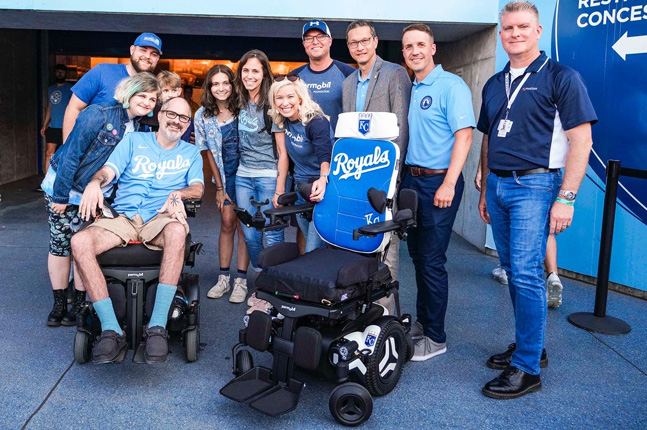
Phi Delta Theta and the Permobil Foundation presenting a custom Kansas City Royals wheelchair to a local fan living with ALS.
The first chair presentation occurred in 2021 at PNC Park, home of the Pittsburgh Pirates, and quickly expanded to additional MLB ballparks, including those of the Minnesota Twins and Chicago White Sox. Each year, Lou Gehrig Day continues to grow across MLB, creating more opportunities to honor Gehrig’s memory and bring ALS awareness to ballparks nationwide.
Honoring Brother Todd Nisbet
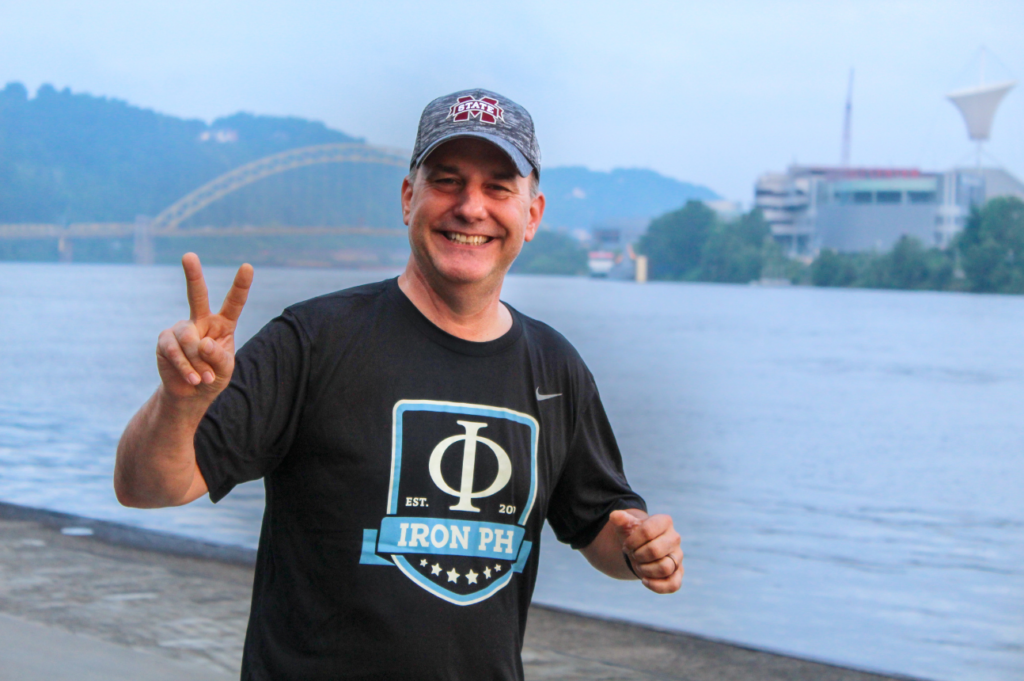
Todd Nisbet running in the Iron Phi 5K during the 83rd Biennial Convention in Pittsburgh, Pennsylvania.
The impact of this partnership is perhaps best seen through the life and legacy of Todd Nisbet, a Phi Delta Theta General Council member, and advocate in the fight against ALS.
Todd played a role in early conversations between Phi Delta Theta and the Permobil Foundation in 2020, where future collaborations were envisioned. His influence helped shape a partnership that now stands as a beacon of service and support for ALS families.
Todd was deeply connected to the Fraternity’s ALS initiatives long before his own diagnosis in 2022. He believed that a cure would come—if not in his lifetime, then for future generations, including his children Harry, Emma, and Virginia.
Todd passed away in June 2025, but ALS did not define him. Alongside his wife, Anita, Todd faced ALS with courage and grace for three years, inspiring all who knew him. His leadership, kindness, and vision embody both the values of Phi Delta Theta and the mission of Permobil. His legacy lives on through every ALS family served and every act of brotherhood extended in his honor.
A Lasting Tribute

Sean Wagner, Nat Love, and J. David Almacy join Todd’s wife Anita and their children Harry, Emma, and Virginia in front of the memorial tree they planted in his honor.
On September 30, 2025, Phi Delta Theta’s Executive Vice President and CEO Sean Wagner, General Council President Nat Love, and Past President of the General Council J. David Almacy joined Todd’s family to plant a memorial tree at the Nisbet family home in Nashville, Tennessee. The tree was first announced just days after the heartbreaking news of Todd’s passing, at the 85th General Convention in Atlanta, Georgia—an event Todd and his family had planned to attend.

While in Nashville, the Permobil Foundation hosted its Roll the Dice fundraiser at Nissan Stadium, a lively event featuring casino-style entertainment, auctions, and community celebration. During the evening program, Todd was honored in a tribute that highlighted the Fraternity’s commitment to the fight against ALS and the lives Todd touched through his leadership and service.
To further honor his legacy, a sister tree will be planted at Phi Delta Theta General Headquarters in Oxford, Ohio, on October 15, ensuring Todd’s example of courage, leadership, and service will remain a permanent part of the Fraternity’s story. In addition, permanent signage at Permobil will honor Todd and celebrate the enduring partnership between Phi Delta Theta and the Permobil Foundation, keeping his influence and vision alive for generations to come.

Carrying the Mission Forward
The partnership between Phi Delta Theta and the Permobil Foundation is more than a collaboration, it is a commitment to action. Rooted in the spirit of Lou Gehrig and carried forward by brothers like Todd Nisbet, this mission continues to bring independence, awareness, and hope to the ALS community.
Through shared dedication, Phi Delta Theta and the Permobil Foundation will continue to honor Lou Gehrig’s legacy, celebrate the strength of ALS warriors, and remind the world that brotherhood, service, and innovation can change lives.

The post Phi Delta Theta and Permobil Partnership in Action: Honoring Todd Nisbet appeared first on Phi Delta Theta.
]]>The post Letter to My Younger Self: Bob Cavanagh, Washington College ’00 appeared first on Phi Delta Theta.
]]>What I didn’t fully appreciate until much later was just how much Phi Delta Theta had shaped my path. My freshman year of college was tough! I was homesick, overwhelmed, and even considered dropping out. Thankfully, I was encouraged to stick it out, reminded how fortunate I was to be in college in the first place. When I returned sophomore year, I rushed Phi Delta Theta and found my people.
The camaraderie and support of my brothers carried me through the rest of my college experience. As someone with four older sisters and no biological brothers, I had always longed for that kind of brotherhood. Phi Delta Theta gave me that and more. The friendships and mentorship I found not only helped me survive those years but also laid the foundation for who I would become.
Nearly twenty-five years later, that sense of brotherhood has never faded. Life has scattered us in different directions, and I’ve lost touch with some, but the magic of Phi Delta Theta is that whenever we reconnect, it feels like no time has passed at all. That immediate connection, picking up where we left off, is something I treasure deeply.
The Fraternity has been more than social ties; it has been a lifeline. The advice, encouragement, and steady presence of brothers have helped me navigate challenges in ways I can’t imagine doing alone. For men who have never experienced fraternity life, I often wonder how they find that same level of support and camaraderie.
Fast forward to today, and I’ve found myself pulled back into fraternity life in ways I never expected. I recently began volunteering on the chapter advisory board to help reinstall New Jersey Alpha. As part of that role, I was invited to attend the General Convention, a gathering I’ve heard about but never taken seriously.
I decided, “Why not?” I had never been, and it seemed like a good opportunity to learn more. What I discovered surprised me: a vibrant, supportive, and deeply connected brotherhood that extended far beyond my chapter. Everyone I met was eager to connect, not because of business cards or résumés, but because of a simple, shared bond: we were brothers!
The Atlanta Convention in June 2025 was a revelation. I came away with new friendships, a deeper understanding of Phi Delta Theta’s reach, and a renewed sense of pride in being part of something much larger than myself. I only wish I had discovered this sooner.
Phi Delta Theta has always been there for me, even when I didn’t fully realize it. And now, nearly twenty-five years later, I find myself grateful not just for the past friendships but for the continuing opportunities to grow, serve, and connect through this extraordinary brotherhood.

Sincerely,
Bob Cavanagh
Washington College ’00
The post Letter to My Younger Self: Bob Cavanagh, Washington College ’00 appeared first on Phi Delta Theta.
]]>The post Major Trophy Winners 2025 appeared first on Phi Delta Theta.
]]>
Oxford Trophy–Colorado Gamma, Colorado State
In its one hundredth year, Colorado Gamma brought together over 180 brothers for its centennial celebration, honoring several generations of Phis. With a strong chapter GPA of 3.30 and recognition as an Iron Phi Chapter for the fourth consecutive year, Colorado Gamma continues to prioritize both academic and philanthropic excellence. This year, they raised more than $37,000 for charitable causes. Beyond the classroom and fundraising, Colorado Gamma is leading the way in wellness education. Through impactful partnerships with organizations like Mothers Against Drunk Driving, they’ve hosted workshops on substance use, mental health, and healthy sleep habits—empowering their members to live well-rounded, values-driven lives. We proudly congratulate Colorado Gamma on their remarkable year and their fourth win of the Oxford Trophy.

Housser Trophy–British Columbia Gamma, UBC Okanagan
For the second time, the British Columbia Gamma Chapter at UBC Okanagan is the winner of the George E. Housser Trophy. In just one year, they tripled their recruitment numbers, thereby strengthening their chapter and increasing their impact on campus. They also tackled financial challenges head-on, eliminating thousands of dollars in chapter debt. Their commitment to philanthropy stood out, raising hundreds of dollars for UBC Okanagan Health and Wellness to support men’s mental health initiatives. With a GPA of 3.32, these brothers have shown that academic excellence, fiscal responsibility, and purposeful growth can go hand in hand. Congratulations to British Columbia Gamma for winning the George E. Housser Trophy.

Founders Trophy–Ohio Epsilon, University of Akron
As the recipient for the Founders Trophy, the Ohio Epsilon Chapter at the University of Akron exemplifies what it means to lead with purpose. Over the past year, the chapter supported three ALS families, completed nearly 1,500 hours of community service, and earned Iron Phi Chapter recognition—demonstrating a commitment to philanthropy and impact. In celebration of their 150th anniversary, Ohio Epsilon welcomed more than two hundred alumni, friends, and family for a milestone event that honored their rich history across generations. With the highest GPA of any fraternity on campus, Ohio Epsilon continues to set the standard for academic excellence while building a legacy grounded in service, brotherhood, and leadership. Phi Delta Theta proudly recognizes Ohio Epsilon on its seventh major trophy win.

Kansas City Trophy–California Psi, Loyola Marymount University
California Psi at Loyola Marymount is redefining what it means to be a chapter of impact. This year, California Psi raised over $26,000 for different causes, including Iron Phi, the B+ Foundation, the Live Like Lou Foundation, and the LA Fire Relief. They were also recognized as a Triple Crown Chapter. California Psi saw an astounding 100 percent retention rate of new members, demonstrating the strength of their brotherhood and new member experience. This year, they strengthened their diversity, equity, and inclusion efforts and rebuilt vital relationships with university staff by hosting eighteen supported events on campus. With a GPA of 3.32, California Psi isn’t just leading, they’re inspiring their campus community. Congratulations to California Psi for winning the Kansas City Trophy!
The post Major Trophy Winners 2025 appeared first on Phi Delta Theta.
]]>The post Farewell to Debbie Smith, Accounts Receivable Specialist appeared first on Phi Delta Theta.
]]>Debbie joined the General Headquarters staff in 1991 as the chapter bookkeeper, and over the decades, she became an invaluable resource for chapters and members. As the accounts receivable specialist, she was the go-to person for everything from Bond Number errors and chapter accounting to processing credit card payments and ensuring GHQ points were accurately tracked through Phikeia and initiation reports, roster updates, and zero balances.
Beyond her professional contributions, Debbie has been cherished by her colleagues for her dedication to the mission of Phi Delta Theta. Her presence at General Headquarters will be deeply missed, but her legacy of service and care will carry on in the systems she helped maintain and the many people she supported throughout her tenure.
Phi Delta Theta is grateful for Debbie’s remarkable thirty-four years of service and wishes her the very best in her retirement.
The post Farewell to Debbie Smith, Accounts Receivable Specialist appeared first on Phi Delta Theta.
]]>The post Phi Delta Theta Inducts Chris Gilbert and Corby Robertson into Sports Hall of Fame appeared first on Phi Delta Theta.
]]>During the 2025 Kleberg Emerging Leaders institute, Phi Delta Theta had the honor of inducting two incredible individual into the Sports Hall of Fame. On the field, in business, and through decades of service, these two Texas Beta Phis have built a shared legacy that continues to shape lives across generations.
Chris Gilbert
Chris Gilbert, Texas ’69, one of the most decorated running backs in University of Texas history, rushed for more than 3,200 yards in just twenty-nine games and became the first player in NCAA history to post three consecutive 1,000-yard seasons. A three-time All-Southwest Conference selection, three-time team MVP, and 1968 consensus All-American, Gilbert also co-captained the Longhorns to a Southwest Conference title and finished eighth in Heisman Trophy voting that same year.
That summer, before his senior season, Gilbert partnered with teammate Corbin Robertson, Texas ’69, to co-found Camp Olympia, a summer camp designed to develop character and leadership in young people through sports and the outdoors. Starting with just eight cabins and eighty-nine campers, Camp Olympia has since grown into a nationally recognized program that has impacted more than 400,000 campers and counselors over its fifty-six year history.
Corbin Robertson
Robertson’s vision extended beyond the camp. He went on to create Whispering Pines Golf Club, consistently ranked among the top courses in the nation, and launched the Spirit Golf Association, which hosts world-class amateur competitions and supports philanthropic initiatives benefiting youth, education, and communities worldwide.
From the football field to the fairway, and from the boardroom to the campfire, Gilbert and Robertson have built a lasting legacy rooted in brotherhood, service, and the belief that sports can help shape lives for the better.
Phi Delta Theta is honored to recognize Chris Gilbert and Corbin J. Robertson Jr. as members of the Phi Delta Theta Sports Hall of Fame.
The post Phi Delta Theta Inducts Chris Gilbert and Corby Robertson into Sports Hall of Fame appeared first on Phi Delta Theta.
]]>The post Now Hiring: Accounting Manager appeared first on Phi Delta Theta.
]]>Who We Are
Phi Delta Theta Fraternity is an international nonprofit organization whose mission is to provide its members a lifetime experience that allows each member to reach their own personal greatness. Founded at Miami University in Oxford, Ohio, on December 26, 1848, Phi Delta Theta International Fraternity has 189 chapters and emerging chapters and ninety alumni clubs across the United States and Canada. To date, the Fraternity has initiated over 294,000 men into the society whose founding principles are Friendship, Sound Learning, and Rectitude.
We are a dynamic organization overseeing multiple entities with a strong commitment to operational excellence, financial integrity, and mission-driven outcomes.
Phi Delta Theta General Headquarters is Certified by Great Place To Work® in the United States. Within the walls of Phi Delta Theta’s General Headquarters, you can find a roster of individuals who care deeply for the Fraternity and spend their working hours helping to take Phi Delta Theta to new heights. Our family-like culture provides for a valuable work experience in many different areas within the Fraternity.
Who We Serve
Guided by our Cardinal Principles, we create transformational experiences for our members, volunteers, communities, and staff all in the pursuit of greatness.
Duties & Responsibilities
- Oversee day-to-day accounting operations including accounts payable, accounts receivable, and general ledger maintenance
- Assist with monthly, quarterly, and annual financial statements and reports
- Ensure compliance with nonprofit accounting standards and regulations
- Assist controller with annual audits and work closely with external auditors
- Implement and maintain internal controls and accounting procedures
- Support financial planning and analysis initiatives
Required Qualifications
- Bachelor’s degree in accounting, finance, or related field
- Minimum 5-7 years of progressive accounting experience
- Nonprofit organization experience strongly preferred
- Knowledge of GAAP and nonprofit accounting principles
- Proficiency in accounting software and Microsoft Excel
- Strong analytical and problem-solving skills
- Excellent written and verbal communication abilities
- Attention to detail and accuracy
- Ability to work independently and manage multiple priorities
What We Offer
- Salaried position with industry competitive compensation commensurate with experience.
- 100% employer-paid health plan, including vision and dental supplemental coverages, health reimbursement arrangements, short- and long-term disability, and life insurance.
- Meaningful 401k retirement plan with a 4% match and additional performance-based contributions.
- Flexible Paid Time Off Policy with additional paid time off for holidays, office closures at years end, and short- and long-term disability insurance, and life insurance plan options.
- Additional benefits include an employee wellness stipend, flexible workspaces, technology stipends with mobile phone plan reimbursements, staff events, and employee recognition programs.
- Hybrid work flexibility, allowing for optimal work-life balance while maintaining collaborative relationships with our team.
- Opportunity to work on a mission focused team and make a meaningful impact on a historic international organization with a 200,000+ membership base.
Work Environments and Physical Requirements
- This hybrid role follows a 3/2 schedule, with three days in the office and two days working remotely.
- Prolonged periods of sitting at a desk and working on a computer.
Application Process
Interested candidates should provide a résumé to Myra Duritsch.
The post Now Hiring: Accounting Manager appeared first on Phi Delta Theta.
]]>The post National Hazing Prevention Week is September 22-26, 2025 appeared first on Phi Delta Theta.
]]>
While hazing prevention is a year-round activity, this week brings awareness to the issues as students return to campuses and welcome new members to their chapters. Two dates that will forever shape the history of Phi Delta Theta are September 14, 2017, the day Max Gruver died due to fraternity hazing at the LSU chapter of Phi Delta Theta, and January 8, 2020, when the Max Gruver Foundation announced a partnership with Phi Delta Theta. Since Max’s death, Steve and Rae Ann Gruver have shared Max’s story with hundreds of college campuses and thousands of college students to prevent another tragedy and stop hazing. Collaborating with Phi Delta Theta, the Gruvers have decided that, with more than 15.1 million high school students at 23,000 high schools in the United States, anti-hazing conversations and education need to begin before students enter college. For this reason,Take Action was created.
Since this partnership, Phi Delta Theta has proudly joined in the fight against hazing through partnerships with the National Hazing Prevention Network and Anti-Hazing Coalition. In addition, Phi Delta Theta was present in the lobbying efforts to pass the Stop Campus Hazing Act, which was signed into law on December 24, 2024.
Phi Delta Theta has zero tolerance for hazing in our brotherhood. No part of Phi Delta Theta’s ritual, ceremonies, or new member process will ask members to do something that makes them feel unsafe. We ask all brothers to Be Their Brothers’ Keepers and take action in the fight against hazing. Below you will find resources and ways you can make a difference during National Hazing Prevention Week.

Hazing Prevention Network, formerly known as hazingprevention.org, is a nonprofit dedicated to empowering people to prevent hazing. Their goal is to educate people about the dangers of hazing, advocate for change, and engage the community in strategies to prevent hazing.
Webinars
Hazing Prevention Network has a series of webinars available for National Hazing Prevention Week. Plan to use the webinars in your National Hazing Prevention Week programming—either the live session or the recording that will be available afterwards to those who register. See complete list of webinars.
Education Resources
The Hazing Prevention Network is committed to sharing hazing prevention resources from partners.
Wear Purple to Bring Awareness
Your campus or organization can pick a day during NHPW (or the whole week) to wear purple to bring awareness to the issue of hazing.
Plan a social media campaign
This week is a great opportunity for your campus or organization to bring attention to the issue of hazing. National Hazing Prevention Network has put together social media graphics and posts to assist in your efforts.
Take the Pledge
As a part of your hazing prevention journey, we encourage you to Take the Pledge! In doing so, you make a commitment to raise awareness of hazing activities in your environment, take notice when a fellow or sister student is experiencing hazing, and don’t be afraid to say something! #BeTheLeader on your campus!
The post National Hazing Prevention Week is September 22-26, 2025 appeared first on Phi Delta Theta.
]]>The post Amplify Your Impact: Why IRAs and Donor-Advised Funds Are Powerful Tools for Giving to the Phi Delta Theta Foundation appeared first on Phi Delta Theta.
]]>IRA Charitable Giving: A Tax-Smart Solution
For donors aged 70½ or older, IRAs offer another powerful way to support the Phi Delta Theta Foundation. Through a Qualified Charitable Distribution (QCD), you can transfer up to $108,000 per year directly from your IRA to a qualified charity—tax-free.
Why Give Through Your IRA?
- Tax-Free Giving: QCDs are excluded from your taxable income, even if you don’t itemize deductions.
- Satisfy Required Minimum Distributions (RMDs): QCDs count toward your RMD, helping you avoid additional income tax.
- Maximize Your Impact: More of your money goes directly to the cause, not to taxes.
What Is a Donor-Advised Fund?
A Donor-Advised Fund (DAF) is a charitable giving account administered by a public charity, designed to help individuals, families, or organizations manage their donations efficiently. Think of a DAF as an investment account for philanthropy: you contribute cash, stocks, or other assets, receive an immediate tax deduction, and then recommend grants to nonprofits over time. Your investment grows tax-free, allowing you to make a lasting impact.
DAFs are on the rise—Fidelity Charitable alone distributed $11.8 billion in gifts through DAFs in 2023, an 18 percent increase over the previous year. The number of DAFs has nearly tripled in the past decade, making them the fastest-growing philanthropic vehicle in the US.
Why Use a DAF?
- Immediate Tax Deduction: Receive a tax deduction the year you contribute, even if you grant funds to charities later.
- Flexibility: Donate cash, stocks, mutual funds, bonds, or even complex assets.
- Anonymity and Simplicity: DAFs can offer privacy and reduce administrative burdens.
- Legacy Building: Create a lasting tradition of giving for your family.
- Financial Savvy: DAF donors are often strategic, leveraging assets for maximum impact.
Who Uses DAFs?
DAF donors are typically financially savvy individuals who value strategic planning and maximizing their philanthropic experience. The median DAF account balance is less than $20,000. Increasingly, younger generations are opening DAFs, making this a tool for donors of all ages.
Why Support the Phi Delta Theta Foundation?
The Phi Delta Theta Foundation is dedicated to strengthening men for life by building on the core values of Friendship, Sound Learning, and Rectitude. The Foundation grants over $1 million annually in scholarships, fellowships, and educational grants, supporting leadership development, health and safety initiatives, and member support through its ambitious Campaign 2030: A Greater Version for Tomorrow.
Your gift—whether through a DAF or IRA—helps sustain these programs and empowers future generations of Phi Delts to achieve personal greatness. The Foundation accepts contributions through DAFs, IRA rollovers, matching gifts, and estate planning arrangements, making it easy for you to choose the giving method that best fits your financial goals.
How to Get Started
The Phi Delta Theta Foundation is a 501(c)(3) organization with nonprofit status. Our Tax ID number is 34-6539803.
- IRA Charitable Rollover: If you’re 70½ or older, ask your IRA custodian to make a direct transfer to the Foundation. This satisfies your RMD and maximizes your tax benefits.
- DAF Giving: Contact your financial adviser or DAF provider to recommend a grant to the Phi Delta Theta Foundation. The process is simple and can be done online.
- Learn More: Contact the Director of Advancement, Brayden Hosman, at bhosman@phideltatheta.org or 513-280-6724 to discuss options in depth.
Make Your Legacy Count
By leveraging Individual Retirement Accounts (IRAs) and Donor-Advised Funds (DAFs), you can make a strategic, tax-efficient gift that supports the mission of Phi Delta Theta for years to come. Join thousands of donors who are building a greater version for tomorrow—your generosity will help shape the future of our brotherhood.
Ready to make your impact? Contact your adviser or the Phi Delta Theta Foundation today.
The post Amplify Your Impact: Why IRAs and Donor-Advised Funds Are Powerful Tools for Giving to the Phi Delta Theta Foundation appeared first on Phi Delta Theta.
]]>The post Veteran, Brother, Pitmaster: Using BBQ to Make a Difference appeared first on Phi Delta Theta.
]]>At the heart of Blue Suede BBQ is a mission to make a difference. Through his TAR HE4L East Carolina Vinegar Sauce, Loschiavo donates proceeds to the Live Like Lou Foundation, Phi Delta Theta’s partner in the fight against ALS. Each bottle sold helps fund research and provides support for families facing the disease. Chris has also used his brand to bring awareness to Little Groups of Paratroopers, Inc. and the Phi Delta Theta Foundation.

As a veteran-owned business, Blue Suede BBQ is built on discipline, tradition, and resilience. But at its core, it is driven by a Phi Delt’s commitment to do what ought to be done. “We aim to be ‘Difference Makers’ through the world of BBQ,” Loschiavo says. “That’s our mission, and it’s what keeps me going every day.”
“We aim to be ‘Difference Makers’ through the world of BBQ. That’s our mission, and it’s what keeps me going every day.”
Chris Loschiavo, Mississippi State ’05
Recently, Blue Suede BBQ participated in this year’s Pinehurst BBQ Festival in North Carolina, which was a huge success for the up-and-coming brand. Competing against some of the best in the BBQ business, Loschiavo’s Memphis-inspired recipes brought home first place in both the Mild Tomato BBQ Sauce and Dry Rub categories. They also debuted a Blue Suede BBQ food truck, a business leap that quickly became a popular feature and extension of the Blue Suede brand. Serving certified Angus brisket sandwiches, smoked wings, pulled pork, and more, the truck has become a popular feature at neighborhood gatherings, festivals, and events.


Their products are now featured at Provisions Ace Hardware in Whispering Pines, North Carolina, the largest Ace Hardware in the nation, and will soon be available in select Food Lion grocery stores. But for Loschiavo, each milestone is simply another opportunity to amplify his mission of service.

The post Veteran, Brother, Pitmaster: Using BBQ to Make a Difference appeared first on Phi Delta Theta.
]]>The post The Phi Delt Bowl: Rivals on the Field, Brothers in the Bond appeared first on Phi Delta Theta.
]]>
Not many Phi Delt chapters can say they make up most of a football roster, but at Centre College and Hanover College, their football teams are filled with members who proudly represent both their campus and Phi Delta Theta. The Kentucky Alpha-Delta Chapter at Centre College has forty-eight Phi Delts on its roster and coaching staff, while Indiana Epsilon at Hanover College is represented by thirty-eight brothers.
As it turned out, Phi Delta Theta’s General Council had already scheduled its fall meeting in Elizabethtown, Kentucky, the same weekend Centre hosted its season opener against Hanover. With Centre being located just an hour away, the timing couldn’t have been better for our General Council to cheer on these two Phi Delt-led teams. Rivals on the field but brothers in the bond, the Council and several General Headquarters staff members jumped at the chance to attend, playfully calling the event the Phi Delt Bowl.


The game itself didn’t disappoint. Hanover came in off an impressive 8–3 record in 2024 and started strong, marching down the field to take a 7–0 lead. But Centre came back in the second quarter, stringing together long drives behind quarterback Jack Gohmann, Centre ’26. Touchdown passes to Centre’s Carter Chandler, and Phis Blake Busson, ’26, and Dant Bowling, ’27, along with a short score from Jack Kennedy, ’26, gave the Colonels a 23–7 advantage.
The Panthers’ responded with several standout efforts. Quarterback Eian Roudebush, Hanover ’27, directed the Panthers’ offense. His dual-threat ability was on full display late in the game with a 17-yard scramble to the Centre 31-yard line, keeping Hanover’s hopes alive. Aidan Jochem, Hanover ’26, made a critical stop on Clint Sansbury, Centre ’27, limiting him to just a one-yard gain and forcing a long-yardage situation. Billy Blevins, Hanover ’26, kept pressure on Gohmann, containing him to a one-yard scramble on third down to force a punt.
Hanover wasn’t finished, clawing back late in the third quarter to cut the deficit to 23–15. But the Centre defense stood tall with a pair of interceptions by Trey Henson, Centre ’26 and Stephen Mack, along with key plays from Will Nichols, Centre ’27, to hold off the Panthers’ comeback attempt. With steady running from Tyler Blythe, Centre ’27, and clutch passes from Gohmann to Chandler, the Colonels closed out the win.
While Centre walked away with the 23–15 victory, the real highlight was seeing so many Phi Delts competing at a high level—and watching brothers and staff supporting them in the stands.

In 1967, Centre College Phis began a ritual of bringing a large portrait of alumnus Fred M. Vinson to football games to ensure Vinson never misses a game. It has continued for decades.
Brothers Playing for the Centre Colonels
James Atkinson – Defensive Lineman
Brennan Bareswilt – Linebacker
Nate Barnhardt – Linebacker
Tyler Blythe – Running Back
Dant Bowling – Wide Receiver
Adam Bowman – Offensive Line
Trace Bowman – Linebacker
Lex Breeden – Linebacker
Blake Busson – Wide Receiver
Jake Carrico – Wide Receiver
Jake Carson – Quarterback
Ollie Carter – Defensive Back
Thomas Cook – Linebacker
Ryan Combs – Defensive Back
Will Delorimier – Defensive Back
Chase Eary – Wide Reciever
Damon Edwards – Wide Reciever
Wyatt Fowler – Defensive Lineman
Kaden Gillespie – Linebacker
Jack Gohmann – Quarterback
Nick Grant – Cornerbacks Coach
Luke Hall – Defensive Lineman
Walker Hall – Running Back
Luke Hammons – Running Back
Evan Hamilton – Linebacker
Ty Hancock – Kicker
Nic Herakovic – Tight End
Trey Henson – Defensive Back
Jack Kennedy – Kicker
Porter Ledoyen – Linebacker
Ethan Mays – Tight End
Jack Mileham – Defensive Lineman
Jake Nash – Offensive Line
Will Nichols – Linebacker
Harris Phelps – Running Back
Clint Sansbury – Running Back
Brooks Sapone – Defensive Back
Thomas Seigler – Linebacker
Lucius Silverthorn – Defensive Back
Caleb Silvers – Long Snapper
Drew Stephenson – Tight End
Lane Sutherland – Defensive Lineman
Jakei Tarter – Tight End
Drew Vocke – Offensive Line
Adam Wicktom – Defensive Lineman
Landon Williams – Kicker
Davis Yates – Running Back
Will Zabel – Linebacker
Brothers Playing for the Hanover Panthers
Breckin Barbee – Wide Receiver
Trevon Bell – Defensive Line
Billy Blevins – Defensive Line
Cannon Brunes – Linebacker
Keetan Burcham-Jones – Defensive Line
Trent Cail – Running Back
Evan Chaney – Defensive Back
Zach Chalfin – Defensive Line
Brenden Clendening – Linebacker
Axel Conover – Defensive Back
Caleb Crutchfield – Defensive Back
Will Dejarnett – Defensive Back
Ethan French – Tight End
Matthew Griffin – Student Assistant – Tight Ends
Nick Hamilton – Quarterback
Ty Hancock – Offensive Line
Reed Hellman – Linebacker
David Holloway – Offensive Line
Zac Jacobs – Offensive Line
Quinn Jenkins – Defensive Back
Aidan Jochem – Linebacker
Scotty Johnson – Wide Receiver
Owen Kruse – Offensive Line
Will Kunselman – Assistant Coach Wide Receivers
Ben Lafferty – Defensive Line
George Marten – Defensive Back
Jett Massey – Defensive Line
Finn McCarthy – Linebacker
Carter Moberly – Defensive Line
Marjon Pickett – Defensive Back
Ben Purciful – Offensive Line
Quentin Richards – Wide Reciever
Eian Roudebush – Quarterback
Ashton Schuetter – Linebacker
Bryce Shepherd – Offensive Line
Sam Smith – Offensive Line Coach
Eli Tackett – Defensive Line
Aidan Troutman – Quarterback
The post The Phi Delt Bowl: Rivals on the Field, Brothers in the Bond appeared first on Phi Delta Theta.
]]>The post Volunteer Profile – Steve Finn, SMU ’80 appeared first on Phi Delta Theta.
]]>Why did you join Phi Delt, and how has it impacted your life and career?
I arrived at the campus of Southern Methodist University in the fall of 1976, and I knew nothing about Phi Delta Theta Fraternity. As I started meeting members from different houses, every time I met a member of Texas Delta, I walked away knowing that they were the best men on campus. Luckily, I received a bid to join our Fraternity and was initiated on April 20, 1977. Little did I know that during my time at SMU, I would be elected IFC president and then receive a job offer to start my lifelong career from a brother who had graduated from Vanderbilt University. I also didn’t realize, as an undergraduate member, that by signing The Bond, I was now a Phi Delt for life. I owe a great deal to the Fraternity, and I’ve been trying to pay it back through my gifts and service to our active members, including being a CAB member of Texas Delta since fall 2014, and then becoming province president of Rho North in spring 2021.

Who or what inspired you to become a volunteer?
In the spring of 2014, Texas Delta faced some serious issues with its members and the university. Four of my brothers—Tom Sabin, ’79, Kent Krause, ’79, Mike Bristol, ’77, and Charlie Carneal, ’73—stepped up and changed the chapter’s direction. I knew I wanted to be part of that, and I was asked to join the CAB later that fall. From that low point, the CAB and our undergraduates worked hard to foster a positive culture within the chapter. At the 2021 Pittsburgh Convention, Texas Delta received the Kansas City Trophy for the best chapter of its size nationwide. I feel very privileged to be part of that success. That same year, I was asked by the CAB to volunteer as the province president of Rho North. I also just completed my fourth year teaching at the Kleberg Leadership Institute, which has been a very rewarding experience for me, working with brothers from all over the country.

What would you tell someone who is considering volunteering for Phi Delta Theta?
Over half of my job as a volunteer involves simply showing up and letting the members know that I care about them and am there to serve and help them improve their chapter, grow their membership, and enhance their undergraduate experience by being a member of Phi Delta Theta.

The post Volunteer Profile – Steve Finn, SMU ’80 appeared first on Phi Delta Theta.
]]>The post Alumnus Profile – John Thompson, Mississippi State ’09 appeared first on Phi Delta Theta.
]]>How have you stayed connected with Phi Delta Theta after graduation?
Right after graduation, I had the privilege of working with the Phi Delta Theta Foundation as a development officer. That role connected me with Phi Delt on an international level and gave me the chance to meet so many more Phis, both younger and older. Today, I stay involved by volunteering for our chapter advisory board. But what really has kept me connected is the use of technology. I’m in a few different group texts with one being upward of thirty Phis. We also started doing video calls. Imagine twenty of your closest friends on one video call. It’s pure chaos. It’s also incredibly grounding to remain in such close fellowship with the men I share this lifelong bond with we call Phi Delta Theta.

Who from your fraternity experience inspired you? What experience has inspired you? Have you ever told them that?
It might be cliché to say that every Phi I’ve met has inspired me in some way, but it’s true. That said, if I had to single out one person, it would be Dana Juett of Texas Epsilon. Dana has since passed, so I never had the chance to tell him, but this is my way of acknowledging him. He was a special man. He was joyful, warmhearted, and sincere in a way that left a mark on me. I only met him a few times, but his presence was unforgettable as were his stories. Beyond that, it’s really the collective friendships and connections that have inspired me most. As men, we don’t vocalize this enough, but having a group of brothers to lean on through both the highs and lows of life has shaped me for the better.
What accomplishments or career milestones are you most proud of, and how do you attribute them to your Phi Delt experience?
I don’t live my life in pursuit of accomplishments for their own sake, so this is a hard question to answer. But I will say Phi Delt deserves credit for shaping the kind of example I strive to set. The Cardinal Principles have always resonated with me, and they continue to guide the way I try to live. In addition, the Fraternity’s commitment to developing leaders has left a lasting impression. I value that focus, because the qualities of a great leader are also the qualities that help you live a life of meaning and purpose.

Do you have advice for current students?
Fully enjoy your undergraduate fraternity experience. It’s something you’ll carry with you for the rest of your life, but don’t let it end there. Be intentional about staying connected. Seek out and meet other Phis outside your chapter, get involved where you can, and keep those bonds alive. Brotherhood is one of the most meaningful gifts Phi Delt gives you, and it only grows stronger when you nurture it.
The post Alumnus Profile – John Thompson, Mississippi State ’09 appeared first on Phi Delta Theta.
]]>The post Strengthening Brotherhood Through Family: How Family Clubs Are Making an Impact appeared first on Phi Delta Theta.
]]>Creating a Home Away From Home
The Nebraska Alpha family club has been an incredible partner to the chapter. They help coordinate meals for special events, deliver care packages during finals, and organize the annual senior dinner to celebrate graduating members and their families. Their involvement makes the chapter feel like a true home away from home.

Building Community at Indiana Gamma
The Indiana Gamma family club is one of our most engaged and consistent examples of family partnership. Families organize regular tailgates during football season, help coordinate meals for recruitment and special events and manage a care package program that ensures brothers feel supported throughout the year. Each spring, they also plan and host the senior dinner to celebrate graduating members and their families. Their dedication to building community and providing encouragement has created a culture of support that positively impacts every brother in the chapter.

Family Partnership at Texas Zeta
At Texas Zeta, the family club and undergraduate chapter have created an exceptional partnership defined by consistent communication through newsletters, planning meetings, and shared online platforms. This alignment positions the family club not as a separate group but as an essential fraternity partner. From coordinating meal support to organizing tailgates and events that strengthen brotherhood, their shared mission and mutual respect set a national example for holistic engagement. At Texas Zeta, family doesn’t stop at the front door, it’s an active force in every aspect of fraternity life.

Interested in Starting a Family Club?
If your chapter doesn’t have a family club, there’s never been a better time to start one. family clubs can take many forms—from informal volunteer groups to structured organizations with regular programming. No matter the size or style, their impact is undeniable.
Ready to Get Involved?
For resources, guides, and examples from other family clubs—or to learn how to start one—visit: phideltatheta.org/join/for-families
The post Strengthening Brotherhood Through Family: How Family Clubs Are Making an Impact appeared first on Phi Delta Theta.
]]>The post Corbin Robertson Honored with Nance-Millett Free Enterprise Award appeared first on Phi Delta Theta.
]]>Corby was initiated into Phi Delta Theta on March 26, 1966, by the Texas Beta Chapter at the University of Texas at Austin. A proud alumnus, he earned a bachelor of business administration through the university’s business honors program.
Corby is a renowned entrepreneur, philanthropist, and leader in the natural resources sector. He serves as the chief executive officer and chairman of Natural Resource Partners L.P., a master limited partnership that owns and manages coal, aggregate, and industrial mineral reserves throughout the United States. Through his leadership, the company has remained a dominant force in energy and mineral investment for decades.
In addition to his work with Natural Resource Partners L.P., Brother Robertson has played a guiding role in several resource-focused organizations, including serving as CEO of Quintana Minerals Corporation and directing Great Northern Properties and Western Pocahontas Properties. His business acumen has helped steward responsible management of over 14 million acres of mineral rights, contributing greatly to the energy industry and economic landscape.
Brother Robertson’s passion for people and education is equally remarkable. He is chairman of the Cullen Trust for Higher Education and has been a key supporter of institutions such as Baylor College of Medicine, the University of Houston, and his alma mater, the University of Texas. Alongside his wife Barbara, he founded the Barbara and Corbin J. Robertson Jr. Presidential Award for Excellence in Education, recognizing and uplifting faculty who demonstrate a transformative impact on student lives.
Brother Robertson has received numerous accolades throughout his career, including the Distinguished Alumnus Award from the University of Texas and the Outstanding Philanthropist Award from the Houston chapter of the Association of Fundraising Professionals. Yet those who know him best describe him as humble, generous, and deeply committed to building a better future through the values of free enterprise, education, and service.
In 2025, Robertson was honored with induction into the Phi Delta Theta Sports Hall of Fame, joining his lifelong friend and business partner, Chris Gilbert, UT Austin ’69, in recognition of Robertson’s lasting impact on the worlds of football and golf.
For his decades of innovation, leadership, and generosity—both in the boardroom and beyond—Phi Delta Theta International Fraternity is proud to honor Corby Robertson Jr. with the 2025 Nance-Millett Free Enterprise Award.
The post Corbin Robertson Honored with Nance-Millett Free Enterprise Award appeared first on Phi Delta Theta.
]]>The post Fall 2025: An Important Back-to-School Message from General Council President Nat J. Love appeared first on Phi Delta Theta.
]]>August is an exciting time for our great Fraternity. Colleges are back in session, students have new opportunities to learn and lead, and most importantly, we open our doors to the next generation of Phi Delts. A new wave of students are preparing to begin their collegiate journey. While the unfamiliar campus environment may bring some nerves as they adjust to life away from home, we have the opportunity to help them create a true home away from home.
As we welcome these first member classes of the new biennium, let us lead by example and demonstrate what it truly means to be a Phi Delt. To be our Brother’s Keeper—a brother who cares deeply and acts boldly to keep every brother safe.
Remember, true leadership is about making the right decisions, even when they are difficult. By prioritizing risk management, we ensure that Phi Delta Theta remains a place where values are lived daily, where brotherhood flourishes, and where futures are built on a foundation of respect and safety.
Twenty-Fifth Anniversary of Alcohol-Free Housing
In today’s world, risks come in many forms—from alcohol misuse and hazing to situations that threaten the physical or emotional safety of our members. Phi Delta Theta has taken a clear and unwavering stance: these dangers have no place in our organization. We are devoted to creating an environment where every brother can thrive without fear of harm or misconduct.
Speaking at our Semi-Centennial Convention in 1898, Robert Morrison urged us not to rest on past achievements but to, “guard against elation. Do not look at the past as a thing that should be satisfying; look at it only as something in general that was well done. Thank God for it but go and do something better.”
Our Fraternity has always embodied that spirit of striving for better. Twenty-five years ago, we were not satisfied with the risk management policies in place—particularly concerning alcohol in our chapter houses. While our membership was strong, our General Council knew we could do more to protect our brothers.
This year marks the twenty-fifth anniversary of one of the boldest decisions in the fraternal world. Many said it would be the end of Phi Delta Theta, but today, we are stronger, safer, and more than three times larger than we were back then.
Leaders like Dr. Robert B. Deloian, M. Scott Mietchen, Robert A. Biggs, and my fellow General Council member Tom Balzer, who was the coordinator of Alcohol-Free Housing, who championed this change and reminded us of Morrison’s challenge to guard against elation. In July 2000, Phi Delta Theta became the first Fraternity to implement an alcohol-free housing policy.
As we reflect on this milestone this school year, let it inspire us to continue pushing forward—to innovate, lead, and protect our brothers with the same courage and care. Phi Delta Theta continually strives to educate our members on ways to conduct chapter activities in a safe and responsible manner. Please review Phi Delta Theta’s risk management policies, which include the alcohol-free housing policy. As a member of Phi Delta Theta, you have a responsibility to uphold the values of our brotherhood. One of the most noble duties of membership is to look out for your fellow brothers. If you see certain members of your chapter engage in activities that are illegal or violate Fraternity policies, it is your responsibility to intervene and prevent them from occurring.
As a dad, I’m proud of this alcohol-free housing policy, and I know many other parents feel the same. These new members are someone’s son, new to campus and starting a big chapter in their lives, and it’s on us to keep them safe. Be your Brother’s Keeper!
Wishing you all the best this semester!
The post Fall 2025: An Important Back-to-School Message from General Council President Nat J. Love appeared first on Phi Delta Theta.
]]>The post Volunteer Profile – Kris Dudziak appeared first on Phi Delta Theta.
]]>
From left to right: Kris Dudziak, ’81, Fred Schultz, ’74, and Chris Aitken, ’04
Tell me about your undergraduate fraternity experience. Why did you choose Phi Delta Theta, and do you have any favorite memories you would like to share?
I joined Phi Delta Theta because of the guys I met at the chapter house and my wanting to better ‘belong’ at the university. I have many fond memories of my days as an active member. I held the positions of recruitment chair, house manager, social chair, and president. During my time at the Minnesota Beta Chapter at Minnesota State Mankato, we took part in many fundraising events for charity. We consistently won at events like the campus-wide Charity Carnival and organized several trampoline jump marathons, raising thousands of dollars for the American Cancer Society. In fact, Minnesota Beta was awarded the Paul C. Beam Trophy for one of the trampoline jump marathons.
How have you stayed connected with Phi Delta Theta after graduation?
As a member, I made many lifelong friends among fellow undergraduates and alumni. In fact, about twenty to twenty-five of us go fishing together every year, and we have been doing so for the past forty-six years! One of our great alumni, Doug Larson, ’69, inspired me as an undergrad. He was our province president at the time and gave the chapter several presentations. After one of them, he took me aside and encouraged me to run for chapter president and to always strive to reach my full potential.
Who or what inspired you to become a volunteer? What would you tell someone who is considering volunteering for Phi Delta Theta?
Fellow brother and Foundation Trustee Emeritus Fred Schultz, ’74, asked me to consider becoming a faculty member at Kleberg. My time there was an incredible experience; I led an outstanding group of undergraduates in the Alpha Eta chapter and had an amazing peer mentor, Brysen Morgan. I encourage alumni to volunteer for Kleberg and to actively participate in their local area chapters; volunteering is reenergizing! As the leader of our First Thursday with the Phis get-togethers, it’s rewarding to reconnect with Phi Delt brothers from my chapter and to meet and get to know Phis from other chapters as well.

Kris Dudziak with the Alpha Eta Chapter of Phi Delta Theta during the 2025 Kleberg Emerging Leaders Institute. Peer mentor Brysen Morgan pictured holding the flag, Kris is behind him on the left.
I have used this part of the Phikeia Oath to guide me throughout my business career and would advise our current undergraduates to take it to heart:
“Not only not less, but greater than transmitted to me.”—The Phikeia Oath
By doing so in all his endeavors, a man can truly become the greatest version of himself.
The post Volunteer Profile – Kris Dudziak appeared first on Phi Delta Theta.
]]>The post Undergraduate Profile – Brysen Morgan, Rogers State ’26 appeared first on Phi Delta Theta.
]]>
Brysen Morgan (second row, center in red) with the peer mentors and the General Council of Phi Delta Theta at the 2025 Kleberg Emerging Leaders Institute.
Who’s a Phi you’d like to thank?
Isaiah Dowdican, ’26. Isaiah is the student body vice president and right-hand man. He is a constant source of encouragement, honest feedback, and sound judgment. His support has pushed me to be a better leader and a better brother. I’m grateful to have someone in my corner who truly embodies the values of Phi Delta Theta.
How has your leadership style adapted while in college and Phi Delta Theta?
Ever since joining Phi Delta Theta and being elected student body president during my time at Rogers State, my leadership style has evolved into one rooted in servant leadership. I’ve learned the most effective way to lead groups, people, projects, or processes is by putting others first and leading by example. When you listen to their needs, empower them to succeed, and search and create opportunities for them to grow, you build trust and inspire those around you to give their best.

Brysen Morgan with the Alpha Eta Chapter of Phi Delta Theta during the 2025 Kleberg Emerging Leaders Institute.
Where do you see yourself in five or ten years?
When I was a freshman, my answer would have been simple: working for a corporation, managing teams, and leading them to success. I have always admired the corporate lifestyle and the energy of an office environment, and I still do. I would love to start in a company and work my way into a management role. Over time, my vision has evolved. In five years, I see myself serving the Oklahoma communities of Claremore, Tulsa, or Inola, possibly on the city council or in another role where I can create real change and strengthen the place I call home. In ten years, my dream is to run for office as a representative for one of these areas, working on legislation that improves the lives of those in my community.
Joining a fraternity is a lifelong commitment. How do you plan on keeping Phi Delta Theta in your life after graduation?
I plan to keep Phi Delta Theta in my life by staying connected with my brothers and continuing to build those relationships long after college. Brotherhood does not end at graduation, and I want to be intentional about staying in touch and supporting one another as we navigate life and careers. I also plan to stay involved with General Headquarters, whether that means volunteering at events, mentoring younger Phis, or finding ways to give back to the organization that has given me so much.
The post Undergraduate Profile – Brysen Morgan, Rogers State ’26 appeared first on Phi Delta Theta.
]]>The post Now Hiring: Advancement Officer, Phi Delta Theta Foundation appeared first on Phi Delta Theta.
]]>This position identifies, qualifies, cultivates, solicits, and stewards gifts of $25,000 and above from alumni, parents, and friends of Phi Delta Theta. They will also be responsible for the Annual Fund Trustees’ Roundtable Society and Living Bond Society growth among loyal Annual Fund donors.
Who We Are
Phi Delta Theta Fraternity is an international nonprofit organization whose mission is to provide its members a lifetime experience that allows each member to reach their own personal greatness. Founded at Miami University in Oxford, Ohio, on December 26, 1848, Phi Delta Theta International Fraternity has 189 chapters and emerging chapters and ninety alumni clubs across the United States and Canada. To date, the Fraternity has initiated over 294,000 men into the society whose founding principles are Friendship, Sound Learning, and Rectitude.
We are a dynamic organization overseeing multiple entities with a strong commitment to operational excellence, financial integrity, and mission-driven outcomes.
Who We Serve
Guided by our Cardinal Principles, we create transformational experiences for our members, volunteers, communities, and staff all in the pursuit of greatness.
Duties & Responsibilities
- Manage a portfolio of 140–150 primary prospects, introducing them to giving opportunities with the Foundation.
- Solicit gifts of $25,000 and above.
- Participate in all aspects of the gift cycle:
- Initiate contact with at least 120 potential leadership and major gift donors annually.
- Develop tailored cultivation strategies, collaborating with organizational volunteers and Foundation Trustees.
- Move potential donors toward solicitation and closure in an appropriate and timely manner.
- Maintain stewardship contacts with donors to ensure ongoing engagement.
- Focus on securing support for Fraternity educational programs and scholarships.
- Monitor all prospect interactions to ensure positive, purposeful donor relations.
- Plan and participate in alumni cultivation, solicitation, and stewardship events, both in partnership with alumni clubs and through special Foundation-sponsored events.
- Support and participate in Phi Delta Theta’s major conferences and other Foundation-supported meetings.
- Assist in developing articles for The Scroll (alumni magazine) and other communication platforms that promote the Foundation’s mission and activities.
- Contribute to the execution of all approved programs, projects, and functions of the Foundation staff.
- Participate in professional and interfraternal conferences and workshops (FFE, AFP, CASE) relevant to Foundation activities.
Qualifications
- Education & Experience: Bachelor’s degree preferred; professional experience in relationship building, alumni relations, or fundraising strongly desired.
- Skills:
- Excellent organizational, written, oral, and interpersonal skills.
- Demonstrated initiative, innovation, and ability to plan, measure, and achieve specific goals.
- Superior people skills, including tact, diplomacy, sophistication, curiosity, and confidentiality.
- Personal Attributes:
- Commitment to the highest ethical standards.
- Empathetic disposition and perseverance in work.
- Optimistic and positive attitude.
- Other Requirements:
- Willingness to travel frequently, including nights and weekends.
- Valid driver’s license and satisfactory driving record.
What We Offer
- Opportunity to work on a mission focused team and make a meaningful impact on a historic international organization with a 200,000+ membership base.
- Salaried position with industry competitive compensation commensurate with experience.
- 100% employer-paid health plan, including vision and dental supplemental coverages, health reimbursement arrangements, short- and long-term disability, and life insurance.
- Meaningful 401k retirement plan with a 4% match and additional performance-based contributions.
- Flexible Paid Time Off Policy with additional paid time off for holidays, office closures at years end, and short- and long-term disability insurance, and life insurance plan options.
- Additional benefits include an employee wellness stipend, flexible workspaces, technology stipends with mobile phone plan reimbursements, staff events, and employee recognition programs.
- Hybrid work flexibility, allowing for optimal work-life balance while maintaining collaborative relationships with our team.
Work Environments and Physical Requirements
Stamina to travel as needed in addition to prolonged periods of sitting at a desk and working on a computer.
Application Process
Interested candidates should provide a résumé, writing samples, and references to Myra Duritsch by September 30, 2025.
The post Now Hiring: Advancement Officer, Phi Delta Theta Foundation appeared first on Phi Delta Theta.
]]>The post Join Us in Arlington on September 8 for an ALS Awareness Game with the Rangers appeared first on Phi Delta Theta.
]]>A ticket block has been reserved in Section 101, and tickets cost $34. This event is open to the public, so please invite your friends and family! Tickets are sold at face value.
All tickets for our block must be pre-purchased through the ticket link below and will not be sold at the gate/event. Any questions can be sent to Laura Peterson at lpeterson@livelikelou.org.
Purchase Tickets

The post Join Us in Arlington on September 8 for an ALS Awareness Game with the Rangers appeared first on Phi Delta Theta.
]]>