The post Fall 2025: An Important Back-to-School Message from General Council President Nat J. Love appeared first on Phi Delta Theta.
]]>August is an exciting time for our great Fraternity. Colleges are back in session, students have new opportunities to learn and lead, and most importantly, we open our doors to the next generation of Phi Delts. A new wave of students are preparing to begin their collegiate journey. While the unfamiliar campus environment may bring some nerves as they adjust to life away from home, we have the opportunity to help them create a true home away from home.
As we welcome these first member classes of the new biennium, let us lead by example and demonstrate what it truly means to be a Phi Delt. To be our Brother’s Keeper—a brother who cares deeply and acts boldly to keep every brother safe.
Remember, true leadership is about making the right decisions, even when they are difficult. By prioritizing risk management, we ensure that Phi Delta Theta remains a place where values are lived daily, where brotherhood flourishes, and where futures are built on a foundation of respect and safety.
Twenty-Fifth Anniversary of Alcohol-Free Housing
In today’s world, risks come in many forms—from alcohol misuse and hazing to situations that threaten the physical or emotional safety of our members. Phi Delta Theta has taken a clear and unwavering stance: these dangers have no place in our organization. We are devoted to creating an environment where every brother can thrive without fear of harm or misconduct.
Speaking at our Semi-Centennial Convention in 1898, Robert Morrison urged us not to rest on past achievements but to, “guard against elation. Do not look at the past as a thing that should be satisfying; look at it only as something in general that was well done. Thank God for it but go and do something better.”
Our Fraternity has always embodied that spirit of striving for better. Twenty-five years ago, we were not satisfied with the risk management policies in place—particularly concerning alcohol in our chapter houses. While our membership was strong, our General Council knew we could do more to protect our brothers.
This year marks the twenty-fifth anniversary of one of the boldest decisions in the fraternal world. Many said it would be the end of Phi Delta Theta, but today, we are stronger, safer, and more than three times larger than we were back then.
Leaders like Dr. Robert B. Deloian, M. Scott Mietchen, Robert A. Biggs, and my fellow General Council member Tom Balzer, who was the coordinator of Alcohol-Free Housing, who championed this change and reminded us of Morrison’s challenge to guard against elation. In July 2000, Phi Delta Theta became the first Fraternity to implement an alcohol-free housing policy.
As we reflect on this milestone this school year, let it inspire us to continue pushing forward—to innovate, lead, and protect our brothers with the same courage and care. Phi Delta Theta continually strives to educate our members on ways to conduct chapter activities in a safe and responsible manner. Please review Phi Delta Theta’s risk management policies, which include the alcohol-free housing policy. As a member of Phi Delta Theta, you have a responsibility to uphold the values of our brotherhood. One of the most noble duties of membership is to look out for your fellow brothers. If you see certain members of your chapter engage in activities that are illegal or violate Fraternity policies, it is your responsibility to intervene and prevent them from occurring.
As a dad, I’m proud of this alcohol-free housing policy, and I know many other parents feel the same. These new members are someone’s son, new to campus and starting a big chapter in their lives, and it’s on us to keep them safe. Be your Brother’s Keeper!
Wishing you all the best this semester!

The post Fall 2025: An Important Back-to-School Message from General Council President Nat J. Love appeared first on Phi Delta Theta.
]]>The post We Are Phi Delt – Defining Who We Are As Fraternity Men appeared first on Phi Delta Theta.
]]>The past year taught us much about ourselves as individuals, as a society, and as Phi Delta Theta. A socially distanced fraternity experience caused both undergraduate and alumni leaders to be resilient, creative, and most importantly, to focus on what is most critical.
When you strip the superfluous aspects away, at its core, the Phi Delt experience has always been about two things throughout its long history. First, the desire to help each other meet our full potential, and second, to impact the community that surrounds us.
As the world continues to reopen and campuses work to energize the college experience once again this fall, Phi Delta Theta has an immense opportunity to re-introduce itself in a proud, visible, and responsible way. With this renewed focus as campus leaders, Phi Delts have the chance to redefine what it means to be a fraternity man and be the example as responsible advocates for their campus communities.
So, as we ramp up for the start of the school year, the General Fraternity is prepared to assist our chapters and volunteers in taking full advantage of this moment and further etching our rightful place as the premier fraternal leadership development society. But as we do this together, we must be thoughtful of who we are as Phi Delts.
This happens in many forms to resist the status quo. We are committed to ensuring that every Phi can contribute to our great brotherhood while working to become the greatest version of himself. This occurs through the chapter leadership experience as a foundation and continues through the Pursuit of Greatness, our credentialed membership development program. The program features a personal and professional development badge as it helps participants build the interpersonal skills and career attributes desired by employers.
We are also committed to lifting others around us and broadening our perspective. Meeting this goal will happen this year, focusing on first-generation recruitment and diversity and inclusion education at the chapter level. We have this fantastic experience that helps make good men great and improves their trajectory. Now, we’ll intentionally broaden access to this experience.
The adage “failing to plan is planning to fail” is true. This is especially the case when many talented undergraduate leaders preparing for the upcoming, in-person academic year have mostly had a virtual experience thus far in their Phi Delt career.
General Headquarters hosted the Summer Leadership Series from August 9–12, 2021, focusing on operations, health and safety, and growth. This conference provided chapter and volunteer leaders a chance to restore and improve the “nuts and bolts” of chapter operations and safely plan social events as our members reconnect with one another and the rest of their campus.
What does a family do? Takes care of one another. Fraternity historically does not occur at a distance, and the inability to connect with one another and the world rapidly took its toll on our members. For this reason, we’re creating a six-point personal wellness program to help Phis proactively address their mental health and find professional assistance if needed.
While we have a significant focus on planning for the known, the skill set of knowing what to do when the unknown occurs is just as critical. The Fraternity’s bystander education program, To Do What Ought to Be Done, will be further used and implemented to ensure Phis know what to do and how to find assistance in episodes of alcohol or drug abuse, hazing, mental health, or sexual assault.
Every Phi Delt is first and foremost a student at their institution, and through their commitment to the Fraternity, takes an oath to better themselves through Sound Learning. This journey starts as a Phikeia through the Fraternity’s standardized new member program that emphasizes initiative, responsibility, teamwork, and accountability. It then builds into the Pursuit of Greatness program and various modules and offerings for officers through PDT U, our online education platform.
While we’ve all enjoyed online education for expanding our ability to educate, we’re looking forward to the return of our hallmark educational programs with an in-person 2022 McKenzie Family Presidents Leadership Conference, January 6-9 and the largest Kleberg Emerging Leaders Institute to-date next summer, July 30-August 2.
When colleges and universities were uncertain of how many students would return in the fall of 2020 and how they would engage students in new ways, they looked to fraternities and sororities. Phi Delta Theta responded in a big way, with 98 percent of its enrolled members returning to its host institutions.
Continuing as champions for their schools and providing an experience that not only retains current students but attracts new ones, Phi Delta Theta offers a strong value proposition focused on principles, engagement, and leadership. To help chapters communicate and share this value proposition on their campuses, the General Headquarters will host a number of Recruitment Workshops throughout the year and offer coaching assistance to those who were significantly impacted by COVID-19 and have large graduating classes in the upcoming two years.
One of the most impressive feats that occurred during the 2020–21 academic year was the success of the Iron Phi program. The program had its best fundraising year of all time, and LiveLikeLou rallied more volunteers to support ALS families than ever before. Phi Delts from around the United States and Canada found purpose in supporting a cause greater than themselves—to battle ALS and support the ALS warriors facing it.
This June, we had the opportunity to create awareness and advocacy for ALS and join forces with other ALS organizations for the inaugural Lou Gehrig Day throughout Major League Baseball. This special day will provide momentum for our cause and bring funding towards research and the support of ALS families. As fraternity is redefined, it will be measured by the impact we make on the world, and Phi Delta Theta is poised to help end ALS.
Phi Delta Theta is very proud of who we are, what we offer, and the impact that we make on the world. As we approach the 2021–22 academic year, we hope you will help us lead the way and show the world that We Are Phi Delt.
Phi Delt chapters – Click here to download and utilize our We Are Phi Delt brand assets and social media toolkit to help us share the message this year.
The post We Are Phi Delt – Defining Who We Are As Fraternity Men appeared first on Phi Delta Theta.
]]>The post An Important Back-to-School Message from General Council President Moe Stephens appeared first on Phi Delta Theta.
]]>As a kid, I looked forward to seeing who my teacher was going to be and whether that teacher would have a reward drawer filled with candy.
As a high school kid of Asian descent in a Midwestern Indiana farm town, I experienced the oft-felt anxiety and fear of rejection. However, sports teams, teammates, and coaches were key to helping me navigate those years.
In college, going back to school meant gathering the boys for the first chapter meeting of the year, recruitment barbecues, and wondering which classes I could blow off and still get an A and which ones I would need to focus on and eke out a B.
In my role at the University of Puget Sound, we spend all summer preparing for the next academic year and do everything we can to help first-year students assimilate and encourage the more seasoned students to help those new faces on the campus.
As a Phi Delt volunteer, I’ve assisted chapters with officer transitions, recruitment, retention, and event planning, all part of the fall experience on a college campus with Greek life. Seeing everyone proudly wearing their letters demonstrates the value of the camaraderie of small, tight knit, organized groups.
As president of the Fraternity’s General Council, I feel nostalgic as we head into this 2022-23 school year, hopeful that the worst of the COVID pandemic is behind us. Even though there were many discouraging aspects of the coronavirus restrictions, as we reflect, it is becoming apparent that there were many positive outcomes because of how the constraints forced us to think differently.
To mention a few, we enhanced our online educational resources to include credentials our men can use during their job searches, demonstrating mastered leadership skills. In addition, there are now online methods for our conferences and special events to virtually include many more undergraduates and alumni. And finally, we’ve seen our undergraduate leaders and alumni try new and innovative ways to engage their brothers and the community. It’s truly been amazing to watch how our organization has thrived under this pressure.
This school year will bring us many new brothers, all having had their high school experiences vastly impacted by the pandemic and hopeful for a unique and wonderful experience on campus. I encourage you, our undergraduate members and leaders, to remember what it is like to be new. Seek opportunities to make these first days on campus full of encouragement, find ways to make a younger student more comfortable, and demonstrate by example what it means to be a Phi. Recruitment doesn’t have to be complicated. It can start with a hello and lead to a lifetime of friendship. The brotherhood and friendship extended to new students the minute you hand them bid cards should come without conditions. At that point, it becomes our job to bring out the best in them and do so in a way that brings honor to the values we all pledged ourselves to live out in our daily lives.
Best of luck to all of you as we begin another year full of promise. I look forward to hearing of your successes, and as always, I am proud to be a Phi!
Moe Stephens II, Southern Indiana ’99
General Council President 2021–23
The post An Important Back-to-School Message from General Council President Moe Stephens appeared first on Phi Delta Theta.
]]>The post A Bit of Optimism in a Mad World appeared first on Phi Delta Theta.
]]>To say that this year has been a wild ride compared to previous years is like comparing the differences between riding a wooden roller coaster to launching into space. This year has been shaky, jarring, uncertain, tense, and at times overwhelming. Sometimes it just feels like the world has gone mad. Since February, the twists and turns, such as changing campus and community policies, recommendations for masks, quarantines, and daily life has been turned upside down. Let us not forget the Great Toilet Paper Shortage of 2020.
I doubt many people will look back and call these very happy times as this year has highlighted the separations between ourselves and our fellow humans instead of our commonalities. The marquee events of our semester that bring us together have largely been placed on hold or fundamentally changed, such as homecoming, graduations, philanthropy events, mixers, Founders Day, province retreats, and our leadership conferences. I never thought I would attend a friend’s graduation wedding via Zoom, but it was a great excuse to wear a tie and bathrobe to a wedding.
For me personally, the events that generally recharge my passion for Phi Delt as a volunteer, create space for self-care, reconnect me with brothers that have become some of my closest friends, and my opportunity to interact with our remarkable undergrads at conferences and retreats, have unfortunately been substituted by Zoom meeting, emails, and the occasional phone call. For many of us, this has been a tough time and an adjustment for which none of us were prepared. It has not been fun for me, and I imagine many of you are experiencing similar feelings towards the current state of things. However, as I learned from my time as a wrestler and offensive lineman, sometimes we just have to embrace the suck and find the opportunities that these challenges present us.
Despite many of us feeling down, cheated, or just less enthusiastic, there are ways to learn, grow, and connect with the foundation of our fraternal experience; connecting with others. I am fortunate enough to have several close friends in the Province President Corps that I speak to often. We often discuss our chapters, our concerns for when “normal” will come back, and how current events impact our undergrads’ experience within our provinces. We share successes, challenges, and the occasional venting session as good old alumni will do. I cannot emphasize enough that those of us who volunteer for this brotherhood feel immense pride in what you do in your chapters, on your campuses, and in your communities. I know this is a little tangential, but I don’t think we share that fact enough with all of you.
There are brothers who I see at our educational conferences, and that routine has been largely disrupted. It feels like decades since I last saw them, was able to sit, catch up on our lives, and discuss the current state of the Fraternity, and our hopes for the future. Quite honestly, I have taken many of these relationships and opportunities to see these brothers for granted over the last nine years as a volunteer.
So what does COVID-19 present as an opportunity?
Right now, how we fundamentally build and maintain relationships and our connections to others has been blasted into pieces. Some of the ways that we are most comfortable interacting, such as social gatherings, face-to-face contacts, and events are largely limited or unavailable. But, we do not need to let the distance between us define how we live our life in The Bond. The opportunity now is to experiment with the ways that we connect with others, including our brothers, alumni, Phikieas, and potential new members. Our connection with others at this time serves several purposes, the most important of which is that it is okay to connect with one another, even if it isn’t perfect, and it’s an opportunity to reconnect and re-engage brothers we may have not spoken to in years. If we did fraternity right, the time between these contacts don’t matter as much because the strength of the connections are so powerful, resilient, and ever impactful to our own mental health and the health of others.
The ways we have communicated and kept in touch have changed, but that doesn’t mean that it is any less in quality, even if it feels a little different. I have been on several Zoom hangouts with brothers since April, and it has been refreshing to reconnect with some that I haven’t seen or spoken to in years. We have hosted hangouts to just check in with one another, planned for a bachelor party and wedding, and even held our own homecoming of sorts. Where normally would text once in a while, we now call each other to chat more often. The connections we have been reinvigorating has been helpful to all of us keeping our spirits bright during these tough times. I am lucky enough to have one chapter brother that calls me nearly every Sunday, and we chat about what meat he is grilling or smoking that day, how everyone else is doing, and try to coordinate when we will see one another next. I cannot emphasize enough that the time invested during undergrad with our brothers pays dividends for the rest of our lives. During some of the worst parts of stay-at-home orders, quarantines, increasing spikes in Covid-19 cases, having the outlet to connect with my brothers has kept me in a better place.
Our connections to others is a major part of what it is to be human, and is a core component of our Fraternity. So our opportunity now is to leverage technology and continue to invest in our fraternal experiences. Use this time to try new ways of connecting with brothers, alumni, Phikeias, and potential new members. Some of your advisors and province presidents may have ideas on how to keep connected with your members, but others may not know how to advise you on how to stay connected due to lack of familiarity, and both are okay as we can’t be masters of everything. As a chapter, hold meetings that include those that are off campus this semester. Continue to find ways to bring even small groups together, such as around a fire pit, a weekly dinner, or even just meeting between classes on campus. Create traditions that the chapter may adopt for years to come that add to our value proposition. Breakaway from practices that are antiquated, don’t move the chapter forward, or leave us behind because we are resistant to challenge the process during these uncertain times. Engage new groups of potential new members, recruit through friend groups, and take multiple new member classes in a semester that are smaller, but fully engaged in not only the Phikeia process, but then remain invested in being active and engaged brothers. Recruit quality members that want to be the change in your chapter because holding onto “how things have always been done.”
If your chapter has struggled to put out an alumni newsletter, try it now with fresh eyes and new ideas. I believe I speak for most alumni when I say that we care much less about you winning intramural championships, but more on how you and the chapter is doing, what you are learning throughout this difficult and uncertain time, and how we can help as alumni. Use the resources available to engage alumni that you haven’t for a long time. Have a meeting with the Phikeias and have an alumni join via video and speak with the new class. Tell the alumni of some of the struggles and how you have tried to address them during Covid-19, as maybe some of us have ways to support or ideas of how to address what is going on in the chapter. Use the fund-raising tools provided by GHQ to help pay for new member dues or help brothers that were unable to pay their dues because of not having a summer job. We want you to become the greatest version of yourself, support you through the process, and assist where we can.
During these trying times, investing and engaging in our brotherhood could not be more important for our own growth and the betterment of our chapters. By trying new ways of connecting with one another, we can provide support for one another, create new ways of engaging undergrad and alumni members, and pave the way for how our chapters operate in the future. As we try new ways of connecting, please know that it will never be perfect from the start, your ideas may need to be retooled or redone, and it is the process that is more important than the final product. Engage in behaviors and activities that create the positive change that makes the human experience so awesome, fulfilling, and ever changing. We are all human, and brothers, and we each are perfectly imperfect, but it is what we do despite the challenges of this year and next that will truly define our character, our growth, and our connections with others. If nothing else during the trying times, reach out and connect with others, because you never know how just a simple phone call, text, email, snapchat, or any other form of communication could make someone’s day.
The post A Bit of Optimism in a Mad World appeared first on Phi Delta Theta.
]]>The post Sound Learning Through Education, Listening, and Being Uncomfortable appeared first on Phi Delta Theta.
]]>As someone who works on diversity, equity, and inclusion initiatives professionally every day, I have been asked more than I ever thought I would about my opinions and thoughts on the recent election and how it relates to the racial and gender issues facing the United States. For those who know me well, they would say, “Great, Deray loves to share his opinion.” In this particular case, I have a lot to say, not just because of what I do professionally, but because of who I am. I’m a Middle-Eastern/North African descent American, born of an immigrant and a Daughter of the American Revolution; I was raised in a household where Christian, Jewish, and Islamic traditions were practiced, expressed, and welcomed; I am a southerner, brought up in the low country of Georgia. All those identities makeup who I am and offer personal insight into many of the diverging viewpoints of today.
I also find myself, probably for the first time in my life, remembering the words of George Washington. Again, to those who know me, that is an oddity; for when it comes to history, I am a proud medievalist and tend to flee from topics that occurred after the fourteenth century. However, I now realize we are at a moment in US history where Washington’s farewell words should be brought back to the collective mind:
“The alternate domination of one faction over another, sharpened by the spirit of revenge, natural to party dissension, which in different ages and countries has perpetrated the most horrid enormities, is itself a frightful despotism.” (Washington, Farewell Address, 1796)
Washington spoke then of the dangers of a two-party system, and I fear we did not heed his warning. We are now at a moment where it seems that US citizens are quick to draw their lines. While I stand for knowing, speaking, and fighting for what you believe and being as politically and socially active as any person wants, needs, or is called to be, I am still first and foremost a proponent of educated and informed actions.
As you may know, Phi Delta Theta is founded on three Cardinal Principles—Friendship, Sound Learning, and Rectitude—and I have come to realize for many sound learning has become a simple statement of academic pursuit for collegiate males, in favor of privileging friendship and rectitude. I think it is time we return to sound learning. For through sound learning we make our truest of friendships and amalgamate reason and empathy within our integrity, our rectitude.
There are many issues facing the US at this moment, beyond the fractured nature of our society due to this two-party system. Even more than healthcare or the environment, it seems that conversations around immigration, racism, criminal justice, and LGBTQ+ issues are the more impassioned conversations in the circles I traverse. What I wish for most is that people would educate themselves on these issues, beyond relying on party politics or the dominant media coverage/cycles. Really study an issue, listen to the people that live or experience the issue, and then have a conversation—really have a conversation—where both sides ponder together not to win an argument or dominate another’s thoughts or opinions, but have a real dialogue. A conversation where both parties/positions not only speak but really listen to the other.
Let us not fall into the factional society Washington warned against. Let us continue to be able to have conversations together. It is every person’s job to educate themselves on the facts and listen to those who have experiential/lived knowledge to help inform your opinion or stance on a particular issue.
I know these conversations and topics can be and often are uncomfortable; however, that’s a good thing. Welcome the uncomfortable; we often grow and learn more about ourselves when we grow from a place of discomfort. When you are uncomfortable, the person(s) you are in a conversation with are probably uncomfortable too. Because you both experience discomfort together and you already have something in common. By working/speaking through the uncomfortable, hopefully you will be able to come to a deeper understanding. Though it might not change either side’s opinions, you can walk away knowing that you educated yourself on a topic, took the time to listen to someone else’s point of view, and talked through both your thoughts and feelings. Whether you agree or disagree, you have respected and honored each other, and you can end the conversation in a good place.
I truly believe if we as a brotherhood return to sound learning by educating ourselves, really listening, and at times live uncomfortably, we will not only see that we can transcend party lines and politics, but that we can have real dialogue and conversations as brothers. Let’s not fall into the trap Washington warned us about, let’s embrace and exemplify the second cardinal principle of sound learning as envisioned by the Immortal Six. So that we can continue to grow together and push each other to the greatest versions of ourselves.
Austin A. Deray currently serves the Fraternity as the Diversity and Inclusion Commissioner and the Delta North Province President. He is a PhD candidate in cultural studies at George Mason University, currently working on his dissertation research on the lived experience of students of racial and ethnic identities within historically white fraternities. He received his MA in European history, with a concentration in medieval history, and an MA in gender studies, his thesis entitled: “The Old Boy Mentalities: A Look into Southern Fraternities,” at Armstrong State University, where he was a lecturer in the Gender Studies department from 2014–2018.
Brother Deray currently works in the Office of Graduate Student Life at Mason, working on leadership and advising initiatives for his unit. He is the adviser to the Graduate and Professional Student Association, the student government for graduate students, and his portfolio includes the diversity, equity, and inclusion initiatives within his office. Deray is a frequent facilitator for not only Mason, but also other DMV universities around diversity, equity, and inclusion topics: anti-Blackness, colorism, discussions of race/ethnicity and gender/sexuality within fraternity and sorority communities, policing, Safe Zone, Title IX, and xenophobia.
The post Sound Learning Through Education, Listening, and Being Uncomfortable appeared first on Phi Delta Theta.
]]>The post On Becoming a Great Man appeared first on Phi Delta Theta.
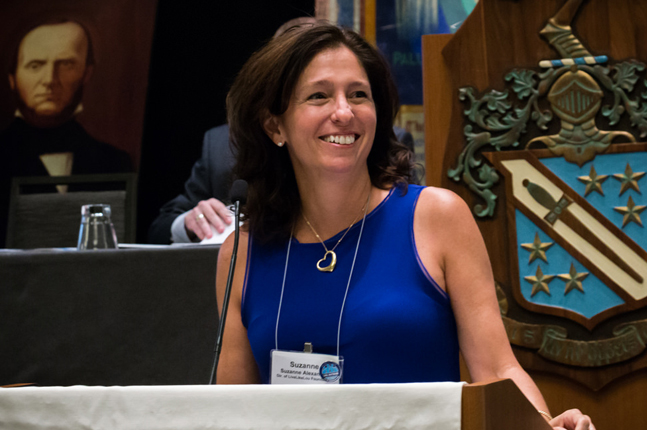
]]>By Suzanne Alexander
I want to tell you a story. It’s a lesson I learned for how to live through really hard things when living at all seems impossible. I had a front-row seat in one man’s journey from a healthy, happy life, to a life filled with a lot of loss. Loss of normalcy, loss of frivolity, loss of hope, and ultimately life itself. In the process, I watched Neil Alexander transform from a regular guy to a Great Man.
It is funny that I call Neil a great man because I knew him ‘back when,’ if you get my drift. A twenty-three-year-old recent college graduate with an unremarkable GPA, a lot of confidence, a quick wit, a dashing smile, and five dollars to his name, but he was enough for me. We built a wonderful life together, pretty satisfied with being unremarkable.
Then there was that teachable moment. Not the moment you would expect me to write about, as the widow of a man whose life was stolen by the 100 percent fatal disease Amyotrophic Lateral Sclerosis (ALS). Not the moments of confusion, confounding aches and pains, baffled doctors, and unhelpful test results for years leading up to his diagnosis either. And not even the moment of his death, something that I still can’t write about.
It was a different teachable moment, as I sat across a room and watched my husband describing his newly-announced diagnosis to a local newspaper reporter as if he was describing a legal case . . . with a dry description of the symptoms, his prognosis, and some colorful dark humor.
It started with the reporter’s surprising question.
It was an obvious question. One that everyone wondered, but no one had dared to ask. Not even me. The mighty Neil Alexander was in his corner office, with floor-to-ceiling windows and a beautiful view of his beloved Pittsburgh, with framed photos of his healthy wife and kids and advanced degrees on display. The room was filled with devoted co-workers and friends prepared to be quoted for the newspaper article and to express encouragement for him upon his early retirement because of ALS.
The story headline: Local Executive Bravely Faces ALS Death Sentence
The reporter’s surprising question: “Are you angry?”
This was the first time I heard Neil speak publicly about the awful hand he had been dealt. As a forty-seven-year-old successful business leader and attorney, with healthy habits, a loving family, and every expectation of growing old comfortably, it was a shock that doctors were now telling him: “There is no treatment. There is no cure.”
They told him, “Two to five years.”
They said, “Do what you love in the time you have left.”
That was it.
Privately well, that was tough. Our kids were nine and seven years old. How could it be? The constant state of grief was paralyzing.
Publicly, that was something else. Neil finally had the answer to the strange twitches, muscle pains, and fatigue. He was almost relieved that he had a name for the mysterious physical maladies he had endured for two years before his diagnosis. So to his friends and newspaper reporters, Neil put on a brave face and voiced a brave conviction that he would fight this disease with everything he had. He would beat the odds and live to see his kids graduate high school!
The human drama of Neil’s diagnosis prompted a lot of interest in those early days. Local reporters called regularly to write Neil’s story of determination to live. He was glad to share his thoughts because he wanted, ultimately, for his kids to one day read his story and follow his example in their own lives; having a public record would be helpful, he thought. So much positivity surrounded Neil as he proclaimed his goals to fight that we nearly forgot the grief and terror of his ALS death sentence.
So the reporter’s probing and personal question felt a bit obtrusive. As if she was looking for a crack in Neil’s veneer to give readers something more intriguing to read.
“Are you angry?” she had asked.
I knew Neil was sad. I saw him cry. Once. On the day of his diagnosis but never again. Years later he revealed to me, in private of course and toward the end of his life, that he cried every single day.
Neil said, “Suzanne, sometimes a good cry just feels good.” And then, he laughed, “You wipe your eyes, check your nose, and get back to work.”
Apparently the act of crying, for Neil, was a private and daily self-care routine that allowed him to focus on his losses and then, once refreshed, decide what he was going to do about them. I love that he shared this lesson with me and I can now share it with his kids. I agree that crying feels good!
But, I was not prepared for this deeply private and evocative question “Are you angry?” to be asked in a crowded room, and for Neil’s answer to possibly become the newspaper story headline: Local Executive Is Angry About His Losses.
We all just watched as Neil answered the reporter’s question with such conviction it seemed he had spoken the words before. But, I can attest, he had never spoken the words before:
“Look,” Neil said. “I have never been hungry. I have never been lonely. I have never lived in fear. I’ve had a good life. I don’t want to die. But I’m not going to start complaining now.”
Neil was lying!
Of course, it’s true he didn’t want to die, and amazingly Neil never did complain. But the rest of it simply wasn’t true.
Neil did actually experience hunger in his life. He did live through excruciating periods of loneliness. And he did have moments of palpable fear, both as a child and as an adult.
I’ve come to learn that most people read the quote from Neil and thought, “Wow. What a good man to show such perspective and such acceptance for his terrible fate!”
But this is the lesson that Neil taught me in that moment: He wasn’t showing perspective, and he was not accepting his terrible fate. Neil was making a choice, just as he had so many times before.
He chose to forget he lived with periods of hunger, loneliness, and fear in his life.
He chose to fight for that unremarkable GPA despite those factors in his early years, to fake that young graduate confidence, to tell a few jokes, and give us all a dashing smile when he only had a few dollars to his name.
He chose to push through the strange twitches, muscle pains, and fatigue, and to keep pushing his doctors for the answer he really didn’t want to hear.
He chose to cry as a daily practice of self-care because life was hard. And he chose to never let me and his kids see him cry.
Then, when pushed by a reporter with a probing and personal question, Neil chose to focus on all that he still had—his family, friends, job, community, time (he still had time)—and he said, “I’ve had a good life.”

When the easy, expected answer was to focus on all of his losses and show anger and sadness, Neil focused his mind and chose to focus on all that he still had. He chose to live his remaining days with gratitude.
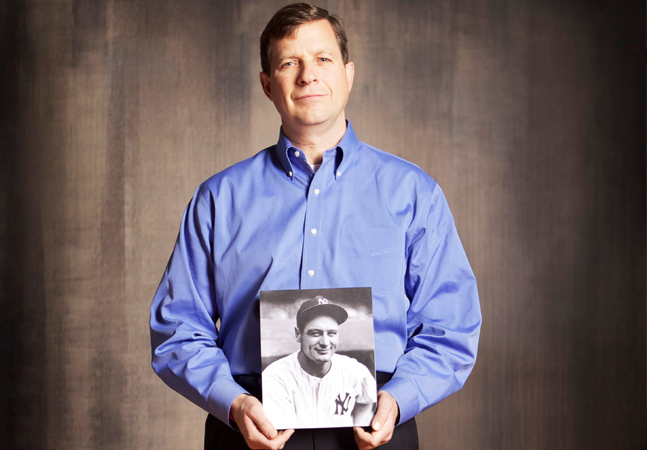
Of course, The Iron Horse Lou Gehrig played a big part in the rest of Neil’s story and what we are building together because of The Luckiest Man’s example is so amazing. Maybe I’ll write about that next. But for now, I hope this lesson Neil left gives you an example of how to live through really hard things. When life seems impossible, I hope you choose to focus on all that you still have, and that you choose to live your remaining days with gratitude, too.
It’s a choice.
Suzanne Alexander is the co-founder and director of The LiveLikeLou Foundation, a national nonprofit organization she started with her husband Neil upon his diagnosis of ALS in 2011. Neil died from his disease in 2015. The Foundation’s purpose is to Leave ALS Better Than We Found It, in honor of baseball Hall-of-Famer and Luckiest Man Lou Gehrig, and the more than 16,000 Americans living with this 100 percent fatal condition every year. Phi Delta Theta Fraternity is the primary philanthropic partner of LiveLikeLou and is active in the cause of ALS through multiple philanthropic programs. Learn more at www.LiveLikeLou.org.
The post On Becoming a Great Man appeared first on Phi Delta Theta.
]]>The post It Is Civility That Will Lead Us Forward appeared first on Phi Delta Theta.
]]>“Be the person that others will look for your daily posts because they know you will encourage them. Be the positive one and help others to have a great day, and you will find that not only will they like you, but you will like you too.” John Patrick Hickey
During my years of service as an army combat engineer officer and as a member of the all-volunteer military force of the United States, I was fascinated by both the art and science of leadership. Military historian Roger Nye once wrote that “leadership is not defined by an individual’s position or rank, but rather confirmed when those that one is charged to lead choose to follow.” The wonderful beauty in realizing this reality is that leaders can then help elevate others while simultaneously accomplishing the mission. Formal and informal leaders, some defined by position and others who are not, demonstrate certain characteristics that influence others in a positive way. Leaders display an uncommon commitment to the cause, other team members, customers, and partners. They serve other members of their organization and their communities selflessly, with humility, empathy, wisdom, and kindness.
At this point, you may be wondering why my opening paragraph in this post about civility is all about leadership. I hope that by starting with leadership I can lay out the argument that a well-functioning civil society needs, no requires, sound leadership, so others can experience a good example that can be emulated, replicated, and seen as a source for positive change.
My argument is meant to promote the merits of civility during these difficult times. I would suggest that civility within a community can itself establish positive conditions for change, mutual support, and the greater good. It is often assumed that an argument is fueled by emotion, even anger. Although that can sometimes be the case, an argument during civil discussion is simply an opposing view, and should be seen as a starting point, instead of a hard stop.
In modern times, there are numerous examples where civility won the day and exposed the roadmap to better times. For example, the market crash of 1929, caused by fears of excessive market speculation by the United States Federal Reserve, caused tremendous upheaval in our society, but calmer heads prevailed. With civility and sound leadership across many sectors of society, and a stronger economy, our people experienced a greater appreciation for place, an increased sense of community—neighbors looking out for neighbors, and tremendous opportunity. The reciprocity achieved out of such a negative far-reaching event sowed the way towards ever greater achievement as a society.
During these challenging times, it is civility that can energize collective innovation and initiative. If only we, as one people, forego antagonizing those with differing views through social media posts, the messaging on our clothes, and threatening actions. We can and should use our arguments to promote better understanding and perhaps better solutions to the challenges we all face.
How can fraternity help us bridge the gap between where we are and where we are heading? Fraternity establishes a baseline for accepted norms, collective values, mutual support, and friendship. In this sense, individual members commit themselves to a code of conduct and the accountability that comes from belonging to a fraternal order.
During the conduct of fraternity business, it is essential that time be allowed for all viewpoints to be shared, so the best possible outcomes can be realized. At the beginning of meetings conducted by one of the groups I belong to, and I will paraphrase here, it is said, “let not our petty grievances disrupt our discussions and our good work.” It’s a solemn reminder that we all have biases, preferences, and beliefs shaped by our upbringing, environment, opportunities, and life’s journey, but at the same time, if we are to imagine what is new and possible, we must embrace civility as a responsibility of all.
For most of us, 2020 has been a year unlike most others. We have dealt with a series of events outside of our control, and in some cases, the second and third order effects of those events. The year is not yet over, but as we enter the fourth quarter, having pulled through the first two-thirds of the year together, it is becoming ever more evident that together we will navigate the remainder of a pandemic, a recession, and a national election. Many of the solutions we discover along the way can make us stronger, more resilient, wiser, and hopefully a little more humble and open to new ideas.
The post It Is Civility That Will Lead Us Forward appeared first on Phi Delta Theta.
]]>The post Our Obligation appeared first on Phi Delta Theta.
]]>I have watched the news the past couple of weeks with a heavy heart. I have heard stories from many of our members and alumni. I have had many restless nights. I have shed tears, thinking about the countless lives impacted by violence, bigotry, and racism. My heart hurts. I have worked to continue to educate myself. I have more work to do, and I recognize that I am not going to be perfect. Anti-racism work is messy and difficult. Those who know me well, know that I am happy to engage in spirited debate on a range of issues and ultimately agree to disagree if necessary. Racism is not, and will never be, one of those things.
I have no problem saying that Black Lives Matter. As a movement, BLM has been weaponized for political purposes. Some people have strong opinions on both sides. However, we must filter out the noise of politics. Saying Black Lives Matter is a humanity issue. Do All Lives Matter? You bet. However, the Black community continues to face violence, harassment, and racism on a daily basis. Is that your reality? If it is not, consider yourself to be in a position to make a difference and amplify the voices of those that do.
Phi Delta Theta Fraternity was founded on the high ideals of friendship, sound learning, and rectitude. Our Founders formed this society to create a place for the free exchange of ideas in a time when universities were less than hospitable to this type of self-awareness. The fact that Phi Delta Theta contributed to systems of oppression and racism, both in policy and practice, in later years is ironic in a way that I would prefer it not to be. For almost 50 years, like many organizations of the time, Phi Delta Theta did not allow students of color to join our Fraternity. Although this policy was abolished in 1954, we cannot continue to diminish this historical fact and its place in our history.
We have come a long way, but we still have work to do. Saying the phrase, “Becoming the greatest version of yourself” does not magically make it so. It takes work. It takes sound learning. It takes rectitude. It takes friendship. Our ritual tells us we have an obligation to our fellow man to live our lives in a way that makes our world a better place. History has shown, and the past two weeks have magnified, the fact that we have a long way to go.
So what do we do now? First, we must listen. We cannot understand what our members of color experience, the lives they have lived. We must not listen without action, and my promise to you is that we will act. I have work to do. We have work to do. We will do this work together.
Moving Forward – A Note from Phi Delta Theta
The death of George Floyd and the resulting protests throughout the world have caused much anger and frustration, and once again highlight issues of racism, inequality, and injustice for Black Americans in the United States. The events have also led to promising conversations about a better tomorrow, and we are greatly encouraged by them.
Phi Delta Theta wants to do everything it can to be part of the solution. We know that making meaningful change begins by listening, learning, and having open dialogue with each other. This is what we are doing, and we’ve been encouraged by the number of our members who have raised their hands to participate.
We are continuing this dialogue with our members who have said they want to be a part of the solution. We are very encouraged by these conversations, and we know it will help Phi Delta Theta take action where it will be most effective for our organization and its people.
The post Our Obligation appeared first on Phi Delta Theta.
]]>The post Three Cardinal Principles in Times of Crisis appeared first on Phi Delta Theta.
]]>We are living in unprecedented times. For many, this is the first time they have experienced any sort of global phenomenon, let alone a global pandemic. However, Phi Delta Theta as an organization has lived through wars, influenza outbreaks, and depressions, and it still stands strong as ever today. In this chaotic time where it seems that the only certain thing is uncertainty (and social distancing), it can be a good thing to reflect back on the values our Founders constructed back in 1848 and how we can utilize them in the face of this uncertain time.
Practicing friendship may seem more difficult than ever when considering the current importance of self-quarantines and social distancing. Deviating from our normal routines of hanging out with friends or large gatherings on campus may have left us with a sense of isolation. But based on what we know about what friendship means to members of Phi Delta Theta, we understand that the relationships we cherish do not simply fade away when we are separated by distance. Our challenge to our members is to think outside the box, how can you connect with your brothers and friends remotely, whether that be a group video call, playing video games online together, or even getting old school and writing a letter to a friend. In times of isolation, people need friendship more than ever, and no group is as prepared to share that as members of Phi Delta Theta.
With many of us having moved back home and with online classes and other obligations being cancelled, we now have a lot more time on our hands. While it’s tempting to binge watch The Office a few times through, we can also use this opportunity to practice sound learning outside the classroom. What is something you have always wanted to do? Maybe it’s reading that book that’s been collecting dust on your shelf, or picking up the guitar or another instrument, or maybe even learning a new talent or skill to prepare you for your dream career. There are so many ways you can push yourself to pursue something new with your newfound free time. Members of Phi Delta Theta are aware of the benefits of learning inside and outside of the classroom, and we hope you’ll make the most of this time to continue your pursuit of knowledge.
With COVID-19 posing such a threat to the health and function of our society, it can be easy to see rectitude as an afterthought, something that you’ll “put on hold” until everything calms down. But now is as important of a time as ever for us to utilize our sense of right and wrong as members of this organization. We can practice rectitude in this situation by fact checking the information that we share on social media and in person, encouraging the spread of truth instead of panic. We should be following CDC recommendations and doing our best to prevent the spread of this virus, but also finding ways to help those that are most vulnerable; this could look like getting groceries or other necessities for those at higher risk, donating to the local food bank to help those that are likely to be economically impacted by this disease, or finding creative ways to support small businesses at this time as well. In addition, garner support from your brothers and other connections and encourage them to do the same.
Phi Delts are known for their commitment to our founding values, and we strongly believe that practicing those values is exactly what the world needs from us right now. We are lucky to have an organization that has survived through hardship in the past as our foundation of living in the present. In the midst of chaos, a group of men that are committed to intentionally building their friendships stronger in isolation, that look to use the circumstances to continue to better themselves, and who are committed to helping others even when everything points to fending for yourself, is more powerful now than it has ever been.
Brothers, we encourage you to go and show the world, wherever you are at, what it means to be a Phi in this moment of time. The world needs us.
The post Three Cardinal Principles in Times of Crisis appeared first on Phi Delta Theta.
]]>The post Words of Wisdom from Past Chapter Presidents appeared first on Phi Delta Theta.
]]>Leave time to focus on yourself.
Learn as much as you can from your alumni.
Reports are important, chapter meetings are important, paperwork is important, BUT the most important thing is brotherhood. You can’t make it happen, it has to come organically from other brothers bonding and connecting. Give them that opportunity whether it’s a group dinner, lunch, pick-up sports etc., and let the magic happen! Don’t push it, but just extend the invitation with a smile!
Set goals early and keep the bar high.
“This is the way we’ve always done it” is an excuse used by single-minded people.
Have FUN!
Take time for yourself. If you can’t take care of yourself, you can’t take care of the chapter.
Enjoy the little things.
Lead by example and practice what you preach.
Separate fraternity and friendship when making decisions.
Be accountable for yourself and all of your brothers. If you tell someone that you are going to do something, stay true to your word and do it.
Do not focus on those people in the chapter who may not be showing up to meetings as much as those that you know have potential. As a leader you cannot turn every person into a leader.
Always have a pulse on all the chapter functions so you won’t be blindsided by anything.
Actively prevent and speak against things that are risky. Don’t be silent.
Be strong in your communications. Make an effort to communicate effectively with your CAB.
At the end of the day, it’s just a group of college kids. Make sure to keep your cool even when you are getting frustrated.
Be aware of all GHQ, IFC, and university rules and risk management policies.
Be prepared to say no to some of the guys in the chapter and do the responsible thing instead of the fun thing. Make the hard decision instead of the easy one.
This position is going to be taxing. Know that you’re doing your best and don’t be afraid to rely on others around you (CAB and your exec). Delegation is key.
Always be communicating, especially with less involved members about what can be done better.
Be yourself. Communication is key.
Being a leader isn’t easy. Criticism and praise will be given no matter what you decide to do. It’s what you do with the feedback you receive and how you continue to improve your chapter. In the end have the best intentions no matter what and look to truly become the greatest version of yourself and strive for your chapter to do the same.
Believe in yourself. You need to be able to say no and put your foot down.
Communication is key. It is vital to stay in touch with your CAB, province president, and leadership consultant. In addition, be sure to be open and honest with your members as to what is going on with the Fraternity.
Divide key responsibilities among brothers with strong leadership early on. This promotes growth on their part and keeps any one strong leader from burning out. Have deliverable (reports, events, newsletters, meetings) due for key positions on set dates or intervals of time (weekly, by-weekly, monthly).
Do not procrastinate and follow the chapter greatness checklist.
Don’t be afraid to ask for help from anyone.
Don’t do everything yourself. Find your core officers who you can trust and have them help you a lot. Also, be positive, your attitude is what makes everyone else’s attitudes.
Don’t worry about pleasing everyone. Instead, worry about improving yourself and the Fraternity like you know you should.
Don’t get bogged down with everyone’s complaints. They are adults and can deal with it themselves.
Don’t let the opinions or traditions of the chapter keep you from making the right decision.
Don’t procrastinate and make sure your VP is doing his job.
Don’t take on too much too quickly. You have an executive board that is there to help you.
You have the power to do great things as president. Don’t doubt your abilities. You were elected because people saw something in you.
Focus on yourself and show other positions how to do their jobs instead of doing it for them.
Follow the values of the Fraternity and you will never be misguided.
Follow your gut and make sure to value everyone’s opinion.
Give people the benefit of the doubt and a few chances. Be firm but fair. Follow through on commitments.
Hard work and preparation are essential for running an effective and smooth chapter meeting. YOU and your executive board set the tone for the entire organization. Make it a positive tone of unity not division.
Don’t be afraid to make people upset. Focus on making this chapter better, not making everyone happy.
Have as many individual conversations as you can.
Lead by example. People will follow you when they see you backing up your word. And stay positive. Turn what looks like setbacks into opportunities.
Learn to be political. You could be objectively correct, but if your ideas are unwieldy, you will get nowhere.
Listen to all your members. Be willing to reach out to them to get some input on how they think the chapter is doing.
Most people in the chapter look out for themselves. You have to look for the betterment of the chapter.
Never be afraid to ask for help (even when you think no one else cares), and don’t try to do everyone else’s job.
Pay attention to your chapter and member needs.
Set a calendar and book venues before the semester even starts.
Set the tone early. Make it apparent that you are in charge but be willing to listen to others.
Lean on the most recent president for advice, and don’t get too worried if at the beginning you feel lost.
Stay motivated.
Stay on top of things early and stay organized. Once you get behind it’s hard to catch up.
Stay organized and don’t procrastinate.
Supporting the active members of your chapter should always be your first priority.
Take time to yourself and let the officer positions work for you.
The external side of the job is arguably more important than the internal. Being respected by your chapter matters a lot, but if people outside the chapter don’t respect your opinions and know who you are, your whole chapter will suffer.
Thicken your skin and have 4-5 people to turn to always.
Always remember that you are the face and should carry yourself with respect. Be completely transparent with the information you receive.
Trust your gut and remember that you serve the chapter.
Work closely with the executive board and stay on top of everything.
You have to command respect. It will be hard to yell at your closer friends, but they will respect you more in the long run.
You were elected for a reason so don’t doubt yourself.
Sometimes the right decision isn’t the most popular one.
The post Words of Wisdom from Past Chapter Presidents appeared first on Phi Delta Theta.
]]>The post How To Keep Your Newly Initiated Brothers Engaged Following The Phikeia Education Period appeared first on Phi Delta Theta.
]]>“I have seen a huge jump in personal growth after joining Phi Delt, and it was sort of addicting in a sense. I have experienced what my Phikeia educator meant when he said, “You get out what you put in.” It motivated me to keep going so I could continue to become a better version of myself. To put it in other words, the Fraternity has given so much to me already, and I want to reciprocate that back to it. There is no difference in how I was taught versus my peers, what matters is how I respond to those teachings.”
I asked a few of the most motivated and engaged new initiates within the chapter I advise about what motivates them to become engaged in a meaningful way as a contributing chapter member. The quotes included in this post are what I received.
Every semester, chapters initiate new members into the Fraternity with the hope that they will become the next leaders of the chapter; that they will find ways to push the chapter to greater heights, and to be some of the most engaged members the chapter has seen in recent memory. Yet, at times, our chapters look at the newly initiated members and see some who are engaged and motivated and others who disengage and rarely contribute. The chapter then looks to the next group of men they recruit and hope that results will be different.
A year passes by, and it’s no different. Why does this happen? Moreover, how do we keep newly initiated members engaged and motivated after the Phikeia education period? Below are a few tips for chapters to think about as they work to maintain engagement of newly initiated members following Phikeia education.
Know Your Phikeias… Truly Know Your Phikeias
Each summer during the Phikeia Educators College, the faculty spends time with Phikeia educators discussing how to facilitate an environment within their program that results in true learning and growth. To do this, members of the chapter’s Phikeia Education Board must build a relationship with each Phikeia individually and at a greater depth. They need to know much more than surface level information: major, year in school and where they call home. They should learn more about their motivations for joining the chapter, their hopes and wishes for membership in Phi Delt, their strengths and areas of improvement, their successes and their challenges, their background, life experiences, and what they are bringing to the Phi Delt experience.
By knowing your Phikieas at a deeper level early on, you can better identify ways in which they can be motivated and engaged beyond the new member period.
Immediately Involve Newly Initiated Brothers in Ways That Are Meaningful to Them
Committees. Committees. Committees. Scholarship Committee, Social Committee, Recruitment Committee, Phikeia Education Committee, Philanthropy Committee, Risk Management Committee, Public Relations Committee, Alumni Committee, Judicial Board, Campus Interfraternity Council Committees. There are so many opportunities for newly initiated members to be involved and engage with their chapter beyond simply attending events and chapter meetings. Find ways to provide newly initiated members with the opportunity to serve on a committee. Through this involvement, they can better understand how the chapter operates, observe motivated and engaged members in their leadership roles, and feel as if they are contributing to the future direction of the chapter.
The caution with this is not to create committees just to have them on paper, but to truly use them and engage more members in the chapter.
Do Not Pressure
We’ve all seen it. The Phikeia who joins enthusiastically, is charismatic and passionate about the Fraternity, and has incredible leadership potential and natural qualities that inspire those around him to be better. He wants to be as involved as possible the second he walks through the door as a potential new member. This is the guy who talks about how he aspires to be a future chapter leader during his Phikeia period. And then, a year later, he is nowhere to be seen. He’s not engaged, does not demonstrate motivation, and is not planning to take on a leadership role within the chapter.
So what happened?
Sometimes, the pressure of wanting an individual to be an instant leader can be detrimental. While you may be excited about someone’s leadership potential, let him ease into it. Provide him with various leadership opportunities that can help set him up for success, but do not overwhelm him. If he dives in too quickly, it can be a challenge. He may not be able to understand who he wants to be as a leader, or what he may bring to leadership roles at the time your brothers are telling him that he’s going to be the next great leader of your chapter. The result could include losing an individual with great leadership potential, because he never fully met the expectations placed upon him.
With that said, you can and should begin to have early conversations with Phikeias who demonstrate sheer leadership potential and talent. Help guide them through the experience and advise them to set realistic and timely expectations to complete their goals.
Intentional Big Brother Programs
“After my Phikeia period ended, the thought of not being involved within the Fraternity never crossed my mind. It was something I wanted to do. I believe I built such strong relationships that it made me want to stay committed to the Fraternity as a whole. I also grew a very strong relationship with my Phi Delt Big Brother which keeps me present within the chapter.”
Big Brother programs vary within our chapters. The ultimate goal of a Big Brother program is to provide each Phikeia with a mentor and a guide, who they connect with, to provide sound advice, counsel, and support. The Big Brother programs we have should be very intentional. This goes back to knowing Phikeias at a deeper level.
Some questions to think about:
- How do you create a pairing that is best for both the Phikeia and the Big Brother?
- How do you ensure that you have criteria and minimum requirements for being a Big Brother?
- How do you create accountability for Big Brothers who take on the responsibility of mentoring and guiding a Phikeia?
If you want to motivate and engage Phikeias after their new member education period, why would you pair them with an unengaged and unmotivated member of your chapter? Apply a critical lens to your Big Brother program and start making intentional pairings. Build a structure that allows for meaningful mentorship to occur between Big and Little Brothers during the Phikeia education period and beyond.
Involve Newer Members in Higher Level Chapter Conversations
When appropriate, find ways to include newly initiated members into higher-level chapter conversations. For example, invite a few newly initiated members to an Executive Committee meeting. Bring a few newly initiated members to the Interfraternity Council meeting and to meetings with the campus-based Fraternity & Sorority Advisor, the House Corporation, or the Chapter Adviser so they can start to learn the bigger picture. Seek their opinion of matters that have an influence on the chapter.
Continually Encourage Reflection on Why Members Joined in the First Place
“I found it easy to stay motivated and involved after my Phikeia semester. I can attribute it directly to Morrison’s philosophy: To do what ought to be done, but would not have been done unless I did it, I thought to be my duty.” This philosophy reminds me to continually devote myself to my chapter and to serve the chapter and my brothers to my greatest abilities. It inspires me to live out what it means to be a Phi every day.”
As a Chapter Adviser for over a decade, I have seen hundreds of members come through the chapter. I am always curious to learn why some members, who received the same educational content as their peers, choose to engage differently and exhibit greater levels of motivation. It is a given that every person is unique and provides his own perspective, but we must capitalize on this as we formally initiate our new members. Reflection is key. If you can encourage your newest members to reflect on the reason(s) they sought out and chose Phi Delt in the first place, you will be more successful in finding ways to meaningfully keep them motivated and engaged.
The post How To Keep Your Newly Initiated Brothers Engaged Following The Phikeia Education Period appeared first on Phi Delta Theta.
]]>The post Six Tips For A Successful And Safe Spring Break appeared first on Phi Delta Theta.
]]>Ah, Spring Break. A time to relax, enjoy, and spend time with brothers before heading back to school for the dreaded end of the semester. For many of you, this week may be your favorite time of year, and most of you are likely embarking on some type of Spring Break adventures. Some of you are probably heading home to spend time with your family, while others may be volunteering for an Alternative Spring Break Program. But chances are, most of you are quite possibly heading somewhere close to a beach, hoping to have the best week of your lives.
While Spring Break can make for some of the most memorable and fun times of your college career, it can also be one of the most dangerous weeks in the life of a college student. While I want to tell you to alternate your drinks with water (and you should), I want you to consider that there are many practical ways to keep yourself and your brothers safe during your Spring Break activities, whatever they may be. We want you to have fun, but we also want you to protect yourself and your brothers as much as possible.
Use the buddy system
While this may sound like something a third-grade teacher once told you, one of the best ways for you to stay safe this Spring Break is to make sure that you always have someone with you. When you’re traveling with a large group, it can be easy to lose track of people. The best way to avoid losing your group is by always having a buddy. Before you leave town, download the Find My Friends app so you can always keep track of each other.
Track your consumption
The average male consumes 18 drinks per day during Spring Break, which for most of you, could be potentially very dangerous. Consuming this amount of alcohol can lead to alcohol poisoning and unintentional injuries, which is the leading cause of Spring Break incidents for men. Realistically, I know it’s unlikely that you will count the number of drinks you’ve had, but there are many apps that will track your drinks and calculate your BAC for you. Try downloading InteiliDrink or R-U-Buzzed to help keep track and keep you safe. The goal is to never get yourself into a situation where you are not aware of your surroundings or your actions, so tracking your consumption is key.
Don’t “do it for the snap”
In fact, you’re better off not posting what you’re doing on social media at all. Doing something risky to show off on social media may seem like a clever idea at the time, but trust me when I tell you that this is never a good idea. What happens on Spring Break doesn’t always stay on Spring Break, especially if you ‘re sharing it with the world.
Ask for consent
If you take nothing else away from this post, I hope that you will remember that before you engage in any activity this Spring Break, the best way to protect yourself is to ask for consent. A recent study showed that women’s two biggest concerns when attending Spring Break activities were 1. Being taken advantage of and 2. Being drugged. Trust me when I tell you that women go away for Spring Break to relax and have fun, but women want things to happen on their own terms. Regardless of what someone is wearing or how they are acting towards you, you must always respect peoples’ boundaries. The best way for you to protect yourself this Spring Break is to always ask for consent.
When in doubt, intervene
If you see a situation where your brothers or someone else is at risk, intervene. This could be directly stepping in or even just causing a distraction – anything to allow the situation to take a turn for a more positive outcome. The bystander effect is in full force during Spring Break, but it’s on us to make sure that we’re looking out for the people around us. If you feel you can’t directly intervene, the best thing you can do is report what you saw or heard and ask someone else to step in.
Do what ought to be done
My final piece of advice to you this Spring Break season is that if you consistently refer to the principles of Phi Delta Theta, you can’t go wrong. When you are in a situation that calls for action, step up and be the man who takes responsibility. We want you to have a fun Spring Break, but we also want you to have fond, positive memories that you can look back on for years to come. At the end of the day, as you’ve heard repeatedly, do what ought to be done.
The post Six Tips For A Successful And Safe Spring Break appeared first on Phi Delta Theta.
]]>The post The Room Where It Happened appeared first on Phi Delta Theta.
]]>It’s not your typical dorm room – fairly large with a high ceiling, probably a bit more spacious than a typical university dorm room of today…rather drab battleship gray in color, no fancy moldings, mattresses upturned for the summer season, two standard desks with pedestrian chairs…two built-in closets, probably added in the early 1900’s. Nothing really special here, other than two brass plaques that indicate that this was the room in Old North Hall (now called Elliott Hall) that has a very special meaning for Phis worldwide.
Miami University in Oxford, Ohio, the 10th oldest public university in the United States, was chartered in 1809 when Thomas Jefferson was still President. Three story Old North Hall was built for $7,000 in 1825 as a male residence hall for 35 students and designed in the Federal style after Connecticut Hall at Yale University in New Haven. Little was done to modernize it until 1899, when steam heat replaced fireplaces, electric lights subbed for oil lamps and porcelain wash basins and chamber pots were traded for modern bathroom amenities.
As one stands between its two parallel windows on a hot summer day and on an equally deserted Ohio campus, one can imagine the gathering of six tail coated students in 1848 in crisp shirts and ascots. The room was probably heated by a fireplace or a wood burning stove. A carpet undoubtedly covered the bare wooden floor to preserve warmth in the colder months and, in the absence of closets, large chiffarobes (or wardrobe chests) were allotted to each resident for his personal belongings. Mid-Victorian desks were crowned with oil lamps for ease of reading and there was possibly a Bible on prominent display for these young men were, after all, in ministerial training.
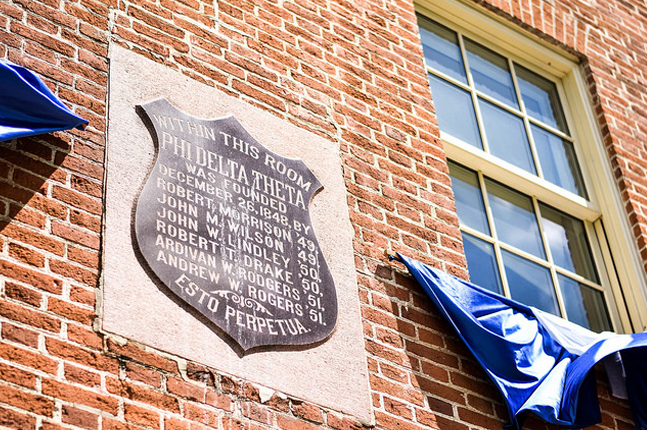
It was in this room that Phi Delta Theta’s vision became reality and where its six noble founders composed and signed the first Bond, handwritten and still preserved at General Headquarters, just a few blocks away. To this day, that same Bond is hand-copied for every new chapter, preserving as best it can the amazingly complex script of the early writers when cursive penmanship was an art form.
As I stood there during the most recent Kleberg Emerging Leaders Institute this summer, my first ever visit to Oxford as a Phi of fifty five years, I was struck by this churning in my brain as we read The Bond aloud – the inevitable song worm that catches us and won’t let go until exhausted. The song, The Room Where it Happened, from the highly lauded Broadway production of Hamilton, encompasses so many of those feelings and emotions:
God help and forgive me
I wanna build
Something that’s gonna
Outlive me
I wanna be in the room where it happens
Brother Ford was a Fellow at the 2017 Kleberg Emerging Leaders Institute. Alongside other alumni, John was immersed in the program and received an on-the-ground look at the leadership development that occurs at the Institute.
The post The Room Where It Happened appeared first on Phi Delta Theta.
]]>The post The Badge of Phi Delta Theta appeared first on Phi Delta Theta.
]]>Phi Delta Theta’s 81st Biennial Convention is approaching and over 600 Phis will soon converge on Savannah, Georgia. Convention is not just a time for legislative action, but it is also a time for Phis to celebrate one another, our great Fraternity and our Bond as brothers. During the Convention season, brothers wear the badge of Phi Delta Theta with great pride and in tremendous unity. This year will be no different. Thus, Phi Delta Theta encourages all brothers to take a few short moments to learn a bit of history about the badge and the proper way to present it.
Listed in Article VII: 15 of The Code as Insignia, or a distinguished mark of membership in an organization, the badge is sacred to every brother of Phi Delta Theta and has been since the badge’s design in June of 1849. The original badge consisted of a flat gold shield with an eye affixed to the upper portion, suggested by Morrison, and a scroll fixed to the lower portion, suggested by Wilson. Morrison added that the Greek letters “ΦΔΘ” shall be inscribed somewhere on Wilson’s scroll. Though the badge was designed in 1849, it was worn only in secret until 1852, when Miami University President, William C. Anderson, an honorary brother, allowed the badge of Phi Delta Theta to be worn at a senior brotherhood celebration and then the senior graduation ceremony a few weeks later. This was the first time since 1841 that the University had shown any support of the Greek community.
Not until 1866 was a sword attached to the golden shield, at the installation of J.C. Black, a brother at the University of Chicago chapter. The addition of the sword to the badge was not official though until the Phi Delta Theta Convention of 1871. Prior to 1871, no description of the badge appeared in Phi Delta Theta’s Constitution. That year, the newly adopted Constitution provided that that badge should consist of a shield, bearing the eye and scroll, with a sword attached by a chain. At the time of its inception, Phi Delta Theta was the first fraternity with a sword incorporated in to its badge design. The badge, except for size and ornamentation, has not been changed since 1871.
A common misunderstanding among many Phis is to wear the badge on the lapel of their coats. Rather, the proper place for the badge of Phi Delta Theta to be worn is over the heart, directly on the dress shirt, rather than on the coat lapel. The Code provides that the badge shall not be worn except by initiated members of the Fraternity or their mothers, wives, daughters, sisters, or fiancées, and a penalty of one year’s suspension may imposed by a chapter on a member violating the clause.
Though the direct meaning and significance of the badge of Phi Delta Theta has never been disclosed to non-members, R.A.D. Wilbanks said it best in 1866, when he wrote to T.M. Paschal of Kentucky Alpha, the emblems of Phi Delta Theta “speak the mystic language of our fraternal union.”
Phi Delta Theta looks forward to joining together with brothers and their families in Savannah! Bring your badge!
The post The Badge of Phi Delta Theta appeared first on Phi Delta Theta.
]]>The post Want To Greatly Improve Your Chapter? Send More Men To The Kleberg Emerging Leaders Institute appeared first on Phi Delta Theta.
]]>Each year, when Ohio Epsilon at the University of Akron begins the process of selecting members to represent the chapter at the Kleberg Emerging Leaders Institute, we remember a great quote from our Province President, Jim Warner.
“You shouldn’t send ducks to eagle school.”
It is a quote that has resonated greatly within Ohio Epsilon, and the chapter has benefited from following this advice and sending as many “eagles” as possible to Kleberg each summer.
The three pillars of the Kleberg Emerging Leaders Institute are purpose, networking and leadership. These values are extremely important because they coincide with the three Cardinal Principles that we abide by as men of Phi Delta Theta. The men that spend valuable time in Oxford, Ohio during Kleberg refine their skills in these three categories, and they always return with a greater understanding of each one.
Sending a large number of men to Kleberg year-after-year has greatly impacted our chapter. Over the past three years, Ohio Epsilon has sent a total of 34 delegates to the conference. We sent 15 men in 2014 with one being a Peer Mentor and another being our first Whole Man Scholar. We were able to show our support of the Kleberg Emerging Leaders Institute and grow the capacity for leadership within Ohio Epsilon at the same time.
The most notable benefits that the chapter has gained are positive attitudes, heightened leadership skills and a greater drive from those who have attended Kleberg. By developing a greater purpose to live our ritual, connect with members of GHQ and other chapters, and attend sessions to refine leadership skills, our members begin to step into leadership roles even before they leave Miami University.
Upon returning to campus, it’s guaranteed that those who attended will begin to work harder, take on more responsibility and apply the knowledge gained at Kleberg to benefit the chapter. Any leadership book can be read and applied, however, what happens to a Phi while he is at the Kleberg Emerging Leaders Institute lights a fire that burns his Phi Delt passion brighter than ever. The building of this Phi pride and the desire to lead, coupled with a greater understanding of the purpose of Phi Delta Theta is easily the most important factor that has led to Ohio Epsilon’s success.
The proof is concrete. More than 70% of our current executive board members attended Kleberg at one point in their undergraduate career. Our past four presidents attended the conference. Three of those four have returned as Peer Mentors.
This summer, we hope to send two peer mentors, three Whole Man Scholars, and 15 undergraduates, for a total of 20 Ohio Epsilon men in attendance.
The experience a man gains in four days at the Kleberg Emerging Leaders Institute is invaluable. It is the gift that keeps on giving, generation after generation. Our chapter has more than doubled in size, been recognized for numerous awards on campus, been named the most outstanding fraternity at the University of Akron’s for three years in a row, and was recently the runner-up for Phi Delta Theta’s Harvard Trophy. This success directly correlates with Ohio Epsilon’s focus on sending more men to Kleberg.
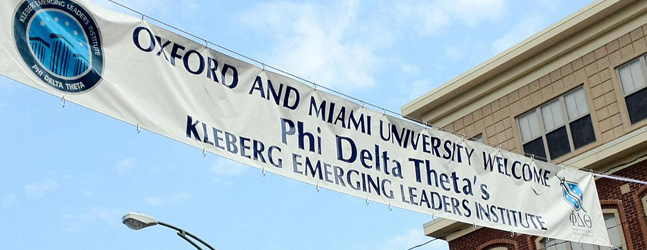
Registration is now open for the 2015 Kleberg Emerging Leaders Institute through myPDT. Per the 2015 Chapter Minimum Standards and Expectations policy, all chapters must have at least three (3) delegates in attendance. This can be a mix of Kleberg delegate track and Phikeia Education training track participants, but does not include brothers named as Peer Mentors or those who receive Whole Man Scholarships to attend the Honors College of Leadership. If a chapter registers three members for the delegate track and one for the Phikeia Education training track, all register for free. Additional delegates may pay the $350 registration fee to attend. All delegates are responsible for their travel costs.
The post Want To Greatly Improve Your Chapter? Send More Men To The Kleberg Emerging Leaders Institute appeared first on Phi Delta Theta.
]]>The post Phi Delta Theta – Maker of Men appeared first on Phi Delta Theta.
]]>We are entering a new era in the life of the college fraternity. The good news, more students are attending college than ever before. But, these students are increasingly coming to college with a driven focus on their careers and with seemingly little time for extra-curricular activities. Due to increasing costs, more students are choosing to enroll in 2-year community colleges or online schools like the University of Phoenix. Even the ones who are attending the traditional 4-year schools are struggling to make ends meet and often question the value of spending money for fraternity dues. And the proportion of women on campus is increasing as well.
Adding to these demographic changes college and university administrations and the federal government are focusing more than ever on issues of sexual assault, sexual harassment, and just plain sexism. Generally speaking, concern over these issues leads to more attention on two sources – athletics and fraternities. As fraternity men, we are faced with two related challenges – sharing our value to our communities and changing our often negative image as it relates to women.
Living in the modern, technological world that we do and the fact that this post started with a brief analysis of contemporary challenges, one would think that the solution would be something new and hip and, well, modern. However, as a historian I am trained to look to the past for solutions and this case is no different.
The solution to these problems is not to be found in new technology, but rather in our focus on the three Cardinal Principles of Phi Delta Theta. But, before you think I am simply going to give you a lecture on the importance of following these precepts laid out by our Founding Brothers, I want to instead focus on an often discussed, yet seldom understood, part of what makes fraternities important – their ability to help young people become men.
Contrary to popular belief, masculinity is not some biological trait. It is socially constructed and it is learned. In America, manhood is often defined as being tough, not showing emotion, and being confident and dominant in what we do. Former NFL player, motivational speaker and activist, Joe Ehrmann spells out what he calls the lies of masculinity: the Ball Field, the Bedroom, and the Billfold. Think about your early life. How often did you hear or feel that your status as a man was tied up in your athletic ability? Didn’t we often make fun of kids in school who weren’t as good at sports? As we got into middle school and high school, our worth as men was tied to our sexual appeal and abilities. Finally, in college and beyond, our value as men is often based on our earning ability. Ehrmann argues that these notions are myths that society, family, and peers drum into our heads from an early age. Often it is only with age and maturity that men are able to break these stereotypes and redefine what it means to be a man.
What we as fraternity men and as Phi Delts can do is challenge those myths to help our members redefine what it means to be a man. Brother Arthur R. Priest gave us the roadmap:
I believe in the college fraternity, creator of friendships.
I believe in its quick-sympathies, and its helping hand.
I believe in its brave idealism,
Stirring every valiant emotion.
Rousing every potential talent.
I believe in its compelling drive for sound scholarship.
For genuine culture.
For clear-eyed honesty.
For business integrity.
I believe in the college fraternity, maker of men.
Read this poem again. Where does it say that manhood means being sexually active? Where does it say that being a man means being good at sports? Where does it say that how much I make defines my worth as a man? Instead, Priest uses words like scholarship, culture, honesty, integrity, emotion, talent, sympathies, helping, and friendship. Being a man is about being true to yourself. This includes being willing to show emotion. It includes being there to help someone in need. It includes living life with integrity. It includes being a genuine friend to people in your life. It includes treating all people, regardless of their gender, race, sexual orientation, or background, with respect and kindness.
I will admit that at various points in my life, I have bought into the myths of manhood and at various points felt either validated or rejected as a man because of it. But, for me, being a member of Phi Delta Theta has helped me learn the value of being myself. Becoming the greatest version of yourself means not buying into the myths of masculinity. It means being able to be vulnerable and emotional if necessary and not allowing society or your peers dictate to you how you must act. A fraternity should be a place where you are free to be yourself and where you know your brothers won’t judge you or force you to conform to society’s definition of manhood.
So, how can we as members of Phi Delta Theta and leaders on campus and in the world show our value and change our reputations? By rejecting the myths of manhood we received growing up and by showing our brothers and the world what it means to be a real man. Like Brother Priest, I too believe in the college fraternity, maker of men.
Jeff Ramsey was initiated into the Wisconsin Beta chapter (Lawrence University) in 1997. He graduated in 2000 with a degree in history and has since been working with college students. He worked in Student Affairs for several years and has recently completed a Ph.D. in history and is looking for a full-time faculty job. He is currently the Province President of Iota North (the Wisconsin chapters) and previously served the Fraternity as a Leadership Consultant (2000-2003). He and his wife, Christina have two boys, Timothy (4 years old) and Samuel (4 months old) and live in the Milwaukee area. In his limited spare time, Jeff enjoys reading, sports and spending time with friends and family.
The post Phi Delta Theta – Maker of Men appeared first on Phi Delta Theta.
]]>The post The Value Of Phi Delta Theta’s Social Structure To Graduating High School Students appeared first on Phi Delta Theta.
]]>One of the attributes that I admire the most about Phi Delta Theta is that it was founded as a social organization. As an undergraduate member, I defined the social aspect as going out with friends on weekends, attending formals and spring break trips. Now as a young professional, as I reflect on my overall undergraduate experience, the most valuable lessons and cherished memories were in line with how our Founding Fathers defined a social fraternity, which is very different than my original understanding of the term. This, along with my current position as an assistant principal of a large suburban high school, ignited my interest in writing this article about what our great Fraternity has to offer graduating high school seniors.
I often see high quality young men graduating from high school who would not only benefit from our great Fraternity, but have a lot to offer in return. However, they often share with me their disinterest in joining a “frat” because of their Animal House misconceptions, or belief that their future goals do not allow time for a simple social club. It is here that I challenge their beliefs, as well as our practices, at least in how we sell PDT to potential new members.
Our Founding Fathers built a social fraternity on the principles of Friendship, Sound Learning and Rectitude. The social aspect allowed the original six members back in 1848 to support each other in growing up as gentlemen while they were great distances from their families. These Founders held each other accountable to these principles, allowing for tough conversations and disagreements among one another when one would stray too far from the teachings of The Bond. This accountability did not cause long-lasting rifts within their friendships, but formed a stronger, more intimate friendship and brotherhood.
Each year, Forbes publishes a piece that highlights the qualities that employers seek in new employees. Recently, the qualities were identified and many fall into the soft skills category. Such qualities as the ability to work collaboratively within a team, make decisions and solve problems, communicate well verbally with others, and organize and prioritize work were all identified. Although I do not agree that fraternity men lack these soft skills, many generalize that today’s college graduates lack these characteristics. I believe Phi Delta Theta’s greatest benefit to our members is that our social organization does in fact teach and allow members to practice these skills in the chapter operations model.
Let me explain why I keep emphasizing “social fraternity.” It is the social structure that our Founders defined that offers the most to our potential new members. High school graduates are experiencing more options now than they ever have before. The days of attending high school for seven hours a day are in the past. Students now explore potential career paths by participating in internships during the day, taking virtual courses from college professors all over the globe, and graduating as a second semester college freshmen through dual credit courses. These students balance these academic experiences with athletic endeavors or clubs such as student council. Young men pursuing these types of opportunities reflect the values PDT should seek in new recruits. However, these young men are not interested in a social drinking club alone. These students are interested in activities and clubs that will make them well-rounded individuals and increase their stock for future employers.
The social fraternity fosters the maturity needed of graduating high school students to be able to turn a friendship into a brotherhood as defined by Robert Morrison and John McMillan Wilson. This brotherhood allows new members to share conversations of common interest, disagreements and the ability to hold one another accountable to a high set of standards. Gandhi once said, “Friendship that insists on agreement on all matters is not worth the name. Friendship to be real must ever sustain the weight of honest differences, however sharp they be.” However, these positive and difficult conversations need to be role modeled and taught during the Phikeia education process.
The democratic and chapter operations model we use allows members to practice, in a real-life scenario, how to have professional conversations with one another. Furthermore, it teaches members conflict resolution and how to disagree while keeping synchronicity. The structure teaches that when the vote or conversation has concluded, the common interest in our brotherhood is stronger than any disagreement. This allows members to hold each other accountable to paying dues, misbehavior that may be unbecoming of a Phi, or the importance of contributing to community service in a manner that builds stronger, well-balanced men, all while maintaining friendships in the chapter.
Today, so much of our lives and communications are online. We text, IM or tweet our friends to talk about our days. We post articles online that we find interesting for others to read and spend roughly eleven hours each day on digital media. Phi Delta Theta teaches members how to have these conversations, and so much more, in person. It allows brothers to share their disagreements without offending each other, as well as how to facilitate a conversation to gain consensus among the chapter for our operational activities. The Fraternity reminds members of simple professional etiquette, such as maintaining eye contact during heated discussions while valuing everyone’s perspective, no matter how much one may disagree. Or, the ability to be vulnerable and stand in front of a chapter to take ownership of a mistake that ultimately will maintain one’s credibility with brothers. Throughout my career, I have had a greater respect for my colleagues who are able to demonstrate these qualities.
In addition to these professional conversations, Phi Delta Theta offers high quality new members so much more than what is learned through high school or family life alone. Through taking advantage of conferences and educational programs, members can learn the importance of professional dress, dinner etiquette, the importance of introducing oneself to successful professionals and the importance of hand-written thank you notes. Members can also learn confidence in the interview structure such as the introduction hand shake, reading social cues throughout the discussion, and how to conclude a conversation, which are taught within the Fraternity structure.
As I think back on how I learned these skills, the social structure of the Fraternity was not the only factor. It was the members that came before me who modeled these practices and coached me through my mistakes that made the difference. As you look on your own campuses and how you can recruit better young men to take your chapter to the next level, do not forget to recruit new members by role modeling and communicating how they will gain and hone these soft skills employers seek through the social structure of Phi Delta Theta.
Kerrie is from Lincoln, NE and attended the University of South Dakota. After graduating, he worked for GHQ as a Leadership Consultant from 2005-07 and traveled the South and Southeast Regions of the U.S. Kerrie currently resides in Kansas City with his wife, Lisa, and is an Assistant Principal of a high school. Kerrie has his master’s and doctorate in Educational Leadership and Policy Studies from the University of Kansas. He continues to serve the Fraternity as the Mu North Province President.
The post The Value Of Phi Delta Theta’s Social Structure To Graduating High School Students appeared first on Phi Delta Theta.
]]>The post Phi Delta Theta “Taking a Stand” Against Sexual Misconduct on College Campuses appeared first on Phi Delta Theta.
]]>The strong stance on sexual misconduct prevention is in line with Phi Delta Theta’s organizational commitment to cultivate responsible young men on college campuses. Nearly 15 years ago, Phi Delta Theta implemented its Alcohol-Free Housing policy, a policy that has both championed responsible behavior and resulted in safer environments for its members and guests. The implementation of Taking a Stand will further develop Phi Delta Theta chapters as valuable assets to the campuses and communities where they exist and empower them to fight the battle against sexual assault.
The Taking A Stand workshop is a half-day program that will be conducted at each campus with all members in attendance by the Fraternity’s staff and a selected group of volunteers during 2015 and then every other year moving forward. Additionally, the Fraternity has committed to provide additional prevention components to all of its in-person educational programs moving forward.
For more information on the implementation of this important initiative contact Associate Executive Vice President Sean Wagner.
The post Phi Delta Theta “Taking a Stand” Against Sexual Misconduct on College Campuses appeared first on Phi Delta Theta.
]]>The post Emerge appeared first on Phi Delta Theta.
]]>As a member of the Phi Delta Theta Educational Committee, I can tell you that a great deal of planning is put into the Kleberg Emerging Leaders Institute. The rewards recognized from this event are second-to-none. Professional and collegiate organizations alike face the ongoing challenge of discovering hidden talent. Case-in-point, Brother Drew Houston emphasized in his General Convention address how his leadership experience in our Fraternity helped him create, manage and expand Dropbox. The Emerging Leaders Institute affords us an opportunity to expand our leadership commitment by discovering hidden talent; within ourselves and others. Whether you are a chapter officer or an emerging leader, you will leave Oxford with an expanded skill set and a renewed commitment to personal excellence.
We are a Brotherhood, a collective, an organization based in the assisting others. The Fraternity also embraces the responsibility to assist the men who make up our collective in becoming the greatest version of themselves. Whether you are joining us in Oxford this summer or not, it will benefit you to reflect on the following.
Purpose
Every business is built upon founding principles: a mission, vision, and collection of values that serve to characterize the quality of their human resources. Now more than ever, employees are seeking out organizations that encompass community involvement as part of their go-to-market offering.
Ask yourself this:
- Is your personal belief system in-sync with Phi Delta Theta’s core principles?
- As you enter the professional world, what purpose will you seek in an organization?
- Do those with whom you associate have a strong purpose and conviction in their lives?
The answers to these questions may not come simply. You may want to revisit them from time to time. Let the questions above serve not so much to judge yourself (or others) but as a reminder of what is genuinely important.
I can assure you of this; those retiring from the workforce in the years to come will not remember most fondly their biggest paycheck. The real meaning in life comes from the friends you make, the lessons you have learned and the tough decision you have made.
Networking
In this day-and-age we may think of a network as the number of followers or connections we have on social media. We may fancy ourselves influential by the size of our social networks. It is important, however, to consider the following:
- How many of your Facebook “friends” would drop everything to meet you for an in-person conversation to help you through a personal struggle?
- Will your connections on Twitter help you get a job when you graduate?
- Are you using your network to find the newest YouTube sensation… or is there an element of learning in your social interactions?
Social Media has changed my life! I utilize LinkedIn, Twitter, and Google every single day to benefit my professional development. I have found professional advancement, extended my subject matter expertise, met industry giants, and have shared my knowledge with people across the world through social media. I consider it a treasure! But, conversations in Siri only go so far.
Your real network is made up of human beings. It’s seeing the face of a friend you haven’t seen in years, giving a hug to someone who needs it, or tying the shoe of a child who would trip without your support. Connections are human interactions. We owe it to ourselves to put down our devices from time-to-time and to find genuine human connection.
Leadership
You don’t have to be a chapter president to be considered a leader. Some of the strongest employees in our company do not have an elevated title.
Ask yourself this:
- Do my conversations with people make them feel better about themselves?
- Do I judge more than I participate?
- Am I willing to put the goals of other ahead of my own?
Leaders serve many different functions. They are servants and kings alike. It is the birth right of our members to acquire as much knowledge as possible, to use it to benefit mankind, and to learn from the times we abuse our power.
Brother Sparky Reardon often speaks of a tiny voice that calls to us to do the right thing. Doing the right thing is often harder than allowing the opportunity for change to pass us by.
You are called upon to make the world a better place…. Because you can!
See you in Oxford!
Yours in the Bond,
David J Kovacovich
Phi Delta Theta Educational Committee
Arizona Beta, Bond #969
The post Emerge appeared first on Phi Delta Theta.
]]>The post Morrison’s Philosophy and Leading a Life of Value appeared first on Phi Delta Theta.
]]>“To do what ought to be done but would not have been done unless I did it, I thought to be my duty.”
-Robert Morrison
The Fork in the Road for Millennials
Today, as young millennials eagerly venturing out into the so-called “real world,” we are confronted with a two-way road where we must make a very crucial decision. In reality, not much has changed about the system that educated us in the years prior to graduation. In fact, while many new terms and studies have been adopted, the entire education system as a whole has remained consistent but yet unresponsive to what is truly happening in the outside world today.
Thus, we are entering into a world that essentially no book or institution can adequately prepare us for. The world is rapidly changing, and our preparation for it is not.
I have always believed that just because you can get really good at doing something, doesn’t necessarily mean that what you are doing is important to begin with. And while the goal of this article is not to bash the school system by any means, it is my hope to shed some light on a concept that we must always remember while we are pursuing the things that we dream of achieving with our lives.
Throughout all of my 17 years of schooling, I was constantly told to build my resume and learn how to sell myself. The more that you add to your resume, the greater your chances of success are in life, right? Back then, it seemed simple enough.
But as millennials, if we wish to be truly successful in this world, we must face that crucial decision of whether to be successful, or to be of value. It is my direct observation that the most successful people in the world did not accomplish what they did in life because they were necessarily smarter, had better resumes, or interviewed better; instead, they were simply just more valuable.
What It Means to Be Valuable
Robert Morrison tells us that he found it to be his duty to do the very things that no one else would have done. This is the very basis of what it means to be a valuable person. And in the world we live in today, it is not a perfect resume nor a great sales pitch that can guarantee you anything. It is what you do and how you do it that will guarantee you a life of true value.
All around us there are those duties to be performed, as Morrison would call them. Perhaps these duties might involve our own personal goals, responsibilities, or relationships, and in other cases, they involve other people, our communities, and the problems within our society. We are living in the day and age when there are more problems to be solved around us than there are people to create them. And if our world really is so advanced and more capable than ever before, where are all of the solutions to these problems?
If you take a close look at all of the people who have changed your life, it is obvious that we should strive to become valuable to the world, and not just successful for the sake of success. In the world we live in, there are far too many people that need our help, far too many problems to be solved, and far too many people who are not willing to do something about either.
It is our responsibility to do what ought to be done. No matter what career path you choose, no matter what your passion may be, these same principles apply and there still remain many duties to be performed.
Doing What Ought to Be Done
Is it enough to know and understand that there is a right thing to do, but not take action to actually do the right thing?
The world is full of people who are world class finger pointers. In the business world, the education world, and even the nonprofit world, everyone knows what the right thing to do is. In fact, we know exactly what the right thing to do is. We even make Powerpoint presentations about the right thing to do, we give speeches about the right thing to do, and we even go so far as to tweet and post about the right thing to do, but there is an elite population of people who actually do the right thing when it needs to be done. That’s a valuable person.
And this should come as no surprise. Doing the right thing is not always as easy as saying yes or no. Oftentimes, when trying to fulfill a universal good, we are met with resistance, hostility, and opposition, and when this happens, we usually throw in the towel.
But valuable people, the people who will never have to worry about finding an opportunity, simply because people will need them to get something done, those people do what ought to be done because no one else wants to do it.
This is our duty as young leaders and as the future of our world. We have to acknowledge the duties that exist around us and make the conscious decision to fulfill those duties. It doesn’t matter if your job title includes that duty or not, or even if you weren’t the first person to realize that duty; simply knowing and realizing is enough for us to do what ought to be done.
A person who is truly valuable always makes the conscious effort to do what ought to be done, especially if no one else wants to do it.
If you don’t do it, who will?
Solve Other People’s Problems
The biggest pitfall I have experienced in students is their sense of entitlement. It is true that we are all naturally good at certain things and naturally, we also love to flaunt the fact that we are good at those things. And when the realization sets in and we have discovered that we have an ability to outperform others, we suddenly develop an ego and feel that the world is indebted to us.
But are any of us really that good at anything?
The biggest fault of this type occurs when people refuse to offer their time and talents simply for the benefit of others and nothing more. As counter-intuitive as it may sound, many college students that I mentor have landed jobs just weeks after gradation simply because they were willing to work for free and offer their talents to solve other people’s problems.
If you have an ability that can be of benefit to others, sometimes you have to swallow your pride and let your abilities speak for themselves. A monetary price for your abilities will never tell someone how truly valuable you are, but your ability to solve problems and help others always will.
I can personally attest to teaching countless hours of private lessons for free, teaching classes for free, performing for free, writing for free, tutoring for free, advising and consulting businesses and nonprofits for free, and even solving some of the biggest problems of others, all for free. And now today, when the time comes for my startups to get off the ground, or for my own problems to be solved, there are people all around me offering to help me out. Even when the time came for me to get my first salaried position, other people whom I had helped in the past were working tirelessly to secure me a position, without me asking them to do so. This all happened because I had proved that I was valuable to them and that my abilities could produce and solve problems; all the while, other people were refusing to offer their time and help without some sort of material compensation.
We sometimes forget that in the grand scheme of things, it is our relationships with people and the things that we do for others that matter the most. Most people make the mistake of trying to win and have everything too soon, while forgetting the big picture altogether.
Be a valuable person by helping others, serving others, and offering your talents where they are needed, even if that sometimes means working for free. Once people realize that the job can’t be done without you, you don’t have to look for opportunities because people will send those opportunities to you. Add value to people’s lives, and even if it doesn’t always come back to you in the form of a paycheck, continue to add value where you can.
This is just part of doing the right thing for the sake of doing the right thing.
Become a Student of Reality
There are really only two things that are certain in life: obstacles and death. Death is inevitable, and should constantly remind us that our time here is limited. There is nothing we can do to counter death, nor is there anything that we can do to skip over it. Let death always be a reminder that life is short and delicate, and it is how we spend our time that will make life worthwhile.
Obstacles, however, belong to an entirely different world of strategy.
A huge pitfall that I have observed in my students is the inability to seek out advantages in obstacles. Most people face obstacles, get angry and upset, blame the world, shut off, and wait it out. But the top 1% of performers in the world experience obstacles and use them as raw material for growth.
As Napoleon Hill famously said, “Every adversity, every failure, every heartache carries with it the seed of an equal or greater benefit.” Except sometimes, we just aren’t digging deep enough to find that benefit.
The final, and probably the most important component of making yourself valuable is to be a perpetual student of the world. By this, I don’t mean just learning about the nuts and bolts of your career or industry, I mean learning from anyone and from every experience. In our lives, we don’t have enemies and great friends, we just have teachers. Every experience with every person is an opportunity to learn something.
While I aim to not make this concept a far too esoteric one, the biggest takeaway is that we need to always seek out the lesson in everything that we do. If you didn’t get a job offer, find out why and make improvements. If someone cheated you out in a business deal, find out where the holes in your plan were and fill them. If a relationship previously ended in your life, learn what went wrong and what you need to improve in your own self for the future.
You see, the seed of benefit is always present, we just have to dig for it. We need to learn how to condition ourselves to see the hidden benefit in every obstacle by asking ourselves what sort of virtue must be put to use at any given moment. In Meditations by Marcus Aurelius, a book I strongly recommend for any person who desires to make positive changes in their life, Marcus Aurelius says, “…always take the present moment as raw material for the exercise of rational and social virtue.” Indeed, we must look to our experiences as opportunities to practice the very virtues that we so deeply hope to exemplify.
Be a person who makes a habit of treating failures and pitfalls as opportunities and advantages. Use obstacles as opportunities to develop and call upon your virtues. Perhaps in this moment you need to be patient, perhaps you need to be more selfless, or perhaps you just need to show up and keep trying until it happens. Only then do you make yourself immune to obstacles in life, and only then do you make yourself a beacon of light and value to others.
It is our duty, as Robert Morrison would call it, to stop chasing after empty success and fame for selfish reasons. Instead, I hope that we can recognize that we are each just one person in an entire world of needs and problems. Let us use our talents and our abilities to become individuals of value to both the world and to ourselves for many generations to come.
For more of my content, visit www.thepolymathinstitute.com
The post Morrison’s Philosophy and Leading a Life of Value appeared first on Phi Delta Theta.
]]>The post What Brings Us This Great Distance? appeared first on Phi Delta Theta.
]]>January 6, 2013
St. Louis, Missouri
5:00am Central Time
The sun has not yet smiled on the Mid-Western Plains but the airport is filled with men wearing Phi Delta Theta letters over their heart. The Presidents Leadership Conference (PLC) has reached its conclusion, and we are on our way back to our institutions to carry out our leadership mission. Back at my institution, a boy sleeps soundly with his favorite teddy bear under his arm, a little girl dreams of Cinderella, and my wife keeps one eye on her cell phone awaiting my call. It is 3am in California. I do not report to PLC on behalf of a Phi Delt Chapter; I do not work in higher education; I am not a General Headquarters staff member; Nor am I a General Council member. I am simply a man who is proud to be a Phi. At every conference, the undergrads are asked to thank the event faculty for taking time away from work and their families. If the undergrads only knew how grateful we are to have the opportunity to experience the development of their character. Those who do not wear the letters of Phi Delta Theta often ask me why I would travel across the country for a “frat” conference. The answer is simple….
I finished my undergraduate brotherhood experience with Phi Delta Theta in the late 1990s. The experience that I gained from being a chapter president allowed me entrance into the professional field of my choice, a collection of valued lessons to guide my decision making and a large group of friends for life. I left college and began a 15-year commitment to personal and professional development. In my post-graduate life, I had earned exemplary professional accolades, got married, purchased a home, and had welcomed the arrival of 2 beautiful children into this world. Then, I received an email from the Phi Delta Theta Fraternity challenging me to become the greatest version of myself. That was not the message on the cover of our rush manual in the fall of 1992 (designed to resemble the cover of a playboy magazine). The accompanying video explained how we made the hard decision to declare ourselves an alcohol-free housed brotherhood and the new-found mission of our membership. We are now what we had once pretended to be: a character building lifetime commitment. In an effort to honor my commitment, I volunteered to be a faculty member at the Kleberg Emerging Leaders Institute this past summer. This was not your father’s Phi Delta Theta.
These days, I am pleasantly surprised by the character of our undergraduate members. Our organization is comprised of men who excel academically, men who are committed to their university and the surrounding community and men who have seized the opportunity to be part of something bigger than they alone strive to be. This is not the entitled generation stereotyped in HR case studies. Our membership is committed to deriving maximum benefit from their college experience.
Phi Delta Theta is a fraternity for life. As such, we are committed to recruiting the men of highest moral character on every campus across the US and into Canada. As alumni, it is incumbent upon us to support our Fraternity’s direction. We should be humbly aware enough to admit that ‘what is’ is as important as ‘what was’ and continue with the mission to recruit members for life. If nothing else, it should be our duty to help young people avoid making the mistakes we may have through our mentorship.
As a faculty member, I have had the opportunity to help our emerging leaders and incoming presidents understand the role that our cardinal principles will play in their development as students, professionals, husbands and fathers. We have explored the transferable social skills that will differentiate our membership from other students as they enter the professional world. The process of teaching serves as a continual reminder of our principles and is never an exhaustive experience. I learn as much as I share with the undergrad members of our Fraternity. I have never been more confident in the future of Phi Delta Theta!
At Phi Delta Theta, we understand that friendships built in the principles of The Bond have lifelong dependency. We understand that learning and educating does not end at graduation. We understand that decision making is the key to success and the right decisions are rooted in our cardinal principles. We understand that hazing serves no purpose except to devalue those we have deemed worthy of wearing our letters over their heart. We understand that the feeling you get from helping others is far more enjoyable than the feeling you get from over-consuming alcohol.
So when my neighbor (who spent just 2 years in active fraternity experience) asks me how the “frat” event was…? I will simply reply, “You wouldn’t understand”!
David Kovacovich (Arizona State ‘97) served as Chapter President and IFC VP of Fraternal Affairs during his undergraduate journey at Arizona State University. Brother Kovacovich has been a faculty member for the Kleberg Emerging Leaders Institute and Presidents Leadership Conference. He currently serves on the Phi Delta Theta Educational Committee.
The post What Brings Us This Great Distance? appeared first on Phi Delta Theta.
]]>The post Looking for Some Heroes appeared first on Phi Delta Theta.
]]>“This is your brain. This is your brain on drugs.”
Years ago, in an effort to fight drug usage, those words were blasted relentlessly on television screens. The commercial first showed an egg (This is your brain) and then showed an egg perfectly frying in a skillet (This is your brain on drugs). I think I know what the government was trying to convey with this public service announcement, but I have to agree with the comedian who said, “Yeah, and there’s some stoned guy out there thinking, ‘That egg sure looks good.’”
I don’t expect fraternity men who haze to read this blog and change what they are doing. So, if you are a hazer and are looking for arguments, ideas, or faults in what I say, stop reading.
This blog is intended for men of character. Men who believe in the teachings of the Bond. Men of substance. Strong men, courageous men. Men of action. Men of strong faith. Men who might be heroes. Men of character. So, if you think that you might fit one of these categories, read on.
I had the privilege to hear fellow Phi Gary Bender (Wichita ’62) speak at convention a couple of years ago, and he ended his talk with a quote that has stuck with me. He said, “Fame is a vapor, popularity is an accident and money takes wings. The only thing that endures is character. Reputation is what man thinks us to be. Character is what God knows us to be. Reputations are chiseled on our tomb stones, character is what the angels of heaven say before the throne of God. If God knows he can trust you, He will enlarge your territory.”
Wow, that’s a powerful statement. Character is what compels you to contribute, to challenge, to grow, to change yourself and others. Character is the quality that determines whether you address the wrongs in your chapter whether they be apathy, alcohol abuse, drug usage, a culture of violence, poor scholarship, or HAZING.
If you are a man of character, you should be compelled to stop hazing in your chapter if it exists. Here are some tips.
Align yourself with other like-minded men of character.
These might not be your best friends, but you know who they are by their actions and words. Have a meaningful discussion about how the new members are treated in your chapter and what you think about hazing. Select only men of character to be your Phikeia educators.
Work overtime to develop Phikeia programming that builds men up, not breaks them down.
Frederick Douglass once said, “It is easier to build strong children than to repair broken men.” Don’t concern yourself with what others will think of you. If you conduct positive Phikeia programming, in a couple of years, the other fraternities will be emulating you. Be courageous and creative.
Have the courage to confront the hazers in your chapter.
Anyone who hazes is a coward. There I’ve said it. Don’t be afraid to gently confront a brother who wants to haze and ask him to explain his motivation for hazing. Be unwilling to accept “tradition”, “it was done to me”, etc. I have often found it impossible to reason with someone who is committed to hazing (especially when using words of two syllables or more!), but give it a try. Confront hazers with like-minded brothers by your side. Confrontation is not a bad thing. If you see a situation that is dangerous (especially involving alcohol), confront quickly, forcefully, and physically if you have to. You won’t get in trouble for doing the right thing.
Rely on GHQ, Province Presidents, University Officials, and Alumni.
First realize that these are not bad people or people out to get you. No one gains when a chapter closes, goes on probation, or when a Phikeia is injured, or leaves with ill feelings toward the fraternity. People who go to Alcoholics Anonymous know that the first step is realizing that there is a problem, standing before others and saying, “Hello, my name is XXX and I am an alcoholic.” If you want to get well, be willing to admit, “My chapter’s name is XXX and we are a hazing chapter.” Doing this puts you on the right track. Please know that there are many people willing to help you. All you have to do is ask.
And, finally,
Look in the mirror and ask yourself, “Is this a man of character at whom I am looking?”
If the answer is yes, you have no choice. You have to stop hazing.
Dr. Sparky Reardon is the Assistant Vice Chancellor/Dean of Students at the University of Mississippi. He has worked in higher education for 34 years. His primary areas of responsibility have included advising fraternities and student government, leadership development, crisis intervention, organizational discipline and teaching. He has a M. Ed. from Delta State University and a B.A.E. and Ph.D. from Ole Miss. Brother Reardon has spoken to thousands of students at numerous universities, conferences, and conventions. He has also been awarded the Robert Shaefer Award for significant, long term service to Greek Life. In 2008 the Ole Miss senior class honored him with a scholarship in his name and in 1995 he was awarded the initial Thomas Frist Award for his outstanding service to students. He has appeared in the History Channel‟s “Frat Boys”, a history of fraternities in America. He enjoys Ole Miss sports, reading, cooking, and traveling.
The post Looking for Some Heroes appeared first on Phi Delta Theta.
]]>The post Want to Fix a Hazing Problem in Your Chapter? Start by Fixing Your Brotherhood Problem appeared first on Phi Delta Theta.
]]>Hello members, friends, and fans of Phi Delta Theta. In honor of National Hazing Prevention Week, my colleague, Josh, and I want to talk about brotherhood, but first, you need some background. About this time last year, I reached the halfway point of my doctoral dissertation. I was studying the impact of moral judgment and moral disengagement on hazing attitudes, and I was putting the finishing touches on the third chapter and preparing for my proposal defense. My study, in a nutshell, was investigating the environmental variables that support a pro-hazing culture. As I sat and thought about my study, I came to ask myself the question “What matters?” Several fraternities have shaken things up in the last few years and significantly changed the environment in which hazing occurs. Phi Delta Theta has the “Don’t Tarnish the Badge” campaign. Sig Ep has the “Balanced Man Program. “Beta Theta Pi has the “Men of Principle Initiative.” Alpha Gamma Rho and Zeta Beta Tau got rid of pledging altogether. As I sat and pondered these changes, I asked myself “If we wanted to know if any of these changes have had any impact, what would I even measure? It’s hard to measure hazing, so what do we measure? What would we expect the impact of these changes to be?” As I sat and thought, rolling around different possibilities in my head, I kept coming back to the same idea – brotherhood.
What is brotherhood? How do students define it? Are there different kinds of brotherhood? How do you measure it? I pondered these questions and more for several days, and I decided that the best way to get an answer to my question was to ask students. So, I sent out an email to my fraternity member listserv and asked for a few volunteers to come meet with me to talk about brotherhood. On the day of the meeting, a dozen or so guys showed up, and I asked a simple question: “What is brotherhood?” I sat and listened, scribbling notes furiously trying to keep up with the conversation, as the young men bounced the question back and forth. Several themes emerged from that conversation, but when I coded my notes, the students discussed four separate and distinct definitions of brotherhood. They were:
- My brothers support me and “have my back” because we’ve been through a lot together. They would do anything for me, and I would do anything for them.
- My brothers and I do almost everything together – they are the people I prefer to spend most of my time with and we always have a blast, whatever we’re doing.
- My brothers and I are drawn together by our similar beliefs, values and backgrounds. They are my best friends and will be the groomsmen in my wedding.
- My brothers help make me a better person by holding me to high standards based on our shared values.
At this point, my head was spinning. Four completely different themes, sometimes used in combination with one another, sometimes not, had emerged from that initial conversation. My next step was to try to make sense of all this new information, so I called up the one person who I consider to have the ultimate combination of fraternity and nerdy quantitative research skills – Josh Schutts. Josh, I’ll let you jump in here and help us make sense of all this.
Admittedly, I came into the fold in many conversations with Gentry about his work with hazing and moral judgment. He mentioned brotherhood and I was immediately hooked. I presume that for many of you, brotherhood is the reason you joined your chapter, and is likely the reason you are still affiliated. My background is in business, so I tend to view our fraternity chapters much like “mini businesses.” In saying that: fraternities don’t have a profit-motive, we have a brotherhood motive. If Apple or Microsoft is for-profit, then Phi Delta Theta is for-Brotherhood.
Conceptually, brotherhood is the currency of fraternity. It is sold to potential members, traded between brothers and alumni, and deposited within our thoughts and memories for all time. As an alumnus of my organization, I recall those memories from time to time – the things we did as friends and brothers. The trouble we got in, the relationships we made, the times we laughed, and the times where we were there for each other. Perhaps a brother could be thought of as “more than a friend, but no less than someone you love.” I heard a wise past national president of Sigma Alpha Epsilon say that once (Jim Pope, Southern Mississippi).
Theoretically, the research is frankly scant in relation to brotherhood. It’s kind of funny that something that means so much to so many is largely unstudied, undocumented, and unanalyzed. I mentioned earlier about brotherhood as a currency. If you buy that, then when we trade or sell it, we are completing a transaction – let’s call it a social transaction, or maybe even a social exchange. Near as I can tell, the best theoretical framework that exists comes from Blau & Scott (1962) who coined “social exchange theory” and talked about mutual benefit associations. I think of fraternities as mutual-benefit associations, so I think there is some wisdom to be found there. Further, Clawson (1989) talks about masculine solidarity and touched on loyalty through race, social class, and gender.
With this theoretical framework in mind, we sat out to devise a way to measure brotherhood. A list of questions was developed that corresponded with each of the four definitions of brotherhood, with a five-point “agree/disagree” scale. We constructed some initial testing on the instrument, determined that it was good, and set to work. We had to put a name to each of the four types, based on the definitions from the focus group and the questions in the instrument, and here is what we came up with (numbers corresponding to the definitions that Gentry described above):
- Brotherhood Based on Gang Mentality (BROGM)
- Brotherhood Based on Shared Social Experiences (BROSSE)
- Brotherhood Based on Common Interests (BROCI)
- Brotherhood Based on Accountability to Shared Values (BROASV)
We measured brotherhood with our instrument, and we also asked students about their alcohol use, attitudes towards hazing, attitudes about the purpose of the new member process, questions about the importance of social status in their chapter, and a scale that measured their moral development.
What we found amazed us.
Student’s scores on BROGM had strong and significant correlations with pro-hazing attitude. Those correlations became weaker as they moved up the scale, and a high score on BROASV had a negative correlation with hazing attitude. The way students defined brotherhood was predictive of the way they perceived hazing and the amount of hazing they stated they would tolerate in their chapter.
We also measured students’ perceptions of the purpose of the new member process (with statements like ‘the pledging process is an opportunity to weed out weak new members’ and ‘it is important that pledges demonstrate their loyalty to the fraternity before they are initiated’) and had similar findings. Students that measured highest on BROGM were much more likely to have an antiquated view of the purposes of the new member process, and again, the relationships became weaker as they moved up the scale. BROASV was negatively correlated with the scale measuring the perception of the purposes of the new member process.
So, conceptually we have many ideas about what brotherhood is. Most of what we know so far is anecdotal, qualitative and contextual. We tell stories to others, and somehow in our mind, we understand what brotherhood means. . . what it means to us anyways. But does it stop there? What if brotherhood means different things to different people? How can we merge what it might mean to you with someone else’s concept? Wouldn’t it be easier to ‘sell’ that to an interested prospective member? We think you can. And we think that if we could quantitatively measure it, or at least most of it, then we would have a common language to talk to our brothers about.
When we begin to understand what brotherhood is, we can then take the leap to see how it manifests and changes. We first begin by understanding its nature. What it is comprised of, and equally, what is it not comprised of. We think about where it comes from, and we think about the best way we measure it. Next, we begin to see it as the ‘cause’ and search for the symptoms or effects it has on people, chapters, institutions, and communities. We measure it over time, and we see if differences exist between race, or age, or number of years as a member of a fraternity. We see these symptoms as antecedents, and we ask questions about what aspects of brotherhood correlate to that are both positive and negative. We look at hope, and commitment, and unethical behavior, and citizenship behavior, and engagement, and moral judgment, organizational learning, and a host of other things that are related to things that occur in our chapters every day.
What good is all of this? Well, for starters, we could diagnose issues in chapters. We could get to the cause, and quit treating the symptoms. We could leave our campuses better than we found them. We could make a difference in someone’s life. We could be more relevant tomorrow than we were yesterday. In sum: We could become the greatest version of ourselves, and help our Chapters achieve a new level of greatness as well.
Gentry McCreary is the Associate Dean of Students at the University of West Florida in Pensacola, FL. He served four years as the Director of Greek Affairs at the University of Alabama, and two years as Director of Greek Life at Middle Tennessee State University. He is a member of Alpha Gamma Rho fraternity from the University of Tennessee. He completed a master’s degree in Higher Education and Student Affairs from the University of South Carolina, and a Ph.D. in Higher Education Administration from the University of Alabama. His research interests include moral development and the social-psychological causes of hazing. Gentry is an avid outdoorsman who enjoys backpacking, canoeing, golf, fishing and upland bird hunting with his German Shorthaired Pointer, Ellie.
Joshua Schutts is the Assistant Dean of Students at The University of Southern Mississippi and a 2000 initiate of the Delta Mu chapter of Pi Kappa Alpha fraternity. He has a B.S.B.A. in Marketing and a M.Ed in Student Affairs Administration from the University of Southern Mississippi. He is currently pursuing a Ph.D in Research, Evaluation, Statistics, and Assessment at the University of Southern Mississippi. He enjoys playing golf and fantasy football. Josh and his dog Roosevelt live in Hattiesburg, MS.
The post Want to Fix a Hazing Problem in Your Chapter? Start by Fixing Your Brotherhood Problem appeared first on Phi Delta Theta.
]]>The post The True Purposes of Higher Education and the Emerging Role of Fraternities in Accomplishing Those Purposes appeared first on Phi Delta Theta.
]]>As delivered by Dr. Eastman at the 2012 Kleberg Emerging Leaders Institute
I am delighted to be with you tonight – and I hope perhaps to stimulate your thinking about both the true purposes of higher education and the emerging role of fraternities in accomplishing those purposes.
My remarks will be relatively brief, for two reasons: First, I simply want to kindle your thinking about this topic, not to do it all for you.
Second, recent findings from cognitive research show that after 9.6 minutes of listening to a talk, the old guys begin to nod off and the young guys begin to engage in sexual fantasy – and I want to keep both of these responses under control.
Just so you know where I am coming from, let me say this: I graduated from college in 1968, a time in which my classmates were being drafted to fight and die in Vietnam, a war I opposed from the start. My university and the country were still essentially segregated, and our school days were full of demonstrations and chanting and marches and civic disobedience and, occasionally, violence.
But my fraternity chapter provided diversity, debate, affection, and opportunities for thoughtful discussion and leadership that made a great difference in my life, then and now, and it has provided enduring friendships that are still strong. I am here tonight because I hope your experience is and will continue to be as rich and rewarding as mine.
As you know, these are tough times for American higher education – particularly public education.
State governments all across the country have cut their universities’ budgets again and again over the past decade: In Florida, public university support is now 40% less than it was five years ago. In many, if not most states, support for public higher education is often a lot less than it was ten years ago, and both tuition and enrollment have continued to increase, often dramatically. And, of course, many of these states were not funding higher education at an adequate level before they began these dramatic cutbacks.
Everybody wants colleges and universities to, in Senator Lamar Alexander’s words, “cut costs, reduce tuition, and improve quality.” And politicians across the political spectrum have ideas about how to do that. Senator Alexander, for example, former Governor of Tennessee and Secretary of the Department of Education, has frequently touted the benefits of a three-year degree program. Others talk about saving money through more accountability, larger classes, more part-time and non-tenured faculty, fewer on-campus amenities, and particularly what so many pundits and politicians and trustees think is the magic potion to control costs – on-line courses.
It is now almost universally accepted that on-line learning is just as effective as live classrooms with live professors, a whole lot less expensive, and inevitable. This idea has, of course, received widespread financial support from such icons as Bill Gates and Mark Zuckerberg, among others, and has been embraced by politicians and trustees who believe the failure to board the on-line train is evidence of professional protectionism by college faculty and administrators.
Perhaps you read about this exact scenario playing out last month at the University of Virginia, one of the world’s great public universities, when the Board of Trustees fired the president for being reluctant to demand that the faculty substitute on-line courses for their classroom teaching.
While UVA’s fiasco has been at least temporarily resolved, these battles are being fought in every state in the country, and the stakes for the form and support of higher education in America are very high.
At the same time, however, both private and public colleges and universities are enrolling more students than ever, and clearly people are paying higher prices than ever.
I understand the frustrations of politicians and parents and students about college prices and the inclinations of some of them to propose quick fixes. But for a first-rate college education, such fixes are not readily available: Despite the financial benefits, traditionally-aged students do not want to graduate from college in three years. They do not sign up for on-line courses if they can help it. They do not like large classes. They are frustrated by part-time faculty and courses taught by graduate students. (By the way, it is estimated that 70% or more of the undergraduate courses now offered at major public universities are taught by graduate students and temporary or part-time faculty.)
The unhappy truth is this: It still takes just as many people to play a Mozart quintet (that would be five) in 2012 as when it was first played in 1780. There has been no improvement in efficiency in the intervening 230 years, nor is there likely to be any.
You could, of course, omit an instrument or two, a violin here, a clarinet there – who would know? Well, those who know Mozart’s music would know. They wouldn’t think it was simply bad; they would think it wasn’t Mozart. And they would be right.
In the same way, most of our courses in higher education still require the same things Socrates required – an instructor, students, and a gathering place – actual or virtual. These elements are pretty much essential, if you are going to do it right.
The diminished funding of higher education is a bad thing for a lot of reasons – but the most important is that our future as the freest, most prosperous country on earth depends on it. Thomas Jefferson made this very point when he founded the University of Virginia 200 years ago. There is no question that the United States has both the best universities in the world and the best system of higher education in the world. Senator Alexander says that the greatness of our colleges and universities is largely the result of three things: the $100 billion a year in federal financial aid that supports need-based aid and loans; the $30 billion a year in federal research funding, mostly through the National Science Foundation, the National Institutes of Health and the Department of Defense; and our long American tradition of institutional autonomy. Unlike most countries in the world, we have almost no national colleges or universities, except for the five service academies.
Now, in the context of the state, national and world-wide economic downturn, which may not show great improvement for decades to come, undergraduates at American universities – especially public universities – are in a particularly difficult situation.
For public universities, educating undergraduates is only one of the many things they do, some of which are much more consequential to many of their constituents than undergraduate education.
Let me give you just four examples of those “other businesses.”
- First, the big universities are engaged in graduate education programs, training MA’s and PhD’s in a variety of disciplines. Many professors spend more of their time with their graduate students than they do with undergrads.
- Second, the big public and private universities are engaged in publicly funded research, to the tune of several hundred million dollars a year, and just as much non-funded research and scholarship. There is no question that this research has been essential to the economy and quality of life of our society. Much of what we now know as the Web, the iPhone, iPad, and Google, as well as the miracles of modern medicine, has resulted from research at universities. Google, for example, was the result of a digital libraries research grant from the National Science Foundation given to Stanford University in the mid-1990s. GPS’s were created by research at MIT, Harvard, and UC-Berkeley, funded by the Department of Defense. All of the key elements of the iPod – LCD monitors, lithium batteries, micro hard drives and microprocessors – were developed by federally-funded research at research universities. And so on . . . .
- Third, the big universities are engaged in mammoth intercollegiate athletic businesses – with budgets often exceeding that for their undergraduate teaching. At schools like Ohio State, Michigan, Texas, Florida, and Georgia, those budgets exceed $100M per year. This is a very large entertainment enterprise and obviously has great PR impact – positive and negative. Big-time intercollegiate athletics are a source of great pride and community- building, but very few schools break even on what they spend on such teams – and almost none of it has anything to do with a high-caliber undergraduate education.
- And fourth, the big universities are engaged, particularly the land-grant universities, in serving the agriculture and the agri-businesses of their states. And, Colleges of Engineering, Business, and Medicine, among others, often have fundamental connections and obligations to entities outside their universities.
So, big universities have a much broader portfolio and a much more complicated set of missions than liberal arts colleges do – but much of what they do, indeed most of what they do, has little or nothing to do with undergraduate education. Nevertheless, more than 80% of the undergraduates in this country are enrolled in our large public, research universities.
In contrast, small liberal arts colleges have a very different approach to higher education – primarily because their only business is the education of 18-22 year old full-time students. Consequently, such schools are able to focus their attention on undergraduates, within and outside the classroom, in a way that most research universities simply cannot. At my college, for example, all students have a close relationship with a faculty mentor; the student-faculty ratio is 13 to 1, and all classes are taught by professors, not substitutes; the average class size is 18 students; and nearly everyone has an internship, studies abroad, and lives on campus.
My point here is that, as state support for the large research universities continues to decrease, the out-of-class, residential, student life experiences that play such an important role in what we all think of as “college” will increasingly have to be developed and carried out by such extra institutional, long-term organizations as fraternities and sororities if they are to be provided at all. The same out-of-class academic and social growth and development that happen in the residential liberal arts college setting can also happen at the big universities perhaps only if fraternities and sororities make it their mission to make it happen.
I do not mean that ΦΔӨ should not continue to be a “social” fraternity: In fact, I mean that we need to employ the full dimension of that word, “social.” Indeed, social and emotional intelligence is just as – if not more – important than academic intelligence – more important for jobs, and for success and happiness in life. Understanding how to live and work with people, many of whom are different from ourselves, is an essential 21st century skill. Whether that difference is that the other is from some country town we never heard of, or that the other has different gender or skin color or religious or sexual orientation than we do, fraternities may be the last best place for learning these essential skills.
Social intelligence means knowing how to work in groups, with both efficiency and respect. It means knowing how to meet and present the self to strangers, how to treat colleagues, how to follow, and how to lead.
Such social skills require mentors and advisors and alumni supporters – and it is clear that the big universities are going to be doing less and less of this, just as they are cutting back in every other aspect of support for undergraduate education, which makes it so important that fraternities do more and more.
So there it is: I believe thoughtfully organized fraternities can satisfy an enormous need in the undergraduate experience that is simply no longer going to be addressed by big public universities.
The historical emphasis of fraternities such as ΦΔӨ on building positive relationships, on courtesy and good manners, on social grace and high morals, on community service and philanthropy are not, in any sense, the add-ons of a good college education: They are what a college education is all about. In our culture, the preferred manner of turning 18 year-old adolescents into 22 year-old adults is college – and what that means has less to do with whether one majors in chemistry or art than with whether one has learned how to make good decisions and how to be a responsible citizen.
I now believe that, given the changes in public support of higher education, it will be up to such organizations as fraternities to maintain the true mission of higher education.
I challenge you current students to consider these issues and the rest of us to assist and support you in that effort. If you young men and those who follow you are going to have the opportunities my generation had in college, you – and we – must work harder and smarter than we did than when we were in college.
As you know, these are also tough times for college graduates, and the better prepared you are, the better your social and academic preparation has been, the better your prospects for the future will be. I believe in being prepared. I believe in working hard. I believe, perhaps more than anything, in what my athletic coaches called, “hustle.”
You may have heard what I call the “hustle” parable:
Every morning in Africa a gazelle wakes up.
It knows it must outrun the fastest lion or it will be killed.
Every morning in Africa a lion wakes up.
It knows it must outrun the slowest gazelle or it will starve.
So, it doesn’t matter whether you’re a lion or a gazelle –
When the sun comes, up you’d better be running.
The post The True Purposes of Higher Education and the Emerging Role of Fraternities in Accomplishing Those Purposes appeared first on Phi Delta Theta.
]]>The post The Words on the Page appeared first on Phi Delta Theta.
]]>What I have come to discover in my Fraternity experience is that you cannot live your Ritual until you are confident in your understanding of it. Think about the last time you heard the words of the Bond, and for our non-Phi Delt readers, think about the last time you read your Creed. Perhaps you simply listened to the words, perhaps someone has memorized the words, perhaps, even, you know the vast majority of the words’ definitions. But what does it all mean? We listen to the writings, but do we truly understand the words on the page?
Our Rituals were written using words, diction, and syntax that are 100-200 years old. They are from a time of intense academic pursuit and a significant appreciation for language; a time of spoken propriety and intellectual prowess for those with the opportunity to attend university. This appreciation for language has been long since forgotten by the general population, and thus poses the inherent question: How can Fraternity and Sorority members of today live their Ritual when its ceremonies and guarded meanings are written in an all but lost form of prose?
Think about the words on the page… When was the last time you used one of those words in such a profound way? When have you heard others use similar words in such an eloquent amalgamation? And when was the last time you stared at those sacred pages and looked beyond the words on the page, looked beyond yourself and your Brothers/Sisters, and sought out the hidden wisdom of the Founders? Unfortunately, the assumption is that we cannot fully answer any of these questions.
Herein lies the challenge for our members – to understand the words on the page to a degree that allows an individual or Chapter to internally process, and externally exhibit the principles and intentions of those words; to live a purposeful life that illustrates the clandestine meanings of those principles. When our vernacular persistently abbreviates and simplifies itself, can we seek the ability to comprehend words that in such a way, have transcended time and have remained unchanged since their inception?
If you are up to the challenge, then let’s talk about where to start. I believe the secret is not only in the words on the page, but also in the words, experiences, and tenets of members from the past that sought the same truths. I believe that living the Ritual of Phi Delta Theta is, quite simply, the actualization of the well-known quote by Walter B. Palmer:
“Phi Delta Theta was organized with three principle objectives: The cultivation of friendship among its members; the acquirement individually of a high degree of mental culture, and the attainment personally of a high standard of morality.”
Think about Brother Palmer’s words… these axioms echo the Three Cardinal Principles of Friendship, Sound Learning, and Rectitude. These few lines of text comprise the articulation of a lifestyle pursuant to the sacred principles we swore to uphold. It is the equation that defines how we can live our Ritual, and it is the map of how we, as members of Phi Delta Theta should live our lives. If this is the map, where is the compass? We can use other quotes from members of the past to clarify Brother Palmer’s words and discern the truth from the words on the page. Below are the three tenets with lines that I believe further-explain their concepts:
The cultivation of friendship among its members…
“It is the spirit of true brotherhood that touches the depths of a man’s inner life and wards off sorrows and disappointments, opens the way for the highest services, and furnishes the inspiration for right living.” – John Wolfe Lindley
The acquirement individually of a high degree of mental culture…
“The Fraternity must always work in harmony with the college for the true ends of education” – Arthur R. Priest.
The attainment personally of a high standard of morality…
“Every organization that is right and proper in its nature, will be what the men who constitute it are.” – Robert Morrison
See how each quote contributes to the clarification of each tenet? If you want to take this exercise a step further, I challenge you to write your own definitions for “highest services, right living, and true ends of education”. In addition, what is Brother Morrison saying in this quote? Take a few minutes and think about these words on the screen, and the fact they are on a screen and not on an actual page… These are just a few examples of thoughts and questions you can ask yourself and your members if you seek to decipher the words on the page.
The fact of the matter is that our members will only understand our Ritual to the degree that they comprehend the meanings of the words on the page. Now, by understand, I’m not referring to having a notion, idea, or feeling, but rather a level of comprehension that one can apply, voice, and model that understanding to others. This is not to say that every member should dedicate years to vigilant study and attaining meaning from the words of Ritual. It simply means that we should work together in helping each other to learn about the words on the page. It means that through sacrificing a little time and deriving greater truth and purpose from the words on the page, we will have the essential ability to articulate what it means to live out those principles and be the men and women we swore to be.
Brother Luke Benfield is the Director of Education at General Headquarters. Luke is a member from the Georgia Gamma Chapter at Mercer University. He has a bachelor’s degree in English literature and economics, as well as a master’s degree in educational leadership. Before coming to GHQ, Luke was the Fraternity and Sorority Life Advisor at Coastal Carolina University, as well as the IFC advisor at Florida Gulf Coast University in graduate school.
The post The Words on the Page appeared first on Phi Delta Theta.
]]>The post Thoughts on “Living Your Creed” appeared first on Phi Delta Theta.
]]>Happy National Ritual Celebration Week! If I had to choose the mantra of the fraternal world in vogue these days, it would have to be “Live Your Ritual,” and there is no better time than now to focus on the ideals that our fraternal rituals espouse.
“Living Your Ritual” is a noble thought, but just how does one go about accomplishing this lofty goal? We know that to be successful in achieving a goal, we must have a plan. One popular example is S.M.A.R.T. – our goals must be Specific, Measurable, Achievable, Realistic, and Timely. Are they?
Simply by asking our members to “Live Your Ritual” defies the very first step of achieving our goal. It is far too vague a command to know exactly what that means and when we have been successful., especially with such a moving, ongoing target. A better option is to clearly define what our individual organizations ask of our members. For some, those ideals may be expressed in a Creed; for others, the key concepts may be part of an Initiation oath or pledge.
I will share the example I am most familiar with as Phi Mu’s National Ritual Chairman. Phi Mu’s Creed sets a standard for members asking them to strive to live loving, honorable, and truthful lives. We all have a certain idea of what each of these means, but the concepts are still far too vague to be measurable.
What does it mean to be loving? Phi Mu’s Creed spells out the expectations: “to lend to those less fortunate a helping hand; to think of God as a protector and guide of us all; to keep forever sacred the memory of those we have loved and lost.; to be to others what we would they would be to us; to keep our lives gentle, merciful and just.”
And to be honorable? By “guarding the purity of our thoughts and deeds; being steadfast in every duty small or large, believing that our given word is binding; striving to esteem the inner man above culture, wealth or pedigree; being honorable, courteous, tender.”
And finally, our members are expected “to serve in the light of truth, avoiding egotism, narrowness and scorn; to give freely of our sympathies.”
I have yet to meet many individuals who can live up to these lofty standards 100% of the time. I will freely admit that I haven’t, but I also know that I try. Some may think it silly of me to keep a copy of the Phi Mu Creed on the dresser where I get ready in the mornings, but it serves to remind me of the kind of person I want to be. We are human beings with human flaws and these are, after all, high expectations. So have I failed? Have we failed? Have our members failed us, or have we failed them?
The Rituals of our fraternal organizations provide a framework for and a picture of the kind of lives we want for our members. We fail our members by not being specific about our expectations. Too often, we recruit our members based on one set of standards and expectations (appearance, partying opportunities), then we do a “bait and switch” when it comes to expecting them to live according to our Ritual. The two are not always in sync.
We fail our members, too, when we do not give them the support and motivation to live our Ritual. Are we providing opportunities for philanthropic work if that is one of our goals? Are we holding memorial services for loved ones we have lost? Are we being the sister/brother to them that we expect them to be to us? When a member strays from our expectations, are we quick to judge and punish, or do we provide a system to address the unacceptable behavior and provide support for change? Do we recognize those that are living examples of our expectations?
To make our Ritual goals more tangible and to demonstrate their achievability, we should be allowing time at every meeting for members who have exemplified our ideals to be recognized and applauded.
Our efforts at clearly defining the meaning of “Living Our Ritual” pay off when we see a measurable difference in the number and caliber of members we recruit and in the number of “cases” that must come before our disciplinary boards. Along the way we may find that for some “Living our Ritual” is not realistic. Is that a bad thing? After all, shouldn’t our members have a shared vision of what it means to be a member?
Where do we begin such a monumental task as “Living Our Ritual”? Let us clearly define what that means and challenge each and every member to invest in our ideals. Let’s take inventory annually to evaluate our shortcomings and plan for change if needed. Let’s celebrate success!
If we truly want to change the too-often negative image of Greek life, let’s not only let our Rituals and ideals be known, but let’s “shout it from the mountaintop” that we are organizations truly striving to develop responsible members to lead their families, their communities and the world today and tomorrow. And we are succeeding! Let’s not make that a well-kept secret!
Peggy King was initiated into the Alpha Eta Chapter of Phi Mu Fraternity at Louisiana State University in 1969. She has served as Phi Mu’s National Council Member-at-large, National Alumnae Vice-president, Volunteer Coordinator, Phi Mu Foundation Trustee and as National Ritual Chairman since 2002. She has received the Fraternity’s Outstanding Alumnae Achievement Award as well as LSU’s Greek Excellence Award and a Leave a Legacy Award in her local community. Peggy holds a B.S. in Spanish, an M.A. in Cultural Anthropology and an MA+30 in Curriculum and Instruction. She currently teaches Spanish in LSU’s Osher Lifelong Learning Institute and is an assessment administrator for Westat, a research company under contract to the U.S. Department of Education.
The post Thoughts on “Living Your Creed” appeared first on Phi Delta Theta.
]]>The post How Do I Know When A Chapter Is Living The Ritual? A Mom Tells Me appeared first on Phi Delta Theta.
]]>As Phi Delta Theta helps observe National Ritual Celebration Week I was asked to share some thoughts on what it means to “Live The Ritual.” I realize that, from time to time, I am asked by university administrators, parents, alumni, and undergraduate members to give a definitive definition of how I know when a chapter is “living the ritual” of Phi Delta Theta. And when I think about this question I’ve come to the conclusion that I know when a chapter is living the ritual when a mom tells me it’s so. Now, I’m going to come back to this “mom as judge” concept a little bit later, but let me first share some thoughts on being a Fraternity man – with a capital ‘F.”
It would be easy and completely appropriate for me to define ‘living the ritual’ as achieving the highest grades on campus; providing a tremendous amount of community service hours and raising a lot of money for charity; holding a lot of campus leadership positions; and using the ritual in all chapter meetings and functions. And while each of these specific acts are visible, public and measurable – and all are good activities that I certainly encourage – for me they don’t define this idea of ‘living the ritual.’
As I think about the three cardinal principles of Friendship, Sound Learning and Rectitude laid out by our Founders 164 years ago in The Bond of Phi Delta Theta, and supported in the ritualistic ceremonies that are the backbone of our Fraternity, they describe to me the characteristics of my concept of a Fraternity man.
I want to return for a minute to the original view and perception of Fraternity men by the broader society. I have always been struck by a visual representation of a Fraternity man which appeared over a century ago. This cartoonist’s drawing coincided with a gathering of Phi Delts, 112 years ago in Louisville, Kentucky, at the Fraternity’s 1900 General Convention. This illustration was printed in the Louisville Courier-Journal and was the first editorial cartoon about any fraternity convention ever published. If you look closely at the cartoon, you’ll see that it characterizes the Phi Delt as standing somewhat larger, broader and with more presence than the man he is walking next to. This cartoon didn’t represent him as a drunk — or slob — or “Frat Guy” – but as “Phi Man” – as a man of character – a leader of men. This Phi Delt wouldn’t have been featured on TFM (Total Frat Move).
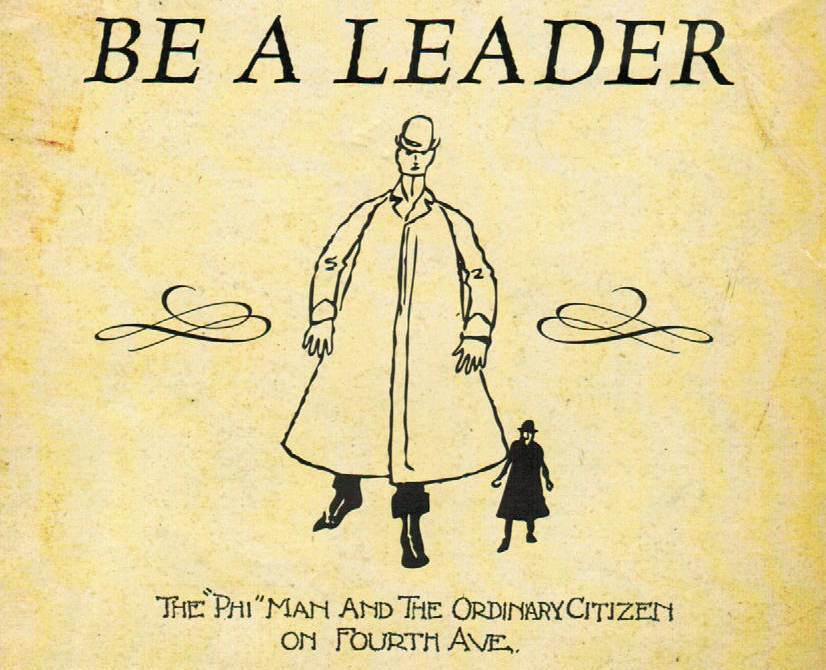
The Founders of Phi Delta Theta were respected leaders of their time and outlined for all of us a set of simple beliefs and principles which, if followed, lead to a life of honor, respect and fulfillment.
To me, living the ritual becomes instinctive, internalized and results in the creation of lifelong habits. And it begins at initiation. As President of Phi Delta Theta, I have had the opportunity of initiating and installing many of our newest chapters. And to each new chapter at the installation banquet I offer the following charge.
“When you were initiated and all signed The Bond of Phi Delta Theta, you agreed to live your lives by three simple principles – Friendship —- Sound Learning — and Moral Rectitude. I charge each of you here to remember and honor those commitments to each other. I charge the men of Phi Delta Theta to:
- To excel in the classroom to the best of your abilities.
- To sit in the front of class, engage with your professors and add to the academic discussion.
- To excel on the athletic field or performance venue– always giving your best performance and exhibiting exemplary sportsmanship and creativity.
- To engage on the campus – get involved in student government and other student organizations. To lead, not just follow.
- To engage in the local community and serve those in need.
- To not abuse alcohol, women or each other.
- Last, but not least, to act in such a manner – both collectively and individually – that all of your mothers, fathers, alumni and friends will take pride in you as a Fraternity man.
If you do that, you will have met the obligations you made when you signed The Bond.”
So, back to the “mom as judge” concept. I know a chapter is “living the ritual” when I hear from the parent of a Phi, which usually turns out to be the mother, who calls or writes to tell me about her son’s experience in the Fraternity. These messages sound like this:
“Having never been involved in a fraternity before, both my husband and I were both VERY impressed and proud to see these young men filled with enthusiasm and dedication. The fraternity has been a wonderful experience for him and I know there will be a void once he graduates this year!”
“The brothers (Missouri Eta – Missouri Western) were going to plunge anyway, but they went beyond a philanthropy project and made it VERY personal for my family. Tanner (who has a disability) is almost 18. We are trying to accept that he will never be married, he will never drive a car and may never attend college. He will never have the opportunity to be a Phi Delta Theta. These men have embraced my family and me and for that I am eternally grateful. Missouri Eta Chapter, from the bottom of my heart, I love each and every one of you. You are compassionate and caring and will ALWAYS be a blessing in my life.”
“I was admittedly apprehensive when he expressed an interest in becoming involved with a fraternity. Our family had no experience with fraternities or sororities and I had some of the typical misconceptions regarding the Greek system. His father and I gave our approval with the caveat that he must maintain a high grade point average and not jeopardize his scholarship, since he wishes to attend law school after graduation. I am proud to say that he is beginning his senior year and has retained his scholarship for all four years in large part due to the scholastic emphasis and support of the Fraternity. I have been very impressed with the level of involvement of the alumni with the undergraduates in Phi Delta Theta. They are truly committed to fostering the development of these young men and certainly stress the virtues that we all wish to instill in our sons: honor, loyalty and responsibility. Personally, I can attest to new levels of leadership and maturity in my son that I believe are directly attributable to his involvement in Phi Delta Theta.”
With time I have become less concerned with “seeing it” in terms of formal activities and more interested in understanding that the process of “living the ritual” is taking place within our chapters. When I hear from a parent with a testimonial like these – I know the chapter is “living the ritual.”
So in closing, here are a few things I believe members of Phi Delta Theta do every day to “live the ritual.”
- We care for one another and lift each other up
- We challenge ourselves, individually, to be better men every day
- We challenge each other to rise to a higher standard
- We call a brother out when he is going down the wrong path
- We don’t turn our backs on a brother in need
- We celebrate each other’s successes
- We believe in words like fraternity, honor, duty, loyalty, leadership, brotherhood, love, and compassion
- We’re not fair-weathered friends
- We take pride in identifying ourselves as Fraternity men
- We believe in the lifetime commitments we made to each other when we signed The Bond
My hope is that all of our brothers do these things – that we each strive to live the ritual to the best of our abilities – because we’re members of Phi Delta Theta – because that’s what Phi Delts do.
Brother Mietchen is the General Council President. Scott is a 1984 graduate of the University of Utah where he earned both his B.S. and MPA. He has served the Fraternity as a chapter consultant, chapter adviser, house corporation president, province president, delegate to the NIC and member of the General Council from 1994-2000 and 2004-Present. Scott became an Iron Phi in 2010. Professionally Scott is President and Managing Partner of Fund Raising Counsel, Inc. (FRCI), the oldest fundraising consulting firm in the Intermountain West. He was recognized as Fund Raiser of the Year in 2006 by the Utah Society of Fund Raisers. Prior to joining FRCI, he served as Vice President for University Advancement at Utah State University. Scott, his wife Lisa, and their children, Abby and Alex live in Salt Lake City.
The post How Do I Know When A Chapter Is Living The Ritual? A Mom Tells Me appeared first on Phi Delta Theta.
]]>The post When All Is Said And Done, Did You Say More Or Do More? appeared first on Phi Delta Theta.
]]>In his book, Seven Habits of Highly Effective People, author Stephen Covey states, “By centering our lives on timeless, unchanging principles, we create a fundamental paradigm of effective living.” I am not sure if Stephen Covey is a fraternity man, but I know for sure that this statement exemplifies exactly what is meant when people in the fraternal world say that you need to live your Ritual. As members of fraternities and sororities we have committed ourselves to organizations that were founded upon timeless, unchanging principles and because of the oath that every one of us took when we became members of our organizations, it is our responsibility to live those values all the time, every day.
Before I move forward with sharing some specific ideas of what living your Ritual looks like, let’s first make sure that we are on the same page about the definition of Ritual. I am sure, for the majority of you who are reading this blog, the first thing that comes to your mind when you hear ‘Ritual’ is some sort of ceremony from your chapter – maybe it’s your formal chapter meeting or maybe it’s your initiation. You are probably also thinking, our Ritual is secret, so how am I supposed to live that every day? Well I am not asking you to put on your robe, sing your songs, or re-enact your ceremonies on a daily basis. What I am asking you to do is to think about the meaning of your organization and what those ceremonies teach you about what it means to be the greatest version of yourself. Think about the words you recited in your oath when you committed yourself to your fraternity for the rest of your life. Think about the three Cardinal Principles of Phi Delta Theta: Friendship, Sound Learning, and Rectitude. Speaker Mari Ann Callais defines it best, Ritual = Values = You!
So now that you understand that living your Ritual means living your organization’s values that you committed to, let’s reflect on what that looks like. My good friend and colleague Scott and I have presented several times to students and professionals about this idea of living your Ritual and what it looks like. We have boiled this idea down to four key categories: knowledge, education, execution, and accountability.
Knowledge. Our Ritual is the one thing that makes our fraternal organizations different from any other organizations on campus and the values and lessons that our own Rituals teach us make our own fraternity or sorority unique from others. It is important for chapters to recognize the importance of learning about your Ritual and making the Ritual readily accessible to all of the members. Members need to embrace the mentality of learning about their Ritual not because they have to but because they want to. Again, I am not referring to just memorizing the lines, the oath, or learning the handshake. I am talking about facilitating discussions and reflections around what that Ritual teaches us about how we live. It is each of our individual responsibilities to make sure that we really know and understand what our Ritual is teaching us. If the fancy words used in your ceremonies confuse you, take some time to dissect that Ritual and interpret what it means today. Re-writing your oath into your own words will help you to gain a deeper perspective and appreciation for the commitment you have made. The very basics of being able to live your Ritual starts with your knowledge and understanding of what it is you are supposed to be living. So if you aren’t familiar with what your Ritual is telling you about your organization, the first step is to take some time to really read it and reflect on it. If you need help comprehending what your Ritual is telling you, your advisors and International staff members are a great resource to reach out to for clarification and understanding.
Education. Once you gain the knowledge of your Ritual, the next step is to make sure that your chapter is teaching the values of your Ritual to all of your members. Chapters who struggle in this category are unable to teach the values and principles of their organization, lack Ritual training, and have little to no follow-up after Ritual ceremonies are conducted. Many organizations have a post-initiation education session with their new members, but what are you doing to continue to educate all of your members about your Ritual? Why not spend 5 minutes at each chapter meeting picking a different part of your Ritual to review and evaluate as a chapter how individual members and the chapter as a whole is actually living that part of the Ritual? Take a separate line of your oath each week and as a chapter discuss it’s meaning and specific examples of how it can be lived. Remember, it’s not just up to our new initiates to understand this, but every member, so let’s be sure we are educating all of our members on an ongoing basis. Chapters who focus on education consistently train, educate, and discuss Ritual in various settings. Members feel comfortable discussing Ritual and a good deal of time is spent reflecting on what Ritual means to the chapter.
Execution. Once you have gained the knowledge and educated your chapter about your Ritual, it’s up to you and all of your members to live and/or execute the values of your Ritual. You have to “walk the walk” and put values into action. The key thing to understand about execution is that you cannot pick and choose when you want to live those values, they must become such a part of your daily routine that you don’t even have to think twice about them. They need to be just as evident on a Friday or Saturday night as they are on a Tuesday afternoon when you are in class. Think back to those three Cardinal Principles and how they can each be incorporated into your daily actions. Demonstrate your friendship by being there for your brothers when they need your help, and putting them before yourself. Dedicate yourself to sound learning, get out of bed and go to class, participate when you are there, and go up and speak to your professor afterwards. Sound learning isn’t just about getting good grades but it is staying open to new experiences and opportunities that will help you to continue to grow into that greater version of yourself, and that doesn’t end when you leave college. When making decisions about how to spend your time and money, both as an individual and as a chapter, let your moral rectitude guide those decisions. Execution is where the rubber meets the road; our Rituals are not just pretty words on papers, but a call to action and a guide for how we should be living our lives every day.
Accountability. Perhaps one of the most important aspects of living our Ritual, but often the most neglected, is accountability. I get so frustrated when I meet with chapter presidents and they tell me that there is nothing they can do about members in their chapter who are not paying dues, getting good grades, or whose behavior is destructive to the organization. “I am not their dad,” they say. Correct, they are not their dads, but they are the president of the organization and each of their members took an oath to uphold the values of their organization. It is up to the leaders, and really all members, to make sure that we are all holding each other accountable for doing what we say we will do when we join our organization. Recognizing members who are living out your values on a regular basis can reinforce accountability among your members. Each week as you review a line of your oath and discuss examples of what it looks like in practice, take time to recognize members who have demonstrated those values through their actions. This will help positively reinforce the idea of living your Ritual and help other members see how they can do that in their own lives. Additionally, when you see members behaving in ways that are inconsistent your values, you must call them out. Have a conversation; remind them of the commitment they made, help them understand the negative impact it is having on the chapter. So often we get caught up in the rules and policies and only holding members accountable for those. Don’t get me wrong, those are important, but remember: our Ritual is the blueprint for the success of our chapter and its members, so let’s start incorporating that into standards meetings and conversations.
At the end of the day it’s important to remember that we made a lifetime commitment to living our Ritual when we were initiated and that doesn’t end when we graduate from college. As a Phi Delt, friendship, sound learning, and rectitude should always be the principles that serve as your paradigm for effective living. Our Ritual is not just words on paper to be memorized or recited once or twice a year. If we are really members of our organization we have to put those timeless and unchanging principles at the center of our life every day.
One of my favorite quotes is “when all is said and done, did you say more or do more?” The future of your fraternity and our Inter-fraternal community depends on your ability and willingness to DO more. It is time for us to stop just saying we stand for these values and actually demonstrating them through our actions every day. Let’s start living our Ritual!
Rachel Westra Marsh currently serves as the Director of Greek Life at the College of Charleston, previous to that she served their community as the Assistant Director of Greek Life for two years. She is originally from Virginia, where she completed her undergraduate studies at Virginia Tech. She spent two years working as a National Consultant for Chi Omega Fraternity before she returned to school to pursue a Master’s Degree in Higher Education and Student Affairs at the University of South Carolina. While pursuing her master’s degree, she served as the graduate assistant for Greek Life as well as Assistant to the Associate Vice President for Student Affairs. Rachel has experience working with NASPA’s Knowledge Community for Sorority/Fraternity Affairs and has given presentations and facilitated at a number of fraternity and sorority conferences. She also serves as a volunteer for Alpha Chi Omega, Beta Theta Pi, Chi Omega, and Sigma Alpha Epsilon.
The post When All Is Said And Done, Did You Say More Or Do More? appeared first on Phi Delta Theta.
]]>The post Building Your Career Through Our Values appeared first on Phi Delta Theta.
]]>My years in college were some of the most enjoyable of my life. It was where I gained my independence by living on my own, developed lifelong bonds of friendship and brotherhood through the Fraternity, developed leadership skills through intercollegiate athletics and involvement in campus life, and gained a love and appreciation for learning. In college, I laid the foundation for my career by working my tail off, but also by playing just as hard.
A healthy balance of hard work and play was important to my success. Those years of extraordinary personal growth and development of my mind, soul, and friendships prepared me for the next phase of my life. Phi Delta Theta’s values of friendship, sound learning, and rectitude were the building blocks to my success.
Friendship
You need others to develop and grow your career. You can’t pull this off alone. The ability to develop and grow your network of friends will provide you with multitudes of people who might help or add value to your career development. The mastery of the Fraternity’s value of friendship has the ability to make you wildly successful in the development and growth of your career.
There is one thing that successful people have more than the average—they have greater networks. The secret to success in any contact-dependent profession (i.e., any career where you have to deal with people – almost every career) is the ability to initiate contacts with prospective buyers on a consistent basis. This simply means that if you are developing your career, looking for a job, applying to graduate programs, the more contacts that you initiate with prospective buyers of your talents (employers), the more opportunities that you will have before you. This also applies to making contacts or making yourself visible to others who have networks of friends who could help you. For example, let your chapter brothers know that you are looking for a job or an opportunity. You never know, one of them may have a father, mother, aunt, uncle, or a family friend who might be looking for your talents or willing to help you grow your career.
Being a member of a fraternity, especially Phi Delta Theta, provides an incredible advantage. Building friendships, both in quantity and quality, will expand your networks and opportunities as you develop and grow your career. Whether you are cultivating friendships within the chapter or learning how to recruit prospective members, you are initiating contacts with others and building your personal network. While the Fraternity provides a strong foundation for your professional network, it is very important to expand your contacts beyond Phi Delta Theta. This not only helps your chapter in recruitment and enhancing the chapter’s visibility on campus, but it expands your friendship base and personal network to realms that may become valuable to you in the future as you grow and develop your career.
Many of the best employment opportunities are identified and pursued through relationships. The more people you know, the more opportunities tend to come your way. Relationships are at the core of business in any sector (for profit, nonprofit, or government). People hire or do business with people. Your first step in any job hunt is to make contact with prospective employers. Your network can help open those doors.
Sound Learning
Learning is the primary reason that you and your family are investing time, money, and resources into four or more years of higher education. As you transition into a career in a global marketplace, the competition is fierce. If you aren’t technically prepared with a good foundation of knowledge in your discipline, you are already at a disadvantage. You certainly don’t have to be a 4.00 student to be a successful in your transition to a career, but you do have to be competent.
Employers and better graduate school programs look for candidates who are technically competent; however, there is a differentiator that will significantly enhance your chances of landing that pivotal first job or getting into a top graduate school. That differentiator is the ability to communicate, in writing and verbally, and the ability to convey a sincere love of learning.
Poor writing skills are the easiest way to eliminate a candidate in a competitive marketplace. Most employers will assess writing skills in your resume or through writing samples. One of the most important courses that you can take as you prepare for your career is a technical writing course. The ability to write in a cogent, concise manner will serve you well to not only land a good job, but to propel you through a successful career.
Employers invest in people in order to develop their talent and to hopefully yield a return on investment. This means that employers, as well as graduate and professional schools, look for candidates who have a love of learning and who will be self-motivated to continually improve and reinvent themselves. My business is very different today than it was five, fifteen, and twenty years ago. My employees and I have had to learn new techniques, technologies, and processes to remain relevant in the market. As an employer, I love to invest in people who have the ability and desire to learn and grow because their innovation “innovates” our business, allowing our firm to succeed and thrive in a competitive market. The easiest way to develop this desire and love of learning is to find a career path or profession that you love. If you become passionate about something, you will love to learn about it.
Rectitude
Once you have made contact with prospective employers or individuals who can help progress your career, you must have something of value to offer. Sound learning should take care of this requirement. However, one more critical element will make or break your career growth and development – that is your integrity. People hire and invest in individuals that they like and trust. Simply put: you are only as valuable as your reputation.
Your judgment and actions shape your character and reputation. Decisions that you make now will stick with you for some time. The Internet and social media often memorialize and make very public both good and bad decisions. Make good decisions; do the right thing; always treat everyone with respect; and guard your reputation. Unimpeachable rectitude will make you an attractive candidate for future employers or business associates.
Chris W. Brussalis is Member-at-Large of the General Council. Chris is President & CEO of The Hill Group, Inc., a national management consulting firm and Adjunct Professor of Management and Policy at the Heinz College of Carnegie Mellon University.
The post Building Your Career Through Our Values appeared first on Phi Delta Theta.
]]>The post We Have Work To Do appeared first on Phi Delta Theta.
]]>When I tell people I’m a fraternity and sorority advisor, I receive several reactions. Whether that’s a look of shock and horror or comments like, “That’s a full time job?” I’ve pretty much heard it all. My least favorite response is, “So you help fraternities plan parties?” I respond simply with,
“No, I don’t have time for that.”
In 2006 I was a senior at the University of Illinois attempting to figure out what I was going to do with my life. I loved being a history and anthropology major and thought a museum might be the place for me. However, I couldn’t shake the nagging feeling that I needed to do something that would make a difference in the world. Cue the entrance of my Greek advisors. I remember sitting with them, asking why fraternity and sorority members say they believe in something when our actions are far different. And they simply said, “Have you thought about advising?” My world changed, and I never looked back.
I didn’t become an advisor because Greek Week was awesome or because my sorority made cool shirts or because I wanted to help fraternities plan parties. I don’t have time for that. I became a fraternity and sorority advisor because we have work to do. A lot of it.
Fast forward five years, and you’ll find me at the University of Oregon where I have the privilege of working with a community that is willing to think. There are a couple key parts to this statement. First, my job is a privilege. I get to spend my days supporting and challenging students in their growth, and I’m lucky enough for those students to be members of an experience I deeply believe in. Second, the ability to think is crucial and often seems rare to locate. In lower levels of the college environments, students are taught to memorize facts. Hopefully by junior and senior year students have moved into the realm of contemplating and engaging their coursework. Often this is leading to shifts in beliefs or attitudes. The ability to think, ponder, wonder, dive deep into possibilities – that is what we often lack in the fraternity and sorority world. In so many unfortunate ways, our membership has taught us to respect tradition so highly that we’ve lost our ability to question it.
Now this is why I am a fraternity and sorority advisor! I have endless amounts of time to work with students, collegiate chapters, inter/national organizations, alumni and colleagues across the country who are ready and willing to engage in critical thinking about the fraternal experience. I would venture to guess most fraternity and sorority advisors feel this way. Survey advisors across the country about their daily activities. What you’ll find is most spend their time acting like emergency room doctors. Major injuries come in, the doctor stops the bleeding, fixes as much as possible and moves on to the next patient. The problem is that no one goes to the emergency room because they’re healthy. So if the majority of an advisor’s time is consumed in the emergency room, they are rarely able to leave the hospital and encourage people to stay healthy. What I’m saying is that if the dysfunction in our fraternity and sorority communities takes nearly all of an advisor’s time to deal with, there’s nothing preventing the high performing chapters from falling among the rest. We need to spend more time among the healthy encouraging them to prosper than fixing the wounds of chapters that live high risk lifestyles. We simply don’t have the time for that.
Earlier I said I became an advisor because we have work to do. So let’s get working! As undergraduates, alumni, headquarters staff and campus-based professionals, it’s time for us to start asking some tough questions. What do we want this experience to be? What purpose can we serve? How can we change the world? It’s not always about how we were founded – it’s hard to make a personal connection to our founders when some of them lived over 200 years ago. It’s about exploring what fraternity could be in light of tomorrow’s student. Easier said than done, and I don’t have a solution. What I do know though, is we have an opportunity to engage undergraduates in a critical conversation about what they’re experiencing. I don’t think we give enough credit to the abilities and brilliance of today’s student to move mountains when given the chance. We also have the opportunity to engage an incredibly optimistic population in the world of possibility. What if fraternities and sororities could ____? Let’s let our undergraduates fill in the blank and then help them realize the potential. It’s time to “live with a healthy disregard for the impossible.”
We don’t have time to talk about parties anymore. And we certainly don’t have time to “do things as they’ve always been done.” But we have endless amounts of time to create something new and like a phoenix, to rise from the ashes a reborn and meaningful experience. I became a fraternity and sorority advisor to engage in the conversation, so let’s do work!
Annie Carlson serves as the Fraternity and Sorority Advisor at the University of Oregon. A 2007 graduate of the University of Illinois, Annie went on to receive her master’s degree in higher education from Florida State University in 2009. Annie volunteers for the Association of Fraternity/Sorority Advisors, Oregon Women in Higher Education, the National Association of Student Personnel Administrators and Beta Theta Pi Fraternity. In her free time, she enjoys spending time with friends, traveling (A LOT!) and hunting down the perfect glass of red wine.
The post We Have Work To Do appeared first on Phi Delta Theta.
]]>