The post Twenty-Five Years Alcohol-Free: Reflections of Phis Who Led the Change appeared first on Phi Delta Theta.
]]>For some, it was controversial. For us, it was defining. Twenty-five years later, the students of today have never known Phi Delta Theta any other way. To reflect on this transformative moment, we sat down with members across generations—undergraduates, chapter leaders, alumni volunteers, and staff—each offering a unique perspective on what this change meant for them and for the Fraternity as a whole. Together, their stories capture how the entire organization played a role in shaping the organization we know today.
“We saw that 75 percent of our undergraduates were underage. And what we were doing as a fraternity and as a Greek system, we were providing places for them to break the law. And we decided that that wasn’t something we wanted to do. Fraternities and sororities are the only organizations on a college campus that have a pledge or take an oath to be better than the average student. And so we felt that there was something better out there. We wanted to provide a better opportunity, a better chance for learning what the Fraternity is all about, rather than having alcohol be the important factor.”
—Bob Deloian, General Council President, 1996–98
“You know, I think the one thing about Phi Delta Theta that is so unique is that we have a long history of adopting change initiatives that are industry-leading and make us who we are, and we’ve been able to embrace those differences. We’ve been able to implement those differences, and we’ve done so fearlessly.”
—Tom Balzer, Program Coordinator of Alcohol-Free Housing, 1997–2001
Because of alcohol-free housing, “The other key things that I’ve seen, growth in the Fraternity, recruitment numbers went up. Our insurance costs, as the broker and as the staff member at the time in charge of that, had a dramatic reduction. If we look now, today, our frequency of claims is down about 67 percent, and the severity of claims is down about 68 percent.”
—Marc Mores, Director of Chapter Services, 2000–04
“There was a lot of positive feedback, because you have to realize, you know, prior to, say, the late 1960s, our fraternity houses were alcohol- and substance-free, and they were like older alumni saying, ‘You finally figured it out. You’re getting back to the core principles of a fraternity: Friendship, Sound Learning, and Rectitude.’ As I like to tell people, reporters in particular, we’re getting out of the bar business, and we’re getting back into the fraternity business, and that was successful.”
—Bob Biggs, Executive Vice President, 1991–2016
“We wouldn’t be where we are without alcohol-free housing. It changed the quality of our members. It changed our parental engagement. It changed the university engagement and changed our alumni engagement. It helped us improve our chapter houses and helped our members focus more on what a fraternity is supposed to be. Nothing would be possible today, or we would not have the success we’re having today, without alcohol-free housing.”
—M. Scott Mietchen, General Council Reporter, 1998–2000
“When I went through recruitment in 1998, alcohol-free housing was a huge selling point for me to join the organization. When I saw the facilities and knew that it would be a safer and cleaner place, it really attracted me as an undergrad to want to join the organization, particularly since the other fraternities on my campus were not alcohol-free.”
—Joe Morel, initiated 1999
“I think it’s important to remember that the organization is what we’re here to protect in the long run. And being alcohol-free means the ideals of the organization can come to the forefront of everything that we do. From volunteering in the community to being a more impactful community member to being more academically driven and focused, it can really shift an organization to that perspective when alcohol isn’t the culture anymore.”
—Phil Cantrill, initiated 2000
“The policy was meant to reduce harm, to basically stop providing a mechanism for undergraduate members to hurt themselves. So, we’re twenty-five years down the line in enforcement. The reason the policy works is because when [a violation] comes to light, there’s rigorous enforcement, meaning we’re removing officers, we’re engaging in education, putting disciplinary controls on a chapter of social probation, then if necessary, charter suspension.”
—Rudy Porchivina, General Council Member-at-Large, 2000–02
“Phi Delta Theta has been able to initiate big strategic plans like Phi Delt 2020 and Phi Delt 2030 and live our values by doing big things to serve our communities. This includes our partnership with the Gruver Foundation and the advent of our Taking a Stand, high school education program, and the creation of the Iron Phi Foundation and the Live Like Lou Foundation. These efforts allow us to live our values in taking on causes a lot bigger than us. Because we’re focusing on our values, and not on our problems, we can focus on delivering best-in-class leadership programming, funding transformational scholarships, and investing our resources in those things.”
—Sean Wagner, chapter president, 2000–01
“We survived twenty-five years where some people thought we might last five by going alcohol-free housing. We proved some of the challenges that we have that we could overcome, and we can sell the idea, and people were willing to join an organization that had alcohol-free chapter houses. The one thing we challenged with people, that doesn’t mean we’re an alcohol-free fraternity; it means our chapter houses are alcohol-free. People can still join, they can still drink, and still have a good time if that’s what they want. It’s just not going to be in our chapter facility. So, I think the biggest thing is we’re still here; we’re still a viable group. [Alcohol-free housing is] a selling point on some campuses when we’re doing expansion presentations.”
—Charley Pride, General Council Treasurer, 2000–02
“Every one of our chapters doesn’t have to be alcohol-free, but they get to be alcohol-free, and there’s an important distinction there. Our chapter houses are our boardrooms. They’re our offices, our places of residence. And keeping that clean and organized is a heck of a lot easier when you’re not throwing humongous parties there. It’s pretty nice to visit a campus on parents’ weekend and not have your feet sticking to the floor. It’s pretty nice to bring a partner or prospective partner to your place of residence, to your fraternity house, and not have the place smelling like a barn. These are just general things that accompany our commitment to alcohol-free housing.”
—Dave Kovacovich, Chapter President, 1996–97
“But for me, specifically as somebody who was leading a group of men, having to wrap my head around fraternity without alcohol in the chapter house, and then communicate that [to others] . . . so navigating not being hypocritical, and making my own choices and what that means—there was a lot there, that I grew a lot during those couple of years.”
—Moe Stephens, Chapter President, 1996–98
“The greatest challenges [of implementation] were actually getting some of the alumni on board. When you think about it, you know, back in the late 1990s and early 2000s, when there would be homecoming games, tailgating generally, they were starting at their fraternity houses. Some fraternity houses were right there by the stadium. And of course, what was there? Alcohol. So that had to stop, and there was a lot of pushback from the alumni until they got used to not being able to have it on the property. And for the undergrads, their biggest problem was that a lot of the more recent alumni would show up at the house with a case of beer or something, and it was difficult to get them to say, ‘Hey, brothers, we can’t have that anymore in here. You need to remove that and take it outside.’”
—Mike Scarlatelli, General Council Member-at-Large, 2000–02
“And as a chapter president, I was terrified. After going to leadership conferences and such and learning about risk management and my own responsibility, if something were to happen under my watch, I would not want to be responsible for that. And so we did everything in our power to make sure that folks were safe at our own parties. And so I sort of think back about that, and then the plight of current chapter presidents and future chapter presidents and the quality of our membership. You know, if we were recruiting based upon actual brotherhood and Sound Learning and Rectitude and what it meant to be a family on campus who enjoyed social activities, certainly. But if all we shared was alcohol, then that wasn’t really a brotherhood in my mind.”
—J. David Almacy, Province President, 1996–2005
The post Twenty-Five Years Alcohol-Free: Reflections of Phis Who Led the Change appeared first on Phi Delta Theta.
]]>The post Six Tips For A Successful And Safe Spring Break appeared first on Phi Delta Theta.
]]>Ah, Spring Break. A time to relax, enjoy, and spend time with brothers before heading back to school for the dreaded end of the semester. For many of you, this week may be your favorite time of year, and most of you are likely embarking on some type of Spring Break adventures. Some of you are probably heading home to spend time with your family, while others may be volunteering for an Alternative Spring Break Program. But chances are, most of you are quite possibly heading somewhere close to a beach, hoping to have the best week of your lives.
While Spring Break can make for some of the most memorable and fun times of your college career, it can also be one of the most dangerous weeks in the life of a college student. While I want to tell you to alternate your drinks with water (and you should), I want you to consider that there are many practical ways to keep yourself and your brothers safe during your Spring Break activities, whatever they may be. We want you to have fun, but we also want you to protect yourself and your brothers as much as possible.
Use the buddy system
While this may sound like something a third-grade teacher once told you, one of the best ways for you to stay safe this Spring Break is to make sure that you always have someone with you. When you’re traveling with a large group, it can be easy to lose track of people. The best way to avoid losing your group is by always having a buddy. Before you leave town, download the Find My Friends app so you can always keep track of each other.
Track your consumption
The average male consumes 18 drinks per day during Spring Break, which for most of you, could be potentially very dangerous. Consuming this amount of alcohol can lead to alcohol poisoning and unintentional injuries, which is the leading cause of Spring Break incidents for men. Realistically, I know it’s unlikely that you will count the number of drinks you’ve had, but there are many apps that will track your drinks and calculate your BAC for you. Try downloading InteiliDrink or R-U-Buzzed to help keep track and keep you safe. The goal is to never get yourself into a situation where you are not aware of your surroundings or your actions, so tracking your consumption is key.
Don’t “do it for the snap”
In fact, you’re better off not posting what you’re doing on social media at all. Doing something risky to show off on social media may seem like a clever idea at the time, but trust me when I tell you that this is never a good idea. What happens on Spring Break doesn’t always stay on Spring Break, especially if you ‘re sharing it with the world.
Ask for consent
If you take nothing else away from this post, I hope that you will remember that before you engage in any activity this Spring Break, the best way to protect yourself is to ask for consent. A recent study showed that women’s two biggest concerns when attending Spring Break activities were 1. Being taken advantage of and 2. Being drugged. Trust me when I tell you that women go away for Spring Break to relax and have fun, but women want things to happen on their own terms. Regardless of what someone is wearing or how they are acting towards you, you must always respect peoples’ boundaries. The best way for you to protect yourself this Spring Break is to always ask for consent.
When in doubt, intervene
If you see a situation where your brothers or someone else is at risk, intervene. This could be directly stepping in or even just causing a distraction – anything to allow the situation to take a turn for a more positive outcome. The bystander effect is in full force during Spring Break, but it’s on us to make sure that we’re looking out for the people around us. If you feel you can’t directly intervene, the best thing you can do is report what you saw or heard and ask someone else to step in.
Do what ought to be done
My final piece of advice to you this Spring Break season is that if you consistently refer to the principles of Phi Delta Theta, you can’t go wrong. When you are in a situation that calls for action, step up and be the man who takes responsibility. We want you to have a fun Spring Break, but we also want you to have fond, positive memories that you can look back on for years to come. At the end of the day, as you’ve heard repeatedly, do what ought to be done.
The post Six Tips For A Successful And Safe Spring Break appeared first on Phi Delta Theta.
]]>The post The Evolution Of The Modern Fraternity appeared first on Phi Delta Theta.
]]>The Dark Power of Fraternities, written on February 19 by Caitlin Flanagan of The Atlantic, caught the attention of the leadership and general membership of Phi Delta Theta Fraternity. While we are very aware of the issues that remain within the walls of fraternities, specifically alcohol-abuse and hazing, Phi Delta Theta and its bold leadership has long been making tough decisions to address them.
No parent, who has the highest hopes when their son or daughter attends college, entering the prime of their life with every good experience yet to come, should have to bury a child. Having said this, society today has become less tolerant of the behavior referenced in the article, especially when it leads to the unthinkable. Understandably, rare instances of death, injury and stereotypical behavior will always make the front page. However, it is unfortunate that positive stories about community service, philanthropy and acts of brotherhood that occur every day are either overshadowed by the bigger, more sensational story or ignored altogether.
Phi Delta Theta introduced an Alcohol Free Housing policy in 1997 with these growing concerns in mind. There was a three-year phase-in period and an implementation of the full policy on July 1, 2000. When this policy was introduced, many skeptics believed that this was the end of our organization. Many predicted the organization’s doom in five years. However, today I’m proud to report that the policy is having a tremendously positive impact, disproving our naysayers, and placing Phi Delta Theta in a much better state today than prior to this groundbreaking decision.
In the early 90s, Phi Delta Theta experienced two undergraduate member deaths. Such moments were incredibly troubling for my predecessors on our Board and they understood that they needed to tackle an issue that was bigger than just Phi Delta Theta. Their solution was to return to the values established by our Founders in 1848 and focus on the Fraternity’s three Cardinal Principles: Friendship – the cultivation of friendship among members, Sound Learning – the acquirement individually of a high degree of mental culture, and Rectitude – the attainment personally of a high standard of morality.
As Phi Delta Theta chapters and its members drifted away from the Fraternity’s true purpose and the vision of our Founders, and upon reflection of our Cardinal Principles, it pointed to a need to realign the organization’s values and actions. Such realignment occurred with the help of Alcohol Free Housing.
Once the organization’s leadership made the decision to move forward, seven goals were established alongside the institution of the Alcohol Free Housing policy: 1) return the focus to our founding principles, 2) combat an alcohol-dominated culture, 3) improve members’ academic performance, 4) stop the deterioration of chapter facilities, 5) slow the rising cost of liability insurance, 6) meet the needs of today’s college students with substantial programming and leadership education, 7) reengage our alumni members.
The return to our core values and the implementation of Alcohol Free Housing has produced overwhelmingly positive results for Phi Delta Theta and the 188 campuses where we exist. We have discovered that many students seek a values-based experience from their fraternity. From 2000, when the policy was fully implemented by all of our chapters until today, we’ve experienced a 41.37% increase in the number of new members who join our organization each year. Our total number of undergraduate members has increased 38.64%.
From a competitive standpoint, our average chapter size is 64 members, the second highest among all fraternities and up from 49 in 2000. The national average hovers around the low to mid 40s. From a chapter growth perspective, we have installed or reinstated 64 chapters since 2000. During the 2012-13 academic year, we installed eight new groups with an average size of 45 new members. We are on pace to do this again in 2013-14.
Sound learning has also improved as the organization’s collective GPA is at 3.01, up from 2.73 in 2000. In addition, our members are making smarter decisions outside of the classroom that keep themselves and their brothers safe from high-risk events. The best way to measure this success is by evaluating the number of incidents that might manifest themselves into insurance claims. We averaged 12.3 alcohol-related insurance claims per year prior to 2000 with an average annual payout of $413,378. Today, we average 4.9 claims a year with an average annual payout of $23,877. The average number of annual claims has decreased 60.5% and the severity of payout has decreased 94.2%. Because of this, our liability insurance costs have dropped substantially, thereby, offering a much more affordable and safer experience to our members. Today, the average per member insurance rate for fraternities is approximately $160 per member; our rate is less than half that at $74 per member.
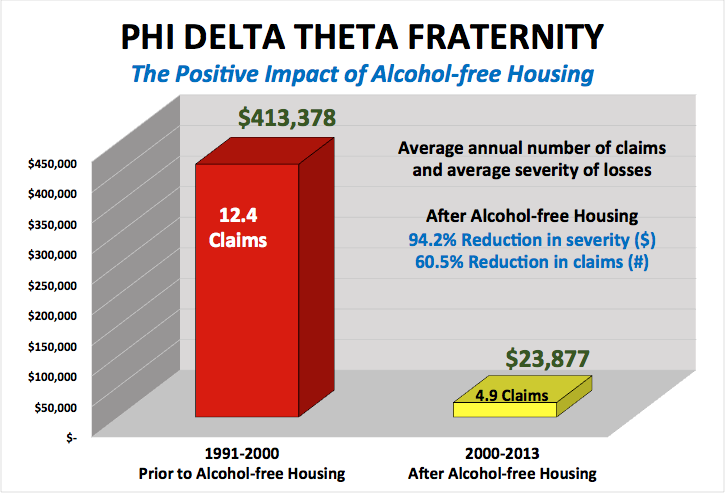
Our alumni have quickly noticed the difference in our organization and have returned to be involved as advisers and mentors. In 2000, we had approximately 200 advisers. Today, we have 885, a 342.5% increase. Because of the positive effects of Alcohol Free Housing, alumni are more comfortable providing both their time and treasure. Additionally, alumni giving is at an all-time high. In 1990, our Foundation raised just over $494,000; in 2000, just over $1.08 million. This past year, $3.65 million was raised to provide valuable educational programs and financial assistance to our members in the form of undergraduate scholarships and graduate fellowships.
More than anything, I believe that by removing alcohol from our facilities, we have been able to focus on things that make us a better organization. While we concentrate a great deal on risk management education, our volunteers and staff no longer regularly focus on incidents involving alcohol. We are now able to broaden our focus to other progressive programming for our members.
While we will be the first to admit that we are certainly not perfect, we are extremely confident about our direction, decisions, and leadership, and we remain committed to tackling the tough issues that currently face our organization and our members. Most importantly, we are proud of our members and their support in helping our Fraternity become the greatest version of itself.
The post The Evolution Of The Modern Fraternity appeared first on Phi Delta Theta.
]]>The post Five Key Points When Planning Events Where Alcohol Will Be Present appeared first on Phi Delta Theta.
]]>Alan: “I tend to think of myself as a one-man wolf pack.” – The Hangover
Mixing brotherhood and alcohol happens every day on college campuses across the country. Often times, our brothers fail to appreciate the fact that their own “one-man wolf pack” actions and decisions do impact our Fraternity. The choices surrounding your own personal alcohol use are yours to make, but you can have a positive impact on the safety of your brothers when you consider these five key points when planning events where alcohol will be present.
1. Location
Deciding where to host a social event or where to hang out with your brothers is of utmost importance. Ideally, should you choose to drink alcohol, you would do so in an establishment that is properly licensed to sell alcohol. The venue would absorb the risks of controlling, selling, and serving the alcohol. When spur-of-the-moment or even planned events occur elsewhere (i.e. a brother’s apartment), you and/or your chapter could be liable for the events that take place. Just this year we have seen an intoxicated fraternity member shoot a bottle-rocket out of his rear end and a group of sophomores use a water balloon launcher to hit unsuspecting targets all in the name of fun but end with severe injuries and unintended consequences.
2. Transportation
Many chapters are using designated driver or safe-ride programs to address this key exposure in today’s Greek community. These programs are a strong attempt to ensure brothers get home safe. Unfortunately, no matter how well-intended, there have been a variety of significant injuries and even deaths when these programs do not strictly adhere to their design. The best choice is to use public transportation for those events that occur more than 10 miles away from your campus. Members who choose to drive themselves and others in their personal automobiles must understand they do so at their own risk as no insurance coverage is available to them for this exposure.
3. Beverages
At events, chapters should never provide alcohol for their own members or for guests. Using chapter funds or passing the hat violates the Fraternity’s risk management policies. Remember to avoid the use of hard liquor and the mixing of energy drinks with alcohol. If you decide to not use a third-party vendor, each person should bring their own beverage of choice. Given that the clear majority of collegiate fraternity and sorority members are under the legal drinking age, Chapters should offer alternatives to alcohol such as complimentary bottled water or other appropriate beverages. Food at any event is a welcome addition but you want to avoid salty foods whenever possible.
4. Pre-Gaming
Pre and post event activities are commonly misinterpreted as the time where no rules apply. Phi Delta Theta’s risk management policies do not come with a time clock or an expiration date. Each member is expected to understand, comprehend and adhere to the risk management policies at all times. If you are unclear ask the chapter’s risk management chairman, president, or a local adviser to review them with you. Younger members commonly use this time to binge drink prior to the registered or planned events. Big brothers or pledge dads should help monitor these activities and step-in when necessary to ensure all members avoid this risky behavior and stay safe.
5. Event Planning
Phi Delta Theta General Headquarters offers assistance in planning your events to ensure your chapter is in compliance with the rules and regulations of the Fraternity. The Headquarters staff offers feedback to assist chapters in planning safe events that reduce the potential for loss. Contact the Phi Delta Theta General Headquarters or visit www.phideltatheta.org for additional information. You can also visit www.jrfco.com for risk management resources.
While you may get a good laugh out of characters like Alan from The Hangover, repeating the antics you watch on the big screen can lead to real world consequences. Remember to not let today’s fun turn into tomorrow’s evidence.
The post Five Key Points When Planning Events Where Alcohol Will Be Present appeared first on Phi Delta Theta.
]]>The post Fraternity Men Who Choose Not To Drink – A Misconception appeared first on Phi Delta Theta.
]]>Full disclosure: I have never had an alcoholic beverage. That being said, you’re probably wondering why someone who has never had a drink is writing about alcohol awareness. Just as there are misconceptions associated with alcohol, there are misconceptions surrounding those who choose not to drink – misconceptions that, when cleared up, can help us to build a stronger, healthier brotherhood.
When others learn that I’ve never had a drink, often times they rush to figure out why I “condemn” alcohol and those who choose to drink. It can be frustrating to be written off at times for my choice to not drink. What they find soon after, however, is that it’s just that, a personal choice. I look forward to going out with my friends and having a good time. Being sober doesn’t keep me from having a good night out, and by no means do I expect others to make the same choice to abstain from alcohol.
I’ve seen fraternity chapters, however, where a schism has appeared. This level of mutual understanding either hasn’t developed or has gone by the wayside. It becomes a battle of those who enjoy a drink versus those who choose not to – a battle of brother versus brother. One group begins ostracizing those who “are irresponsible”, while the other group starts judging those who “hate fun”. As brothers, neither group is in the right.
This rough relationship is all too often the result of a lack of accountability and a consequence of knee-jerk reactions. As we’ve frequently heard, alcohol awareness in fraternities is a matter of taking ownership of your actions and the actions of your brothers. What does it say about our brotherhood if, instead of choosing to come together and find a middle ground, we choose to draw party lines?
There’s nothing more powerful than having a real one-on-one conversation and letting a brother know that you care about him. How often do instances of a brother going too far with his drinking end with a genuine conversation with him the next day? Instead, how often is that brother pushed aside, talked about, or taken to the judicial board? My hope is that we, as brothers who choose not to drink, can have these conversations and show concern without ever condemning our brothers or pushing them to the side.
And, on the other end, how well are these conversations, when they do happen, received? This is where I’d like the misconception about those who don’t drink to be cleared up. It’s not that those who choose to not drink see themselves differently. There isn’t a holier-than-thou attitude that comes with this choice. Instead of seeing these conversations with your brothers who don’t drink as someone’s attempt to levy judgment on you, do you see it as an authentic display of care and compassion?
I know that we can reach this level of mutual respect. It’s tough to sit down with a brother and let him know that you’re concerned when his drinking caused him to go a little too far. I can only imagine how hard it is to be on the other end, choosing to listen and take what he’s saying to heart. It’s this level of understanding that allows us to foster a true sense of brotherhood.
Brother Boulter joined the GHQ Staff as an Expansion Consultant in 2012 after graduating from Kettering University with a degree in Electrical Engineering. While at Kettering, Michael served his chapter, Michigan Delta, in a number of roles. Guided by his work as President, his chapter won the Kettering President’s Cup in 2011. While serving as Recruitment Chairman, he completely revamped his chapter’s recruitment program, which led to their largest pledge class in 20 years. Michael was a delegate to both ELI and PLC and returned to both conferences the following year as a Peer Mentor. Outside of Phi Delta Theta, he was President of the Running Club and Recruitment Chairman of IFC, a position in which he was recognized as the Officer of the Year. Being an Iron Phi, Michael is an avid runner with a 5 year “running streak.”
The post Fraternity Men Who Choose Not To Drink – A Misconception appeared first on Phi Delta Theta.
]]>The post A Deeper Look Into Alcohol Awareness appeared first on Phi Delta Theta.
]]>I’ve never agreed with the formal definition of ‘binge drinking,’ I think it limits the debate and understanding of what problem drinking really is. The CDC defines binge drinking as four or five drinks in two hours. A few weeks ago I went to a baseball game with my father. Throughout the game he and I had two 16-ounce beers each. After the game we went to a bourbon bar across the river and each had a glass of bourbon, maybe an ounce apiece. I’m sure that by official definition my father and I were both binge drinking that evening. My father is in his 50’s, and baseball, beer and bourbon is just an interest we both share. And I am not about to tell a successful, healthy, 50-year-old man that having some drinks during and after a baseball game with his son is a bad idea. Neither of us were reckless that evening. And it’s not like as soon as we crossed the threshold of that fourth drink that we all of a sudden were exponentially more likely to do something ridiculous, like heave hotel furniture off a fourteenth floor balcony. Even if we did decide to end our evening by throwing hotel furniture off of a fourteenth floor balcony, I can assure you that our decision to do so was heavily influenced by something other then the few drinks we had at a baseball game.
To often do I feel that Alcohol Awareness is accompanied by terms like “binge drinking” and other numbers and statistics used to describe the habits of college students. When we bombard students with these numbers it is easier to ignore them, then to try and decipher their meaning.
I think we need to change the way we think about what alcohol awareness is and what problem drinking really means. Alcohol Awareness is not shouting numbers and stats at students. And though that may not be it’s intent, as a recent college graduate I can promise you that’s what it can feel like. Alcohol Awareness needs to be used as a platform to facilitate some sort of internal dialogue with each individual student. The problems that students experience due to their alcohol consumption cannot always be defined by numbers, rather, they are defined by actions.
When I was in college I was a serious problematic drinker. But because of these numbers it was easy for me to watch the behavior of my peers and decide that my drinking, in fact, was not problematic. Everyone around me was drinking the same as I was. What I failed to recognize was that though I was drinking just as much as everyone else I knew, alcohol had a different effect on me than others. One particular quarter my behavior had gotten so out of hand that a friend actually sat me down and told me that he felt I had a drinking problem. I thought about what he was telling me and again I found myself going back to these numbers. Yes, by textbook definition I had a drinking problem, but, by text book definition so did he, and so did the rest of my friends. So why was I being singled out? Through some serious self-evaluation, I realized what he was actually saying. He wasn’t coming to me saying, “Jake, you have a drinking problem and if you’re not careful you could become an alcoholic and die.” What he was saying was “Jake, you have a problem, and when you drink you turn into a punk and a jerk and no one wants to be around you anymore.” If we think about what college students experience as a result of their excessive drinking–vomiting, fighting, drunk driving, drunk texting–we can all agree that these are problems that occur when we drink. Rather then trying to convince college students that problematic drinking is related to the number of drinks they have and the frequency at which they have those drinks, we need to get each student to ask one single question. “Do problems often occur when I drink?” The answer to this question is the definition of problem drinking.
My advice to everyone–students, parents, college administrators, siblings and friends–if there is an individual you are concerned about, do not approach them and use these terms. Because trust me, they’ve all heard it before. Speak their language and give them hard evidence, evidence they cannot ignore or deny. If they are the type person that ends up crying in the corner of every party as soon as they get drunk, that is a problem. If they continually get drunk and decide that it’s a good idea to punch something in the face, that is a problem. If they get drunk and embarrass themselves by trying to sleep with every person that crosses their path, that is a problem.
Alcohol Awareness is taking ownership over your own actions as well as the actions of your peers. It is about eliminating problematic drinking by utilizing the personal relationships we have with one another. And finally it is about creating a better, healthier, safer community on each individual campus. A community where individuals take an active role in the fight against alcohol related harm.
As a 2011 graduate of The Ohio State University, and a member of Delta Tau Delta Fraternity, Jake has just stepped out of unique world that is Fraternity and Sorority Life. Throughout his college career, Jake constantly found himself in harmful situations due to his alcohol consumption. Since graduating, Jake has given his time and efforts to figuring out why he continually put himself in harms way and how could he have prevented many of the tragedies he experienced. Jake is now a speaker for CAMPUSPEAK and has devoted his career to speaking to college students about their alcohol use and how to reduce alcohol-related harm.
The post A Deeper Look Into Alcohol Awareness appeared first on Phi Delta Theta.
]]>The post Underage Drinking And The “Over Aged” appeared first on Phi Delta Theta.
]]>I’ve been asked to write a few articles and blogs since becoming an alcohol awareness speaker. I always find I do my best writing in the airport. So hello from Denver International! I don’t know if it’s the 12 dollar wraps, automatic flush urinals, or the 9 passenger horn-honking golf carts that inspire great writing. Or maybe it’s the fact that this is the only time that I can focus with absolute 100% concentration without the distractions of everyday life. When you have a 3 hour layover in Denver, what else are you gonna do?
As an alcohol awareness speaker, I am constantly following the news wires and national media to discover bad decisions resulting from the use and abuse of alcohol. One of the more interesting stories of late involved a group underage drinkers. Underage drinking is against the law, and right from the start, has a tendency to produces negative consequences. Duh. I don’t know if you are in the know on this one, but you have to be 21 to consume booze, a fact that used to really bother me until January 1991 when I turned 21. It’s funny how every person under age 21 is an enormously aggressive advocate for changing the drinking age. You know the whole argument, “I can die for my country in battle, I can vote, but I can’t drink a beer.” then something magical happens… You turn 21 and you don’t care at all anymore about the drinking age laws. There is a 5 year window when you want the drinking age changed. Age 16 to age 21 is the demographic of this social movement. Not enough people in this window to change the law, even with 97 University Presidents that agree with the law change because they see 19 year olds dying of alcohol poisoning. Surely the 19 year old would drink less if it were legal. At least they wouldn’t have a criminal record for something they are going to do anyway. Then you turn 21 and you can drink; so you let the 16 year olds worry about it. Not your prob anymore.
So anyway back to the underage drinkers. They were charged with underage drinking, minor consumption, and open containers. Yes, they were in the car, which means one of them got a DUI. He was pulled over for nearly hitting a pedestrian on campus. Oh boy could this have been worse for this young man. Hitting a pedestrian, causing bodily injury or death, can change lives in a second for so many people involved. 19 year old drinking. Underage DUI. Sounds like any weekend at any university in any city.
Okay here’s the kicker… The driver of the car was a 19 year old football player being recruited to play football at the University of New Mexico. The car he was driving was the SUV of the Head Coach of the football team at the University of New Mexico. He was driving the coach’s car, drunk, on a Saturday, to the the stadium, on game day.
Just a few bad decisions here, huh?
It took less than 24 hours for the university to fire the head coach. This was the final straw that the university needed to sever ties with him.
Every time I see a story like this, I try to put myself in the shoes of the people involved. I imagine all of the scenarios where I could possibly put myself in a similar situation, and think about how I can ensure that I NEVER make the same mistake that they did. We really can learn from other people’s mistakes.
Let’s put our fraternity shoes on for a moment. There are so many parallels between this example and the fraternity world. A big brother purchases alcohol for his little brother; an executive board purchases alcohol for a rush party; an alumnus purchases alcohol for a tailgate before the big game. Any “over-aged” person – from a 21 year old member, to a member of the executive board, to the chapter advisory board, to a random alumnus – that enables any underage member of the chapter to drink, is putting himself, the student, and the chapter at risk. The “Coach” and the “Player” are putting their futures and the chapter’s future in jeopardy.
When an underage person is caught drinking, the first thing the police do after that initial arrest of the minor in possession, is find out who helped the young man obtain the alcohol, and then they arrest that person as well. Don’t be like the coach in New Mexico who enabled his player to drink underage, drive while intoxicated, and almost commit vehicular manslaughter. This coach is lucky he is not facing a murder trial.
Every decision has a consequence even if it initially seems harmless. Think before you act, especially when that decision impacts others directly or indirectly. You always need to keep in mind that you will be held accountable not only for your own decisions but for the decisions of others that you’ve enabled with your actions.
Adam Ritz is a media personality and keynote speaker. Follow him on twitter @AdamRitz
The post Underage Drinking And The “Over Aged” appeared first on Phi Delta Theta.
]]>The post Raise Your Voice To Be An Everyday Hero appeared first on Phi Delta Theta.
]]>Standing among others at the international arrival gates, I waited for a friend to arrive from abroad. I noticed a TSA agent walk a gentleman over to the chairs in the waiting area, where he was told a wheelchair would be there for him shortly. Over the next 30 minutes, I witnessed a simple but measurable act of kindness and social responsibility.
The gentleman was thin and walked gingerly. He appeared peaked and pale but determined. A couple nearby, waiting for their daughter, also observed the gentleman. After about 15 minutes, the father approached the gentleman and asked when his flight was departing. A brief consultation revealed the gentleman’s flight departed in 30 minutes. For some reason, he was wheeled out of the secured area and left to await another wheelchair to take him to the ticketing counter.
It was no one’s job to check for this gentleman’s departure time, make sure he made his flight, or arrived at the correct gate inside the terminal. It was no one’s job to check on him or to call again for the wheelchair.
The father waiting for his daughter to arrive from abroad took the initiative. He asked if he could escort the gentleman to the ticket counter.
I do not know how long this gentleman would have sat in that chair and I do not know if anyone else would have taken action. We all stood there watching, as bystanders. Only one person took the initiative to step up and take action.
Each October, we ask student leaders to address alcohol abuse during National Collegiate Alcohol Awareness Week (NCAAW), held annually the third full week of October. We ask you to educate your peers and hold awareness events to remind students that most of their peers make healthy choices, drink at lower-risk levels (4 or fewer drinks in a sitting for males), and designate a sober driver. We ask you to make a plan for a safe night out and to always designate a sober driver.
In addition to these events, we encourage you to take your programming one extra step. We invite you to be an everyday hero – to raise your voice and be sure those around you stay safe.
The concept of an everyday hero means anyone can take action. There is no need for superpowers, X-ray vision, or large muscles.
Simple actions such as speaking up when someone is leaving with a person they will regret in the morning or stepping up and taking the keys from someone who wants to drive after drinking are ways to be that everyday hero. Actions can include calling for help when you are concerned about someone who is drinking too much, who is insistent on driving after drinking, or who is becoming angry or violent.
However, it is much easier to talk about stepping up and often more difficult to put those words into action.
In 2008, the University of Arizona, in partnership with collegiate entities including the National Collegiate Athletic Association (NCAA) and The BACCHUS Network , developed an empowered bystander intervention and skill development program. The program explores the reasons people do not intervene in problematic situations and offers the opportunity to learn and practice skills for intervening in the future.
The Step Up! program is centered on the idea that “teaching people about the determinants of prosocial behavior makes them more aware of why they sometimes don’t help. As a result they are more likely to help in the future.”
The program explores the reasons why people are bystanders in situations in which they know (have a “gut feeling”) that something is not right, rather than are empowered to step up and take action.
Researchers identified three variables that influence the likelihood of a person intervening, and the biggest determinant is whether or not there are other people around. Known as the Bystander Effect, people are more likely to help when they are the only bystander than when others are present.
This means that at a party or event, we are less likely to intervene or call for help if someone has been drinking heavily or is passed out.
You can increase your chapter’s confidence and ability to raise its voice and take action by becoming trained in and then training your peers in the five decision-making steps for intervening:
- Notice the event
- Interpret the event as a problem or emergency
- Assume personal responsibility
- Know how to help
- Implement the help
The Step Up! program is available at no charge. You can download the facilitator’s guide, student book, and PowerPoint from their website.
Although the program was designed with a focus on student-athletes, the core content is applicable to any student group. We encourage you to take time this Fall to consider how you can increase the likelihood you and your friends will take action: to pick up a piece of trash, to call for help when someone had too much to drink, or to talk to a friend about his or her drinking, smoking, eating habits, or other health and safety concerns.
As leaders on your campus and within your chapter, we ask you to take on many roles – as an educator of correct information and resources and as a friend who will talk with a peer or brother when concerned. We also ask you to be role models and to be willing to put into practice what you ask and expect of others.
And the next time you or I see someone who seems to have been forgotten, we will walk over and ask him if we can be of assistance. We just might be that everyday hero to him.
Andrea Zelinko is the Director of Alcohol Abuse and Impaired Driving Prevention Initiatives for The BACCHUS Network and Coordinator of the Coalition of Colorado Campus Alcohol and Drug Educators (CADE). She has been with BACCHUS for eight years. She also serves as editor for The Peer Educator, BACCHUS’ bi-monthly publication on current events, trends, and campus happenings in peer education. Andrea joined BACCHUS after completing her Masters in Student Affairs and Higher Education at Colorado State University, where she also advised their peer education group.
The post Raise Your Voice To Be An Everyday Hero appeared first on Phi Delta Theta.
]]>The post Focus On What You Can Control appeared first on Phi Delta Theta.
]]>I have a six year old. He is a great kid. But I already know he is not the tough kid in the pack. However, he is also not the mean one or the one that picks on others just to be spiteful. But, inevitably the nice kid is always worried about what the mean kid is going to do to him.
We have a neighbor. He is a year younger than my child. He is the tough kid…the one that might hit you or kick you just because he has the guts to do it. He is the one riding a bike before everyone else, the dare devil, the free spirit. His name is Hoagie…with a name like that you will be tough. I like him but I also know he is going to pick on my guy given the opportunity.
Recently we were at a neighborhood party. My son approached me and reported that he was certain that Hoagie was going to hit him. To be honest, based on what I had observed, I thought it would happen as well. However, I looked at him and said to him what I say to college fraternity leaders on a daily basis…”Focus on what you can control.” My son looked at me kind of funny but I went on to say “Can you control if Hoagie hits you?” He quickly replied “No.” So I said, “What can you control in this situation so you don’t get hit?” His eyes lit up and he quickly said “How fast I run…I have to run faster than Hoagie.” And my guy had the confidence to deal with the situation and he RAN.
I have had the great opportunity to work for Pi Kappa Phi Fraternity for the past 11 years. I was hired after an alcohol related death of a new member and soon after I came on staff we had another alcohol related death of a new member. At that time our National President challenged me, our staff and a committee of experts to “fix it.” To be honest, I was overwhelmed. However, through a strategic planning process created by the Higher Education Center and with the expertise of some wonderful professionals, Pi Kappa Phi created a plan and it was a plan that gave us the ability to focus on what we could control. Since 2003, we have reduced our claims from 11 to 0. From that plan, our insurance fee per man has gone from $250 a year to $163 if you pay early. Has our organization fixed the alcohol problems on American college campuses? Absolutely not; however, have we provided education, training and mature adult guidance and something is working. The only way we have seen these improvements is from our student members making safer choices and focusing on what they can control.
It is National Collegiate Alcohol Awareness Week: the time of the year when we educate and challenge college students on the topic of alcohol. You are fraternity men. It is no secret that every study states that fraternity men drink at higher rates than the average student. Don’t be offended by the statistic but don’t be proud of it either. This week we challenge you to think about “what you can control.”
So, here again, you are just a fraternity man…one guy. But, you are ONE GUY…what can you control? Some thoughts…you can control how much alcohol you consume in a given night. You can control if you are the member coordinating and providing alcohol to minors. You can control if you see a friend making a high risk or illegal decision and if you choose to intervene. You can control if you hand your little brother alcohol on big brother/little brother night (one of the most dangerous nights in a man’s new member period).
If you are an officer, you can’t control what every member does. And you can’t control what people do before / after an event; however, you do control the planning of the event and the behavior expectations during the event. Look around your chapter facility…are your members bringing alcohol into the house? You can’t make your members drink responsibly or prevent them from drinking underage, but you can provide them with a safe alcohol-free environment that encourages responsible behavior. Is the chapter using funds to purchase alcohol? If you are leader, take control and stop the practice.
You get the point…you can control more than you think. One person is not going to fix the alcohol challenges on American college campuses. But, focus on what you control. Simply, do your part.
Lori Hart is the Director of Alcohol Education for Pi Kappa Phi Fraternity and speaker for CAMPUSPEAK, Inc. In 2007, Lori was recognized by Campus Activities Magazine as “Speaker of the Year” and “Female Performer of the Year” for her contributions as an on-campus speaker in areas including relationships, alcohol and Fraternity and Sorority Life. She is the 2009 recipient of a “Distinguished Service Award” from the Association of Fraternity/Sorority Advisors and the 2010 recipient of the “Dr. Karleem Riess Award” from the Southeastern Interfraternity Conference.
The post Focus On What You Can Control appeared first on Phi Delta Theta.
]]>The post Alcohol And Recruitment appeared first on Phi Delta Theta.
]]>Alcohol and fraternity recruitment; on many campus these two items are unfortunately synonymous with each other. Our fraternity men often believe that recruits are “looking for alcohol” or will not join unless we give them alcohol. Reality says that recruits will take their cues from you, the recruiters. If you can show them a good time without alcohol, they wont miss it. If all you talk about is alcohol and parties they will look for it and expect it, and if you hand them a beer as soon as they walk through the door you will have a member who expects to have alcohol at every function from that point on. The fact is, it is our members who want to have alcohol at recruitment because they just do not know how to talk to new recruits without a beer in their hand. Conversation is hard and translating our fraternal values into words can be even harder if our members do not have experiences with our values to fall back on. Below are some common excuses fraternity advisors hear about why fraternities need alcohol at recruitment, and the rebuttals to those arguments. Use this in your next recruitment planning meeting when the guy in the back of the room who only shows up for parties and just happened to wander into your meeting starts to speak up.
He’s Not Who We Thought He Was
We’ve all been there, at a party somewhere and there’s this random guy hanging out who starts to get a little out of control. No one is really sure who he is or how he got there but all of a sudden he’s starting a fight, or creeping out the female guests, or puking his guts out in the bathroom. Now multiply that by the number of recruits you have at your event. No one really knows any of these guys, where they are from, what their names are or what their background is. They could be cool, chill and fun to hang out with, or they could be violent, belligerent, or a rapist; but you gave them alcohol that night so the responsibility for their behavior belongs to you and your chapter.
A Modern Day Animal House
As fraternity men we spend a lot of our time combating the “Animal House Myth” that fraternities exist just to party, haze the pledges, use women and flunk out of school. When we spend our time recruiting with alcohol we just reinforce that stereotype; what our community shows potential members is that we cannot even go a week without drinking. Yet we wonder why the media likes to portray fraternities with the same “Animal House” lens.
But We Are a Social Fraternity
Have you ever looked up the definition of social in a dictionary? Social is defined by friendship, relationships, alliances and interactions. Not once do the words “party” or “alcohol” get mentioned. We are members of social fraternities, fraternities that are built on friendship and brotherhood, not alcohol.
But When You Drink You Find Out Who He Really Is
This excuse assumes that when you drink you are having real conversation and that you cannot have a real conversation without alcohol. The reality is that more real conversations happen every day without alcohol than with it. Having positive interactions with people can provide meaning to the conversation, can build stronger relationships and is likely to bring the recruit back the next day. Fraternities should be teaching our men to have these conversations sober to prepare them for the real world where alcohol is not the base of all conversation.
We Can’t Get the Active Brothers to Show Up for Recruitment Without Alcohol
Ever wonder why a chapter that doesn’t recruit with alcohol has so much more success getting brothers to show up for recruitment (and everything else)? It’s because when you recruit with alcohol you end up with a bunch of alcoholics and men who don’t know how to hang out together without alcohol being present. Pretty soon every activity your chapter does without alcohol has poor attendance because no one wants to go if they cannot drink.
But the Recruits Will Not Come if We Don’t Have Alcohol
First of all do you really want to recruit guys that are only looking for alcohol? Those are probably the guys that will only show up for parties too, and will cause problems when they are there. Secondly if you create an environment where the recruits feel comfortable hanging out with each other and make your recruits feel welcome in your house or recruitment location they will not need alcohol to have a good time. Men bond together in friendship and brotherhood naturally, you just have to plan ahead and have activities going on to facilitate that bonding.
All the Other Fraternities are Using Alcohol
Recruitment is all about branding yourself. It is the Public Relations arm of your not for profit organization, so of course you want to brand yourself as being better than the other fraternities on your campus. Why then do you all try to do the exact same activities as one another (i.e. all attempt to use alcohol as your main recruitment tool). Stand out, be different, choose a new path. Establish yourself as the fraternity that can hang out together without alcohol. Show the men who are looking for more out of their fraternity experience that your chapter has something to offer. Let the other chapters recruit the problem members while you get all the guys that want more from the fraternity than four drunken years.
We Need Alcohol to Have Fun
If this is true than the real world will not be kind to you. We have all had valuable experiences with our chapter brothers sober whether those experiences are white water rafting, doing an outdoor ropes course, attending chapter meeting or just sitting down and having a meal together. We know that alcohol is not the only way to have fun so why create that façade during recruitment? When we do, the recruits begin to expect everything to involve alcohol.
It’s Against the Law (and your National Policies)
I hate using the law argument but the reality is that throughout the United States of America the legal drinking age is 21. Very few fraternity recruits are of the age where they can legally consume alcohol, and it is illegal for the chapter to provide alcohol to recruits. Additionally your national fraternity has rules against having alcohol during recruitment and you put your status as a fraternity at risk when you decide to ignore this policy.
Keith Ellis is the Associate Director of Fraternity and Sorority Life at the University of South Carolina. Keith spent three years at the University of Kentucky as the fraternity advisor and worked diligently with the fraternity leaders there to build a strong values based community. Keith graduated from the University of Memphis in 2002 with a Bachelor of Arts in Philosophy and during his time as an undergrad was a chartering member of the Tennessee Beta chapter of Sigma Phi Epsilon and served on the Standards Board, as Vice President of Recruitment and as President. Keith received his Maters in Higher Education Administration from the University of Kansas before moving to Kentucky to be the Assistant Director of Student Involvement. Keith is pursuing a doctoral degree in Educational Policy Evaluation focusing on legal issues and hazing in Greek Letter Organizations. Keith has served as a UIFI facilitator and is on the faculty for the Novak Hazing Prevention Institute.
The post Alcohol And Recruitment appeared first on Phi Delta Theta.
]]>The post “Courage” Means Many Things To Many People appeared first on Phi Delta Theta.
]]>Director of Greek Life – University of Michigan
“Courage” means many things to many people, and as I think about its meaning in Greek Life, Phi Delta Theta comes to mind. I remember clearly the 1998 closing of the University of Michigan Phi Delta Theta Chapter. That fall, serious violations of risk management policy couldn’t be ignored, and this large and popular fraternity with a long and proud history was suddenly gone. It took courage on the part of the international organization to do the right thing. I thought it was the right thing then and now, twelve years later, there is no doubt that it was the right thing.
That wasn’t the end of the story however. When Phi Delta Theta returned to the University of Michigan campus, it did so as an alcohol-free facility. Once again, this was a courageous move on the part of the international organization. Alcohol-free fraternities did not exist at the University of Michigan, and Phi Delta Theta knew that this would be difficult. The courage of its convictions existed not just at the international level but at the local level as well. University of Michigan alumni of Phi Delta Theta were steadfast in their desire to reestablish the chapter as alcohol-free, no matter how difficult. It turned out that it was, in fact, difficult to experience the success it desired for the new chapter. In the next few years other organizations jumped on, and subsequently off, the alcohol-free band wagon. Phi Delta Theta, however, did not waiver.
Today, Phi Delta Theta is a successful chapter in an alcohol-free facility. Members are leaders in the Greek and Campus Communities. Their house is a showcase. Most importantly, they are attracting the men who are willing and able to live by the values of the fraternity. I am extremely proud of the courage that Phi Delta Theta at the University of Michigan has demonstrated in the past and continues to demonstrate every day. It is with the utmost respect that I congratulate the Fraternity on its 10th anniversary of alcohol-free housing. You are truly among Michigan’s “leaders and best!”
Mary Beth’s blog post is part of a series to celebrate Phi Delta Theta’s Brotherhood: Our Substance of Choice campaign, a 10-year celebration of alcohol-free housing. Read the white paper, written by Dr. Edward G. Whipple, Past President of Phi Delta Theta and Vice President for Student Affairs at Bowling Green State University, recapping 10 years of alcohol-free housing.
The post “Courage” Means Many Things To Many People appeared first on Phi Delta Theta.
]]>The post You Will Usually Find The Leaders ‘Out On A Limb’ appeared first on Phi Delta Theta.
]]>I am not a member of Phi Delta Theta Fraternity. I am a D.U. It was, however, my great honor to be decreed a member of the very select group of The Order of The Sword and The Shield by Phi Delta Theta. My son JJ was with me that night and the look of pride in his eyes that he held for me will never be forgotten. Several Phi Delts are great friends and Dr. Thomas Sparky Reardon is much like a brother to me, one that in my family life, I never had.
Friendship, Sound Learning, Rectitude. Morrison, Wilson, Lindley, Drake, Rodgers, and Rogers. The Immortal Six. Could they have ever imagined on a cold December night in 1848 in Ohio that their vision would create a Fraternity of great leaders? A fraternity clearly ‘out on a limb?’ First in offering a free magazine to its members; a pledge button, a pledge manual; first to hold every major office in the United States; a brother on the moon; staunchly and primarily anti-hazing; and for our purposes of discussion today, the national leader in substance free living facilities for its members. As my dear friend, mentor, and hero Sparky Reardon offered at the old Mid-American Greek Council Association meeting in Chicago when Phi Delt made the announcement, “Even pigs don’t poop where they sleep.” He also offered, when I asked him if he was nervous explaining the new substance free living policy to his first group of undergraduates, “Will, I was shaking like a dog poopin’ peach seeds.” I have never seen that, but the image made quite an imprint in my mind!
I applaud Phi Delta Theta for inspiring and empowering the fraternities to make a smart move toward substance free housing much like the women’s groups had done years before. It doesn’t take long to realize when you visit a sorority chapter house why it is such better shape than the average fraternity house: The absence of alcohol and alcohol related damages and problems. In fact, I have often heard when people visit a clean and orderly well-kept fraternity house, “Wow…this looks like a sorority!” The highest compliment and given because the brothers live like human beings. Who led the way? Phi Delta Theta. Who stood at the base of the tree and waited for the branch to break? The rest of us. As Sparky likes to say, “If you’re not the lead dog in the sled dog team, the view is always the same.” Phi Delta Theta, since its inception, has been the lead dog in almost every major area of goodness, greatness, and rectitude for the entire Greek Community.
A fraternity that historically appealed to Hank Ketchum, J. Williard Marriott, Doak Walker, Wes Welker, University of Alabama President Robert Witt, US Vice President Adlai Stevenson, Neil Armstrong, Tim Conway, and Frank Lloyd Wright, now appeals to young men who value service over substance abuse, brotherhood over barbarity, and love of others above love of self. Ten years after the Great Decision to go substance free in housing, ten years after the predictions of the end of the Fraternity, ten years after Phi Delt went out on the limb, IT IS STRONGER THAN EVER!!! Leadership is lonely, and though many have now climbed a little farther out on the limb of sanity, Phi Delta Theta continues to lead the way, reap the benefits, and consider new frontiers of character driven decision making to encounter and pioneer. One can only imagine what is next for Phi Delta Theta!
The Phikeia Oath says, in part, “I will strive in all ways to transmit the Fraternity to those who may follow not only not less, but greater, than it was to me.” Any brother who has imagined, instigated, and installed the substance free living facilities policy has done just this. And to the undergraduates who had to make the real changes in their community life together in the face of other fraternity’s staunch ridicule and criticism: You have my respect, my admiration, and my thanks that someday my son JJ might have the opportunity to become a brother of yours and not only live through the process, but become a man among fine friends, great learning, and personal rectitude because of it. God Bless Phi Delta Theta and the lives it has changed and saved! I am honored to be your interfraternal brother.
Dr. Keim has spoken to over 2,500,000 students on over 2,500 different campuses about leadership. He earned his Ph.D. from Oregon State University and is married with four children. Dr. Keim is a member of Delta Upsilon Fraternity and has received many fraternity awards for his contribution to improving Greek life. He has published numerous books, videos, and articles and is a long-time friend to Phi Delta Theta. At the 2009 Emerging Leaders Institute, Will was awarded with the Order of the Sword & Shield, an award given to a non-member who has promoted the attainment of higher education, shown an appreciation for Greek letter societies, and proven to exemplify the principles of friendship, sound learning, and rectitude.
Will’s blog post is part of a series to celebrate Phi Delta Theta’s Brotherhood: Our Substance of Choice campaign, a 10-year celebration of alcohol-free housing. Read the white paper, written by Dr. Edward G. Whipple, Past President of Phi Delta Theta and Vice President for Student Affairs at Bowling Green State University, recapping 10 years of alcohol-free housing.
The post You Will Usually Find The Leaders ‘Out On A Limb’ appeared first on Phi Delta Theta.
]]>The post Alcohol-Free Housing – A College President’s Perspective appeared first on Phi Delta Theta.
]]>In 2009, the Phi Delta Theta Fraternity re-installed a local chapter at Butler University. That fall saw the opening of a refurbished “Castle,” which had served as home to the chapter since 1929. The Fraternity’s return, however, also was accompanied by a new commitment to alcohol-free housing.
As president of Butler University, I know that alcohol abuse remains a major problem on university campuses. In the 2007 report Wasting the Best and the Brightest, published by the Center on Addiction and Substance Abuse at Columbia University, over 40% of college students surveyed had engaged in binge drinking. Within the fraternity and sorority population, however, the incidence of reported binge drinking was 67%.
Alcohol abuse in Greek life has been associated with hazing, deterioration of living facilities, rising insurance costs, injuries, sexual assaults, and death. The anticipated benefits of an alcohol-free housing environment include a renewed focus on friendships, academic achievement, leadership development, and service opportunities.
The Indiana Gamma Chapter of Phi Delta Theta at Butler has asserted that their house is not a bar but a home where students live in an environment that enables academic success and brotherhood. The members seek to excel as campus leaders. Their success will lead to better recruitment and retention of brothers, revitalization of alumni involvement in the chapter, and an improved public image for Greeks.
This past year, in celebrating the 150th anniversary of its founding at Butler, the Chapter was recognized for its LEED-certified building renovation, won the university’s Student Government Association Legacy Award for being the organization that made the biggest impact on campus, and had one of its alumni leaders, Phillip S. Kappes, honored with the Phi Delta Theta Legion of Merit.
I commend the Indiana Gamma Chapter for its auspicious beginning and look forward to its continuing success in implementing an alcohol-free housing policy as a cornerstone for encouraging members to embody academic distinction, servant-leadership, and lifelong friendship leavened by the qualities of confidence, honesty, and reliability.
May other national fraternities look to this alcohol-free housing policy as a model that could help change the binge-drinking culture on college campuses across the country.
Dr. Fong’s blog post is part of a series to celebrate Phi Delta Theta’s Brotherhood: Our Substance of Choice campaign, a 10-year celebration of alcohol-free housing. Read the white paper, written by Dr. Edward G. Whipple, Past President of Phi Delta Theta and Vice President for Student Affairs at Bowling Green State University, recapping 10 years of alcohol-free housing.
The post Alcohol-Free Housing – A College President’s Perspective appeared first on Phi Delta Theta.
]]>The post A Personal Perspective on Alcohol-Free Housing and How It Changed My Chapter appeared first on Phi Delta Theta.
]]>I recently returned to my alma mater (Widener University) for my Chapter’s (Pennsylvania Mu) 25th Anniversary celebration. Of course, 15 years into my Chapter’s history, and halfway through my collegiate career, an interesting thing happened to Phi Delta Theta; the alcohol-free housing policy was implemented. While this meant a lot of things to a lot of different people, what it meant for me at the time, as a 20-year-old chapter president, was that I now had to make sure this policy was enforced and that we were not recruiting new members at Friday and Saturday night parties at our house.
While I can go on and on about the trials and tribulations of that experience and that what I learned during those years is a big part of who I am today, what I realized during my time back on campus is how the transition that my chapter brothers and I went through has now impacted the brothers now residing at 511 E. 13th St.
My Chapter brothers were great guys, and to this day are some of my best friends. Prior to alcohol-free housing being implemented, we were pretty content on meeting the potential new members that came down to rush and to our parties on weekends, just like everyone else on Greek Row. But once July 1, 2000 arrived, we were forced to get out of the house and recruit men that weren’t just looking for a party. We had to search for those who were interested in learning what we were all about and why we had a house that wasn’t full of beer cans and puke.
I will never forget talking to one potential new member who was referred to us by his RA. John Lynn was a freshman with a 4.0 GPA and all the leadership potential in the world and wanted to make an educated decision about the organization that he was about to join. John wanted to know if he could truly get as much out of the experience as he was planning on putting into it. I’m not going to lie, recruiting John was an exhausting process as he examined every single aspect and detail of our organization and received input from the people that mattered in his life. I think we recruited him for about three weeks including a four hour Q&A session in my room where he eventually decided that Phi Delt was right for him. John would later go on to become my little brother and give and get plenty as he succeeded me as Chapter President. This started a slow transition for our chapter of recruiting through referrals, activities on campus, and organizations to find individuals that were better men than us, always pushing the Fraternity further ahead.
So here we are 10 years after the policy was implemented. While recruitment numbers are down at Widener and we’ve lost a few chapters, Penn Mu is bucking the trend and bringing in terrific leaders. They have had the largest spring recruitment classes for the last three years (Widener features deferred recruitment for freshmen). They aren’t perfect, but the membership roster does boast four student orientation leaders, three IFC officers, and five presidents of major student organizations on campus all within a Chapter of 22 members (largest on campus). I take no credit for what is going on there now as I am only an alumnus who lives 600 miles away, but I take solace in the fact that the chapter continues to evolve learning (both the good and bad) from their predecessors, and that what was a tough transition for those of us who went through it, has turned into a success for the men of Pennsylvania Mu. As a proud alumnus and a guy who has spent the last 7 years as a GHQ staff member, this is reassuring and seems to be a microcosm of what we have seen throughout Phi Delta Theta, a continual evolution of our chapters under this policy, aspiring to live out an oath familiar to all of us: “…to transmit the Fraternity to those who many follow after, not only not less, but greater than it was transmitted to me”.
Sean has been a member of the Fraternity’s GHQ staff for over seven years serving as a Leadership Consultant, Director of Expansion, Director of Alumni Services, and is currently the Associate Executive Vice President. Sean graduated from Widener University (PA Mu) with a Communications Degree in 2002 and received his Masters in Public Administration and Non-Profit Management from Northern Kentucky University in 2009. A native of Philadelphia, Sean currently resides in Cincinnati with his wife Michelle where he also serves as a board member of the Inner City Tennis Project, an organization that teaches health and life lessons through the sport of tennis, ran in Flying Pig Marathon as an Iron Phi member of “Team Fat Guy” raising money for ALS and the Phi Delta Theta Foundation, and is a member of the Who Dey Nation.
Sean’s blog post is part of a series to celebrate Phi Delta Theta’s Brotherhood: Our Substance of Choice campaign, a 10-year celebration of alcohol-free housing. Read the white paper, written by Dr. Edward G. Whipple, Past President of Phi Delta Theta and Vice President for Student Affairs at Bowling Green State University, recapping 10 years of alcohol-free housing.
The post A Personal Perspective on Alcohol-Free Housing and How It Changed My Chapter appeared first on Phi Delta Theta.
]]>The post Celebrating 10 Years of Alcohol-Free Housing – Read the White Paper By Dr. Edward G. Whipple appeared first on Phi Delta Theta.
]]>The Fraternity has experienced positive results regarding the seven key reasons for implementing an alcohol-free housing policy and expects such results to improve annually. Phi Delta Theta still faces important issues associated with alcohol-free housing but believes that all of them can be resolved with time as well as committed student and alumni leaders.
Read the White Paper
The post Celebrating 10 Years of Alcohol-Free Housing – Read the White Paper By Dr. Edward G. Whipple appeared first on Phi Delta Theta.
]]>The post You Are Responsible For Your Own Health And Happiness appeared first on Phi Delta Theta.
]]>This is a big week (at least in education) on college campuses. The third week in October is traditionally National Collegiate Alcohol Awareness Week (NCAAW), and every year about 1,000 campuses will conduct awareness campaigns and educational programs.
Get ready to hear a lot of facts. (some of them even true).
Some of the facts will be meant to alarm you and shake you out of apathy, to let you know if you don’t make healthy choices some bad things can happen. Things like:
- After a heavy night of drinking, your ability to think abstractly can be impaired for up to 30 days (not good for college students).
- About 1/3 of all college students say they have done something they regretted because of their drinking in the last 12 months
- Approximately 160,000 first-year college students will drop out of school this year or not come back next year and alcohol or other drug issues will be one of the major reasons.
And indeed these facts should make us stand up and take notice – because what college student in their right mind would want them to happen?
Some of the facts will take on the opposite tactic – to remind you that most of us are pretty healthy when it comes to our choices, or to point out that there are misperceptions about what is really happening campus. So, we will hear things like:
- 70% of college students have not had more than 5 drinks on any given night in the last two weeks.
- 82% of college students either always or almost always have a designated driver as part of their social plan.
- Nearly 40% of college students report not having a drink in the last month – even though the perception on campuses is that number is only 7%
I love these sets of facts, both kinds, because personally, I want to know some of the risks I might be facing and I want to know what is really happening around me. But here’s the deal on facts. You can usual find radically different “right answers’ to the same question depending on who you listen to (and what their agenda is).
Which is why what comes next is my favorite fact for NCAAW. Because it is undeniably true.
You are responsible for your own health and happiness.
It’s a fact. You. Not your parents, not your teachers, not your friends. You. YOU are responsible for making the decision whether or not you will choose to drink. If you do choose to drink, YOU are the one who has to set limits for yourself that your body can handle. YOU are the one who has to take steps to protect yourself, from making sure you have a safe ride home to not mixing alcohol with other drugs or medications, to avoiding drinking game or dares that might make you drink more than is safe.
Now, if you are smart, you will get a little help in the matter. Learn the information you need to make good decisions. Surround yourself with the kind of friends who are going to respect and support your decisions. Know there are places you can go on campus if you need a little help being strong in your decisions or if things have happened in the past tat are getting in the way of your current happiness.
So, this NCAAW, celebrate the fact that you are strong enough and smart enough to get what you want out of your life. And then go for it. And don’t let anything, certainly not something like poor decisions in your social life or peer pressure, get in the way of you getting it.
David Hellstrom has been a associated with The BACCHUS Network in various capacities over the last 20+ years, working with college students on health and leadership issues. In addition to his work with BACCHUS, David is an adjunct faculty member with the Leadership Minor at the University of Minnesota and also speaks on the topics of health and leadership through his association with CAMPUSPEAK.
The post You Are Responsible For Your Own Health And Happiness appeared first on Phi Delta Theta.
]]>The post You Have the Ability to Respond appeared first on Phi Delta Theta.
]]>As we address the problem of alcohol abuse during this important week, I invite you to consider that most of the problems on our college campus and in our fraternity chapters, especially problems associated with alcohol abuse, have bystanders – those who see it, hear about it, or know about it and do nothing. Say nothing.
Yet we can’t talk about alcohol abuse without also talking about problems like hazing, drug abuse, sexual abuse/assault, eating disorders, and discrimination (racism, sexism, homophobia, anti-Semitism). And, as we have all seen lately: bullying.
So, what we can we do? In that moment when we have the thought about the problem not being right – about wanting to make a difference and take care of someone – what can we do? I get to travel the country offering students the following three tools to take out into life and practice:
1. Interpret what’s happening as a problem (if it is, indeed, a problem)
2. Be the one responsible for dealing with the problem
3. Identify the barrier in the way of taking action, go beyond that barrier, and take action!
First, you must interpret what’s happening as a problem. To be clear, we are talking about those problems that we know are a problem yet we sell out for the reasons, justifications, explanations and excuses we have for it not being a problem. And you really do already know when something is a problem – the values of Phi Delta Theta are the only compass you need. YOU KNOW!
Secondly, you must declare that you are the one responsible for dealing with the problem. Even though you are not be the actual perpetrator, this is an opportunity to simply declare: I AM THE ONE! You are simply declaring that you will be the one to do something about it.
Finally, once you have interpreted something is a problem and declared that you are the one to deal it, you will then have a thought. It will be a thought something like, “Well, no one else is doing anything, it must not be a problem.” Or, “Someone else will do something, it’s not my job.” Or, you will have an experience of fear – a fear of emotional or physical harm.
The real opportunity is to identify this thought as the barrier that is stopping you, go beyond that barrier, and take the appropriate action necessary in that moment. Whatever action will make the difference in that situation. Whatever action will let you be the brother you have actually taken the oath to be. Whatever action will let you be someone who takes care of others – someone who is willing to take the risk and have the courage to transform your values into action.
This is our opportunity to now practice these three tools. This is our time to not be bystanders but actually be the agents of change in our chapters, our communities, and in society. After all, it’s why fraternities were founded – to develop college men into caring, committed and courageous human beings in the world.
Mike Dilbeck is the Creator and Producer of the RESPONSE ABILITY Project – a national initiative to cause a tipping point in bystander behavior on the college campus. Mike is former Assistant Executive Director of Sigma Nu Fraternity and currently the Founder and President of BECK & CO., LLC. in Chicago. He is also a professional speaker with CAMPUSPEAK and travels the country presenting the RESPONSE ABILITY message on college campuses. For more information on the Project and Mike, visit www.RAProject.org. You can email him directly at mike@RAProject.org.
The post You Have the Ability to Respond appeared first on Phi Delta Theta.
]]>The post Perception Vs. Reality appeared first on Phi Delta Theta.
]]>Is there truly an increase? We wouldn’t know for sure unless we took an official survey of campuses, or unless we compared the number of media stories from this fall to prior semesters. Official scientific studies aside, there is no doubt that alcohol remains the number one abused drug on college campuses. It’s easy to forget that alcohol is a drug, and for many traditional aged students, it is an illegal drug to possess or consume.
Many students perceive their peers to be drinking alcohol at a much higher rate than what’s actually reported. We know this based on over a decade of research and preventative programming that supports the theory that, once students know how much their peers are actually drinking, their rates of drinking decrease to better match the reported norm. Thus, their new perception becomes reality.
So why does it seem that every fall the media is able to report higher-than-normal drinking rates? Is it because students go home for the summer and forget what the norm is on their campus or in their organizations? Is it the large influx of freshmen who haven’t yet been exposed to the norm, therefore feeling the need to overcompensate and match the perception of the partying college student? Is there a group or organization that feels the need to start the semester off with a bang and ends up becoming a media circus? Or is it truly a trend that we’re seeing—the trend that starts with Fall 2010, where students are actually drinking more, or experiencing increased negative consequences compared to prior years? Only time will tell, but if perception is reality, the media has unfortunately characterized this fall semester as the return of the “binge drinking” semester.
The term “binge drinking” carries with it many negative connotations. Let’s be clear that only a small group of researchers, and the media outlets that report their findings, still use the term “binge drinking.” What does binge drinking describe? What does using that term accomplish? “Binge drinking” is defined as 5 drinks in one sitting for men and 4 drinks in one sitting for women.
When I travel to campuses and work with students and organizations, I don’t use this term. Rather, I focus on “high risk drinking” which encompasses gender, body size/weight, and the negative related consequences involved with increased drinking. When we start discussing and dissecting these consequences, we begin to understand the actual origin of drinking behavior and consequences as related to neurological and biological effects. I’ve found that once students are armed with more reliable information, they are better able to make informed, healthier choices. The alternative of using “binge drinking” as the crux of education or prevention efforts tends to have the opposite or no effect.
As over 1,000 campuses host programs this week during National Collegiate Alcohol Awareness Week, I challenge all students, advisors, and volunteers to consider what is the most effective, proactive approach to alcohol education for your campus and your organization. What will shift your community’s misperceptions to create a new reality? Identify local and regional partners to assist you with this, ahead of a problem, crisis, party, or tragedy, and work collectively to decrease alcohol abuse and negative related consequences in your community.
I know from firsthand experience that Phi Delta Theta is a leading fraternal organization in these efforts in national and local arenas. I hope this inspires you to continue this type of work in your local communities.
Bobby Gordon is an award-winning alcohol/other drug educator. With over 15 years of experience in programming, curriculum development, consulting and research, Bobby has spoken to countless college students, professional organizations, regional conferences and community leaders about alcohol/other drug prevention. He has served as a former alcohol/other drug counselor, campus administrator, and faculty member at several schools. Bobby served the Association of Fraternity/Sorority Advisors for over 13 years as a Board member of the Inter-Association Task Force on Alcohol and Other Drugs (IATF), and has volunteered for organizations like The BACCHUS Network and Hazing Prevention.org. He is a proud alumnus of Kappa Sigma Fraternity, and enjoys the opportunity to speak to local college fraternity, sorority, and student athlete communities. You can learn more about Bobby at www.campuspeak.com/gordon.
The post Perception Vs. Reality appeared first on Phi Delta Theta.
]]>The post One Mother’s Plea appeared first on Phi Delta Theta.
]]>My message to Phi Delta Theta and all fraternity men is direct and simple. No man’s life is worth the risk. Every man that comes into your chapter is precious to someone. Each one is someone’s son, brother, grandson, nephew or uncle. When they come to your chapter you have no idea of the knowledge or experience they have with alcohol. I plead that every chapter take care to assure no family has to go through what we did on that day in 2009 and given the situation, we had a very positive outcome, our son is alive.
In order to prevent another incident like our son’s or the others that ended up in a death, a number of things have to change. I am not naïve enough to believe that fraternities will stop drinking so here are my suggestions.
Leadership should be two deep. By this I mean that any decision made in planning, preparing for and carrying out events, even spontaneous ones, should be made by at least two leaders. Two heads are better than one and by allowing two people to weigh in on a decision there is a check and balance. Anticipate the unexpected, no one set out for this to happen.
Alcohol impairs judgment and the insidious thing is you don’t feel you are impaired. My son and the people he was with did not recognize how serious things were. It took someone from outside of the situation who had not been drinking to see it. I recommend that every event have at least one person appointed who has the job of wing man, who stays alert and clear and watches for unanticipated consequences.
Members should work on changing the culture of their chapter to focus on building brotherhood and supporting one another, rather than drinking. Leaders should lead by example. Avoid group think and peer pressure and be aware the center in the brain that controls decision making is not fully developed until age 25.
We love our son more than life itself. I have often said that if he had died someone would have to remind me to breathe, every breath, everyday, possibly for years. There is no need for any parent to have to fear, we should know our sons are safe in the care of the brotherhood of their fraternity.
Cindy Trupka shares her personal story to convey the passion she has about the importance of protecting the well being and safety of all children, even those who are adults. She is the mother of three; a daughter Brittany Winnike, and two sons A. Tristan Trupka and Brennan J. Trupka. Our family is well aware that the outcome for Brennan could have been far worse and of the precious gift we have been given of his continued life. It is this gift that supports her passion to share their story. Cindy believes one incident averted or one life saved will be worth the effort.
The post One Mother’s Plea appeared first on Phi Delta Theta.
]]>The post It Happens…. appeared first on Phi Delta Theta.
]]>It’s happens; a brother has too much to drink and does something stupid or goes to the hospital.
It happens; someone’s girlfriend falls down stairs and breaks her ankle.
It happens; a brother takes the Phikeia education process into his own hands.
Now, you can tell yourself that this only happens to “bad” chapters. Or, this only happens to “other” chapters. Or, this stuff doesn’t “really happen,” GHQ is just trying to scare us.
In my more than three years as Director of Chapter Services at GHQ, I can tell you that I dealt with each of the situations above. These things happen at all chapters; big schools and small schools, ten-man chapters and 100-man chapters, drunk or sober. It happens….
So, the question isn’t if it’s going to happen but how are you going to deal with it when it does. There are two audiences that must be addressed when situations like this happen. The first involves addressing the situation internally with your brothers. Does your chapter have an established investigation process? Once the investigation is complete, is there a judicial process in place to deal with any problematic behavior that is identified? If the need arises for an appeal, is there an officer in your chapter familiar with The Code? If the answer to any of these questions is no, please contact your chapter advisory board chairman, province president, or GHQ to assist.
External audiences must also be addressed in situations like these. Who is going to call the Greek Advisor? Who is going to answer the phone if the press or someone’s mom or dad calls? Does the president know that he should inform GHQ, the province president, and chapter advisory board chairman of an incident? If your chapter doesn’t have a crisis management plan, follow this link for more information.
To end this post, I would like to offer some advice. Any situation is made better if you begin dealing with it on your own. GHQ, the Greek Advisor, your province president and your chapter advisor will be much more receptive to bad news if they hear it directly from the chapter. Generally, everyone understands that it happens…. But, they also expect our members to be responsible. So take this responsibility before someone has to take it for you.
Jesse Moyer currently works at KnowledgeWorks, a public education think tank, as a program coordinator for the Organizational Learning and Innovation team. Prior to joining KnowledgeWorks, Brother Moyer served General Headquarters as a Leadership Consultant and as the Director of Chapter Services. He is a 2003 graduate of the University of South Dakota where he earned a B.A. in contemporary media and journalism. He went on to earn a M.Ed. in human resources development at Xavier University. Jesse has held several volunteer positions within the Fraternity including President of the Oxford Alumni Club and Chapter Advisory Board Member at Ohio Theta (the University of Cincinnati). Jesse, his wife Courtnee, and son Cooper (2) live in Hamilton, Ohio.
The post It Happens…. appeared first on Phi Delta Theta.
]]>The post How to Save a Life appeared first on Phi Delta Theta.
]]>I know all too well the consequences of silence. My brother Joey died at his Ohio State fraternity after a night of heavy drinking with his brothers. Everybody knew Joey partied hard, but nobody identified his warning signs as a problem at the time. Looking back, I missed so many opportunities to say something. Unfortunately, I had also lost myself in the Greek party culture. Things were blurry.
We have all laughed at a drunken person at one time or another. But, when do you stop laughing and start acting? Do you have a brother who frequently wets his bed? Constantly sleeps through class? Has an alter ego? Maybe he’s violent, makes bad sexual decisions, or regularly blacks out? Many of us know in our hearts that something isn’t right, but instead of stepping up and taking accountability; we sit back and justify inaction by telling ourselves “he will grow out of it.”
Don’t repeat my mistake – make a decision today to say something. Take your brother to lunch or find a time when it’s just the two of you. Let him know you are concerned and don’t want to lose him. Be specific about the things he does when he drinks. There’s a good chance he doesn’t even know it. Your brother cares what you think. You have the power to help him see things clearly. You might just save his life.
Erica Upshaw is a speaker with CAMPUSPEAK. For more information on her programs for college audiences, please visit www.campuspeak.com. You can also visit her weekly blog and website at keepfriendshipalive.com.
The post How to Save a Life appeared first on Phi Delta Theta.
]]>The post The Basic Rules of Alcohol appeared first on Phi Delta Theta.
]]>In case you’re already a little confused, allow me the opportunity to explain a little more about who I am. I am not your average alcohol speaker. What many of them do is come to your campus, or to your organizations, and they stand up in front of you and basically say something to the affect of, “…you people really need to stop drinking!” And then after the program they go back to their hotel room and what do you think they do? That’s right – they drink! You will never hear me tell an audience not to drink. I think it is very hypocritical…at least it would be for me. Yeah, that’s right, I do drink. So it would be wrong for me to tell you not to. I do think we should follow the rules and the laws, but I’m not the type to believe that a zero-tolerance mindset works.
I also don’t have a big story to tell you. I’ve never killed anyone in a car wreck; I’m not a recovering alcoholic; I’m not from a family of alcoholics; none of that stuff. Now don’t hear me wrong. Those stories carry a great message. You should listen and make sure you don’t head down the same path. But that’s not me.
My approach to alcohol is very simple. If you want to drink, that’s your business. It really is. But what I will ask is this – if you choose to drink, just slow down! You know how it is – most college parties operate off the “finish it all” method. The party ain’t over until the alcohol is gone! So really, I see that as being a big part of the issue. Most people who choose to drink alcohol simply need to slow down a little.
I think it’s also important that we take a moment to acknowledge something else. It seems like more and more are choosing not to drink at all. For whatever reason. Personally, I think college students have very tough decisions to make when it comes to their social life. And, honestly, choosing not to drink at all is probably the best answer for some – or maybe for everyone from time-to-time. I applaud those who are able to make this decision. I think it is really awesome that they are able to overcome the peer pressure to drink that often exists within the college social scene.
But for those who still choose to consume alcohol, let’s continue this conversation.
We need to follow that old message – “If you drink – drink responsibly!” So here’s the deal. If you want to drink…to drink responsibly…you really have to recognize a couple of things that are reflected in our rules. Believe me – if there is something we have rules about in today’s fraternities and sororities, it is alcohol. Loads of rules. Notebooks of rules. You go to a national fraternity or sorority meeting and they’ll give you the notebook. They probably even have a video supporting the notebook. They may even have a speaker like me there to help you understand the notebook and video so you can return to your campus and simply fix the problems with alcohol! But really, if you read the rules closely, there are only two big ones that must be followed. Two rules, out of the entire notebook that are absolute requirements.
Rule #1 – you have to be 21-years-old to drink alcohol! I know – sounds a little strange, but that’s the rule! It’s the law in all fifty states! I’m not sure what you think about this law; I’m not even sure what I think about it. But I do know this. It’s not a fraternity policy. It’s not even a school policy. It’s not something your board of trustees came up with one night just to make you and your friends mad. It is a federally mandated state law. Now, remember – I’m not going to tell you not to drink; even if you’re under this age limit. I still think it’s your decision. But here is what I will ask. If you choose to drink and you are under the age of 21, please do not try to tell me you are a responsible drinker. We decided a long time ago in this country that when you violate the laws you are being irresponsible. So really, if you choose to drink under that age I just hope you are mature enough to choose to accept whatever repercussions might come with this decision. When you get caught don’t start screaming and yelling, throwing things at the officer, crying about whom you are or what family you’re from or how much money your family has given to the school. You knew this law way before I brought it up here so if you choose to drink and you’re underage, just choose to accept responsibility for this decision if/when you get caught.
Rule #2 – this one is really simpler than the first. Rule #2 simply says, you can’t get drunk! I know – you are ready to argue. Some of you may live in places where simply being drunk isn’t against the rules. But here is my thought. Have you ever realized that our parties seem to be okay until folks have had too much to drink and that’s when we start to have problems? I really do believe that if the school administrators could be honest…and the police could be honest…they don’t have big problem with the fact that students choose to drink. If they do it’s really more of a moral issue than one related to the rules, etc. What they have a problem with is when we have had too much and that’s when it becomes a problem for both the drinker and those around them. And while we’re talking about it, I have also found that not near as many of our members get drunk as we may think. In fact, I think if you watched closely you would find that most of our members drink fairly responsibly. But we still have that handful that we need to address. That small group that needs some leadership.
So those are the rules. Just two of them. But here’s yet another thought. I really do believe that if we took care of rule #2 we wouldn’t even have to talk about rule #1. Again, it’s not that folks are drinking that causes the issues – regardless of their age. The issues only seem to start once folks have had too much to drink and turn stupid as a result.
Please let me be clear. We do have rules. We have notebooks of rules. But really, if you read them closely, all those rules in the notebooks relate to one of these two: 1) if you are underage you can’t drink, and 2) regardless of your age you shouldn’t get drunk. Any of the others may relate to things like fire codes, proper facility management, etc. Our rules are important. It is important that we recognize that people are generally held to a minimum standard. If you choose to join a fraternity or a sorority we are even held to a higher standard. And there is good reason for all of these rules and regulations. But in the end, when it comes to alcohol and its use, it is fair to simplify the notebook and just accept that we only have two rules. Follow these and you should be fine.
Let me summarize my thoughts in only five words: If you drink, drink responsibly!
Rick Barnes is a speaker with CAMPUSPEAK. For more information on his programs for college audiences, please visit www.campuspeak.com. Feel free to contact Rick directly by email at Rick@RickBarnesPresents.com.
The post The Basic Rules of Alcohol appeared first on Phi Delta Theta.
]]>The post Connecting Substance Abuse to Mental Health appeared first on Phi Delta Theta.
]]>Here is what we know:
- Approximately 25-percent of young people will suffer from a diagnosable mental disorder in a given year.
- You don’t have to have a mental disorder to be concerned with mental health issues. Our mental health is affected by stress, lack of sleep, lack of life balance, death, divorce, break ups, etc.
- 80 to 90-percent of individuals who seek help from a mental health professional see a vast improvement in their symptoms.
- Two-thirds of those who need it will never reach out and talk about their issues.
We know these issues are out there, we know that treatment is working, but we also know that people are not seeking help. The reason for this is the stigmas that are associated with talking about problems, admitting problems, seeking counseling, and what it may mean to have a diagnosis of a mental disorder. People are afraid of being labeled as “crazy, weak, or unstable.” Worse, they wonder how seeking help may affect their social status, personal relationships, or careers.
This is National Collegiate Alcohol Awareness Week, and while it may not seem relevant to talk about mental health during this time, there is quite a connection between substance use and mental health. It is estimated that approximately two-thirds of individuals who abuse alcohol and/or drugs have a co-occurring mental health issue.
What does that mean for you? Well, it could mean that the brother in your chapter who makes a fool of himself every weekend by getting so belligerent that he can’t remember his own name or find his pants the next morning, could be drinking to mask an underlying sense of depression that he is too embarrassed to talk about. It could mean that your pledge brother who always seems to find himself in the middle of physical fights in the wee hours of the morning is drinking (and fighting) because he is struggling with coming to terms with the abuse he experienced as a child. Or, it could mean that the guy who you see drinking way more than you see doing anything else, is really failing out of school and drinks because he hates himself. Sure, it could be that these men and so many others like them just “like to party” or are “just being college students” or “just drink to relax.” It could be, but data shows that there is only a 34-percent chance of that being true. It is more likely that something else is going on with that person.
What can you do? You can erase the stigma surrounding mental health by creating a chapter culture where talking about emotions is celebrated. You can reach out to your campus counseling center. You can actually hold brothers accountable for their actions while under the influence, but ad to that a genuine concern for their mental health. There are a host of resources out there and literally hundreds of ideas about how to elevate these issues. Mostly, having the courage to understand what is really going on with people means that you have to be willing to listen without judgment, believe them, and help them seek help.
Colleen Coffey is the Program Manager for the National Mental Health Awareness Campaign and a speaker for CAMPUSPEAK. Learn more about her at www.campuspeak.com, or email her at colleen@nostigma.org.
The post Connecting Substance Abuse to Mental Health appeared first on Phi Delta Theta.
]]>The post Reasons Why Phi Delta Theta Implemented Alcohol-Free Housing appeared first on Phi Delta Theta.
]]>- Friendship, Sound Learning, and Rectitude are the three cardinal principles of Phi Delta Theta. However, it seemed that for many of our chapters these sacred principles had taken a backseat, and were no longer the focus of the members . Brotherhood in our chapters was suffering and apathy was rampant.
- Overall academic performance was weak, at best, as many of our members failed to meet chapter and university scholarship requirements.
- Alcohol abuse had led to horrible image damage that curtailed our ability to recruit campus leaders, aggravated campus officials to the point of distrust, and alienated much of our alumni base across the United States and Canada.
- Alcohol-related incidents, including deaths, sexual assaults, fights, hazing and vandalism had become all too common. These horrific incidents became a terrible financial burden and were a major stain on a Fraternity that strives for the development of strong moral character within its membership.
- Once majestic Fraternity houses had become shells of their former selves. They had been trashed by the continuous wear and tear that came with weekend after weekend of parties, and vandalism by members and non-members.
- Many house corporation officers, chapter advisers and other alumni had lost the will to fulfill their respective duties and assist chapters with day-to-day operations. Many were tired of having to constantly deal with problems and wanted a change.
- Many members of Phi Delta Theta were acting in a way that did not bring credit to the Fraternity. Simply put, their actions did not meet up with the Fraternity’s cardinal principles. The poor actions and lack of accountability of our members was hurting the Fraternity as a whole.
- Drastic increases in liability premiums were a concern as well. These increases were a result of the incidents mentioned above and were a major financial burden for our undergraduates.
All of these factors played an important role in the decision of the General Council to launch the initiative to eliminate alcohol from all chapter facilities by the year 2000. This decision went into effect for 100% of the Phi Delta Theta chapters in the United States and Canada on July 1st, 2000. On July 1, 2010, we will recognize ten years of full implementation of the alcohol-free housing program that has had a very positive impact on moving Phi Delta Theta forward as a values-based fraternity. We are proud of the student and alumni members who have embraced the policy to realize our full potential as Brothers in the Bond.
Bob Biggs is from the Georgia Epsilon Chapter and graduated from Georgia Southern University in 1976. He is the Executive Vice President of Phi Delta Theta. Bob has an MBA from Xavier University and has served on the GHQ staff for 32 years. He is involved in interfraternity services, serving on several national boards, including the ALS Association (Lou Gehrig‟s Disease). Bob is also a Past President of the Fraternity Executives Association and the Interfraternity Edgewater Conference. He has two children in college while he and his wife, Coni, and their youngest daughter reside in Oxford.
The post Reasons Why Phi Delta Theta Implemented Alcohol-Free Housing appeared first on Phi Delta Theta.
]]>