The post First-Generation College Student 2024 Impact Report appeared first on Phi Delta Theta.
]]>Phi Delta Theta outpaces both averages irrespective of whether a student is a first- or continuing-generation student.* The past three years, Phi Delta Theta freshmen have returned to campus for a sophomore year 99 percent of the time, whether first-generation or not. Compare this to the national average. According to the Center for First-Generation Student Success, 81 percent of first-generation students return to school for a sophomore year, compared to 87 percent continuing generation students.
* A first-generation college student is defined as a student who has not had a parent or guardian complete a four-year degree. A continuing-generation student is a student who has a parent or guardian who has completed a four-year degree.
Bridging the Gap to Membership
In 2020, the Phi Delta Theta Foundation Board of Trustees approved an initiative to fund $1,000,000 in first-generation new member scholarships over four years. Since then, 560 individuals from 157 chapters have received a first-generation new member scholarship: that’s 84 percent of eligible chapters! These scholarships are available to new members in their first year of membership and are first-generation college students.
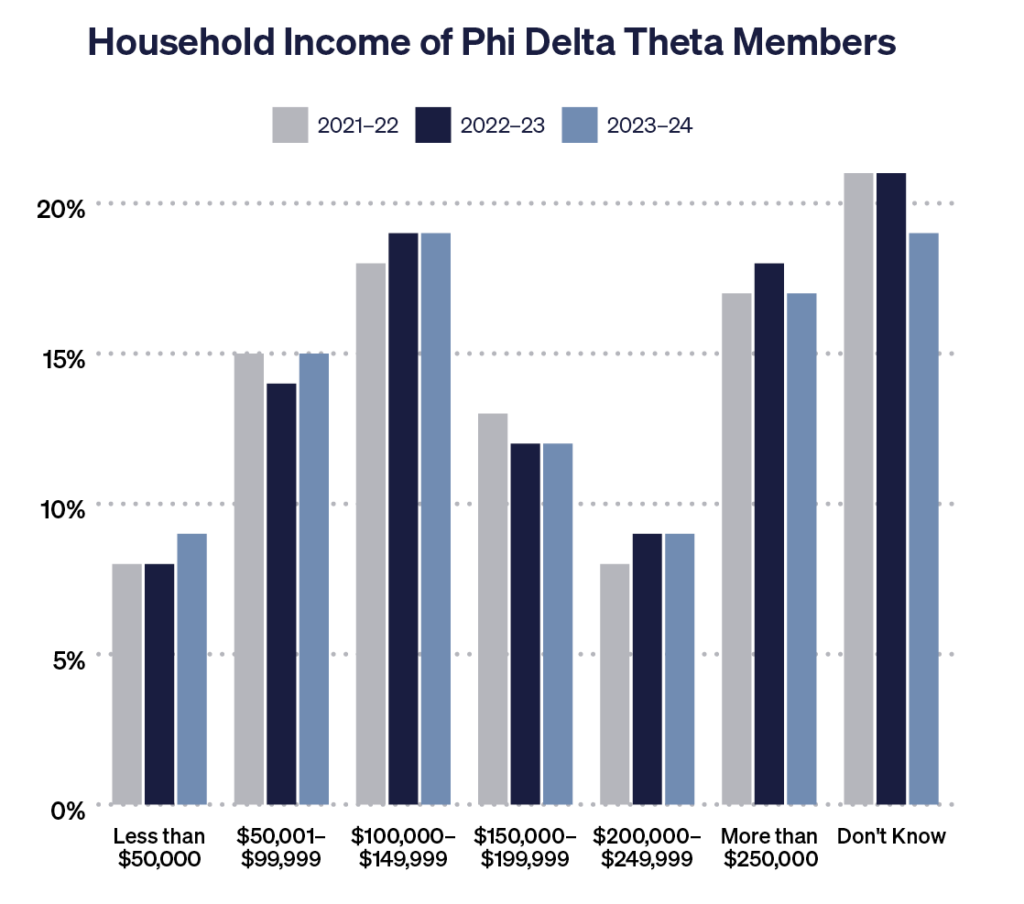
First-generation college students have a median household income that is less than 50 percent of their continuing-generation peers. This scholarship serves as a bridge to membership for those needing extra support during their first year. Students have shared that this scholarship allowed them to work fewer hours to spend more time studying, buy books needed for their classes, and take research trips, to name a few. While scholarships cannot pay directly for fraternity membership, they are offsetting the investment students are making in their commitment and exposure to an organization that can directly improve their social mobility through a values-based experience.
Primarily due to financial challenges, navigating unfamiliar environments, and a lack of on-campus mentorship, retention and graduation rates for first-generation college students are significantly lower than for students with parents who attended college.
“This scholarship not only alleviates some of the financial pressures associated with my studies but also motivates me to keep pushing through.”
Izaiah Acosta, UW-Whitewater ’24
Demographics
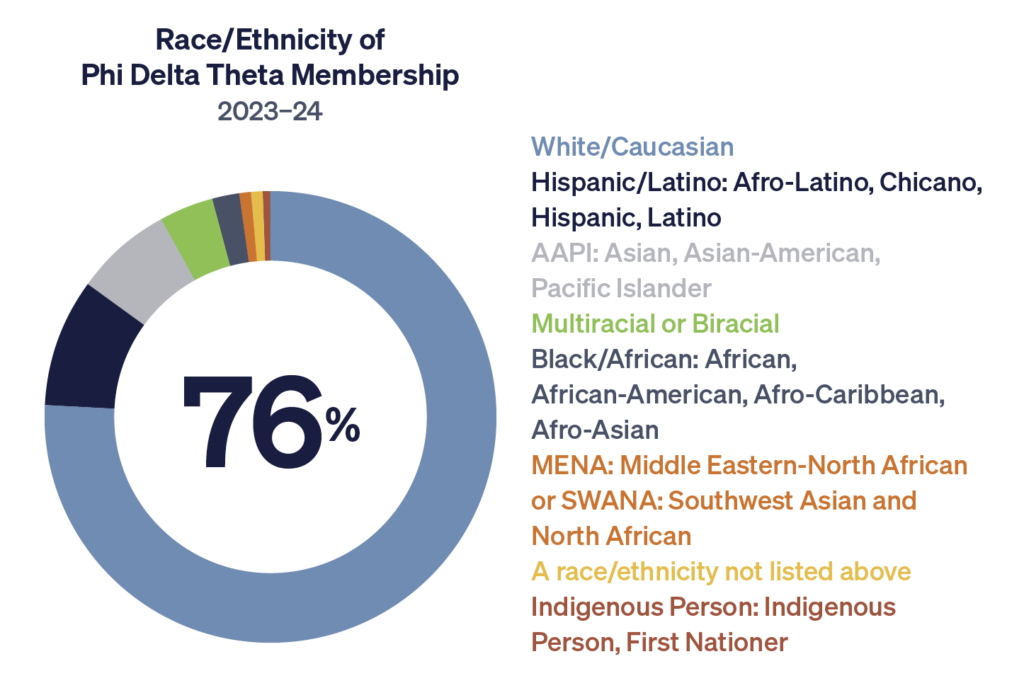
Phi Delta Theta’s work includes understanding the makeup of the Fraternity’s undergraduate membership. Being transparent about our undergraduate member demographics has facilitated valuable conversations and impactful decision-making. It also led to a focus on attracting first-generation students to our organization.
“I am dedicated to making the most out of this opportunity, determined to use my education to create a positive influence in my community and beyond. Your support not only has unlocked doors for me but has also ignited my enthusiasm for ongoing learning and personal development.”
Bryce Wiginton, West Texas A&M ’25
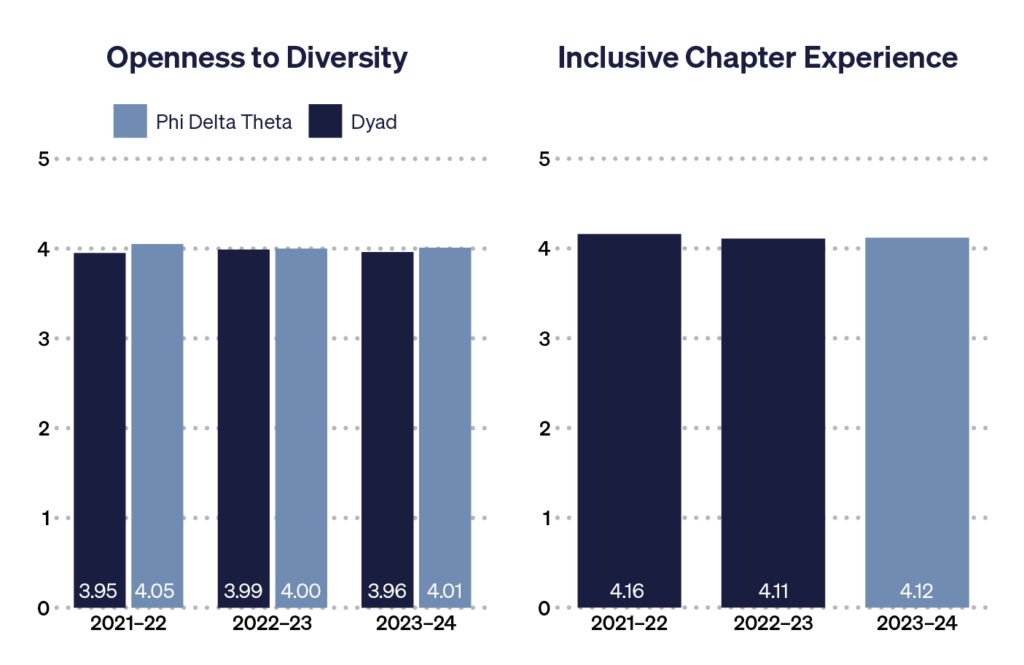
Through our partnership with Dyad Strategies, we know that first-generation college students are less likely to prioritize the social aspects of the Fraternity and have different life experiences and perspectives. On average, they work twenty or more hours per week, pay their own dues, and need financial assistance. We also learned that their views are more inclusive, promote further diversification, and help our chapters focus on leadership and philanthropy, ensuring a better and healthier experience for all.
Letter from the Executive Vice President and CEO
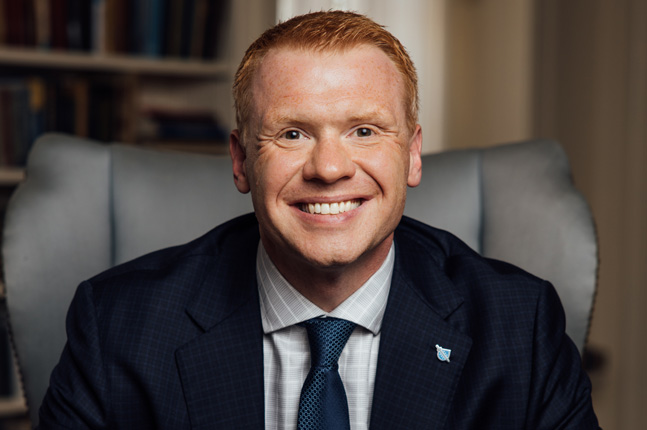
Dear Brothers, Parents, and Friends,
It has now been three years since Phi Delta Theta Fraternity and Foundation launched our initiative to expand opportunities for first-generation student members. As we reflect on the progress made, I am thrilled to share the incredible achievements and outcomes that have come from these efforts, which have far exceeded our expectations.
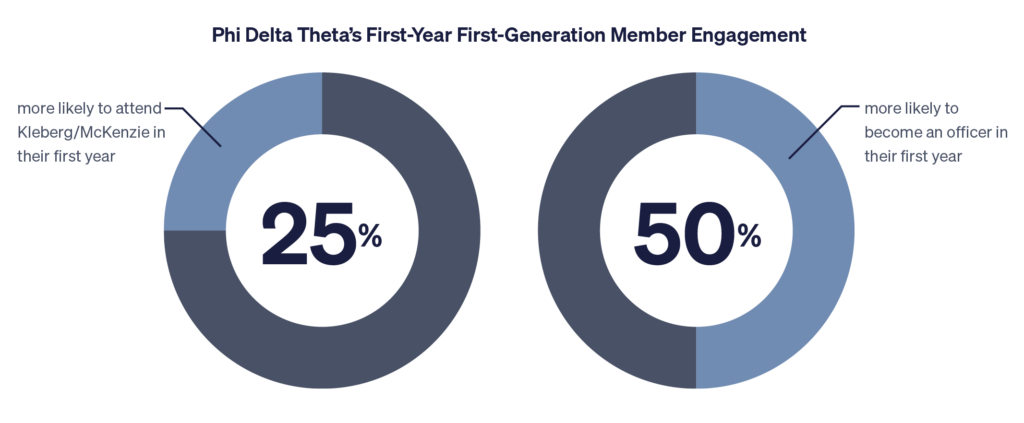
Through careful monitoring and evaluation of both first-generation students and their continuing-generation peers, we’ve gained invaluable insights. The data confirms that our first-generation members are not just participating in our leadership programs; they are excelling. These brothers are demonstrating exceptional leadership potential early in their fraternity experience. For instance, first-generation new members are 50 percent more likely to become officers within their first year of membership compared to their peers. This speaks volumes about their drive and the effectiveness of our leadership training. Furthermore, 38 percent of our 2024 first-generation scholarship recipients have assumed officer roles in their first year. Additionally, nearly 20 percent of scholarship recipients have attended a milestone leadership conference like McKenzie or Kleberg, further solidifying their leadership journey.
These statistics are more than just numbers. They highlight the profound impact Phi Delta Theta is having on these students. Not only are they rising to leadership positions within our chapters, but they are also thriving academically and socially. Our data shows that first-generation members are 18 percent more likely to remain enrolled at their institution beyond their first year compared to their first-generation peers outside the Fraternity. This is a testament to the supportive community, personal growth, and opportunities for development that Phi Delta Theta provides.
What does this mean for the broader fraternity experience? It means that our first-generation members are contributing significantly to the strength and vitality of our chapters. Their presence enhances the overall brotherhood, bringing diverse perspectives and experiences that benefit all members, especially as they assume leadership roles. Moreover, these programs are not only advancing the individual growth of these members but also contributing to the overall retention rates of first-generation students at their universities—a powerful, positive outcome for both the Fraternity and higher education institutions alike.
Looking ahead, we are energized by the progress we’ve seen and eagerly anticipate even greater achievements in the coming years. We are especially excited to follow the careers of our first-generation scholarship recipients as our first class of recipients enter the workforce next year. These young men are the future leaders in their communities and industries, and we take pride in knowing that Phi Delta Theta has played a pivotal role in their development.
As always, none of this would be possible without your unwavering support. Whether through financial contributions, mentorship, or involvement, you have helped make this program a resounding success. We are incredibly grateful for your continued dedication to advancing our mission. Please do not hesitate to reach out if you have any questions or wish to learn more about how you can further support our initiatives.
Thank you again for your generosity and belief in the potential of our first-generation members.
Humbly and proud to be a Phi!
The post First-Generation College Student 2024 Impact Report appeared first on Phi Delta Theta.
]]>The post Sound Learning in Action: Undergraduate Iker Sanchez Combines Global Perspective with Genetic Research appeared first on Phi Delta Theta.
]]>Under the guidance of Professor Arielle Cooley, an expert in evolutionary genetics, Iker is examining whether genetic changes are driven by shifts in protein-coding or gene regulation. His hands-on research involves gene manipulation in tobacco plants, where he explores how changes in specific genes affect pigment production.
In the lab, Iker is experimenting with gene manipulation in tobacco plants to observe how these changes affect pigment production. They collaborate with the computer science department to develop image analysis codes that quantify pigment levels and link visible traits to specific genetic changes (phenotyping).
Iker’s journey in the lab has been a challenging yet rewarding experience. It has strengthened his problem-solving skills, as he constantly works to optimize his experiments and fine-tune his methods. He has a great appreciation for his Phi Delta Theta experience for guiding him through his education. His passion for genetics extends beyond the lab, as he hopes to pursue a future in prosthetic development—a long-term goal that has driven much of his academic exploration.
How has Phi Delta Theta provided you with support or motivation in your pursuit of Sound Learning and academic success?
Phi Delta Theta has been a constant source of motivation and support throughout my academic career. The sense of community that we have fostered in the Fraternity and the emphasis on Sound Learning developed an environment where we could talk about personal life, share laughs, and still learn from each other’s class or experiences with the same enthusiasm and care. My brothers have constantly encouraged me to be the best version of myself, whether by inviting me to study together when needed, sharing advice on how to express my ideas more directly (which as an international student I appreciate immensely), or just being there as a support for stressful times.
How did your interest in Biochemistry, Biophysics, and Molecular Biology develop, and what drew you to pursue this major?
Since I was ten, I always dreamed of working in the prosthetic development area. That is what pushed me to leave my country, in search of opportunities to make that dream come true. I finished high school in Germany, where I learned about the biochemistry, biophysics, and molecular biology major from Whitman College. This major resonated more with me than other majors I had in mind, such as biomedical or biotechnology, as I consider it to be a more scientific approach to my goal. Not only that but it also felt like a major that would submerge me completely in all the natural sciences.
Balancing a rigorous academic schedule with Fraternity life can be demanding. How do you manage to excel in both your studies and your role as a Phi Delt?
Time management has been key in balancing my roles in the chapter as well as my studies. Having my priorities clear and creating a schedule flexible enough that allows me to dedicate sufficient time to not only my responsibilities but to other projects as well is what has allowed me to achieve goals throughout my college years. Besides that Phi Delta Theta has instilled in me the importance of leading by example, motivating me to put my best foot forward in everything I do, not only towards the chapter as treasurer but also to academics and other parts of my personal life.
What are your future career goals?
My future career goals involve continuing in research in a graduate school, likely in the field of biomedical science and engineering, with the hope of contributing to prosthetic development or innovations in disease treatment or drug development, which I have grown an interest to lately.
How do you think your Fraternity experience will continue to influence your academic or professional journey after graduation?
Phi Delta Theta has taught me the value of leadership, teamwork, and community, all of which are critical in a research environment. The bonds I’ve formed here will serve as a lifelong network of support, and the skills I’ve gained, such as time management and the ability to balance multiple commitments successfully, will be instrumental in my professional development. All the lessons in brotherhood and perseverance will stay with me long after graduation, shaping both my personal and professional life.
The post Sound Learning in Action: Undergraduate Iker Sanchez Combines Global Perspective with Genetic Research appeared first on Phi Delta Theta.
]]>The post 3 Mid-Term Tactics For Scholarship Chairmen To Improve Your Chapter’s GPA appeared first on Phi Delta Theta.
]]>It’s a tumultuous time of year for Phi Delt scholarship chairmen. You’ve worked hard all semester – planning study hours and tracking brotherhood performance – and now the end of the school year is in sight. Spring break and formal are right around the corner; you’re excited. There’s only one thing keeping you from fun in the sun: exam season…
Many chapter members find themselves in similar spots leading up to finals season after mid-terms – wanting to do a little bit better. Here are some tips for scholarship chairmen and general chapter members looking to boost chapter GPA’s by semester’s end:
Report
First and foremost, it’s important to know where you and your chapter brothers stand. If you’re a scholarship chairman, ask chapter members to fill out a Grade Check Form and have it signed by their professors. This will help you see where brothers are succeeding and where they could use some improvement.
Set Goals
Using Phi Delt’s Academic Goal Sheet, have members write out what their perfect semester looks like in terms of academic success. What GPA are you striving for as an individual or as a chapter? How do you envision yourself performing on upcoming papers or exams? What are you going to do in order to address your academic areas that need improvement? Be sure to help members lay out step-by-step plans for meeting milestones, and set hard deadlines!
Plan
Track brotherhood GPA in a spreadsheet and put some thought into where the chapter should go from here. Do you need to increase study hour obligations to meet overall goals? Are incentives needed to help brothers meet their individual goals? Sit down with your executive board and come up with a plan that will meet most members’ needs for the remainder of the year.
There is no perfect science in helping your chapter to achieve academic success. However, with a little planning and the use of Phi Delt’s academic resources, you’ll surely be able to leave your chapter better than when you inherited it.
For more guidance as to how you can help your chapter meet Phi Delta Theta’s new minimum standard GPA of a 2.75, follow this link!
The post 3 Mid-Term Tactics For Scholarship Chairmen To Improve Your Chapter’s GPA appeared first on Phi Delta Theta.
]]>The post The Only Academic Policy Your Chapter Needs To Drastically Improve Its GPA appeared first on Phi Delta Theta.
]]>Sound Learning. It’s why college exists.
Learning occurs in many different fashions during one’s time at college. Whether it’s learning about different subject matters in the classroom or strengthening vital soft skills outside of the classroom, it’s a fact that around every corner on campus, there is an opportunity to learn.
The age-old argument comparing the importance of in the classroom learning versus outside of the classroom learning will always exist. Truthfully, for the majority, both are extremely important. Luckily, for members of the Greek community, the fraternal experience inherently cultivates the many soft skills needed to successfully work with others. If structured correctly, the Greek experience can also be that extra push needed to succeed in the classroom.
When looking at averages, members of Greek organizations do succeed in the classroom. However, we’ve all witnessed members who struggle to maintain their GPA for a variety of reasons, and their struggle brings down the whole.
In an ideal Greek community, only those who are committed to academic success would be recruited. If this was the case, there wouldn’t be a need for academic programs or policies within our walls. However, we all know that this isn’t reality.
Having been a fraternity scholarship chairman and from working with many chapters on their academic goals, I’ve seen a plethora of techniques implemented with the hope of improving the chapter’s GPA. Some work better than others, but what I’ve realized is that most academic programs are way too complicated. They have great intentions, but they are generally very difficult to manage.
I’ve found one simple academic policy that trumps any other, and I recently saw it succeed in action. I’m the Chapter Advisory Board Chairman for the Iowa Gamma Chapter of Phi Delta Theta at Iowa State University, and improving academic performance has been a main goal for the chapter. At the beginning of the Fall 2014 semester, the chapter ranked 18th out of 29 fraternities on campus with a 2.90 GPA. After one semester using the policy, they rank 6th with a 3.09. Yes, it has only been one semester, but the policy’s positive cultural changes are already being realized.
So what is this secret academic success sauce? We call it the “3 Strike Policy.” It’s simple. The chapter started by selecting a 2.5 threshold. If a member obtains a semester GPA below 2.5, he receives a strike. Three strikes and he is no longer a member of Phi Delta Theta. No questions asked. It’s really that simple, and the policy is the ultimate measure of accountability. Each individual must look himself in the mirror and determine what he must do in the classroom to remain a member of Phi Delta Theta.
You may be wondering how to create buy-in for such policy. It can be done with one simple phrase for each class:
Seniors –You only have two semesters left. You’re safe!
Juniors – You’re telling me that in your four remaining semesters, you can’t achieve a 2.5+ GPA once?
Sophomores (The only tough-ish sell) – Do you see any negatives that can come out of us pushing to you to succeed?
Freshmen – Here is our academic policy. If you don’t like it, we’re not for you.
At the end of each semester, the scholarship chairman can divvy out the strikes to those below a 2.5. If it’s strike #3, we’re sorry, we think you need to focus your energies elsewhere. For those who receive their first or second strike, require them to meet with your chapter’s scholarship chairman and academic adviser to develop a plan. Another smart move is to hold a membership review after the second strike. Doing this gives the chapter the opportunity to take action a strike early if the academic case is severe or if that members is causing other issues.
A chapter can do all of the programming it likes (study hours, time management seminars, competitions, incentives, etc.), but without a policy with a backbone, these practices will never create long-term success. Long-term chapter academic success will only occur when each individual has something to lose and must take on personal responsibility for his performance. Membership standards always win.
After a few semesters, begin to increase the minimum threshold. Change that 2.5 to a 2.6 and see what happens. Your chapter GPA will without a doubt increase as the threshold increases. Ultimately, you’ll begin to recruit those who are more likely to succeed academically, and the policy itself will become an afterthought.
But we’re brothers, some may say. Pause, smile, and calmly say, “Real brothers challenge each other to become the greatest version of themselves.”
The post The Only Academic Policy Your Chapter Needs To Drastically Improve Its GPA appeared first on Phi Delta Theta.
]]>The post The True Purposes of Higher Education and the Emerging Role of Fraternities in Accomplishing Those Purposes appeared first on Phi Delta Theta.
]]>As delivered by Dr. Eastman at the 2012 Kleberg Emerging Leaders Institute
I am delighted to be with you tonight – and I hope perhaps to stimulate your thinking about both the true purposes of higher education and the emerging role of fraternities in accomplishing those purposes.
My remarks will be relatively brief, for two reasons: First, I simply want to kindle your thinking about this topic, not to do it all for you.
Second, recent findings from cognitive research show that after 9.6 minutes of listening to a talk, the old guys begin to nod off and the young guys begin to engage in sexual fantasy – and I want to keep both of these responses under control.
Just so you know where I am coming from, let me say this: I graduated from college in 1968, a time in which my classmates were being drafted to fight and die in Vietnam, a war I opposed from the start. My university and the country were still essentially segregated, and our school days were full of demonstrations and chanting and marches and civic disobedience and, occasionally, violence.
But my fraternity chapter provided diversity, debate, affection, and opportunities for thoughtful discussion and leadership that made a great difference in my life, then and now, and it has provided enduring friendships that are still strong. I am here tonight because I hope your experience is and will continue to be as rich and rewarding as mine.
As you know, these are tough times for American higher education – particularly public education.
State governments all across the country have cut their universities’ budgets again and again over the past decade: In Florida, public university support is now 40% less than it was five years ago. In many, if not most states, support for public higher education is often a lot less than it was ten years ago, and both tuition and enrollment have continued to increase, often dramatically. And, of course, many of these states were not funding higher education at an adequate level before they began these dramatic cutbacks.
Everybody wants colleges and universities to, in Senator Lamar Alexander’s words, “cut costs, reduce tuition, and improve quality.” And politicians across the political spectrum have ideas about how to do that. Senator Alexander, for example, former Governor of Tennessee and Secretary of the Department of Education, has frequently touted the benefits of a three-year degree program. Others talk about saving money through more accountability, larger classes, more part-time and non-tenured faculty, fewer on-campus amenities, and particularly what so many pundits and politicians and trustees think is the magic potion to control costs – on-line courses.
It is now almost universally accepted that on-line learning is just as effective as live classrooms with live professors, a whole lot less expensive, and inevitable. This idea has, of course, received widespread financial support from such icons as Bill Gates and Mark Zuckerberg, among others, and has been embraced by politicians and trustees who believe the failure to board the on-line train is evidence of professional protectionism by college faculty and administrators.
Perhaps you read about this exact scenario playing out last month at the University of Virginia, one of the world’s great public universities, when the Board of Trustees fired the president for being reluctant to demand that the faculty substitute on-line courses for their classroom teaching.
While UVA’s fiasco has been at least temporarily resolved, these battles are being fought in every state in the country, and the stakes for the form and support of higher education in America are very high.
At the same time, however, both private and public colleges and universities are enrolling more students than ever, and clearly people are paying higher prices than ever.
I understand the frustrations of politicians and parents and students about college prices and the inclinations of some of them to propose quick fixes. But for a first-rate college education, such fixes are not readily available: Despite the financial benefits, traditionally-aged students do not want to graduate from college in three years. They do not sign up for on-line courses if they can help it. They do not like large classes. They are frustrated by part-time faculty and courses taught by graduate students. (By the way, it is estimated that 70% or more of the undergraduate courses now offered at major public universities are taught by graduate students and temporary or part-time faculty.)
The unhappy truth is this: It still takes just as many people to play a Mozart quintet (that would be five) in 2012 as when it was first played in 1780. There has been no improvement in efficiency in the intervening 230 years, nor is there likely to be any.
You could, of course, omit an instrument or two, a violin here, a clarinet there – who would know? Well, those who know Mozart’s music would know. They wouldn’t think it was simply bad; they would think it wasn’t Mozart. And they would be right.
In the same way, most of our courses in higher education still require the same things Socrates required – an instructor, students, and a gathering place – actual or virtual. These elements are pretty much essential, if you are going to do it right.
The diminished funding of higher education is a bad thing for a lot of reasons – but the most important is that our future as the freest, most prosperous country on earth depends on it. Thomas Jefferson made this very point when he founded the University of Virginia 200 years ago. There is no question that the United States has both the best universities in the world and the best system of higher education in the world. Senator Alexander says that the greatness of our colleges and universities is largely the result of three things: the $100 billion a year in federal financial aid that supports need-based aid and loans; the $30 billion a year in federal research funding, mostly through the National Science Foundation, the National Institutes of Health and the Department of Defense; and our long American tradition of institutional autonomy. Unlike most countries in the world, we have almost no national colleges or universities, except for the five service academies.
Now, in the context of the state, national and world-wide economic downturn, which may not show great improvement for decades to come, undergraduates at American universities – especially public universities – are in a particularly difficult situation.
For public universities, educating undergraduates is only one of the many things they do, some of which are much more consequential to many of their constituents than undergraduate education.
Let me give you just four examples of those “other businesses.”
- First, the big universities are engaged in graduate education programs, training MA’s and PhD’s in a variety of disciplines. Many professors spend more of their time with their graduate students than they do with undergrads.
- Second, the big public and private universities are engaged in publicly funded research, to the tune of several hundred million dollars a year, and just as much non-funded research and scholarship. There is no question that this research has been essential to the economy and quality of life of our society. Much of what we now know as the Web, the iPhone, iPad, and Google, as well as the miracles of modern medicine, has resulted from research at universities. Google, for example, was the result of a digital libraries research grant from the National Science Foundation given to Stanford University in the mid-1990s. GPS’s were created by research at MIT, Harvard, and UC-Berkeley, funded by the Department of Defense. All of the key elements of the iPod – LCD monitors, lithium batteries, micro hard drives and microprocessors – were developed by federally-funded research at research universities. And so on . . . .
- Third, the big universities are engaged in mammoth intercollegiate athletic businesses – with budgets often exceeding that for their undergraduate teaching. At schools like Ohio State, Michigan, Texas, Florida, and Georgia, those budgets exceed $100M per year. This is a very large entertainment enterprise and obviously has great PR impact – positive and negative. Big-time intercollegiate athletics are a source of great pride and community- building, but very few schools break even on what they spend on such teams – and almost none of it has anything to do with a high-caliber undergraduate education.
- And fourth, the big universities are engaged, particularly the land-grant universities, in serving the agriculture and the agri-businesses of their states. And, Colleges of Engineering, Business, and Medicine, among others, often have fundamental connections and obligations to entities outside their universities.
So, big universities have a much broader portfolio and a much more complicated set of missions than liberal arts colleges do – but much of what they do, indeed most of what they do, has little or nothing to do with undergraduate education. Nevertheless, more than 80% of the undergraduates in this country are enrolled in our large public, research universities.
In contrast, small liberal arts colleges have a very different approach to higher education – primarily because their only business is the education of 18-22 year old full-time students. Consequently, such schools are able to focus their attention on undergraduates, within and outside the classroom, in a way that most research universities simply cannot. At my college, for example, all students have a close relationship with a faculty mentor; the student-faculty ratio is 13 to 1, and all classes are taught by professors, not substitutes; the average class size is 18 students; and nearly everyone has an internship, studies abroad, and lives on campus.
My point here is that, as state support for the large research universities continues to decrease, the out-of-class, residential, student life experiences that play such an important role in what we all think of as “college” will increasingly have to be developed and carried out by such extra institutional, long-term organizations as fraternities and sororities if they are to be provided at all. The same out-of-class academic and social growth and development that happen in the residential liberal arts college setting can also happen at the big universities perhaps only if fraternities and sororities make it their mission to make it happen.
I do not mean that ΦΔӨ should not continue to be a “social” fraternity: In fact, I mean that we need to employ the full dimension of that word, “social.” Indeed, social and emotional intelligence is just as – if not more – important than academic intelligence – more important for jobs, and for success and happiness in life. Understanding how to live and work with people, many of whom are different from ourselves, is an essential 21st century skill. Whether that difference is that the other is from some country town we never heard of, or that the other has different gender or skin color or religious or sexual orientation than we do, fraternities may be the last best place for learning these essential skills.
Social intelligence means knowing how to work in groups, with both efficiency and respect. It means knowing how to meet and present the self to strangers, how to treat colleagues, how to follow, and how to lead.
Such social skills require mentors and advisors and alumni supporters – and it is clear that the big universities are going to be doing less and less of this, just as they are cutting back in every other aspect of support for undergraduate education, which makes it so important that fraternities do more and more.
So there it is: I believe thoughtfully organized fraternities can satisfy an enormous need in the undergraduate experience that is simply no longer going to be addressed by big public universities.
The historical emphasis of fraternities such as ΦΔӨ on building positive relationships, on courtesy and good manners, on social grace and high morals, on community service and philanthropy are not, in any sense, the add-ons of a good college education: They are what a college education is all about. In our culture, the preferred manner of turning 18 year-old adolescents into 22 year-old adults is college – and what that means has less to do with whether one majors in chemistry or art than with whether one has learned how to make good decisions and how to be a responsible citizen.
I now believe that, given the changes in public support of higher education, it will be up to such organizations as fraternities to maintain the true mission of higher education.
I challenge you current students to consider these issues and the rest of us to assist and support you in that effort. If you young men and those who follow you are going to have the opportunities my generation had in college, you – and we – must work harder and smarter than we did than when we were in college.
As you know, these are also tough times for college graduates, and the better prepared you are, the better your social and academic preparation has been, the better your prospects for the future will be. I believe in being prepared. I believe in working hard. I believe, perhaps more than anything, in what my athletic coaches called, “hustle.”
You may have heard what I call the “hustle” parable:
Every morning in Africa a gazelle wakes up.
It knows it must outrun the fastest lion or it will be killed.
Every morning in Africa a lion wakes up.
It knows it must outrun the slowest gazelle or it will starve.
So, it doesn’t matter whether you’re a lion or a gazelle –
When the sun comes, up you’d better be running.
The post The True Purposes of Higher Education and the Emerging Role of Fraternities in Accomplishing Those Purposes appeared first on Phi Delta Theta.
]]>The post Learn to “Say No” to Good Things appeared first on Phi Delta Theta.
]]>Just Say No! Many of us are adept at saying no to bad things. However, we are living in an over committed and over programmed world in which the new campaign spread throughout colleges should be, “Just Say No…to good opportunities.”
I’ve discovered that one can’t do everything all the time. In fact, there is only 100% of you a day and despite what your coach, parent, or teacher may have told you when you were little, you can’t give 110% of yourself to anything. It is mathematically impossible. There is only one whole you and you are often being pulled in multiple directions. Therefore, as you engage in activities throughout the day that 100% of you dwindles. 20% of yourself to this class, 30% of yourself to this committee, 10% of yourself to your friends, 20% to another leadership position, 10% of yourself to the gym, and before you know it there is 10% of you left for things that you need at least 60% of yourself to accomplish. This is when stress happens and this is when you experience burnout. You are doing too much.
I get it, you care and you want to do many different things. As an advisor you are my favorite student and my biggest headache. You’ve been told your whole life that you are a leader and therefore you have a strong desire to “lead” things. People come to you and ask for your support, tap you for leadership positions and recommend you for seats on boards. Your friends know that they can always depend on you to step up and get things done and you feel an obligation to satisfy all expectations. You’ve even convinced yourself that you work best when you are under pressure and stressed out.
But, what always ends up happening? Something doesn’t get done. Even if it does get done it isn’t your best work. You inevitably will double or triple book yourself. You get tired but don’t have time for rejuvenation. Your friends want to do something fun but you’ve got so much work to do that you can’t even fathom heading out on the town for a good time and even when you do take that chance you are thinking about the consequences of having fun. You neglect to take care of yourself and so you become ill which greatly affects your level of performance. You pull all- nighters to cram for a test or finish a paper. You yearn for a vacation and complain to those around you about how busy you are all the time. Sound familiar?
I was you. I’m not going to lie, at 28 I’m sometimes still you. I vividly remember one of my mentors in college encouraging a group of student leaders, including myself, to seriously reflect on all that we were involved in on campus. Make a list and go through each activity. While you are examining this list think about those things that you really value–your passions. Also, think about those activities in which you are learning the most, and ultimately think about those activities that are actually helping you become the person you want to be–your ideal self. For those things that don’t make it into these categories you need to let them go.
I decided to follow her instructions and in the process I gave up one of my jobs, and three extracurricular activities. I crossed them off the list, sent in my resignations, and honestly never looked back. I kept the things that fit into the categories above and I have to tell you a weight was instantly lifted off my shoulders.
Even now, I have to sit down and think about things prior to making a commitment and I’ve had to walk away from things that are great professional and personal opportunities. I’m not going to lie—I still don’t enjoy this process, but I know that in the end I’m making the best decision for myself and the rest of the organization.
College students engage in résumé building in a way that has become quite reckless. It is not only hurting you and adding stress to your life but it is adding stress to those that are depending on you to prioritize that commitment. All of your commitments can’t possibly be number one; something is bound to fall by the wayside. If I could get students to understand that the quality of your involvement and your articulation of that quality is much more important than the quantity of things you are involved with, then I think I would be eligible for retirement simply on merit alone.
Be okay with the fact that you aren’t a superhero. Sometimes you actually can’t do it all and most of the time you can’t do it all extremely well. I have learned that people appreciate it when you are honest about your disinterest or inability to prioritize that particular commitment and when you take initiative to step down from a role instead of prolonging your subpar involvement.
Take time to engage in intentional reflection about your commitments. Think about those things that you love to do versus those things that have become a burden. The next time someone asks you to do something, instead of saying “Yes” immediately, think about responding with, “Let me get back to you on that. Sounds like a great opportunity but I just want to make sure I have time to commit and give it my best effort.” Stop filling out applications just because you were sent an email with a link. Do you really care about that project? Are there things that you want out of that experience that you are already getting from existing opportunities?
If you are struggling with this exercise chat with those that advise you in your roles. Are they seeing strain on your involvement? Have there been moments where they have felt you didn’t prioritize that specific role? How has that affected others in the organization?
Be honest with yourself. Believe me; not being an officer in that one organization isn’t going to be the detriment of your life post college.
Involvement in co-curricular activities is never going to be the reason that you get your college diploma and in fact, though Phi Delta Theta is a worthwhile fraternal organization I don’t believe it has been granted the privilege of disseminating college degrees. Remember, that in the term “student leader” student comes first. What you chose to involve yourself with after that word is completely up to you, but I strongly encourage you to be discerning about where you expend your daily 100%. Yes and no are two incredibly powerful words; please learn to use them wisely.
Krystal Clark, M.Ed. is a native of Portsmouth, Virginia and received her BA in Sociology and Psychology from The College of William & Mary in Williamsburg, VA. After graduation she ventured to College Park, MD where she completed her M.Ed. in College Student Personnel at the University of Maryland, College Park. During her time at Maryland Krystal served as a Student Affairs Residential Fellow in the Office of Fraternity & Sorority Life and continued her work in this functional area post-graduation at Duke University in Durham, NC where she served in the role of Program Coordinator. In February 2010 she became a proud member of Delta Delta Delta and in June 2011 she began as the Associate Director of Greek Life at Vanderbilt University in Nashville, TN. She is an active volunteer in the Association for Fraternity/Sorority Advisors, the Junior League of Nashville, and Big Brothers Big Sisters of Middle Tennessee.
The post Learn to “Say No” to Good Things appeared first on Phi Delta Theta.
]]>The post Maintaining a Balanced Life While in School appeared first on Phi Delta Theta.
]]>Throughout my visits as a Province President, one of the issues that came up often when speaking with undergraduate members and officers was maintaining or creating a balanced life. College and life in general present many challenges, including demands on your time, energy and relationships. I’ve said this on many occasions that Phi Delta Theta is a part of your life, it should never BECOME your life. Here is some practical advice:
1. Make Time for Yourself – While scheduling and planning all the things you need to do throughout the term and academic year, don’t forget to make time for yourself. Make sure to schedule time to relax, exercise, indulge yourself and have fun! It’s easy to forget with all the pressures from school, fraternity, family, etc that you need special care in order to be your best. So plan to give yourself good, quality time — not just what is left over at the end of the day.
2. Prioritize – Don’t sweat the “small stuff” in life! Be sure to review your priorities often to be sure they are in-sync your goals and values. Keep focused on the important things in life such like your family, your education, your friendships, etc. Don’t get sidetracked by dwelling on issues that don’t necessitate the attention given.
3. Do Your Best – Stop comparing yourself to your peers which in many cases leaves you feeling inadequate. Focus on doing your best. When you do well or when you do your best, people notice. Whether you realize it or not, you are always being evaluated by your professors, teachers, administrators and even potential employers. The key is to knowing and being satisfied with doing your best; perfection is unattainable on earth anyway.
4. Set Realistic Goals – If you set goals that are too high, you’ll end up wearing yourself out, feeling frustrated and disappointed in yourself or others for not achieving goals. If you set your goals too low, you’ll have too much time on your hands and feel empty when you achieve your goals. The goals you set should be a bit of stretch, but not so much that you can’t achieve them. Consider setting goals for yourself — not only for your chapter, but for other aspects of campus life. And remember not to let others influence your goals.
5. Simplify – It seems human nature for just about everyone to take on too many tasks and responsibilities, to try to do too much and to try and please too many people. What you need to do is look for ways to simplify your life. Change your lifestyle. Delegate responsibilities and trust will be get done. Learn to say NO — it’s sometimes a hard thing to do, but sometimes you need to do it to protect yourself.
6. Ask for Help – One of the great things about college and being in a fraternity is that you have access to all sorts of help — you typically can turn to your professors, fraternity brothers, advisors, leadership consultant, alumni, health clinic, and counseling center for the assistance you need. Do not be afraid to ask for help — and seek that assistance as early as you can! Don’t be embarrassed; we all need help at times, and that’s why both college institution and Phi Delta Theta have these resources available to you.
The post Maintaining a Balanced Life While in School appeared first on Phi Delta Theta.
]]>The post A Seasonal Note…On Final Exams appeared first on Phi Delta Theta.
]]>It’s early December and final exams are around the corner (if not already upon you). With them comes another opportunity to positively set yourself apart or save yourself from academic disaster – hopefully the former. If you’re anything like I was as an undergraduate at this time of year, you’re stressed out and desperately craving winter recess. It will come. Now is the time to focus.
Easier said than done, you say? Yes and no. Yes, because your life is surely filled with distractions that draw your attention away from the task at end. No, because it’s really not that complicated. Earning great grades in your class is like peacebuilding (my area of work) in that it’s less a matter of possibility and more a matter of willingness. That is to say, it’s not whether earning an “A” is possible, it’s whether you’re willing to do the work necessary to get there. There are, of course, noteworthy exceptions to that general proposition, but now is not the time to dwell on them. Now is the time focus.
Although I’ve earned degrees at various levels, I’ve never really thought of myself as all that smart. Consequently, I tell many students with whom I work that they don’t necessarily have to be smart to excel in college (although it helps), but they do have to be smart enough to take good advice (and discerning enough to separate out bad advice). That was my strength academically. What I lacked in sheer brilliance (and that was a lot), I made up for by following good advice. If a teacher said to study for three hours, I did. If an advisor told me to take a particular course from a particular professor, I did. If a trusted friend told me to throw out a paper and start over, I did. The recipe was not complicated and it need not be for you either. The key is to focus.
Your last final may seem a long way off (or not), but it’s only three weeks out at best. Put the distractions aside and make it happen. Make this grade – your grade – happen. Do what ought to be done. Do what needs to be done to let you rest comfortably over winter break knowing that you did everything in your power to fulfill your commitment to sound learning. Put in extra hours, avoid distractions, eat food that nourishes your mind and body, get fresh air, get some rest to replenish yourself, and most importantly FOCUS.
That’s good advice. I promise.
– Jay Wilgus, J.D., M.D.R. (Utah Alpha, 2001) is the Director of the Office of Student Conflict Resolution at the University of Michigan. He earned a bachelors degree and law degree at the University of Utah. He earned a masters degree in dispute resolution at Pepperdine University.
The post A Seasonal Note…On Final Exams appeared first on Phi Delta Theta.
]]>The post Using Your Academic Experience To Improve Your Chances Of A Successful Job Search appeared first on Phi Delta Theta.
]]>During your college career, your number one focus should be on growing your mind in many exciting, new ways and most academic curricula are designed to do just that. But, let’s face it. You need to get a job afterwards and, unfortunately, if you go through your academic years haphazardly, you could end up with great academic credentials but a dearth of the tangible job skills that hiring firms are looking for. Don’t despair. And don’t compromise your academic pursuits “just to get a job”. Here is a list of some of the important skills that I look for from young, new hires and ways that you can gain them while staying true to your academic experience:
- Practical problem solving skills – Generally, college is designed to teach theory and critical reasoning, but the business world is not theoretical. What I am looking for on your resume is evidence that you can use these skills to solve real-world problems. Lab work, special projects, and independent research are ways that your academic experience may expose you to problems faced in the non-academic world. The important ingredient here is working with real world data. Create opportunities to analyze real world problems and articulate logical solutions.
- Team work – Much of college performance is a zero-sum game – you get an “A”; I get a “B”, but much of business work, especially for younger hires, is collaborative. Seek out classes that have group projects or get involved in a club or venture that requires a multi-discipline team. Try out different roles on a team. Gain experience both as a leader and follower.
- Writing skills – The ability to articulate your message in a well structured and concise manner is very important in most corporate settings. Don’t think that you can be a math and science geek or sales guy and not have to express yourself on paper. Not true. Whether you are good at writing or not, you need to force yourself to include in your college portfolio a few English, History, Literature or other classes that emphasize writing papers over taking tests.
- Well-roundedness – I like hiring well-rounded people. They are able to adapt to the changing landscape that often accompanies a fast-paced business environment. A strong GPA and nothing else usually doesn’t do much for me. Don’t be afraid to take some risks during your college career and take some stretch classes and explore some non-academic interests (clubs, music, community service). I would hire an intellectually curious, multi-tasker over a one-dimensional, 4.0’er almost every time.
- Computer skills – Nearly everyone in the business world uses Word, Excel and Powerpoint. If you don’t know them, you need to learn them. I would also recommend going further and learning a database language like SQL and a programming language like Visual Basic, JAVA or C++. Mastering the logical design of computer programming will make you a much more effective worker. If you have a free elective, why not try sampling from the CompSci department?
Industry specific interest
The crux of the problem is this: hiring newly minted college grads is risky because they usually do not have a track record of experiences that portend future success in the business environment. How can you use your academic experience to lessen this risk? Easy,
- Target some of your electives and research projects in such a way that they allow you to investigate different industries that may interest you. For example, if you are interested in the healthcare industry and in one of your history classes you have to write a paper on “a famous historical figure,” chose a medical researcher such as Salk or Pasteur.
- Find a professor who is doing research in a targeted area and ask if you could help out. Many times the offer of free labor can open up doors. Independent research, in your area of interest, is even better because you will go through the whole process, from formulating an idea to creating a practical solution. Most colleges offer credit for independent research too!
- Join or start a club that deals with this particular industry and get some practical exposure. Show your commitment and initiative through a leadership position in the club
I cannot emphasize this enough… experience that is directly related to the industry in which you are interested will set your resume apart from others. It says, “Hey, look at me! I’m not just applying for this job on a whim. I’m really interested in making it my career.” During an interview, it also creates a tangible metric which I can use to evaluate your likely success working on my team. I like that.
Happy job hunting!
R. Scott Morris is President of Morris Consulting, LLC where he advises financial markets trading firms on a number of different quantitative modeling and trading issues. He is also the author of Polished – Adding Shine to your Resume, Cover Letter, and Interviewing Skills and has a blog and facebook group which answer questions for college students about the job search process. See his web-site: www.PolishedU.com for details.
Prior to starting his own consulting business, Scott was CEO of the Boston Options Exchange Group, LLC (BOX), managing director of the automated execution and high frequency trading businesses in the equity division of Goldman Sachs, and partner in charge of the financial engineering group at Hull Trading Company, a stock and options market making firm.
Scott has a Bachelor’s degree in Economics, and MBA in finance and statistics, both from the University of Chicago. He is a member of the Illinois Beta Chapter of Phi Delta Theta.
The post Using Your Academic Experience To Improve Your Chances Of A Successful Job Search appeared first on Phi Delta Theta.
]]>The post 5 Classes I Wish I Would Have Taken in College appeared first on Phi Delta Theta.
]]>Working with Phi Delta Theta’s educational endeavors, I constantly have to ask myself, “What lessons are important to our young Phi Delts and how can we provide them with this education?” The topics are endless and it’s tough to know how to prioritize. We ultimately tailor our educational message to the topics that are most relevant and present within chapter operations for all Phi Delts. Once again, tough to prioritize, but that’s where our focus remains.
Having said all of this, and seeing my “# of years since I was an undergraduate” tally increase, I continue to come across “real-life” lessons that one would think I should have learned about as an undergraduate. You know what they say – “Hindsight is 20/20.” So in an effort to encourage you to soak up information about real life topics prior to leaving school, I’ve decided to develop a list of classes that I wish I would have taken as an undergraduate.
While there may not be classes offered at your school around these topics, I can guarantee there is someone who can lead you to the right place.
Organizational Psychology 101 – I recently finished my MBA and my favorite class was through the psychology department – Go figure. Each of you will ultimately find yourself working within an organization. Even you, Mr. Entrepreneur will need to know the ins and outs of organizational psychology once you’ve started a business and have employees. Organizational psychology tries to answer such questions as: “How do we increase productivity?”, “What time-off and vacation structure results in our employees showing up to work at the highest rate?”, “How do you keep employees happy?”, “Why does our company have this culture?”, “How do you work with a person of that personality type?”, and much more. It is fascinating stuff, and having knowing a bit about the topic will make you a valuable employee.
Real Estate 101 – The majority of you will one day own a piece of property. Many times, this is the biggest investment you will make during your lifetime. Not knowing about real estate going into the process may ultimately leave you with frustrations or a dismal financial situation. It is important to know about mortgages, interest rates, down payments, private mortgage insurance (PMI), amortization schedules, etc. There are a lot of terms and decisions thrown your way during the home-buying process and being well equipped with this knowledge is extremely beneficial.
Public Speaking 201 – Most schools will require a basic speech class, but I would recommend taking a few. You can never become too confident in front of a group of people and trust me, it will happen. Your experience will be seen by your colleagues, employees, potential clients, and boss. You will also be able to pass along your message in a more professional manner. The fears of public speaking can dwindle with a little experience.
Personal Finances 101 – Now I’m not one to speak about how to develop the perfect marriage as I’ve only had a better half for ummm… a little over a year and a half (I may or may not have just looked at my Outlook calendar), but I can tell you that the number one reason for divorce is finances. Whether you intend on getting married or not, it is essential to have a base of personal finance knowledge leaving college. You will have income, increased expenses, dependents, retirement funding options, tax responsibilities, and much more. You don’t have to be a Finance or Accounting major to obtain this education. If your school does not offer classes about personal finances, I guarantee your career center can lead you to the right place.
Negotiations 101 – Finally, your life will be full of negotiations – with yourself and others. Knowing the art of finding the balanced and middle ground will help you immensely. You’ll know how to laugh at your car salesman when he asks you “How much would you like your monthly payment to be?” or converse with your boss when discussing your salary and benefits package. A negotiations education will also allow you to know how to negotiate deals with clients and even allow you to weigh your own schedule, allowing for time for things that are important to you.
So there you have it, a little advice that I wish I would have taken myself. Let me state that you will need to further your knowledge of these topics post-college. I am, by no means, an expert in any of these topics, but I can guarantee that spending time with these topics is one of the best investments you can make for your future.
The post 5 Classes I Wish I Would Have Taken in College appeared first on Phi Delta Theta.
]]>